Sales/Collection
Process
ACC202
Kateri Manglicmot
BSIT – IV
Value Chain
Value Chain
Primary Activities
Creates value directly
INBOUND LOGISTICS
An integral element of business
operations for a manufacturing
firm, involving the processes of
receiving, storing and distributing
raw materials for use in production.
OPERATIONS
It transform resource or data inputs into desired goods,
services, or results, and create and deliver value to the
customers. Two or more connected operations constitute a
process, and are generally divided into four basic categories:
(1) processing, (2) inspection, (3) transport, and (4) storage.
OUTBOUND LOGISTICS
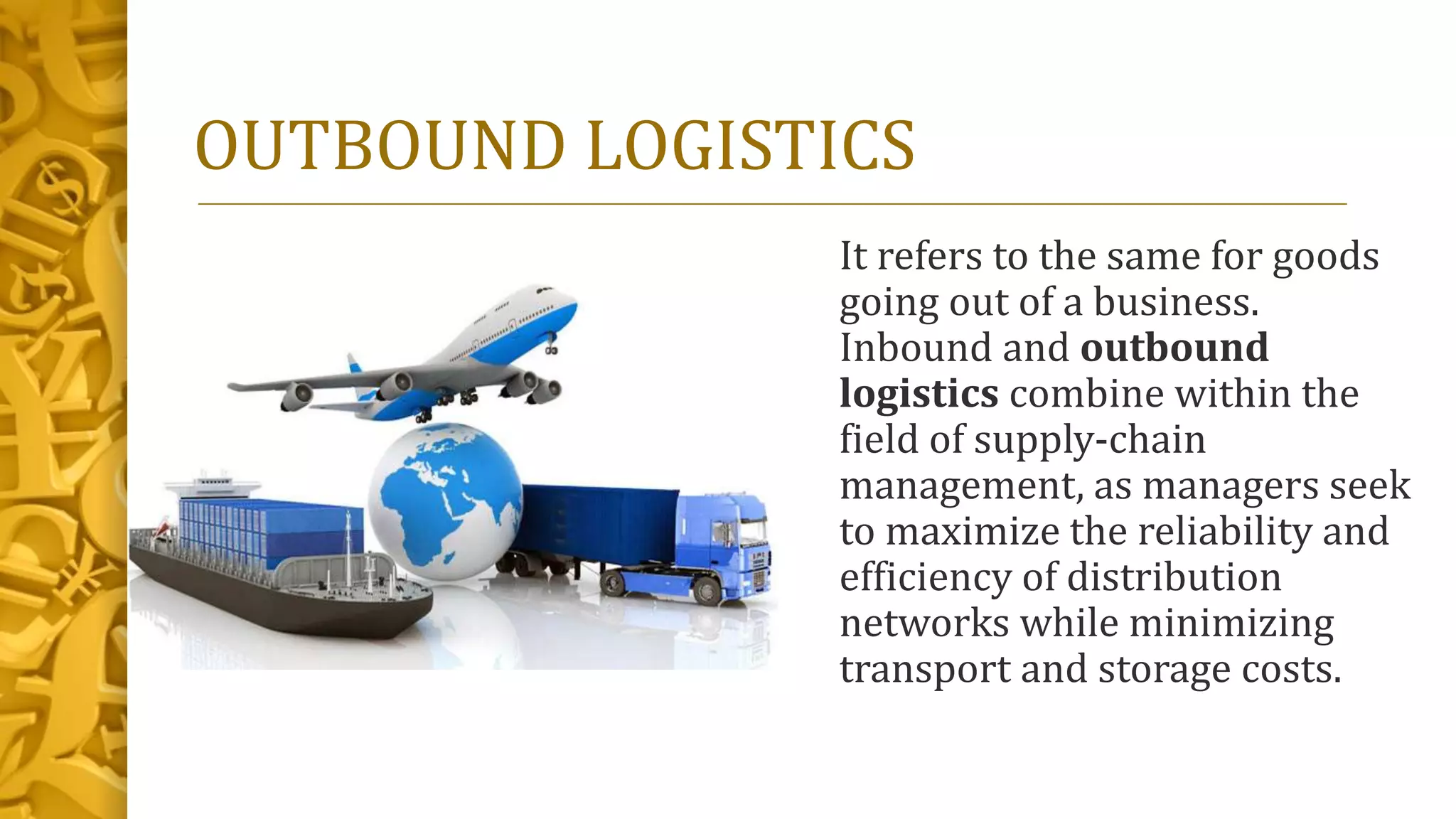
It refers to the same for goods
going out of a business.
Inbound and outbound
logistics combine within the
field of supply-chain
management, as managers seek
to maximize the reliability and
efficiency of distribution
networks while minimizing
transport and storage costs.
MARKETING & SALES
Marketing is not advertising.
Marketing is finding out what
people want, why they want it
and how much they’ll spend.
Don't confuse marketing with
advertising.
Sales is sales! It's converting an
inquiry or lead into a contract or
shipment. Sales is not market
research, business development
or advertising.
SERVICE
The promotion of economic activities
offered by a business to its
clients. Service marketing might
include the process of selling
telecommunications, health treatment,
financial, hospitality, car rental, air
travel, and professional services.
Value Chain
Support Activities
Creates value indirectly
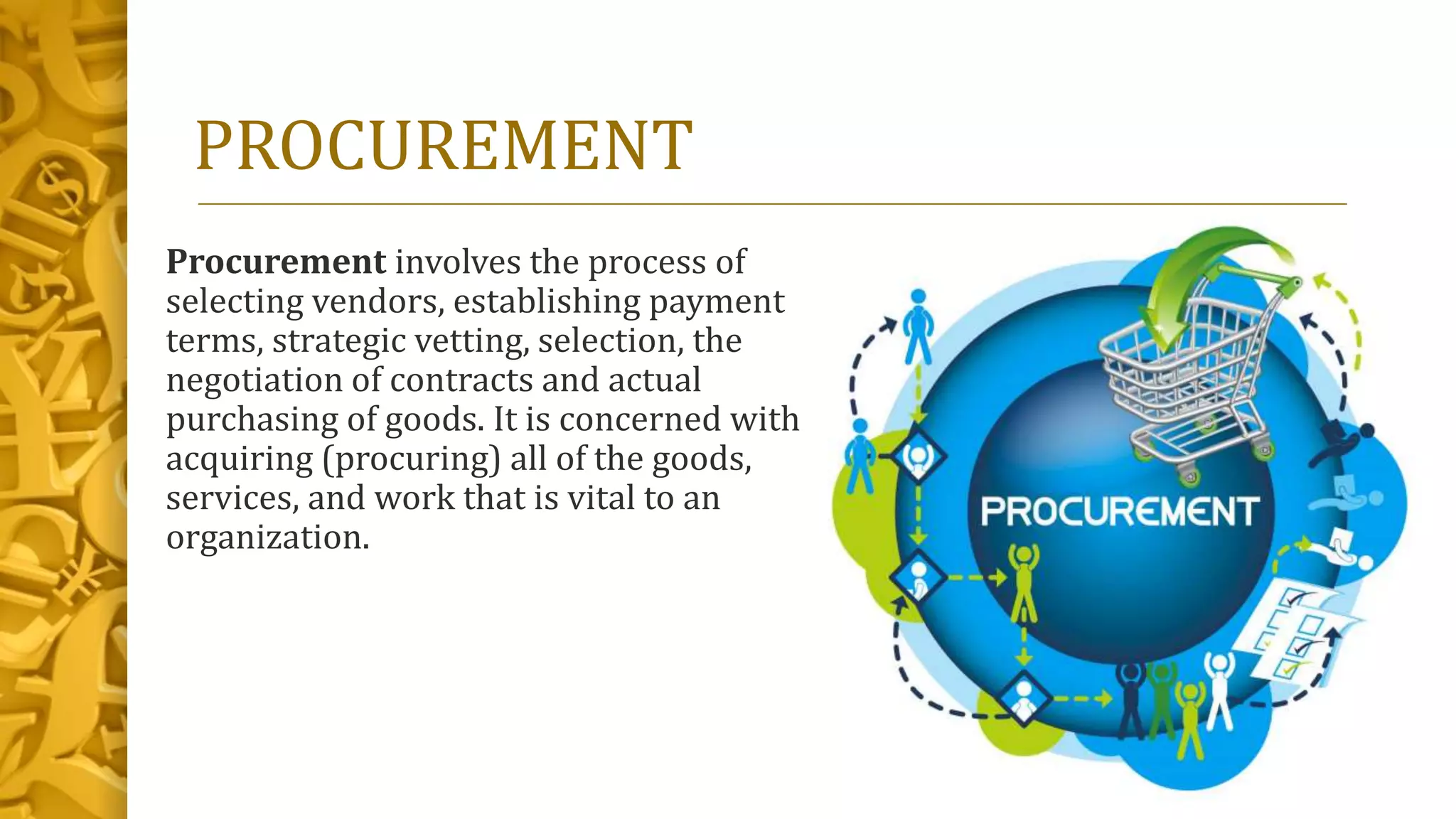
PROCUREMENT
Procurement involves the process of
selecting vendors, establishing payment
terms, strategic vetting, selection, the
negotiation of contracts and actual
purchasing of goods. It is concerned with
acquiring (procuring) all of the goods,
services, and work that is vital to an
organization.
INFORMATION TECHNOLOGY
Information technology (IT) is the
application of computers to store,
study, retrieve, transmit, and
manipulate data, or information,
often in the context of a business or
other enterprise. They draw
on technologies that support the
analysis of customer and competitor
information to improve the
strategic focus of sales activities.
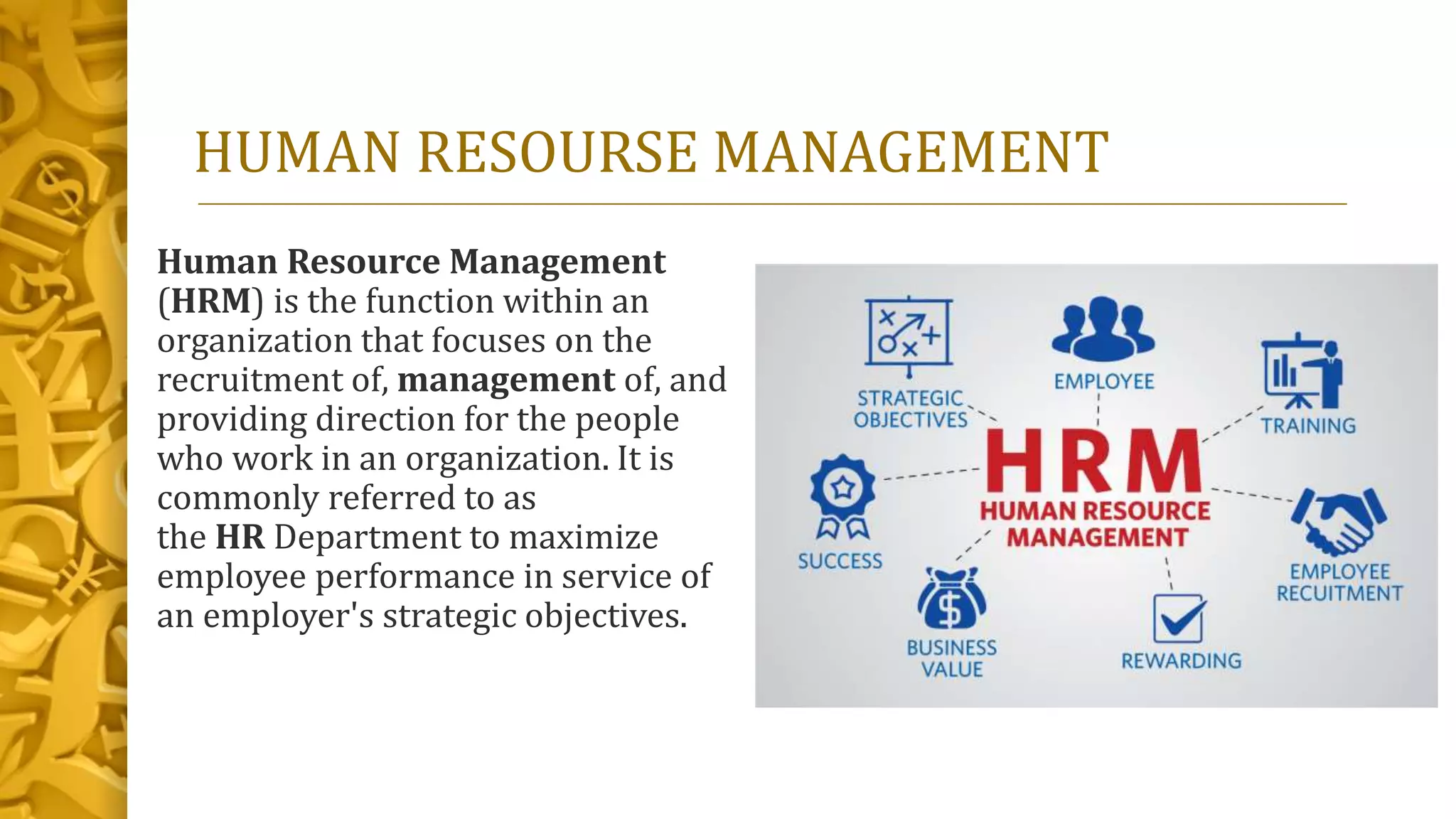
HUMAN RESOURSE MANAGEMENT
Human Resource Management
(HRM) is the function within an
organization that focuses on the
recruitment of, management of, and
providing direction for the people
who work in an organization. It is
commonly referred to as
the HR Department to maximize
employee performance in service of
an employer's strategic objectives.
INFRASTRUCTURE
Infrastructure is the basic physical
systems of a business or nation;
transportation, communication, sewage,
water and electric systems are all
examples of infrastructure. These
systems tend to be high-cost investments;
however, they are vital to a country's
economic development and prosperity.
Process Steps
Overall, the sales / collection process comprises everything from
taking a customer’s order through collecting payment from the
customer. Details may vary across organizations, but the sales /
collection process generally comprises seven generic steps.
1. Take the customer’s order.
2. Approve the customer’s credit.
3. Fill the order based on approved credit.
4. Ship the product.
5. Bill the customer.
6. Collect payment.
7. Process uncollectible receivables as needed
Process Steps
Process Steps Flowchart
Start
To Warehouse End
Place Order
Customer
Order
Order
Database
Grant
Credit
?
Approved
Customer
Order
Inform
Customer
Cancel Order
Customer
Order Taking
Department Credit Department
AIS Elements (Input / Output)
Documents
Customer Order
• Summarizes items ordered
and prices
• Originates in sales
department
• Terminates in warehouse
Picking List
• Guides selection of items
from warehouse
• Originates in warehouse
• Terminates in shipping
department
Packing List
• Specifies contents of
shipment
• Originates in shipping
department
• Terminates with customer
Documents
Bill of Lading
• Specifies freight terms
• FOB destination or shipping
point
• Freight prepaid or collect
• Originates in shipping
department
• Terminates with common
carrier
Customer Invoice
• Bills client
• Originates in billing
department
• Terminates with customer
Customer Check
• Remits payment
• Originates with customer
• Terminates with cash
receipts department
Documents
Remittance Advice
• Provides source document
for AIS
• Originates with customer
• Terminates with
accounting
Deposit Slip
• Transmits cash receipts to
bank
• Originates with cash
receipts department
• Terminates with bank
1. Establishing a formal credit approval process
2. Maintaining adequate inventory
3. Incorporating independent order checking
4. Insuring goods in transit
5. Matching documents prior to billing
6. Separating duties: authorization, custody, recordkeeping
7. Endorsing checks restrictively
8. Reconciling the bank statement
Internal Controls
1. Maintain customer lists
2. Generate sequentially-numbered forms
3. Look up inventory status
4. Identify unpaid and past-due invoices
5. Record transactions in the accounting information system
Information Technology
References:
http://myweb.scu.edu.tw/~hankgau/Docs/AIS/IM/Ch.12%20-
%20Sales-Collection%20Process.pdf
https://en.wikipedia.org/wiki/
http://studylib.net/doc/10203047/chapter-11-sales---collection-
process

Sales Collection Process

  • 1.
  • 2.
  • 4.
  • 5.
    INBOUND LOGISTICS An integralelement of business operations for a manufacturing firm, involving the processes of receiving, storing and distributing raw materials for use in production.
  • 6.
    OPERATIONS It transform resourceor data inputs into desired goods, services, or results, and create and deliver value to the customers. Two or more connected operations constitute a process, and are generally divided into four basic categories: (1) processing, (2) inspection, (3) transport, and (4) storage.
  • 7.
    OUTBOUND LOGISTICS It refersto the same for goods going out of a business. Inbound and outbound logistics combine within the field of supply-chain management, as managers seek to maximize the reliability and efficiency of distribution networks while minimizing transport and storage costs.
  • 8.
    MARKETING & SALES Marketingis not advertising. Marketing is finding out what people want, why they want it and how much they’ll spend. Don't confuse marketing with advertising. Sales is sales! It's converting an inquiry or lead into a contract or shipment. Sales is not market research, business development or advertising.
  • 9.
    SERVICE The promotion ofeconomic activities offered by a business to its clients. Service marketing might include the process of selling telecommunications, health treatment, financial, hospitality, car rental, air travel, and professional services.
  • 10.
  • 11.
    PROCUREMENT Procurement involves theprocess of selecting vendors, establishing payment terms, strategic vetting, selection, the negotiation of contracts and actual purchasing of goods. It is concerned with acquiring (procuring) all of the goods, services, and work that is vital to an organization.
  • 12.
    INFORMATION TECHNOLOGY Information technology(IT) is the application of computers to store, study, retrieve, transmit, and manipulate data, or information, often in the context of a business or other enterprise. They draw on technologies that support the analysis of customer and competitor information to improve the strategic focus of sales activities.
  • 13.
    HUMAN RESOURSE MANAGEMENT HumanResource Management (HRM) is the function within an organization that focuses on the recruitment of, management of, and providing direction for the people who work in an organization. It is commonly referred to as the HR Department to maximize employee performance in service of an employer's strategic objectives.
  • 14.
    INFRASTRUCTURE Infrastructure is thebasic physical systems of a business or nation; transportation, communication, sewage, water and electric systems are all examples of infrastructure. These systems tend to be high-cost investments; however, they are vital to a country's economic development and prosperity.
  • 15.
    Process Steps Overall, thesales / collection process comprises everything from taking a customer’s order through collecting payment from the customer. Details may vary across organizations, but the sales / collection process generally comprises seven generic steps.
  • 16.
    1. Take thecustomer’s order. 2. Approve the customer’s credit. 3. Fill the order based on approved credit. 4. Ship the product. 5. Bill the customer. 6. Collect payment. 7. Process uncollectible receivables as needed Process Steps
  • 17.
    Process Steps Flowchart Start ToWarehouse End Place Order Customer Order Order Database Grant Credit ? Approved Customer Order Inform Customer Cancel Order Customer Order Taking Department Credit Department
  • 18.
  • 19.
    Documents Customer Order • Summarizesitems ordered and prices • Originates in sales department • Terminates in warehouse Picking List • Guides selection of items from warehouse • Originates in warehouse • Terminates in shipping department Packing List • Specifies contents of shipment • Originates in shipping department • Terminates with customer
  • 20.
    Documents Bill of Lading •Specifies freight terms • FOB destination or shipping point • Freight prepaid or collect • Originates in shipping department • Terminates with common carrier Customer Invoice • Bills client • Originates in billing department • Terminates with customer Customer Check • Remits payment • Originates with customer • Terminates with cash receipts department
  • 21.
    Documents Remittance Advice • Providessource document for AIS • Originates with customer • Terminates with accounting Deposit Slip • Transmits cash receipts to bank • Originates with cash receipts department • Terminates with bank
  • 22.
    1. Establishing aformal credit approval process 2. Maintaining adequate inventory 3. Incorporating independent order checking 4. Insuring goods in transit 5. Matching documents prior to billing 6. Separating duties: authorization, custody, recordkeeping 7. Endorsing checks restrictively 8. Reconciling the bank statement Internal Controls
  • 23.
    1. Maintain customerlists 2. Generate sequentially-numbered forms 3. Look up inventory status 4. Identify unpaid and past-due invoices 5. Record transactions in the accounting information system Information Technology
  • 24.