PRESENTATOR
Name: Sudipta Sinha
Reg No: 2009631004
Dept of FES
Shahjalal University of Science &
Technology
Sylhet
PRESENTATION ON
Species Silviculture
Of
SILIVICULTURE
Silvics = The ecological study of forest trees.
Including life history & general characteristics
= The art & science of
cultivating forests based on
knowledge of
silvics.
Species Silviculture
Management of individual species
applying silvicultural knowledge
SAL Shorea robusta
Family Dipterocarpaceae
The word Shorea comes from
the name of Sir John Shore,
former Governor General of
India
HISTORICAL OVERVIEW
 Object of worship among Buddhist & Hindus
DISTRIBUTION
Native to southern Asia
Ranging south of the Himalaya, from Myanmar in
the east to Nepal, India & Bangladesh
In Bangladesh
distributed in the Dhaka, Gazipur, Tangail,
Mymensingh, and Jamalpur districts, including some
patches in the greater Comilla and Sylhet districts
►0.12 million hectares of land
►4.7% of the total forest area
Fig. 1
Map showing the
distribution of moist
deciduous Sal
(Shorea robusta)
forests of
Bangladesh.
CLIMATIC CONDITION
 Temperature:
 mean annual temperature is 26.3oC
 the average maximum temperature is 27.5oC
the average minimum temperature is 18.5oC
 Average Rainfall: 1000-2000mm
PHYSIOGRAPHIC CONDITION
 Both hilly & flat areas
 But best in lower slops & in valleys
Soli type: Well-drained moist deep sandy loam soil
FOREST TYPE
Tropical moist deciduous
GENERAL DISCRIPTION
1. Morphology
2. Physionomy
3. Wood anatomy
1.
Morphology
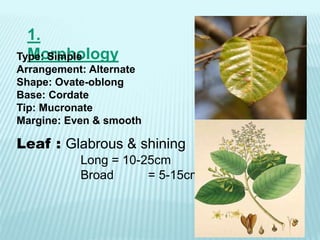
Leaf : Glabrous & shining
Long = 10-25cm
Broad = 5-15cm
Type: Simple
Arrangement: Alternate
Shape: Ovate-oblong
Base: Cordate
Tip: Mucronate
Margine: Even & smooth
Flower :
White, pink & pinky cream in colour.
Regular,Bisexual, Hypogynous, &
Pentamerous
Fruit :
One seeded &
winged
Seed :
Without endosperm
& fleshy
2. Physionomy
♣ Gragarious
♣ Seldom completely leafless
♣ Moderately slow growing
♣ Bole is clear & straight
♣ Crown tends to be round to flat in older ones
♣ In fertile sites
height 36-46m
grith 3m
In infertile sites
height 18-30m
grith 1.5-2.1m
♣ Bark is 2-5cm thick
♣ Root system : tap root is extended upto 120cm only
3.Wood Anatomy
Naturally lasting timber
Weight 25-30kg
Chemical Composition :
Water = 10.8% Carbohydrate = 62.7%
Oil = 14.8% Protein = 8%
Fibre = 1.4% Ash = 2.3%
Diffuse porous
Light in colour when freshly cut, & becoming dark
brown with exposure
Sapwood – Pale grayish or brownish-white
Heartwood – Brown or reddish-brown
PHENOLOGY
 Leaf fall January-March
 New leaves appear February-May
 Flower bud appear February
 Fruit ripen June
SILVICULTURAL CHARECTERISTICS
 Moist deciduous formation
 Light demander
 Complete overhead light is needed
 Soil pH 4.5-5.5
 Higher level of N & K
Lower level of P, indicates optimal condition for
growth
 Long & strong tap root
SILVICULTURAL CHARECTERISTICS
 Development of lateral root system is suitable in
sandy or sandy loam soil
 Medium aged trees are good coppicer.
 Very susceptible to drought & frost
 Young trees are injured by animals
 Suffers from the attack of Polyparous shoreae.
NATURAL REGENERATION
Success of natural regeneration depends
on:
 Sufficient seed production
 Proper & efficient dissemination
 Good seed germination
 Establishment of seedlings in sufficient
numbers
Two ways :
i. From seed
ii. From vegetative parts
Operations for successful natural regeneration
of SAL :
 Adequate seed supply
 Combination of good seed year & timely
commencement of monsoon
 Dense foliaged trees should be thinned out & light
crowned species should be retained
 Soil working
 Fencing regeneration area
 Controlled grazing
 Burning, before a good seed year
ARTIFICIAL REGENERATION
Sal plantation can be raised successfully by
:
❀ Direct sowing of freshly collected viable & fertile
seeds
❀ Planting of seedlings in understory
❀ Dona planting
❀ Poly pot plants
❀ Basket plants
❀ Stump planting
❀ Vegetative propagation
Best time - Rainy season
Caution: Before planting, fresh or undecompised leaves
of SAL must be removed from the planting spot.
DISEASES
Root diseases:
Root rot - Polyporus shoreae
Root collar – Sebacina alutacea
Stem diseases:
heart rot – Hymenopchaete rubiginosa
Stem canker – Macro-phoma shoreae
Leaf spots:
Perioconiella shoreae
Seed nycoflora:
Aspergillus spp.
USES
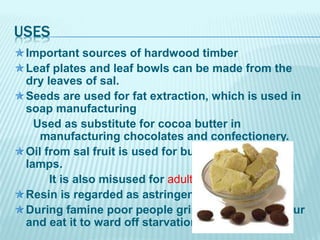
Important sources of hardwood timber
Leaf plates and leaf bowls can be made from the
dry leaves of sal.
Seeds are used for fat extraction, which is used in
soap manufacturing
Used as substitute for cocoa butter in
manufacturing chocolates and confectionery.
Oil from sal fruit is used for burning in earthen
lamps.
It is also misused for adulterating ghee.
Resin is regarded as astringent and detergent
During famine poor people grind the fruit into flour
and eat it to ward off starvation.
That’s all about SAL TREE
Any Question ???
Have A Good Day

SAL

  • 2.
    PRESENTATOR Name: Sudipta Sinha RegNo: 2009631004 Dept of FES Shahjalal University of Science & Technology Sylhet
  • 3.
  • 4.
    SILIVICULTURE Silvics = Theecological study of forest trees. Including life history & general characteristics = The art & science of cultivating forests based on knowledge of silvics.
  • 5.
    Species Silviculture Management ofindividual species applying silvicultural knowledge
  • 7.
    SAL Shorea robusta FamilyDipterocarpaceae The word Shorea comes from the name of Sir John Shore, former Governor General of India
  • 8.
    HISTORICAL OVERVIEW  Objectof worship among Buddhist & Hindus
  • 9.
    DISTRIBUTION Native to southernAsia Ranging south of the Himalaya, from Myanmar in the east to Nepal, India & Bangladesh In Bangladesh distributed in the Dhaka, Gazipur, Tangail, Mymensingh, and Jamalpur districts, including some patches in the greater Comilla and Sylhet districts ►0.12 million hectares of land ►4.7% of the total forest area
  • 10.
    Fig. 1 Map showingthe distribution of moist deciduous Sal (Shorea robusta) forests of Bangladesh.
  • 11.
    CLIMATIC CONDITION  Temperature: mean annual temperature is 26.3oC  the average maximum temperature is 27.5oC the average minimum temperature is 18.5oC  Average Rainfall: 1000-2000mm
  • 12.
    PHYSIOGRAPHIC CONDITION  Bothhilly & flat areas  But best in lower slops & in valleys Soli type: Well-drained moist deep sandy loam soil
  • 13.
  • 14.
    GENERAL DISCRIPTION 1. Morphology 2.Physionomy 3. Wood anatomy
  • 15.
    1. Morphology Leaf : Glabrous& shining Long = 10-25cm Broad = 5-15cm Type: Simple Arrangement: Alternate Shape: Ovate-oblong Base: Cordate Tip: Mucronate Margine: Even & smooth
  • 16.
    Flower : White, pink& pinky cream in colour. Regular,Bisexual, Hypogynous, & Pentamerous
  • 17.
    Fruit : One seeded& winged Seed : Without endosperm & fleshy
  • 18.
    2. Physionomy ♣ Gragarious ♣Seldom completely leafless ♣ Moderately slow growing ♣ Bole is clear & straight ♣ Crown tends to be round to flat in older ones ♣ In fertile sites height 36-46m grith 3m In infertile sites height 18-30m grith 1.5-2.1m ♣ Bark is 2-5cm thick ♣ Root system : tap root is extended upto 120cm only
  • 19.
    3.Wood Anatomy Naturally lastingtimber Weight 25-30kg Chemical Composition : Water = 10.8% Carbohydrate = 62.7% Oil = 14.8% Protein = 8% Fibre = 1.4% Ash = 2.3% Diffuse porous Light in colour when freshly cut, & becoming dark brown with exposure Sapwood – Pale grayish or brownish-white Heartwood – Brown or reddish-brown
  • 20.
    PHENOLOGY  Leaf fallJanuary-March  New leaves appear February-May  Flower bud appear February  Fruit ripen June
  • 21.
    SILVICULTURAL CHARECTERISTICS  Moistdeciduous formation  Light demander  Complete overhead light is needed  Soil pH 4.5-5.5  Higher level of N & K Lower level of P, indicates optimal condition for growth  Long & strong tap root
  • 22.
    SILVICULTURAL CHARECTERISTICS  Developmentof lateral root system is suitable in sandy or sandy loam soil  Medium aged trees are good coppicer.  Very susceptible to drought & frost  Young trees are injured by animals  Suffers from the attack of Polyparous shoreae.
  • 23.
    NATURAL REGENERATION Success ofnatural regeneration depends on:  Sufficient seed production  Proper & efficient dissemination  Good seed germination  Establishment of seedlings in sufficient numbers Two ways : i. From seed ii. From vegetative parts
  • 24.
    Operations for successfulnatural regeneration of SAL :  Adequate seed supply  Combination of good seed year & timely commencement of monsoon  Dense foliaged trees should be thinned out & light crowned species should be retained  Soil working  Fencing regeneration area  Controlled grazing  Burning, before a good seed year
  • 25.
    ARTIFICIAL REGENERATION Sal plantationcan be raised successfully by : ❀ Direct sowing of freshly collected viable & fertile seeds ❀ Planting of seedlings in understory ❀ Dona planting ❀ Poly pot plants ❀ Basket plants ❀ Stump planting ❀ Vegetative propagation Best time - Rainy season Caution: Before planting, fresh or undecompised leaves of SAL must be removed from the planting spot.
  • 26.
    DISEASES Root diseases: Root rot- Polyporus shoreae Root collar – Sebacina alutacea Stem diseases: heart rot – Hymenopchaete rubiginosa Stem canker – Macro-phoma shoreae Leaf spots: Perioconiella shoreae Seed nycoflora: Aspergillus spp.
  • 27.
    USES Important sources ofhardwood timber Leaf plates and leaf bowls can be made from the dry leaves of sal. Seeds are used for fat extraction, which is used in soap manufacturing Used as substitute for cocoa butter in manufacturing chocolates and confectionery. Oil from sal fruit is used for burning in earthen lamps. It is also misused for adulterating ghee. Resin is regarded as astringent and detergent During famine poor people grind the fruit into flour and eat it to ward off starvation.
  • 28.
    That’s all aboutSAL TREE Any Question ???
  • 29.