Question ?
Describe laboratory water examination
procedure, analysis and interpretation of result
Outline
Introduction on laboratory water examination,
analysis and interpretation.
Laboratory water examination procedure
Laboratory water analysis
 water interpretation of the results
Introduction
Laboratory water examination procedure has divided
into three areas:
i. Physical water examination procedure , analysis
and interpretation
ii. Chemical water examination procedure , analysis
and interpretation
iii. Bacteriological water examination procedure,
analysis and interpretation
Physical examination of water 1/4
Physical water examination
procedure deal with physical
parameters example
pH,turbidity,total disolved
solid,color, taste, odor,electrical
conductivity and temperature.
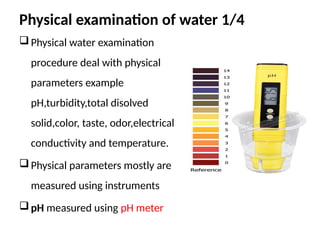
Physical parameters mostly are
measured using instruments
pH measured using pH meter
Physical water examination 2/4
Turbidity measured using
Nephelometer Nephelometric
Turbidity Unit(NTU)
Total dissolved solids(TDS)
measured using conductvity
sensors
Color measured by using
spectrophotometer
Electrical conductivity
measured by using electrical
conductivity meter
Physical water examination 3/4
Intensity of taste and odor in water is
measured by osmoscope and expressed in
unity called Threshod Odour Number.
Temperature is measured by thermometer
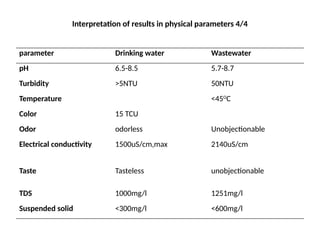
Interpretation of results in physical parameters 4/4
parameter Drinking water Wastewater
pH 6.5-8.5 5.7-8.7
Turbidity >5NTU 50NTU
Temperature <45O
C
Color 15 TCU
Odor odorless Unobjectionable
Electrical conductivity 1500uS/cm,max 2140uS/cm
Taste Tasteless unobjectionable
TDS 1000mg/l 1251mg/l
Suspended solid <300mg/l <600mg/l
Bacteriological water examination procedure, analysis and interpretation 1/4
Bacteriological water examination procedure deal with
biological parameters example fecal coliform and total
coliform.
There are two method used to obtain fecal count
which are membrane filtration method and most
probable number method.
 But the most effective method is membrane filtration
method
Procedures for bacteriological Examinations 2/4
Sterile all apparatus used in analysis by using
alcohol 70%
Dillute the water sample by using pure water
Select appropriate culture media, and dispense the
broth in sterile petri dish
Flame the forceps, and remove the membrane from
the sterile package.
Place the membrane filter into the funnel assembly.
Flame the pouring lip of the sample container and
pour the sample into the funnel.
Procedures for bacteriological examination 3/4
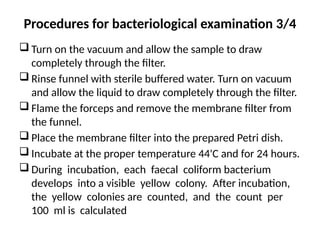
 Turn on the vacuum and allow the sample to draw
completely through the filter.
 Rinse funnel with sterile buffered water. Turn on vacuum
and allow the liquid to draw completely through the filter.
 Flame the forceps and remove the membrane filter from
the funnel.
 Place the membrane filter into the prepared Petri dish.
 Incubate at the proper temperature 44'C and for 24 hours.
 During incubation, each faecal coliform bacterium
develops into a visible yellow colony. After incubation,
the yellow colonies are counted, and the count per
100 ml is calculated
Analysis and interpretation of biological
examination in water… 4/4
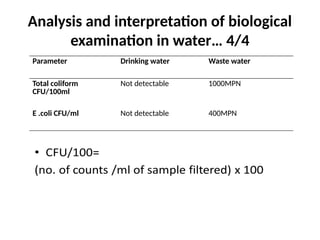
Parameter Drinking water Waste water
Total coliform
CFU/100ml
Not detectable 1000MPN
E .coli CFU/ml Not detectable 400MPN
Chemical water examination procedure , analysis and interpretation… 1/12
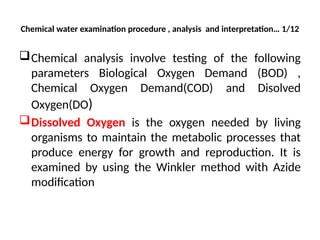
Chemical analysis involve testing of the following
parameters Biological Oxygen Demand (BOD) ,
Chemical Oxygen Demand(COD) and Disolved
Oxygen(DO)
Dissolved Oxygen is the oxygen needed by living
organisms to maintain the metabolic processes that
produce energy for growth and reproduction. It is
examined by using the Winkler method with Azide
modification
Chemical water examination… 2/ 12
Procedures:
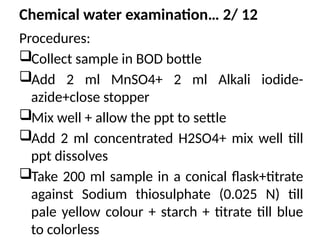
Collect sample in BOD bottle
Add 2 ml MnSO4+ 2 ml Alkali iodide-
azide+close stopper
Mix well + allow the ppt to settle
Add 2 ml concentrated H2SO4+ mix well till
ppt dissolves
Take 200 ml sample in a conical flask+titrate
against Sodium thiosulphate (0.025 N) till
pale yellow colour + starch + titrate till blue
to colorless
Chemical water examination… 3/12
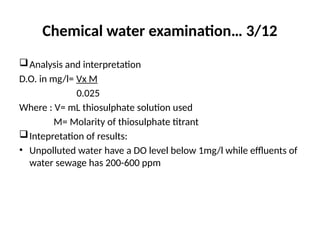
Analysis and interpretation
D.O. in mg/l= Vx M
0.025
Where : V= mL thiosulphate solution used
M= Molarity of thiosulphate titrant
Intepretation of results:
• Unpolluted water have a DO level below 1mg/l while effluents of
water sewage has 200-600 ppm
Chemical water examination… 4/12
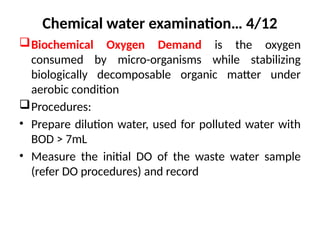
Biochemical Oxygen Demand is the oxygen
consumed by micro-organisms while stabilizing
biologically decomposable organic matter under
aerobic condition
Procedures:
• Prepare dilution water, used for polluted water with
BOD > 7mL
• Measure the initial DO of the waste water sample
(refer DO procedures) and record
Chemical water examination…5/12
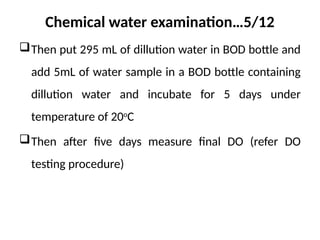
Then put 295 mL of dillution water in BOD bottle and
add 5mL of water sample in a BOD bottle containing
dillution water and incubate for 5 days under
temperature of 20o
C
Then after five days measure final DO (refer DO
testing procedure)
Chemical water examination…6/12
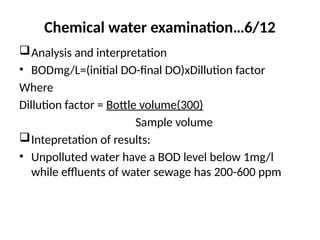
Analysis and interpretation
• BODmg/L=(initial DO-final DO)xDillution factor
Where
Dillution factor = Bottle volume(300)
Sample volume
Intepretation of results:
• Unpolluted water have a BOD level below 1mg/l
while effluents of water sewage has 200-600 ppm
Chemical water examination …7/12
Chemical Oxygen Demand
Is used to determined the quantity of pollution
in water after waste water treatment. The
higher value the COD indicates the higher
organic pollution in the water sample.
Procedure for biological oxygen demand…
9/12
Take 10mls of sample into a round bottle reflex flask
Add some glass beads to prevent the solution from
bumping into the flask while heating
Add 1mls of mercury sulphate (HgSO4) solution to
flask and mix by swirling the flask
Add 5mls potassium dichromate(K2cr2O7) solution
Now add slowly and careful 15 mls of silver sulphate-
sulphuric acid solution
Procedure for biological oxygen Demand…
11/12
Connect the reflex condenser and digest the contents
using hot plate for 2hrs
After digestion cool the flask and rinse the condenser
with 25mls distilled water collecting the same flask
Add 2-4 drops of ferroin indicator to the flask and
titrate with 0.025M Ferrous ammonium sulphate
solution to the end point
Make the blank preparation in the same manner as
sample used distilled water instead of the sample
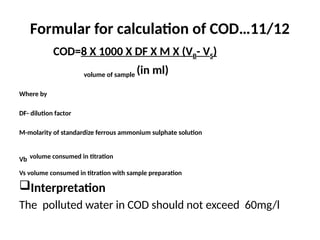
Formular for calculation of COD…11/12
COD=8 X 1000 X DF X M X (VB- VS)
volume of sample (in ml)
Where by
DF- dilution factor
M-molarity of standardize ferrous ammonium sulphate solution
Vb volume consumed in titration
Vs volume consumed in titration with sample preparation
Interpretation
The polluted water in COD should not exceed 60mg/l
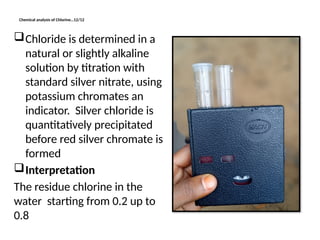
Chemical analysis of Chlorine…12/12
Chloride is determined in a
natural or slightly alkaline
solution by titration with
standard silver nitrate, using
potassium chromates an
indicator. Silver chloride is
quantitatively precipitated
before red silver chromate is
formed
Interpretation
The residue chlorine in the
water starting from 0.2 up to
0.8

Describe laboratory water examination procedure

  • 1.
    Question ? Describe laboratorywater examination procedure, analysis and interpretation of result
  • 2.
    Outline Introduction on laboratorywater examination, analysis and interpretation. Laboratory water examination procedure Laboratory water analysis  water interpretation of the results
  • 3.
    Introduction Laboratory water examinationprocedure has divided into three areas: i. Physical water examination procedure , analysis and interpretation ii. Chemical water examination procedure , analysis and interpretation iii. Bacteriological water examination procedure, analysis and interpretation
  • 4.
    Physical examination ofwater 1/4 Physical water examination procedure deal with physical parameters example pH,turbidity,total disolved solid,color, taste, odor,electrical conductivity and temperature. Physical parameters mostly are measured using instruments pH measured using pH meter
  • 5.
    Physical water examination2/4 Turbidity measured using Nephelometer Nephelometric Turbidity Unit(NTU) Total dissolved solids(TDS) measured using conductvity sensors Color measured by using spectrophotometer Electrical conductivity measured by using electrical conductivity meter
  • 6.
    Physical water examination3/4 Intensity of taste and odor in water is measured by osmoscope and expressed in unity called Threshod Odour Number. Temperature is measured by thermometer
  • 7.
    Interpretation of resultsin physical parameters 4/4 parameter Drinking water Wastewater pH 6.5-8.5 5.7-8.7 Turbidity >5NTU 50NTU Temperature <45O C Color 15 TCU Odor odorless Unobjectionable Electrical conductivity 1500uS/cm,max 2140uS/cm Taste Tasteless unobjectionable TDS 1000mg/l 1251mg/l Suspended solid <300mg/l <600mg/l
  • 8.
    Bacteriological water examinationprocedure, analysis and interpretation 1/4 Bacteriological water examination procedure deal with biological parameters example fecal coliform and total coliform. There are two method used to obtain fecal count which are membrane filtration method and most probable number method.  But the most effective method is membrane filtration method
  • 9.
    Procedures for bacteriologicalExaminations 2/4 Sterile all apparatus used in analysis by using alcohol 70% Dillute the water sample by using pure water Select appropriate culture media, and dispense the broth in sterile petri dish Flame the forceps, and remove the membrane from the sterile package. Place the membrane filter into the funnel assembly. Flame the pouring lip of the sample container and pour the sample into the funnel.
  • 10.
    Procedures for bacteriologicalexamination 3/4  Turn on the vacuum and allow the sample to draw completely through the filter.  Rinse funnel with sterile buffered water. Turn on vacuum and allow the liquid to draw completely through the filter.  Flame the forceps and remove the membrane filter from the funnel.  Place the membrane filter into the prepared Petri dish.  Incubate at the proper temperature 44'C and for 24 hours.  During incubation, each faecal coliform bacterium develops into a visible yellow colony. After incubation, the yellow colonies are counted, and the count per 100 ml is calculated
  • 11.
    Analysis and interpretationof biological examination in water… 4/4 Parameter Drinking water Waste water Total coliform CFU/100ml Not detectable 1000MPN E .coli CFU/ml Not detectable 400MPN
  • 12.
    Chemical water examinationprocedure , analysis and interpretation… 1/12 Chemical analysis involve testing of the following parameters Biological Oxygen Demand (BOD) , Chemical Oxygen Demand(COD) and Disolved Oxygen(DO) Dissolved Oxygen is the oxygen needed by living organisms to maintain the metabolic processes that produce energy for growth and reproduction. It is examined by using the Winkler method with Azide modification
  • 13.
    Chemical water examination…2/ 12 Procedures: Collect sample in BOD bottle Add 2 ml MnSO4+ 2 ml Alkali iodide- azide+close stopper Mix well + allow the ppt to settle Add 2 ml concentrated H2SO4+ mix well till ppt dissolves Take 200 ml sample in a conical flask+titrate against Sodium thiosulphate (0.025 N) till pale yellow colour + starch + titrate till blue to colorless
  • 14.
    Chemical water examination…3/12 Analysis and interpretation D.O. in mg/l= Vx M 0.025 Where : V= mL thiosulphate solution used M= Molarity of thiosulphate titrant Intepretation of results: • Unpolluted water have a DO level below 1mg/l while effluents of water sewage has 200-600 ppm
  • 15.
    Chemical water examination…4/12 Biochemical Oxygen Demand is the oxygen consumed by micro-organisms while stabilizing biologically decomposable organic matter under aerobic condition Procedures: • Prepare dilution water, used for polluted water with BOD > 7mL • Measure the initial DO of the waste water sample (refer DO procedures) and record
  • 16.
    Chemical water examination…5/12 Thenput 295 mL of dillution water in BOD bottle and add 5mL of water sample in a BOD bottle containing dillution water and incubate for 5 days under temperature of 20o C Then after five days measure final DO (refer DO testing procedure)
  • 17.
    Chemical water examination…6/12 Analysisand interpretation • BODmg/L=(initial DO-final DO)xDillution factor Where Dillution factor = Bottle volume(300) Sample volume Intepretation of results: • Unpolluted water have a BOD level below 1mg/l while effluents of water sewage has 200-600 ppm
  • 18.
    Chemical water examination…7/12 Chemical Oxygen Demand Is used to determined the quantity of pollution in water after waste water treatment. The higher value the COD indicates the higher organic pollution in the water sample.
  • 19.
    Procedure for biologicaloxygen demand… 9/12 Take 10mls of sample into a round bottle reflex flask Add some glass beads to prevent the solution from bumping into the flask while heating Add 1mls of mercury sulphate (HgSO4) solution to flask and mix by swirling the flask Add 5mls potassium dichromate(K2cr2O7) solution Now add slowly and careful 15 mls of silver sulphate- sulphuric acid solution
  • 20.
    Procedure for biologicaloxygen Demand… 11/12 Connect the reflex condenser and digest the contents using hot plate for 2hrs After digestion cool the flask and rinse the condenser with 25mls distilled water collecting the same flask Add 2-4 drops of ferroin indicator to the flask and titrate with 0.025M Ferrous ammonium sulphate solution to the end point Make the blank preparation in the same manner as sample used distilled water instead of the sample
  • 21.
    Formular for calculationof COD…11/12 COD=8 X 1000 X DF X M X (VB- VS) volume of sample (in ml) Where by DF- dilution factor M-molarity of standardize ferrous ammonium sulphate solution Vb volume consumed in titration Vs volume consumed in titration with sample preparation Interpretation The polluted water in COD should not exceed 60mg/l
  • 22.
    Chemical analysis ofChlorine…12/12 Chloride is determined in a natural or slightly alkaline solution by titration with standard silver nitrate, using potassium chromates an indicator. Silver chloride is quantitatively precipitated before red silver chromate is formed Interpretation The residue chlorine in the water starting from 0.2 up to 0.8