Bonnie J. M. Swoger SUNY Geneseo
Using a standardized assessment Pros Cons Time savings (no need to develop a new assessment from scratch) Ability to compare with other schools Assessment  has already been validated Cost Lack of access to individual student data Less flexibility
About Project SAILS Standardized Assessment of Information Literacy Skills Developed by Kent State University Assessment was independently validated against SAT scores and another info. Lit. assessment. www.projectsails.org $3 per student, max of $2000
About the Assessment Each student answers 45 questions from a bank of 150. 30-60 minutes Knowledge based questions based on ACRL information literacy standards Standards are further refined into 8 “skill sets” Demographic questions  Class year Major Participation in a library instruction intensive class
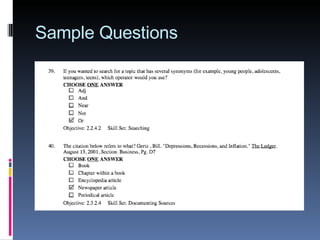
Sample Questions
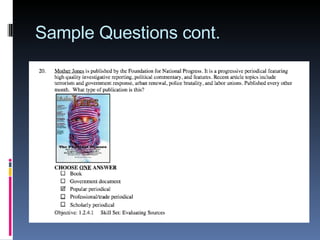
Sample Questions cont.
Our administration of SAILS 200 students Emails to students Flyers Appeals to faculty to offer extra credit $3 gift certificate to the library café or $3 donation to student group charities Even distribution across class years Some majors represented better than others
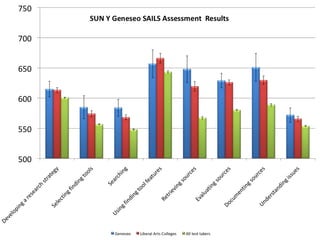
Results Results are emailed as a PDF after the semester in which the assessment was administered. Project SAILS calculates scores and margins of error. Scores are separated based on demographic questions and Project SAILS skill sets.
 
Our Results Students who had participated in a library instruction intensive class tend to do better than those who hadn’t This needs further examination, based on the small number of students. Relatively little difference between majors with the exception of Business majors who tended to score lower Very large margins of error
Our Results Continued Students increase skills in four areas: Selecting Finding Tools Searching Retrieving Sources Documenting Sources Little to no increase in four other areas: Developing a Research Strategy Using Finding Tool Features Evaluating Sources Understanding Issues
Conclusions Challenge getting enough test takers for statistically significant results Collaboration with faculty and students groups is important Our results are useful for library administrators in justifying the personnel expense of the expanding instruction program. We won’t be using the SAILS again now, but we may repeat it in a few years. Results used to inform a new home-grown assessment for our Freshman writing class.

Sails Assessment

  • 1.
    Bonnie J. M.Swoger SUNY Geneseo
  • 2.
    Using a standardizedassessment Pros Cons Time savings (no need to develop a new assessment from scratch) Ability to compare with other schools Assessment has already been validated Cost Lack of access to individual student data Less flexibility
  • 3.
    About Project SAILSStandardized Assessment of Information Literacy Skills Developed by Kent State University Assessment was independently validated against SAT scores and another info. Lit. assessment. www.projectsails.org $3 per student, max of $2000
  • 4.
    About the AssessmentEach student answers 45 questions from a bank of 150. 30-60 minutes Knowledge based questions based on ACRL information literacy standards Standards are further refined into 8 “skill sets” Demographic questions Class year Major Participation in a library instruction intensive class
  • 5.
  • 6.
  • 7.
    Our administration ofSAILS 200 students Emails to students Flyers Appeals to faculty to offer extra credit $3 gift certificate to the library café or $3 donation to student group charities Even distribution across class years Some majors represented better than others
  • 8.
    Results Results areemailed as a PDF after the semester in which the assessment was administered. Project SAILS calculates scores and margins of error. Scores are separated based on demographic questions and Project SAILS skill sets.
  • 9.
  • 10.
    Our Results Studentswho had participated in a library instruction intensive class tend to do better than those who hadn’t This needs further examination, based on the small number of students. Relatively little difference between majors with the exception of Business majors who tended to score lower Very large margins of error
  • 11.
    Our Results ContinuedStudents increase skills in four areas: Selecting Finding Tools Searching Retrieving Sources Documenting Sources Little to no increase in four other areas: Developing a Research Strategy Using Finding Tool Features Evaluating Sources Understanding Issues
  • 12.
    Conclusions Challenge gettingenough test takers for statistically significant results Collaboration with faculty and students groups is important Our results are useful for library administrators in justifying the personnel expense of the expanding instruction program. We won’t be using the SAILS again now, but we may repeat it in a few years. Results used to inform a new home-grown assessment for our Freshman writing class.