TRAINING ON
BASIC SAFETY
16-5-2024
SAFETYFIRST ALWAYS
I SOLEMNLY AFFIRM THAT I WILL DO
EVERYTHING POSSIBLE FOR THE
PREVENTION OF ACCIDENTS AND
OCCUPATIONAL DISEASES AND
PROTECTION OF THE ENVIRONMENT IN
THE INTEREST OF SELF, MY FAMILY, MY
PROJECT, MY COMMUNITY AND THE
NATION AT LARGE.
SELF INTRODUCTION
R.Mohan,
Electrical Engineer & HSE Professional.
Qualification : D.E.E, A.M.I.E, DIS(RLI), NEBOSH (IGC)-UK
Professional Qualification:
1.Diploma in Industrial Safety (from Ministry of Labour,
Govt.of India)
2.NEBOSH (IGC) - UK
2.Certified Lead Auditor in OHSAS 18001: 2007 &
ISO45001:2018(OHSMS)
3.Certified Lead Auditor in ISO 14001:2004 (EMS)
4.Certified IMS Internal Auditor (LRQA, UK)
5. Life member of National Safety Council, India
PROFESSIONAL EXPERIENCE
 43 years of experience in various fields of
Electrical Engineering and Health, Safety &
Environment in Indian Railways, Metro Rail
Projects & Power sector.
 Electrical Plant Maintenance - 10 years
 Electrical Rolling Stock - Production, Planning &
QA/QC - 8 years
 Technical training & Teaching - 2 years
 HSE Function(Mfg & Constn) - 21 years
 HSE Metro Consultancy (IE) - 2 years
EXPERIENCE SUMMARY
 Worked in Integral Coach Factory of Indian Railways for 26
yrs in Electrical and Safety.
 Worked in Cethar (Power sector), Trichy for 5 yrs, heading
the HSE department in Boiler manufacturing & EPC power
projects construction.
 Worked in L&T as HEAD/EHS for 5 yrs, in CMRL, RIYADH
METRO & Railways, Roads , Airport projects.
 Worked in AECOM as Associate Director at Navy project,
Karwar.
 Worked in Texmaco Rail as Chief Safety Manager in Chennai
Metro Rail Project.
 Worked as freelance HSE Consultant for various Corporates
including L&T, SIEMENS, L&W Construction etc – in
Corporate HSE Trainings, Safety audits, HSE System
implementation. Specialised in Behaviour based safety
trainings.
Now working in
PUNE METRO RAIL PROJECT – LINE 3
( A PPP Project by PMRDA & PITCMRL) as
Chief Safety & Environment Expert in
TPF GETINSA EURO STUDIOS (Independent
Engineer)
AGENDA
NEED FOR SAFETY
AGENCIES CAUSING ACCIDENTS
ACCIDENT PREVENTION
HAZARD IDENTIFICATION & RISK
ASSESSMENT
UNSAFE CONDITION/UNSAFE ACTION
NEAR MISS & ACCIDENT
WHY SAFETY ???
NATURAL DISASTERS
TSUNAMI , 2004 , TAMILNADU
FAKUSHIMA NUCLEAR
DISASTER – TSUNAMI, JAPAN
2011
SPANISH FLU PANDEMIC 1918
GLOBAL PANDEMIC 2019
MAN MADE DISASTERS IN INDIA
UNCHAHAR BOILER
EXPLOSION( 2017)
CHASNALA MINE
DISASTER(1975)
BHOPAL GAS TRAGEDY 1984
BALCO CHIMNEY COLLAPSE(2009)
ALREADY LIVING WITH DANGER - INDUSTRIES
WHY
NEED
FOR
SAFETY ?
LIVING WITH DANGERS ?
CONSTRUCTION SAFETY VIDEO
WHY NEED FOR SAFETY ?
 An accident results in physical, psychological,
social and financial losses to the injured, his
family, management and the society.
 Losses mentioned will vary according to
the severity of the injury - minor, severe or
fatal.
FOR INJURED PERSON
Suffering and pain
Worry
Absence of recreation
Incapacity to perform normal work
Loss of wages
Medical expenses
Loss of limb or life
FOR MANAGEMENT
Production/Project Delay
Time lost by Foremen and Executive
Compensation and medical costs
Time and cost of First aid
Time lost by employees not directly involved
Loss of injured employees service
Training a new employee
Damage to Plant & Machinery
Replacement & repair of Equipment
Damage of raw and or finished products
Inferior products/Defective construction
Waste of material
Worker’s unrest at work/agitation
Legal Litigations
Poor Brand value
FOR MANAGERS/SUPERVISORS
 Worry
 Loss of Prestige
 A good worker lost or incapacitated
 Selecting and training a substitute
 More supervision is required for the new
man
 Loss of output
 Loss of morale
FOR SOCIETY
 Increased fatal accidents - Live lost
 Cost of the Maintenance of the disabled
and the dependents.
 Increase in the price index - Losses
borne by the establishment due to the
accidents transferred to the
products/project
manufactured/constructed by them
 Inferior products.
 Unrest in the Society
TO FAMILY
 Mental agony
 Loss of family head/bread winner if, fatal
 Hospital and conveyance expenses
 Disruption of family life
 Children’s education/career lost
Keeping in view the above factors, safety is the prime most need
in any organisation and priority should be accorded in line with
the Legislations & Company safety policy.
“SAFETY, NO DOUBT IS EVERY BODY’S BUSINESS” BUT IT
REQUIRES MANAGEMENT’S SUSTAINED EFFORTS TO
ENSURE ACCIDENT PREVENTION PROGRAMME WORKS
SUCESSFULLY.
WHAT IS AN ACCIDENT ?
ACCIDENTS & PREVENTION
ACCIDENT : “ IT IS AN UNPLANNED / UNEXPECTED
EVENT WHICH CAUSES (OR) IS LIKELY TO CAUSE
AN INJURY / ILL HEALTH OR LOSS OF PROPERTY
” – DR.HEINRICH
ISO 45001 STANDARD DEFENITION
Accident :
Occurrence arising out of, or in the course of, work that
could or does result in injury and ill health .
- An incident where injury and ill health occurs is
sometimes referred to as an “accident”
- An incident where no injury and ill health occurs, but
has the potential to do so, may be referred to as a
“near-miss”, “near-hit” or “close call”.
Injury and ill health :
Adverse effect on the physical, mental or cognitive condition of a
person. These adverse effects include occupational disease, illness
and death.
Dr.HEINRICH SAFETY THEORY
Dr.Heinrich studied 75000 LOST TIME ACCIDENTS
AND FOUND 98% OF ACCIDENTS WERE CAUSED BY
EITHER UNSAFE ACTIONS (OR) UNSAFE CONDITIONS
(OR) BOTH
UNSAFE ACTION/UNSAFE CONDITION
UNSAFE CONDITION
UNSAFE ACTION
DR. HEINRICH THEORY OF ACCIDENTS
MAJOR / FATAL
MINOR INJURY
NO INJURY
INCIDENT/NEAR
MISS CASES
0.3 %
8.8%
90.9%
UNSAFE-ACTIONS /CONDITION
1
29
300
ACCIDENT PREVENTION
TO PREVENT ACCIDENTS – ELIMINATE UNSAFE ACTIONS
& UNSAFE CONDITIONS BY
ELIMINATION
SUBSTITUTION
ENGINEERING CONTROL
ADMINISTRATIVE CONTROL
PPE
ACCIDENT CAUSATION
Acciden
t
Causes
Direct
Causes
Unsafe
Act
Unsafe
Conditio
n
Indirect
Causes
Physiologic
al Problem
Psychological
Problem
Lack Of
Skills
Natural
Calamit
y
MANAGEMENT
CONTROL
ELIMINATING
UNSAFE CONDITIONS
DISCOVERING
CAUSES
ELIMINATING
UNSAFE ACTIONS
SAFE GUARDING ALL MACHINE
EQUIPMENT & WORK SPACE
RECTIFYING / PREVENTING
DEFECTIVE CONDITIONS
SUITABLE & SAFE DESIGN
& CONSTRUCTION
SAFE ARRANGEMENT OF
PROCESS/WORK METHODS
ADEQUATE & SUITABLE
ILLUMINATION
ADEQUATE & SUITABLE
VENTILATION
SAFE DRESS & PPEs
JOB SAFETY ANALYSIS
HIRA
INVESTIGATION OF
ACCIDENTS
INSPECTION OF PLANT
AND EQUIPMENTS
RECORDING AND
TABULATION OF DATA
ANALYSIS OF DATA
PERSONAL ADJUSTMENT
SAFETY EDUCATION
AND TRAINING
PROPER SUPERVISION
DISCIPLINE
BEHAVIOUR
ACCIDENT PREVENTION
PROGRAMME
Accident
Preventio
n
Humanity
Economic
Social
Legal
Productivit
y
NEED FOR SAFETY IN ACCIDENT PREVENTION
SAFETY TRIANGLE
SAFETY TRIANGLE
SAFETY
PRODUCTIVITY
QUALITY
AGENTS CAUSING INJURY/ILL HEALTH
1. CHEMICALS
2. PHYSICAL
3. ERGONOMICS
4. PSYCHOLOGICAL
5. BIOLOGICAL
6. SOCIAL
7. PHYSIOLOGICAL
70 to 80 % of general occupational health problems
are due to Chemical Agents.
HAZARDS IN INDUSTRIES….
 SLIP, TRIP , FALL
 ELECTROCUTION
 EXCAVATION HAZARD
 COLLAPSE OF CRANE/EQUIPMENT, BUILDING
 FIRE, NOISE HAZARD, ILLUMINATION HAZARD
 FALL OF OBJECTS, FALL OF PERSONS, WORK AT HEIGHT
HAZARD
 CUT INJURY, MACHINERY HAZARDS,ENTANGLEMENT
 CHEMICAL HAZARDS – TOXIC RELEASE, SKIN INJURY,
 TRANSPORT HAZARD
 BIOLOGICAL HAZARDS
 ROAD/RAILWAY TRAFFIC HAZARD
 ENVIRONMENTAL POLLUTION
UNSAFE CONDITION
UNSAFE ACT
UNSAFE CONDITION
UNSAFE ACTION/CONDITION REPORTING
HAZARD IDENTIFICATION & RISK
ASSESSMENT
Hazard Vs Risk
Hazard Vs Risk
Hazard – Wild Animal
Risk – Injury
Risk Level – HIGH
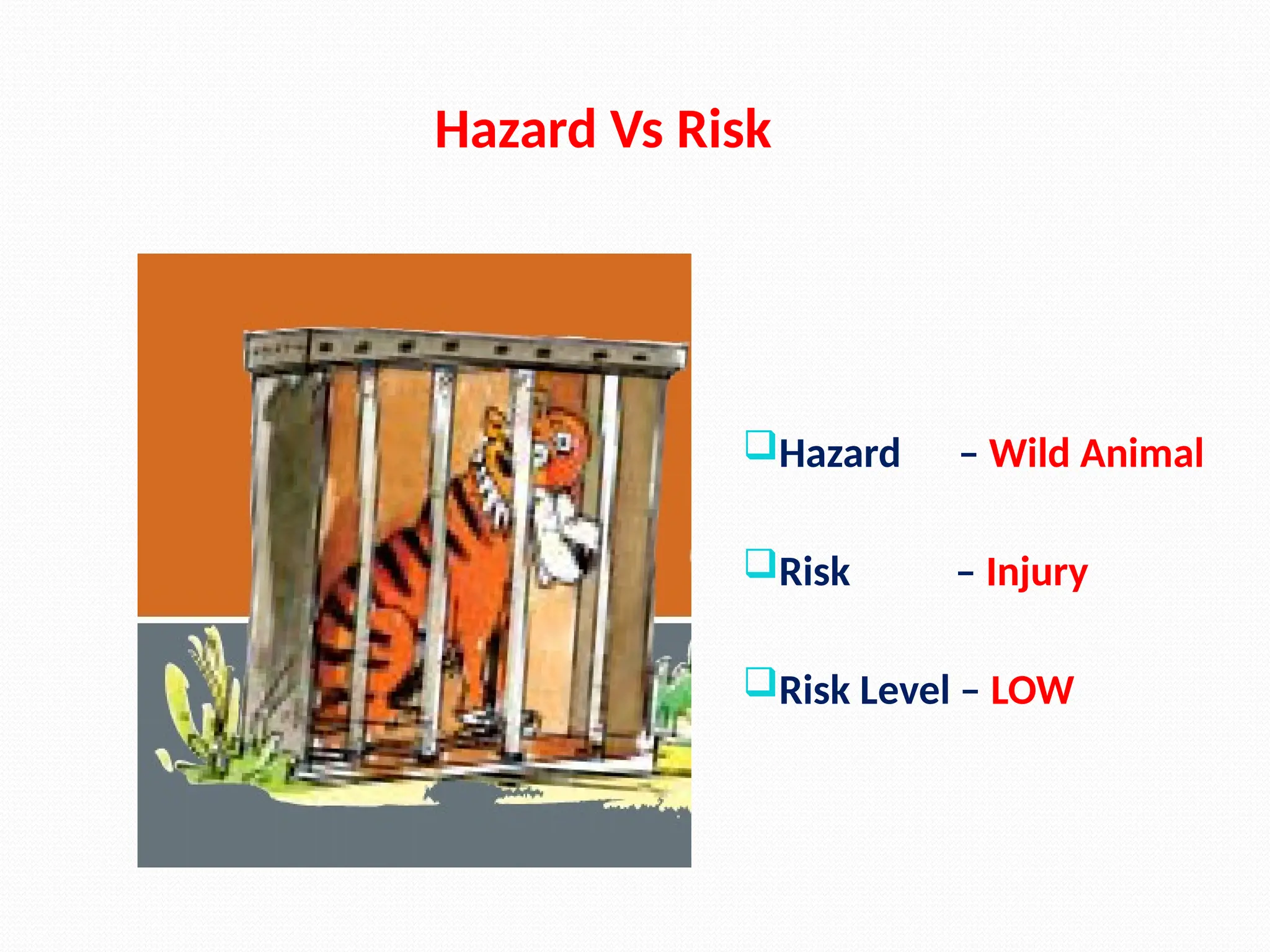
Hazard Vs Risk
Hazard Vs Risk
Hazard – Wild Animal
Risk – Injury
Risk Level – LOW
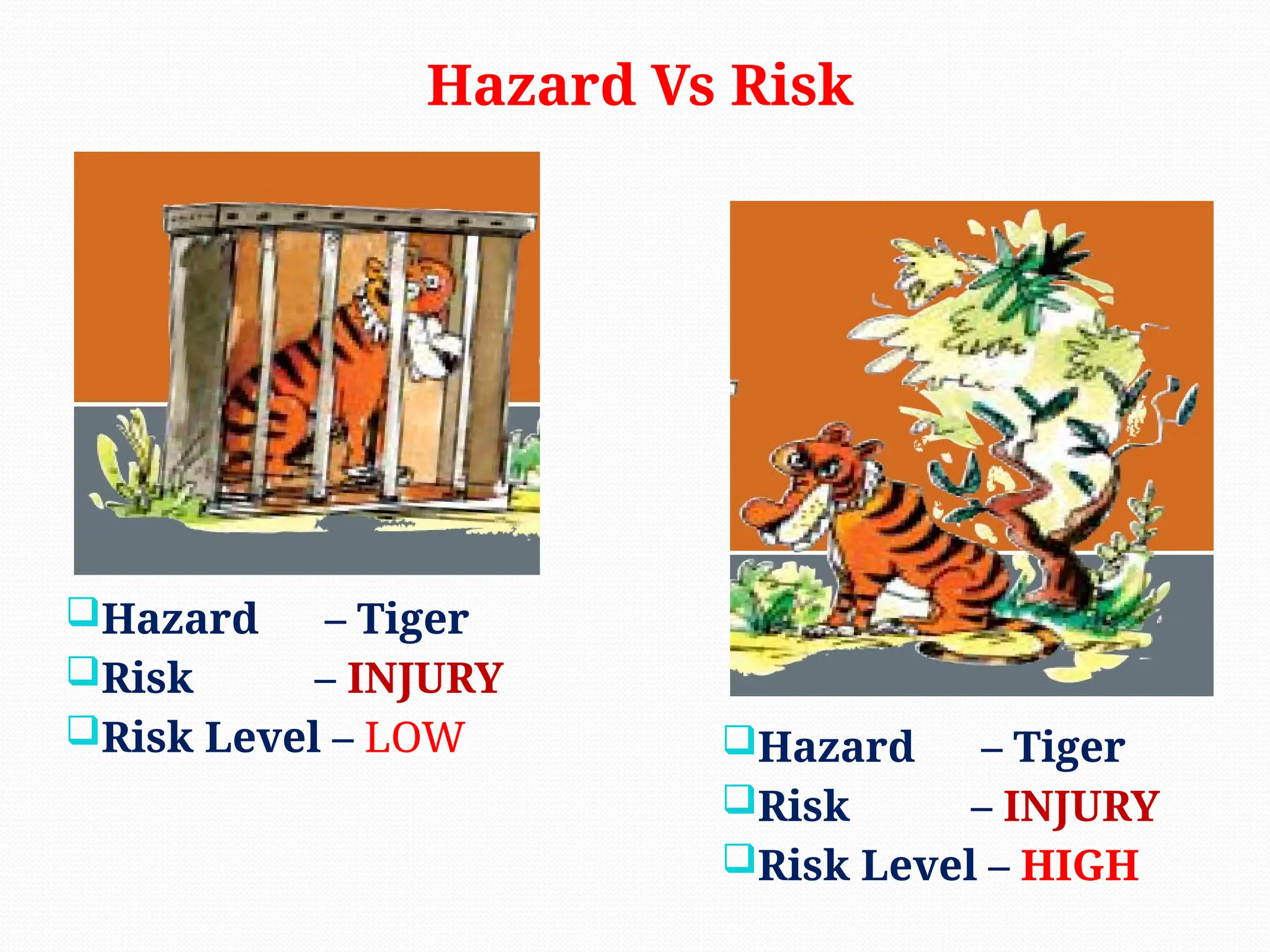
Hazard Vs Risk
Hazard – Tiger
Risk – INJURY
Risk Level – LOW Hazard – Tiger
Risk – INJURY
Risk Level – HIGH
RISK LEVEL
HAZARD CAN BE ELIMINATED
BUT
RISK CAN ONLY BE CONTROLLED & NOT
ELIMINATED
3 HIDDEN HAZRAD VIDEO
Source, situation, or act with a potential for harm in terms of
human injury or ill-health or a combination of these.
Important Terms
Combination of the likelihood of an occurrence of a hazardous
event or exposure and the severity of injury or ill-health than
can be caused by the event or exposure
Hazard
Risk
Risk assessment
Process of evaluating the risk(s) arising from a hazard(s), taking
into account the adequacy of any existing controls, and deciding
whether or not the risk(s) is acceptable.
EXERCISE
Identify Hazard & Risk
ANSWERS
 Hazard
 Falling material (Source)
 Open manhole (Situation)
 Reading newspaper while walking (act)
 Risk
 Head injury
 Fall into open manhole leading to injury
 Risk Level - High
Risk Assessment is simply asking:
What can go
wrong ???
How bad
can it be ???
Can we
tolerate it ???
How likely ???
HIRA Process
2. Hazard
Identification
3. Risk
Evaluation
1. Preparation
6.
Implementatio
n & Review
5. Record
Keeping
4. Risk Control
1.List of activities
2.Risk Assessment Team
3.Input for Risk
Assessment
Identify workplace
hazard in each activity
and the possible outcome
1.Source
2.Situation
3.Act
1. Identifying the existing
risk control measures;
2. Determining probability
3. Assessing the potential
severity
4. Assessing the risk level
Control hazards and reduce
risks by the following
hierarchy of control measures.
• Elimination
• Substitution
• Engineering controls
• Administrative controls
• Personal protective
equipment
1.Recording the risk
assessment including the
control measures identified
2.Preparing the safe work
method
1. Operation control – Safe
Work Method
2.Communication
3.Review
NAPO HIRA VIDEO - 2
Inputs for HSE Risk Assessment
List of work activities
List of machinery and tools used
Records of past incidents and accidents
Relevant legislation
Relevant codes of practice or specifications
Details of existing control measures
Feedback from staff, clients, suppliers, interested parties
Other information such as MSDS, manufacturer’s
instruction manual
Copies of any relevant previous risk assessments
 Presence of existing control measures shall be first identified for
every hazard.
 By considering the effectiveness of the existing controls and the
consequences of their failure, the risk level can be assessed
Existing Control measures
Risk Evaluation
Probability Descriptions
(The highest category will always be used)
VALUE Status Description
5 Very much likely Happens several times per year in a construction site.
4 Most Likely Happens several times per year in our OC.
3 Likely Incident occurred in our OC.
2 Unlikely Known to occur in other OCs & construction industry.
1 Most Unlikely Never heard of in construction industry.
Probability
Risk Evaluation
Severity Descriptions
(The highest category shall always be used)
VALUE
Result of Hazard to Personnel
Severity of the
Environmental Impact
Safety Health
5 Single or multiple Fatality Terminal illness Massive effect
4
Serious Injury requiring
hospitalisation
Unemployable due to
illness Major effect
3 Lost Time Injury Intense health effect Localized effect
2
Injury requiring Medical
Treatment but not Lost Time Minor health effect Minor effect
1
First Aid treatment only
Slight health effect Slight effect
Severity
Risk Evaluation
Hierarchy of
Controlling Hazards
Risk Control
Elimination
Substitution
Engineering Control
Administrative Control
PPEs
Hierarchy of Control
HAZARD ELIMINATION
HAZARD SUBSTITUTION
HAZARD ISOLATION
HAZARD - ENGINEERING CONTROL
HAZARD – ADMINISTRATIVE CONTROL
PPEs
ELIMINATION
SUBSTITUTION
 Substitution is using a safer alternative to the
source of the hazard. An example is using plant-
based printing inks as a substitute for solvent-based
inks. When considering a substitute, it's important to
compare the potential new risks of the substitute to
the original risks.
 It may be alternate chemical, alternate m/c, method
etc.,
ISOLATION
ENGINEERING CONTROL
ADMINISTRATIVE CONTROL
 TRAININGS
 SAFETY POSTERS & SIGNAGES
 HEALTH CHECK UPs
PPEs
PPEs should only be considered
when
all other control methods are
impractical, or
to increase control when used with
another method higher up in the
Hierarchy of Control.
4 CROCODILE THEORY OF HIRA - PDF
5 HIERARCHY OF CONTROL VIDEO
Residual Risks
 The remaining risks for which the planned controls are not
able to effectively remove or control.
 It shall be ensured that the residual risks are
acceptable and manageable.
 It is called ALARP ( As low as Reasonably
Practicable)
Record Keeping
Record the risk assessment including the controlling
measures identified
Prepare the safe work method(Methods Statement,
SOP, Plan)
Implementation & Review
IMPLEMENTATION
 Implement the control measures as decided from HIRA
 Review the performance of control measures
implemented periodically , if there is a significant change
in work processes
 Eg - Introduction of new machinery or change in work
procedure.
 After an incident
Communication
Employees to be informed of
 the nature of the risk involved
 the measures implemented to control the risk
Through
 EHS Induction training
 Daily Tool box talk
 Training programs
 Safety Committee Meetings
 Safety posters display
 Safety Handbook
 Health briefings
 Workers have a right to be protected from harm caused
by any failure to take reasonable risk control measures at
their workplace.
 Risk assessment is the responsibility of the employer and
is a part of the management system. A continuous
process of risk assessment should be anchored in the
Safety and Health Policy of the company.
 The employer decides who actually carries out the risk
assessment. This can be the employer themself, workers
designated by the employer, or external services, if there
are no competent personnel in the workplace.
HIRA CYCLE
SAMPLE HIRA MATRIX
SAMPLE HIRA
HAZARD IDENTIFICATION & RISK ASSESSMENT FOR ALL ACTIVITIES
NEAR MISS INCIDENTS
Objective
To help raise your awareness
about
 Near Misses & Reporting
 Unsafe conditions
Why Health & Safety is important
 Workplaces can be dangerous places
 Injuries happen in all kinds of workplaces
 We wish every personnel to return to their
home/camp safely – daily.
IT IS AN UNPLANNED, UNSCHEDULED,
UNWANTED EVENT
THAT DID NOT RESULT IN INJURY , WHICH
UNDER SLIGHTLY DIFFERENT
CIRCUMSTANCES COULD HAVE RESULTED
IN HARM, INJURY
OR
DEATH TO PEOPLE OR DAMAGE TO ASSETS
OR THE ENVIRONMENT.
WHAT IS A ‘NEAR MISS’?
INCIDENT,ACCIDENT & NEAR MISS
 Occurrence arising out of, or in the course of, work
that could or does result in injury and ill health
 An incident where injury and ill health occurs
is sometimes referred to as an “accident”.
 An incident where no injury and ill health occurs,
but has the potential to do so, may be referred to
as a “near-miss”, “near-hit” or “close call”.
NEAR MISS INCIDENT
INCIDENT DEFINITIONS
• INCIDENT - an unplanned, undesired event that
adversely, resulting in injury or not, disrupts/affects,
completion of a task.
• NEAR MISS - incidents where no property was
damaged and no personal injury sustained, but where,
given a slight shift in time or position, damage and/or
injury easily could have occurred.
 ACCIDENT - an undesired event that results in
personal injury or property damage.
• Lost Time Accident – an accident resulting in
time off work .
• Reportable Incident – injured cannot return
to work within 48 hours
• Dangerous Occurrence - escape of flammable
substance, explosion, fire, collapse of load
bearing apparatus, pipeline ruptures,
pressure vessel ruptures, transport incidents,
bursting of revolving wheel, O/H electric line
contact, building collapse etc.
ACCIDENT
A B
NEAR-MISS
SO WHAT IS THE DIFFERENCE BETWEEN AN
ACCIDENT AND A NEAR-MISS?
•LUCK
•SECONDS
•CENTIMETERS
BUT REMEMBER WHAT WE SAID……
‘AN ACCIDENT IS ALSO AN
UNPLANNED, UNSCHEDULED,
UNWANTED EVENT.
THEREFORE THE POTENTIAL IS THE SAME FOR BOTH
ACCIDENTS AND NEAR MISSES!
IGNORING A NEAR-MISS IS UNSAFE
BEHAVIOUR THAT WILL RESULT IN
CONTINUOUS UNSAFE CONDITION.
UNSAFE CONDITIONS MUST BE ACTIONED!
IT WILL ULTIMATELY LEAD TO AN ACCIDENT,
INJURY OR EVEN DEATH!
NEAR MISSES MUST BE REPORTED!
NEXT TIME IT COULD BE YOUR COLLEAGUE,
FRIEND OR EVEN YOURSELF!
LACK OF MANAGEMENT CONTROL
LACK OF TRAINING,IGNORANCE,PRESSURE OF PRODUCTION/PROGRESS
UNSAFE BEHAVIOUR
UNSAFE ACT UNSAFE CONDITION
+ +
HAZARDS
RISK
NEAR MISSES INJURIES(MINOR/MAJOR)
Industrial Lift Truck found
operating without proper fuel
tank lid
The transported load was
held on by a single loose
strap
Unsafe storage of materials in the
work site.
Unsafe Actions
Horseplay
By passing Safety Devices
Operating machineries without proper
authority/permit
Working on Moving equipment
Taking an unsafe position or posture
Unsafe loading, placing, mixing and
combining
Improper work methods
Not wearing PPEs
Unsafe Conditions
 Improper Tools
 Damaged PPE
 Defective Equipment
 Improper dress/apparel
 Hazardous chemicals
 Poor Housekeeping
 Poor Illumination
 Improper Guarding
 Slippery floor
Actions Required
 Report all Near Misses, incidents, unsafe
Conditions and Unsafe Acts immediately.
 Conduct investigations to explore what,
when and how injuries, incidents, Near
misses occurred, as well as why they
happened and how they could be
prevented from happening again.
 During an Investigation, try to avoid
automatically putting the blame on
someone. Focus on learning what
improvement should be made in
production and safety systems to prevent
similar incidents.
UNSAFE CONDITION
UNSAFE CONDITION contd…
Scaffold tag system implemented
LOCK OUT / TAG OUT SYSTEM
UNSAFE BEHAVIOUR
 Drinking & smoking habit
 Not bothered about Safety
 Regular absence for work
 Late to work always
 I know everything mind set
 I am in this Company for a long time
 I never used PPEs & nothing happened to me
 Not worried about family members
 Not following work procedures
JUST BECAUSE IT IS
RIGHT TODAY, DOES NOT
MEAN IT WILL BE
RIGHT TOMORROW
SAFETY IS 24 X 7 X365
LEGAL REQUIREMENTS
AS PER CLAUSE 6.1.3 OF
ISO45001: 2018
WHY LEGAL COMPLIANCE?
As per ISO 45001 : 2018
Clause 6.1.3 – Determining Legal requirements
& other requirements
Clause 9.1.2 – Evaluation of Compliances
This is the base act from which all other Acts/Rules
were formed subsequently.
It is formed based on ILO Conventions and it is more or
less similar to all countries as it is the base act to
protect workers in various industries.
It mainly cover Registration of Factory, Welfare,
Health, Safety and other General conditions.
Based on this act, Every state formulated their own
Factories rules.
THE FACTORIES ACT - 1948
Why this act..?
- Approximately 80 million workers in India are engaged in
Building And Other Construction Works.
- Building And Other Construction Works are one of the
numerous and vulnerable segment of the unorganised labour
in India.
- The Building And Other Construction Works are Characterised by
their inherent risk to the life & limb of the workers.
- The work is also characterised by its casual nature, temporary
relationship between Employer and Employee, Uncertain working
hours, lack of basic community and inadequacy of welfare facilities.
BOCW- ACT’ 1996
COST OF NON COMPLIANCE
 COST OF NON COMPLIANCE IS MUCH HIGHER
THAN COST OF COMPLIANCE.
 APART FROM COST, THE BRAND IMAGE OF THE
COMPANY GOES DOWN, LEGAL LITIGATIONS,
DISRUPTION OF WORK, FEAR AMONG
WORKMEN, HEAVY WORKMEN TURNOVER
WILL ABRUPTLY STOP THE WORK, WHICH
WILL RESULT IN HUGE LOSS.
 A GOOD MANAGEMENT WILL WORK TOWARDS
ACHIEVING EXCELLENCE IN SAFETY AS A
HABIT/CULTURE, WHICH WILL IMPROVE
PRODUCTIVITY, HARMONY & BRAND VALUE.
ALWAYS COMPLY WITH ALL LEGAL
REQUIREMENTS IN ALL AREAS OF OUR
CONSTRUCTION / FACTORY ACTIVITIES &
MAINTAIN A CORDIAL RELATIONS WITH
STATUTORY AUTHORITIES.
ALWAYS AVOID ANY LEGAL TANGLE &
MAINTAIN GOOD COMPLIANCE RECORD
WHICH WILL GO IN LONG WAY TO BE A
RESPONSIBLE ORGANISATION.
LEGAL COMPLIANCE
BEST PRACTICES FOR SAFETY
 Daily tool box talk, wherein Site engineer can brief
workers about importance of safety & work hazards.
 Display of safety posters for awareness.
 Regular training to staff & workers on HSE areas.
 Organising safety committee meetings periodically.
 Reduce accidents , injuries & ill health by proper
HSE system in place.
 Preparing Hazard identification & Risk Assessment
(HIRA) for all the activities in the company.
 Safety audits & inspections.
 Sub contractor evaluation on HSE performance
 100% Compliance to PPE usage
BEST HSE SYSTEM
 SAFETY DEPARTMENT IN PLACE
 HSE MGT SYSTEM TO ESTABLISH wrt ISO45001:2018
 COMPLYING ALL LEGAL REQUIREMENTS
 HIRA IN PLACE
 PROPER HSE PLANS, MS, SOP etc
 SAFETY AUDITS & INSPECTION
 SAFETY TRAINING TO ALL
 SAFETY BUDGET TO PREPARE
 REQULAR HSE REVIEW BY TOP MANAGEMENT
 APPLYING FOR NATIONAL & INTERNATIONAL
SAFETY AWARDS.
 BEHAVIOUR BASED SAFETY APPROACH
ANY DOUBTS ?
PUNE METRO LINE 3
BEST PRACTICES FOLLOWED
AT SITE
WELL MAINTAINED BARRICADES
WELL MAINTAINED P&M EQUIPMENT
INNOVATIVE RA & MS NOTICE BOARD
DISPALYED AT SITE
GOOD SHE TRAINING FACILITIES
ANTI COLLISION SENSOR IN GANTRY CRANES FOR ADDITIONAL SAFETY
ALCOHOL CHECK FOR WORKERS
DONE AT SITE
ILLUMINATION
MONITORING AT SITE
COMMITMENT TO WORK SAFELY
Key to successful completion of any project is in Safety
Training. Building safe attitude is also a key factor in
maintaining a safe workplace.
Safety is, and always will be a team effort, safety starts
with each individual employee who comes on site and
concludes with everyone leaving safe and healthy at the
end of the day and eventually to rejoin their families.
10 Commandments of workplace safety:
1. Always be responsible for the safety of yourself and others.
2. Always remember all accidents are preventable.
3. Always follow company rules, regulations and procedures.
4. Always assess the risks, stop, and think.
5. Always be proactive about safety.
6. Always avoid situations you’re not trained to handle.
7. Always manage the lift.
8. Always be prepared.
9. Always practice good housekeeping.
10. Always take the safest path, never take shortcuts.
Incorporating these ‘commandments’ into a safety program is good for
keeping the workplace more safer to all
CRITICAL SAFETY POINTS
 Safety training to workers & Engineers
 Safety plan, Method statements & SOP
 Hazard Identification & Risk Assessment for all
activities
 Regular Safety inspection & Safety Audits
 Near miss & Unsafe condition/action reporting
 Safety committee meeting and review of safety
performance
 Work permit system, LOTO
 Power blocks, traffic blocks in Railway working
 Implementation of National/International Best
practices on Safety
SAMPLE HIRA POSTER FOR SAFETY TRAINING
NOVEL SAFETY POSTER DEVELOPED BY ME WITH
MY TEAM AT CMRL
HAPPY & HEALTHY WORKMEN FOR
GOOD SAFETY
CONCLUSION &
WRAP UP…
BACK TO HOME SAFELY…
 Each and every person who leaves his home for
his work in the morning should come back to his
home safely in evening in good health & shape.
 Have you ever imagined that your loved one will
never be returning home? Or you get a call that
he/she is in the hospital due to some incident
occurred? These thoughts only get us goose
bumps.
 This is the only reason that why it is
important to create a safe working
environment.
 Workplace safety is very important for each
and every employee in the industry because
all the workers desire to work in a safe and
protected atmosphere.
 Health and safety is the key factor for all
the industries in order to promote the
wellness of both employees and employers.
 It is a duty and moral responsibility of the
Organisations to look after the employee’s
protection.
POOR SAFETY CULTURE RESULTS IN….
 MORE ACCIDENTS & LIVES LOST
 HEAVY FINANCIAL LOSS
 SOCIETAL IMBALANCE/UNREST
 LOSS OF COMPANY’S BRAND VALUE
 UNWILLING PARTNERS & INVESTMENTS
 UNWILLING WORKERS TO WORK IN THE
COMPANY
 LEGAL LITIGATIONS
 EVEN CLOSURE OF COMPANY
FOLLOW
SAFETY DAILY
AS
SAFETY HAS
NO HOLIDAY
NOTHING IN THIS WORLD
IS SO URGENT or IMPORTANT
THAT IT CAN PRECEED
SAFETY
157
WE ALL TAKE PLEDGE IN
SAVING A LIFE!!!
BY CHANGING OUR BEHAVIOUR TOWARDS SAFETY
WE ALL WORK TOGETHER
FOR THE
SAFE & SUCCESSFUL COMPLETION
OF THE PROJECT
YOU CAN CONTACT ME
@
R.Mohan@rodicconsultants.com
Cell - 9840898142
THANK YOU

Basic traing on safety Health and Environment

  • 1.
  • 2.
    SAFETYFIRST ALWAYS I SOLEMNLYAFFIRM THAT I WILL DO EVERYTHING POSSIBLE FOR THE PREVENTION OF ACCIDENTS AND OCCUPATIONAL DISEASES AND PROTECTION OF THE ENVIRONMENT IN THE INTEREST OF SELF, MY FAMILY, MY PROJECT, MY COMMUNITY AND THE NATION AT LARGE.
  • 3.
    SELF INTRODUCTION R.Mohan, Electrical Engineer& HSE Professional. Qualification : D.E.E, A.M.I.E, DIS(RLI), NEBOSH (IGC)-UK Professional Qualification: 1.Diploma in Industrial Safety (from Ministry of Labour, Govt.of India) 2.NEBOSH (IGC) - UK 2.Certified Lead Auditor in OHSAS 18001: 2007 & ISO45001:2018(OHSMS) 3.Certified Lead Auditor in ISO 14001:2004 (EMS) 4.Certified IMS Internal Auditor (LRQA, UK) 5. Life member of National Safety Council, India
  • 4.
    PROFESSIONAL EXPERIENCE  43years of experience in various fields of Electrical Engineering and Health, Safety & Environment in Indian Railways, Metro Rail Projects & Power sector.  Electrical Plant Maintenance - 10 years  Electrical Rolling Stock - Production, Planning & QA/QC - 8 years  Technical training & Teaching - 2 years  HSE Function(Mfg & Constn) - 21 years  HSE Metro Consultancy (IE) - 2 years
  • 5.
    EXPERIENCE SUMMARY  Workedin Integral Coach Factory of Indian Railways for 26 yrs in Electrical and Safety.  Worked in Cethar (Power sector), Trichy for 5 yrs, heading the HSE department in Boiler manufacturing & EPC power projects construction.  Worked in L&T as HEAD/EHS for 5 yrs, in CMRL, RIYADH METRO & Railways, Roads , Airport projects.  Worked in AECOM as Associate Director at Navy project, Karwar.  Worked in Texmaco Rail as Chief Safety Manager in Chennai Metro Rail Project.  Worked as freelance HSE Consultant for various Corporates including L&T, SIEMENS, L&W Construction etc – in Corporate HSE Trainings, Safety audits, HSE System implementation. Specialised in Behaviour based safety trainings.
  • 6.
    Now working in PUNEMETRO RAIL PROJECT – LINE 3 ( A PPP Project by PMRDA & PITCMRL) as Chief Safety & Environment Expert in TPF GETINSA EURO STUDIOS (Independent Engineer)
  • 7.
    AGENDA NEED FOR SAFETY AGENCIESCAUSING ACCIDENTS ACCIDENT PREVENTION HAZARD IDENTIFICATION & RISK ASSESSMENT UNSAFE CONDITION/UNSAFE ACTION NEAR MISS & ACCIDENT
  • 9.
  • 10.
    NATURAL DISASTERS TSUNAMI ,2004 , TAMILNADU FAKUSHIMA NUCLEAR DISASTER – TSUNAMI, JAPAN 2011 SPANISH FLU PANDEMIC 1918 GLOBAL PANDEMIC 2019
  • 11.
    MAN MADE DISASTERSIN INDIA UNCHAHAR BOILER EXPLOSION( 2017) CHASNALA MINE DISASTER(1975) BHOPAL GAS TRAGEDY 1984 BALCO CHIMNEY COLLAPSE(2009)
  • 12.
    ALREADY LIVING WITHDANGER - INDUSTRIES
  • 13.
  • 14.
  • 15.
  • 16.
    WHY NEED FORSAFETY ?  An accident results in physical, psychological, social and financial losses to the injured, his family, management and the society.  Losses mentioned will vary according to the severity of the injury - minor, severe or fatal.
  • 17.
    FOR INJURED PERSON Sufferingand pain Worry Absence of recreation Incapacity to perform normal work Loss of wages Medical expenses Loss of limb or life
  • 18.
    FOR MANAGEMENT Production/Project Delay Timelost by Foremen and Executive Compensation and medical costs Time and cost of First aid Time lost by employees not directly involved Loss of injured employees service Training a new employee Damage to Plant & Machinery Replacement & repair of Equipment Damage of raw and or finished products Inferior products/Defective construction Waste of material Worker’s unrest at work/agitation Legal Litigations Poor Brand value
  • 19.
    FOR MANAGERS/SUPERVISORS  Worry Loss of Prestige  A good worker lost or incapacitated  Selecting and training a substitute  More supervision is required for the new man  Loss of output  Loss of morale
  • 20.
    FOR SOCIETY  Increasedfatal accidents - Live lost  Cost of the Maintenance of the disabled and the dependents.  Increase in the price index - Losses borne by the establishment due to the accidents transferred to the products/project manufactured/constructed by them  Inferior products.  Unrest in the Society
  • 21.
    TO FAMILY  Mentalagony  Loss of family head/bread winner if, fatal  Hospital and conveyance expenses  Disruption of family life  Children’s education/career lost Keeping in view the above factors, safety is the prime most need in any organisation and priority should be accorded in line with the Legislations & Company safety policy. “SAFETY, NO DOUBT IS EVERY BODY’S BUSINESS” BUT IT REQUIRES MANAGEMENT’S SUSTAINED EFFORTS TO ENSURE ACCIDENT PREVENTION PROGRAMME WORKS SUCESSFULLY.
  • 22.
    WHAT IS ANACCIDENT ?
  • 23.
    ACCIDENTS & PREVENTION ACCIDENT: “ IT IS AN UNPLANNED / UNEXPECTED EVENT WHICH CAUSES (OR) IS LIKELY TO CAUSE AN INJURY / ILL HEALTH OR LOSS OF PROPERTY ” – DR.HEINRICH
  • 24.
    ISO 45001 STANDARDDEFENITION Accident : Occurrence arising out of, or in the course of, work that could or does result in injury and ill health . - An incident where injury and ill health occurs is sometimes referred to as an “accident” - An incident where no injury and ill health occurs, but has the potential to do so, may be referred to as a “near-miss”, “near-hit” or “close call”. Injury and ill health : Adverse effect on the physical, mental or cognitive condition of a person. These adverse effects include occupational disease, illness and death.
  • 25.
    Dr.HEINRICH SAFETY THEORY Dr.Heinrichstudied 75000 LOST TIME ACCIDENTS AND FOUND 98% OF ACCIDENTS WERE CAUSED BY EITHER UNSAFE ACTIONS (OR) UNSAFE CONDITIONS (OR) BOTH
  • 26.
  • 27.
    DR. HEINRICH THEORYOF ACCIDENTS MAJOR / FATAL MINOR INJURY NO INJURY INCIDENT/NEAR MISS CASES 0.3 % 8.8% 90.9% UNSAFE-ACTIONS /CONDITION 1 29 300
  • 28.
    ACCIDENT PREVENTION TO PREVENTACCIDENTS – ELIMINATE UNSAFE ACTIONS & UNSAFE CONDITIONS BY ELIMINATION SUBSTITUTION ENGINEERING CONTROL ADMINISTRATIVE CONTROL PPE
  • 29.
  • 30.
    MANAGEMENT CONTROL ELIMINATING UNSAFE CONDITIONS DISCOVERING CAUSES ELIMINATING UNSAFE ACTIONS SAFEGUARDING ALL MACHINE EQUIPMENT & WORK SPACE RECTIFYING / PREVENTING DEFECTIVE CONDITIONS SUITABLE & SAFE DESIGN & CONSTRUCTION SAFE ARRANGEMENT OF PROCESS/WORK METHODS ADEQUATE & SUITABLE ILLUMINATION ADEQUATE & SUITABLE VENTILATION SAFE DRESS & PPEs JOB SAFETY ANALYSIS HIRA INVESTIGATION OF ACCIDENTS INSPECTION OF PLANT AND EQUIPMENTS RECORDING AND TABULATION OF DATA ANALYSIS OF DATA PERSONAL ADJUSTMENT SAFETY EDUCATION AND TRAINING PROPER SUPERVISION DISCIPLINE BEHAVIOUR ACCIDENT PREVENTION PROGRAMME
  • 31.
  • 32.
  • 33.
    AGENTS CAUSING INJURY/ILLHEALTH 1. CHEMICALS 2. PHYSICAL 3. ERGONOMICS 4. PSYCHOLOGICAL 5. BIOLOGICAL 6. SOCIAL 7. PHYSIOLOGICAL 70 to 80 % of general occupational health problems are due to Chemical Agents.
  • 34.
    HAZARDS IN INDUSTRIES…. SLIP, TRIP , FALL  ELECTROCUTION  EXCAVATION HAZARD  COLLAPSE OF CRANE/EQUIPMENT, BUILDING  FIRE, NOISE HAZARD, ILLUMINATION HAZARD  FALL OF OBJECTS, FALL OF PERSONS, WORK AT HEIGHT HAZARD  CUT INJURY, MACHINERY HAZARDS,ENTANGLEMENT  CHEMICAL HAZARDS – TOXIC RELEASE, SKIN INJURY,  TRANSPORT HAZARD  BIOLOGICAL HAZARDS  ROAD/RAILWAY TRAFFIC HAZARD  ENVIRONMENTAL POLLUTION
  • 35.
  • 36.
  • 37.
  • 38.
    HAZARD IDENTIFICATION &RISK ASSESSMENT
  • 39.
  • 40.
    Hazard Vs Risk Hazard– Wild Animal Risk – Injury Risk Level – HIGH
  • 41.
  • 42.
    Hazard Vs Risk Hazard– Wild Animal Risk – Injury Risk Level – LOW
  • 43.
    Hazard Vs Risk Hazard– Tiger Risk – INJURY Risk Level – LOW Hazard – Tiger Risk – INJURY Risk Level – HIGH
  • 45.
  • 46.
    HAZARD CAN BEELIMINATED BUT RISK CAN ONLY BE CONTROLLED & NOT ELIMINATED
  • 47.
  • 48.
    Source, situation, oract with a potential for harm in terms of human injury or ill-health or a combination of these. Important Terms Combination of the likelihood of an occurrence of a hazardous event or exposure and the severity of injury or ill-health than can be caused by the event or exposure Hazard Risk Risk assessment Process of evaluating the risk(s) arising from a hazard(s), taking into account the adequacy of any existing controls, and deciding whether or not the risk(s) is acceptable.
  • 49.
  • 50.
    ANSWERS  Hazard  Fallingmaterial (Source)  Open manhole (Situation)  Reading newspaper while walking (act)  Risk  Head injury  Fall into open manhole leading to injury  Risk Level - High
  • 51.
    Risk Assessment issimply asking: What can go wrong ??? How bad can it be ??? Can we tolerate it ??? How likely ???
  • 52.
    HIRA Process 2. Hazard Identification 3.Risk Evaluation 1. Preparation 6. Implementatio n & Review 5. Record Keeping 4. Risk Control 1.List of activities 2.Risk Assessment Team 3.Input for Risk Assessment Identify workplace hazard in each activity and the possible outcome 1.Source 2.Situation 3.Act 1. Identifying the existing risk control measures; 2. Determining probability 3. Assessing the potential severity 4. Assessing the risk level Control hazards and reduce risks by the following hierarchy of control measures. • Elimination • Substitution • Engineering controls • Administrative controls • Personal protective equipment 1.Recording the risk assessment including the control measures identified 2.Preparing the safe work method 1. Operation control – Safe Work Method 2.Communication 3.Review
  • 54.
  • 55.
    Inputs for HSERisk Assessment List of work activities List of machinery and tools used Records of past incidents and accidents Relevant legislation Relevant codes of practice or specifications Details of existing control measures Feedback from staff, clients, suppliers, interested parties Other information such as MSDS, manufacturer’s instruction manual Copies of any relevant previous risk assessments
  • 56.
     Presence ofexisting control measures shall be first identified for every hazard.  By considering the effectiveness of the existing controls and the consequences of their failure, the risk level can be assessed Existing Control measures
  • 57.
    Risk Evaluation Probability Descriptions (Thehighest category will always be used) VALUE Status Description 5 Very much likely Happens several times per year in a construction site. 4 Most Likely Happens several times per year in our OC. 3 Likely Incident occurred in our OC. 2 Unlikely Known to occur in other OCs & construction industry. 1 Most Unlikely Never heard of in construction industry. Probability
  • 58.
    Risk Evaluation Severity Descriptions (Thehighest category shall always be used) VALUE Result of Hazard to Personnel Severity of the Environmental Impact Safety Health 5 Single or multiple Fatality Terminal illness Massive effect 4 Serious Injury requiring hospitalisation Unemployable due to illness Major effect 3 Lost Time Injury Intense health effect Localized effect 2 Injury requiring Medical Treatment but not Lost Time Minor health effect Minor effect 1 First Aid treatment only Slight health effect Slight effect Severity
  • 59.
  • 60.
  • 61.
  • 64.
  • 65.
  • 66.
  • 67.
  • 68.
  • 69.
  • 70.
  • 71.
    SUBSTITUTION  Substitution isusing a safer alternative to the source of the hazard. An example is using plant- based printing inks as a substitute for solvent-based inks. When considering a substitute, it's important to compare the potential new risks of the substitute to the original risks.  It may be alternate chemical, alternate m/c, method etc.,
  • 72.
  • 73.
  • 74.
    ADMINISTRATIVE CONTROL  TRAININGS SAFETY POSTERS & SIGNAGES  HEALTH CHECK UPs
  • 75.
    PPEs PPEs should onlybe considered when all other control methods are impractical, or to increase control when used with another method higher up in the Hierarchy of Control.
  • 76.
    4 CROCODILE THEORYOF HIRA - PDF
  • 77.
    5 HIERARCHY OFCONTROL VIDEO
  • 78.
    Residual Risks  Theremaining risks for which the planned controls are not able to effectively remove or control.  It shall be ensured that the residual risks are acceptable and manageable.  It is called ALARP ( As low as Reasonably Practicable)
  • 79.
    Record Keeping Record therisk assessment including the controlling measures identified Prepare the safe work method(Methods Statement, SOP, Plan)
  • 80.
  • 81.
    IMPLEMENTATION  Implement thecontrol measures as decided from HIRA  Review the performance of control measures implemented periodically , if there is a significant change in work processes  Eg - Introduction of new machinery or change in work procedure.  After an incident
  • 82.
    Communication Employees to beinformed of  the nature of the risk involved  the measures implemented to control the risk Through  EHS Induction training  Daily Tool box talk  Training programs  Safety Committee Meetings  Safety posters display  Safety Handbook  Health briefings
  • 83.
     Workers havea right to be protected from harm caused by any failure to take reasonable risk control measures at their workplace.  Risk assessment is the responsibility of the employer and is a part of the management system. A continuous process of risk assessment should be anchored in the Safety and Health Policy of the company.  The employer decides who actually carries out the risk assessment. This can be the employer themself, workers designated by the employer, or external services, if there are no competent personnel in the workplace.
  • 84.
  • 85.
  • 88.
  • 89.
    HAZARD IDENTIFICATION &RISK ASSESSMENT FOR ALL ACTIVITIES
  • 90.
  • 91.
    Objective To help raiseyour awareness about  Near Misses & Reporting  Unsafe conditions
  • 92.
    Why Health &Safety is important  Workplaces can be dangerous places  Injuries happen in all kinds of workplaces  We wish every personnel to return to their home/camp safely – daily.
  • 93.
    IT IS ANUNPLANNED, UNSCHEDULED, UNWANTED EVENT THAT DID NOT RESULT IN INJURY , WHICH UNDER SLIGHTLY DIFFERENT CIRCUMSTANCES COULD HAVE RESULTED IN HARM, INJURY OR DEATH TO PEOPLE OR DAMAGE TO ASSETS OR THE ENVIRONMENT. WHAT IS A ‘NEAR MISS’?
  • 94.
    INCIDENT,ACCIDENT & NEARMISS  Occurrence arising out of, or in the course of, work that could or does result in injury and ill health  An incident where injury and ill health occurs is sometimes referred to as an “accident”.  An incident where no injury and ill health occurs, but has the potential to do so, may be referred to as a “near-miss”, “near-hit” or “close call”.
  • 95.
  • 99.
    INCIDENT DEFINITIONS • INCIDENT- an unplanned, undesired event that adversely, resulting in injury or not, disrupts/affects, completion of a task. • NEAR MISS - incidents where no property was damaged and no personal injury sustained, but where, given a slight shift in time or position, damage and/or injury easily could have occurred.
  • 100.
     ACCIDENT -an undesired event that results in personal injury or property damage. • Lost Time Accident – an accident resulting in time off work . • Reportable Incident – injured cannot return to work within 48 hours • Dangerous Occurrence - escape of flammable substance, explosion, fire, collapse of load bearing apparatus, pipeline ruptures, pressure vessel ruptures, transport incidents, bursting of revolving wheel, O/H electric line contact, building collapse etc.
  • 101.
  • 103.
    SO WHAT ISTHE DIFFERENCE BETWEEN AN ACCIDENT AND A NEAR-MISS? •LUCK •SECONDS •CENTIMETERS
  • 105.
    BUT REMEMBER WHATWE SAID…… ‘AN ACCIDENT IS ALSO AN UNPLANNED, UNSCHEDULED, UNWANTED EVENT. THEREFORE THE POTENTIAL IS THE SAME FOR BOTH ACCIDENTS AND NEAR MISSES!
  • 106.
    IGNORING A NEAR-MISSIS UNSAFE BEHAVIOUR THAT WILL RESULT IN CONTINUOUS UNSAFE CONDITION. UNSAFE CONDITIONS MUST BE ACTIONED! IT WILL ULTIMATELY LEAD TO AN ACCIDENT, INJURY OR EVEN DEATH! NEAR MISSES MUST BE REPORTED! NEXT TIME IT COULD BE YOUR COLLEAGUE, FRIEND OR EVEN YOURSELF!
  • 107.
    LACK OF MANAGEMENTCONTROL LACK OF TRAINING,IGNORANCE,PRESSURE OF PRODUCTION/PROGRESS UNSAFE BEHAVIOUR UNSAFE ACT UNSAFE CONDITION + + HAZARDS RISK NEAR MISSES INJURIES(MINOR/MAJOR)
  • 108.
    Industrial Lift Truckfound operating without proper fuel tank lid
  • 109.
    The transported loadwas held on by a single loose strap
  • 110.
    Unsafe storage ofmaterials in the work site.
  • 115.
    Unsafe Actions Horseplay By passingSafety Devices Operating machineries without proper authority/permit Working on Moving equipment Taking an unsafe position or posture Unsafe loading, placing, mixing and combining Improper work methods Not wearing PPEs
  • 116.
    Unsafe Conditions  ImproperTools  Damaged PPE  Defective Equipment  Improper dress/apparel  Hazardous chemicals  Poor Housekeeping  Poor Illumination  Improper Guarding  Slippery floor
  • 117.
    Actions Required  Reportall Near Misses, incidents, unsafe Conditions and Unsafe Acts immediately.  Conduct investigations to explore what, when and how injuries, incidents, Near misses occurred, as well as why they happened and how they could be prevented from happening again.  During an Investigation, try to avoid automatically putting the blame on someone. Focus on learning what improvement should be made in production and safety systems to prevent similar incidents.
  • 118.
  • 119.
  • 120.
  • 121.
  • 122.
  • 123.
    LOCK OUT /TAG OUT SYSTEM
  • 124.
    UNSAFE BEHAVIOUR  Drinking& smoking habit  Not bothered about Safety  Regular absence for work  Late to work always  I know everything mind set  I am in this Company for a long time  I never used PPEs & nothing happened to me  Not worried about family members  Not following work procedures
  • 125.
    JUST BECAUSE ITIS RIGHT TODAY, DOES NOT MEAN IT WILL BE RIGHT TOMORROW SAFETY IS 24 X 7 X365
  • 126.
    LEGAL REQUIREMENTS AS PERCLAUSE 6.1.3 OF ISO45001: 2018
  • 127.
  • 128.
    As per ISO45001 : 2018 Clause 6.1.3 – Determining Legal requirements & other requirements Clause 9.1.2 – Evaluation of Compliances
  • 130.
    This is thebase act from which all other Acts/Rules were formed subsequently. It is formed based on ILO Conventions and it is more or less similar to all countries as it is the base act to protect workers in various industries. It mainly cover Registration of Factory, Welfare, Health, Safety and other General conditions. Based on this act, Every state formulated their own Factories rules. THE FACTORIES ACT - 1948
  • 131.
    Why this act..? -Approximately 80 million workers in India are engaged in Building And Other Construction Works. - Building And Other Construction Works are one of the numerous and vulnerable segment of the unorganised labour in India. - The Building And Other Construction Works are Characterised by their inherent risk to the life & limb of the workers. - The work is also characterised by its casual nature, temporary relationship between Employer and Employee, Uncertain working hours, lack of basic community and inadequacy of welfare facilities. BOCW- ACT’ 1996
  • 132.
    COST OF NONCOMPLIANCE  COST OF NON COMPLIANCE IS MUCH HIGHER THAN COST OF COMPLIANCE.  APART FROM COST, THE BRAND IMAGE OF THE COMPANY GOES DOWN, LEGAL LITIGATIONS, DISRUPTION OF WORK, FEAR AMONG WORKMEN, HEAVY WORKMEN TURNOVER WILL ABRUPTLY STOP THE WORK, WHICH WILL RESULT IN HUGE LOSS.  A GOOD MANAGEMENT WILL WORK TOWARDS ACHIEVING EXCELLENCE IN SAFETY AS A HABIT/CULTURE, WHICH WILL IMPROVE PRODUCTIVITY, HARMONY & BRAND VALUE.
  • 133.
    ALWAYS COMPLY WITHALL LEGAL REQUIREMENTS IN ALL AREAS OF OUR CONSTRUCTION / FACTORY ACTIVITIES & MAINTAIN A CORDIAL RELATIONS WITH STATUTORY AUTHORITIES. ALWAYS AVOID ANY LEGAL TANGLE & MAINTAIN GOOD COMPLIANCE RECORD WHICH WILL GO IN LONG WAY TO BE A RESPONSIBLE ORGANISATION. LEGAL COMPLIANCE
  • 134.
    BEST PRACTICES FORSAFETY  Daily tool box talk, wherein Site engineer can brief workers about importance of safety & work hazards.  Display of safety posters for awareness.  Regular training to staff & workers on HSE areas.  Organising safety committee meetings periodically.  Reduce accidents , injuries & ill health by proper HSE system in place.  Preparing Hazard identification & Risk Assessment (HIRA) for all the activities in the company.  Safety audits & inspections.  Sub contractor evaluation on HSE performance  100% Compliance to PPE usage
  • 135.
    BEST HSE SYSTEM SAFETY DEPARTMENT IN PLACE  HSE MGT SYSTEM TO ESTABLISH wrt ISO45001:2018  COMPLYING ALL LEGAL REQUIREMENTS  HIRA IN PLACE  PROPER HSE PLANS, MS, SOP etc  SAFETY AUDITS & INSPECTION  SAFETY TRAINING TO ALL  SAFETY BUDGET TO PREPARE  REQULAR HSE REVIEW BY TOP MANAGEMENT  APPLYING FOR NATIONAL & INTERNATIONAL SAFETY AWARDS.  BEHAVIOUR BASED SAFETY APPROACH
  • 136.
  • 137.
    PUNE METRO LINE3 BEST PRACTICES FOLLOWED AT SITE
  • 138.
  • 139.
  • 140.
    INNOVATIVE RA &MS NOTICE BOARD DISPALYED AT SITE
  • 141.
  • 142.
    ANTI COLLISION SENSORIN GANTRY CRANES FOR ADDITIONAL SAFETY
  • 143.
    ALCOHOL CHECK FORWORKERS DONE AT SITE ILLUMINATION MONITORING AT SITE
  • 144.
    COMMITMENT TO WORKSAFELY Key to successful completion of any project is in Safety Training. Building safe attitude is also a key factor in maintaining a safe workplace. Safety is, and always will be a team effort, safety starts with each individual employee who comes on site and concludes with everyone leaving safe and healthy at the end of the day and eventually to rejoin their families.
  • 145.
    10 Commandments ofworkplace safety: 1. Always be responsible for the safety of yourself and others. 2. Always remember all accidents are preventable. 3. Always follow company rules, regulations and procedures. 4. Always assess the risks, stop, and think. 5. Always be proactive about safety. 6. Always avoid situations you’re not trained to handle. 7. Always manage the lift. 8. Always be prepared. 9. Always practice good housekeeping. 10. Always take the safest path, never take shortcuts. Incorporating these ‘commandments’ into a safety program is good for keeping the workplace more safer to all
  • 146.
    CRITICAL SAFETY POINTS Safety training to workers & Engineers  Safety plan, Method statements & SOP  Hazard Identification & Risk Assessment for all activities  Regular Safety inspection & Safety Audits  Near miss & Unsafe condition/action reporting  Safety committee meeting and review of safety performance  Work permit system, LOTO  Power blocks, traffic blocks in Railway working  Implementation of National/International Best practices on Safety
  • 147.
    SAMPLE HIRA POSTERFOR SAFETY TRAINING
  • 148.
    NOVEL SAFETY POSTERDEVELOPED BY ME WITH MY TEAM AT CMRL
  • 149.
    HAPPY & HEALTHYWORKMEN FOR GOOD SAFETY
  • 150.
  • 151.
    BACK TO HOMESAFELY…  Each and every person who leaves his home for his work in the morning should come back to his home safely in evening in good health & shape.  Have you ever imagined that your loved one will never be returning home? Or you get a call that he/she is in the hospital due to some incident occurred? These thoughts only get us goose bumps.  This is the only reason that why it is important to create a safe working environment.
  • 152.
     Workplace safetyis very important for each and every employee in the industry because all the workers desire to work in a safe and protected atmosphere.  Health and safety is the key factor for all the industries in order to promote the wellness of both employees and employers.  It is a duty and moral responsibility of the Organisations to look after the employee’s protection.
  • 153.
    POOR SAFETY CULTURERESULTS IN….  MORE ACCIDENTS & LIVES LOST  HEAVY FINANCIAL LOSS  SOCIETAL IMBALANCE/UNREST  LOSS OF COMPANY’S BRAND VALUE  UNWILLING PARTNERS & INVESTMENTS  UNWILLING WORKERS TO WORK IN THE COMPANY  LEGAL LITIGATIONS  EVEN CLOSURE OF COMPANY
  • 154.
  • 155.
    NOTHING IN THISWORLD IS SO URGENT or IMPORTANT THAT IT CAN PRECEED SAFETY
  • 157.
    157 WE ALL TAKEPLEDGE IN SAVING A LIFE!!! BY CHANGING OUR BEHAVIOUR TOWARDS SAFETY
  • 158.
    WE ALL WORKTOGETHER FOR THE SAFE & SUCCESSFUL COMPLETION OF THE PROJECT
  • 159.
    YOU CAN CONTACTME @ R.Mohan@rodicconsultants.com Cell - 9840898142
  • 160.

Editor's Notes

  • #60 This presentation demonstrates the new capabilities of PowerPoint and it is best viewed in Slide Show. These slides are designed to give you great ideas for the presentations you’ll create in PowerPoint 2010! For more sample templates, click the File tab, and then on the New tab, click Sample Templates.