ACCIDENT CAUSATION
Presented by :
Iliyas Najeem 820351
Nabila Ahmad Nasir 816558
Shaliza Samsudin 816231
Samer Jibrail 818636
Introduction
Accidents have been broadly defined as:
An accident is an undesirable incidental and unplanned event that could
have been prevented had circumstances leading up to the accident been
recognized, and acted upon, prior to its occurrence.
Most scientists who study unintentional injury avoid using the term
"accident" and focus on factors that increase risk of severe injury and that
reduce injury incidence and severity (Robertson, 2015).
Accident Causation Models
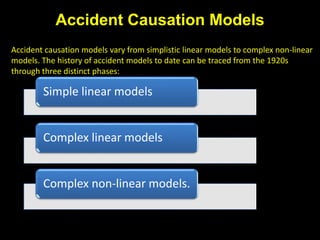
Accident causation models vary from simplistic linear models to complex non-linear
models. The history of accident models to date can be traced from the 1920s
through three distinct phases:
Simple linear models
Complex linear models
Complex non-linear models.
Simple sequential linear accident models:
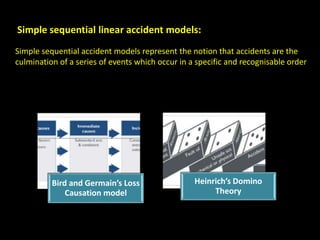
Simple sequential accident models represent the notion that accidents are the
culmination of a series of events which occur in a specific and recognisable order
Bird and Germain’s Loss
Causation model
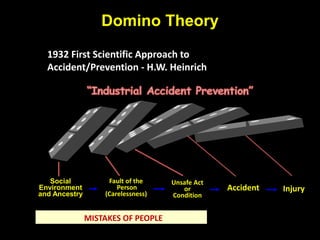
Heinrich’s Domino
Theory
Domino Theory
1932 First Scientific Approach to
Accident/Prevention - H.W. Heinrich
Social
Environment
and Ancestry
Fault of the
Person
(Carelessness)
Unsafe Act
or
Condition
Accident Injury
MISTAKES OF PEOPLE
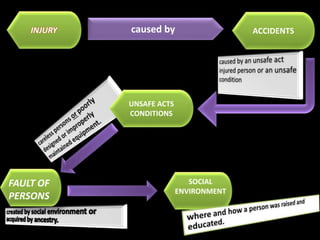
INJURY
UNSAFE ACTS
CONDITIONS
ACCIDENTScaused by
FAULT OF
PERSONS
SOCIAL
ENVIRONMENT
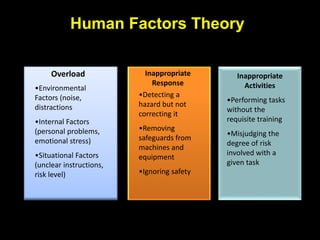
Human Factors Theory
Overload
•Environmental
Factors (noise,
distractions
•Internal Factors
(personal problems,
emotional stress)
•Situational Factors
(unclear instructions,
risk level)
Inappropriate
Response
•Detecting a
hazard but not
correcting it
•Removing
safeguards from
machines and
equipment
•Ignoring safety
Inappropriate
Activities
•Performing tasks
without the
requisite training
•Misjudging the
degree of risk
involved with a
given task
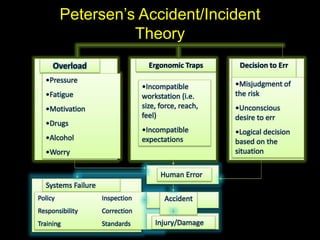
Petersen’s Accident/Incident
Theory
Overload
•Pressure
•Fatigue
•Motivation
•Drugs
•Alcohol
•Worry
Ergonomic Traps
•Incompatible
workstation (i.e.
size, force, reach,
feel)
•Incompatible
expectations
Decision to Err
•Misjudgment of
the risk
•Unconscious
desire to err
•Logical decision
based on the
situation
Systems Failure
Policy Inspection
Responsibility Correction
Training Standards
Human Error
Accident
Injury/Damage
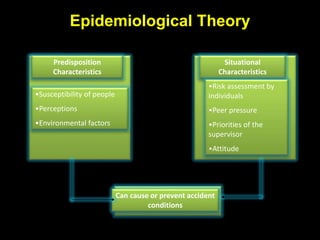
Epidemiological Theory
Predisposition
Characteristics
•Susceptibility of people
•Perceptions
•Environmental factors
Situational
Characteristics
•Risk assessment by
individuals
•Peer pressure
•Priorities of the
supervisor
•Attitude
Can cause or prevent accident
conditions
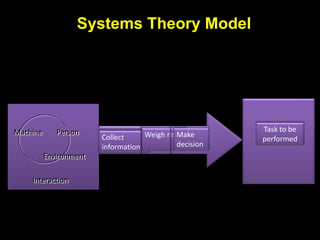
Systems Theory Model
Machine Person
Environment
Interaction
Collect
information
Weigh risksMake
decision
Task to be
performed
Combination Theory
• For some accidents, a given model may be very
accurate, for others less so
• Often the cause of an accident cannot be adequately
explained by just one model/theory
• Actual cause may combine parts of several different
models
Behavioral Theory
• Often referred to as behavior-based safety (BBS)
• 7 basic principles of BBS
– Intervention
– Identification of internal factors
– Motivation to behave in the desired manner
– Focus on the positive consequences of
appropriate behavior
– Application of the scientific method
– Integration of information
– Planned interventions
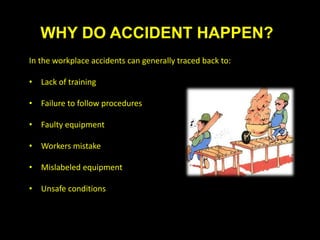
WHY DO ACCIDENT HAPPEN?
In the workplace accidents can generally traced back to:
• Lack of training
• Failure to follow procedures
• Faulty equipment
• Workers mistake
• Mislabeled equipment
• Unsafe conditions
COST OF ACCIDENT
Many managers believe that the broker will pick up the
costs of an misfortune, and that's why they pay their
insurance. Though the costs of an accident can be
cracked down into the direct cost and indirect (uninsured)
costs.
Direct costs of an accident
• Direct costs are those costs that are increased directly from the accident. They are quite easy
to analyze, and include the medical costs incurred and the reward payments made to the
injured workers. Direct costs are usually insurable by companies.
Indirect costs of an accident
• Indirect costs are the less clear costs of an accident that can be costed. Although the indirect
costs created by accidents are unseen, they too must be paid from incomes from the sale of
products. They are more difficult to estimate and tend not to be protected. Indirect costs
include:
• Time away from the work not covered by employees' compensation insurance.
• Payment of other staffs who are not damaged, for example those who stopped work to look
after or help the injured worker and those who require output from the injured in order to
complete their responsibilities.
• The cost of injury to materials or equipment involved in the accident;
ACCIDENT INVESTIGATION AND
THEIR ROLE IN SAFETY
MANAGEMENT
ACCIDENT INVESTIGATION
Is a process of systematic collection and analysis of
information relating to a accident that led to the loss of
property, time or health of individuals or even the loss
of lives.
WHY CONDUCT ACCIDENT
INVESTIGATION???
• To determine How and Why these accident occurred
• To reduce risks for employees
• To respond to the management needs
• To identify violations of company procedures
• To comply with workers’ compensation rules
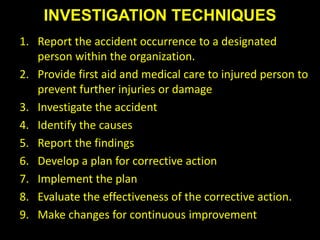
INVESTIGATION TECHNIQUES
1. Report the accident occurrence to a designated
person within the organization.
2. Provide first aid and medical care to injured person to
prevent further injuries or damage
3. Investigate the accident
4. Identify the causes
5. Report the findings
6. Develop a plan for corrective action
7. Implement the plan
8. Evaluate the effectiveness of the corrective action.
9. Make changes for continuous improvement
ROLES IN SAFETY MANAGEMENT
1. Supervisor
2. Line Manager
3. Safety officer
4. Staff Managers
5. Committee Investigations
Workers’ Compensation
Remedies available to the injured employees under
Employees’ Social Security Act 1969
SOCSO (Social Security Organizaition) or PERKESO
( Pertubuhan Keselamatan Social) under Ministry of
HR, establish January 1971 to administer and enforce
Employees’ Social Security Act 1969 and Employee
Social Security General Rules 1971.
Provide free medical treatment, facility for physical or vocational
rehabilitation and financial assistance to employees if they have lost
abilities due to accidents or diseases that have reduced their abilities to
work or rendered.
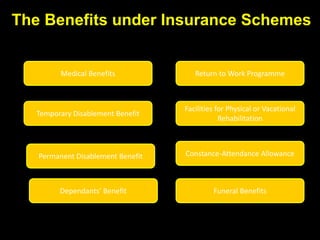
Benefits :
Medical benefits, temporary and permanent disablement benefit, constant
attendance allowance, dependant’s benefits, funeral benefit,
rehabilitation benefit, education, survivors’ pension, invalidity grant.
The General Principles of
Employees’ Social Security
• Solidarity Fund
• Replacement of Income
• Equality
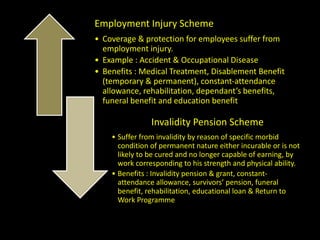
Employment Injury Scheme
• Coverage & protection for employees suffer from
employment injury.
• Example : Accident & Occupational Disease
• Benefits : Medical Treatment, Disablement Benefit
(temporary & permanent), constant-attendance
allowance, rehabilitation, dependant’s benefits,
funeral benefit and education benefit
Invalidity Pension Scheme
• Suffer from invalidity by reason of specific morbid
condition of permanent nature either incurable or is not
likely to be cured and no longer capable of earning, by
work corresponding to his strength and physical ability.
• Benefits : Invalidity pension & grant, constant-
attendance allowance, survivors’ pension, funeral
benefit, rehabilitation, educational loan & Return to
Work Programme
Medical Benefits
The Benefits under Insurance Schemes
Temporary Disablement Benefit
Permanent Disablement Benefit Constance-Attendance Allowance
Facilities for Physical or Vacational
Rehabilitation
Return to Work Programme
Dependants’ Benefit Funeral Benefits
CONCLUSION
• Accident can be triggered through several factor and mostly it has
been supported with theories.
• By identifying the direct cost and indirect cost, company can be more
aware of their financial budget in order to avoid company loss.
• Accident investigation can be effective when it is written in a standard
and clear guidelines and having a clear assigned of responsibilities in
conducting the investigation.
• Payment of benefits made to eligible employees or dependants under
the Employees’ Social Security Act 1969 and Employees’ Social
Security (General) Regulations 1971. This is to ensure that fairness and
equality to all employees are achieved to those that have contributed
to the solidarity fund.

Accident Causation

  • 1.
    ACCIDENT CAUSATION Presented by: Iliyas Najeem 820351 Nabila Ahmad Nasir 816558 Shaliza Samsudin 816231 Samer Jibrail 818636
  • 2.
    Introduction Accidents have beenbroadly defined as: An accident is an undesirable incidental and unplanned event that could have been prevented had circumstances leading up to the accident been recognized, and acted upon, prior to its occurrence. Most scientists who study unintentional injury avoid using the term "accident" and focus on factors that increase risk of severe injury and that reduce injury incidence and severity (Robertson, 2015).
  • 3.
    Accident Causation Models Accidentcausation models vary from simplistic linear models to complex non-linear models. The history of accident models to date can be traced from the 1920s through three distinct phases: Simple linear models Complex linear models Complex non-linear models.
  • 4.
    Simple sequential linearaccident models: Simple sequential accident models represent the notion that accidents are the culmination of a series of events which occur in a specific and recognisable order Bird and Germain’s Loss Causation model Heinrich’s Domino Theory
  • 5.
    Domino Theory 1932 FirstScientific Approach to Accident/Prevention - H.W. Heinrich Social Environment and Ancestry Fault of the Person (Carelessness) Unsafe Act or Condition Accident Injury MISTAKES OF PEOPLE
  • 6.
  • 8.
    Human Factors Theory Overload •Environmental Factors(noise, distractions •Internal Factors (personal problems, emotional stress) •Situational Factors (unclear instructions, risk level) Inappropriate Response •Detecting a hazard but not correcting it •Removing safeguards from machines and equipment •Ignoring safety Inappropriate Activities •Performing tasks without the requisite training •Misjudging the degree of risk involved with a given task
  • 9.
    Petersen’s Accident/Incident Theory Overload •Pressure •Fatigue •Motivation •Drugs •Alcohol •Worry Ergonomic Traps •Incompatible workstation(i.e. size, force, reach, feel) •Incompatible expectations Decision to Err •Misjudgment of the risk •Unconscious desire to err •Logical decision based on the situation Systems Failure Policy Inspection Responsibility Correction Training Standards Human Error Accident Injury/Damage
  • 10.
    Epidemiological Theory Predisposition Characteristics •Susceptibility ofpeople •Perceptions •Environmental factors Situational Characteristics •Risk assessment by individuals •Peer pressure •Priorities of the supervisor •Attitude Can cause or prevent accident conditions
  • 11.
    Systems Theory Model MachinePerson Environment Interaction Collect information Weigh risksMake decision Task to be performed
  • 12.
    Combination Theory • Forsome accidents, a given model may be very accurate, for others less so • Often the cause of an accident cannot be adequately explained by just one model/theory • Actual cause may combine parts of several different models
  • 13.
    Behavioral Theory • Oftenreferred to as behavior-based safety (BBS) • 7 basic principles of BBS – Intervention – Identification of internal factors – Motivation to behave in the desired manner – Focus on the positive consequences of appropriate behavior – Application of the scientific method – Integration of information – Planned interventions
  • 14.
    WHY DO ACCIDENTHAPPEN? In the workplace accidents can generally traced back to: • Lack of training • Failure to follow procedures • Faulty equipment • Workers mistake • Mislabeled equipment • Unsafe conditions
  • 16.
    COST OF ACCIDENT Manymanagers believe that the broker will pick up the costs of an misfortune, and that's why they pay their insurance. Though the costs of an accident can be cracked down into the direct cost and indirect (uninsured) costs.
  • 17.
    Direct costs ofan accident • Direct costs are those costs that are increased directly from the accident. They are quite easy to analyze, and include the medical costs incurred and the reward payments made to the injured workers. Direct costs are usually insurable by companies. Indirect costs of an accident • Indirect costs are the less clear costs of an accident that can be costed. Although the indirect costs created by accidents are unseen, they too must be paid from incomes from the sale of products. They are more difficult to estimate and tend not to be protected. Indirect costs include: • Time away from the work not covered by employees' compensation insurance. • Payment of other staffs who are not damaged, for example those who stopped work to look after or help the injured worker and those who require output from the injured in order to complete their responsibilities. • The cost of injury to materials or equipment involved in the accident;
  • 18.
    ACCIDENT INVESTIGATION AND THEIRROLE IN SAFETY MANAGEMENT
  • 19.
    ACCIDENT INVESTIGATION Is aprocess of systematic collection and analysis of information relating to a accident that led to the loss of property, time or health of individuals or even the loss of lives.
  • 20.
    WHY CONDUCT ACCIDENT INVESTIGATION??? •To determine How and Why these accident occurred • To reduce risks for employees • To respond to the management needs • To identify violations of company procedures • To comply with workers’ compensation rules
  • 21.
    INVESTIGATION TECHNIQUES 1. Reportthe accident occurrence to a designated person within the organization. 2. Provide first aid and medical care to injured person to prevent further injuries or damage 3. Investigate the accident 4. Identify the causes 5. Report the findings 6. Develop a plan for corrective action 7. Implement the plan 8. Evaluate the effectiveness of the corrective action. 9. Make changes for continuous improvement
  • 22.
    ROLES IN SAFETYMANAGEMENT 1. Supervisor 2. Line Manager 3. Safety officer 4. Staff Managers 5. Committee Investigations
  • 23.
    Workers’ Compensation Remedies availableto the injured employees under Employees’ Social Security Act 1969 SOCSO (Social Security Organizaition) or PERKESO ( Pertubuhan Keselamatan Social) under Ministry of HR, establish January 1971 to administer and enforce Employees’ Social Security Act 1969 and Employee Social Security General Rules 1971. Provide free medical treatment, facility for physical or vocational rehabilitation and financial assistance to employees if they have lost abilities due to accidents or diseases that have reduced their abilities to work or rendered. Benefits : Medical benefits, temporary and permanent disablement benefit, constant attendance allowance, dependant’s benefits, funeral benefit, rehabilitation benefit, education, survivors’ pension, invalidity grant.
  • 24.
    The General Principlesof Employees’ Social Security • Solidarity Fund • Replacement of Income • Equality
  • 25.
    Employment Injury Scheme •Coverage & protection for employees suffer from employment injury. • Example : Accident & Occupational Disease • Benefits : Medical Treatment, Disablement Benefit (temporary & permanent), constant-attendance allowance, rehabilitation, dependant’s benefits, funeral benefit and education benefit Invalidity Pension Scheme • Suffer from invalidity by reason of specific morbid condition of permanent nature either incurable or is not likely to be cured and no longer capable of earning, by work corresponding to his strength and physical ability. • Benefits : Invalidity pension & grant, constant- attendance allowance, survivors’ pension, funeral benefit, rehabilitation, educational loan & Return to Work Programme
  • 26.
    Medical Benefits The Benefitsunder Insurance Schemes Temporary Disablement Benefit Permanent Disablement Benefit Constance-Attendance Allowance Facilities for Physical or Vacational Rehabilitation Return to Work Programme Dependants’ Benefit Funeral Benefits
  • 27.
    CONCLUSION • Accident canbe triggered through several factor and mostly it has been supported with theories. • By identifying the direct cost and indirect cost, company can be more aware of their financial budget in order to avoid company loss. • Accident investigation can be effective when it is written in a standard and clear guidelines and having a clear assigned of responsibilities in conducting the investigation. • Payment of benefits made to eligible employees or dependants under the Employees’ Social Security Act 1969 and Employees’ Social Security (General) Regulations 1971. This is to ensure that fairness and equality to all employees are achieved to those that have contributed to the solidarity fund.

Editor's Notes

  • #24 Remedies available to the injured employees under Employees’ Social Security Act 1969 SOCSO (Social Security Organizaition) or PERKESO ( Pertubuhan Keselamatan Social) under Ministry of HR, establish January 1971 to administer and enforce Employees’ Social Security Act 1969 and Employee Social Security General Rules 1971. Provide free medical treatment, facility for physical or vacational rehabilitation and financial assistance to employees if they have lost abilities due to accidents or diseases that hav reduced their abilities to work or rendered.