
WT4603
Wood Processing Safety &
Practice
Lecture Unit 0
 WOOD DUST & RISK ASSESSMENT
 Lecturer: Mr. Joseph Lyster
 joseph.lyster@ul.ie
 Notes prepared by: Mr. Michael Brennan and Mr. Joseph Lyster
 Notes available on www.slideshare.net/WT4603
Department of Manufacturing & Operations Engineering
WT4603
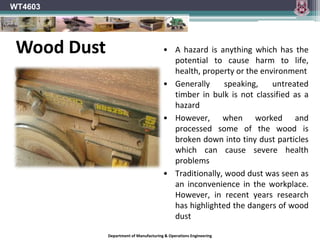
• A hazard is anything which has the
potential to cause harm to life,
health, property or the environment
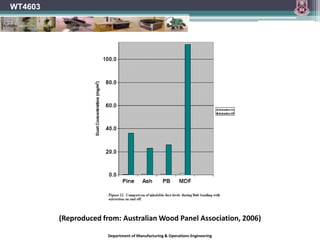
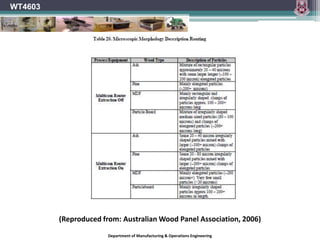
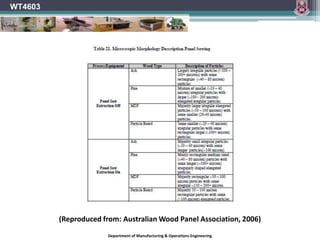
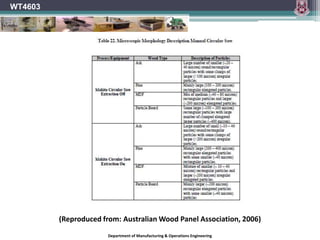
• Generally speaking, untreated
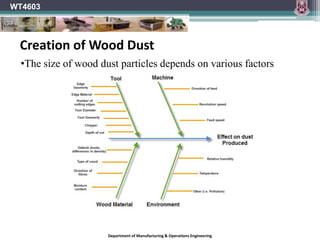
timber in bulk is not classified as a
hazard
• However, when worked and
processed some of the wood is
broken down into tiny dust particles
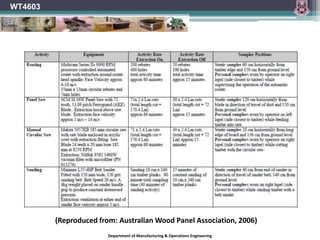
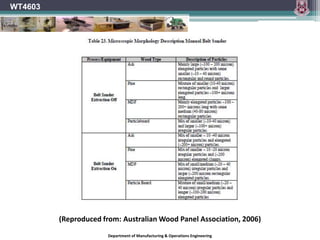
which can cause severe health
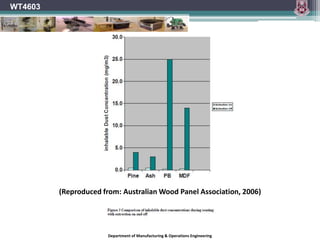
problems
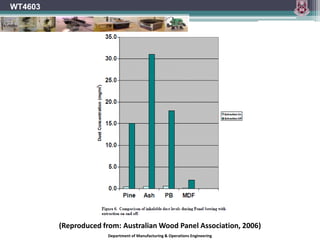
• Traditionally, wood dust was seen as
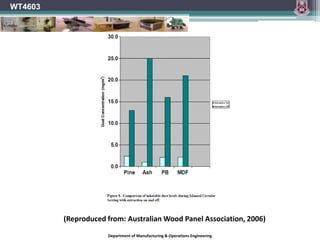
an inconvenience in the workplace.
However, in recent years research
has highlighted the dangers of wood
dust
Wood Dust
Department of Manufacturing & Operations Engineering
WT4603
• Research , such as that of Greenberg (2003) found that “workers exposed to dust in
occupations such as furniture making, sanding and wood machining may have an
increased risk of nasal and paranasal sinus cancer. Thus in 1994 the International
Agency for Research on Cancer designated wood dust as a known carcinogen”
• Hardwood and M.D.F. have been classified by the I.A.R.C. as a class 1 carcinogen
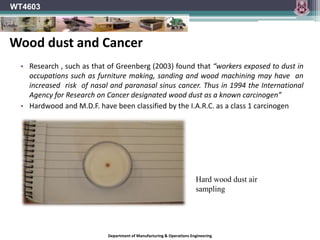
Hard wood dust air
sampling
Wood dust and Cancer
Department of Manufacturing & Operations Engineering
WT4603
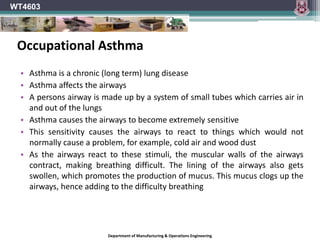
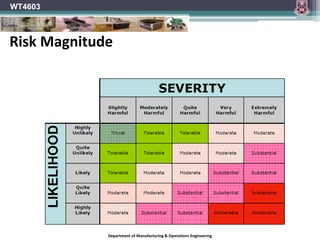
• Asthma is a chronic (long term) lung disease
• Asthma affects the airways
• A persons airway is made up by a system of small tubes which carries air in
and out of the lungs
• Asthma causes the airways to become extremely sensitive
• This sensitivity causes the airways to react to things which would not
normally cause a problem, for example, cold air and wood dust
• As the airways react to these stimuli, the muscular walls of the airways
contract, making breathing difficult. The lining of the airways also gets
swollen, which promotes the production of mucus. This mucus clogs up the
airways, hence adding to the difficulty breathing
Occupational Asthma
Department of Manufacturing & Operations Engineering
WT4603
• Tightening of the muscles around the airways (an asthma attack) can
happen very quickly and is the most likely cause of mild asthma
• Such an attack can be relived quickly using the correct inhaler. Swelling of
the mucus however takes much longer to treat and is particular dangerous
in a bad asthma attack
• The main symptoms of asthma include
 shortness of breath,
 tightening of the chest
 dyspnoea
 wheezing
 coughing.
• These symptoms may develop at any time in ones life and may be episodic
or persistent
Occupational Asthma
Department of Manufacturing & Operations Engineering
WT4603
•In accordance with the 1995 London Hazard Centre Fact Sheet on Wood
Based Boards, manufactured boards can be divided into three sub groups:
Laminated Boards
Particle Boards
Fibre Boards
•These boards consist of wood particles which may be glued or bonded
together by formaldehyde resin
•Formaldehyde is a strong irritant and sensitizer to humans and animals. The
two main routes of exposure are inhalation and dermal contact
Formaldehyde
Department of Manufacturing & Operations Engineering
WT4603
•The short term health effects of formaldehyde exposure include
“When formaldehyde is present in the air at levels exceeding 0.1 ppm, some
individuals may experience health effects such as watery eyes; burning
sensations of the eyes, nose, and throat; coughing; wheezing; nausea; and skin
irritation. Some people are very sensitive to formaldehyde, while others have
no reaction to the same level of exposure.” (www.cancer.gov)
•Although there is a lot of research and evidence on the short term health
effects of formaldehyde exposure, very little is known about the long term
health effects.
•Many carcinogenicity studies have been carried out, the most relevant being
the IARCs (International Agency for Research on Cancer) 2004
reclassification of formaldehyde as a known human carcinogen.
Formaldehyde
WT4603
Department of Manufacturing & Operations Engineering
•Isocyanates are chemical compounds. When they react with compounds
containing alcohol (Hydroxyl) they produce polyurethane polymers, which are
the basis of all polyurethane products, for example, polyurethane paint and glue
•In the woodwork room, Isocyanates are used as binders in manufactured
boards such as Orientated Strad Board (O.S.B.), Medium Density Fibre Board
(M.D.F.) and Particle Board
•Isocyanates are very suited for this role as being a urethane adhesive they have
very good bonding properties.
Isocyantes
WT4603
Department of Manufacturing & Operations Engineering
•Although very useful, Isocyantes can have ill effects on human health.
“Acute or chronic exposure to high concentrations of isocyanates can result
in respiroratry health effects through a direct irritant action”
(Davies, 1984)
•Isocyanates have been shown to cause occupational asthma through a
sensitising mechanism
•Subsequently, Isocyanates are now deemed to be the number one cause of
occupational asthma (Chun-Yeung and Malo, 1994)
Isocyantes
WT4603
Department of Manufacturing & Operations Engineering
•As with all occupational asthma triggers, asthma symptoms vary in
development
“Extended exposure to isocyanate vapour at barely measureable levels can
cause asthma or asthma like conditions in some individuals. Alternatively, a
single event involving a high exposure may have similar effects.”
(Steven et al, 1999)
•Once a person has become sensitised, the individual may develop asthma
like conditions after exposure to very low concentrations of isocyantes, even
less than the Occupational Exposure Limit (O.E.L.)
•In the Technology room, the main form of isocyanate exposure comes from
inhalation of dust from manufactured boards. Another potential route of
exposure is the use of polyurethane based paints and varnishes (evaporation
and sanding).
Isocyantes
WT4603
Department of Manufacturing & Operations Engineering
•Dust explosions are not a new phenomenon. Records such as those of the
British coal mines during the nineteenth century highlight the existence of
such incidents.
What exactly is a dust explosion?
“The phenomenon named dust explosion is in fact quite simple and easy to
envisage in terms of daily light exposure. Any solid material that can burn in
air will do so with a violence and speed that increases with increasing degree
of subdivision of the material”
(Eckhoff 2003, p.1)
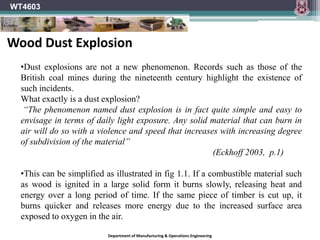
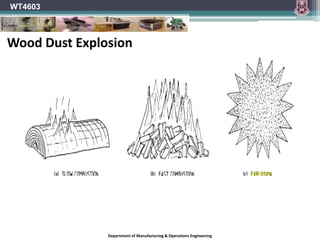
•This can be simplified as illustrated in fig 1.1. If a combustible material such
as wood is ignited in a large solid form it burns slowly, releasing heat and
energy over a long period of time. If the same piece of timber is cut up, it
burns quicker and releases more energy due to the increased surface area
exposed to oxygen in the air.
Wood Dust Explosion
WT4603
Department of Manufacturing & Operations Engineering
Wood Dust Explosion
WT4603
Department of Manufacturing & Operations Engineering
•The effects of a dust explosion can include death or serious injury to workers,
destruction of plant and building, a large fireball, secondary explosions and
fire. Dust explosions in wood dust extraction systems can be very catastrophic
as :
“When a dust cloud ignites in an enclosed volume it results in a very rapid rise
in pressure within the container. Typical peak pressures in laboratory
apparatus are in the range 8-10 bar. In normal circumstances the plant or
building will not be strong enough to withstand the pressure from the
explosion and it will fail in a sudden and uncontrolled manor. Anyone close to
exploding plant or inside a room where an explosion occurs is likely to be
killed or seriously injured
(Health And Safety Executive 2003)
Wood Dust Explosion
WT4603
Department of Manufacturing & Operations Engineering
•Processing wood results in the creation of airborne dust particles.
•These particles vary in size
•It is commonly acknowledged that there are two particle size
ranges which are of concern when studying Local Exhaust
Ventilation.
Respirable – Reach the depth of the lungs
Inhalable – Dust that can be breathed in but gets caught in
the nose, mouth and upper respiratory tract
Creation of Wood Dust
WT4603
Department of Manufacturing & Operations Engineering
•The size of wood dust particles depends on various factors
Creation of Wood Dust
WT4603
Department of Manufacturing & Operations Engineering
•Local exhaust ventilation (L.E.V.) is the most common method of removing
potential airborne wood particles from a class room
•L.E.V. involves having an extraction unit located in close proximity of a dust
source (i.e., a machine), which, in turn, draws the dust away before it becomes
airborne
•Although it is almost impossible to have complete dust extraction, extraction
systems are of vital importance as they control dust levels to within the
occupational exposure limit
•There are two different types of L.E.V. which are used in Irish post primary
schools and are specifically highlighted in circular letter M45/01. They are (a)
Local system and (b) Centralised system
L.E.V
Department of Manufacturing & Operations Engineering
WT4603
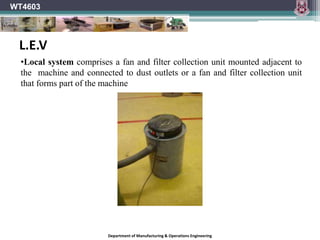
•Local system comprises a fan and filter collection unit mounted adjacent to
the machine and connected to dust outlets or a fan and filter collection unit
that forms part of the machine
L.E.V
Department of Manufacturing & Operations Engineering
WT4603
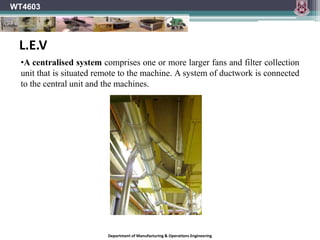
•A centralised system comprises one or more larger fans and filter collection
unit that is situated remote to the machine. A system of ductwork is connected
to the central unit and the machines.
L.E.V
Department of Manufacturing & Operations Engineering
WT4603
• An Occupational Exposure Limits (O.E.L.) is the concentration
of a hazardous substance in the workplace air which most
people can be exposed to without any negative effects.
• The Occupational Exposure Limit for wood dust is laid down in
the Health, Safety and Welfare (Chemical Agents)
Regulations, 2001
 10mg/m³ for inhalable dust
 5mg/m³ for respirable dust
 Circular letter M45/01
 D.E.S. Incentive for the provision of wood dust extraction
systems in Irish second level schools
Occupational Exposure Limits
Department of Manufacturing & Operations Engineering
WT4603
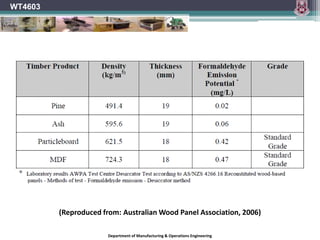
(Reproduced from: Australian Wood Panel Association, 2006)
Department of Manufacturing & Operations Engineering
WT4603
(Reproduced from: Australian Wood Panel Association, 2006)
Department of Manufacturing & Operations Engineering
WT4603
(Reproduced from: Australian Wood Panel Association, 2006)
Department of Manufacturing & Operations Engineering
WT4603
(Reproduced from: Australian Wood Panel Association, 2006)
Department of Manufacturing & Operations Engineering
WT4603
(Reproduced from: Australian Wood Panel Association, 2006)
Department of Manufacturing & Operations Engineering
WT4603
(Reproduced from: Australian Wood Panel Association, 2006)
Department of Manufacturing & Operations Engineering
WT4603
(Reproduced from: Australian Wood Panel Association, 2006)
Department of Manufacturing & Operations Engineering
WT4603
(Reproduced from: Australian Wood Panel Association, 2006)
Department of Manufacturing & Operations Engineering
WT4603
(Reproduced from: Australian Wood Panel Association, 2006)
Department of Manufacturing & Operations Engineering
WT4603
(Reproduced from: Australian Wood Panel Association, 2006)
Department of Manufacturing & Operations Engineering
WT4603
Introduction: (Page 1 – side 1)
i. Outline the purpose of this booklet
ii. Outline the sections to be contained
iii. Outline the machines to be assessed
Risk Assessment
Department of Manufacturing & Operations Engineering
WT4603
Nature of Environment: (Page 1 – side 1)
i. Outline location (Main work shop SR2-047)
ii. Outline who uses the environment
iii. Outline activities carried out in the environment
Risk Assessment
Department of Manufacturing & Operations Engineering
WT4603
Health & Safety: (Page 1 – side 2)
i. Outline risk assessment as in HSA act 2005
ii. Outline risk assessment as in BS4163
iii. Both articles are quoted in Unit 1 and Unit 2 lecture notes
Risk Assessment
Department of Manufacturing & Operations Engineering
WT4603
Machine Provision: (Page 2 – side 1)
i. Simple floor plan sketch of the workshop and the position of each machine
to be assessed
ii. Note safe paths marked out on workshop floor
iii. Also note main power control and isolator positions
iv. Note that machines are CE marked
Risk Assessment
Department of Manufacturing & Operations Engineering
WT4603
Hazards, Risks and Risk Control Measures (Page 2
– side 2)
i. Define a hazard (Give an example)
ii. Define a risk (Give an example)
iii. Define a risk control measure (Give an example)
Risk Assessment
Department of Manufacturing & Operations Engineering
WT4603
Risk Assessment Procedure (Page 2 – side 2)
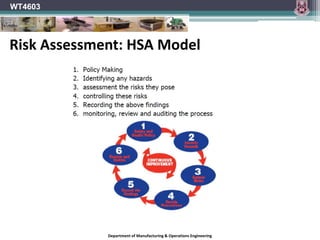
i. Show HSA cyclical model (Briefly explain each part of model)
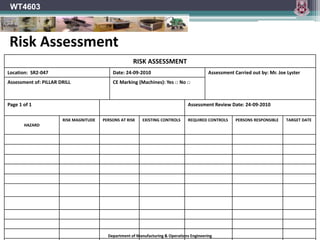
ii. Risk Assessment (Show a blank risk assessment matrix template – explain
parts)
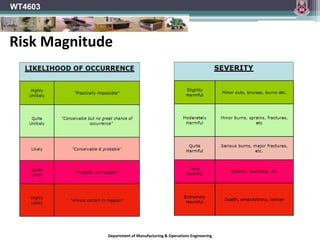
iii. Risk Magnitude (Show a blank risk magnitude matrix template – explain
parts)
Risk Assessment
Department of Manufacturing & Operations Engineering
WT4603
Workshop Health & Safety Management (Page 3
– Side 1)
i. Note any regulations, conditions of work etc… posted on the walls.
ii. Outline the different types of safety signage in the workshop (Show images)
Risk Assessment
Department of Manufacturing & Operations Engineering
WT4603
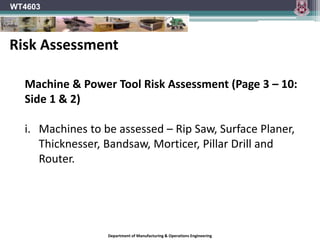
Machine & Power Tool Risk Assessment (Page 3 – 10:
Side 1 & 2)
i. Machines to be assessed – Rip Saw, Surface Planer,
Thicknesser, Bandsaw, Morticer, Pillar Drill and
Router.
Risk Assessment
Department of Manufacturing & Operations Engineering
WT4603
i. Machine
a. Describe Machine purpose
b. Max of 2-3 labelled images
c. List Existing Hazards/Control Measures (Use a table – 2 columns x
No. of rows)
d. Risk Magnitude matrix for each Hazard Identified (Can vary
depending on Machine)
e. Complete Risk Assessment matrix table outlining all information
Risk Assessment
Department of Manufacturing & Operations Engineering
WT4603
Risk Assessment: HSA Model
Department of Manufacturing & Operations Engineering
WT4603
Risk Magnitude
Department of Manufacturing & Operations Engineering
WT4603
Risk Magnitude
Department of Manufacturing & Operations Engineering
WT4603
RISK ASSESSMENT
Location: SR2-047 Date: 24-09-2010 Assessment Carried out by: Mr. Joe Lyster
Assessment of: PILLAR DRILL CE Marking (Machines): Yes □ No □
Page 1 of 1 Assessment Review Date: 24-09-2010
HAZARD
RISK MAGNITUDE PERSONS AT RISK EXISTING CONTROLS REQUIRED CONTROLS PERSONS RESPONSIBLE TARGET DATE
Risk Assessment
Department of Manufacturing & Operations Engineering
WT4603
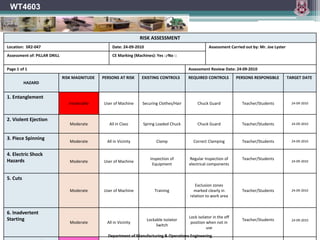
RISK ASSESSMENT
Location: SR2-047 Date: 24-09-2010 Assessment Carried out by: Mr. Joe Lyster
Assessment of: PILLAR DRILL CE Marking (Machines): Yes □̷ No □
Page 1 of 1 Assessment Review Date: 24-09-2010
HAZARD
RISK MAGNITUDE PERSONS AT RISK EXISTING CONTROLS REQUIRED CONTROLS PERSONS RESPONSIBLE TARGET DATE
1. Entanglement
Intolerable User of Machine Securing Clothes/Hair Chuck Guard Teacher/Students 24-09-2010
2. Violent Ejection
Moderate All in Class Spring Loaded Chuck Chuck Guard Teacher/Students 24-09-2010
3. Piece Spinning
Moderate All in Vicinity Clamp Correct Clamping Teacher/Students 24-09-2010
4. Electric Shock
Hazards Moderate User of Machine
Inspection of
Equipment
Regular Inspection of
electrical components
Teacher/Students
24-09-2010
5. Cuts
Moderate User of Machine Training
Exclusion zones
marked clearly in
relation to work area
Teacher/Students 24-09-2010
6. Inadvertent
Starting
Moderate All in Vicinity
Lockable Isolator
Switch
Lock isolator in the off
position when not in
use
Teacher/Students 24-09-2010
Department of Manufacturing & Operations Engineering
WT4603
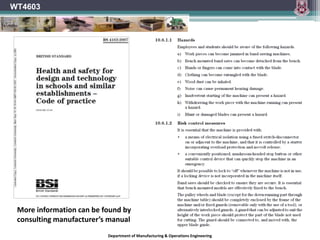
More information can be found by
consulting manufacturer’s manual
Department of Manufacturing & Operations Engineering
WT4603
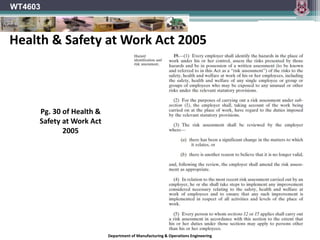
Health & Safety at Work Act 2005
Pg. 30 of Health &
Safety at Work Act
2005
Department of Manufacturing & Operations Engineering
WT4603
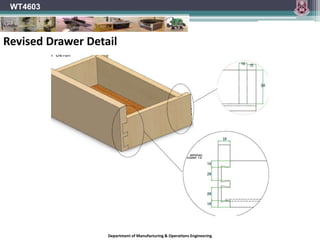
Revised Drawer Detail
Department of Manufacturing & Operations Engineering
WT4603
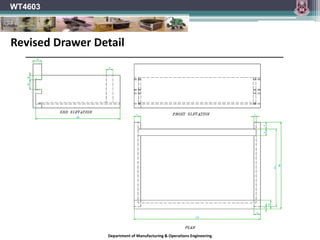
Revised Drawer Detail
Department of Manufacturing & Operations Engineering
WT4603
End of Semester Exam
INSTRUCTIONS TO CANDIDATES:
Students MUST answer TWO questions from
SECTION A (2 x 25 Marks)
AND
Students MUST answer ANY 10 questions from
SECTION B (10 x 5 Marks)
NOTE FOR SECTION A:
LM094 – (Materials & Architectural Technology) must
answer question 1 in Section A and may not answer
question 2
LM067 – (Wood Science & Technology) must answer
question 2 in Section A and may not answer question 1
Department of Manufacturing & Operations Engineering
WT4603
Next Week:
The Lathe

Wt4603 unit8 week9

  • 1.
    WT4603 Wood Processing Safety& Practice Lecture Unit 0  WOOD DUST & RISK ASSESSMENT  Lecturer: Mr. Joseph Lyster  joseph.lyster@ul.ie  Notes prepared by: Mr. Michael Brennan and Mr. Joseph Lyster  Notes available on www.slideshare.net/WT4603
  • 2.
    Department of Manufacturing& Operations Engineering WT4603 • A hazard is anything which has the potential to cause harm to life, health, property or the environment • Generally speaking, untreated timber in bulk is not classified as a hazard • However, when worked and processed some of the wood is broken down into tiny dust particles which can cause severe health problems • Traditionally, wood dust was seen as an inconvenience in the workplace. However, in recent years research has highlighted the dangers of wood dust Wood Dust
  • 3.
    Department of Manufacturing& Operations Engineering WT4603 • Research , such as that of Greenberg (2003) found that “workers exposed to dust in occupations such as furniture making, sanding and wood machining may have an increased risk of nasal and paranasal sinus cancer. Thus in 1994 the International Agency for Research on Cancer designated wood dust as a known carcinogen” • Hardwood and M.D.F. have been classified by the I.A.R.C. as a class 1 carcinogen Hard wood dust air sampling Wood dust and Cancer
  • 4.
    Department of Manufacturing& Operations Engineering WT4603 • Asthma is a chronic (long term) lung disease • Asthma affects the airways • A persons airway is made up by a system of small tubes which carries air in and out of the lungs • Asthma causes the airways to become extremely sensitive • This sensitivity causes the airways to react to things which would not normally cause a problem, for example, cold air and wood dust • As the airways react to these stimuli, the muscular walls of the airways contract, making breathing difficult. The lining of the airways also gets swollen, which promotes the production of mucus. This mucus clogs up the airways, hence adding to the difficulty breathing Occupational Asthma
  • 5.
    Department of Manufacturing& Operations Engineering WT4603 • Tightening of the muscles around the airways (an asthma attack) can happen very quickly and is the most likely cause of mild asthma • Such an attack can be relived quickly using the correct inhaler. Swelling of the mucus however takes much longer to treat and is particular dangerous in a bad asthma attack • The main symptoms of asthma include  shortness of breath,  tightening of the chest  dyspnoea  wheezing  coughing. • These symptoms may develop at any time in ones life and may be episodic or persistent Occupational Asthma
  • 6.
    Department of Manufacturing& Operations Engineering WT4603 •In accordance with the 1995 London Hazard Centre Fact Sheet on Wood Based Boards, manufactured boards can be divided into three sub groups: Laminated Boards Particle Boards Fibre Boards •These boards consist of wood particles which may be glued or bonded together by formaldehyde resin •Formaldehyde is a strong irritant and sensitizer to humans and animals. The two main routes of exposure are inhalation and dermal contact Formaldehyde
  • 7.
    Department of Manufacturing& Operations Engineering WT4603 •The short term health effects of formaldehyde exposure include “When formaldehyde is present in the air at levels exceeding 0.1 ppm, some individuals may experience health effects such as watery eyes; burning sensations of the eyes, nose, and throat; coughing; wheezing; nausea; and skin irritation. Some people are very sensitive to formaldehyde, while others have no reaction to the same level of exposure.” (www.cancer.gov) •Although there is a lot of research and evidence on the short term health effects of formaldehyde exposure, very little is known about the long term health effects. •Many carcinogenicity studies have been carried out, the most relevant being the IARCs (International Agency for Research on Cancer) 2004 reclassification of formaldehyde as a known human carcinogen. Formaldehyde
  • 8.
    WT4603 Department of Manufacturing& Operations Engineering •Isocyanates are chemical compounds. When they react with compounds containing alcohol (Hydroxyl) they produce polyurethane polymers, which are the basis of all polyurethane products, for example, polyurethane paint and glue •In the woodwork room, Isocyanates are used as binders in manufactured boards such as Orientated Strad Board (O.S.B.), Medium Density Fibre Board (M.D.F.) and Particle Board •Isocyanates are very suited for this role as being a urethane adhesive they have very good bonding properties. Isocyantes
  • 9.
    WT4603 Department of Manufacturing& Operations Engineering •Although very useful, Isocyantes can have ill effects on human health. “Acute or chronic exposure to high concentrations of isocyanates can result in respiroratry health effects through a direct irritant action” (Davies, 1984) •Isocyanates have been shown to cause occupational asthma through a sensitising mechanism •Subsequently, Isocyanates are now deemed to be the number one cause of occupational asthma (Chun-Yeung and Malo, 1994) Isocyantes
  • 10.
    WT4603 Department of Manufacturing& Operations Engineering •As with all occupational asthma triggers, asthma symptoms vary in development “Extended exposure to isocyanate vapour at barely measureable levels can cause asthma or asthma like conditions in some individuals. Alternatively, a single event involving a high exposure may have similar effects.” (Steven et al, 1999) •Once a person has become sensitised, the individual may develop asthma like conditions after exposure to very low concentrations of isocyantes, even less than the Occupational Exposure Limit (O.E.L.) •In the Technology room, the main form of isocyanate exposure comes from inhalation of dust from manufactured boards. Another potential route of exposure is the use of polyurethane based paints and varnishes (evaporation and sanding). Isocyantes
  • 11.
    WT4603 Department of Manufacturing& Operations Engineering •Dust explosions are not a new phenomenon. Records such as those of the British coal mines during the nineteenth century highlight the existence of such incidents. What exactly is a dust explosion? “The phenomenon named dust explosion is in fact quite simple and easy to envisage in terms of daily light exposure. Any solid material that can burn in air will do so with a violence and speed that increases with increasing degree of subdivision of the material” (Eckhoff 2003, p.1) •This can be simplified as illustrated in fig 1.1. If a combustible material such as wood is ignited in a large solid form it burns slowly, releasing heat and energy over a long period of time. If the same piece of timber is cut up, it burns quicker and releases more energy due to the increased surface area exposed to oxygen in the air. Wood Dust Explosion
  • 12.
    WT4603 Department of Manufacturing& Operations Engineering Wood Dust Explosion
  • 13.
    WT4603 Department of Manufacturing& Operations Engineering •The effects of a dust explosion can include death or serious injury to workers, destruction of plant and building, a large fireball, secondary explosions and fire. Dust explosions in wood dust extraction systems can be very catastrophic as : “When a dust cloud ignites in an enclosed volume it results in a very rapid rise in pressure within the container. Typical peak pressures in laboratory apparatus are in the range 8-10 bar. In normal circumstances the plant or building will not be strong enough to withstand the pressure from the explosion and it will fail in a sudden and uncontrolled manor. Anyone close to exploding plant or inside a room where an explosion occurs is likely to be killed or seriously injured (Health And Safety Executive 2003) Wood Dust Explosion
  • 14.
    WT4603 Department of Manufacturing& Operations Engineering •Processing wood results in the creation of airborne dust particles. •These particles vary in size •It is commonly acknowledged that there are two particle size ranges which are of concern when studying Local Exhaust Ventilation. Respirable – Reach the depth of the lungs Inhalable – Dust that can be breathed in but gets caught in the nose, mouth and upper respiratory tract Creation of Wood Dust
  • 15.
    WT4603 Department of Manufacturing& Operations Engineering •The size of wood dust particles depends on various factors Creation of Wood Dust
  • 16.
    WT4603 Department of Manufacturing& Operations Engineering •Local exhaust ventilation (L.E.V.) is the most common method of removing potential airborne wood particles from a class room •L.E.V. involves having an extraction unit located in close proximity of a dust source (i.e., a machine), which, in turn, draws the dust away before it becomes airborne •Although it is almost impossible to have complete dust extraction, extraction systems are of vital importance as they control dust levels to within the occupational exposure limit •There are two different types of L.E.V. which are used in Irish post primary schools and are specifically highlighted in circular letter M45/01. They are (a) Local system and (b) Centralised system L.E.V
  • 17.
    Department of Manufacturing& Operations Engineering WT4603 •Local system comprises a fan and filter collection unit mounted adjacent to the machine and connected to dust outlets or a fan and filter collection unit that forms part of the machine L.E.V
  • 18.
    Department of Manufacturing& Operations Engineering WT4603 •A centralised system comprises one or more larger fans and filter collection unit that is situated remote to the machine. A system of ductwork is connected to the central unit and the machines. L.E.V
  • 19.
    Department of Manufacturing& Operations Engineering WT4603 • An Occupational Exposure Limits (O.E.L.) is the concentration of a hazardous substance in the workplace air which most people can be exposed to without any negative effects. • The Occupational Exposure Limit for wood dust is laid down in the Health, Safety and Welfare (Chemical Agents) Regulations, 2001  10mg/m³ for inhalable dust  5mg/m³ for respirable dust  Circular letter M45/01  D.E.S. Incentive for the provision of wood dust extraction systems in Irish second level schools Occupational Exposure Limits
  • 20.
    Department of Manufacturing& Operations Engineering WT4603 (Reproduced from: Australian Wood Panel Association, 2006)
  • 21.
    Department of Manufacturing& Operations Engineering WT4603 (Reproduced from: Australian Wood Panel Association, 2006)
  • 22.
    Department of Manufacturing& Operations Engineering WT4603 (Reproduced from: Australian Wood Panel Association, 2006)
  • 23.
    Department of Manufacturing& Operations Engineering WT4603 (Reproduced from: Australian Wood Panel Association, 2006)
  • 24.
    Department of Manufacturing& Operations Engineering WT4603 (Reproduced from: Australian Wood Panel Association, 2006)
  • 25.
    Department of Manufacturing& Operations Engineering WT4603 (Reproduced from: Australian Wood Panel Association, 2006)
  • 26.
    Department of Manufacturing& Operations Engineering WT4603 (Reproduced from: Australian Wood Panel Association, 2006)
  • 27.
    Department of Manufacturing& Operations Engineering WT4603 (Reproduced from: Australian Wood Panel Association, 2006)
  • 28.
    Department of Manufacturing& Operations Engineering WT4603 (Reproduced from: Australian Wood Panel Association, 2006)
  • 29.
    Department of Manufacturing& Operations Engineering WT4603 (Reproduced from: Australian Wood Panel Association, 2006)
  • 30.
    Department of Manufacturing& Operations Engineering WT4603 Introduction: (Page 1 – side 1) i. Outline the purpose of this booklet ii. Outline the sections to be contained iii. Outline the machines to be assessed Risk Assessment
  • 31.
    Department of Manufacturing& Operations Engineering WT4603 Nature of Environment: (Page 1 – side 1) i. Outline location (Main work shop SR2-047) ii. Outline who uses the environment iii. Outline activities carried out in the environment Risk Assessment
  • 32.
    Department of Manufacturing& Operations Engineering WT4603 Health & Safety: (Page 1 – side 2) i. Outline risk assessment as in HSA act 2005 ii. Outline risk assessment as in BS4163 iii. Both articles are quoted in Unit 1 and Unit 2 lecture notes Risk Assessment
  • 33.
    Department of Manufacturing& Operations Engineering WT4603 Machine Provision: (Page 2 – side 1) i. Simple floor plan sketch of the workshop and the position of each machine to be assessed ii. Note safe paths marked out on workshop floor iii. Also note main power control and isolator positions iv. Note that machines are CE marked Risk Assessment
  • 34.
    Department of Manufacturing& Operations Engineering WT4603 Hazards, Risks and Risk Control Measures (Page 2 – side 2) i. Define a hazard (Give an example) ii. Define a risk (Give an example) iii. Define a risk control measure (Give an example) Risk Assessment
  • 35.
    Department of Manufacturing& Operations Engineering WT4603 Risk Assessment Procedure (Page 2 – side 2) i. Show HSA cyclical model (Briefly explain each part of model) ii. Risk Assessment (Show a blank risk assessment matrix template – explain parts) iii. Risk Magnitude (Show a blank risk magnitude matrix template – explain parts) Risk Assessment
  • 36.
    Department of Manufacturing& Operations Engineering WT4603 Workshop Health & Safety Management (Page 3 – Side 1) i. Note any regulations, conditions of work etc… posted on the walls. ii. Outline the different types of safety signage in the workshop (Show images) Risk Assessment
  • 37.
    Department of Manufacturing& Operations Engineering WT4603 Machine & Power Tool Risk Assessment (Page 3 – 10: Side 1 & 2) i. Machines to be assessed – Rip Saw, Surface Planer, Thicknesser, Bandsaw, Morticer, Pillar Drill and Router. Risk Assessment
  • 38.
    Department of Manufacturing& Operations Engineering WT4603 i. Machine a. Describe Machine purpose b. Max of 2-3 labelled images c. List Existing Hazards/Control Measures (Use a table – 2 columns x No. of rows) d. Risk Magnitude matrix for each Hazard Identified (Can vary depending on Machine) e. Complete Risk Assessment matrix table outlining all information Risk Assessment
  • 39.
    Department of Manufacturing& Operations Engineering WT4603 Risk Assessment: HSA Model
  • 40.
    Department of Manufacturing& Operations Engineering WT4603 Risk Magnitude
  • 41.
    Department of Manufacturing& Operations Engineering WT4603 Risk Magnitude
  • 42.
    Department of Manufacturing& Operations Engineering WT4603 RISK ASSESSMENT Location: SR2-047 Date: 24-09-2010 Assessment Carried out by: Mr. Joe Lyster Assessment of: PILLAR DRILL CE Marking (Machines): Yes □ No □ Page 1 of 1 Assessment Review Date: 24-09-2010 HAZARD RISK MAGNITUDE PERSONS AT RISK EXISTING CONTROLS REQUIRED CONTROLS PERSONS RESPONSIBLE TARGET DATE Risk Assessment
  • 43.
    Department of Manufacturing& Operations Engineering WT4603 RISK ASSESSMENT Location: SR2-047 Date: 24-09-2010 Assessment Carried out by: Mr. Joe Lyster Assessment of: PILLAR DRILL CE Marking (Machines): Yes □̷ No □ Page 1 of 1 Assessment Review Date: 24-09-2010 HAZARD RISK MAGNITUDE PERSONS AT RISK EXISTING CONTROLS REQUIRED CONTROLS PERSONS RESPONSIBLE TARGET DATE 1. Entanglement Intolerable User of Machine Securing Clothes/Hair Chuck Guard Teacher/Students 24-09-2010 2. Violent Ejection Moderate All in Class Spring Loaded Chuck Chuck Guard Teacher/Students 24-09-2010 3. Piece Spinning Moderate All in Vicinity Clamp Correct Clamping Teacher/Students 24-09-2010 4. Electric Shock Hazards Moderate User of Machine Inspection of Equipment Regular Inspection of electrical components Teacher/Students 24-09-2010 5. Cuts Moderate User of Machine Training Exclusion zones marked clearly in relation to work area Teacher/Students 24-09-2010 6. Inadvertent Starting Moderate All in Vicinity Lockable Isolator Switch Lock isolator in the off position when not in use Teacher/Students 24-09-2010
  • 44.
    Department of Manufacturing& Operations Engineering WT4603 More information can be found by consulting manufacturer’s manual
  • 45.
    Department of Manufacturing& Operations Engineering WT4603 Health & Safety at Work Act 2005 Pg. 30 of Health & Safety at Work Act 2005
  • 46.
    Department of Manufacturing& Operations Engineering WT4603 Revised Drawer Detail
  • 47.
    Department of Manufacturing& Operations Engineering WT4603 Revised Drawer Detail
  • 48.
    Department of Manufacturing& Operations Engineering WT4603 End of Semester Exam INSTRUCTIONS TO CANDIDATES: Students MUST answer TWO questions from SECTION A (2 x 25 Marks) AND Students MUST answer ANY 10 questions from SECTION B (10 x 5 Marks) NOTE FOR SECTION A: LM094 – (Materials & Architectural Technology) must answer question 1 in Section A and may not answer question 2 LM067 – (Wood Science & Technology) must answer question 2 in Section A and may not answer question 1
  • 49.
    Department of Manufacturing& Operations Engineering WT4603 Next Week: The Lathe