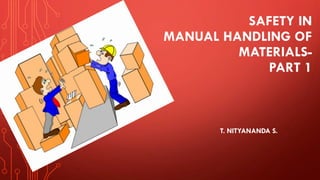
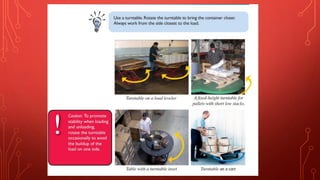
SAFETY IN
MANUAL HANDLING OF
MATERIALS-
PART 1
T. NITYANANDA S.
MANUAL MATERIAL HANDLING
ACTIVITY
•PULLING - PUSHING - LIFTING -
LOWERING
•CARRYING - FEEDING MATERIAL TO MACHINE
•COLLECTING FROM MACHINE
•STACKING – LOADING
•PLACING - MIXING - PUTTING OBJECTS –
THROWING
•MANUAL HANDLING IN MECHANICAL MATERIAL
HANDLING.
• PUTTING CHAIN AROUND A JOB TO BE LIFTED
• PREPARING A HITCH
• FITTING A EYE BOLT
• FITTIG A D-SHAKLE
• PUTTING A CHAIN OR ROPE ON CRANK HOOK
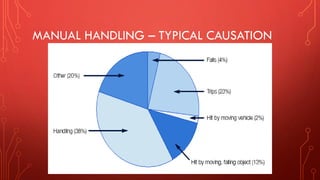
MANUAL HANDLING – TYPICAL CAUSATION
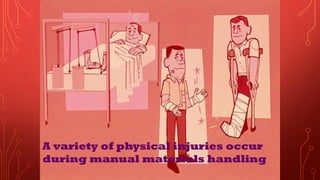
A variety of physical injuries occur
during manual materials handling
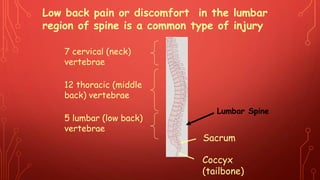
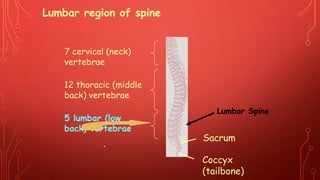
7 cervical (neck)
vertebrae
12 thoracic (middle
back) vertebrae
5 lumbar (low back)
vertebrae
Coccyx
(tailbone)
Low back pain or discomfort in the lumbar
region of spine is a common type of injury
Sacrum
Lumbar Spine
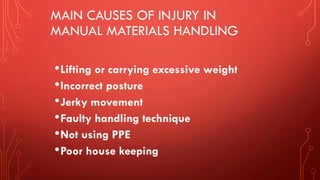
MAIN CAUSES OF INJURY IN
MANUAL MATERIALS HANDLING
•Lifting or carrying excessive weight
•Incorrect posture
•Jerky movement
•Faulty handling technique
•Not using PPE
•Poor house keeping
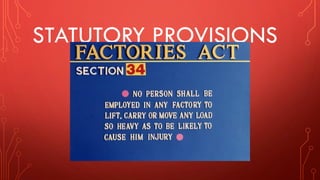
STATUTORY PROVISIONS
STATUTORY
PROVISIONS…
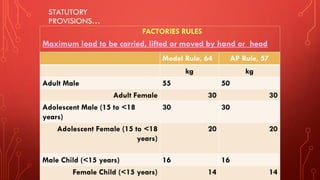
FACTORIES RULES
Maximum load to be carried, lifted or moved by hand or head
Model Rule, 64 AP Rule, 57
kg kg
Adult Male 55 50
Adult Female 30 30
Adolescent Male (15 to <18
years)
30 30
Adolescent Female (15 to <18
years)
20 20
Male Child (<15 years) 16 16
Female Child (<15 years) 14 14
LOAD ON ONE HAND CAUSES STRAIN
• Lifting & carrying a heavy
load by one hand [even if
this is within statutory limit
referred earlier] may result
in undue strain
• Distributing the load
wherever possible to two
hands is safer [eg., two
bags of 15 kg instead of
one of 30 kg]
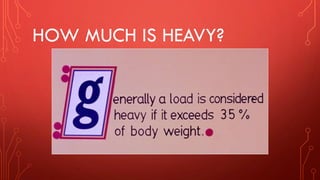
HOW MUCH IS HEAVY?
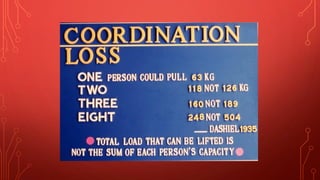
CAN MORE THAN ONE PERSON
SHARE THE LOAD EQUALLY?
No ! ……… because of
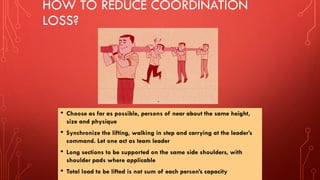
HOW TO REDUCE COORDINATION
LOSS?
• Choose as far as possible, persons of near about the same height,
size and physique
• Synchronize the lifting, walking in step and carrying at the leader’s
command. Let one act as team leader
• Long sections to be supported on the same side shoulders, with
shoulder pads where applicable
• Total load to be lifted is not sum of each person’s capacity
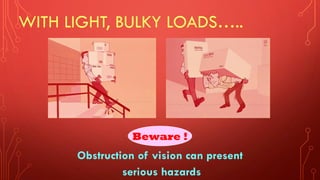
WITH LIGHT, BULKY LOADS…..
Obstruction of vision can present
serious hazards
Beware !
POSTURE
• Apart from the weight of
the load, body posture for
lifting the load is crucial
• Low back pains even when
lifting up a child were
reported
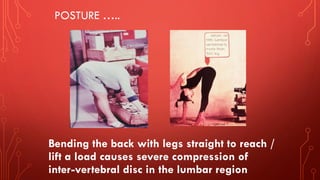
POSTURE …..
Bending the back with legs straight to reach /
lift a load causes severe compression of
inter-vertebral disc in the lumbar region
7 cervical (neck)
vertebrae
12 thoracic (middle
back) vertebrae
5 lumbar (low
back) vertebrae
Coccyx
(tailbone)
Lumbar region of spine
Sacrum
Lumbar Spine
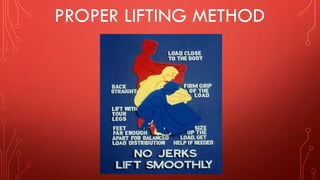
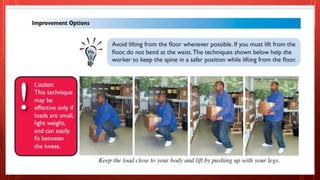
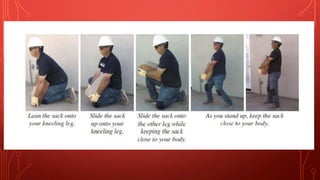
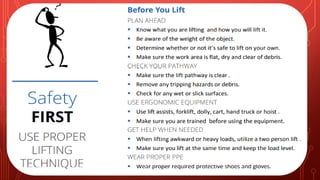
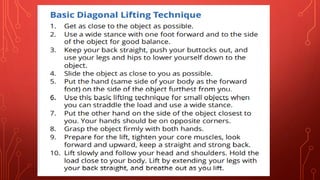
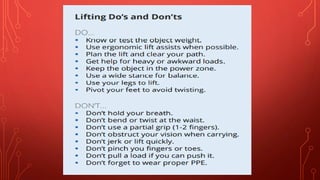
PROPER LIFTING METHOD
LET US SEE ILLUSTRATIONS OF
THE ELEMENTS OF PROPER
LIFTING METHOD
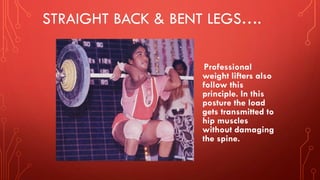
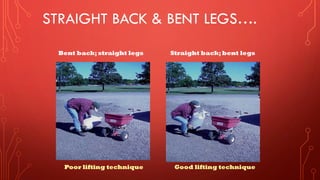
STRAIGHT BACK & BENT LEGS
STRAIGHT BACK & BENT LEGS….
Professional
weight lifters also
follow this
principle. In this
posture the load
gets transmitted to
hip muscles
without damaging
the spine.
STRAIGHT BACK & BENT LEGS….
Poor lifting technique Good lifting technique
Bent back; straight legs Straight back; bent legs
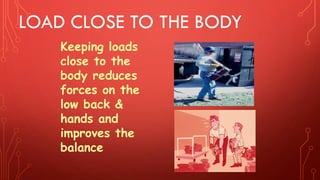
Keeping loads
close to the
body reduces
forces on the
low back &
hands and
improves the
balance
LOAD CLOSE TO THE BODY
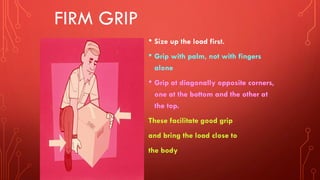
FIRM GRIP
• Size up the load first.
• Grip with palm, not with fingers
alone
• Grip at diagonally opposite corners,
one at the bottom and the other at
the top.
These facilitate good grip
and bring the load close to
the body
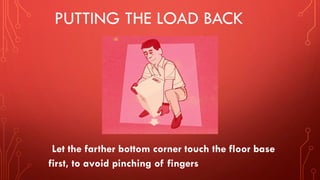
PUTTING THE LOAD BACK
Let the farther bottom corner touch the floor base
first, to avoid pinching of fingers
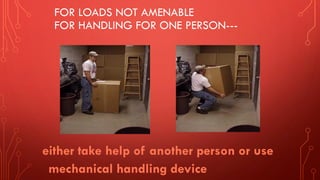
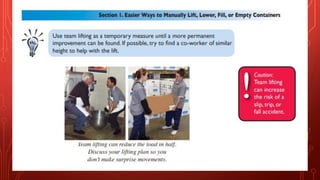
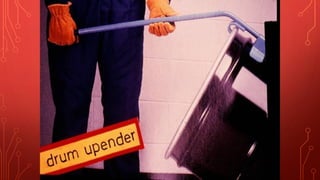
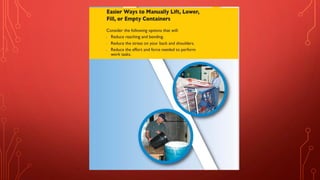
FOR LOADS NOT AMENABLE
FOR HANDLING FOR ONE PERSON---
either take help of another person or use
mechanical handling device
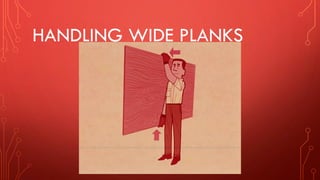
HANDLING WIDE PLANKS
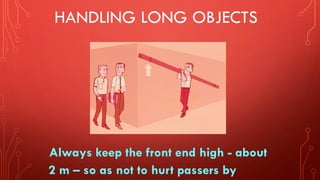
HANDLING LONG OBJECTS
Always keep the front end high - about
2 m – so as not to hurt passers by
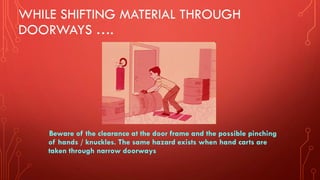
WHILE SHIFTING MATERIAL THROUGH
DOORWAYS ….
Beware of the clearance at the door frame and the possible pinching
of hands / knuckles. The same hazard exists when hand carts are
taken through narrow doorways
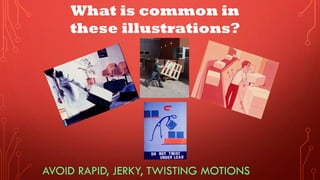
AVOID RAPID, JERKY, TWISTING MOTIONS
What is common in
these illustrations?
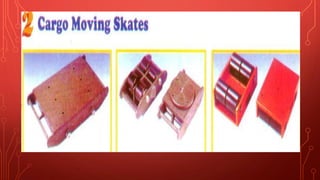
ACCESSORIES TO
MANUAL HANDLING
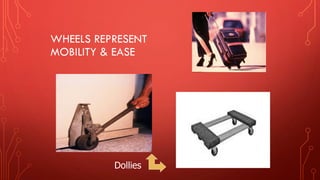
WHEELS REPRESENT
MOBILITY & EASE
Dollies
2-WHEEL HAND TRUCKS /
WHEEL BOROUGHS
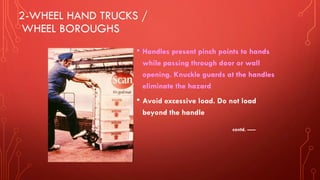
• Handles present pinch points to hands
while passing through door or wall
opening. Knuckle guards at the handles
eliminate the hazard
• Avoid excessive load. Do not load
beyond the handle
contd. -----
2-WHEEL HAND TRUCKS /
WHEEL BOROUGHS ---
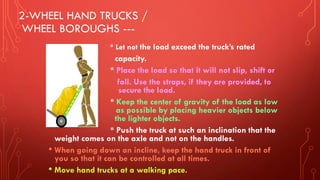
* Let not the load exceed the truck’s rated
capacity.
* Place the load so that it will not slip, shift or
fall. Use the straps, if they are provided, to
secure the load.
* Keep the center of gravity of the load as low
as possible by placing heavier objects below
the lighter objects.
* Push the truck at such an inclination that the
weight comes on the axle and not on the handles.
• When going down an incline, keep the hand truck in front of
you so that it can be controlled at all times.
• Move hand trucks at a walking pace.
SAFE USE OF
HAND TRUCK
/ WHEEL
BARROW
Knuckle guards
Wheels within the frame of hand truck
Wheel guards preferred
Brakes to avoid stopping with foot on wheel / axle
Centre of gravity of load, Load not to shift
In good repair
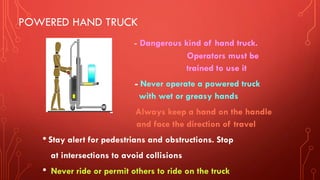
POWERED HAND TRUCK
- Dangerous kind of hand truck.
Operators must be
trained to use it
- Never operate a powered truck
with wet or greasy hands
- Always keep a hand on the handle
and face the direction of travel
• Stay alert for pedestrians and obstructions. Stop
at intersections to avoid collisions
• Never ride or permit others to ride on the truck
LOW PALLET TRUCK
Safety Features
•Three point finger
[raise, neutral and
lower] control
•Safety loop handle
•Leak proof
hydraulic pump
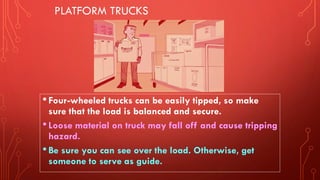
PLATFORM TRUCKS
•Four-wheeled trucks can be easily tipped, so make
sure that the load is balanced and secure.
•Loose material on truck may fall off and cause tripping
hazard.
•Be sure you can see over the load. Otherwise, get
someone to serve as guide.
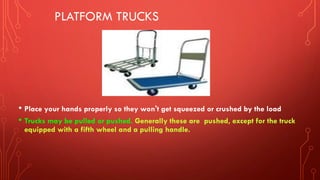
PLATFORM TRUCKS
• Place your hands properly so they won't get squeezed or crushed by the load
• Trucks may be pulled or pushed. Generally these are pushed, except for the truck
equipped with a fifth wheel and a pulling handle.
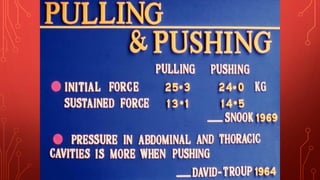
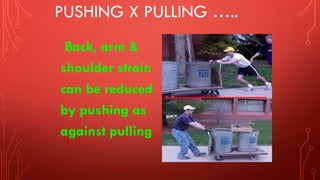
PUSHING X PULLING …..
Back, arm &
shoulder strain
can be reduced
by pushing as
against pulling
--------------------------------------
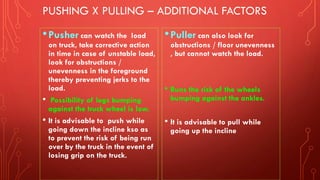
PUSHING X PULLING – ADDITIONAL FACTORS
•Pusher can watch the load
on truck, take corrective action
in time in case of unstable load,
look for obstructions /
unevenness in the foreground
thereby preventing jerks to the
load.
• Possibility of legs bumping
against the truck wheel is low.
• It is advisable to push while
going down the incline kso as
to prevent the risk of being run
over by the truck in the event of
losing grip on the truck.
•Puller can also look for
obstructions / floor unevenness
, but cannot watch the load.
• Runs the risk of the wheels
bumping against the ankles.
• It is advisable to pull while
going up the incline
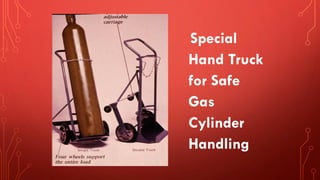
Special
Hand Truck
for Safe
Gas
Cylinder
Handling
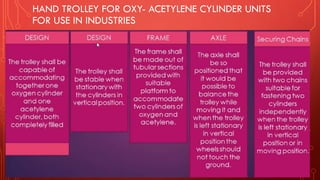
SPECIAL TRUCKS FOR OXY- ACETYLENE CYLINDERS -
REQUIREMENTS OF IS 8016- 1996 (REAFFIRMED 2017)
MARKING
•Load carrying capacity
•Manufacturer
•Serial no. of
Manufacturer
•Year of Manufacture
OTHERS
•Transport within premises
•Not for transport over
long distances / public
roads
•USE only if the object
cannot be moved easily
•Robust, but light
HAND TROLLEY FOR OXY- ACETYLENE CYLINDER UNITS
FOR USE IN INDUSTRIES
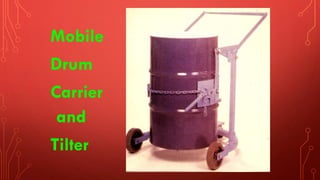
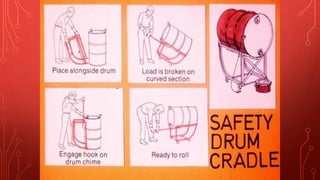
Mobile
Drum
Carrier
and
Tilter
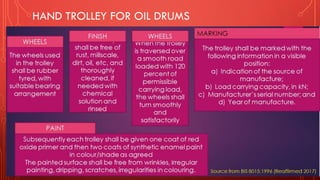
HAND TROLLEY FOR OIL DRUMS
LOADER
Can be positioned at proper height to avoid bending, stretching and
strain for shifting the load to the floor [as in the inset]
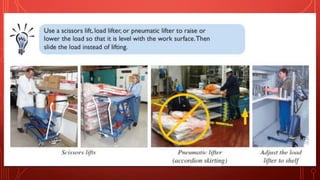
MOBILE SCISSOR-LIFT
[FOOT OPERATED HYDRAULIC JACK]
•Suitable for
lifting,
transporting
and loading
POWER-OPERATED SCISSOR-LIFT
[STATIONARY OR MOBILE]
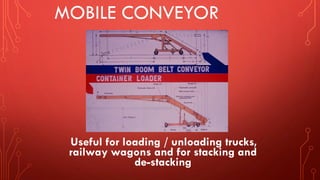
MOBILE CONVEYOR
Useful for loading / unloading trucks,
railway wagons and for stacking and
de-stacking
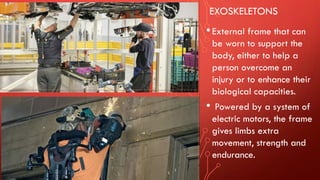
EXOSKELETONS
•External frame that can
be worn to support the
body, either to help a
person overcome an
injury or to enhance their
biological capacities.
• Powered by a system of
electric motors, the frame
gives limbs extra
movement, strength and
endurance.
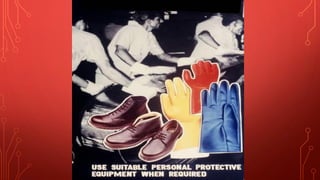
COMMON PPE FOR MANUAL HANDLING
Safety Shoe [seen under
Impact Test]
Chrome leather gloves
Cotton & Canvas Gloves
MANAGEMENT INITIATIVES:
MANUAL HANDLING
•Minimizing manual handling of materials
•Mechanization to replace Repetitive manual
handling activities
•Adequate training of workers assigned to
manual handling.
•Using suitable handling accessories /devices
Strict adherence to statutory limits
GOOD HOUSEKEEPING …
IMPORTANT FOR SAFE MATERIALS HANDLING
REMOVES TRIPPING HAZARDS
GOOD HOUSEKEEPING …
MARKING AND KEEPING AISLES CLEAR, IS
NECESSARY FOR SAFE MATERIALS HANDLING
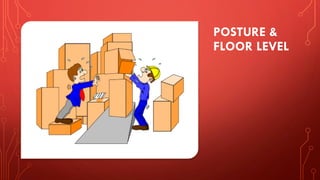
POSTURE &
FLOOR LEVEL

3.1_Manual Material Handling.pdf

  • 1.
    SAFETY IN MANUAL HANDLINGOF MATERIALS- PART 1 T. NITYANANDA S.
  • 2.
    MANUAL MATERIAL HANDLING ACTIVITY •PULLING- PUSHING - LIFTING - LOWERING •CARRYING - FEEDING MATERIAL TO MACHINE •COLLECTING FROM MACHINE •STACKING – LOADING •PLACING - MIXING - PUTTING OBJECTS – THROWING •MANUAL HANDLING IN MECHANICAL MATERIAL HANDLING. • PUTTING CHAIN AROUND A JOB TO BE LIFTED • PREPARING A HITCH • FITTING A EYE BOLT • FITTIG A D-SHAKLE • PUTTING A CHAIN OR ROPE ON CRANK HOOK
  • 3.
    MANUAL HANDLING –TYPICAL CAUSATION
  • 4.
    A variety ofphysical injuries occur during manual materials handling
  • 5.
    7 cervical (neck) vertebrae 12thoracic (middle back) vertebrae 5 lumbar (low back) vertebrae Coccyx (tailbone) Low back pain or discomfort in the lumbar region of spine is a common type of injury Sacrum Lumbar Spine
  • 6.
    MAIN CAUSES OFINJURY IN MANUAL MATERIALS HANDLING •Lifting or carrying excessive weight •Incorrect posture •Jerky movement •Faulty handling technique •Not using PPE •Poor house keeping
  • 7.
  • 8.
    STATUTORY PROVISIONS… FACTORIES RULES Maximum loadto be carried, lifted or moved by hand or head Model Rule, 64 AP Rule, 57 kg kg Adult Male 55 50 Adult Female 30 30 Adolescent Male (15 to <18 years) 30 30 Adolescent Female (15 to <18 years) 20 20 Male Child (<15 years) 16 16 Female Child (<15 years) 14 14
  • 9.
    LOAD ON ONEHAND CAUSES STRAIN • Lifting & carrying a heavy load by one hand [even if this is within statutory limit referred earlier] may result in undue strain • Distributing the load wherever possible to two hands is safer [eg., two bags of 15 kg instead of one of 30 kg]
  • 10.
  • 11.
    CAN MORE THANONE PERSON SHARE THE LOAD EQUALLY? No ! ……… because of
  • 13.
    HOW TO REDUCECOORDINATION LOSS? • Choose as far as possible, persons of near about the same height, size and physique • Synchronize the lifting, walking in step and carrying at the leader’s command. Let one act as team leader • Long sections to be supported on the same side shoulders, with shoulder pads where applicable • Total load to be lifted is not sum of each person’s capacity
  • 14.
    WITH LIGHT, BULKYLOADS….. Obstruction of vision can present serious hazards Beware !
  • 15.
    POSTURE • Apart fromthe weight of the load, body posture for lifting the load is crucial • Low back pains even when lifting up a child were reported
  • 16.
    POSTURE ….. Bending theback with legs straight to reach / lift a load causes severe compression of inter-vertebral disc in the lumbar region
  • 17.
    7 cervical (neck) vertebrae 12thoracic (middle back) vertebrae 5 lumbar (low back) vertebrae Coccyx (tailbone) Lumbar region of spine Sacrum Lumbar Spine
  • 18.
  • 19.
    LET US SEEILLUSTRATIONS OF THE ELEMENTS OF PROPER LIFTING METHOD
  • 20.
    STRAIGHT BACK &BENT LEGS
  • 21.
    STRAIGHT BACK &BENT LEGS…. Professional weight lifters also follow this principle. In this posture the load gets transmitted to hip muscles without damaging the spine.
  • 22.
    STRAIGHT BACK &BENT LEGS…. Poor lifting technique Good lifting technique Bent back; straight legs Straight back; bent legs
  • 23.
    Keeping loads close tothe body reduces forces on the low back & hands and improves the balance LOAD CLOSE TO THE BODY
  • 24.
    FIRM GRIP • Sizeup the load first. • Grip with palm, not with fingers alone • Grip at diagonally opposite corners, one at the bottom and the other at the top. These facilitate good grip and bring the load close to the body
  • 25.
    PUTTING THE LOADBACK Let the farther bottom corner touch the floor base first, to avoid pinching of fingers
  • 26.
    FOR LOADS NOTAMENABLE FOR HANDLING FOR ONE PERSON--- either take help of another person or use mechanical handling device
  • 33.
  • 34.
    HANDLING LONG OBJECTS Alwayskeep the front end high - about 2 m – so as not to hurt passers by
  • 35.
    WHILE SHIFTING MATERIALTHROUGH DOORWAYS …. Beware of the clearance at the door frame and the possible pinching of hands / knuckles. The same hazard exists when hand carts are taken through narrow doorways
  • 36.
    AVOID RAPID, JERKY,TWISTING MOTIONS What is common in these illustrations?
  • 37.
  • 40.
  • 43.
    2-WHEEL HAND TRUCKS/ WHEEL BOROUGHS • Handles present pinch points to hands while passing through door or wall opening. Knuckle guards at the handles eliminate the hazard • Avoid excessive load. Do not load beyond the handle contd. -----
  • 44.
    2-WHEEL HAND TRUCKS/ WHEEL BOROUGHS --- * Let not the load exceed the truck’s rated capacity. * Place the load so that it will not slip, shift or fall. Use the straps, if they are provided, to secure the load. * Keep the center of gravity of the load as low as possible by placing heavier objects below the lighter objects. * Push the truck at such an inclination that the weight comes on the axle and not on the handles. • When going down an incline, keep the hand truck in front of you so that it can be controlled at all times. • Move hand trucks at a walking pace.
  • 45.
    SAFE USE OF HANDTRUCK / WHEEL BARROW Knuckle guards Wheels within the frame of hand truck Wheel guards preferred Brakes to avoid stopping with foot on wheel / axle Centre of gravity of load, Load not to shift In good repair
  • 46.
    POWERED HAND TRUCK -Dangerous kind of hand truck. Operators must be trained to use it - Never operate a powered truck with wet or greasy hands - Always keep a hand on the handle and face the direction of travel • Stay alert for pedestrians and obstructions. Stop at intersections to avoid collisions • Never ride or permit others to ride on the truck
  • 47.
    LOW PALLET TRUCK SafetyFeatures •Three point finger [raise, neutral and lower] control •Safety loop handle •Leak proof hydraulic pump
  • 48.
    PLATFORM TRUCKS •Four-wheeled truckscan be easily tipped, so make sure that the load is balanced and secure. •Loose material on truck may fall off and cause tripping hazard. •Be sure you can see over the load. Otherwise, get someone to serve as guide.
  • 49.
    PLATFORM TRUCKS • Placeyour hands properly so they won't get squeezed or crushed by the load • Trucks may be pulled or pushed. Generally these are pushed, except for the truck equipped with a fifth wheel and a pulling handle.
  • 51.
    PUSHING X PULLING….. Back, arm & shoulder strain can be reduced by pushing as against pulling --------------------------------------
  • 52.
    PUSHING X PULLING– ADDITIONAL FACTORS •Pusher can watch the load on truck, take corrective action in time in case of unstable load, look for obstructions / unevenness in the foreground thereby preventing jerks to the load. • Possibility of legs bumping against the truck wheel is low. • It is advisable to push while going down the incline kso as to prevent the risk of being run over by the truck in the event of losing grip on the truck. •Puller can also look for obstructions / floor unevenness , but cannot watch the load. • Runs the risk of the wheels bumping against the ankles. • It is advisable to pull while going up the incline
  • 53.
  • 54.
    SPECIAL TRUCKS FOROXY- ACETYLENE CYLINDERS - REQUIREMENTS OF IS 8016- 1996 (REAFFIRMED 2017) MARKING •Load carrying capacity •Manufacturer •Serial no. of Manufacturer •Year of Manufacture OTHERS •Transport within premises •Not for transport over long distances / public roads •USE only if the object cannot be moved easily •Robust, but light
  • 55.
    HAND TROLLEY FOROXY- ACETYLENE CYLINDER UNITS FOR USE IN INDUSTRIES
  • 56.
  • 58.
  • 59.
    LOADER Can be positionedat proper height to avoid bending, stretching and strain for shifting the load to the floor [as in the inset]
  • 61.
    MOBILE SCISSOR-LIFT [FOOT OPERATEDHYDRAULIC JACK] •Suitable for lifting, transporting and loading
  • 62.
  • 63.
    MOBILE CONVEYOR Useful forloading / unloading trucks, railway wagons and for stacking and de-stacking
  • 64.
    EXOSKELETONS •External frame thatcan be worn to support the body, either to help a person overcome an injury or to enhance their biological capacities. • Powered by a system of electric motors, the frame gives limbs extra movement, strength and endurance.
  • 66.
    COMMON PPE FORMANUAL HANDLING Safety Shoe [seen under Impact Test] Chrome leather gloves Cotton & Canvas Gloves
  • 69.
    MANAGEMENT INITIATIVES: MANUAL HANDLING •Minimizingmanual handling of materials •Mechanization to replace Repetitive manual handling activities •Adequate training of workers assigned to manual handling. •Using suitable handling accessories /devices Strict adherence to statutory limits
  • 70.
    GOOD HOUSEKEEPING … IMPORTANTFOR SAFE MATERIALS HANDLING REMOVES TRIPPING HAZARDS
  • 71.
    GOOD HOUSEKEEPING … MARKINGAND KEEPING AISLES CLEAR, IS NECESSARY FOR SAFE MATERIALS HANDLING
  • 72.