SAFE DRIVING PRACTICES
Topics Covered
• MSM & PSL Technique
• Safe distance
• Defensive driving
• Purpose & use of bye pass & flyovers
• Emergency handling techniques
• Driving in difficult conditions
MSM & PSL Technique
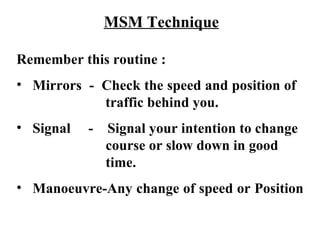
MSM Technique

Remember this routine :
• Mirrors - Check the speed and position of
            traffic behind you.
• Signal   -   Signal your intention to change
               course or slow down in good
               time.
• Manoeuvre-Any change of speed or Position
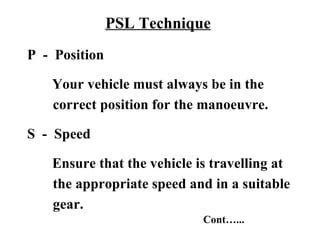
PSL Technique
P - Position

   Your vehicle must always be in the
   correct position for the manoeuvre.

S - Speed

   Ensure that the vehicle is travelling at
   the appropriate speed and in a suitable
   gear.
                            Cont…...
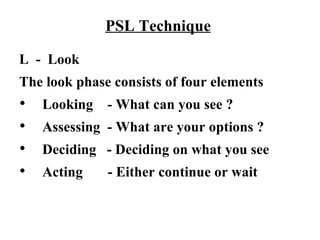
PSL Technique

L - Look
The look phase consists of four elements
   Looking   - What can you see ?
   Assessing - What are your options ?
   Deciding - Deciding on what you see
   Acting    - Either continue or wait
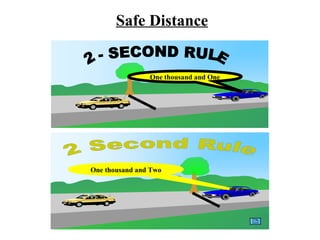
Safe Distance
Safe Distance


                One thousand and One


One thousand and Two
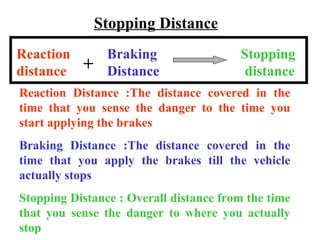
Stopping Distance
Reaction        Braking                 Stopping
distance   +    Distance                 distance
Reaction Distance :The distance covered in the
time that you sense the danger to the time you
start applying the brakes
Braking Distance :The distance covered in the
time that you apply the brakes till the vehicle
actually stops
Stopping Distance : Overall distance from the time
that you sense the danger to where you actually
stop
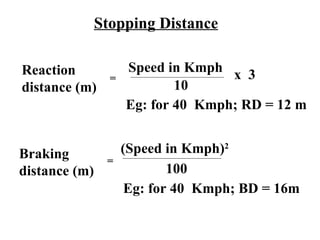
Stopping Distance

Reaction             Speed in Kmph
                 =                  x 3
distance (m)                 10
                     Eg: for 40 Kmph; RD = 12 m


Braking              (Speed in Kmph)2
                =
distance (m)                 100
                      Eg: for 40 Kmph; BD = 16m
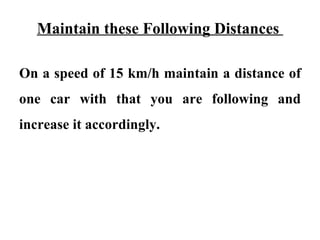
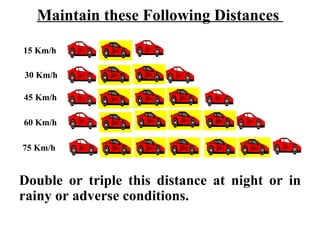
Maintain these Following Distances

On a speed of 15 km/h maintain a distance of
one car with that you are following and
increase it accordingly.
Maintain these Following Distances

15 Km/h

30 Km/h

45 Km/h

60 Km/h

75 Km/h


Double or triple this distance at night or in
rainy or adverse conditions.
Defensive Driving
Defensive Driving

The driver often has to cope with
unpredictable, irrational, offensive and some
times dangerous driving behaviour.
In such conditions, drivers need to learn and
practice a defensive strategy.
This strategy is called ‘ Defensive Driving’ ,
sometimes known as ‘ Planned Driving’.

                              Cont…...
Defensive Driving

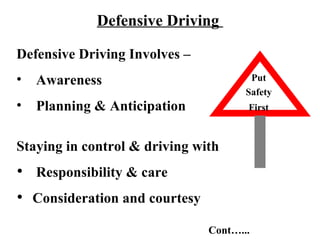
Defensive Driving Involves –
•   Awareness                          Put
                                      Safety
•   Planning & Anticipation           First


Staying in control & driving with
 Responsibility & care
 Consideration and courtesy

                               Cont…...
Defensive Driving

Effective Observation
You must make a mental note of the
• Speed
• Behaviour
• Possible intentions of any other road user.
Without this you can’t assess a traffic
situation correctly.
                                        Cont…...
Defensive Driving
Effective Observation
For this, four steps are -
•   Look
•   Assess and
•   Decide before you Act
That’s what effective observation is all about.


                               Cont…...
Defensive Driving
Signaling
Signal to warn others of your intention and
help other road users.

Signal clearly and in good time.

Use warning signals such as flashing with
headlights only as an alternative to the horn
to remind others that you are there.

                                      Cont…...
Defensive Driving

Signaling

Use horn only if

 You think someone may not have seen you.

 You want to warn other road users of your
  presence, e.g. at blind bends or junctions.


                                      Cont…...
Defensive Driving

Some Other Tips

• Follow the MSM/PSL technique every time
 you recognize a hazard.

• Always leave yourself enough time and
 space to cope with what’s ahead.
                                    Cont…..
Defensive Driving
Some Other Tips

• Always keep a view of lighting and weather
  conditions in mind. For these be careful
  and drive slowly.
• Always think of or take care of the other
  road users such as cyclist, motorcyclist,
  powered vehicles used by disabled people,
  buses and coaches, pedestrians, elderly
  persons, children, animals, horse riders etc.
Purpose And Use of Bye pass &
          Flyover
Purpose & Use of Bye pass & Flyover

•    To save time
•    As safe approaching alternatives
•    To reduce traffic congestion
•    To lower driving hassles
Emergency Handling Techniques

Everyone hopes that he or she need not deal
with   difficult   situations   on   the   road.
However, no one can predict when an
emergency will arise, so be prepared for such
eventualities.
Shattered Wind Screen
If the windscreen shatters-
1.   Remain calm
2.   Turn on the hazard lights
3.   Slow down and move to the side of the
     road
4.   Stop at the road side and remove the
     shattered screen and broken bits of glass
5.   Do not use your bare hands to take away
     the glass. Use a rag or cloth
6.   Drive slowly to a workshop
Fire
A short circuit in the electrical system of the
vehicle or the alarming speed of the vehicle can
cause a fire. If this happens -
1. Stop your vehicle quickly by the side of the
   road.
2. Get all passengers out of the vehicle in an
   orderly manner.


                                 Cont…..
Fire

3. Move them as far away as possible from
   the vehicle.
4. Use a fire extinguisher to put out the fire.
   If you do not have one or are unable to
   put out the fire, call the Fire Brigade. The
   telephone number of the Fire Brigade is
   101.
Stuck Accelerator Pedal

1. Try to lift the pedal up with the toe of your
   shoe. Do not take your attention off the
   road.
2. If you cannot free the pedal in this manner,
   turn on the hazard lights,shift to neutral
   gear and move the vehicle safely to the side
   of the road.
3. Stop the vehicle and switch off the ignition.
Foot Brake Failure

1. Turn on the hazard lights and move safely
   to the side of the road.
2. ‘Change Down’ quickly to a lower gear,
   preferably to the 2nd gear and release the
   clutch to use the engine brake.
3. Apply the handbrake.
4. Switch off the engine.
Loose Wheel
 When any of the wheels are loose, the vehicle
 may wander from side to side accompanied
 by excessive noise from the loose wheel. You
 will also have difficulty in steering the
 vehicle.
In such a situation
• Slow down,
• Give the appropriate signal and stop at a
  safe spot by side of the road. Tighten the
  loose wheel before proceeding.
Tyre Blow-Out
 When a tyre blows out, there will be a strong
 pull on the vehicle towards the side of the
 blown tyre. The pull is greater for the front
 wheel than for the rear wheel.
 When this happens:
• Tighten you grip on the steering wheel
• Steer against the pull to keep on course.
• Brake gently and progressively and stop the
  vehicle by the side of the road.
Skidding

Skidding is triggered by:
• Abrupt steering, braking or acceleration
• Loss of traction on slippery roads
Skidding

If you get into a skid:
• Stop accelerating
• Press clutch
• Do not brake
• Steer slightly in the direction of skid
• Do not oversteer
Driving in Difficult Conditions
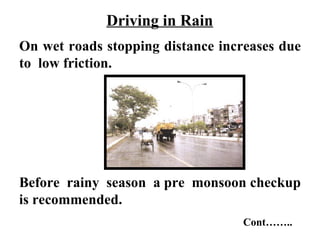
Driving in Rain
On wet roads stopping distance increases due
to low friction.


Before rainy season a pre monsoon checkup
is recommended.
                                  Cont……..
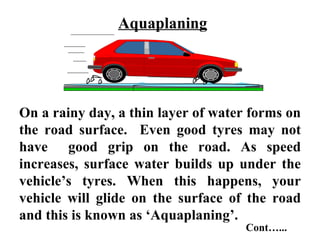
Aquaplaning


On a rainy day, a thin layer of water forms on
the road surface. Even good tyres may not
have good grip on the road. As speed
increases, surface water builds up under the
vehicle’s tyres. When this happens, your
vehicle will glide on the surface of the road
and this is known as ‘Aquaplaning’.
                                     Cont…...
Aquaplaning

If it occurs

1. Stop acceleration.
2. Press clutch and do not brake.
3. Hold steering in straight position.
Aquaplaning
Indications
•   Steering will become light
•   Skidding on increasing speed
To prevent
•   Use tyres with proper tread
•   Drive slow through water-logged area

                                    Cont……..
Driving in Rain

In rainy season be cautious of -
• Pot holes
• Submerged causeway or bridge
• Test brakes after crossing a water-logged
   road
• Your speed & following distance
Driving in Fog

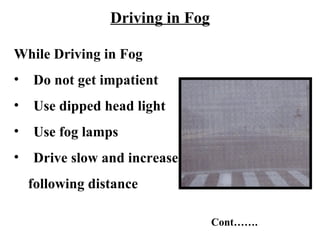
While Driving in Fog
•   Do not get impatient
•   Use dipped head light
•   Use fog lamps
•   Drive slow and increase
    following distance

                                  Cont…….
Driving in Fog

• Drive in your left lane near the kerb

• Use wipers to regularly clean your windscreen

• Do not overtake

• Avoid parking your vehicle on the road
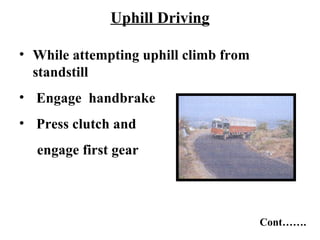
Uphill Driving

• While attempting uphill climb from
  standstill
• Engage handbrake
• Press clutch and
  engage first gear


                                       Cont…….
Uphill Driving


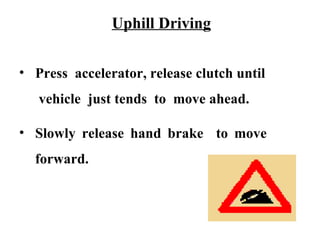
• Press accelerator, release clutch until
   vehicle just tends to move ahead.

• Slowly release hand brake to move
  forward.
Downhill Driving


                         ENGI
                             NE B
          Clutch pedal            RAKE
            released


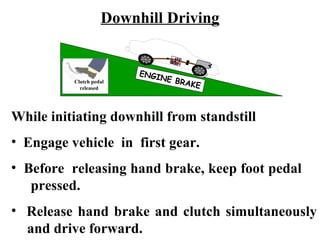
While initiating downhill from standstill
• Engage vehicle in first gear.
• Before releasing hand brake, keep foot pedal
   pressed.
• Release hand brake and clutch simultaneously
  and drive forward.
Driving in Hot Whether

• Tyre pressure should be checked and
  adjusted when they are cold.

• Check the level of coolant in the system.

• Keep the windscreen as clear as possible.
  This helps to cut down glare.


                                  Cont…….
Driving in Hot Weather
• The use of sun-visor or correct sunglasses
  can also reduce the glare.
• Make sure you use adequate ventilation
  inside the car air-conditioning helps.
• Take plenty of breaks and refreshment on
  a long trip.
• Take care of braking and cornering on
  road surfaces that becomes very soft in this
  weather.
Night Driving
 Driving at night can be difficult as compared
 to driving during the day.
• Make sure you can see and be seen
• Use High beams only on Highways & that
  too when you are not following a vehicle.
• Use dipper for oncoming vehicle in the
  range of 150-200 m
• Always use low beam while city driving
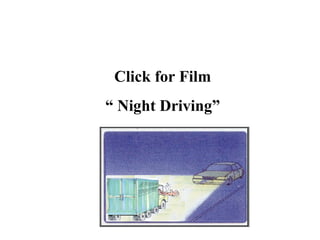
Click for Film
“ Night Driving”
Learning from the Film

1. How will you cope with the hazards of
   driving at night?
2. How will you avoid getting dazzled by
   the headlight of oncoming vehicles?
Recap
Choose the correct answer:
1. In PSL technique, ‘S’ stands for:
  a. Stop
  b. Steering
  c. Speed
  d. Sign
Recap
Choose the correct answer:
2. During rainy season safe distance should
  be :
  a. 1.5 times the normal
  b. 2-3 times the normal
  c. 8-10 times the normal
  d. Half the normal
Recap
Choose the correct answer:
3. In case of a skid
  a. Steer in the direction of skid
  b. Steer opposite to the direction of skid
  c. Do not steer
  d. Steer hard
Recap
Choose the correct answer:
4. Use low beam while :
  a. Driving in Fog
  b. Following other vehicles
  c. Overtaking
  d. All of the above

Safe driving practices

  • 1.
  • 2.
    Topics Covered • MSM& PSL Technique • Safe distance • Defensive driving • Purpose & use of bye pass & flyovers • Emergency handling techniques • Driving in difficult conditions
  • 3.
    MSM & PSLTechnique
  • 4.
    MSM Technique Remember thisroutine : • Mirrors - Check the speed and position of traffic behind you. • Signal - Signal your intention to change course or slow down in good time. • Manoeuvre-Any change of speed or Position
  • 5.
    PSL Technique P -Position Your vehicle must always be in the correct position for the manoeuvre. S - Speed Ensure that the vehicle is travelling at the appropriate speed and in a suitable gear. Cont…...
  • 6.
    PSL Technique L -Look The look phase consists of four elements  Looking - What can you see ?  Assessing - What are your options ?  Deciding - Deciding on what you see  Acting - Either continue or wait
  • 7.
  • 8.
    Safe Distance One thousand and One One thousand and Two
  • 9.
    Stopping Distance Reaction Braking Stopping distance + Distance distance Reaction Distance :The distance covered in the time that you sense the danger to the time you start applying the brakes Braking Distance :The distance covered in the time that you apply the brakes till the vehicle actually stops Stopping Distance : Overall distance from the time that you sense the danger to where you actually stop
  • 10.
    Stopping Distance Reaction Speed in Kmph = x 3 distance (m) 10 Eg: for 40 Kmph; RD = 12 m Braking (Speed in Kmph)2 = distance (m) 100 Eg: for 40 Kmph; BD = 16m
  • 11.
    Maintain these FollowingDistances On a speed of 15 km/h maintain a distance of one car with that you are following and increase it accordingly.
  • 12.
    Maintain these FollowingDistances 15 Km/h 30 Km/h 45 Km/h 60 Km/h 75 Km/h Double or triple this distance at night or in rainy or adverse conditions.
  • 13.
  • 14.
    Defensive Driving The driveroften has to cope with unpredictable, irrational, offensive and some times dangerous driving behaviour. In such conditions, drivers need to learn and practice a defensive strategy. This strategy is called ‘ Defensive Driving’ , sometimes known as ‘ Planned Driving’. Cont…...
  • 15.
    Defensive Driving Defensive DrivingInvolves – • Awareness Put Safety • Planning & Anticipation First Staying in control & driving with  Responsibility & care  Consideration and courtesy Cont…...
  • 16.
    Defensive Driving Effective Observation Youmust make a mental note of the • Speed • Behaviour • Possible intentions of any other road user. Without this you can’t assess a traffic situation correctly. Cont…...
  • 17.
    Defensive Driving Effective Observation Forthis, four steps are - • Look • Assess and • Decide before you Act That’s what effective observation is all about. Cont…...
  • 18.
    Defensive Driving Signaling Signal towarn others of your intention and help other road users. Signal clearly and in good time. Use warning signals such as flashing with headlights only as an alternative to the horn to remind others that you are there. Cont…...
  • 19.
    Defensive Driving Signaling Use hornonly if  You think someone may not have seen you.  You want to warn other road users of your presence, e.g. at blind bends or junctions. Cont…...
  • 20.
    Defensive Driving Some OtherTips • Follow the MSM/PSL technique every time you recognize a hazard. • Always leave yourself enough time and space to cope with what’s ahead. Cont…..
  • 21.
    Defensive Driving Some OtherTips • Always keep a view of lighting and weather conditions in mind. For these be careful and drive slowly. • Always think of or take care of the other road users such as cyclist, motorcyclist, powered vehicles used by disabled people, buses and coaches, pedestrians, elderly persons, children, animals, horse riders etc.
  • 22.
    Purpose And Useof Bye pass & Flyover
  • 23.
    Purpose & Useof Bye pass & Flyover • To save time • As safe approaching alternatives • To reduce traffic congestion • To lower driving hassles
  • 24.
  • 25.
    Emergency Handling Techniques Everyonehopes that he or she need not deal with difficult situations on the road. However, no one can predict when an emergency will arise, so be prepared for such eventualities.
  • 26.
    Shattered Wind Screen Ifthe windscreen shatters- 1. Remain calm 2. Turn on the hazard lights 3. Slow down and move to the side of the road 4. Stop at the road side and remove the shattered screen and broken bits of glass 5. Do not use your bare hands to take away the glass. Use a rag or cloth 6. Drive slowly to a workshop
  • 27.
    Fire A short circuitin the electrical system of the vehicle or the alarming speed of the vehicle can cause a fire. If this happens - 1. Stop your vehicle quickly by the side of the road. 2. Get all passengers out of the vehicle in an orderly manner. Cont…..
  • 28.
    Fire 3. Move themas far away as possible from the vehicle. 4. Use a fire extinguisher to put out the fire. If you do not have one or are unable to put out the fire, call the Fire Brigade. The telephone number of the Fire Brigade is 101.
  • 29.
    Stuck Accelerator Pedal 1.Try to lift the pedal up with the toe of your shoe. Do not take your attention off the road. 2. If you cannot free the pedal in this manner, turn on the hazard lights,shift to neutral gear and move the vehicle safely to the side of the road. 3. Stop the vehicle and switch off the ignition.
  • 30.
    Foot Brake Failure 1.Turn on the hazard lights and move safely to the side of the road. 2. ‘Change Down’ quickly to a lower gear, preferably to the 2nd gear and release the clutch to use the engine brake. 3. Apply the handbrake. 4. Switch off the engine.
  • 31.
    Loose Wheel Whenany of the wheels are loose, the vehicle may wander from side to side accompanied by excessive noise from the loose wheel. You will also have difficulty in steering the vehicle. In such a situation • Slow down, • Give the appropriate signal and stop at a safe spot by side of the road. Tighten the loose wheel before proceeding.
  • 32.
    Tyre Blow-Out Whena tyre blows out, there will be a strong pull on the vehicle towards the side of the blown tyre. The pull is greater for the front wheel than for the rear wheel. When this happens: • Tighten you grip on the steering wheel • Steer against the pull to keep on course. • Brake gently and progressively and stop the vehicle by the side of the road.
  • 33.
    Skidding Skidding is triggeredby: • Abrupt steering, braking or acceleration • Loss of traction on slippery roads
  • 34.
    Skidding If you getinto a skid: • Stop accelerating • Press clutch • Do not brake • Steer slightly in the direction of skid • Do not oversteer
  • 35.
  • 36.
    Driving in Rain Onwet roads stopping distance increases due to low friction. Before rainy season a pre monsoon checkup is recommended. Cont……..
  • 37.
    Aquaplaning On a rainyday, a thin layer of water forms on the road surface. Even good tyres may not have good grip on the road. As speed increases, surface water builds up under the vehicle’s tyres. When this happens, your vehicle will glide on the surface of the road and this is known as ‘Aquaplaning’. Cont…...
  • 38.
    Aquaplaning If it occurs 1.Stop acceleration. 2. Press clutch and do not brake. 3. Hold steering in straight position.
  • 39.
    Aquaplaning Indications • Steering will become light • Skidding on increasing speed To prevent • Use tyres with proper tread • Drive slow through water-logged area Cont……..
  • 40.
    Driving in Rain Inrainy season be cautious of - • Pot holes • Submerged causeway or bridge • Test brakes after crossing a water-logged road • Your speed & following distance
  • 41.
    Driving in Fog WhileDriving in Fog • Do not get impatient • Use dipped head light • Use fog lamps • Drive slow and increase following distance Cont…….
  • 42.
    Driving in Fog •Drive in your left lane near the kerb • Use wipers to regularly clean your windscreen • Do not overtake • Avoid parking your vehicle on the road
  • 43.
    Uphill Driving • Whileattempting uphill climb from standstill • Engage handbrake • Press clutch and engage first gear Cont…….
  • 44.
    Uphill Driving • Pressaccelerator, release clutch until vehicle just tends to move ahead. • Slowly release hand brake to move forward.
  • 45.
    Downhill Driving ENGI NE B Clutch pedal RAKE released While initiating downhill from standstill • Engage vehicle in first gear. • Before releasing hand brake, keep foot pedal pressed. • Release hand brake and clutch simultaneously and drive forward.
  • 46.
    Driving in HotWhether • Tyre pressure should be checked and adjusted when they are cold. • Check the level of coolant in the system. • Keep the windscreen as clear as possible. This helps to cut down glare. Cont…….
  • 47.
    Driving in HotWeather • The use of sun-visor or correct sunglasses can also reduce the glare. • Make sure you use adequate ventilation inside the car air-conditioning helps. • Take plenty of breaks and refreshment on a long trip. • Take care of braking and cornering on road surfaces that becomes very soft in this weather.
  • 48.
    Night Driving Drivingat night can be difficult as compared to driving during the day. • Make sure you can see and be seen • Use High beams only on Highways & that too when you are not following a vehicle. • Use dipper for oncoming vehicle in the range of 150-200 m • Always use low beam while city driving
  • 49.
    Click for Film “Night Driving”
  • 50.
    Learning from theFilm 1. How will you cope with the hazards of driving at night? 2. How will you avoid getting dazzled by the headlight of oncoming vehicles?
  • 51.
    Recap Choose the correctanswer: 1. In PSL technique, ‘S’ stands for: a. Stop b. Steering c. Speed d. Sign
  • 52.
    Recap Choose the correctanswer: 2. During rainy season safe distance should be : a. 1.5 times the normal b. 2-3 times the normal c. 8-10 times the normal d. Half the normal
  • 53.
    Recap Choose the correctanswer: 3. In case of a skid a. Steer in the direction of skid b. Steer opposite to the direction of skid c. Do not steer d. Steer hard
  • 54.
    Recap Choose the correctanswer: 4. Use low beam while : a. Driving in Fog b. Following other vehicles c. Overtaking d. All of the above