






BEGINNING TO DRIVE
Topics Covered

•   Moving Off
•   Stopping
•   Steering Holding
Before Moving Off
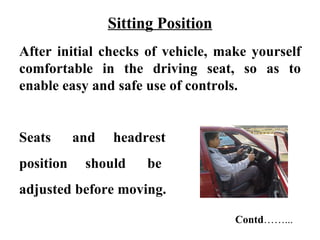
Sitting Position
After initial checks of vehicle, make yourself
comfortable in the driving seat, so as to
enable easy and safe use of controls.


Seats      and   headrest
position    should     be
adjusted before moving.

                                    Contd……...
Starting the Engine
Starting the Engine

• Ensure that the handbrake is engaged and
  the gear lever is in neutral position.
• Turn the ignition key and pull choke if
  necessary. Both ignition and oil pressure
  lights will glow.
• Turn the key further to actuate the electric
  starter. The key should be released as soon
  as the engine starts.

                              Cont….
Starting the Engine

• If the engine does not start, repeat this
  process again after a few seconds.
• Press accelerator slightly to initiate smooth
  running of engine. When this happens,
  gradually remove your foot from the
  accelerator.
• At this time, the ignition and oil pressure
  lamps must stop glowing.
Moving off
Moving off
After smooth start of the engine.
• With your left foot , press and
 hold the clutch pedal fully down
• Move gear lever from neutral
 into 1st gear.
• With your right foot ,     press
 accelerator slightly and hold
 it steady.
Moving off

• Make your final safety checks, before you
  actually move the vehicle. Use mirrors and
  look over your shoulders to see that all is
  clear.
• After being sure of clear space and safety,
  release the handbrake.


                             Cont….
Moving off
• Slowly and smoothly, release the clutch
  pedal until you hear the engine sound
  change slightly.
• Let the clutch pedal come up a little more.
  The vehicle will begin to move.


                                   Cont….
Moving off
• Slowly releasing the clutch, gently pressing
  the accelerator, feeling the engine sound
  change to a smooth take off, are initial
  moments where you require a relaxed mind
  and confidence.
• Don’t hurry up for this, if the engine stops
  with a jerk , press the clutch , put the gear
  in neutral and repeat the process.

                              Cont….
Moving off

• As the vehicle begins to move, press the
  accelerator gradually for more speed and,
  at the same time let the clutch come up,
  smoothly.
• Then take your left foot off the clutch
  pedal.
• Indicate your coming on to the lane.


                             Cont….
Stopping
Stopping
• Stopping should be smooth and gradual.
  This enables the other driver to react in
  time, prevents wheel locking and reduces
  wear and tear of brakes and tyres.
    Do’s for stopping
•   Look in the rear view mirror
• Where necessary, give indication using
  indicators or hand signal.

                                   Cont….
Stopping
• Move your right foot off the accelerator to
  allow the engine to slow down.
• Push the brake pedal lightly with your
  right foot.
• As the vehicle slows down or comes to a
  halt, press the clutch pedal down with the
  left foot to prevent stalling and
  simultaneously press the brake pedal more
  firmly with a stopping hand signal.
                               Cont….
Stopping

• Pull the handbrake
• Bring gear to neutral
• Move feet off the pedals


                             Cont….
Stopping in an Emergency
Stopping in an emergency increases the risk
of skidding. A quick reaction is crucial in an
emergency.
Practice the following routine
• Keep both hands on the steering wheel for
  as much control as possible.
• Avoid braking so hard that you lock any of
  the wheels.
.
                                 Cont….
Stopping in an Emergency
• Don’t touch the clutch pedal until just
  before you stop. This helps with your
  braking and stability.
• Don’t touch the handbrake. Most
  handbrakes work on the back wheels only.
  Extra braking here can cause skidding.
  Practice braking to judge the correct
  pressure and remember to take into
  account road and weather conditions
Steering Holding
Steering Holding
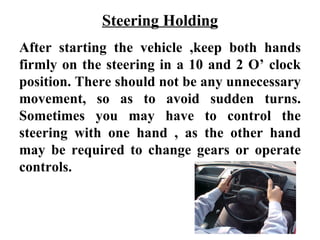
After starting the vehicle ,keep both hands
firmly on the steering in a 10 and 2 O’ clock
position. There should not be any unnecessary
movement, so as to avoid sudden turns.
Sometimes you may have to control the
steering with one hand , as the other hand
may be required to change gears or operate
controls.
Click for Film
“ Starting up & Moving off ”
Learning from the Film

1. What should you check before
   starting the vehicle?
2.   When & how should you use the
     Clutch?
Recap
Recap
True or False?
1. Look in the rear view mirror before
   stopping.
2. The correct way to hold the steering is
   to keep both hands firmly on the
   steering in a 11 O’ clock and 1 O’ clock
   position.

Starting off

  • 1.
  • 2.
    Topics Covered • Moving Off • Stopping • Steering Holding
  • 3.
  • 4.
    Sitting Position After initialchecks of vehicle, make yourself comfortable in the driving seat, so as to enable easy and safe use of controls. Seats and headrest position should be adjusted before moving. Contd……...
  • 5.
  • 6.
    Starting the Engine •Ensure that the handbrake is engaged and the gear lever is in neutral position. • Turn the ignition key and pull choke if necessary. Both ignition and oil pressure lights will glow. • Turn the key further to actuate the electric starter. The key should be released as soon as the engine starts. Cont….
  • 7.
    Starting the Engine •If the engine does not start, repeat this process again after a few seconds. • Press accelerator slightly to initiate smooth running of engine. When this happens, gradually remove your foot from the accelerator. • At this time, the ignition and oil pressure lamps must stop glowing.
  • 8.
  • 9.
    Moving off After smoothstart of the engine. • With your left foot , press and hold the clutch pedal fully down • Move gear lever from neutral into 1st gear. • With your right foot , press accelerator slightly and hold it steady.
  • 10.
    Moving off • Makeyour final safety checks, before you actually move the vehicle. Use mirrors and look over your shoulders to see that all is clear. • After being sure of clear space and safety, release the handbrake. Cont….
  • 11.
    Moving off • Slowlyand smoothly, release the clutch pedal until you hear the engine sound change slightly. • Let the clutch pedal come up a little more. The vehicle will begin to move. Cont….
  • 12.
    Moving off • Slowlyreleasing the clutch, gently pressing the accelerator, feeling the engine sound change to a smooth take off, are initial moments where you require a relaxed mind and confidence. • Don’t hurry up for this, if the engine stops with a jerk , press the clutch , put the gear in neutral and repeat the process. Cont….
  • 13.
    Moving off • Asthe vehicle begins to move, press the accelerator gradually for more speed and, at the same time let the clutch come up, smoothly. • Then take your left foot off the clutch pedal. • Indicate your coming on to the lane. Cont….
  • 14.
  • 15.
    Stopping • Stopping shouldbe smooth and gradual. This enables the other driver to react in time, prevents wheel locking and reduces wear and tear of brakes and tyres. Do’s for stopping • Look in the rear view mirror • Where necessary, give indication using indicators or hand signal. Cont….
  • 16.
    Stopping • Move yourright foot off the accelerator to allow the engine to slow down. • Push the brake pedal lightly with your right foot. • As the vehicle slows down or comes to a halt, press the clutch pedal down with the left foot to prevent stalling and simultaneously press the brake pedal more firmly with a stopping hand signal. Cont….
  • 17.
    Stopping • Pull thehandbrake • Bring gear to neutral • Move feet off the pedals Cont….
  • 18.
    Stopping in anEmergency Stopping in an emergency increases the risk of skidding. A quick reaction is crucial in an emergency. Practice the following routine • Keep both hands on the steering wheel for as much control as possible. • Avoid braking so hard that you lock any of the wheels. . Cont….
  • 19.
    Stopping in anEmergency • Don’t touch the clutch pedal until just before you stop. This helps with your braking and stability. • Don’t touch the handbrake. Most handbrakes work on the back wheels only. Extra braking here can cause skidding. Practice braking to judge the correct pressure and remember to take into account road and weather conditions
  • 20.
  • 21.
    Steering Holding After startingthe vehicle ,keep both hands firmly on the steering in a 10 and 2 O’ clock position. There should not be any unnecessary movement, so as to avoid sudden turns. Sometimes you may have to control the steering with one hand , as the other hand may be required to change gears or operate controls.
  • 22.
    Click for Film “Starting up & Moving off ”
  • 23.
    Learning from theFilm 1. What should you check before starting the vehicle? 2. When & how should you use the Clutch?
  • 24.
  • 25.
    Recap True or False? 1.Look in the rear view mirror before stopping. 2. The correct way to hold the steering is to keep both hands firmly on the steering in a 11 O’ clock and 1 O’ clock position.