The contribution of Learning & Development
Standards to Business Performance
Marius Meyer
7 March 2018, Skills Summit
@mariusSABPP
@SABPP1 @sabpp_1
Agenda
• HR Standards & Audit Update
• Professional Practice Standards (Phase 2)
• Role of L& D in business success
• Conclusion
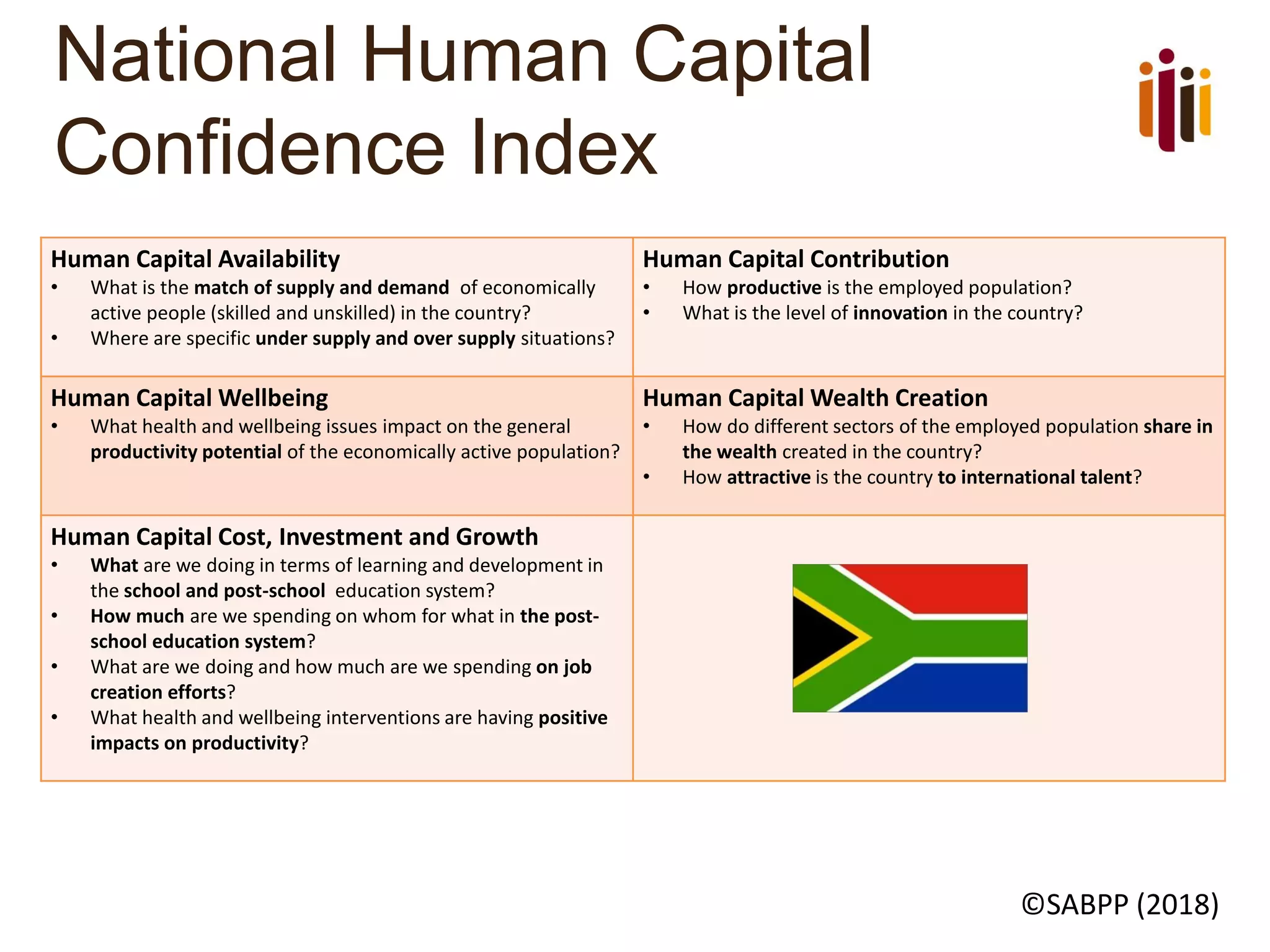
National Human Capital
Confidence Index
Human Capital Availability
• What is the match of supply and demand of economically
active people (skilled and unskilled) in the country?
• Where are specific under supply and over supply situations?
Human Capital Contribution
• How productive is the employed population?
• What is the level of innovation in the country?
Human Capital Wellbeing
• What health and wellbeing issues impact on the general
productivity potential of the economically active population?
Human Capital Wealth Creation
• How do different sectors of the employed population share in
the wealth created in the country?
• How attractive is the country to international talent?
Human Capital Cost, Investment and Growth
• What are we doing in terms of learning and development in
the school and post-school education system?
• How much are we spending on whom for what in the post-
school education system?
• What are we doing and how much are we spending on job
creation efforts?
• What health and wellbeing interventions are having positive
impacts on productivity?
©SABPP (2018)
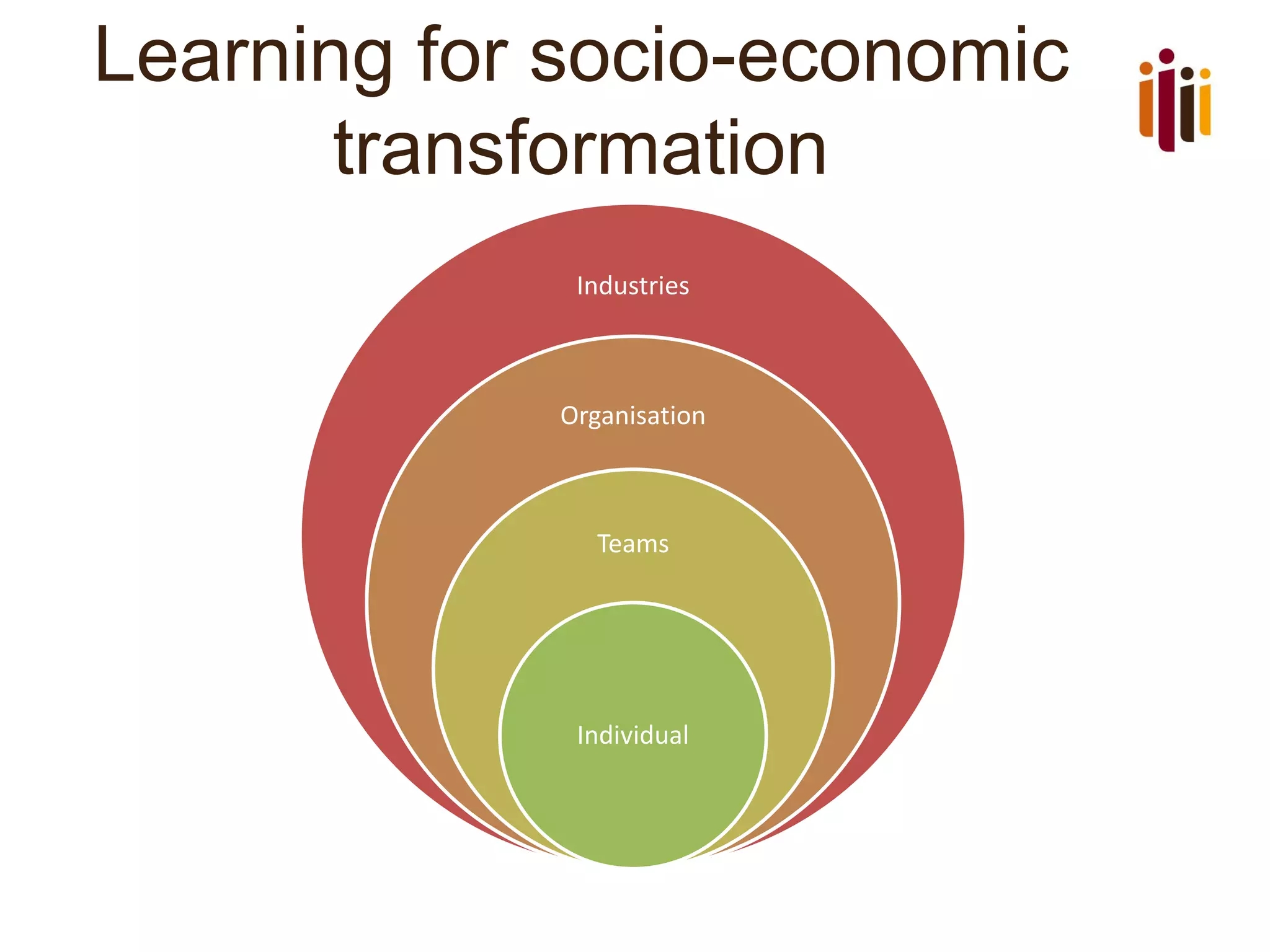
Learning for socio-economic
transformation
Industries
Organisation
Teams
Individual
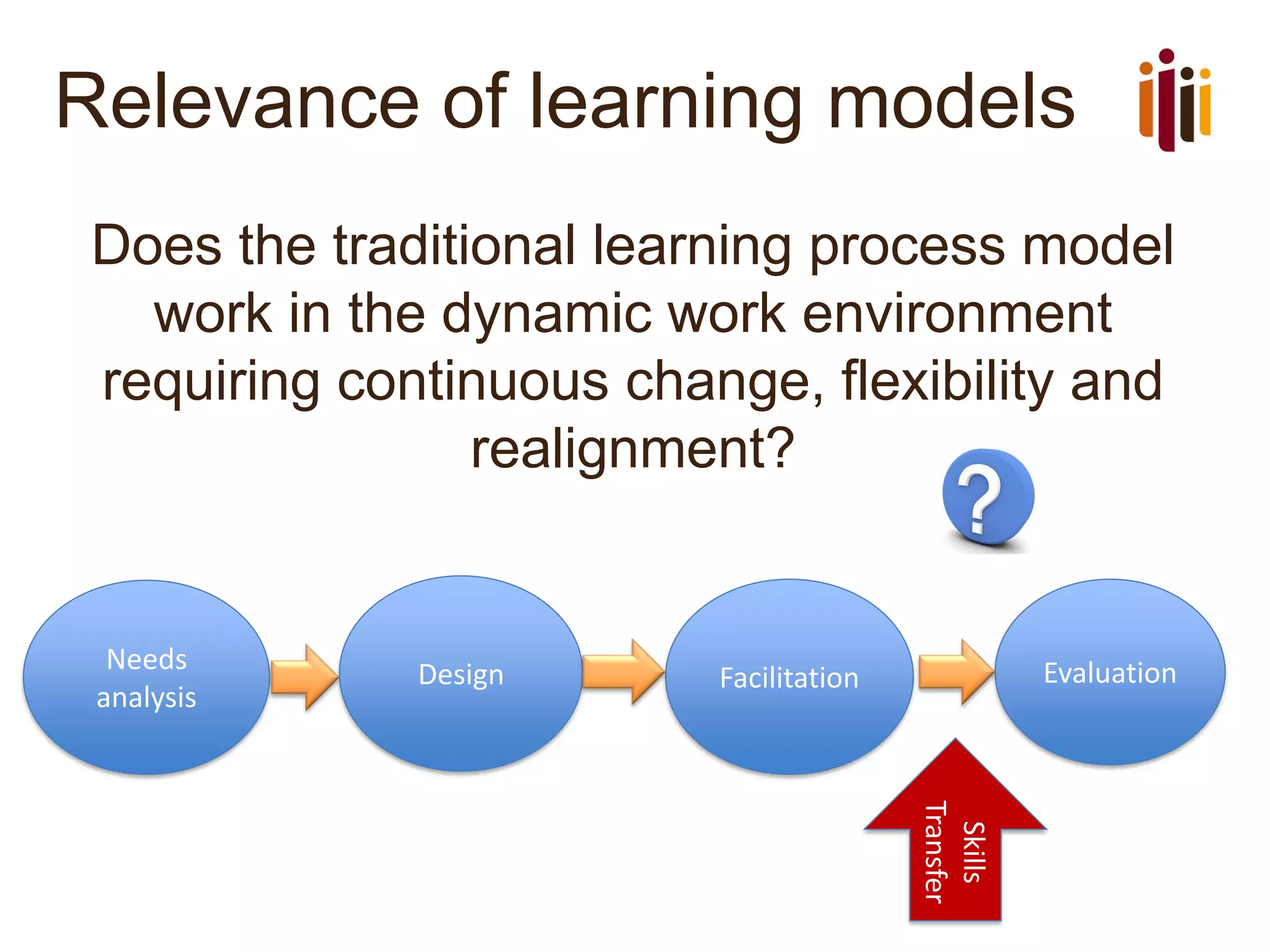
Relevance of learning models
Does the traditional learning process model
work in the dynamic work environment
requiring continuous change, flexibility and
realignment?
Needs
analysis
Design Facilitation Evaluation
Skills
Transfer
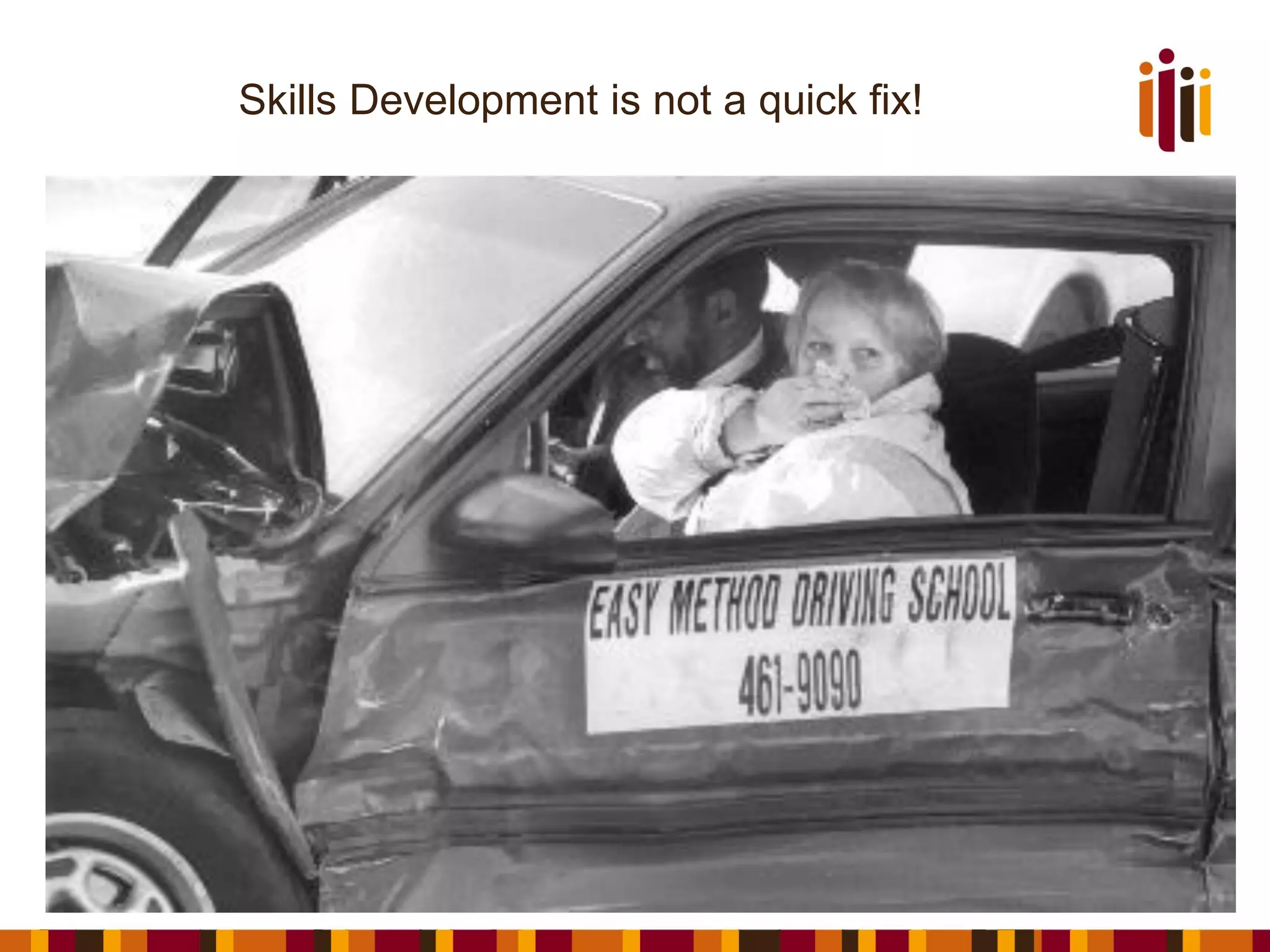
Skills Development is not a quick fix!
How effective is your L&D function to
drive business performance?
Very effective - Excellent
Effective - Good
Average
Below average
Poor
The bad news about training
Only 8-15% of training is transferred to the
workplace.
TraPlane landing in Hudson River
2009
about competence
Reporter: How did you do it?
“I think it was my training.”
Capt Chesley Sullenberger
HR Standards Files
13 standards (2013) 25 standards (2014)
BUSINESS STRATEGY – HR BUSINESS ALIGNMENT
Strategic
HRM
Talent
Management
HR Risk
Management
HR ARCHITECTURE
I
HR VALUE &
DELIVERY PLATFORM
Work-
force
planning
Learning
&
Deve-
lopment
Perfor-
mance
Mana-
gement
Reward
&
Recogni-
tion
Em-
ployee
wellness
Employ-
ment
Rela-
tions
Organi-
sation
Deve-
lopment
HR Service
Delivery
HR Technology
(HRIS)
Prepare
Imple-
ment
Review ImproveHR MEASUREMENT
HR Audit: Standards & Metrics
HRCOMPETENCIES
© SABPP HR MANAGEMENT SYSTEM STANDARDS
BUSINESS STRATEGY – HR BUSINESS ALIGNMENT
Strategic
HRM
5.3
Talent
Management
4.1
HR Risk
Management
6
FUNCTIONAL & CROSS FUNCTIONAL HR VALUE CHAIN
HR VALUE &
DELIVERY PLATFORM
Work-
force
Planning
5.2
Learning
5.7
Perfor-
mance
5.5
Reward
5.9
Well-
ness
6.2
ERM
6.3
OD
5.1
HR Service
Delivery
5
HR Technology
(HRIS) 5.1
Prepare
Imple-
ment
Review ImproveMEASURING HR SUCCESS 4.1
HR Audit: Standards & Metrics
HRCOMPETENCIES
AUDITED RATINGS – OVERALL AVERAGE
(25 companies audited)
3 Components of a Standard Element
How can we make it
work in practice?
Application
What do we want to
achieve?
Objectives
What is it?
Definition
LEARNING & DEVELOPMENT
DEFINITION
Learning and development is the practice of
providing occupationally directed and other learning
activities that enable and enhance the knowledge,
practical skills and work place experience and
behaviour of individuals and teams based on current
and future occupational requirements for optimal
organisational performance and sustainability.
SABPP (2013)
LEARNING & DEVELOPMENT
OBJECTIVES
• To create an occupationally competent and engaged workforce which builds organisational
capability, providing employees with opportunities to develop new knowledge and skills
• To focus learning and development plans on improving people’s ability to perform to
achieve organisational objectives and provide the means for measuring the impact of
learning and development interventions.
• To support and accelerate skills development and achievement of employment equity and
organisational transformation and limit the impact of skills shortages.
• To create a learning culture and environment that enables optimal individual, team and
organisation learning and growth in both competencies and behaviour.
• To capture and replicate and enhance critical knowledge within the organisation.
• To ensure learning and development is a catalyst for continuous improvement, change and
innovation.
SABPP (2013)
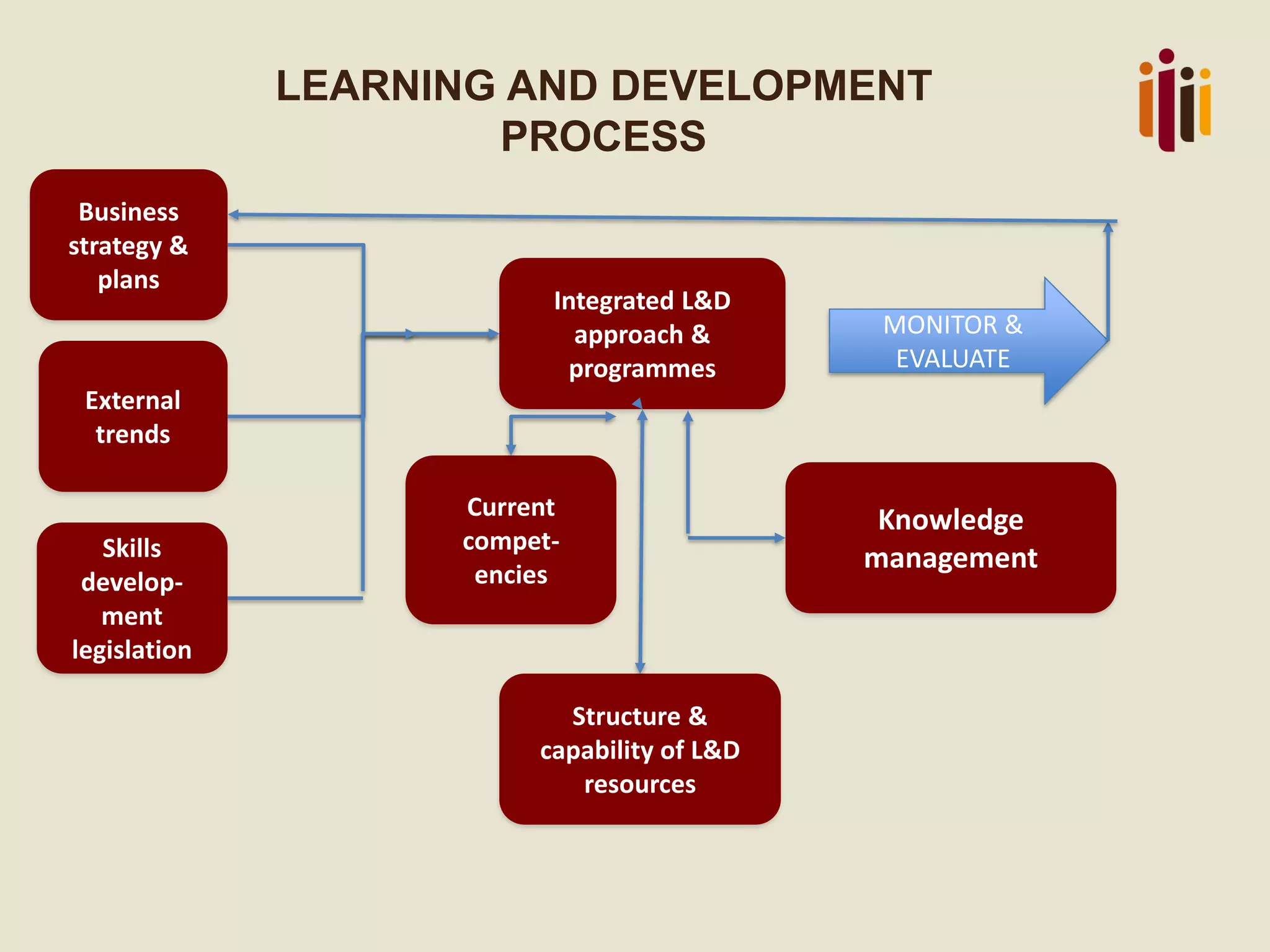
LEARNING AND DEVELOPMENT
PROCESS
Integrated L&D
approach &
programmes
Structure &
capability of L&D
resources
MONITOR &
EVALUATE
Business
strategy &
plans
External
trends
Knowledge
managementSkills
develop-
ment
legislation
Current
compet-
encies
L&D Audit Evidence
L&D Requirements Type of Evidence Sources of Evidence
Competent workforce
which builds organisational
capability – develop new
knowledge and skills
Documents – skills needs
Documents – competencies
Employee engagement
surveys
Interviews – mgt/staff
HR/HRD professionals
Line managers
Employees
Focus L&D plans on ability
to perform to achieve org
objectives - measure
Documents – L&D
performance management
WSP and ATR
Measuring L&D impact
Interviews with line mgt
HR/HRD professionals
Line managers
Support skills development
and EE and limit skills
shortages
WSP and ATR
EE Plan and Report
Analysis of skills gaps/plans
HR/HRD professionals
Line managers
Employees
Create learning culture –
competencies/behaviour
Evidence of processes to
capture critical knowledge
HR/HRD professionals
Line managers
Capture and enhance
knowledge
Continuous improvement HR/HRD professionals
Line managers
HR Professional Practice Standards
• Absenteeism management
• Career management
• Coaching & mentoring
• Collective bargaining
• Disciplinary procedure
• Dispute resolution
• Diversity management
• Grievance procedure
• Leadership development
• Learning design
• Learning evaluation
• Learning needs analysis
• On-boarding
• Organisation design
• Performance appraisals
• Recruitment
• Remuneration benchmarking
• Selection
• Succession planning
L&D
Workplace Learning System
EMERGENT ECOSYSTEM TRANSCENDENT
Structured
onboarding
Structured work
experience
Performance
help
Targeted
learning
Improvement
Support learning
of others
Share how
updated
Learning
networks
Clear development pathway
Participate in organisational
processes
Integrate learning with business
processes and events
Participate in learning circles
Participate in team-based work
Develop team members
Support the development of
learning networks
Participate in external
bodies/associations
Refine organisational practices
Talent feeder
systems
Improvement
projects
Gap between
practitioners
and experts
small
Learning
processes in
personal &
business
learning
Influence
profession
Keep up to date
Let us use learning as a catalyst
for change
Conclusion
The HR Standards and Audits have changed the
face of people management in South Africa. The HR
Standards usher in a new period of institutionalising
people management as a best practice for sound HR
professionalism in organisations.
As HRD practitioners you are the specialists who
can make this change successful.
Let us build a great HRD function aligned to
business strategy and National HR Standards at
your organisation.
We set HR standards!
professional@sabpp.co.za or registrations@sabpp.co.za
(Professional Registration)
executiveoffice@sabpp.co.za (CEO office)
marius@sabpp.co.za (CEO & Strategy inputs)
xolani@sabpp.co.za (COO)
hrstandards@sabpp.co.za (HR Standards)
hraudit@sabpp.co.za (HR Audits)
naren@sabpp.co.za (Learning & Quality)
events@sabpp.co.za (Events & HR Standards files)
Website: www.sabpp.co.za Blog: hrtoday.me
Tel: 011 045-5400 or (010) 007 5906

SABPP Skills Summit 7 March 2018

  • 1.
    The contribution ofLearning & Development Standards to Business Performance Marius Meyer 7 March 2018, Skills Summit @mariusSABPP @SABPP1 @sabpp_1
  • 2.
    Agenda • HR Standards& Audit Update • Professional Practice Standards (Phase 2) • Role of L& D in business success • Conclusion
  • 4.
    National Human Capital ConfidenceIndex Human Capital Availability • What is the match of supply and demand of economically active people (skilled and unskilled) in the country? • Where are specific under supply and over supply situations? Human Capital Contribution • How productive is the employed population? • What is the level of innovation in the country? Human Capital Wellbeing • What health and wellbeing issues impact on the general productivity potential of the economically active population? Human Capital Wealth Creation • How do different sectors of the employed population share in the wealth created in the country? • How attractive is the country to international talent? Human Capital Cost, Investment and Growth • What are we doing in terms of learning and development in the school and post-school education system? • How much are we spending on whom for what in the post- school education system? • What are we doing and how much are we spending on job creation efforts? • What health and wellbeing interventions are having positive impacts on productivity? ©SABPP (2018)
  • 5.
  • 6.
    Relevance of learningmodels Does the traditional learning process model work in the dynamic work environment requiring continuous change, flexibility and realignment? Needs analysis Design Facilitation Evaluation Skills Transfer
  • 7.
    Skills Development isnot a quick fix!
  • 8.
    How effective isyour L&D function to drive business performance? Very effective - Excellent Effective - Good Average Below average Poor
  • 9.
    The bad newsabout training Only 8-15% of training is transferred to the workplace.
  • 10.
    TraPlane landing inHudson River 2009 about competence Reporter: How did you do it? “I think it was my training.” Capt Chesley Sullenberger
  • 11.
    HR Standards Files 13standards (2013) 25 standards (2014)
  • 12.
    BUSINESS STRATEGY –HR BUSINESS ALIGNMENT Strategic HRM Talent Management HR Risk Management HR ARCHITECTURE I HR VALUE & DELIVERY PLATFORM Work- force planning Learning & Deve- lopment Perfor- mance Mana- gement Reward & Recogni- tion Em- ployee wellness Employ- ment Rela- tions Organi- sation Deve- lopment HR Service Delivery HR Technology (HRIS) Prepare Imple- ment Review ImproveHR MEASUREMENT HR Audit: Standards & Metrics HRCOMPETENCIES © SABPP HR MANAGEMENT SYSTEM STANDARDS
  • 13.
    BUSINESS STRATEGY –HR BUSINESS ALIGNMENT Strategic HRM 5.3 Talent Management 4.1 HR Risk Management 6 FUNCTIONAL & CROSS FUNCTIONAL HR VALUE CHAIN HR VALUE & DELIVERY PLATFORM Work- force Planning 5.2 Learning 5.7 Perfor- mance 5.5 Reward 5.9 Well- ness 6.2 ERM 6.3 OD 5.1 HR Service Delivery 5 HR Technology (HRIS) 5.1 Prepare Imple- ment Review ImproveMEASURING HR SUCCESS 4.1 HR Audit: Standards & Metrics HRCOMPETENCIES AUDITED RATINGS – OVERALL AVERAGE (25 companies audited)
  • 14.
    3 Components ofa Standard Element How can we make it work in practice? Application What do we want to achieve? Objectives What is it? Definition
  • 15.
    LEARNING & DEVELOPMENT DEFINITION Learningand development is the practice of providing occupationally directed and other learning activities that enable and enhance the knowledge, practical skills and work place experience and behaviour of individuals and teams based on current and future occupational requirements for optimal organisational performance and sustainability. SABPP (2013)
  • 16.
    LEARNING & DEVELOPMENT OBJECTIVES •To create an occupationally competent and engaged workforce which builds organisational capability, providing employees with opportunities to develop new knowledge and skills • To focus learning and development plans on improving people’s ability to perform to achieve organisational objectives and provide the means for measuring the impact of learning and development interventions. • To support and accelerate skills development and achievement of employment equity and organisational transformation and limit the impact of skills shortages. • To create a learning culture and environment that enables optimal individual, team and organisation learning and growth in both competencies and behaviour. • To capture and replicate and enhance critical knowledge within the organisation. • To ensure learning and development is a catalyst for continuous improvement, change and innovation. SABPP (2013)
  • 17.
    LEARNING AND DEVELOPMENT PROCESS IntegratedL&D approach & programmes Structure & capability of L&D resources MONITOR & EVALUATE Business strategy & plans External trends Knowledge managementSkills develop- ment legislation Current compet- encies
  • 18.
    L&D Audit Evidence L&DRequirements Type of Evidence Sources of Evidence Competent workforce which builds organisational capability – develop new knowledge and skills Documents – skills needs Documents – competencies Employee engagement surveys Interviews – mgt/staff HR/HRD professionals Line managers Employees Focus L&D plans on ability to perform to achieve org objectives - measure Documents – L&D performance management WSP and ATR Measuring L&D impact Interviews with line mgt HR/HRD professionals Line managers Support skills development and EE and limit skills shortages WSP and ATR EE Plan and Report Analysis of skills gaps/plans HR/HRD professionals Line managers Employees Create learning culture – competencies/behaviour Evidence of processes to capture critical knowledge HR/HRD professionals Line managers Capture and enhance knowledge Continuous improvement HR/HRD professionals Line managers
  • 19.
    HR Professional PracticeStandards • Absenteeism management • Career management • Coaching & mentoring • Collective bargaining • Disciplinary procedure • Dispute resolution • Diversity management • Grievance procedure • Leadership development • Learning design • Learning evaluation • Learning needs analysis • On-boarding • Organisation design • Performance appraisals • Recruitment • Remuneration benchmarking • Selection • Succession planning L&D
  • 20.
    Workplace Learning System EMERGENTECOSYSTEM TRANSCENDENT Structured onboarding Structured work experience Performance help Targeted learning Improvement Support learning of others Share how updated Learning networks Clear development pathway Participate in organisational processes Integrate learning with business processes and events Participate in learning circles Participate in team-based work Develop team members Support the development of learning networks Participate in external bodies/associations Refine organisational practices Talent feeder systems Improvement projects Gap between practitioners and experts small Learning processes in personal & business learning Influence profession Keep up to date
  • 21.
    Let us uselearning as a catalyst for change
  • 22.
    Conclusion The HR Standardsand Audits have changed the face of people management in South Africa. The HR Standards usher in a new period of institutionalising people management as a best practice for sound HR professionalism in organisations. As HRD practitioners you are the specialists who can make this change successful. Let us build a great HRD function aligned to business strategy and National HR Standards at your organisation.
  • 23.
    We set HRstandards! professional@sabpp.co.za or registrations@sabpp.co.za (Professional Registration) executiveoffice@sabpp.co.za (CEO office) marius@sabpp.co.za (CEO & Strategy inputs) xolani@sabpp.co.za (COO) hrstandards@sabpp.co.za (HR Standards) hraudit@sabpp.co.za (HR Audits) naren@sabpp.co.za (Learning & Quality) events@sabpp.co.za (Events & HR Standards files) Website: www.sabpp.co.za Blog: hrtoday.me Tel: 011 045-5400 or (010) 007 5906