THE NATIONAL HR STANDARDS AS A QUALITY
FRAMEWORK FOR HIGH IMPACT PEOPLE
MANAGEMENT IN BUSINESS
Marius Meyer, Chief Executive Officer: SABPP
11 June 2015
@mariusSABPP
@SABPP1
A G E N D A
• Introduction - context
• Overview of HR Standards Journey
• Examples of HR Standards
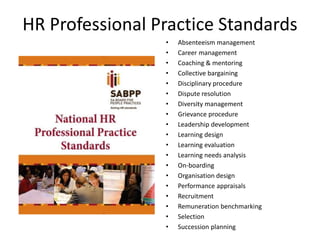
• HR Professional Practice Standards
(Phase 3)
• HR Auditing
• Conclusion
Business chamber support
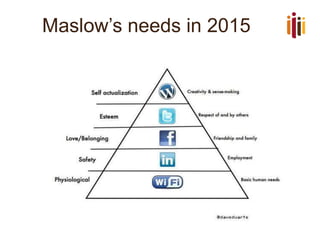
Maslow’s needs in 2015
FOLLOW US ON :
@sabpp1 SABPP
@siphiwemoyo Chairman
@mariussabpp CEO
@xolani_mawande COO
@SiphiweMashoene Events
#hrstandards
#sabpp
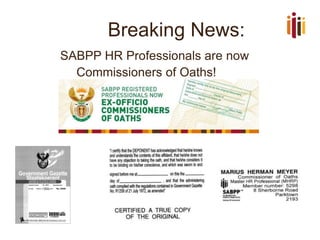
Breaking News:
SABPP HR Professionals are now
Commissioners of Oaths!
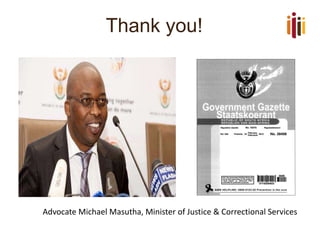
Thank you!
Advocate Michael Masutha, Minister of Justice & Correctional Services
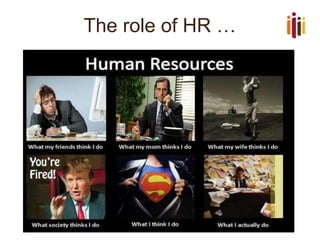
The role of HR …
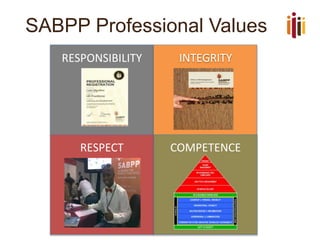
SABPP Professional Values
RESPONSIBILITY
I
RESPECT
INTEGRITY
COMPETENCE
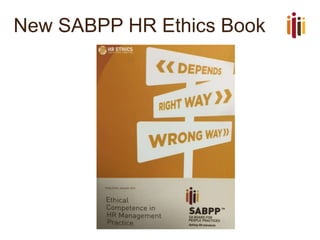
New SABPP HR Ethics Book
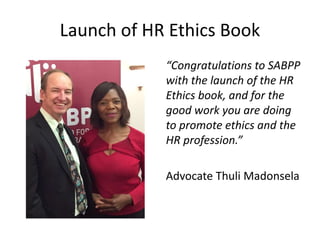
Launch of HR Ethics Book
“Congratulations to SABPP
with the launch of the HR
Ethics book, and for the
good work you are doing
to promote ethics and the
HR profession.”
Advocate Thuli Madonsela
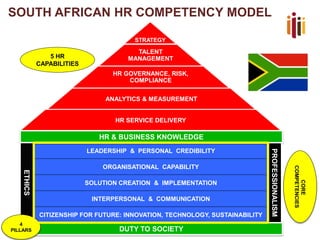
SOUTH AFRICAN HR COMPETENCY MODEL
STRATEGY
TALENT
MANAGEMENT
HR GOVERNANCE, RISK,
COMPLIANCE
ANALYTICS & MEASUREMENT
HR SERVICE DELIVERY
5 HR
CAPABILITIES
LEADERSHIP & PERSONAL CREDIBILITY
ORGANISATIONAL CAPABILITY
SOLUTION CREATION & IMPLEMENTATION
INTERPERSONAL & COMMUNICATION
CITIZENSHIP FOR FUTURE: INNOVATION, TECHNOLOGY, SUSTAINABILITY
CORE
COMPETENCIES
HR & BUSINESS KNOWLEDGE
DUTY TO SOCIETY
ETHICS
PROFESSIONALISM
4
PILLARS
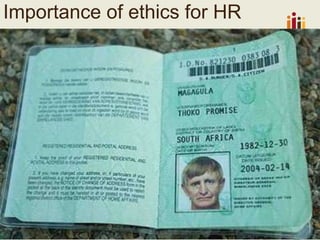
Importance of ethics for HR
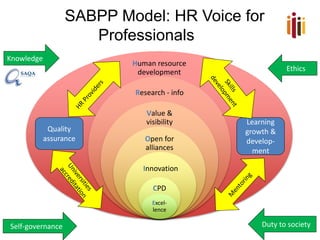
New SABPP Model: HR Voice for
Professionals
Human resource
development
Research - info
Value &
visibility
Open for
alliances
Innovation
CPD
Excel-
lence
Quality
assurance
Learning
growth &
develop-
ment
Knowledge
Self-governance Duty to society
Ethics
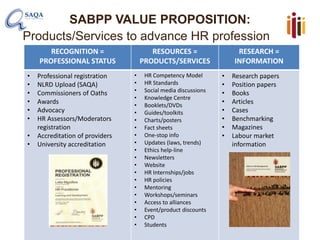
SABPP VALUE PROPOSITION:
Products/Services to advance HR profession
RECOGNITION =
PROFESSIONAL STATUS
RESOURCES =
PRODUCTS/SERVICES
RESEARCH =
INFORMATION
• Professional registration
• NLRD Upload (SAQA)
• Commissioners of Oaths
• Awards
• Advocacy
• HR Assessors/Moderators
registration
• Accreditation of providers
• University accreditation
• HR Competency Model
• HR Standards
• Social media discussions
• Knowledge Centre
• Booklets/DVDs
• Guides/toolkits
• Charts/posters
• Fact sheets
• One-stop info
• Updates (laws, trends)
• Ethics help-line
• Newsletters
• Website
• HR Internships/jobs
• HR policies
• Mentoring
• Workshops/seminars
• Access to alliances
• Event/product discounts
• CPD
• Students
• Research papers
• Position papers
• Books
• Articles
• Cases
• Benchmarking
• Magazines
• Labour market
information
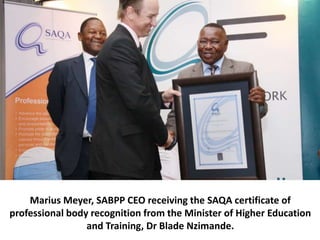
Marius Meyer, SABPP CEO receiving the SAQA certificate of
professional body recognition from the Minister of Higher Education
and Training, Dr Blade Nzimande.
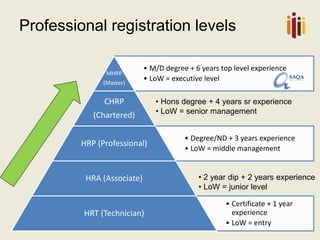
Professional registration levels
• M/D degree + 6 years top level experience
• LoW = executive level
MHRP
(Master)
CHRP
(Chartered)
• Degree/ND + 3 years experience
• LoW = middle management
HRP (Professional)
HRA (Associate)
• Certificate + 1 year
experience
• LoW = entry
HRT (Technician)
• Hons degree + 4 years sr experience
• LoW = senior management
• 2 year dip + 2 years experience
• LoW = junior level
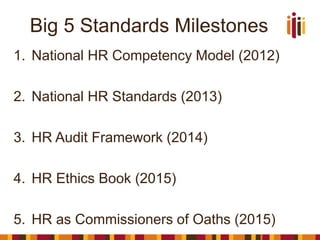
Big 5 Standards Milestones
1. National HR Competency Model (2012)
2. National HR Standards (2013)
3. HR Audit Framework (2014)
4. HR Ethics Book (2015)
5. HR as Commissioners of Oaths (2015)
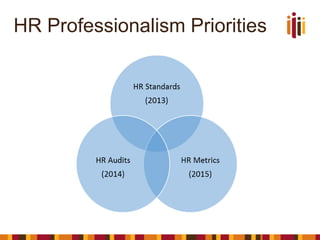
HR Professionalism Priorities
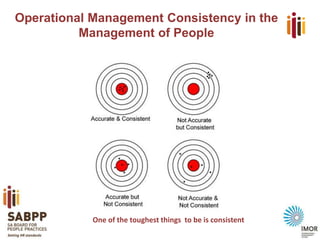
Operational Management Consistency in the
Management of People
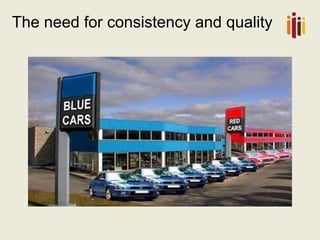
One of the toughest things to be is consistent
Why a national HR Standard?
• We need to improve the quality of HR
practice.
• HR will not be seen as a true profession
without standards.
• Inconsistencies – practices, sites, business
units, companies, industries.
• Too many bad examples of things going
wrong – Marikana, Medupi.
• Raising the bar for the HR profession and
business impact.
What are standards really?
• A level of acceptable quality
• Good enough in terms of professionalism
• What is good or normal or usual
• A guideline for practice
• A foundation for reasonable expectations
and sound judgement
• A basis for measurement (M&E)
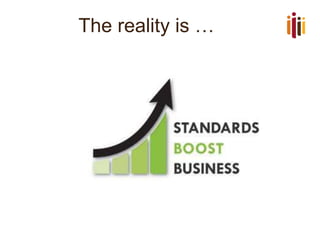
The reality is …
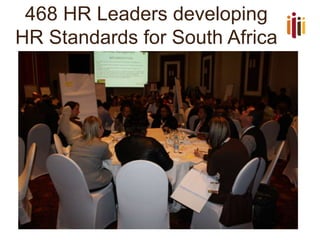
468 HR Leaders developing
HR Standards for South Africa
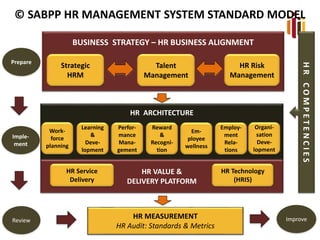
BUSINESS STRATEGY – HR BUSINESS ALIGNMENT
Strategic
HRM
Talent
Management
HR Risk
Management
HR ARCHITECTURE
I
HR VALUE &
DELIVERY PLATFORM
Work-
force
planning
Learning
&
Deve-
lopment
Perfor-
mance
Mana-
gement
Reward
&
Recogni-
tion
Em-
ployee
wellness
Employ-
ment
Rela-
tions
Organi-
sation
Deve-
lopment
HR Service
Delivery
HR Technology
(HRIS)
Prepare
Imple-
ment
Review ImproveHR MEASUREMENT
HR Audit: Standards & Metrics
HRCOMPETENCIES
© SABPP HR MANAGEMENT SYSTEM STANDARD MODEL
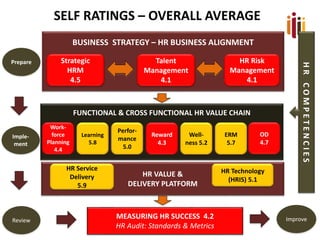
BUSINESS STRATEGY – HR BUSINESS ALIGNMENT
Strategic
HRM
4.5
Talent
Management
4.1
HR Risk
Management
4.1
FUNCTIONAL & CROSS FUNCTIONAL HR VALUE CHAIN
HR VALUE &
DELIVERY PLATFORM
Work-
force
Planning
4.4
Learning
5.8
Perfor-
mance
5.0
Reward
4.3
Well-
ness 5.2
ERM
5.7
OD
4.7
HR Service
Delivery
5.9
HR Technology
(HRIS) 5.1
Prepare
Imple-
ment
Review ImproveMEASURING HR SUCCESS 4.2
HR Audit: Standards & Metrics
HRCOMPETENCIES
SELF RATINGS – OVERALL AVERAGE
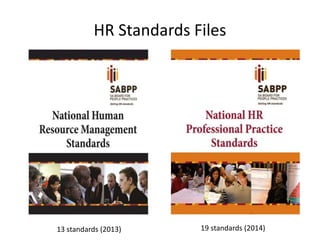
HR Standards Files
13 standards (2013) 19 standards (2014)
HR Professional Practice Standards
• Absenteeism management
• Career management
• Coaching & mentoring
• Collective bargaining
• Disciplinary procedure
• Dispute resolution
• Diversity management
• Grievance procedure
• Leadership development
• Learning design
• Learning evaluation
• Learning needs analysis
• On-boarding
• Organisation design
• Performance appraisals
• Recruitment
• Remuneration benchmarking
• Selection
• Succession planning
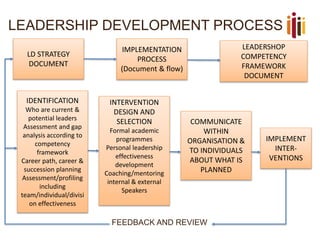
LEADERSHIP DEVELOPMENT PROCESS
FEEDBACK AND REVIEW
LD STRATEGY
DOCUMENT
IMPLEMENTATION
PROCESS
(Document & flow)
LEADERSHOP
COMPETENCY
FRAMEWORK
DOCUMENT
INTERVENTION
DESIGN AND
SELECTION
Formal academic
programmes
Personal leadership
effectiveness
development
Coaching/mentoring
internal & external
Speakers
COMMUNICATE
WITHIN
ORGANISATION &
TO INDIVIDUALS
ABOUT WHAT IS
PLANNED
IMPLEMENT
INTER-
VENTIONS
IDENTIFICATION
Who are current &
potential leaders
Assessment and gap
analysis according to
competency
framework
Career path, career &
succession planning
Assessment/profiling
including
team/individual/divisi
on effectiveness
HR Standards Supporters
In-house Presentations
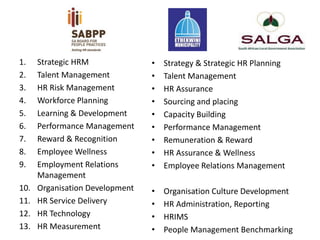
1. Strategic HRM
2. Talent Management
3. HR Risk Management
4. Workforce Planning
5. Learning & Development
6. Performance Management
7. Reward & Recognition
8. Employee Wellness
9. Employment Relations
Management
10. Organisation Development
11. HR Service Delivery
12. HR Technology
13. HR Measurement
• Strategy & Strategic HR Planning
• Talent Management
• HR Assurance
• Sourcing and placing
• Capacity Building
• Performance Management
• Remuneration & Reward
• HR Assurance & Wellness
• Employee Relations Management
• Organisation Culture Development
• HR Administration, Reporting
• HRIMS
• People Management Benchmarking
Professional forum support
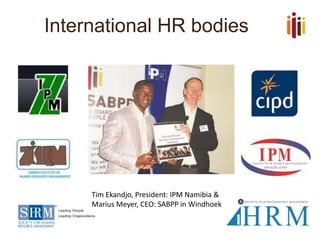
International HR bodies
Tim Ekandjo, President: IPM Namibia &
Marius Meyer, CEO: SABPP in Windhoek
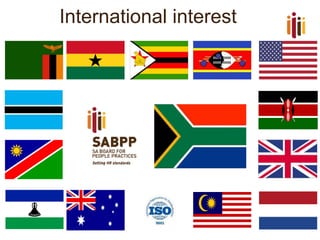
International interest
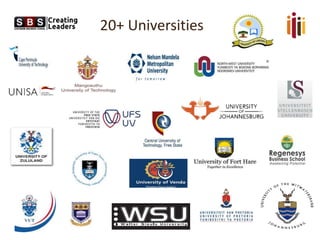
20+ Universities
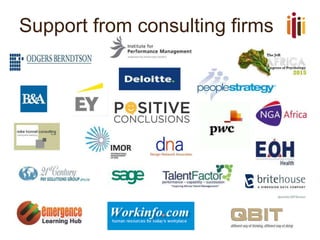
Support from consulting firms
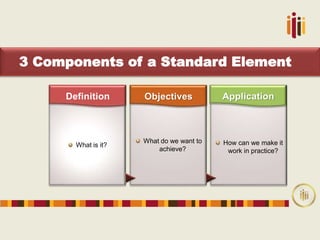
3 Components of a Standard Element
How can we make it
work in practice?
Application
What do we want to
achieve?
Objectives
What is it?
Definition
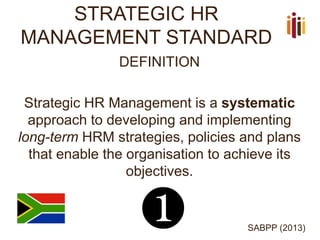
STRATEGIC HR
MANAGEMENT STANDARD
DEFINITION
Strategic HR Management is a systematic
approach to developing and implementing
long-term HRM strategies, policies and plans
that enable the organisation to achieve its
objectives.
SABPP (2013)
❶
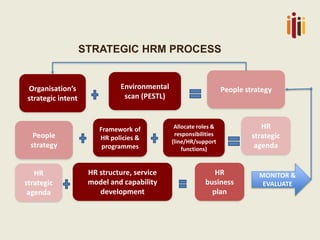
STRATEGIC HRM PROCESS
Framework of
HR policies &
programmes
Environmental
scan (PESTL)
HR structure, service
model and capability
development
People strategy
HR
strategic
agenda
Organisation’s
strategic intent
HR
strategic
agenda
HR
business
plan
People
strategy
Allocate roles &
responsibilities
(line/HR/support
functions)
MONITOR &
EVALUATE
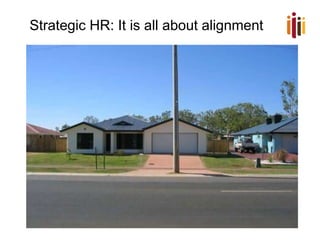
Strategic HR: It is all about alignment
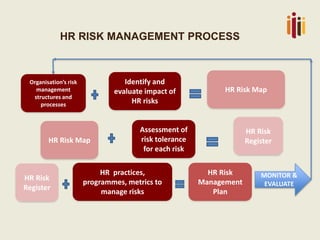
HR RISK MANAGEMENT PROCESS
Assessment of
risk tolerance
for each risk
Identify and
evaluate impact of
HR risks
HR practices,
programmes, metrics to
manage risks
HR Risk Map
HR Risk
Register
Organisation’s risk
management
structures and
processes
HR Risk
Register
HR Risk
Management
Plan
HR Risk Map
MONITOR &
EVALUATE
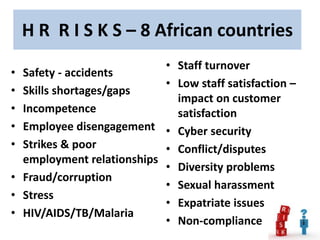
H R R I S K S – 8 African countries
• Safety - accidents
• Skills shortages/gaps
• Incompetence
• Employee disengagement
• Strikes & poor
employment relationships
• Fraud/corruption
• Stress
• HIV/AIDS/TB/Malaria
• Staff turnover
• Low staff satisfaction –
impact on customer
satisfaction
• Cyber security
• Conflict/disputes
• Diversity problems
• Sexual harassment
• Expatriate issues
• Non-compliance
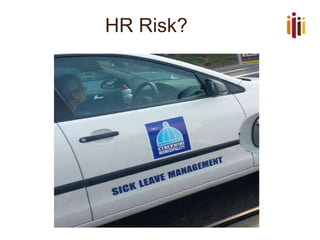
HR Risk?
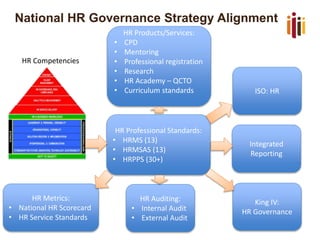
National HR Governance Strategy Alignment
HR Professional Standards:
• HRMS (13)
• HRMSAS (13)
• HRPPS (30+)
HR Products/Services:
• CPD
• Mentoring
• Professional registration
• Research
• HR Academy – QCTO
• Curriculum standards
HR Metrics:
• National HR Scorecard
• HR Service Standards
HR Auditing:
• Internal Audit
• External Audit
King IV:
HR Governance
ISO: HR
Integrated
Reporting
HR Competencies
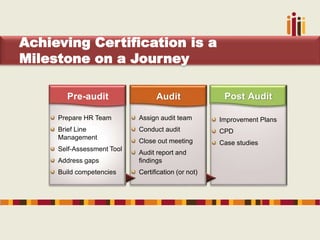
Achieving Certification is a
Milestone on a Journey
Improvement Plans
CPD
Case studies
Post Audit
Assign audit team
Conduct audit
Close out meeting
Audit report and
findings
Certification (or not)
Audit
Prepare HR Team
Brief Line
Management
Self-Assessment Tool
Address gaps
Build competencies
Pre-audit
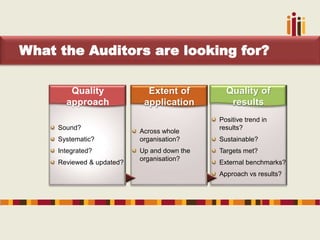
What the Auditors are looking for?
Positive trend in
results?
Sustainable?
Targets met?
External benchmarks?
Approach vs results?
Quality of
results
Across whole
organisation?
Up and down the
organisation?
Extent of
application
Sound?
Systematic?
Integrated?
Reviewed & updated?
Quality
approach
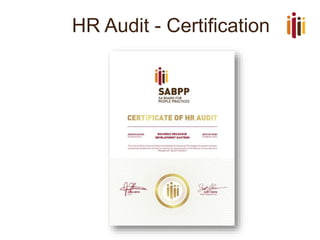
HR Audit - Certification
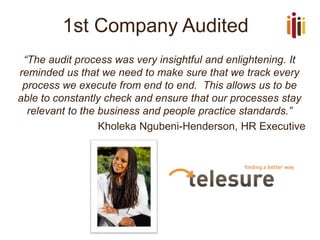
1st Company Audited
“The audit process was very insightful and enlightening. It
reminded us that we need to make sure that we track every
process we execute from end to end. This allows us to be
able to constantly check and ensure that our processes stay
relevant to the business and people practice standards.”
Kholeka Ngubeni-Henderson, HR Executive
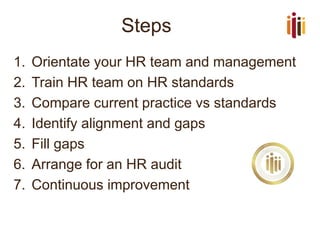
Steps
1. Orientate your HR team and management
2. Train HR team on HR standards
3. Compare current practice vs standards
4. Identify alignment and gaps
5. Fill gaps
6. Arrange for an HR audit
7. Continuous improvement
The need for consistency and quality
Conclusion
The National HR Standards have changed the
face of people management in South Africa.
The HR Standards usher in a new period of
institutionalising people management as a
best practice for sound HR professionalism
and business impact in organisations. Thank
you DCCI for the invitation to your HR Forum.
We set HR standards!
professional@sabpp.co.za or registrations@sabpp.co.za
(Professional Registration)
executiveoffice@sabpp.co.za (CEO office)
marius@sabpp.co.za (CEO & Strategy inputs)
xolani@sabpp.co.za (COO)
hraudit@sabpp.co.za (HR Audits)
penny@sabpp.co.za (Research)
naren@sabpp.co.za (Learning & Quality)
events@sabpp.co.za (Events & HR Standards files)
Website: www.sabpp.co.za Blog: hrtoday.me
Office: 8 Sherborne Str, Parktown, South Africa
Tel: +27 11 045-5400 Fax: 011 482-4830

Sabpp durban chamber 2015

  • 1.
    THE NATIONAL HRSTANDARDS AS A QUALITY FRAMEWORK FOR HIGH IMPACT PEOPLE MANAGEMENT IN BUSINESS Marius Meyer, Chief Executive Officer: SABPP 11 June 2015 @mariusSABPP @SABPP1
  • 2.
    A G EN D A • Introduction - context • Overview of HR Standards Journey • Examples of HR Standards • HR Professional Practice Standards (Phase 3) • HR Auditing • Conclusion
  • 3.
  • 4.
  • 5.
    FOLLOW US ON: @sabpp1 SABPP @siphiwemoyo Chairman @mariussabpp CEO @xolani_mawande COO @SiphiweMashoene Events #hrstandards #sabpp
  • 6.
    Breaking News: SABPP HRProfessionals are now Commissioners of Oaths!
  • 7.
    Thank you! Advocate MichaelMasutha, Minister of Justice & Correctional Services
  • 8.
  • 9.
  • 10.
    New SABPP HREthics Book
  • 11.
    Launch of HREthics Book “Congratulations to SABPP with the launch of the HR Ethics book, and for the good work you are doing to promote ethics and the HR profession.” Advocate Thuli Madonsela
  • 12.
    SOUTH AFRICAN HRCOMPETENCY MODEL STRATEGY TALENT MANAGEMENT HR GOVERNANCE, RISK, COMPLIANCE ANALYTICS & MEASUREMENT HR SERVICE DELIVERY 5 HR CAPABILITIES LEADERSHIP & PERSONAL CREDIBILITY ORGANISATIONAL CAPABILITY SOLUTION CREATION & IMPLEMENTATION INTERPERSONAL & COMMUNICATION CITIZENSHIP FOR FUTURE: INNOVATION, TECHNOLOGY, SUSTAINABILITY CORE COMPETENCIES HR & BUSINESS KNOWLEDGE DUTY TO SOCIETY ETHICS PROFESSIONALISM 4 PILLARS
  • 13.
  • 14.
    New SABPP Model:HR Voice for Professionals Human resource development Research - info Value & visibility Open for alliances Innovation CPD Excel- lence Quality assurance Learning growth & develop- ment Knowledge Self-governance Duty to society Ethics
  • 15.
    SABPP VALUE PROPOSITION: Products/Servicesto advance HR profession RECOGNITION = PROFESSIONAL STATUS RESOURCES = PRODUCTS/SERVICES RESEARCH = INFORMATION • Professional registration • NLRD Upload (SAQA) • Commissioners of Oaths • Awards • Advocacy • HR Assessors/Moderators registration • Accreditation of providers • University accreditation • HR Competency Model • HR Standards • Social media discussions • Knowledge Centre • Booklets/DVDs • Guides/toolkits • Charts/posters • Fact sheets • One-stop info • Updates (laws, trends) • Ethics help-line • Newsletters • Website • HR Internships/jobs • HR policies • Mentoring • Workshops/seminars • Access to alliances • Event/product discounts • CPD • Students • Research papers • Position papers • Books • Articles • Cases • Benchmarking • Magazines • Labour market information
  • 16.
    Marius Meyer, SABPPCEO receiving the SAQA certificate of professional body recognition from the Minister of Higher Education and Training, Dr Blade Nzimande.
  • 17.
    Professional registration levels •M/D degree + 6 years top level experience • LoW = executive level MHRP (Master) CHRP (Chartered) • Degree/ND + 3 years experience • LoW = middle management HRP (Professional) HRA (Associate) • Certificate + 1 year experience • LoW = entry HRT (Technician) • Hons degree + 4 years sr experience • LoW = senior management • 2 year dip + 2 years experience • LoW = junior level
  • 18.
    Big 5 StandardsMilestones 1. National HR Competency Model (2012) 2. National HR Standards (2013) 3. HR Audit Framework (2014) 4. HR Ethics Book (2015) 5. HR as Commissioners of Oaths (2015)
  • 19.
  • 20.
    Operational Management Consistencyin the Management of People One of the toughest things to be is consistent
  • 21.
    Why a nationalHR Standard? • We need to improve the quality of HR practice. • HR will not be seen as a true profession without standards. • Inconsistencies – practices, sites, business units, companies, industries. • Too many bad examples of things going wrong – Marikana, Medupi. • Raising the bar for the HR profession and business impact.
  • 22.
    What are standardsreally? • A level of acceptable quality • Good enough in terms of professionalism • What is good or normal or usual • A guideline for practice • A foundation for reasonable expectations and sound judgement • A basis for measurement (M&E)
  • 23.
  • 24.
    468 HR Leadersdeveloping HR Standards for South Africa
  • 25.
    BUSINESS STRATEGY –HR BUSINESS ALIGNMENT Strategic HRM Talent Management HR Risk Management HR ARCHITECTURE I HR VALUE & DELIVERY PLATFORM Work- force planning Learning & Deve- lopment Perfor- mance Mana- gement Reward & Recogni- tion Em- ployee wellness Employ- ment Rela- tions Organi- sation Deve- lopment HR Service Delivery HR Technology (HRIS) Prepare Imple- ment Review ImproveHR MEASUREMENT HR Audit: Standards & Metrics HRCOMPETENCIES © SABPP HR MANAGEMENT SYSTEM STANDARD MODEL
  • 26.
    BUSINESS STRATEGY –HR BUSINESS ALIGNMENT Strategic HRM 4.5 Talent Management 4.1 HR Risk Management 4.1 FUNCTIONAL & CROSS FUNCTIONAL HR VALUE CHAIN HR VALUE & DELIVERY PLATFORM Work- force Planning 4.4 Learning 5.8 Perfor- mance 5.0 Reward 4.3 Well- ness 5.2 ERM 5.7 OD 4.7 HR Service Delivery 5.9 HR Technology (HRIS) 5.1 Prepare Imple- ment Review ImproveMEASURING HR SUCCESS 4.2 HR Audit: Standards & Metrics HRCOMPETENCIES SELF RATINGS – OVERALL AVERAGE
  • 27.
    HR Standards Files 13standards (2013) 19 standards (2014)
  • 28.
    HR Professional PracticeStandards • Absenteeism management • Career management • Coaching & mentoring • Collective bargaining • Disciplinary procedure • Dispute resolution • Diversity management • Grievance procedure • Leadership development • Learning design • Learning evaluation • Learning needs analysis • On-boarding • Organisation design • Performance appraisals • Recruitment • Remuneration benchmarking • Selection • Succession planning
  • 29.
    LEADERSHIP DEVELOPMENT PROCESS FEEDBACKAND REVIEW LD STRATEGY DOCUMENT IMPLEMENTATION PROCESS (Document & flow) LEADERSHOP COMPETENCY FRAMEWORK DOCUMENT INTERVENTION DESIGN AND SELECTION Formal academic programmes Personal leadership effectiveness development Coaching/mentoring internal & external Speakers COMMUNICATE WITHIN ORGANISATION & TO INDIVIDUALS ABOUT WHAT IS PLANNED IMPLEMENT INTER- VENTIONS IDENTIFICATION Who are current & potential leaders Assessment and gap analysis according to competency framework Career path, career & succession planning Assessment/profiling including team/individual/divisi on effectiveness
  • 30.
  • 31.
  • 32.
    1. Strategic HRM 2.Talent Management 3. HR Risk Management 4. Workforce Planning 5. Learning & Development 6. Performance Management 7. Reward & Recognition 8. Employee Wellness 9. Employment Relations Management 10. Organisation Development 11. HR Service Delivery 12. HR Technology 13. HR Measurement • Strategy & Strategic HR Planning • Talent Management • HR Assurance • Sourcing and placing • Capacity Building • Performance Management • Remuneration & Reward • HR Assurance & Wellness • Employee Relations Management • Organisation Culture Development • HR Administration, Reporting • HRIMS • People Management Benchmarking
  • 33.
  • 34.
    International HR bodies TimEkandjo, President: IPM Namibia & Marius Meyer, CEO: SABPP in Windhoek
  • 35.
  • 36.
  • 37.
  • 38.
    3 Components ofa Standard Element How can we make it work in practice? Application What do we want to achieve? Objectives What is it? Definition
  • 39.
    STRATEGIC HR MANAGEMENT STANDARD DEFINITION StrategicHR Management is a systematic approach to developing and implementing long-term HRM strategies, policies and plans that enable the organisation to achieve its objectives. SABPP (2013) ❶
  • 40.
    STRATEGIC HRM PROCESS Frameworkof HR policies & programmes Environmental scan (PESTL) HR structure, service model and capability development People strategy HR strategic agenda Organisation’s strategic intent HR strategic agenda HR business plan People strategy Allocate roles & responsibilities (line/HR/support functions) MONITOR & EVALUATE
  • 41.
    Strategic HR: Itis all about alignment
  • 42.
    HR RISK MANAGEMENTPROCESS Assessment of risk tolerance for each risk Identify and evaluate impact of HR risks HR practices, programmes, metrics to manage risks HR Risk Map HR Risk Register Organisation’s risk management structures and processes HR Risk Register HR Risk Management Plan HR Risk Map MONITOR & EVALUATE
  • 43.
    H R RI S K S – 8 African countries • Safety - accidents • Skills shortages/gaps • Incompetence • Employee disengagement • Strikes & poor employment relationships • Fraud/corruption • Stress • HIV/AIDS/TB/Malaria • Staff turnover • Low staff satisfaction – impact on customer satisfaction • Cyber security • Conflict/disputes • Diversity problems • Sexual harassment • Expatriate issues • Non-compliance
  • 44.
  • 45.
    National HR GovernanceStrategy Alignment HR Professional Standards: • HRMS (13) • HRMSAS (13) • HRPPS (30+) HR Products/Services: • CPD • Mentoring • Professional registration • Research • HR Academy – QCTO • Curriculum standards HR Metrics: • National HR Scorecard • HR Service Standards HR Auditing: • Internal Audit • External Audit King IV: HR Governance ISO: HR Integrated Reporting HR Competencies
  • 46.
    Achieving Certification isa Milestone on a Journey Improvement Plans CPD Case studies Post Audit Assign audit team Conduct audit Close out meeting Audit report and findings Certification (or not) Audit Prepare HR Team Brief Line Management Self-Assessment Tool Address gaps Build competencies Pre-audit
  • 47.
    What the Auditorsare looking for? Positive trend in results? Sustainable? Targets met? External benchmarks? Approach vs results? Quality of results Across whole organisation? Up and down the organisation? Extent of application Sound? Systematic? Integrated? Reviewed & updated? Quality approach
  • 48.
    HR Audit -Certification
  • 49.
    1st Company Audited “Theaudit process was very insightful and enlightening. It reminded us that we need to make sure that we track every process we execute from end to end. This allows us to be able to constantly check and ensure that our processes stay relevant to the business and people practice standards.” Kholeka Ngubeni-Henderson, HR Executive
  • 50.
    Steps 1. Orientate yourHR team and management 2. Train HR team on HR standards 3. Compare current practice vs standards 4. Identify alignment and gaps 5. Fill gaps 6. Arrange for an HR audit 7. Continuous improvement
  • 51.
    The need forconsistency and quality
  • 52.
    Conclusion The National HRStandards have changed the face of people management in South Africa. The HR Standards usher in a new period of institutionalising people management as a best practice for sound HR professionalism and business impact in organisations. Thank you DCCI for the invitation to your HR Forum.
  • 53.
    We set HRstandards! professional@sabpp.co.za or registrations@sabpp.co.za (Professional Registration) executiveoffice@sabpp.co.za (CEO office) marius@sabpp.co.za (CEO & Strategy inputs) xolani@sabpp.co.za (COO) hraudit@sabpp.co.za (HR Audits) penny@sabpp.co.za (Research) naren@sabpp.co.za (Learning & Quality) events@sabpp.co.za (Events & HR Standards files) Website: www.sabpp.co.za Blog: hrtoday.me Office: 8 Sherborne Str, Parktown, South Africa Tel: +27 11 045-5400 Fax: 011 482-4830