Draft Working Paper, May 2017
Addressing Adolescence – What is working and what can be planned better?
Schematic Analysis for better outreach and impact
Paramita Majumdar1
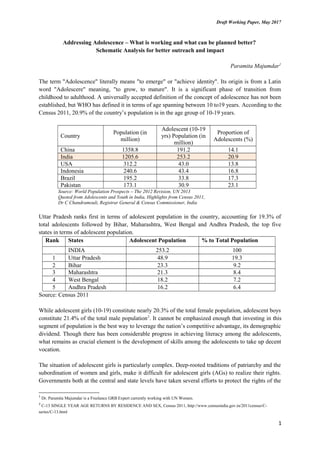
The term "Adolescence" literally means "to emerge" or "achieve identity". Its origin is from a Latin
word "Adolescere" meaning, "to grow, to mature". It is a significant phase of transition from
childhood to adulthood. A universally accepted definition of the concept of adolescence has not been
established, but WHO has defined it in terms of age spanning between 10 to19 years. According to the
Census 2011, 20.9% of the country’s population is in the age group of 10-19 years.
Country
Population (in
million)
Adolescent (10-19
yrs) Population (in
million)
Proportion of
Adolescents (%)
China 1358.8 191.2 14.1
India 1205.6 253.2 20.9
USA 312.2 43.0 13.8
Indonesia 240.6 43.4 16.8
Brazil 195.2 33.8 17.3
Pakistan 173.1 30.9 23.1
Source: World Population Prospects – The 2012 Revision, UN 2013
Quoted from Adolescents and Youth in India, Highlights from Census 2011,
Dr C Chandramouli, Registrar General & Census Commissioner, India
Uttar Pradesh ranks first in terms of adolescent population in the country, accounting for 19.3% of
total adolescents followed by Bihar, Maharashtra, West Bengal and Andhra Pradesh, the top five
states in terms of adolescent population.
Rank States Adolescent Population % to Total Population
INDIA 253.2 100
1 Uttar Pradesh 48.9 19.3
2 Bihar 23.3 9.2
3 Maharashtra 21.3 8.4
4 West Bengal 18.2 7.2
5 Andhra Pradesh 16.2 6.4
Source: Census 2011
While adolescent girls (10-19) constitute nearly 20.3% of the total female population, adolescent boys
constitute 21.4% of the total male population2
. It cannot be emphasized enough that investing in this
segment of population is the best way to leverage the nation’s competitive advantage, its demographic
dividend. Though there has been considerable progress in achieving literacy among the adolescents,
what remains as crucial element is the development of skills among the adolescents to take up decent
vocation.
The situation of adolescent girls is particularly complex. Deep-rooted traditions of patriarchy and the
subordination of women and girls, make it difficult for adolescent girls (AGs) to realize their rights.
Governments both at the central and state levels have taken several efforts to protect the rights of the
1
Dr. Paramita Majumdar is a Freelance GRB Expert currently working with UN Women.
2
C-13 SINGLE YEAR AGE RETURNS BY RESIDENCE AND SEX, Census 2011, http://www.censusindia.gov.in/2011census/C-
series/C-13.html
1
Draft Working Paper, May 2017
adolescents. Some of the schemes initiated by the Government to develop the adolescent girls that
have been quite successful are mentioned in the following paragraphs.
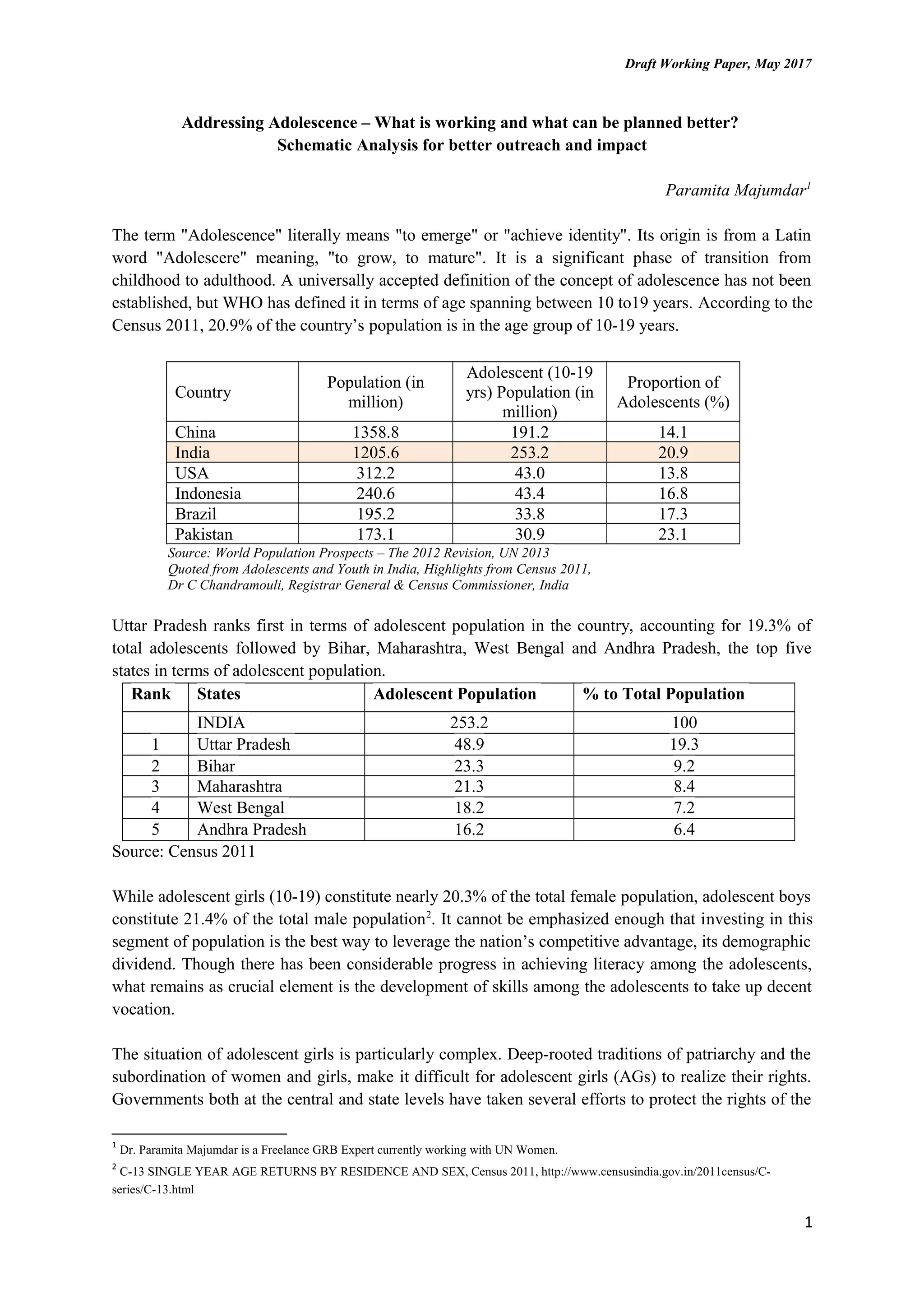
1. Rajiv Gandhi Scheme for Empowerment of Adolescent Girls (RGSEAG) – SABLA
The Ministry of Women and Child Development, Government of India, in the year 2000 came up
with scheme called Kishori Shakti Yojna (KSY) using the infrastructure of Integrated Child
Development Services (ICDS). The objectives of the Scheme were to improve the nutritional and
health status of girls in the age group of 11-18 years as well as to equip them to improve and upgrade
their home-based and vocational skills; and to promote their overall development including awareness
about their health, personal hygiene, nutrition, family welfare and management.
Thereafter, Nutrition Programme for Adolescent Girls (NPAG) was initiated as a pilot project in
the year 2002-03 in 51 identified districts across the country to address the problem of under-nutrition
among adolescent girls.
Both KSY and NPAG have influenced the lives of AGs to some extent, but have not shown the
desired impact. Both the schemes had limited financial assistance and coverage, besides having
similar interventions and catered to the same target groups.
A need was therefore felt to formulate a new comprehensive scheme merging the erstwhile two
schemes to address the multi-dimensional problems of the AGs. Thus the Rajiv Gandhi Scheme for
Empowerment of Adolescent Girls (RGSEAG) – SABLA, replaced KSY and NPAG in the 200
selected districts. The objectives of the Scheme are to:
(i) Enable the AGs for self-development and empowerment
(ii) Improve their nutrition and health status.
(iii)Promote awareness about health, hygiene, nutrition, Adolescent Reproductive and Sexual
Health (ARSH) and family and child care.
(iv) Upgrade their home-based skills, life skills and tie up with National Skill Development
Program (NSDP) for vocational skills
(v) Mainstream out of school AGs into formal/non formal education
(vi)Provide information/guidance about existing public services such as PHC, CHC, Post Office,
Bank, Police Station, etc.
2. Scheme for Promotion of Menstrual Hygiene3
:
The Ministry of Health and Family Welfare introduced a scheme for promotion of menstrual hygiene
among adolescent girls in the age group of 10-19 years in rural areas in 2010. The scheme aims at
ensuring that adolescent girls in the target group have adequate knowledge and information about
menstrual hygiene and the use of sanitary napkins, that high quality, safe products are made available
to them, and that environmentally safe disposal mechanisms are readily accessible. The scheme has
been launched as part of the Adolescent Reproductive and Sexual Health (ARSH) component
under RCH II.
The major objectives of the scheme are:
3
http://nrhm.gov.in/nrhmcomponnets/reproductive-child-health/adolescent-health/mhs.html?start=5
2
Draft Working Paper, May 2017
• To increase awareness among adolescent girls on Menstrual Hygiene
• To increase access to and use of high quality sanitary napkins to adolescent girls in rural areas.
• To ensure safe disposal of Sanitary Napkins in an environmentally friendly manner.
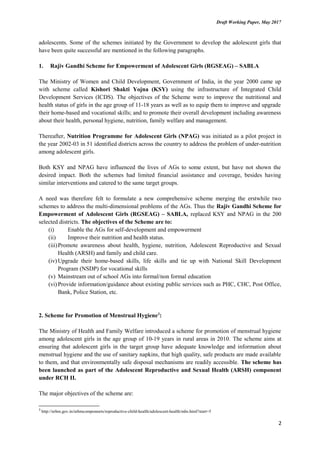
Under the scheme a pack of 6 sanitary napkins is provided under the NRHM’s brand ‘Freedays’.
These napkins are sold to the adolescents girls at Rs. 6 for a pack of 6 napkins in the village by the
Accredited Social Health Activist (ASHA). On sale of each pack, the ASHA gets an incentive of Rs. 1
per pack besides a free pack of sanitary napkins per month.
3. Kanyashree Prakalpa4
Department of Women Development and Social Welfare, Government of West Bengal has
designed the Kanyashree Prakalpa - a conditional cash transfer scheme with the aim of improving
the status and well being of the girl child in West Bengal by incentivizing schooling of all teenage
girls and delaying their marriages until the age of 18, the legal age of marriage. Kanyashree
Prakalpa is a West Bengal Government sponsored scheme implemented in all districts of the State.
The scheme has two components:
(i) Annual Scholarship of Rs. 500/-(Rupees Five hundred only) for unmarried girls aged
13-18 years enrolled in classes VIII-XII in government recognized regular or equivalent
open school or equivalent vocational/technical training course.
(ii) One time Grant of Rs. 25,000/-(Rupees Twenty-five thousand only) for girls turned 18 at
the time of application, enrolled in government recognized regular or open school/college
or pursuing vocational/technical training or sports activity or is an inmate of Home
registered under JJ Act 2000.
Benefits under the scheme are granted to girls belonging to families with annual family income of
not more than Rs. 1, 20,000/- (Rupees One Lakh and twenty thousand only). The bar for family
income is not applicable if the girl has lost both parents, is physically challenged (40% disability)
or is an inmate of Juvenile Justice Home.
Given that child marriage has a grossly negative impact on the lives of children, adolescents and
young women, this scheme is expected to bring about improved outcomes in terms of their
educational status, health (especially facilitate the prevention of infant and maternal mortality) and
contribute towards the empowerment of the girls in the State, and bring immeasurable benefits for
the larger society as a whole.
Kanyashree Prakalpa has received national and international recognition for its design and features of
good governance. Awards received5
:
• West Bengal Chief Ministers Award for Empowerment of Girls, 2014
• Manthan Award for Digital Inclusion for Development (South Asia and Asia Pacific) 2014
under the category E-Women and Empowerment.
• National E-governance Award 2014 – 2015 awarded by the Department of Administrative
Reforms and Public Grievances, Government of India.
4
https://wbkanyashree.gov.in/kp_scheme.php
5
https://www.wbkanyashree.gov.in/kp_4.0/awards.php
3
Draft Working Paper, May 2017
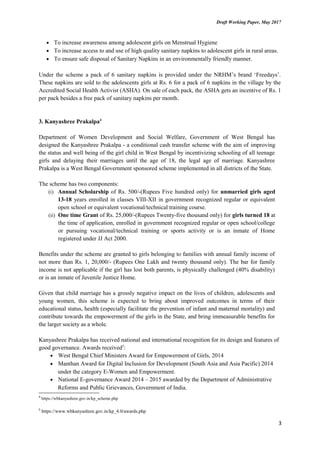
• Skoch Award and Order of Merit 2015 for Smart Governance.
• CSI-Nihilent Award, 2014-15.
• United Nations WSIS Prize 2016 Champion in e-Government Category (WSIS Action Line
C7)
• Finalist in GEM-Tech Awards 2016 organized by ITU and UN Women
The Scheme was appreciated as a good practice at:
• The "Girls Summit organized by DFID and UNICEF (London, July 2014)
• Consultation on "Child Marriage and Teenage Pregnancies" organized Tata Institute of Social
Sciences (Delhi, March 2015).
• Consultation on "Empowerment of Adolescent Girls" organized by the World Bank (Ranchi,
May 2015).
• National Workshop on "Conditional Cash Transfers for Children: Experiences of States in
India" organized by NITI Aayog, India (Delhi, December 2015).
• Trafficking in Persons (TIP) Enclave organized by U. S. Consulate & Shakti Vahini (Siliguri,
February 2016).
Bengal government has also been working with its Bihar counterpart in particular to ensure that
children who form a part of a large floating population (between both states) continue to go to school.
This includes adopting a similar syllabus in both states so that a child who studies in Bengal and then
shifts to Bihar, would study the same material.6
4. Psychosocial Counselling for Adolescent Girls in Schools7
Kerala
Adolescents are vulnerable to a psychological dysfunction when they suffer physical injuries,
psychological trauma, or major changes in their environment, especially in the absence of strong
support systems. It is crucial therefore that their problems are recognized early and solutions provided
accordingly. For a society which is in transition, like ours, the rising trend of the psychiatric morbidity
in adolescent girls, who will be mothers in future, is alarming and therefore, immediate positive
measures should be taken at appropriate levels8
. In this direction, Government of Kerala’s
Psychosocial Counselling for Adolescent Girls in Schools is commendable.
From 2008-09 onwards in the state the Kishori Shakti Yojana has been redesigned for addressing the
various issues such as physical and psycho-social needs of adolescent school girls. School Health
clinic/counseling programme was launched by the Directorate of Social Justice and is being
implemented in 163 selected schools where more girls are studying under 163 ICDS project area
through ICDS network. The service of a full time expert and qualified lady counselor is engaged for
providing counseling/guidance support to Adolescent school girls.
6
http://indianexpress.com/article/india/india-news-india/west-bengal-government-shashi-panja-girl-child-scheme-club-
kanyashree-sabla-mamata-2882482/
7
http://www.swd.kerala.gov.in/index.php/women-a-child-development/schemes--programmes-/adolescent-state/218?
task=view
8
The term ‘psychosocial’ refers to the interplay between the biological, physiological, emotional, cognitive, social,
environmental and the maturational factors. Adolescents should be considered as a special group in developmental,
educational and health programmes. Regular screening programmes should be instituted in target areas like schools and
colleges, where a large number of adolescents get together. Their problems should be recognized early and solutions should
be provided accordingly. For a society which is in transition, like ours, the rising trend of the psychiatric morbidity in
adolescent girls, who will be mothers in future, is alarming and therefore, immediate positive measures should be taken at
appropriate levels.( https://www.ncbi.nlm.nih.gov/pmc/articles/PMC3644444/)
4
Draft Working Paper, May 2017
Health check up and related activities were also implemented in co-ordination with other departments
such as Health, Education and Local self Government Institutions. Four days basic training on
Adolescent counseling was imparted to the school counselors and one day orientation programme was
imparted to the Head masters and Higher Secondary School principals of the selected 163 schools
where school counseling programme is going on. Such programme should be extended across all
schools, not only in Kerala but in other states as well.
5. Pre-matric scholarship to the children of those engaged in unclean occupations9
The Government of India is implementing the Scheme of Pre-Matric Scholarship to children of those
engaged in 'unclean' occupations since 1977-78. Under the scheme, 100% central assistance is
provided to State Governments/UT Administrations from the Government of India for the total
expenditure under the Scheme, over and above their respective Committed Liability to implement this
Scheme.
The objective of the scheme is to provide financial assistance to children of whose parents/guardians
belong to one of the following categories, to pursue Pre-matric education:-
i. Persons who are either presently engaged in manual scavenging or were so engaged upto or
after 1.1.97 or the date on which the "The Employment of manual scavengers and
construction of Dry latrines (Prohibition) Act 1993" came into force in their State/UT,
whichever is earlier;
ii. Tanners;
iii. Flayers; and
iv. Waste pickers
Conditions of Eligibility:
Scholarship will be admissible to the children/wards of Indian Nationals who, irrespective of their
religion are:
i. either presently engaged in manual scavenging or were so engaged upto or after 1.1.97 or the
date on which the "The Employment of manual scavengers and construction of Dry latrines
(Prohibition) Act 1993" came into force in their State/UT, whichever is earlier;
ii. presently engaged in Tanning and/or Flaying/ or waste picking.
Children who are born to parents who are not engaged in such occupations, but have been adopted
by such person (as mentioned in sub para 2(i) above) will be eligible for scholarship only after a
lapse of three years from the date of such adoption provided that they have been living with the
adopted parents since the date of such adoption. Such children will be eligible only if their parents
furnish such certificates (such as of proof of their occupation, date of adoption etc.) as may be
required by the concerned State Government/Union Territory administration.
A certificate should be obtained from the eligible candidates as follows:
a. From Children/wards mentioned in sub- para 2(i)(a):only once, at the time of their first
application/renewal, as the case may be, of Pre-matric Scholarship, after the coming into force
of this revision (of 2011), to the effect that at least one parent belongs to the relevant
categories;
b. From Children/wards mentioned in sub- para 2(i)(b):every year, to the effect that at least one
parent is currently engaged in tanning and/or flaying.
9
http://socialjustice.nic.in/SchemeList/Send/24?mid=24541
5
Draft Working Paper, May 2017
Duration and course of studies:
The scholarships may be given to students enrolled in class I or any subsequent class or pre-matric
stage in the case of day scholars, and class III or any subsequent class of pre-matric stage in case of
hostellers. The scholarship will terminate at the end of class X. The duration of scholarship in an
academic year is ten months.
The rates under the scheme are as follows:
Day Scholars: Class I to X Rs. 110/- p.m. for ten month
Hostellers: Class III to X Rs. 700/- p.m. for ten month
In addition an ad-hoc grant of Rs. 750/- per student per annum to all day scholars and Rs. 1000/- per
student per annum to hostellers would be admissible. Besides this there are additional provisions of
allowances for students amongst target groups with disabilities.
6. SAKSHAM10
(the self-reliant individual) aims at all-round development of Adolescent Boys (ABs)
to make them self-reliant, gender-sensitive and aware citizens, when they grow up. The scheme will
cover all adolescent boys (both school going and out of school) in the age-group of 11 to 18 years
subdivided into two categories, viz. 11-14 & 14-18 years. Budget allocation of Rs. 100 crore has been
earmarked for 12th Five Year Plan. The objectives of the Saksham scheme would be to facilitate,
educate and empower ABs so as to enable them to become self-reliant, gender-sensitive and aware
citizens. The scheme will have the following objectives –
(i) To make the Adolescent Boys gender sensitive.
(ii) To create sensitized Ahimsa Messengers to address Violence against Women.
(iii) To enable ABs for self-development and empowerment.
(iv) To address the health needs i.e. the physical, mental and emotional health of ABs.
(v) To promote awareness about health, hygiene, nutrition and Adolescent Reproductive &
Sexual Health (ARSH) and family and child care.
(vi) To provide appropriate information and vocational skills for ABs above 16 years through
National Skill Development Program (NSDP) for future work-participation.
(vii) To provide necessary life skill education and to provide information/guidance about existing
public services.
(viii) To channelize the energies of ABs for nation building.
The structures under Integrated Child Development Services Scheme (ICDS) will be utilized as a
platform for the Saksham scheme. This shall be supported by a dedicated Saksham unit/cell created at
the Centre, State, District and Block level. Anganwadi Centre is the focal point for the delivery of the
services, where Anganwadi infrastructure is inadequate, alternative place such as Community Centre,
School or Panchayat Hall may be used. The Vocational Service Providers (VTPs) under the National
Skill Development Programme (NSDP) of Ministry of Labour & Employment will be used to provide
Vocational Training to ABs.
7. Schemes for Adolescent Girls in Andhra Pradesh
Apart from the implementation of KSY and Sabla scheme, the State Government of Andhra Pradesh
has enacted Andhra Pradesh Bangaru Talli Girl Child Promotion and Empowerment Act, 2013 which
provides incentives for achieving certain milestones to the girl child born after 1st May, 2013 till she
reaches the age of 21 years. The Bangaru Talli Scheme extends to the whole of Andhra Pradesh and
10
http://pib.nic.in/newsite/PrintRelease.aspx?relid=104307
6
Draft Working Paper, May 2017
applies to all girl children born on or after 1st May, 2013 in economically backward households
limited to the first two children in the household.
The objectives are as follows:
• To enhance the social status of the girl child
• To delay age of marriage
• To ensure registration of birth and immunization
• Enrolment for better nutrition and improving the girl's educational standards
The 'Bangaru Talli' scheme seeks to achieve these objectives by cash transfer on fulfilling the
conditions of institutional deliveries, birth registration, complete immunization, enrolment in
Anganwadis and education upto graduation. The details of the benefits are as follows
Sl. No Age Trigger Out Flow (in Rs.)
1 At Birth Birth Registration 2,500/ Year
2 1st & 2nd Birth Day Immunization 1,000/ Year
3 3rd to 5th Birth Day Anganwadi 1,500/ Year
4 6th to 10th Birth Day 1st to 5th Class 2,000/ Year
5 11th to 13th Birth Day 6th to 8th Class 2,500/ Year
6 14th to 15th Birth Day 9th & 10th Class 3,000/ Year
7 16th & 17th Birth Day 11th & 12th Class 3,500/ Year
8 18th to 21st Birth Day Graduation 1 to 4th Year 4,000/ Year
Total 55,000
In addition on completion of 18 years Rs. 50,000 / Rs.1 lakh is paid if she has passed 12th class/ or graduated
Bangaru Talli emphasizes on education but does not provide for the vital input of skill development to
the adolescents. Thus, the scope of the scheme is limited and does not fully satisfy the very purpose of
enhancement of the social status of the girl child through the introduction of the scheme. It can be
stated that despite the implementation of SABLA and other programmes there remains a gap in
fulfilling the needs of the adolescents in Andhra Pradesh.
On the occasion of 2016 International Women's Day, Andhra Pradesh government has also announced
a number of schemes aimed at empowerment of women, including opening an exclusive toll-free
helpline 181 for women in distress, facilitating compulsory registration of marriages in all gram
panchayats and municipal wards to eliminate harmful practices like child marriage, 'Kanya Sakthi'
teams in all junior and degree colleges in the state for ensuring compulsory non-combat training for
girls.
Suggestion
(i) As the SABLA scheme is based on modern concept of human resource development and aims to
empower the adolescent girls into an adult women in every aspect, the scheme should be
customised as per the state’s requirement and expanded to all the districts from the current total
of 117 ICDS Projects in seven districts covered for implementation of the scheme. Sabla scheme
is being implemented for ensuring self development and empowerment of adolescent girls in
terms of improvement in nutrition, better health, creating awareness of hygienic traits, adolescent
reproductive and sexual health, family and child care, life and vocational skills, public services
like primary health centres, post offices, banks, and police stations etc. To include the adolescent
disabled girls or those under JJ Act, components of Kanyashri Prakalpa can be studied and
incorporated. Further components of the Saksham scheme which aimed at holistic development
7
Draft Working Paper, May 2017
for adolescent boys in age-group 11-18 years, so as to inculcate in them respect for women, and
engaging them in nation-building activities, can also be appropriately tweaked in for a state
sponsored holistic scheme for the adolescent girls and boys.
(ii) A new programme can be planned for Psychological counselling of adolescent girls both at the
school and college level. As is known, adolescence is marked by physical bodily changes, often
marked by puberty ceremonies; emotional changes, including the start of love interests;
changing, and often more, responsibilities particularly for girls, but without corresponding space
or voice to take part in community decision-making, processes; changing behaviours and ways of
thinking, both positive, i.e. thinking more seriously about the future, and negative, withdrawing
from friends and family and contemplating suicide; increasing restrictions, particularly for girls
related to e.g. dress and mobility; and early marriage, largely for girls. Attention has not been
paid to the mental health and psychosocial needs of adolescence girls. While education is valued
highly in India by both parents and adolescents, many adolescents drop out because of household
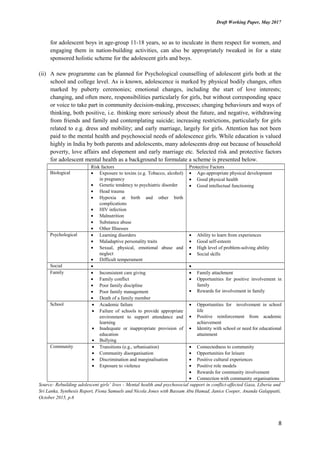
poverty, love affairs and elopement and early marriage etc. Selected risk and protective factors
for adolescent mental health as a background to formulate a scheme is presented below.
Risk factors Protective Factors
Biological • Exposure to toxins (e.g. Tobacco, alcohol)
in pregnancy
• Genetic tendency to psychiatric disorder
• Head trauma
• Hypoxia at birth and other birth
complications
• HIV infection
• Malnutrition
• Substance abuse
• Other Illnesses
• Age-appropriate physical development
• Good physical health
• Good intellectual functioning
Psychological • Learning disorders
• Maladaptive personality traits
• Sexual, physical, emotional abuse and
neglect
• Difficult temperament
• Ability to learn from experiences
• Good self-esteem
• High level of problem-solving ability
• Social skills
Social • •
Family • Inconsistent care giving
• Family conflict
• Poor family discipline
• Poor family management
• Death of a family member
• Family attachment
• Opportunities for positive involvement in
family
• Rewards for involvement in family
School • Academic failure
• Failure of schools to provide appropriate
environment to support attendance and
learning
• Inadequate or inappropriate provision of
education
• Bullying
• Opportunities for involvement in school
life
• Positive reinforcement from academic
achievement
• Identity with school or need for educational
attainment
Community • Transitions (e.g., urbanisation)
• Community disorganisation
• Discrimination and marginalisation
• Exposure to violence
• Connectedness to community
• Opportunities for leisure
• Positive cultural experiences
• Positive role models
• Rewards for community involvement
• Connection with community organisations
Source: Rebuilding adolescent girls’ lives - Mental health and psychosocial support in conflict-affected Gaza, Liberia and
Sri Lanka, Synthesis Report, Fiona Samuels and Nicola Jones with Bassam Abu Hamad, Janice Cooper, Ananda Galappatti,
October 2015, p.6
8

Addressing Adolescence

  • 1.
    Draft Working Paper,May 2017 Addressing Adolescence – What is working and what can be planned better? Schematic Analysis for better outreach and impact Paramita Majumdar1 The term "Adolescence" literally means "to emerge" or "achieve identity". Its origin is from a Latin word "Adolescere" meaning, "to grow, to mature". It is a significant phase of transition from childhood to adulthood. A universally accepted definition of the concept of adolescence has not been established, but WHO has defined it in terms of age spanning between 10 to19 years. According to the Census 2011, 20.9% of the country’s population is in the age group of 10-19 years. Country Population (in million) Adolescent (10-19 yrs) Population (in million) Proportion of Adolescents (%) China 1358.8 191.2 14.1 India 1205.6 253.2 20.9 USA 312.2 43.0 13.8 Indonesia 240.6 43.4 16.8 Brazil 195.2 33.8 17.3 Pakistan 173.1 30.9 23.1 Source: World Population Prospects – The 2012 Revision, UN 2013 Quoted from Adolescents and Youth in India, Highlights from Census 2011, Dr C Chandramouli, Registrar General & Census Commissioner, India Uttar Pradesh ranks first in terms of adolescent population in the country, accounting for 19.3% of total adolescents followed by Bihar, Maharashtra, West Bengal and Andhra Pradesh, the top five states in terms of adolescent population. Rank States Adolescent Population % to Total Population INDIA 253.2 100 1 Uttar Pradesh 48.9 19.3 2 Bihar 23.3 9.2 3 Maharashtra 21.3 8.4 4 West Bengal 18.2 7.2 5 Andhra Pradesh 16.2 6.4 Source: Census 2011 While adolescent girls (10-19) constitute nearly 20.3% of the total female population, adolescent boys constitute 21.4% of the total male population2 . It cannot be emphasized enough that investing in this segment of population is the best way to leverage the nation’s competitive advantage, its demographic dividend. Though there has been considerable progress in achieving literacy among the adolescents, what remains as crucial element is the development of skills among the adolescents to take up decent vocation. The situation of adolescent girls is particularly complex. Deep-rooted traditions of patriarchy and the subordination of women and girls, make it difficult for adolescent girls (AGs) to realize their rights. Governments both at the central and state levels have taken several efforts to protect the rights of the 1 Dr. Paramita Majumdar is a Freelance GRB Expert currently working with UN Women. 2 C-13 SINGLE YEAR AGE RETURNS BY RESIDENCE AND SEX, Census 2011, http://www.censusindia.gov.in/2011census/C- series/C-13.html 1
  • 2.
    Draft Working Paper,May 2017 adolescents. Some of the schemes initiated by the Government to develop the adolescent girls that have been quite successful are mentioned in the following paragraphs. 1. Rajiv Gandhi Scheme for Empowerment of Adolescent Girls (RGSEAG) – SABLA The Ministry of Women and Child Development, Government of India, in the year 2000 came up with scheme called Kishori Shakti Yojna (KSY) using the infrastructure of Integrated Child Development Services (ICDS). The objectives of the Scheme were to improve the nutritional and health status of girls in the age group of 11-18 years as well as to equip them to improve and upgrade their home-based and vocational skills; and to promote their overall development including awareness about their health, personal hygiene, nutrition, family welfare and management. Thereafter, Nutrition Programme for Adolescent Girls (NPAG) was initiated as a pilot project in the year 2002-03 in 51 identified districts across the country to address the problem of under-nutrition among adolescent girls. Both KSY and NPAG have influenced the lives of AGs to some extent, but have not shown the desired impact. Both the schemes had limited financial assistance and coverage, besides having similar interventions and catered to the same target groups. A need was therefore felt to formulate a new comprehensive scheme merging the erstwhile two schemes to address the multi-dimensional problems of the AGs. Thus the Rajiv Gandhi Scheme for Empowerment of Adolescent Girls (RGSEAG) – SABLA, replaced KSY and NPAG in the 200 selected districts. The objectives of the Scheme are to: (i) Enable the AGs for self-development and empowerment (ii) Improve their nutrition and health status. (iii)Promote awareness about health, hygiene, nutrition, Adolescent Reproductive and Sexual Health (ARSH) and family and child care. (iv) Upgrade their home-based skills, life skills and tie up with National Skill Development Program (NSDP) for vocational skills (v) Mainstream out of school AGs into formal/non formal education (vi)Provide information/guidance about existing public services such as PHC, CHC, Post Office, Bank, Police Station, etc. 2. Scheme for Promotion of Menstrual Hygiene3 : The Ministry of Health and Family Welfare introduced a scheme for promotion of menstrual hygiene among adolescent girls in the age group of 10-19 years in rural areas in 2010. The scheme aims at ensuring that adolescent girls in the target group have adequate knowledge and information about menstrual hygiene and the use of sanitary napkins, that high quality, safe products are made available to them, and that environmentally safe disposal mechanisms are readily accessible. The scheme has been launched as part of the Adolescent Reproductive and Sexual Health (ARSH) component under RCH II. The major objectives of the scheme are: 3 http://nrhm.gov.in/nrhmcomponnets/reproductive-child-health/adolescent-health/mhs.html?start=5 2
  • 3.
    Draft Working Paper,May 2017 • To increase awareness among adolescent girls on Menstrual Hygiene • To increase access to and use of high quality sanitary napkins to adolescent girls in rural areas. • To ensure safe disposal of Sanitary Napkins in an environmentally friendly manner. Under the scheme a pack of 6 sanitary napkins is provided under the NRHM’s brand ‘Freedays’. These napkins are sold to the adolescents girls at Rs. 6 for a pack of 6 napkins in the village by the Accredited Social Health Activist (ASHA). On sale of each pack, the ASHA gets an incentive of Rs. 1 per pack besides a free pack of sanitary napkins per month. 3. Kanyashree Prakalpa4 Department of Women Development and Social Welfare, Government of West Bengal has designed the Kanyashree Prakalpa - a conditional cash transfer scheme with the aim of improving the status and well being of the girl child in West Bengal by incentivizing schooling of all teenage girls and delaying their marriages until the age of 18, the legal age of marriage. Kanyashree Prakalpa is a West Bengal Government sponsored scheme implemented in all districts of the State. The scheme has two components: (i) Annual Scholarship of Rs. 500/-(Rupees Five hundred only) for unmarried girls aged 13-18 years enrolled in classes VIII-XII in government recognized regular or equivalent open school or equivalent vocational/technical training course. (ii) One time Grant of Rs. 25,000/-(Rupees Twenty-five thousand only) for girls turned 18 at the time of application, enrolled in government recognized regular or open school/college or pursuing vocational/technical training or sports activity or is an inmate of Home registered under JJ Act 2000. Benefits under the scheme are granted to girls belonging to families with annual family income of not more than Rs. 1, 20,000/- (Rupees One Lakh and twenty thousand only). The bar for family income is not applicable if the girl has lost both parents, is physically challenged (40% disability) or is an inmate of Juvenile Justice Home. Given that child marriage has a grossly negative impact on the lives of children, adolescents and young women, this scheme is expected to bring about improved outcomes in terms of their educational status, health (especially facilitate the prevention of infant and maternal mortality) and contribute towards the empowerment of the girls in the State, and bring immeasurable benefits for the larger society as a whole. Kanyashree Prakalpa has received national and international recognition for its design and features of good governance. Awards received5 : • West Bengal Chief Ministers Award for Empowerment of Girls, 2014 • Manthan Award for Digital Inclusion for Development (South Asia and Asia Pacific) 2014 under the category E-Women and Empowerment. • National E-governance Award 2014 – 2015 awarded by the Department of Administrative Reforms and Public Grievances, Government of India. 4 https://wbkanyashree.gov.in/kp_scheme.php 5 https://www.wbkanyashree.gov.in/kp_4.0/awards.php 3
  • 4.
    Draft Working Paper,May 2017 • Skoch Award and Order of Merit 2015 for Smart Governance. • CSI-Nihilent Award, 2014-15. • United Nations WSIS Prize 2016 Champion in e-Government Category (WSIS Action Line C7) • Finalist in GEM-Tech Awards 2016 organized by ITU and UN Women The Scheme was appreciated as a good practice at: • The "Girls Summit organized by DFID and UNICEF (London, July 2014) • Consultation on "Child Marriage and Teenage Pregnancies" organized Tata Institute of Social Sciences (Delhi, March 2015). • Consultation on "Empowerment of Adolescent Girls" organized by the World Bank (Ranchi, May 2015). • National Workshop on "Conditional Cash Transfers for Children: Experiences of States in India" organized by NITI Aayog, India (Delhi, December 2015). • Trafficking in Persons (TIP) Enclave organized by U. S. Consulate & Shakti Vahini (Siliguri, February 2016). Bengal government has also been working with its Bihar counterpart in particular to ensure that children who form a part of a large floating population (between both states) continue to go to school. This includes adopting a similar syllabus in both states so that a child who studies in Bengal and then shifts to Bihar, would study the same material.6 4. Psychosocial Counselling for Adolescent Girls in Schools7 Kerala Adolescents are vulnerable to a psychological dysfunction when they suffer physical injuries, psychological trauma, or major changes in their environment, especially in the absence of strong support systems. It is crucial therefore that their problems are recognized early and solutions provided accordingly. For a society which is in transition, like ours, the rising trend of the psychiatric morbidity in adolescent girls, who will be mothers in future, is alarming and therefore, immediate positive measures should be taken at appropriate levels8 . In this direction, Government of Kerala’s Psychosocial Counselling for Adolescent Girls in Schools is commendable. From 2008-09 onwards in the state the Kishori Shakti Yojana has been redesigned for addressing the various issues such as physical and psycho-social needs of adolescent school girls. School Health clinic/counseling programme was launched by the Directorate of Social Justice and is being implemented in 163 selected schools where more girls are studying under 163 ICDS project area through ICDS network. The service of a full time expert and qualified lady counselor is engaged for providing counseling/guidance support to Adolescent school girls. 6 http://indianexpress.com/article/india/india-news-india/west-bengal-government-shashi-panja-girl-child-scheme-club- kanyashree-sabla-mamata-2882482/ 7 http://www.swd.kerala.gov.in/index.php/women-a-child-development/schemes--programmes-/adolescent-state/218? task=view 8 The term ‘psychosocial’ refers to the interplay between the biological, physiological, emotional, cognitive, social, environmental and the maturational factors. Adolescents should be considered as a special group in developmental, educational and health programmes. Regular screening programmes should be instituted in target areas like schools and colleges, where a large number of adolescents get together. Their problems should be recognized early and solutions should be provided accordingly. For a society which is in transition, like ours, the rising trend of the psychiatric morbidity in adolescent girls, who will be mothers in future, is alarming and therefore, immediate positive measures should be taken at appropriate levels.( https://www.ncbi.nlm.nih.gov/pmc/articles/PMC3644444/) 4
  • 5.
    Draft Working Paper,May 2017 Health check up and related activities were also implemented in co-ordination with other departments such as Health, Education and Local self Government Institutions. Four days basic training on Adolescent counseling was imparted to the school counselors and one day orientation programme was imparted to the Head masters and Higher Secondary School principals of the selected 163 schools where school counseling programme is going on. Such programme should be extended across all schools, not only in Kerala but in other states as well. 5. Pre-matric scholarship to the children of those engaged in unclean occupations9 The Government of India is implementing the Scheme of Pre-Matric Scholarship to children of those engaged in 'unclean' occupations since 1977-78. Under the scheme, 100% central assistance is provided to State Governments/UT Administrations from the Government of India for the total expenditure under the Scheme, over and above their respective Committed Liability to implement this Scheme. The objective of the scheme is to provide financial assistance to children of whose parents/guardians belong to one of the following categories, to pursue Pre-matric education:- i. Persons who are either presently engaged in manual scavenging or were so engaged upto or after 1.1.97 or the date on which the "The Employment of manual scavengers and construction of Dry latrines (Prohibition) Act 1993" came into force in their State/UT, whichever is earlier; ii. Tanners; iii. Flayers; and iv. Waste pickers Conditions of Eligibility: Scholarship will be admissible to the children/wards of Indian Nationals who, irrespective of their religion are: i. either presently engaged in manual scavenging or were so engaged upto or after 1.1.97 or the date on which the "The Employment of manual scavengers and construction of Dry latrines (Prohibition) Act 1993" came into force in their State/UT, whichever is earlier; ii. presently engaged in Tanning and/or Flaying/ or waste picking. Children who are born to parents who are not engaged in such occupations, but have been adopted by such person (as mentioned in sub para 2(i) above) will be eligible for scholarship only after a lapse of three years from the date of such adoption provided that they have been living with the adopted parents since the date of such adoption. Such children will be eligible only if their parents furnish such certificates (such as of proof of their occupation, date of adoption etc.) as may be required by the concerned State Government/Union Territory administration. A certificate should be obtained from the eligible candidates as follows: a. From Children/wards mentioned in sub- para 2(i)(a):only once, at the time of their first application/renewal, as the case may be, of Pre-matric Scholarship, after the coming into force of this revision (of 2011), to the effect that at least one parent belongs to the relevant categories; b. From Children/wards mentioned in sub- para 2(i)(b):every year, to the effect that at least one parent is currently engaged in tanning and/or flaying. 9 http://socialjustice.nic.in/SchemeList/Send/24?mid=24541 5
  • 6.
    Draft Working Paper,May 2017 Duration and course of studies: The scholarships may be given to students enrolled in class I or any subsequent class or pre-matric stage in the case of day scholars, and class III or any subsequent class of pre-matric stage in case of hostellers. The scholarship will terminate at the end of class X. The duration of scholarship in an academic year is ten months. The rates under the scheme are as follows: Day Scholars: Class I to X Rs. 110/- p.m. for ten month Hostellers: Class III to X Rs. 700/- p.m. for ten month In addition an ad-hoc grant of Rs. 750/- per student per annum to all day scholars and Rs. 1000/- per student per annum to hostellers would be admissible. Besides this there are additional provisions of allowances for students amongst target groups with disabilities. 6. SAKSHAM10 (the self-reliant individual) aims at all-round development of Adolescent Boys (ABs) to make them self-reliant, gender-sensitive and aware citizens, when they grow up. The scheme will cover all adolescent boys (both school going and out of school) in the age-group of 11 to 18 years subdivided into two categories, viz. 11-14 & 14-18 years. Budget allocation of Rs. 100 crore has been earmarked for 12th Five Year Plan. The objectives of the Saksham scheme would be to facilitate, educate and empower ABs so as to enable them to become self-reliant, gender-sensitive and aware citizens. The scheme will have the following objectives – (i) To make the Adolescent Boys gender sensitive. (ii) To create sensitized Ahimsa Messengers to address Violence against Women. (iii) To enable ABs for self-development and empowerment. (iv) To address the health needs i.e. the physical, mental and emotional health of ABs. (v) To promote awareness about health, hygiene, nutrition and Adolescent Reproductive & Sexual Health (ARSH) and family and child care. (vi) To provide appropriate information and vocational skills for ABs above 16 years through National Skill Development Program (NSDP) for future work-participation. (vii) To provide necessary life skill education and to provide information/guidance about existing public services. (viii) To channelize the energies of ABs for nation building. The structures under Integrated Child Development Services Scheme (ICDS) will be utilized as a platform for the Saksham scheme. This shall be supported by a dedicated Saksham unit/cell created at the Centre, State, District and Block level. Anganwadi Centre is the focal point for the delivery of the services, where Anganwadi infrastructure is inadequate, alternative place such as Community Centre, School or Panchayat Hall may be used. The Vocational Service Providers (VTPs) under the National Skill Development Programme (NSDP) of Ministry of Labour & Employment will be used to provide Vocational Training to ABs. 7. Schemes for Adolescent Girls in Andhra Pradesh Apart from the implementation of KSY and Sabla scheme, the State Government of Andhra Pradesh has enacted Andhra Pradesh Bangaru Talli Girl Child Promotion and Empowerment Act, 2013 which provides incentives for achieving certain milestones to the girl child born after 1st May, 2013 till she reaches the age of 21 years. The Bangaru Talli Scheme extends to the whole of Andhra Pradesh and 10 http://pib.nic.in/newsite/PrintRelease.aspx?relid=104307 6
  • 7.
    Draft Working Paper,May 2017 applies to all girl children born on or after 1st May, 2013 in economically backward households limited to the first two children in the household. The objectives are as follows: • To enhance the social status of the girl child • To delay age of marriage • To ensure registration of birth and immunization • Enrolment for better nutrition and improving the girl's educational standards The 'Bangaru Talli' scheme seeks to achieve these objectives by cash transfer on fulfilling the conditions of institutional deliveries, birth registration, complete immunization, enrolment in Anganwadis and education upto graduation. The details of the benefits are as follows Sl. No Age Trigger Out Flow (in Rs.) 1 At Birth Birth Registration 2,500/ Year 2 1st & 2nd Birth Day Immunization 1,000/ Year 3 3rd to 5th Birth Day Anganwadi 1,500/ Year 4 6th to 10th Birth Day 1st to 5th Class 2,000/ Year 5 11th to 13th Birth Day 6th to 8th Class 2,500/ Year 6 14th to 15th Birth Day 9th & 10th Class 3,000/ Year 7 16th & 17th Birth Day 11th & 12th Class 3,500/ Year 8 18th to 21st Birth Day Graduation 1 to 4th Year 4,000/ Year Total 55,000 In addition on completion of 18 years Rs. 50,000 / Rs.1 lakh is paid if she has passed 12th class/ or graduated Bangaru Talli emphasizes on education but does not provide for the vital input of skill development to the adolescents. Thus, the scope of the scheme is limited and does not fully satisfy the very purpose of enhancement of the social status of the girl child through the introduction of the scheme. It can be stated that despite the implementation of SABLA and other programmes there remains a gap in fulfilling the needs of the adolescents in Andhra Pradesh. On the occasion of 2016 International Women's Day, Andhra Pradesh government has also announced a number of schemes aimed at empowerment of women, including opening an exclusive toll-free helpline 181 for women in distress, facilitating compulsory registration of marriages in all gram panchayats and municipal wards to eliminate harmful practices like child marriage, 'Kanya Sakthi' teams in all junior and degree colleges in the state for ensuring compulsory non-combat training for girls. Suggestion (i) As the SABLA scheme is based on modern concept of human resource development and aims to empower the adolescent girls into an adult women in every aspect, the scheme should be customised as per the state’s requirement and expanded to all the districts from the current total of 117 ICDS Projects in seven districts covered for implementation of the scheme. Sabla scheme is being implemented for ensuring self development and empowerment of adolescent girls in terms of improvement in nutrition, better health, creating awareness of hygienic traits, adolescent reproductive and sexual health, family and child care, life and vocational skills, public services like primary health centres, post offices, banks, and police stations etc. To include the adolescent disabled girls or those under JJ Act, components of Kanyashri Prakalpa can be studied and incorporated. Further components of the Saksham scheme which aimed at holistic development 7
  • 8.
    Draft Working Paper,May 2017 for adolescent boys in age-group 11-18 years, so as to inculcate in them respect for women, and engaging them in nation-building activities, can also be appropriately tweaked in for a state sponsored holistic scheme for the adolescent girls and boys. (ii) A new programme can be planned for Psychological counselling of adolescent girls both at the school and college level. As is known, adolescence is marked by physical bodily changes, often marked by puberty ceremonies; emotional changes, including the start of love interests; changing, and often more, responsibilities particularly for girls, but without corresponding space or voice to take part in community decision-making, processes; changing behaviours and ways of thinking, both positive, i.e. thinking more seriously about the future, and negative, withdrawing from friends and family and contemplating suicide; increasing restrictions, particularly for girls related to e.g. dress and mobility; and early marriage, largely for girls. Attention has not been paid to the mental health and psychosocial needs of adolescence girls. While education is valued highly in India by both parents and adolescents, many adolescents drop out because of household poverty, love affairs and elopement and early marriage etc. Selected risk and protective factors for adolescent mental health as a background to formulate a scheme is presented below. Risk factors Protective Factors Biological • Exposure to toxins (e.g. Tobacco, alcohol) in pregnancy • Genetic tendency to psychiatric disorder • Head trauma • Hypoxia at birth and other birth complications • HIV infection • Malnutrition • Substance abuse • Other Illnesses • Age-appropriate physical development • Good physical health • Good intellectual functioning Psychological • Learning disorders • Maladaptive personality traits • Sexual, physical, emotional abuse and neglect • Difficult temperament • Ability to learn from experiences • Good self-esteem • High level of problem-solving ability • Social skills Social • • Family • Inconsistent care giving • Family conflict • Poor family discipline • Poor family management • Death of a family member • Family attachment • Opportunities for positive involvement in family • Rewards for involvement in family School • Academic failure • Failure of schools to provide appropriate environment to support attendance and learning • Inadequate or inappropriate provision of education • Bullying • Opportunities for involvement in school life • Positive reinforcement from academic achievement • Identity with school or need for educational attainment Community • Transitions (e.g., urbanisation) • Community disorganisation • Discrimination and marginalisation • Exposure to violence • Connectedness to community • Opportunities for leisure • Positive cultural experiences • Positive role models • Rewards for community involvement • Connection with community organisations Source: Rebuilding adolescent girls’ lives - Mental health and psychosocial support in conflict-affected Gaza, Liberia and Sri Lanka, Synthesis Report, Fiona Samuels and Nicola Jones with Bassam Abu Hamad, Janice Cooper, Ananda Galappatti, October 2015, p.6 8