ADOLESCENTS
HEALTH
PROGRAMME
ADOLESCENT
• It is a vital stage of growth and development.
• It is a period of transition from childhood to adulthood.
• WHO – age period between 10 – 19 years for both sexes,
married & unmarried people.
ADOLESCENT
1. Adolescence : 10 – 19 years
2. Early Adolescence : 10 – 13 years
3. Middle adolescence : 14 – 16 years
4. Late adolescence : 17 – 19 years
5. Youth : 15 – 24 years
6. Young people : 10 - 24 years
WHY ADOLESCENT HEALTH?
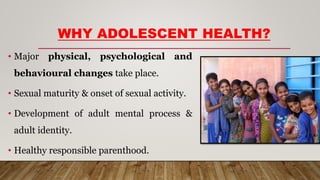
• Major physical, psychological and
behavioural changes take place.
• Sexual maturity & onset of sexual activity.
• Development of adult mental process &
adult identity.
• Healthy responsible parenthood.
WHY ADOLESCENT HEALTH?
• Great human resource for the society.
• Growth spurt(growing quickly) and physical activity.
• Menstruation.
• Pregnancy.
MAJOR ADOLESCENT PROBLEMS
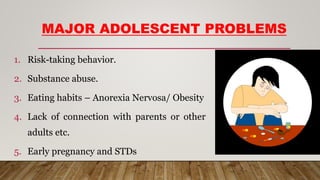
1. Risk-taking behavior.
2. Substance abuse.
3. Eating habits – Anorexia Nervosa/ Obesity
4. Lack of connection with parents or other
adults etc.
5. Early pregnancy and STDs
ADOLESCENT HEALTH
PROGRAMMES
1. RMNCH+A
2. Rashtriya Kishor Swasthya Karyakram (RKSK)
3. Kishori Shakti Yojana
4. Nutrition Programme for Adolescent Girls (NPAG)
5. Balika Samridhi Yojana
6. WIFS
RMNCH+A (REPRODUCTIVE, MATERNAL,
NEWBORN CHILD PLUS ADOLESCENT
HEALTH)
• It address(express) the major causes of
mortality among women and children.
• RMNCH+A was formed in 2013.
Aim:
To ensure equal focus on various life stages.
KEY STRATEGIES OF RMNCH+A
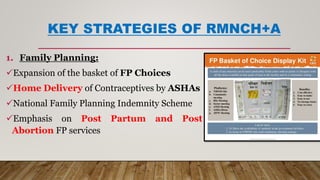
1. Family Planning:
Expansion of the basket of FP Choices
Home Delivery of Contraceptives by ASHAs
National Family Planning Indemnity Scheme
Emphasis on Post Partum and Post
Abortion FP services
National family planning indemnity
scheme
•Compensation for death/failure/complication
following sterilization operation.
KEY STRATEGIES OF RMNCH+A
2. Maternal Health:
Early registration of pregnancy
ANC services, detection and follow-up of high risk cases.
Encouraging institutional deliveries
Maternal Death Review
Comprehensive/complete Abortion Care
KEY STRATEGIES OF RMNCH+A
3. Child Health:
Essential newborn care at specialised units for stabilization and care of sick
newborn babies
Home based newborn care
Promotion of breastfeeding and timely initiation of complementary feeding
Management of cases of severe acute malnutrition at Nutrition
Rehabilitation Centres
Micronutrient supplementation (eg. Vitamins)
RASHTRIYA KISHOR SWASTHYA
KARYAKRAM (RKSK)
• The Ministry of Health & Family Welfare.
• Launched on 7th January, 2014.
• RKSK has been developed to strengthen
the adolescent component of the
RMNCH+A strategy.
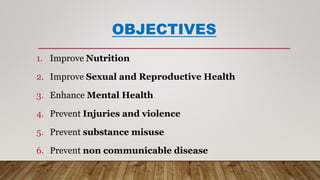
OBJECTIVES
1. Improve Nutrition
2. Improve Sexual and Reproductive Health
3. Enhance Mental Health
4. Prevent Injuries and violence
5. Prevent substance misuse
6. Prevent non communicable disease
SERVICES PROVIDED:
WIFS (Weekly Iron Folic acid Supplementation)
Clinics and counselling
Peer Educator & Adolescent Health Day
Menstrual Hygiene Scheme
KISHORI SHAKTI YOJANA
• Launched – year 2000
• Aim:
Breaking the intergenerational(generation
gap) life cycle of nutritional & gender
disadvantage and providing a supportive
environment for self development.
OBJECTIVES
1. To improve nutritional and health status of girls in age group of
11-18 years.
2. To provide required literacy and numeracy skills through the
non-formal stream of education.
3. To stimulate a desire for more social exposure and knowledge
and to help them improve their decision making capabilities.
OBJECTIVES
4. To train the adolescent girls to improve/ upgrade home-based
vocational skills.
5. To promote awareness of health, hygiene, nutrition and family
welfare, home management and child care.
6. To gain a better understanding of their environment related social
issues and the impact on their lives.
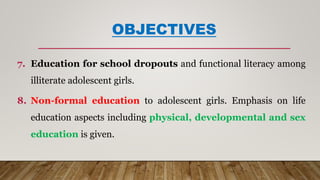
OBJECTIVES
7. Education for school dropouts and functional literacy among
illiterate adolescent girls.
8. Non-formal education to adolescent girls. Emphasis on life
education aspects including physical, developmental and sex
education is given.
BENEFICIARIES
• Adolescent girls who are unmarried and
• Belong to families below the poverty
line
• School drop-outs
NUTRITION PROGRAMME FOR
ADOLESCENT GIRLS (NPAG)
i.Nutrition Programme for Adolescent Girls (NPAG) is a Government of India
scheme through which special nutrition is provided to adolescent girls
from families living below poverty line.
i.Two backward districts of Karnataka i.e. Kolar and Gulbarga have been
selected for implementing this programme on an experimental basis.
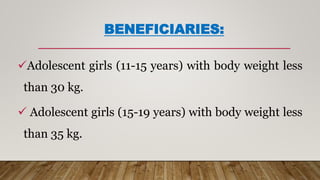
BENEFICIARIES:
Adolescent girls (11-15 years) with body weight less
than 30 kg.
 Adolescent girls (15-19 years) with body weight less
than 35 kg.
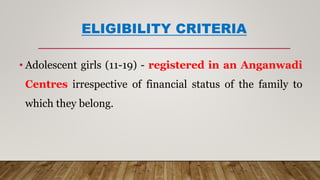
ELIGIBILITY CRITERIA
• Adolescent girls (11-19) - registered in an Anganwadi
Centres irrespective of financial status of the family to
which they belong.
BENEFITS
1. Improvement of nutritional and health status
of girls.
2. 6 kg of free food grain (rice) per month per
beneficiary.
BALIKA SAMRIDHI YOJANA
•Launched by Government of India in 1997.
•Aim - to delay the age of marriage.
OBJECTIVES
1. To change negative family and community attitudes
towards the girl child at birth and towards her mother.
2. To improve enrollment and retention of girl children in
schools.
3. to increase the age of marriage of girls.
4. To assist the girl to undertake income generation activities.
BENEFICIARIES
1. Girl children belonging to families below the poverty line.
2. Who are born on or after 15th August, 1997.
3. The benefits are restricted to two girl children in a
household irrespective of number of children in the household.
BENEFITS
• Benefits: A post birth grant amount of Rs. 500/-
CLASS Amount of Annual Scholarship
I-III Rs. 300/- per annum for each class
IV Rs. 500/- per annum
V Rs. 600/- per annum
VI-VII Rs. 700/- per annum
VIII Rs. 800/- per annum
IX-X Rs. 1000/- per annum
PROCEDURE FOR OBTAINING THE
BENEFIT
• ICDS infrastructure in rural areas and Health Department in
urban areas.
• The application forms are available with Anganwadi Workers
in the villages and with Health functionaries in urban.
WIFS (WEEKLY IRON FOLIC ACID
SUPPLEMENTATION)
•The programme covers 11.2 crore beneficiaries.
•8.4 crore in-school.
•2.8 crore out of school beneficiaries.
SALIENT FEATURES OF WIFS
•To reduce the prevalence and
severity of anaemia in
adolescent population (10-19
years).
TARGET GROUPS
1. School going adolescent girls and boys in 6th to
12th class enrolled in government/government
aided/municipal schools.
2. Out of school student
3. Urban and rural area
INTERVENTION
• Supervised Weekly Iron-folic Acid Supplements 100mg
elemental iron and 500ug Folic acid.
• Screening of target groups for moderate/severe anaemia and
referring these cases to an appropriate health facility.
• Biannual de-worming (Albendazole 400mg)
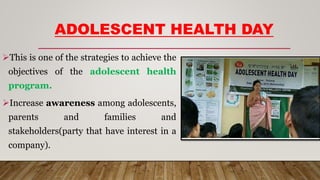
ADOLESCENT HEALTH DAY
This is one of the strategies to achieve the
objectives of the adolescent health
program.
Increase awareness among adolescents,
parents and families and
stakeholders(party that have interest in a
company).
ADOLESCENT HEALTH DAY
The AHD should be organized in every village.
Once every quarter on a convenient day (preferably on a
Sunday).
AWCs or community spaces may be - venues for
organizing the AHD.
ADOLESCENT HEALTH DAY
Services should be offered to all the adolescent target
groups (male/female; 10-14 and 15-19 age;
school going, drop out; and married
adolescents).
adolescent health programme        .pptx

adolescent health programme .pptx

  • 1.
  • 2.
    ADOLESCENT • It isa vital stage of growth and development. • It is a period of transition from childhood to adulthood. • WHO – age period between 10 – 19 years for both sexes, married & unmarried people.
  • 3.
    ADOLESCENT 1. Adolescence :10 – 19 years 2. Early Adolescence : 10 – 13 years 3. Middle adolescence : 14 – 16 years 4. Late adolescence : 17 – 19 years 5. Youth : 15 – 24 years 6. Young people : 10 - 24 years
  • 4.
    WHY ADOLESCENT HEALTH? •Major physical, psychological and behavioural changes take place. • Sexual maturity & onset of sexual activity. • Development of adult mental process & adult identity. • Healthy responsible parenthood.
  • 5.
    WHY ADOLESCENT HEALTH? •Great human resource for the society. • Growth spurt(growing quickly) and physical activity. • Menstruation. • Pregnancy.
  • 6.
    MAJOR ADOLESCENT PROBLEMS 1.Risk-taking behavior. 2. Substance abuse. 3. Eating habits – Anorexia Nervosa/ Obesity 4. Lack of connection with parents or other adults etc. 5. Early pregnancy and STDs
  • 7.
    ADOLESCENT HEALTH PROGRAMMES 1. RMNCH+A 2.Rashtriya Kishor Swasthya Karyakram (RKSK) 3. Kishori Shakti Yojana 4. Nutrition Programme for Adolescent Girls (NPAG) 5. Balika Samridhi Yojana 6. WIFS
  • 8.
    RMNCH+A (REPRODUCTIVE, MATERNAL, NEWBORNCHILD PLUS ADOLESCENT HEALTH) • It address(express) the major causes of mortality among women and children. • RMNCH+A was formed in 2013. Aim: To ensure equal focus on various life stages.
  • 9.
    KEY STRATEGIES OFRMNCH+A 1. Family Planning: Expansion of the basket of FP Choices Home Delivery of Contraceptives by ASHAs National Family Planning Indemnity Scheme Emphasis on Post Partum and Post Abortion FP services
  • 10.
    National family planningindemnity scheme •Compensation for death/failure/complication following sterilization operation.
  • 11.
    KEY STRATEGIES OFRMNCH+A 2. Maternal Health: Early registration of pregnancy ANC services, detection and follow-up of high risk cases. Encouraging institutional deliveries Maternal Death Review Comprehensive/complete Abortion Care
  • 12.
    KEY STRATEGIES OFRMNCH+A 3. Child Health: Essential newborn care at specialised units for stabilization and care of sick newborn babies Home based newborn care Promotion of breastfeeding and timely initiation of complementary feeding Management of cases of severe acute malnutrition at Nutrition Rehabilitation Centres Micronutrient supplementation (eg. Vitamins)
  • 13.
    RASHTRIYA KISHOR SWASTHYA KARYAKRAM(RKSK) • The Ministry of Health & Family Welfare. • Launched on 7th January, 2014. • RKSK has been developed to strengthen the adolescent component of the RMNCH+A strategy.
  • 14.
    OBJECTIVES 1. Improve Nutrition 2.Improve Sexual and Reproductive Health 3. Enhance Mental Health 4. Prevent Injuries and violence 5. Prevent substance misuse 6. Prevent non communicable disease
  • 15.
    SERVICES PROVIDED: WIFS (WeeklyIron Folic acid Supplementation) Clinics and counselling Peer Educator & Adolescent Health Day Menstrual Hygiene Scheme
  • 16.
    KISHORI SHAKTI YOJANA •Launched – year 2000 • Aim: Breaking the intergenerational(generation gap) life cycle of nutritional & gender disadvantage and providing a supportive environment for self development.
  • 17.
    OBJECTIVES 1. To improvenutritional and health status of girls in age group of 11-18 years. 2. To provide required literacy and numeracy skills through the non-formal stream of education. 3. To stimulate a desire for more social exposure and knowledge and to help them improve their decision making capabilities.
  • 18.
    OBJECTIVES 4. To trainthe adolescent girls to improve/ upgrade home-based vocational skills. 5. To promote awareness of health, hygiene, nutrition and family welfare, home management and child care. 6. To gain a better understanding of their environment related social issues and the impact on their lives.
  • 19.
    OBJECTIVES 7. Education forschool dropouts and functional literacy among illiterate adolescent girls. 8. Non-formal education to adolescent girls. Emphasis on life education aspects including physical, developmental and sex education is given.
  • 20.
    BENEFICIARIES • Adolescent girlswho are unmarried and • Belong to families below the poverty line • School drop-outs
  • 21.
    NUTRITION PROGRAMME FOR ADOLESCENTGIRLS (NPAG) i.Nutrition Programme for Adolescent Girls (NPAG) is a Government of India scheme through which special nutrition is provided to adolescent girls from families living below poverty line. i.Two backward districts of Karnataka i.e. Kolar and Gulbarga have been selected for implementing this programme on an experimental basis.
  • 22.
    BENEFICIARIES: Adolescent girls (11-15years) with body weight less than 30 kg.  Adolescent girls (15-19 years) with body weight less than 35 kg.
  • 23.
    ELIGIBILITY CRITERIA • Adolescentgirls (11-19) - registered in an Anganwadi Centres irrespective of financial status of the family to which they belong.
  • 24.
    BENEFITS 1. Improvement ofnutritional and health status of girls. 2. 6 kg of free food grain (rice) per month per beneficiary.
  • 25.
    BALIKA SAMRIDHI YOJANA •Launchedby Government of India in 1997. •Aim - to delay the age of marriage.
  • 26.
    OBJECTIVES 1. To changenegative family and community attitudes towards the girl child at birth and towards her mother. 2. To improve enrollment and retention of girl children in schools. 3. to increase the age of marriage of girls. 4. To assist the girl to undertake income generation activities.
  • 27.
    BENEFICIARIES 1. Girl childrenbelonging to families below the poverty line. 2. Who are born on or after 15th August, 1997. 3. The benefits are restricted to two girl children in a household irrespective of number of children in the household.
  • 28.
    BENEFITS • Benefits: Apost birth grant amount of Rs. 500/- CLASS Amount of Annual Scholarship I-III Rs. 300/- per annum for each class IV Rs. 500/- per annum V Rs. 600/- per annum VI-VII Rs. 700/- per annum VIII Rs. 800/- per annum IX-X Rs. 1000/- per annum
  • 29.
    PROCEDURE FOR OBTAININGTHE BENEFIT • ICDS infrastructure in rural areas and Health Department in urban areas. • The application forms are available with Anganwadi Workers in the villages and with Health functionaries in urban.
  • 30.
    WIFS (WEEKLY IRONFOLIC ACID SUPPLEMENTATION) •The programme covers 11.2 crore beneficiaries. •8.4 crore in-school. •2.8 crore out of school beneficiaries.
  • 31.
    SALIENT FEATURES OFWIFS •To reduce the prevalence and severity of anaemia in adolescent population (10-19 years).
  • 32.
    TARGET GROUPS 1. Schoolgoing adolescent girls and boys in 6th to 12th class enrolled in government/government aided/municipal schools. 2. Out of school student 3. Urban and rural area
  • 33.
    INTERVENTION • Supervised WeeklyIron-folic Acid Supplements 100mg elemental iron and 500ug Folic acid. • Screening of target groups for moderate/severe anaemia and referring these cases to an appropriate health facility. • Biannual de-worming (Albendazole 400mg)
  • 34.
    ADOLESCENT HEALTH DAY Thisis one of the strategies to achieve the objectives of the adolescent health program. Increase awareness among adolescents, parents and families and stakeholders(party that have interest in a company).
  • 35.
    ADOLESCENT HEALTH DAY TheAHD should be organized in every village. Once every quarter on a convenient day (preferably on a Sunday). AWCs or community spaces may be - venues for organizing the AHD.
  • 36.
    ADOLESCENT HEALTH DAY Servicesshould be offered to all the adolescent target groups (male/female; 10-14 and 15-19 age; school going, drop out; and married adolescents).