MAA
(MOTHERS’ ABSOLUTE AFFECTION)
A
PRESENTATION
BY
Dr. ABAKASH BARIK
BHMS (ODISHA)
MD (HOM)
NATIONAL INSTITUTE
OF
HOMOEOPATHY,KOLKATTA
SENIOR MEDICAL OFFICER (HOMOEOPATHY)
DIRECTORATE OF AYUSH
GOVT. OF NCT OF DELHI
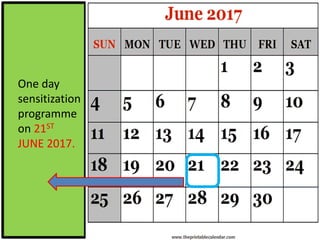
One day
sensitization
programme
on 21ST
JUNE 2017.
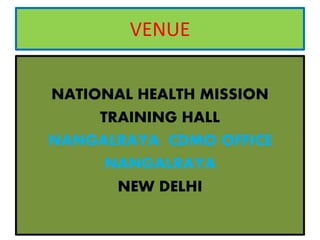
VENUE
NATIONAL HEALTH MISSION
TRAINING HALL
NANGALRAYA CDMO OFFICE
NANGALRAYA
NEW DELHI
SPOKE PERSONS
Dr. NEETA SINGLA, RCH Nodal, New Delhi District
Dr. SUCHETA MAHINDRU, MO, New Delhi District
Dr . HARSHPRIYA, District Immunization Officer
They highlighted the outstanding features of
‘MAA’ Mothers ’ Absolute Affection
programme. It was quite effective. They
reviewed and also discussed the data of
family planning of each dispensary and how
the number would be increased effectively
in this coming year. In the last session of the
day, significance of ORS was emphasized in
the management of diarrhoea in children.
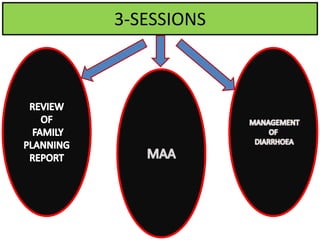
3-SESSIONS
MAA (Mothers’ Absolute Affection)
• It is a nationwide programme, has been
implemented across states/UTs, from August 2016.
• Aim of this programme, to improve the
breastfeeding and appropriate child feeding
practices in the country through health system.
About the programme
Under the National Health Mission of the Ministry
of Health and Family Welfare, Government of
India, improving breastfeeding practices for quality
survival of newborns, a yearlong MAA (Mothers’
Absolute Affection) programme has been launched
all over the country from August 2016.
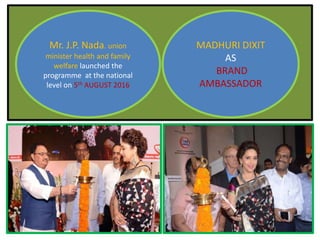
Mr. J.P. Nada. union
minister health and family
welfare launched the
programme at the national
level on 5th AUGUST 2016
MADHURI DIXIT
AS
BRAND
AMBASSADOR
The sensitization programme targets
health care providers (ALLOPATHIC
DOCTORS,AYUSH DOCTORS, ANMs,
AWWs and ASHAs) who have the
responsibility for establishing and
implementing breast feeding.
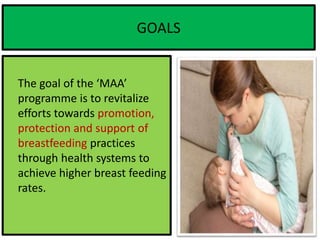
GOALS
The goal of the ‘MAA’
programme is to revitalize
efforts towards promotion,
protection and support of
breastfeeding practices
through health systems to
achieve higher breast feeding
rates.

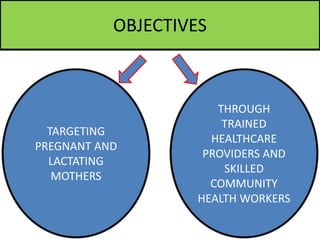
OBJECTIVES
TARGETING
PREGNANT AND
LACTATING
MOTHERS
THROUGH
TRAINED
HEALTHCARE
PROVIDERS AND
SKILLED
COMMUNITY
HEALTH WORKERS
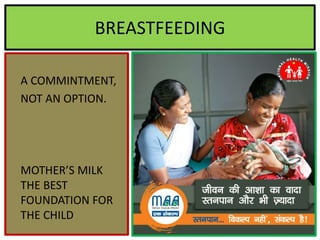
BREASTFEEDING
A COMMINTMENT,
NOT AN OPTION.

MOTHER’S MILK
THE BEST
FOUNDATION FOR
THE CHILD
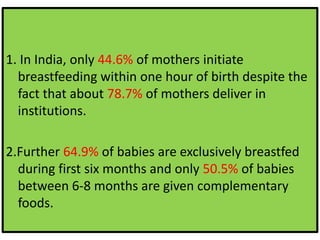
1. In India, only 44.6% of mothers initiate
breastfeeding within one hour of birth despite the
fact that about 78.7% of mothers deliver in
institutions.
2.Further 64.9% of babies are exclusively breastfed
during first six months and only 50.5% of babies
between 6-8 months are given complementary
foods.
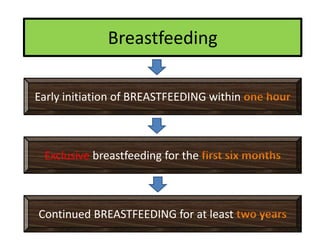
Breastfeeding
Early initiation of BREASTFEEDING within
Exclusive breastfeeding for the
Continued BREASTFEEDING for at least
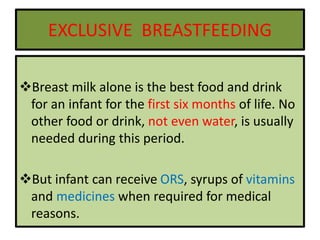
EXCLUSIVE BREASTFEEDING
Breast milk alone is the best food and drink
for an infant for the first six months of life. No
other food or drink, not even water, is usually
needed during this period.
But infant can receive ORS, syrups of vitamins
and medicines when required for medical
reasons.
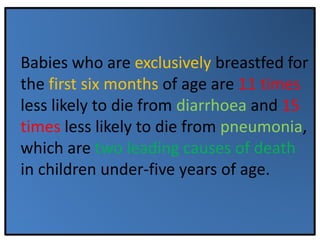
Babies who are exclusively breastfed for
the first six months of age are 11 times
less likely to die from diarrhoea and 15
times less likely to die from pneumonia,
which are two leading causes of death
in children under-five years of age.
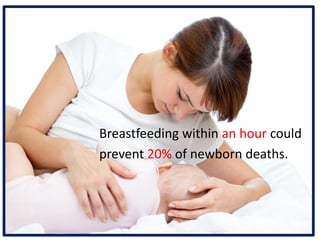
Breastfeeding within an hour could
prevent 20% of newborn deaths.
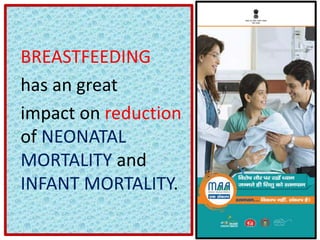
BREASTFEEDING
has an great
impact on reduction
of NEONATAL
MORTALITY and
INFANT MORTALITY.
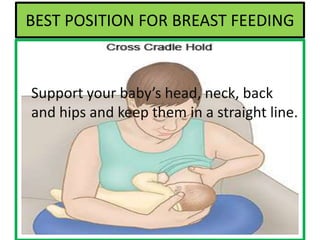
BEST POSITION FOR BREAST FEEDING
Support your baby’s head, neck, back
and hips and keep them in a straight line.
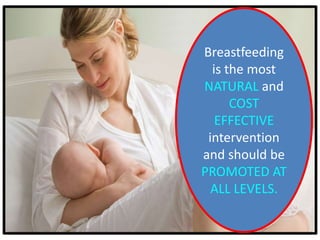
Breastfeeding
is the most
NATURAL and
COST
EFFECTIVE
intervention
and should be
PROMOTED AT
ALL LEVELS.
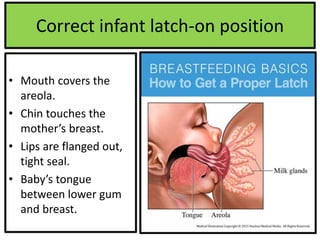
Correct infant latch-on position
• Mouth covers the
areola.
• Chin touches the
mother’s breast.
• Lips are flanged out,
tight seal.
• Baby’s tongue
between lower gum
and breast.
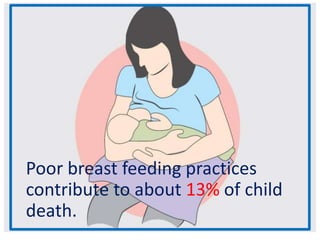
Poor breast feeding practices
contribute to about 13% of child
death.
.
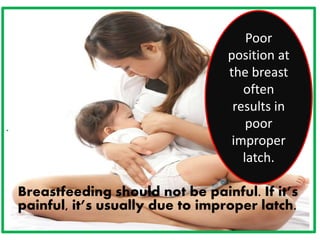
Breastfeeding should not be painful. If it’s
painful, it’s usually due to improper latch.
Poor
position at
the breast
often
results in
poor
improper
latch.
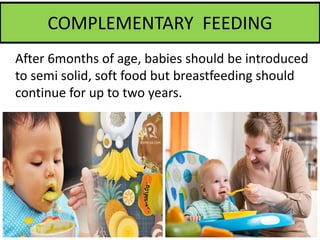
COMPLEMENTARY FEEDING
After 6months of age, babies should be introduced
to semi solid, soft food but breastfeeding should
continue for up to two years.
MANAGEMENT OF DIARRHOEA
Diarrhoea is a very common problem in the
children under five.
Diarrhoea can be serious and even lead to .
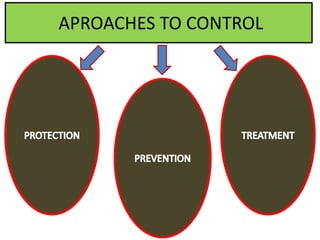
APROACHES TO CONTROL
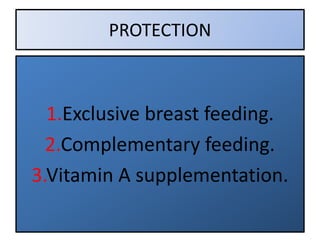
PROTECTION
1.Exclusive breast feeding.
2.Complementary feeding.
3.Vitamin A supplementation.
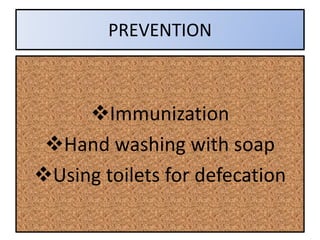
PREVENTION
Immunization
Hand washing with soap
Using toilets for defecation
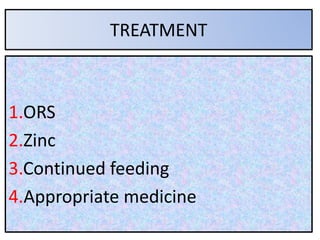
TREATMENT
1.ORS
2.Zinc
3.Continued feeding
4.Appropriate medicine
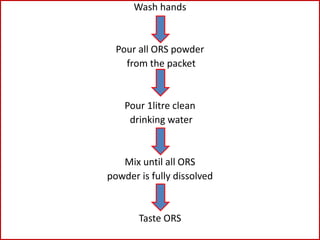
Wash hands
Pour all ORS powder
from the packet
Pour 1litre clean
drinking water
Mix until all ORS
powder is fully dissolved
Taste ORS
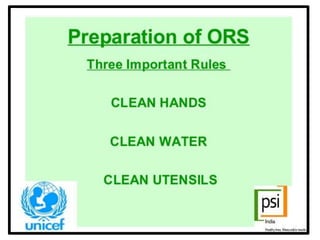
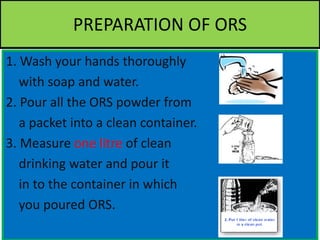
PREPARATION OF ORS
1. Wash your hands thoroughly
with soap and water.
2. Pour all the ORS powder from
a packet into a clean container.
3. Measure one litre of clean
drinking water and pour it
in to the container in which
you poured ORS.
PREPARATION OF ORS
4.Stir until all the powder in the container has been
mixed water and none remain at the bottom of the
container.
5.Taste ORS solution before giving it to the child. It
should taste like tears-neither too sweet nor too
salty. If it tastes too sweet or too salty then throw
away the solution and prepare ORS solution again.
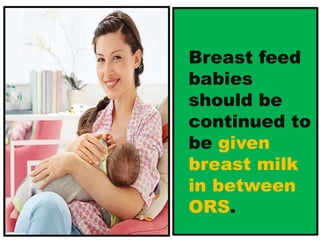
Breast feed
babies
should be
continued to
be given
breast milk
in between
ORS.
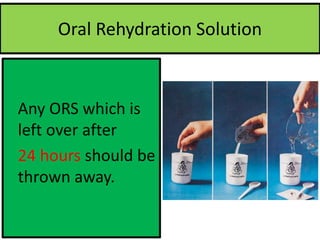
Oral Rehydration Solution
Any ORS which is
left over after
24 hours should be
thrown away.
BE
HEALTHY
BE
HAPPY
Maa 1(mothers' absolute affection)

Maa 1(mothers' absolute affection)