REPRODUCTIVE, MATERNAL.
NEWBORN, CHILD AND ADOLESCENT
HEALTH (RMNCH+A) PROGRAMME
Dr Sanjay Ranaut
MPH 1st Year
HISTORICAL BACKGROUND
1. 1950: MCH services as a basic health service in PHC
2. 1952: National Family Planning Programme
3. 1966: All India Hospital Post Partum Programme
4. 1977: National Family Welfare Programme
5. 1992: National Child Survival & Safe Motherhood programme
6. 1997: RCH phase-I
7. 2005: NRHM
8. 2005: RCH phase -II
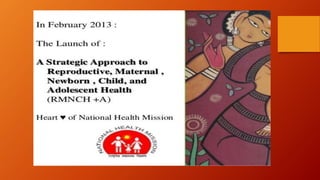
9. 2013: RMNCH+A
Special focus under RCH-II
1. Essential obstetric care:
- Institutional delivery
- Delivery by SBA
2. Emergency Obstetric Care:
- Operationalizing FRU
- PHC 24 ˣ 7 delivery services
3. Essential Newborn Care / Care of the sick Newborn
RCH-II, not included the underserved groups including Adolescent, urban
poor and tribal population
8 May 2018
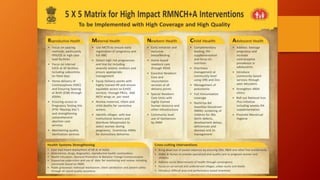
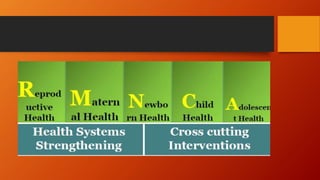
RMNCH+A STRATEGIC APPROCH 2013
1.This was a comprehensive strategy for improving the maternal and child
health outcomes , under NRHM
2.It was based on the evidence that maternal and child health cannot be
improved in isolation as adolescent health and family planning have an
important bearing on the outcomes.
3.This strategy encompasses various high impact interventions across the
life cycle.
4.The strategy was based on the concept of ‘CONTINUUM OF CARE’
• There are two dimensions to healthcare:
• (1) stages of the life cycle
• (2) places where the care is provided
• These together constitute the
‘Continuum of Care’
GOALS
• Reduction of Infant Mortality Rate (IMR) to 25 per 1,000 live births
by 2017
• Reduction in Maternal Mortality Ratio (MMR) to 100 per 100,000
live births by 2017
• Reduction in Total Fertility Rate(TFR) to 2.1 by 2017
Reproductive Health
• Focus on spacing methods, particularly PPIUCD at high case
load facilities
• Focus on Interval IUCDat all facilities including subcenters
on fixed days
• Home delivery of Contraceptives (HDC) and ensuring
spacing at birth (ESB) through ASHAs
• Ensuring access to pregnancy testing kits and strengthening
Comprehensive Abortion care services
• Maintaining quality sterilization services
Maternal Health
• Use of MCTS/ RCH portal for early registration of pregnancy
• Detect High risk pregnancies and ensuring appropriate
management. PMSMA clinics on 9th of every month (Pradhan
Mantri Surakshit Matritva Abhiyaan)
• Equip Delivery Points with highly trained HR and ensure
equitable access to EmOC (basic and advanced) services through
FRUs. Add MCH wings as per need.
• Review maternal, infant and child death review and take
corrective actions.
• Identify villages with high number of home deliveries and
distribute Misoprostol to select women during pregnancy;
incentivize ANMs for domiciliary deliveries
Newborn Care
• Early Initiation and exclusive breastfeeding
• Home based New born care through ASHA
• Essential Newborn care and resuscitation: NSSK (Navjat
Shishu Suraksha Karyakram)
• Special Newborn care Unit (SNCU), New born Stabilization
Unit (NBSU), Newborn care corner (NBCC).
• Community level use of Gentamycin by ANM
Child Health
• IYCF: Infant and young child feeding- Complimentary feeding
starting at age 6 months.
• NIPI: National Iron Plus Initaitive starting at 6 months of age (6 -60
mths 1 ml IFA biweekly, 5-10 years weekly WIFS Junior -pink)
• Management of Diarrhoea at community level using ORS and Zn
Tab (special Intensified Diarrhoea Control Fornight drives in July
every year). Also covered under IMNCI trainings
• Management of pneumonia: IMNCI trainings
• Full Immunization coverage
• RBSK: Rashtriya Bal Swasthya Karyakram- birth to 18 years
Rashtriya Kishor Swasthya Karyakram
4 pronged strategy
Adolescent Care
• Menstrual hygiene programme: Sanitary pad supplied through
ASHA/ANM @ Rs 6 per pack of 6 sanitary napkins
• Yuva Paramarsh Clinics for counselling of adolescents on sexual/
reproductive/ mental health. Addressal of teenage pregnancy
and increase contraceptive prevalence in adolescents
• Weekly Iron Folic Acid Supplements to adolescents in Govt and
Govt Aided schools
• Peer educators in high priority districts where adolescents act
as educators for fellow adolescents at community level.
WHAT IS NEW IN RMNCH+A?
Inter-linkages between different interventions at various stages of the life
cycle
2. Linking child survival to other inventions such as reproductive health,
family planning , maternal health
3. Sharper focus on adolescents
4. Recognizing nurses as ‘pivots’ for service delivery
5. Expanding focus on child development and quality of life
6. Intensification of activities in High Priority districts.
References
• A Strategic Approach to Reproductive, Maternal, Newborn, Child and
Adolescent Health(RMNCH+A) in India. Ministry of Health & Family Welfare
Government of India February 2013
• Revised operating manual for preparation and monitering of RCH-II &
immunization component of NRHM state programme implementation plans
(PIPs). Ministry of Health & Family Welfare Government of India. November
2010
• Guidelines for Preparation of Annual Programme Implementation Plan
National Rural Health Mission. 2013-2014
• Govt. of India(2014),Annaul Report 2013-14,Ministry of Health and Family
Welfare ,New Delhi.
• Guidance note on gap analysis of RMNCH+A implementation in
India.Ministry of Health & Family Welfare Government of India
February 2013
• Guidance note for RMNCH+A implementation in High priority
districts. India. Ministry of Health & Family Welfare Government
of India February 2013
• Coverage Evaluation Survey 2009 annual report: UNICEF
Thank You

Rmnch+a

  • 1.
    REPRODUCTIVE, MATERNAL. NEWBORN, CHILDAND ADOLESCENT HEALTH (RMNCH+A) PROGRAMME Dr Sanjay Ranaut MPH 1st Year
  • 2.
    HISTORICAL BACKGROUND 1. 1950:MCH services as a basic health service in PHC 2. 1952: National Family Planning Programme 3. 1966: All India Hospital Post Partum Programme 4. 1977: National Family Welfare Programme 5. 1992: National Child Survival & Safe Motherhood programme 6. 1997: RCH phase-I 7. 2005: NRHM 8. 2005: RCH phase -II 9. 2013: RMNCH+A
  • 3.
    Special focus underRCH-II 1. Essential obstetric care: - Institutional delivery - Delivery by SBA 2. Emergency Obstetric Care: - Operationalizing FRU - PHC 24 ˣ 7 delivery services 3. Essential Newborn Care / Care of the sick Newborn RCH-II, not included the underserved groups including Adolescent, urban poor and tribal population
  • 4.
  • 5.
    RMNCH+A STRATEGIC APPROCH2013 1.This was a comprehensive strategy for improving the maternal and child health outcomes , under NRHM 2.It was based on the evidence that maternal and child health cannot be improved in isolation as adolescent health and family planning have an important bearing on the outcomes. 3.This strategy encompasses various high impact interventions across the life cycle. 4.The strategy was based on the concept of ‘CONTINUUM OF CARE’
  • 6.
    • There aretwo dimensions to healthcare: • (1) stages of the life cycle • (2) places where the care is provided • These together constitute the ‘Continuum of Care’
  • 7.
    GOALS • Reduction ofInfant Mortality Rate (IMR) to 25 per 1,000 live births by 2017 • Reduction in Maternal Mortality Ratio (MMR) to 100 per 100,000 live births by 2017 • Reduction in Total Fertility Rate(TFR) to 2.1 by 2017
  • 11.
    Reproductive Health • Focuson spacing methods, particularly PPIUCD at high case load facilities • Focus on Interval IUCDat all facilities including subcenters on fixed days • Home delivery of Contraceptives (HDC) and ensuring spacing at birth (ESB) through ASHAs
  • 12.
    • Ensuring accessto pregnancy testing kits and strengthening Comprehensive Abortion care services • Maintaining quality sterilization services
  • 14.
    Maternal Health • Useof MCTS/ RCH portal for early registration of pregnancy • Detect High risk pregnancies and ensuring appropriate management. PMSMA clinics on 9th of every month (Pradhan Mantri Surakshit Matritva Abhiyaan) • Equip Delivery Points with highly trained HR and ensure equitable access to EmOC (basic and advanced) services through FRUs. Add MCH wings as per need.
  • 15.
    • Review maternal,infant and child death review and take corrective actions. • Identify villages with high number of home deliveries and distribute Misoprostol to select women during pregnancy; incentivize ANMs for domiciliary deliveries
  • 17.
    Newborn Care • EarlyInitiation and exclusive breastfeeding • Home based New born care through ASHA • Essential Newborn care and resuscitation: NSSK (Navjat Shishu Suraksha Karyakram) • Special Newborn care Unit (SNCU), New born Stabilization Unit (NBSU), Newborn care corner (NBCC). • Community level use of Gentamycin by ANM
  • 19.
    Child Health • IYCF:Infant and young child feeding- Complimentary feeding starting at age 6 months. • NIPI: National Iron Plus Initaitive starting at 6 months of age (6 -60 mths 1 ml IFA biweekly, 5-10 years weekly WIFS Junior -pink) • Management of Diarrhoea at community level using ORS and Zn Tab (special Intensified Diarrhoea Control Fornight drives in July every year). Also covered under IMNCI trainings
  • 20.
    • Management ofpneumonia: IMNCI trainings • Full Immunization coverage • RBSK: Rashtriya Bal Swasthya Karyakram- birth to 18 years
  • 22.
    Rashtriya Kishor SwasthyaKaryakram 4 pronged strategy
  • 23.
    Adolescent Care • Menstrualhygiene programme: Sanitary pad supplied through ASHA/ANM @ Rs 6 per pack of 6 sanitary napkins • Yuva Paramarsh Clinics for counselling of adolescents on sexual/ reproductive/ mental health. Addressal of teenage pregnancy and increase contraceptive prevalence in adolescents • Weekly Iron Folic Acid Supplements to adolescents in Govt and Govt Aided schools • Peer educators in high priority districts where adolescents act as educators for fellow adolescents at community level.
  • 24.
    WHAT IS NEWIN RMNCH+A? Inter-linkages between different interventions at various stages of the life cycle 2. Linking child survival to other inventions such as reproductive health, family planning , maternal health 3. Sharper focus on adolescents 4. Recognizing nurses as ‘pivots’ for service delivery 5. Expanding focus on child development and quality of life 6. Intensification of activities in High Priority districts.
  • 25.
    References • A StrategicApproach to Reproductive, Maternal, Newborn, Child and Adolescent Health(RMNCH+A) in India. Ministry of Health & Family Welfare Government of India February 2013 • Revised operating manual for preparation and monitering of RCH-II & immunization component of NRHM state programme implementation plans (PIPs). Ministry of Health & Family Welfare Government of India. November 2010 • Guidelines for Preparation of Annual Programme Implementation Plan National Rural Health Mission. 2013-2014 • Govt. of India(2014),Annaul Report 2013-14,Ministry of Health and Family Welfare ,New Delhi.
  • 26.
    • Guidance noteon gap analysis of RMNCH+A implementation in India.Ministry of Health & Family Welfare Government of India February 2013 • Guidance note for RMNCH+A implementation in High priority districts. India. Ministry of Health & Family Welfare Government of India February 2013 • Coverage Evaluation Survey 2009 annual report: UNICEF
  • 27.

Editor's Notes

  • #18 24 hour unit NBSU Transit till sncu,NBCC EVERY LABOUR ROOM