<Insert Picture Here>


Servlets 3.0
Asynchronous, Extensiblity, Ease-of-use
Arun Gupta, Java EE & GlassFish Guy
blogs.sun.com/arungupta, @arungupta
Beijing 2010
December 13–16, 2010


                       2
The following is intended to outline our general
product direction. It is intended for information
purposes only, and may not be incorporated into any
contract. It is not a commitment to deliver any
material, code, or functionality, and should not be
relied upon in making purchasing decisions.
The development, release, and timing of any
features or functionality described for Oracle’s
products remains at the sole discretion of Oracle.


                                                      3
Agenda
• Overview
• Ease of Development
• Dynamic Registration of Servlets and
  Filters
• Pluggability
• Asynchronous Support
• Security Enhancements
• Miscellaneous


                                         4
Overview
l
    Java Servlet 3.0 done as part of JSR 315
    – Final release done in December 2009.
l
    ~20 members in the expert group
    – Major Java EE vendors, open source web container
      developers, framework authors
l
    Main areas of focus
    –   Ease of Development
    –   Pluggability
    –   Asynchronous support
    –   Security


                                                         5
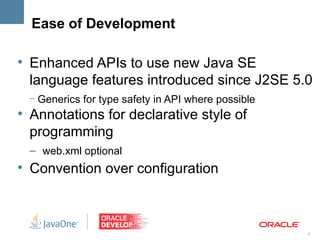
Ease of Development

l
    Enhanced APIs to use new Java SE
    language features introduced since J2SE 5.0
    – Generics for type safety in API where possible
l
    Annotations for declarative style of
    programming
    – web.xml optional
l
    Convention over configuration


                                                       6
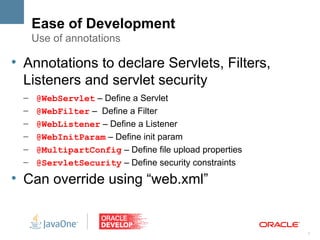
Ease of Development
        Use of annotations

l
    Annotations to declare Servlets, Filters,
    Listeners and servlet security
    –   @WebServlet – Define a Servlet
    –   @WebFilter – Define a Filter
    –   @WebListener – Define a Listener
    –   @WebInitParam – Define init param
    –   @MultipartConfig – Define file upload properties
    –   @ServletSecurity – Define security constraints
l
    Can override using “web.xml”


                                                           7
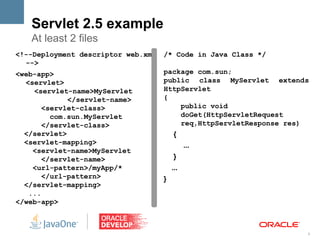
Servlet 2.5 example
   At least 2 files
<!--Deployment descriptor web.xml   /* Code in Java Class */
  -->
<web-app>                           package com.sun;
  <servlet>                         public class MyServlet extends
    <servlet-name>MyServlet         HttpServlet
             </servlet-name>        {
       <servlet-class>                  public void
         com.sun.MyServlet              doGet(HttpServletRequest
       </servlet-class>                 req,HttpServletResponse res)
  </servlet>                            {
  <servlet-mapping>                           ...
    <servlet-name>MyServlet
       </servlet-name>                  }
    <url-pattern>/myApp/*               ...
       </url-pattern>               }
  </servlet-mapping>
   ...
</web-app>


                                                                   8
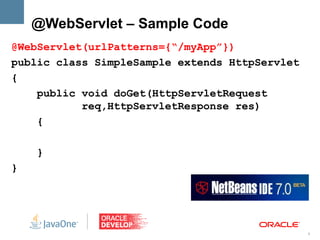
@WebServlet – Sample Code
@WebServlet(urlPatterns={“/myApp”})
public class SimpleSample extends HttpServlet
{
    public void doGet(HttpServletRequest
           req,HttpServletResponse res)
    {

    }
}


                                                9
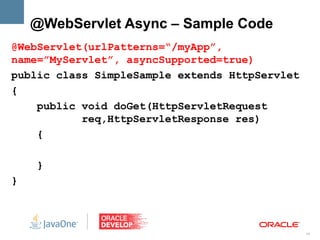
@WebServlet Async – Sample Code
@WebServlet(urlPatterns=“/myApp”,
name=”MyServlet”, asyncSupported=true)
public class SimpleSample extends HttpServlet
{
    public void doGet(HttpServletRequest
           req,HttpServletResponse res)
    {

    }
}


                                                10
Dynamic Registration
     Create and/or register
• ServletContext#add[Servlet | Filter]
     • Overloaded versions take [Servlet | Filter] name and
          – Fully qualified [Servlet | Filter] class name or
          – Class <? extends [Servlet | Filter]> or
          – [Servlet | Filter] instance
       • User returned Registration handle to configure all aspects of
         [Servlet | Filter]
l
    ServletContext#create[Servlet | Filter]
    – Takes Class<? Extends [Servlet | Filter]> argument
    – Supports resource injection by container
    – Returned [Servlet | Filter] instance may be fully customized before it
      is registered


                                                                               11
Dynamic Registration
     Lookup
l
    ServletContext#find[Servlet |
    Filter]Registration
    – Takes [Servlet | Filter] name as argument
    – Returned Registration handle provides subset of configuration
      methods
    – May only be used to add initialization parameters and mappings
    – Conflict returned as java.util.Set


                                                                       12
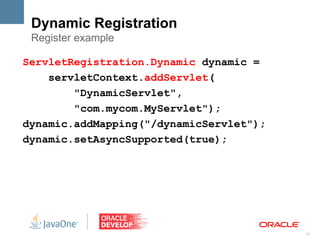
Dynamic Registration
 Register example

ServletRegistration.Dynamic dynamic =
    servletContext.addServlet(
        "DynamicServlet",
        "com.mycom.MyServlet");
dynamic.addMapping("/dynamicServlet");
dynamic.setAsyncSupported(true);


                                         13
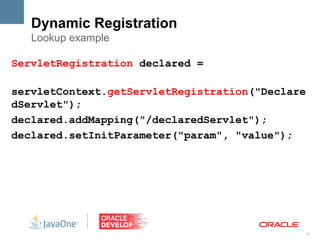
Dynamic Registration
   Lookup example

ServletRegistration declared =

servletContext.getServletRegistration("Declare
dServlet");
declared.addMapping("/declaredServlet");
declared.setInitParameter("param", "value");


                                                 14
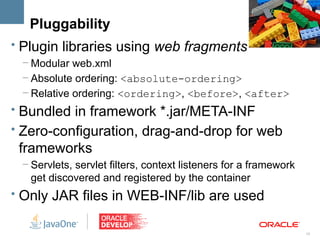
Pluggability
• Plugin libraries using web fragments
 – Modular web.xml
 – Absolute ordering: <absolute-ordering>
 – Relative ordering: <ordering>, <before>, <after>
• Bundled in framework *.jar/META-INF
• Zero-configuration, drag-and-drop for web
 frameworks
 – Servlets, servlet filters, context listeners for a framework
   get discovered and registered by the container
• Only JAR files in WEB-INF/lib are used


                                                                  15
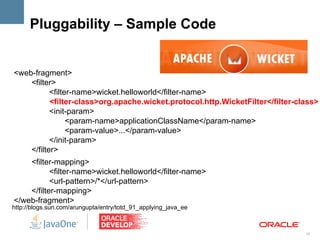
Pluggability – Sample Code


<web-fragment>
    <filter>
           <filter-name>wicket.helloworld</filter-name>
           <filter-class>org.apache.wicket.protocol.http.WicketFilter</filter-class>
           <init-param>
                 <param-name>applicationClassName</param-name>
                 <param-value>...</param-value>
           </init-param>
    </filter>
    <filter-mapping>
           <filter-name>wicket.helloworld</filter-name>
           <url-pattern>/*</url-pattern>
    </filter-mapping>
</web-fragment>
http://blogs.sun.com/arungupta/entry/totd_91_applying_java_ee


                                                                                16
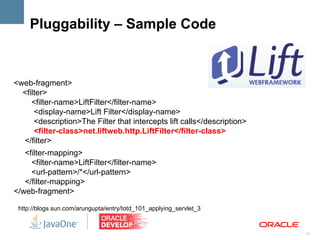
Pluggability – Sample Code


<web-fragment>
  <filter>
     <filter-name>LiftFilter</filter-name>
      <display-name>Lift Filter</display-name>
      <description>The Filter that intercepts lift calls</description>
      <filter-class>net.liftweb.http.LiftFilter</filter-class>
  </filter>
   <filter-mapping>
     <filter-name>LiftFilter</filter-name>
     <url-pattern>/*</url-pattern>
   </filter-mapping>
</web-fragment>

 http://blogs.sun.com/arungupta/entry/totd_101_applying_servlet_3


                                                                         17
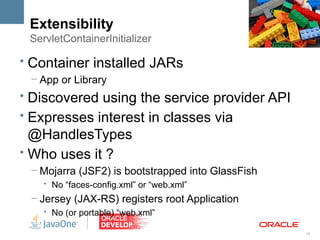
Extensibility
 ServletContainerInitializer

• Container installed JARs
 – App or Library
• Discovered using the service provider API
• Expresses interest in classes via
  @HandlesTypes
• Who uses it ?
 – Mojarra (JSF2) is bootstrapped into GlassFish
    • No “faces-config.xml” or “web.xml”
 – Jersey (JAX-RS) registers root Application
    • No (or portable) “web.xml”

                                                   18
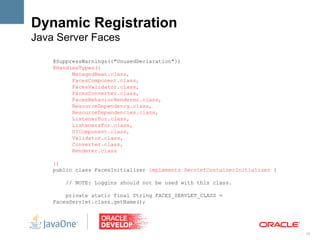
Dynamic Registration
Java Server Faces

    @SuppressWarnings({"UnusedDeclaration"})
    @HandlesTypes({
          ManagedBean.class,
          FacesComponent.class,
          FacesValidator.class,
          FacesConverter.class,
          FacesBehaviorRenderer.class,
          ResourceDependency.class,
          ResourceDependencies.class,
          ListenerFor.class,
          ListenersFor.class,
          UIComponent.class,
          Validator.class,
          Converter.class,
          Renderer.class

    })
    public class FacesInitializer implements ServletContainerInitializer {

        // NOTE: Loggins should not be used with this class.

        private static final String FACES_SERVLET_CLASS =
    FacesServlet.class.getName();


                                                                             19
Dynamic Registration
Java Server Faces

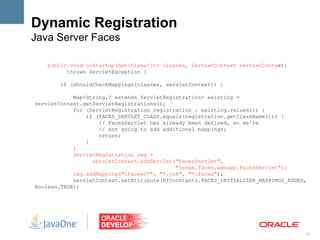
    public void onStartup(Set<Class<?>> classes, ServletContext servletContext)
          throws ServletException {

        if (shouldCheckMappings(classes, servletContext)) {

            Map<String,? extends ServletRegistration> existing =
servletContext.getServletRegistrations();
            for (ServletRegistration registration : existing.values()) {
                if (FACES_SERVLET_CLASS.equals(registration.getClassName())) {
                    // FacesServlet has already been defined, so we're
                    // not going to add additional mappings;
                    return;
                }
            }
            ServletRegistration reg =
                  servletContext.addServlet("FacesServlet",
                                            "javax.faces.webapp.FacesServlet");
            reg.addMapping("/faces/*", "*.jsf", "*.faces");
            servletContext.setAttribute(RIConstants.FACES_INITIALIZER_MAPPINGS_ADDED,
Boolean.TRUE);


                                                                                    20
Resource Sharing
• Static and JSP not confined to document root
  of the web application
• May be placed in WEB-INF/lib/
  [*.jar]/META-INF/resources
• Resources in root take precedence over
  those in bundled JAR
• Container must honor this new location when
 – Processing HTTP requests
 – Calls to ServletContext#getResource[AsStream]


                                                   21
Resource Sharing – Sample Code


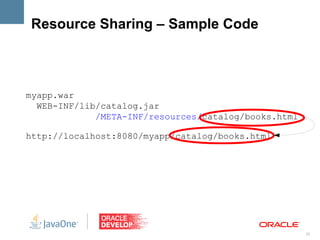
myapp.war
  WEB-INF/lib/catalog.jar
             /META-INF/resources/catalog/books.html

http://localhost:8080/myapp/catalog/books.html


                                                      22
Why Asynchronous Servlets?

l
    Not for Async IO
    – Requests mostly small (single packet)
    – Hard to asynchronously produce large responses
    – Async IO support waiting for NIO2

l
    Async Servlets are for:
    – Waiting for resources (eg JDBC connection)
    – Waiting for events (eg Chat)
    – Waiting for responses (eg web services)


                                                       23
Blocking waiting consumes resources

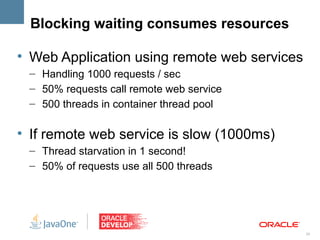
l
    Web Application using remote web services
    – Handling 1000 requests / sec
    – 50% requests call remote web service
    – 500 threads in container thread pool

l
    If remote web service is slow (1000ms)
    – Thread starvation in 1 second!
    – 50% of requests use all 500 threads


                                                24
Asynchronous API
Enable asynchronous support

l
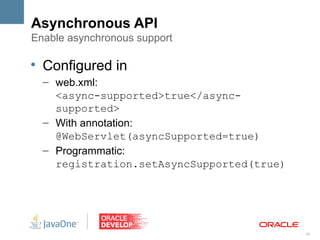
    Configured in
    – web.xml:
      <async-supported>true</async-
      supported>
    – With annotation:
      @WebServlet(asyncSupported=true)
    – Programmatic:
      registration.setAsyncSupported(true)


                                             25
Asynchronous Servlets – Sample Code

   AsyncContext context = request.startAsync();
   context.addListener(new AsyncListener() { … });
   context.dispatch(“/request.jsp”);
   //context.start(Runnable action);
   . . .
   context.complete();


http://blogs.sun.com/arungupta/entry/totd_139_asynchronous_request_processing


                                                                                26
Security
    Annotations to define security constraints
l
    @ServletSecurity used to define access
    control constraints
l
    @HttpConstraint for all HTTP methods
l
    @HttpMethodConstraint for specific HTTP
    methods
l
    More specific wins


                                                 27
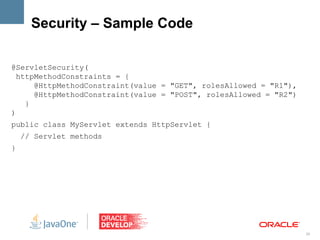
Security – Sample Code

@ServletSecurity(
  httpMethodConstraints = {
      @HttpMethodConstraint(value = "GET", rolesAllowed = "R1"),
      @HttpMethodConstraint(value = "POST", rolesAllowed = "R2")
    }
)
public class MyServlet extends HttpServlet {
    // Servlet methods
}


                                                                   28
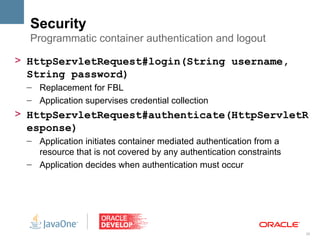
Security
  Programmatic container authentication and logout

> HttpServletRequest#login(String username,
  String password)
 – Replacement for FBL
 – Application supervises credential collection
> HttpServletRequest#authenticate(HttpServletR
  esponse)
 – Application initiates container mediated authentication from a
   resource that is not covered by any authentication constraints
 – Application decides when authentication must occur


                                                                    29
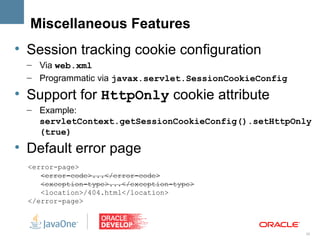
Miscellaneous Features
l
    Session tracking cookie configuration
    – Via web.xml
    – Programmatic via javax.servlet.SessionCookieConfig
l
    Support for HttpOnly cookie attribute
    – Example:
      servletContext.getSessionCookieConfig().setHttpOnly
      (true)
l
    Default error page
    <error-page>
       <error-code>...</error-code>
       <exception-type>...</exception-type>
       <location>/404.html</location>
    </error-page>


                                                           30
Miscellaneous Features / API (contd)

ServletRequest#getServletContext
ServletRequest#getDispatcherType
Servlet[Request|
Response]Wrapper#isWrapperFor
HttpServletResponse#getStatus
HttpServletResponse#getHeader
HttpServletResponse#getHeaders
HttpServletResponse#getHeaderNames


                                       31
Miscellaneous Features / API (contd)
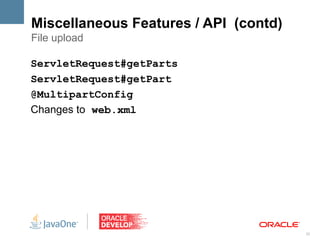
File upload

ServletRequest#getParts
ServletRequest#getPart
@MultipartConfig
Changes to web.xml


                                       32
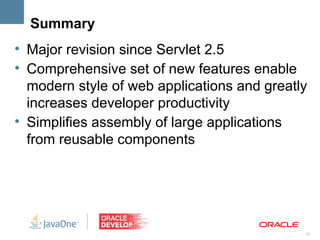
Summary
l
    Major revision since Servlet 2.5
l
    Comprehensive set of new features enable
    modern style of web applications and greatly
    increases developer productivity
l
    Simplifies assembly of large applications
    from reusable components


                                               33
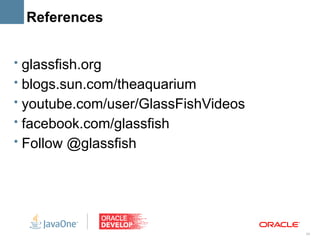
References


• glassfish.org
• blogs.sun.com/theaquarium
• youtube.com/user/GlassFishVideos
• facebook.com/glassfish
• Follow @glassfish


                                     34

Servlets 3.0 - Asynchronous, Extensibility, Ease-of-use @ JavaOne Brazil 2010

  • 1.
    <Insert Picture Here> Servlets3.0 Asynchronous, Extensiblity, Ease-of-use Arun Gupta, Java EE & GlassFish Guy blogs.sun.com/arungupta, @arungupta
  • 2.
  • 3.
    The following isintended to outline our general product direction. It is intended for information purposes only, and may not be incorporated into any contract. It is not a commitment to deliver any material, code, or functionality, and should not be relied upon in making purchasing decisions. The development, release, and timing of any features or functionality described for Oracle’s products remains at the sole discretion of Oracle. 3
  • 4.
    Agenda • Overview • Easeof Development • Dynamic Registration of Servlets and Filters • Pluggability • Asynchronous Support • Security Enhancements • Miscellaneous 4
  • 5.
    Overview l Java Servlet 3.0 done as part of JSR 315 – Final release done in December 2009. l ~20 members in the expert group – Major Java EE vendors, open source web container developers, framework authors l Main areas of focus – Ease of Development – Pluggability – Asynchronous support – Security 5
  • 6.
    Ease of Development l Enhanced APIs to use new Java SE language features introduced since J2SE 5.0 – Generics for type safety in API where possible l Annotations for declarative style of programming – web.xml optional l Convention over configuration 6
  • 7.
    Ease of Development Use of annotations l Annotations to declare Servlets, Filters, Listeners and servlet security – @WebServlet – Define a Servlet – @WebFilter – Define a Filter – @WebListener – Define a Listener – @WebInitParam – Define init param – @MultipartConfig – Define file upload properties – @ServletSecurity – Define security constraints l Can override using “web.xml” 7
  • 8.
    Servlet 2.5 example At least 2 files <!--Deployment descriptor web.xml /* Code in Java Class */ --> <web-app> package com.sun; <servlet> public class MyServlet extends <servlet-name>MyServlet HttpServlet </servlet-name> { <servlet-class> public void com.sun.MyServlet doGet(HttpServletRequest </servlet-class> req,HttpServletResponse res) </servlet> { <servlet-mapping> ... <servlet-name>MyServlet </servlet-name> } <url-pattern>/myApp/* ... </url-pattern> } </servlet-mapping> ... </web-app> 8
  • 9.
    @WebServlet – SampleCode @WebServlet(urlPatterns={“/myApp”}) public class SimpleSample extends HttpServlet { public void doGet(HttpServletRequest req,HttpServletResponse res) { } } 9
  • 10.
    @WebServlet Async –Sample Code @WebServlet(urlPatterns=“/myApp”, name=”MyServlet”, asyncSupported=true) public class SimpleSample extends HttpServlet { public void doGet(HttpServletRequest req,HttpServletResponse res) { } } 10
  • 11.
    Dynamic Registration Create and/or register • ServletContext#add[Servlet | Filter] • Overloaded versions take [Servlet | Filter] name and – Fully qualified [Servlet | Filter] class name or – Class <? extends [Servlet | Filter]> or – [Servlet | Filter] instance • User returned Registration handle to configure all aspects of [Servlet | Filter] l ServletContext#create[Servlet | Filter] – Takes Class<? Extends [Servlet | Filter]> argument – Supports resource injection by container – Returned [Servlet | Filter] instance may be fully customized before it is registered 11
  • 12.
    Dynamic Registration Lookup l ServletContext#find[Servlet | Filter]Registration – Takes [Servlet | Filter] name as argument – Returned Registration handle provides subset of configuration methods – May only be used to add initialization parameters and mappings – Conflict returned as java.util.Set 12
  • 13.
    Dynamic Registration Registerexample ServletRegistration.Dynamic dynamic = servletContext.addServlet( "DynamicServlet", "com.mycom.MyServlet"); dynamic.addMapping("/dynamicServlet"); dynamic.setAsyncSupported(true); 13
  • 14.
    Dynamic Registration Lookup example ServletRegistration declared = servletContext.getServletRegistration("Declare dServlet"); declared.addMapping("/declaredServlet"); declared.setInitParameter("param", "value"); 14
  • 15.
    Pluggability • Plugin librariesusing web fragments – Modular web.xml – Absolute ordering: <absolute-ordering> – Relative ordering: <ordering>, <before>, <after> • Bundled in framework *.jar/META-INF • Zero-configuration, drag-and-drop for web frameworks – Servlets, servlet filters, context listeners for a framework get discovered and registered by the container • Only JAR files in WEB-INF/lib are used 15
  • 16.
    Pluggability – SampleCode <web-fragment> <filter> <filter-name>wicket.helloworld</filter-name> <filter-class>org.apache.wicket.protocol.http.WicketFilter</filter-class> <init-param> <param-name>applicationClassName</param-name> <param-value>...</param-value> </init-param> </filter> <filter-mapping> <filter-name>wicket.helloworld</filter-name> <url-pattern>/*</url-pattern> </filter-mapping> </web-fragment> http://blogs.sun.com/arungupta/entry/totd_91_applying_java_ee 16
  • 17.
    Pluggability – SampleCode <web-fragment> <filter> <filter-name>LiftFilter</filter-name> <display-name>Lift Filter</display-name> <description>The Filter that intercepts lift calls</description> <filter-class>net.liftweb.http.LiftFilter</filter-class> </filter> <filter-mapping> <filter-name>LiftFilter</filter-name> <url-pattern>/*</url-pattern> </filter-mapping> </web-fragment> http://blogs.sun.com/arungupta/entry/totd_101_applying_servlet_3 17
  • 18.
    Extensibility ServletContainerInitializer • Containerinstalled JARs – App or Library • Discovered using the service provider API • Expresses interest in classes via @HandlesTypes • Who uses it ? – Mojarra (JSF2) is bootstrapped into GlassFish • No “faces-config.xml” or “web.xml” – Jersey (JAX-RS) registers root Application • No (or portable) “web.xml” 18
  • 19.
    Dynamic Registration Java ServerFaces @SuppressWarnings({"UnusedDeclaration"}) @HandlesTypes({ ManagedBean.class, FacesComponent.class, FacesValidator.class, FacesConverter.class, FacesBehaviorRenderer.class, ResourceDependency.class, ResourceDependencies.class, ListenerFor.class, ListenersFor.class, UIComponent.class, Validator.class, Converter.class, Renderer.class }) public class FacesInitializer implements ServletContainerInitializer { // NOTE: Loggins should not be used with this class. private static final String FACES_SERVLET_CLASS = FacesServlet.class.getName(); 19
  • 20.
    Dynamic Registration Java ServerFaces public void onStartup(Set<Class<?>> classes, ServletContext servletContext) throws ServletException { if (shouldCheckMappings(classes, servletContext)) { Map<String,? extends ServletRegistration> existing = servletContext.getServletRegistrations(); for (ServletRegistration registration : existing.values()) { if (FACES_SERVLET_CLASS.equals(registration.getClassName())) { // FacesServlet has already been defined, so we're // not going to add additional mappings; return; } } ServletRegistration reg = servletContext.addServlet("FacesServlet", "javax.faces.webapp.FacesServlet"); reg.addMapping("/faces/*", "*.jsf", "*.faces"); servletContext.setAttribute(RIConstants.FACES_INITIALIZER_MAPPINGS_ADDED, Boolean.TRUE); 20
  • 21.
    Resource Sharing • Staticand JSP not confined to document root of the web application • May be placed in WEB-INF/lib/ [*.jar]/META-INF/resources • Resources in root take precedence over those in bundled JAR • Container must honor this new location when – Processing HTTP requests – Calls to ServletContext#getResource[AsStream] 21
  • 22.
    Resource Sharing –Sample Code myapp.war WEB-INF/lib/catalog.jar /META-INF/resources/catalog/books.html http://localhost:8080/myapp/catalog/books.html 22
  • 23.
    Why Asynchronous Servlets? l Not for Async IO – Requests mostly small (single packet) – Hard to asynchronously produce large responses – Async IO support waiting for NIO2 l Async Servlets are for: – Waiting for resources (eg JDBC connection) – Waiting for events (eg Chat) – Waiting for responses (eg web services) 23
  • 24.
    Blocking waiting consumesresources l Web Application using remote web services – Handling 1000 requests / sec – 50% requests call remote web service – 500 threads in container thread pool l If remote web service is slow (1000ms) – Thread starvation in 1 second! – 50% of requests use all 500 threads 24
  • 25.
    Asynchronous API Enable asynchronoussupport l Configured in – web.xml: <async-supported>true</async- supported> – With annotation: @WebServlet(asyncSupported=true) – Programmatic: registration.setAsyncSupported(true) 25
  • 26.
    Asynchronous Servlets –Sample Code AsyncContext context = request.startAsync(); context.addListener(new AsyncListener() { … }); context.dispatch(“/request.jsp”); //context.start(Runnable action); . . . context.complete(); http://blogs.sun.com/arungupta/entry/totd_139_asynchronous_request_processing 26
  • 27.
    Security Annotations to define security constraints l @ServletSecurity used to define access control constraints l @HttpConstraint for all HTTP methods l @HttpMethodConstraint for specific HTTP methods l More specific wins 27
  • 28.
    Security – SampleCode @ServletSecurity( httpMethodConstraints = { @HttpMethodConstraint(value = "GET", rolesAllowed = "R1"), @HttpMethodConstraint(value = "POST", rolesAllowed = "R2") } ) public class MyServlet extends HttpServlet { // Servlet methods } 28
  • 29.
    Security Programmaticcontainer authentication and logout > HttpServletRequest#login(String username, String password) – Replacement for FBL – Application supervises credential collection > HttpServletRequest#authenticate(HttpServletR esponse) – Application initiates container mediated authentication from a resource that is not covered by any authentication constraints – Application decides when authentication must occur 29
  • 30.
    Miscellaneous Features l Session tracking cookie configuration – Via web.xml – Programmatic via javax.servlet.SessionCookieConfig l Support for HttpOnly cookie attribute – Example: servletContext.getSessionCookieConfig().setHttpOnly (true) l Default error page <error-page> <error-code>...</error-code> <exception-type>...</exception-type> <location>/404.html</location> </error-page> 30
  • 31.
    Miscellaneous Features /API (contd) ServletRequest#getServletContext ServletRequest#getDispatcherType Servlet[Request| Response]Wrapper#isWrapperFor HttpServletResponse#getStatus HttpServletResponse#getHeader HttpServletResponse#getHeaders HttpServletResponse#getHeaderNames 31
  • 32.
    Miscellaneous Features /API (contd) File upload ServletRequest#getParts ServletRequest#getPart @MultipartConfig Changes to web.xml 32
  • 33.
    Summary l Major revision since Servlet 2.5 l Comprehensive set of new features enable modern style of web applications and greatly increases developer productivity l Simplifies assembly of large applications from reusable components 33
  • 34.
    References • glassfish.org • blogs.sun.com/theaquarium •youtube.com/user/GlassFishVideos • facebook.com/glassfish • Follow @glassfish 34