Servlet 3.0


              Minh Hoang TO

              Portal Team
Servlet 3.0 Specification


 - Java Specification Request JSR-315


 - Part of Java Enterprise Edition 6


 - Compliant servers:

    Apache Tomcat 7, JBoss AS 7, Jetty 8, GlassFish 3, ...


                     www.exoplatform.com - Copyright 2012 eXo Platform   2
Agenda

- Annotations

- Web Fragment

- Dynamic Registration

- Programmatic Login

- Asynchronous Servlet

- File Upload


                www.exoplatform.com - Copyright 2012 eXo Platform   3
Annotations


- Use annotations to declare servlet, filter, listener and specify metadata for the
declared component


@WebServlet
@WebFilter
@WebInitParam
@WebListener
@ServletSecurity
@HttpConstraint


- Servlet container detects annotated class and injects metadata into declared
components at deploy time


                       www.exoplatform.com - Copyright 2012 eXo Platform              4
Annotations

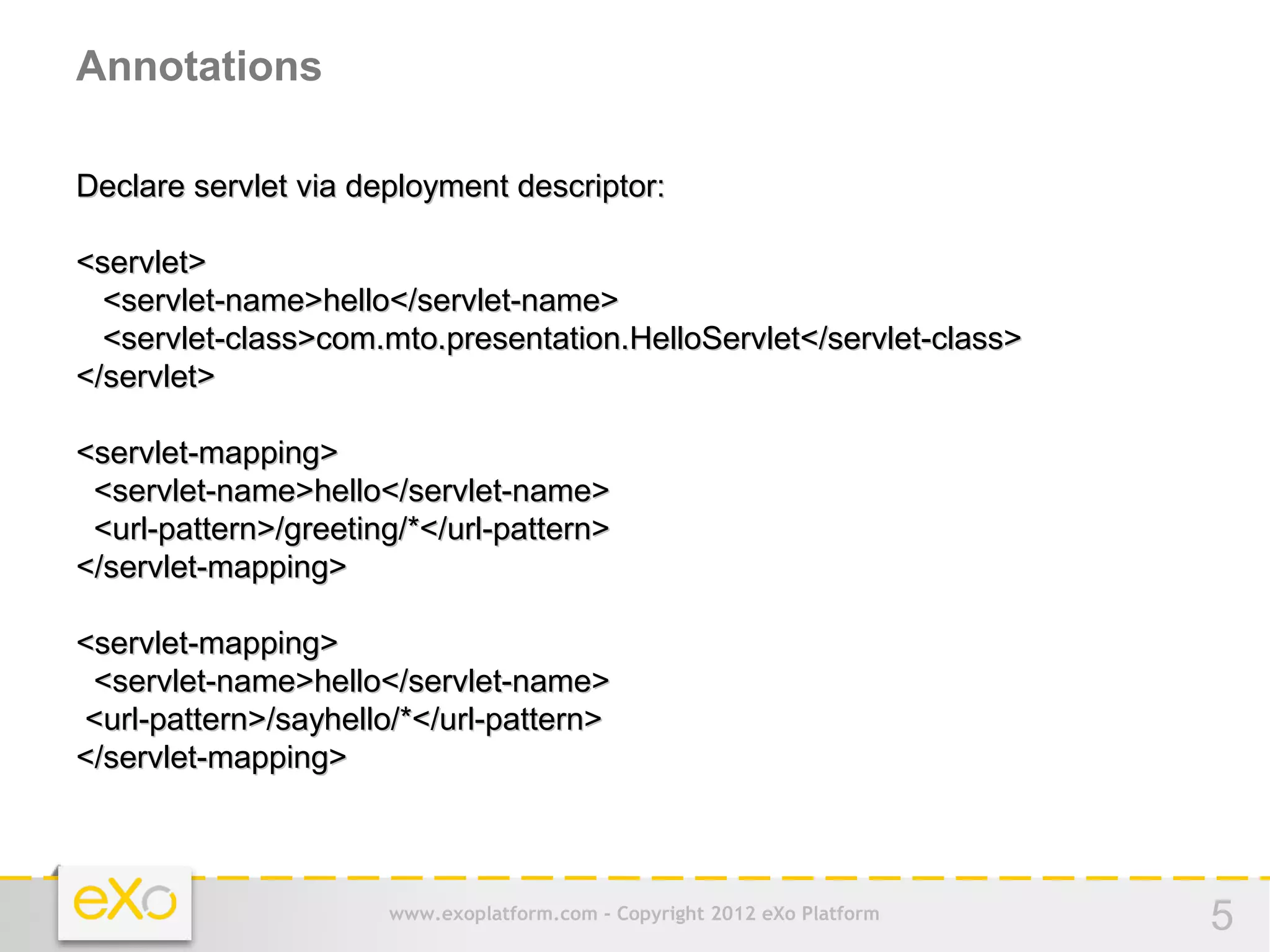
Declare servlet via deployment descriptor:

<servlet>
  <servlet-name>hello</servlet-name>
  <servlet-class>com.mto.presentation.HelloServlet</servlet-class>
</servlet>

<servlet-mapping>
 <servlet-name>hello</servlet-name>
 <url-pattern>/greeting/*</url-pattern>
</servlet-mapping>

<servlet-mapping>
 <servlet-name>hello</servlet-name>
<url-pattern>/sayhello/*</url-pattern>
</servlet-mapping>


                      www.exoplatform.com - Copyright 2012 eXo Platform   5
Annotations

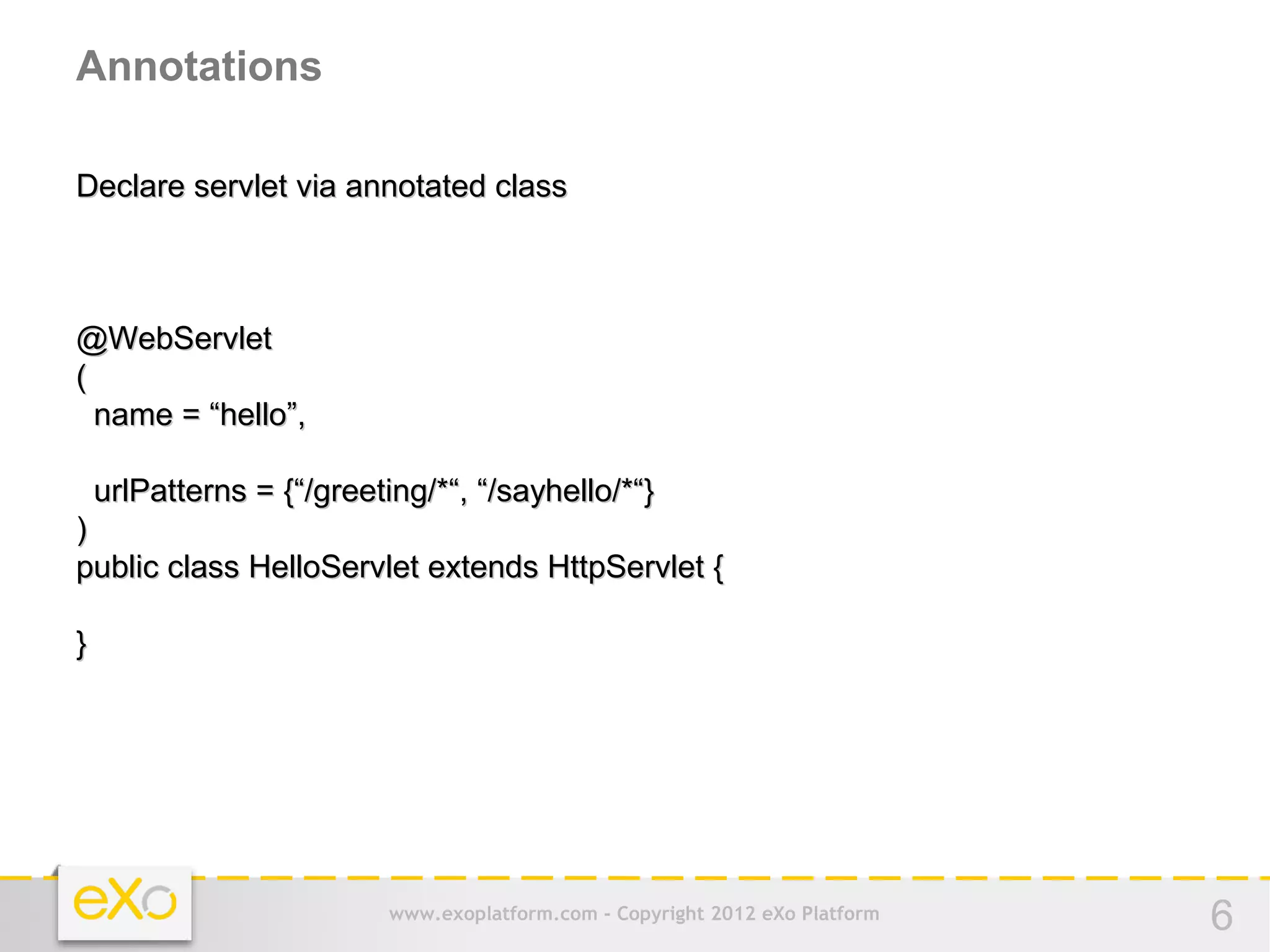
Declare servlet via annotated class


@WebServlet
(
  name = “hello”,

    urlPatterns = {“/greeting/*“, “/sayhello/*“}
)
public class HelloServlet extends HttpServlet {

}


                           www.exoplatform.com - Copyright 2012 eXo Platform   6
Annotations

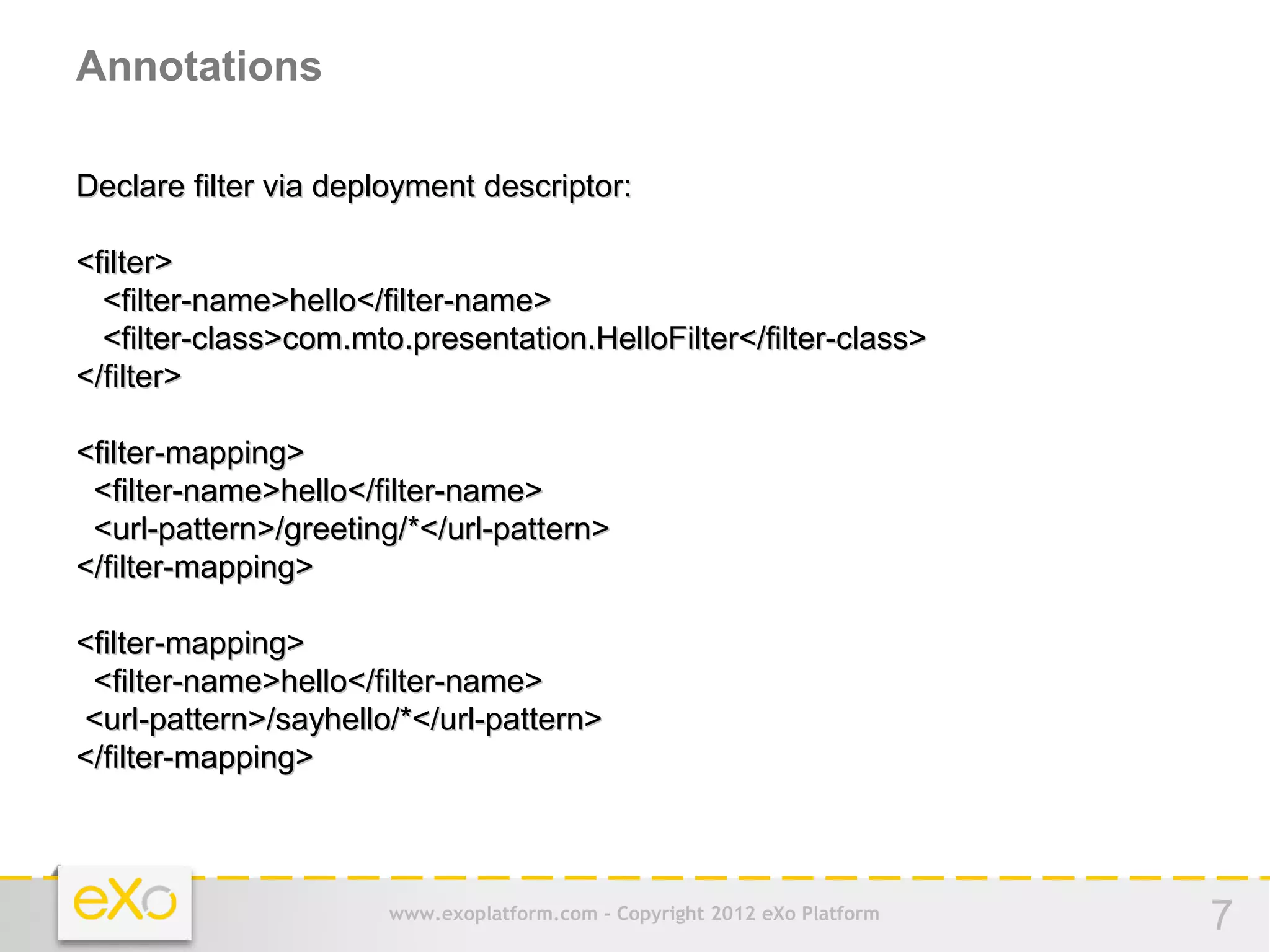
Declare filter via deployment descriptor:

<filter>
  <filter-name>hello</filter-name>
  <filter-class>com.mto.presentation.HelloFilter</filter-class>
</filter>

<filter-mapping>
 <filter-name>hello</filter-name>
 <url-pattern>/greeting/*</url-pattern>
</filter-mapping>

<filter-mapping>
 <filter-name>hello</filter-name>
<url-pattern>/sayhello/*</url-pattern>
</filter-mapping>


                       www.exoplatform.com - Copyright 2012 eXo Platform   7
Annotations

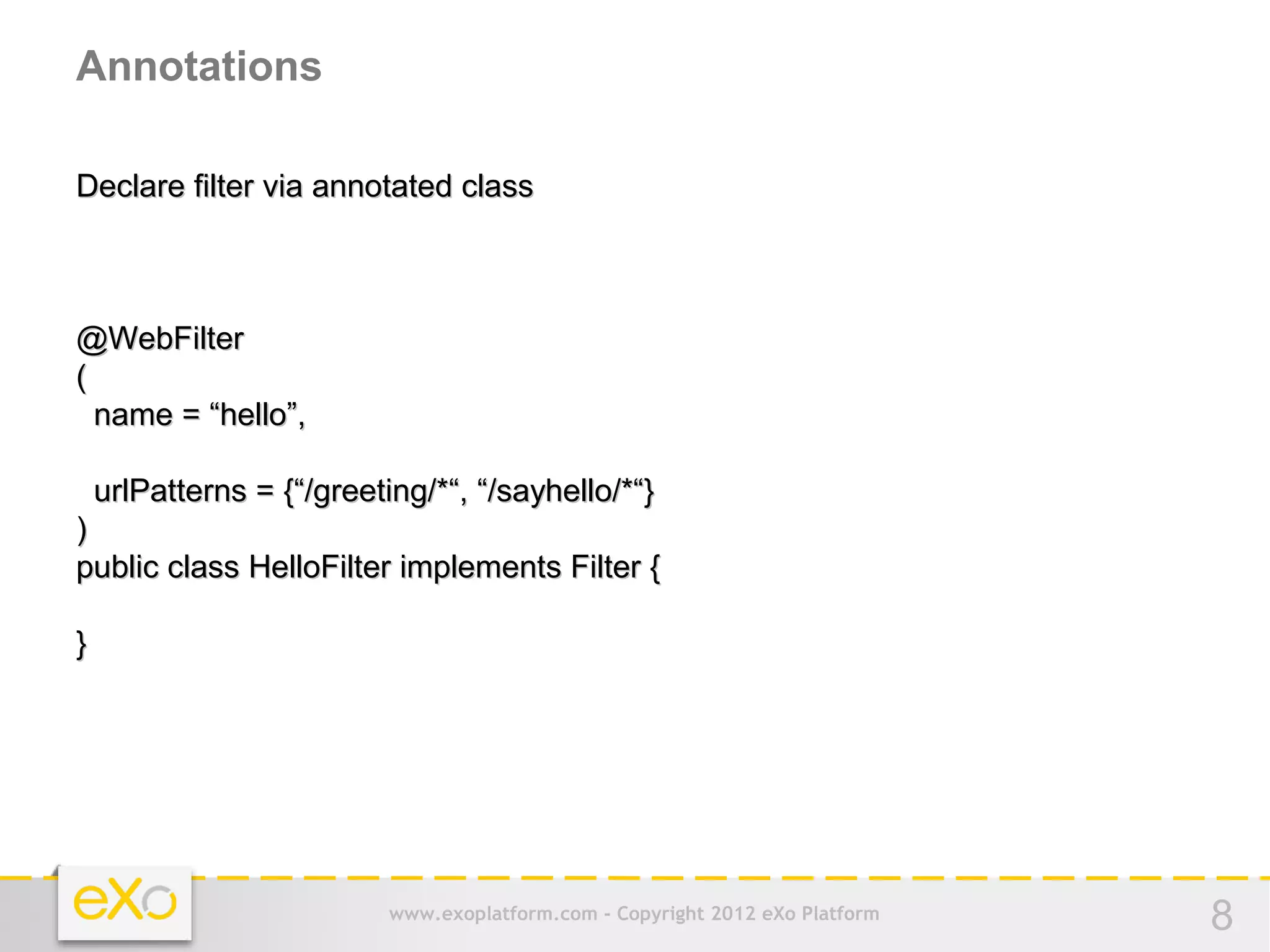
Declare filter via annotated class


@WebFilter
(
  name = “hello”,

    urlPatterns = {“/greeting/*“, “/sayhello/*“}
)
public class HelloFilter implements Filter {

}


                           www.exoplatform.com - Copyright 2012 eXo Platform   8
Annotations


- Type safe and less error-prone

- Facilitate work of developers

- No need to master XSD of deployment descriptor


BUT

- Frequent recompilation is a big obstacle


                       www.exoplatform.com - Copyright 2012 eXo Platform   9
Web Fragment


- Divide WEB-INF/web.xml into multiples META-INF/web-fragment.xml :

  1. Each web-fragment.xml is packed in a .jar artifact under WEB-INF/lib

  2. Web application components could be declared in web-fragment.xml

  3. Order of fragment processing is manageable


                     www.exoplatform.com - Copyright 2012 eXo Platform      10
Web Fragment


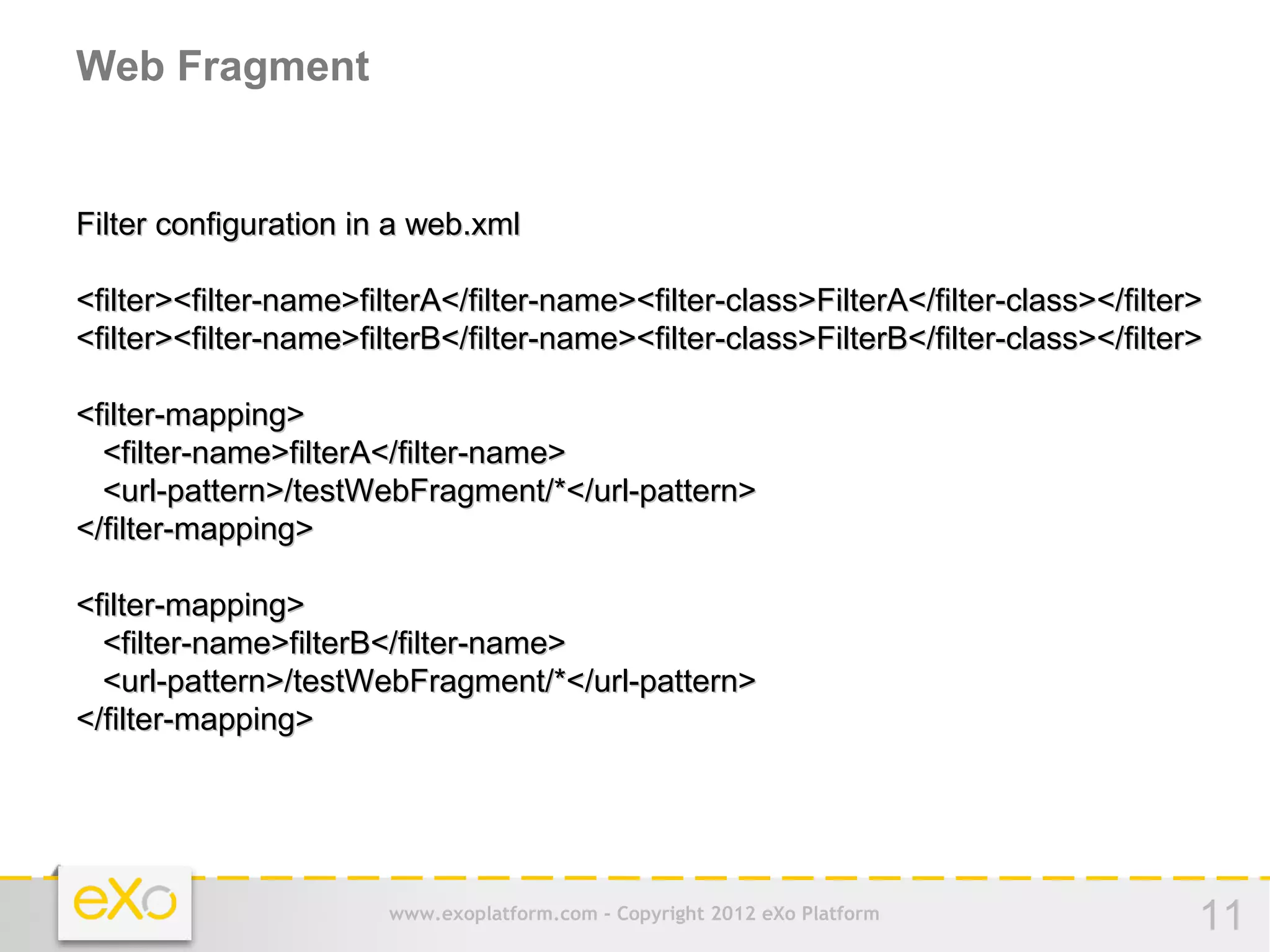
Filter configuration in a web.xml

<filter><filter-name>filterA</filter-name><filter-class>FilterA</filter-class></filter>
<filter><filter-name>filterB</filter-name><filter-class>FilterB</filter-class></filter>

<filter-mapping>
  <filter-name>filterA</filter-name>
  <url-pattern>/testWebFragment/*</url-pattern>
</filter-mapping>

<filter-mapping>
  <filter-name>filterB</filter-name>
  <url-pattern>/testWebFragment/*</url-pattern>
</filter-mapping>


                        www.exoplatform.com - Copyright 2012 eXo Platform             11
Web Fragment

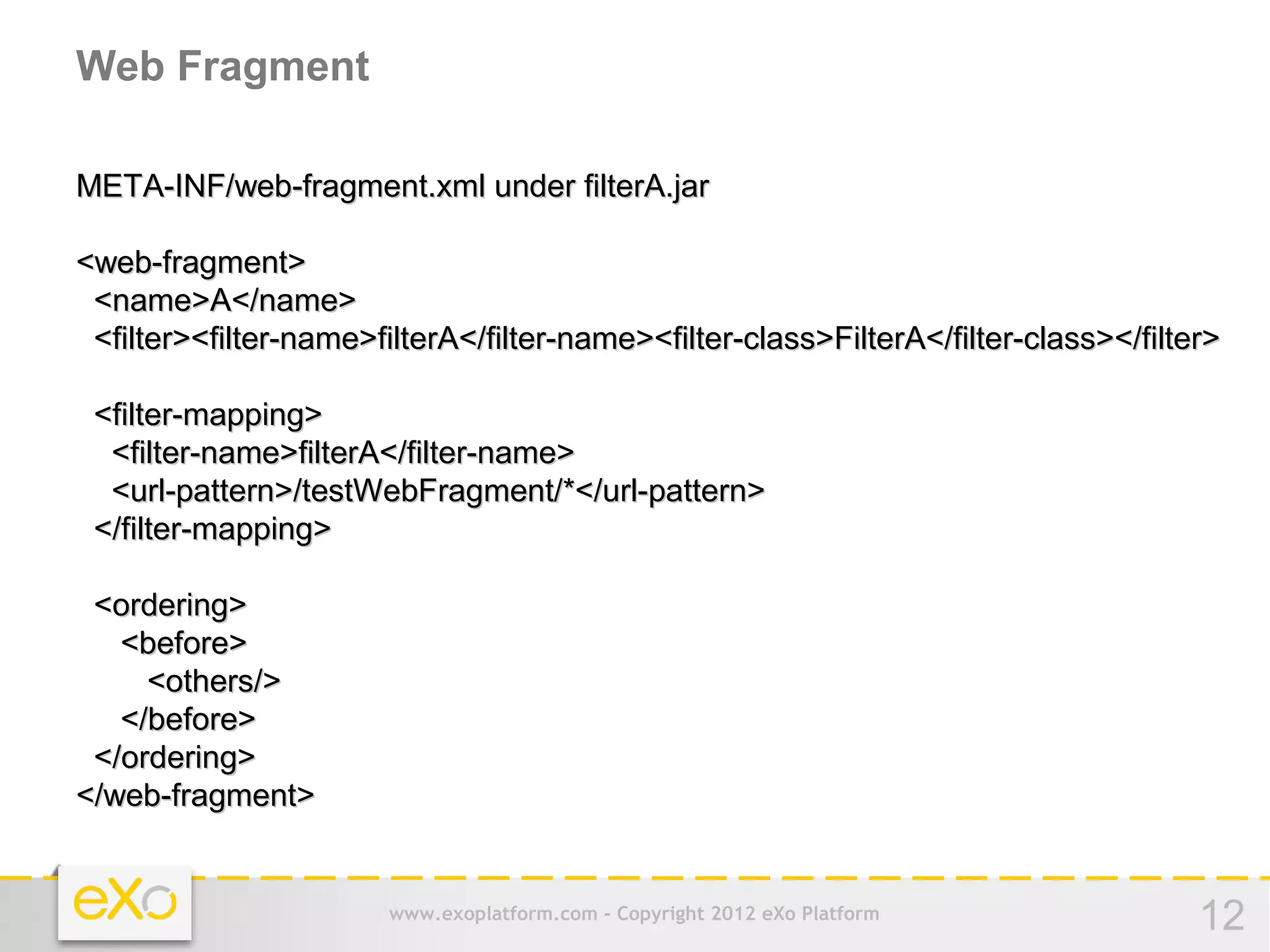
META-INF/web-fragment.xml under filterA.jar

<web-fragment>
 <name>A</name>
 <filter><filter-name>filterA</filter-name><filter-class>FilterA</filter-class></filter>

 <filter-mapping>
  <filter-name>filterA</filter-name>
  <url-pattern>/testWebFragment/*</url-pattern>
 </filter-mapping>

 <ordering>
   <before>
     <others/>
   </before>
 </ordering>
</web-fragment>


                        www.exoplatform.com - Copyright 2012 eXo Platform             12
Web Fragment

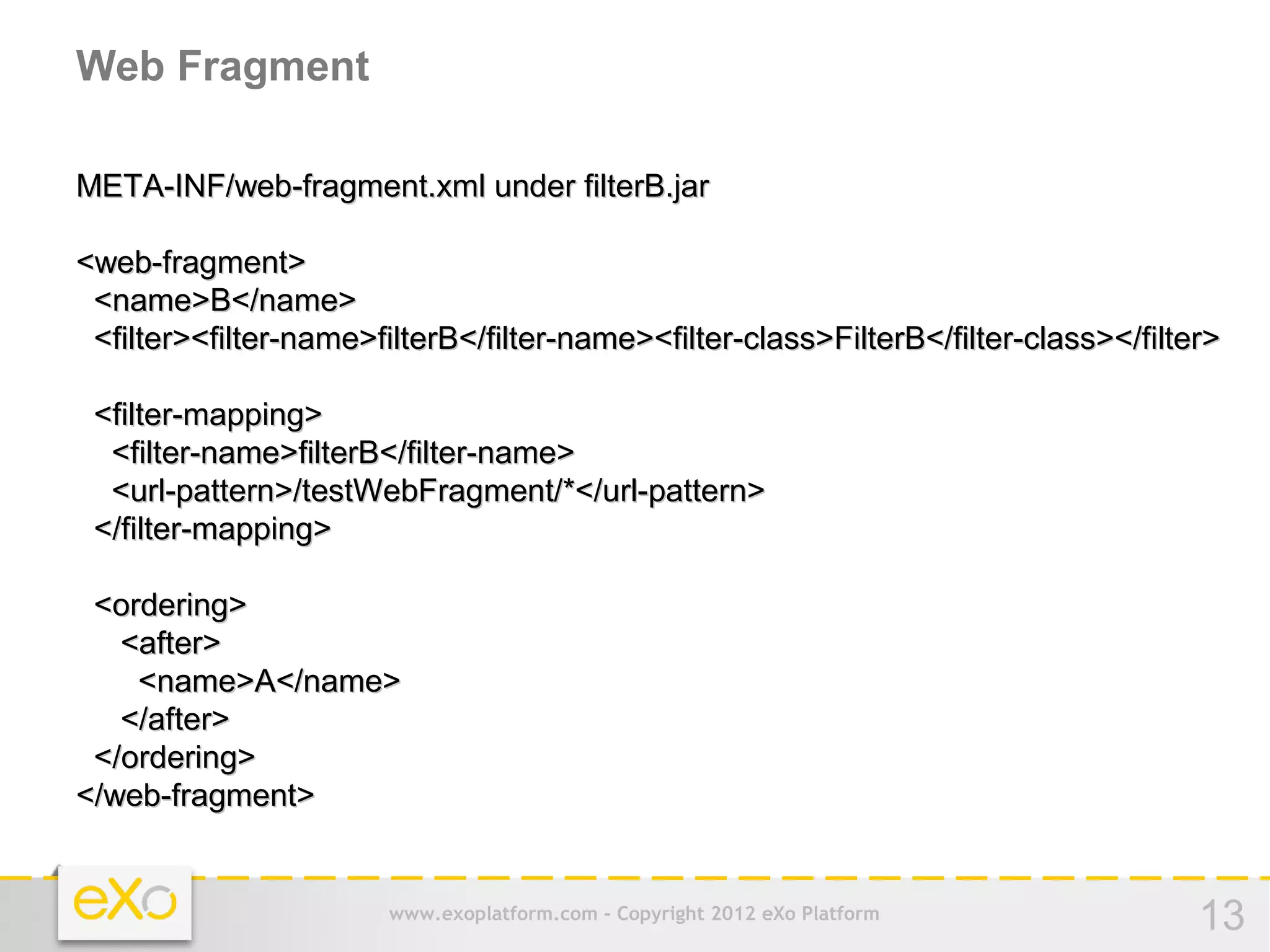
META-INF/web-fragment.xml under filterB.jar

<web-fragment>
 <name>B</name>
 <filter><filter-name>filterB</filter-name><filter-class>FilterB</filter-class></filter>

 <filter-mapping>
  <filter-name>filterB</filter-name>
  <url-pattern>/testWebFragment/*</url-pattern>
 </filter-mapping>

 <ordering>
   <after>
    <name>A</name>
   </after>
 </ordering>
</web-fragment>


                        www.exoplatform.com - Copyright 2012 eXo Platform             13
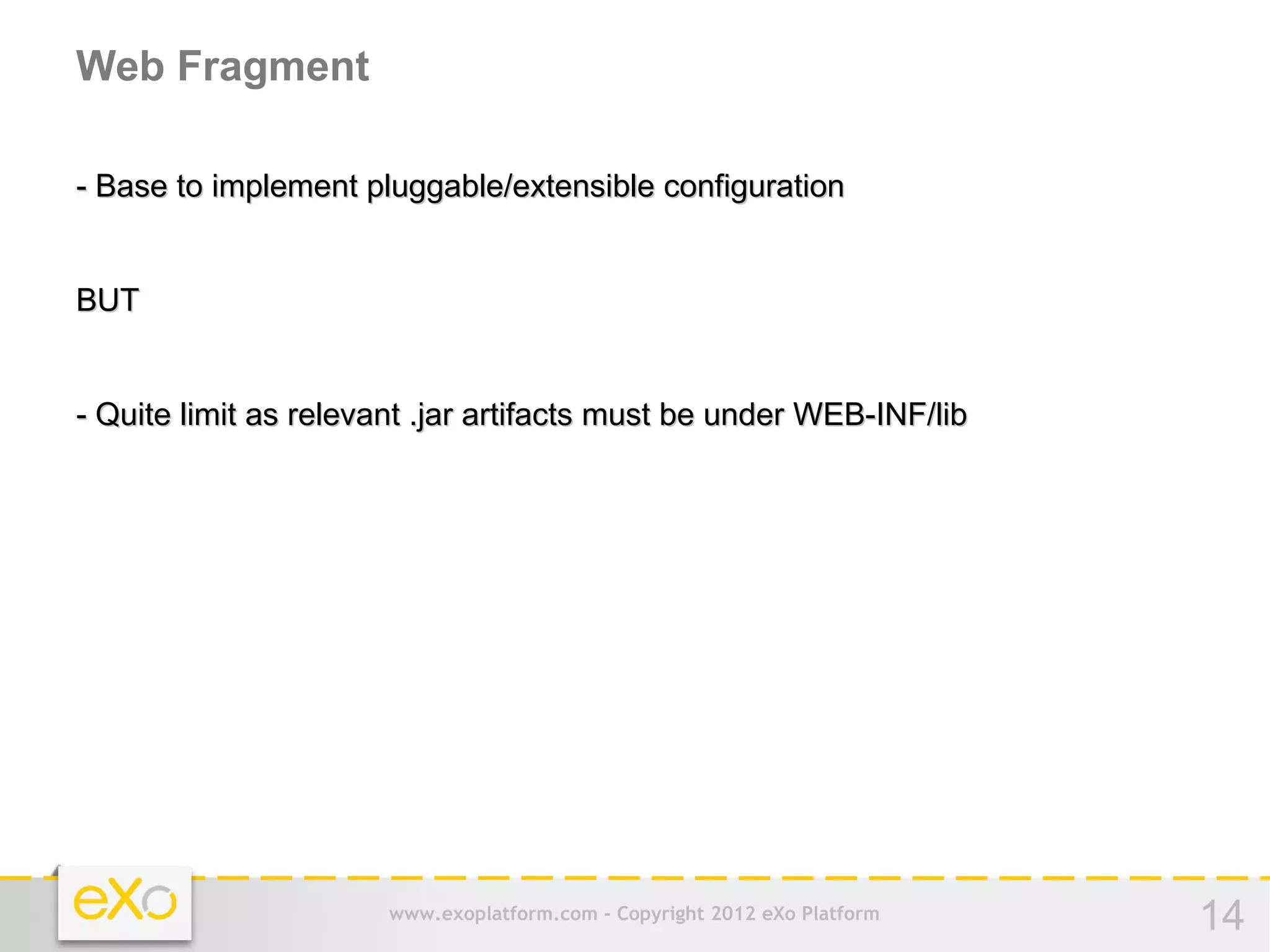
Web Fragment

- Base to implement pluggable/extensible configuration


BUT


- Quite limit as relevant .jar artifacts must be under WEB-INF/lib


                       www.exoplatform.com - Copyright 2012 eXo Platform   14
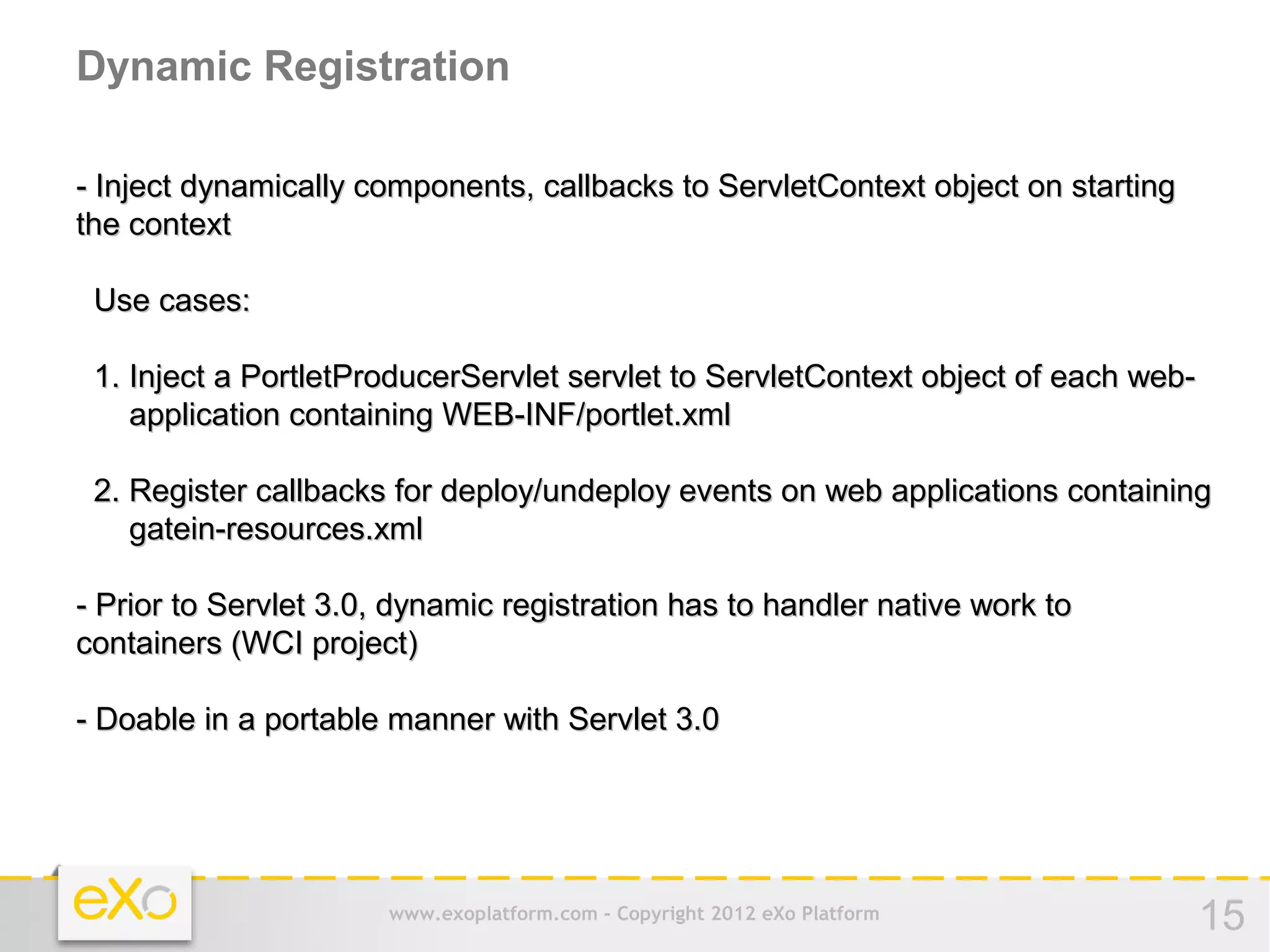
Dynamic Registration

- Inject dynamically components, callbacks to ServletContext object on starting
the context

 Use cases:

 1. Inject a PortletProducerServlet servlet to ServletContext object of each web-
    application containing WEB-INF/portlet.xml

 2. Register callbacks for deploy/undeploy events on web applications containing
    gatein-resources.xml

- Prior to Servlet 3.0, dynamic registration has to handler native work to
containers (WCI project)

- Doable in a portable manner with Servlet 3.0


                       www.exoplatform.com - Copyright 2012 eXo Platform            15
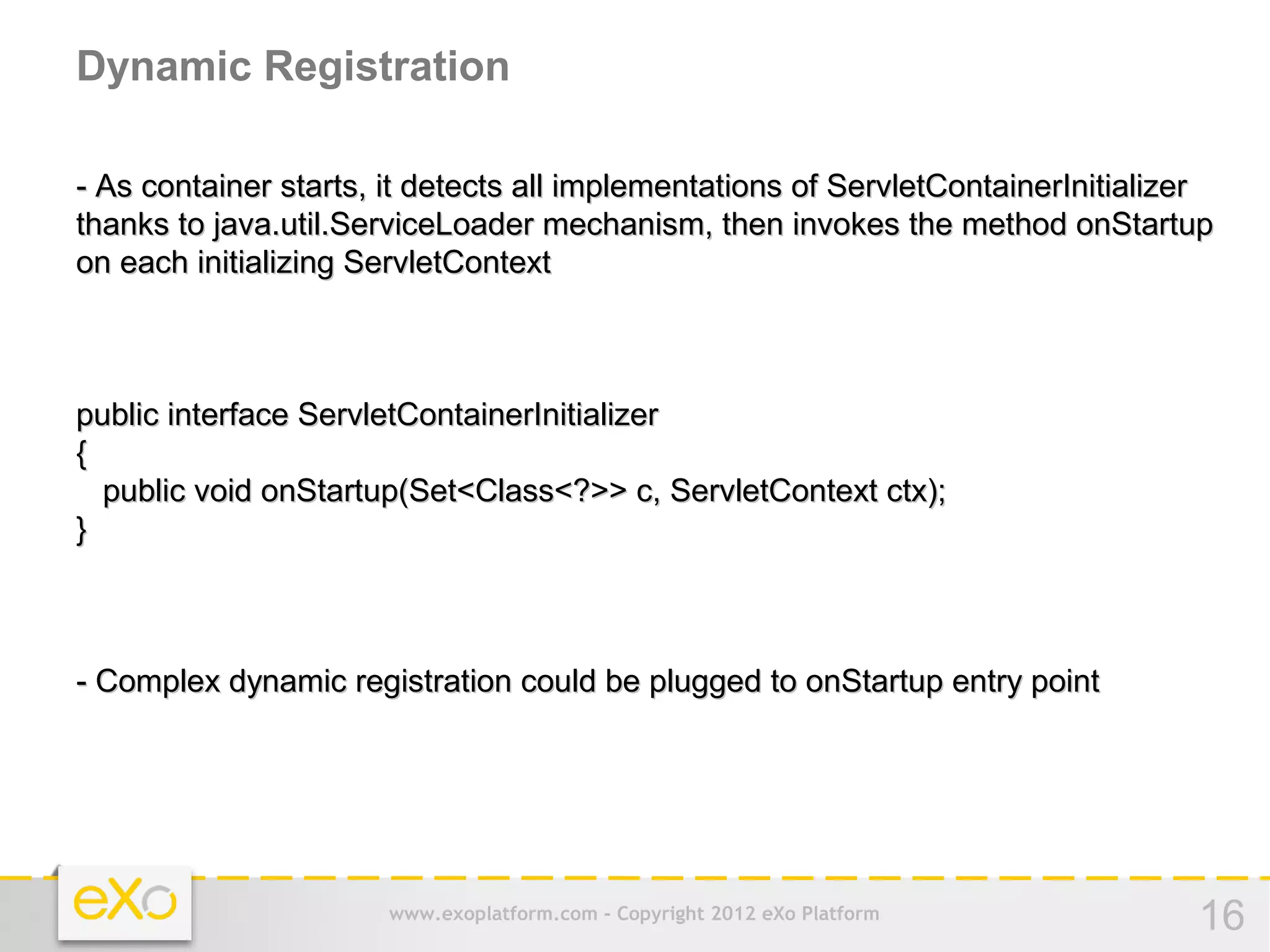
Dynamic Registration

- As container starts, it detects all implementations of ServletContainerInitializer
thanks to java.util.ServiceLoader mechanism, then invokes the method onStartup
on each initializing ServletContext


public interface ServletContainerInitializer
{
  public void onStartup(Set<Class<?>> c, ServletContext ctx);
}


- Complex dynamic registration could be plugged to onStartup entry point


                       www.exoplatform.com - Copyright 2012 eXo Platform          16
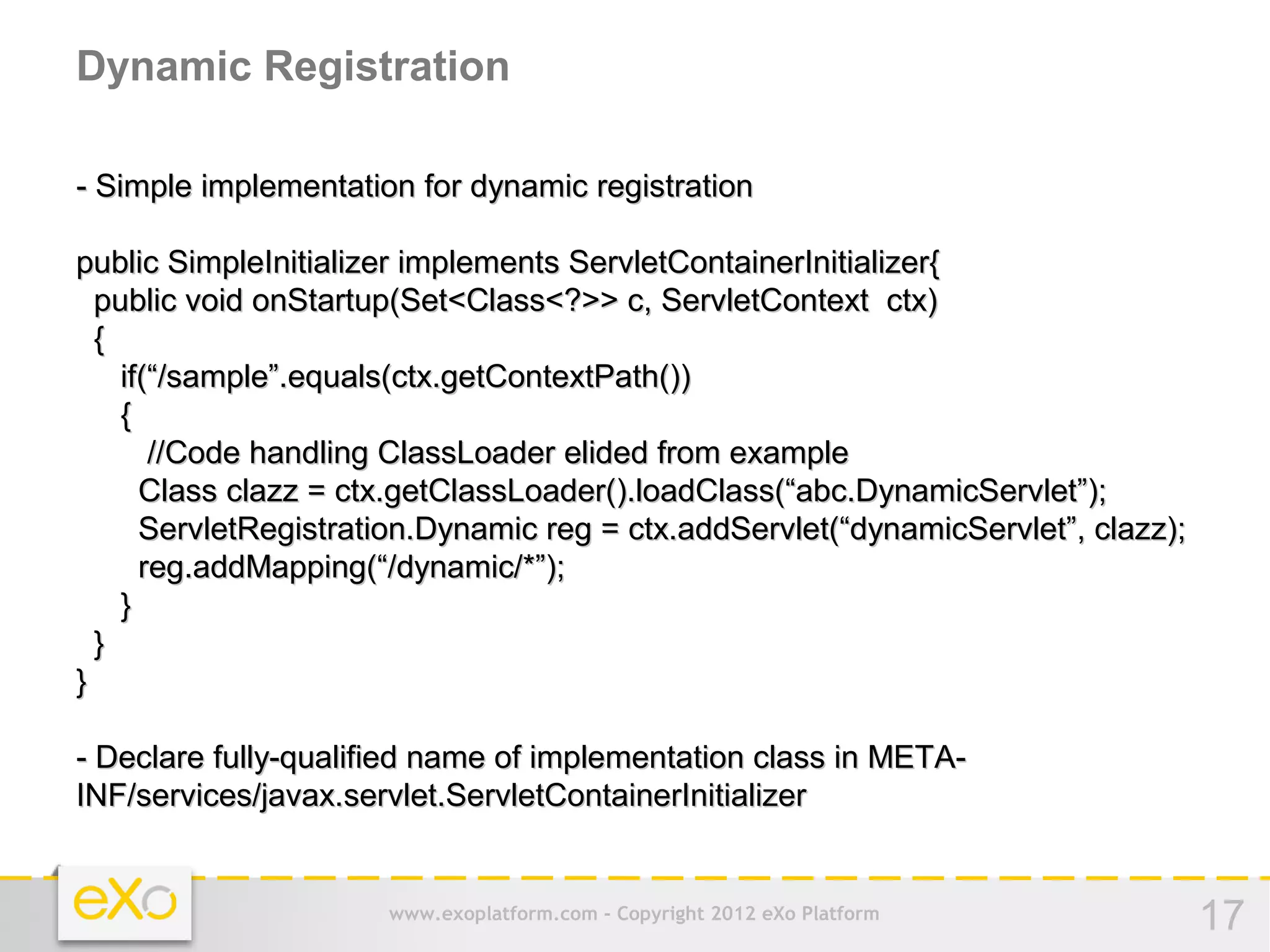
Dynamic Registration

- Simple implementation for dynamic registration

public SimpleInitializer implements ServletContainerInitializer{
  public void onStartup(Set<Class<?>> c, ServletContext ctx)
  {
    if(“/sample”.equals(ctx.getContextPath())
    {
       //Code handling ClassLoader elided from example
      Class clazz = ctx.getClassLoader().loadClass(“abc.DynamicServlet”);
      ServletRegistration.Dynamic reg = ctx.addServlet(“dynamicServlet”, clazz);
      reg.addMapping(“/dynamic/*”);
    }
  }
}

- Declare fully-qualified name of implementation class in META-
INF/services/javax.servlet.ServletContainerInitializer


                      www.exoplatform.com - Copyright 2012 eXo Platform            17
Dynamic Registration


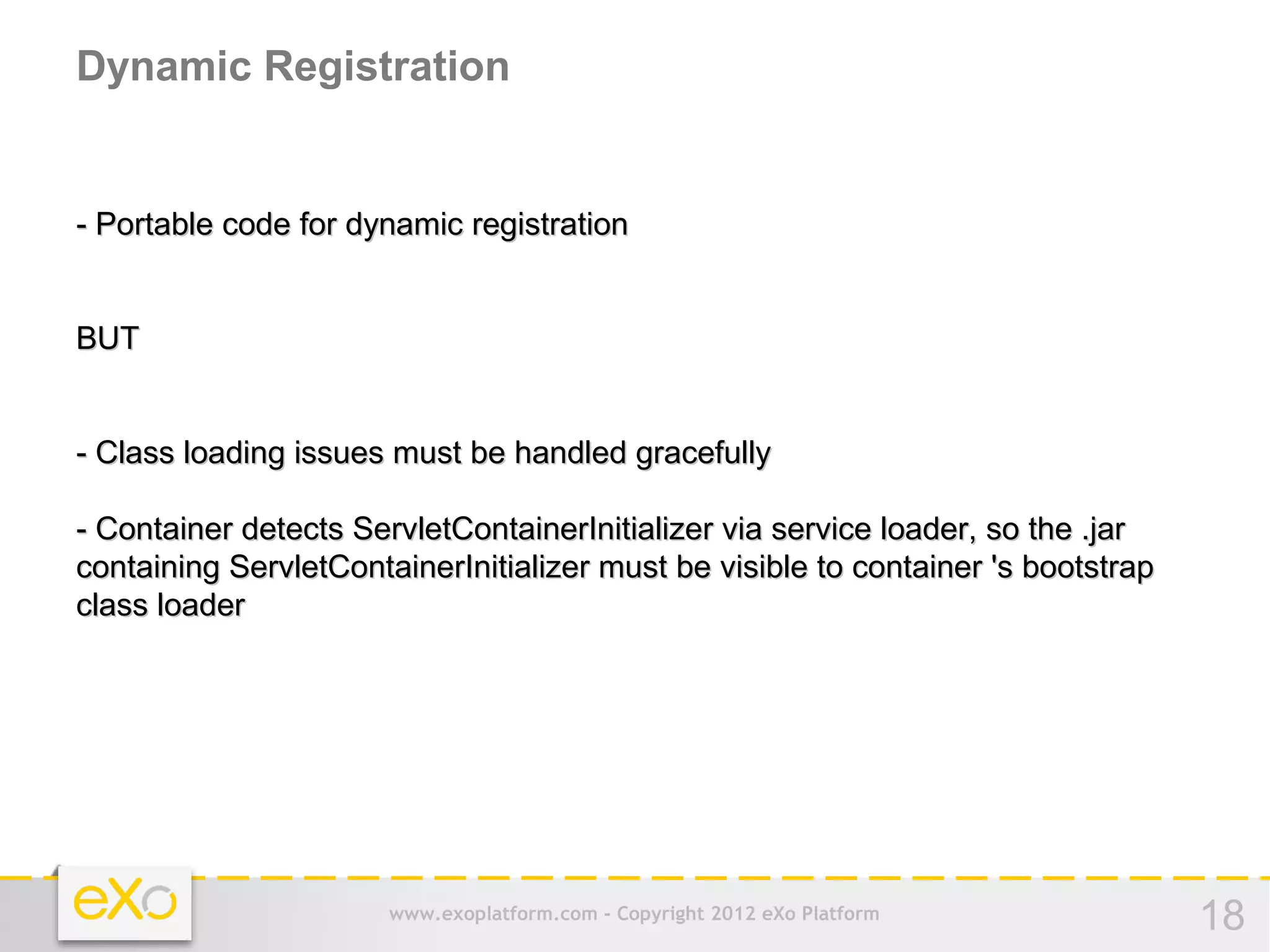
- Portable code for dynamic registration


BUT


- Class loading issues must be handled gracefully

- Container detects ServletContainerInitializer via service loader, so the .jar
containing ServletContainerInitializer must be visible to container 's bootstrap
class loader


                       www.exoplatform.com - Copyright 2012 eXo Platform           18
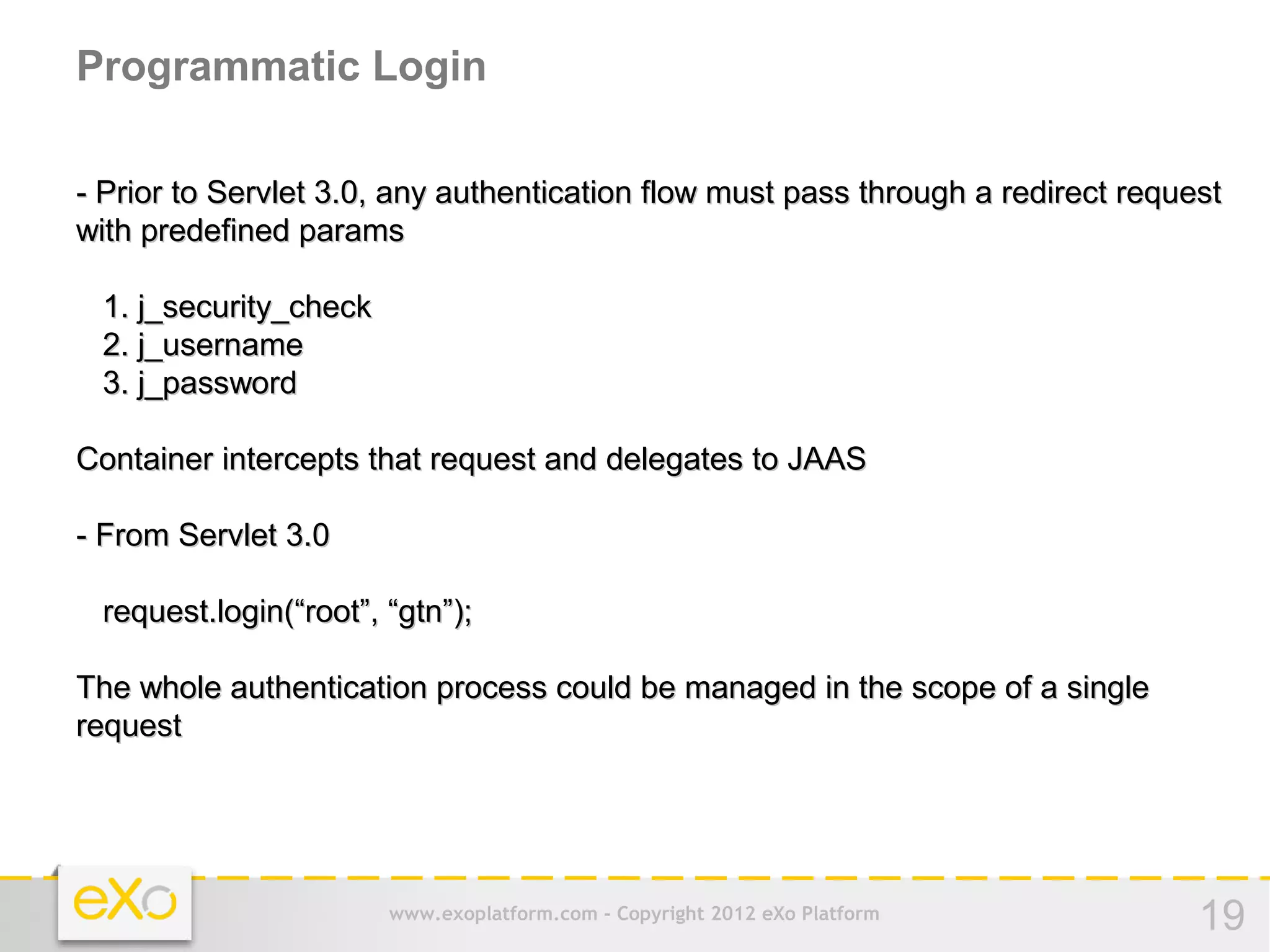
Programmatic Login

- Prior to Servlet 3.0, any authentication flow must pass through a redirect request
with predefined params

 1. j_security_check
 2. j_username
 3. j_password

Container intercepts that request and delegates to JAAS

- From Servlet 3.0

 request.login(“root”, “gtn”);

The whole authentication process could be managed in the scope of a single
request


                       www.exoplatform.com - Copyright 2012 eXo Platform          19
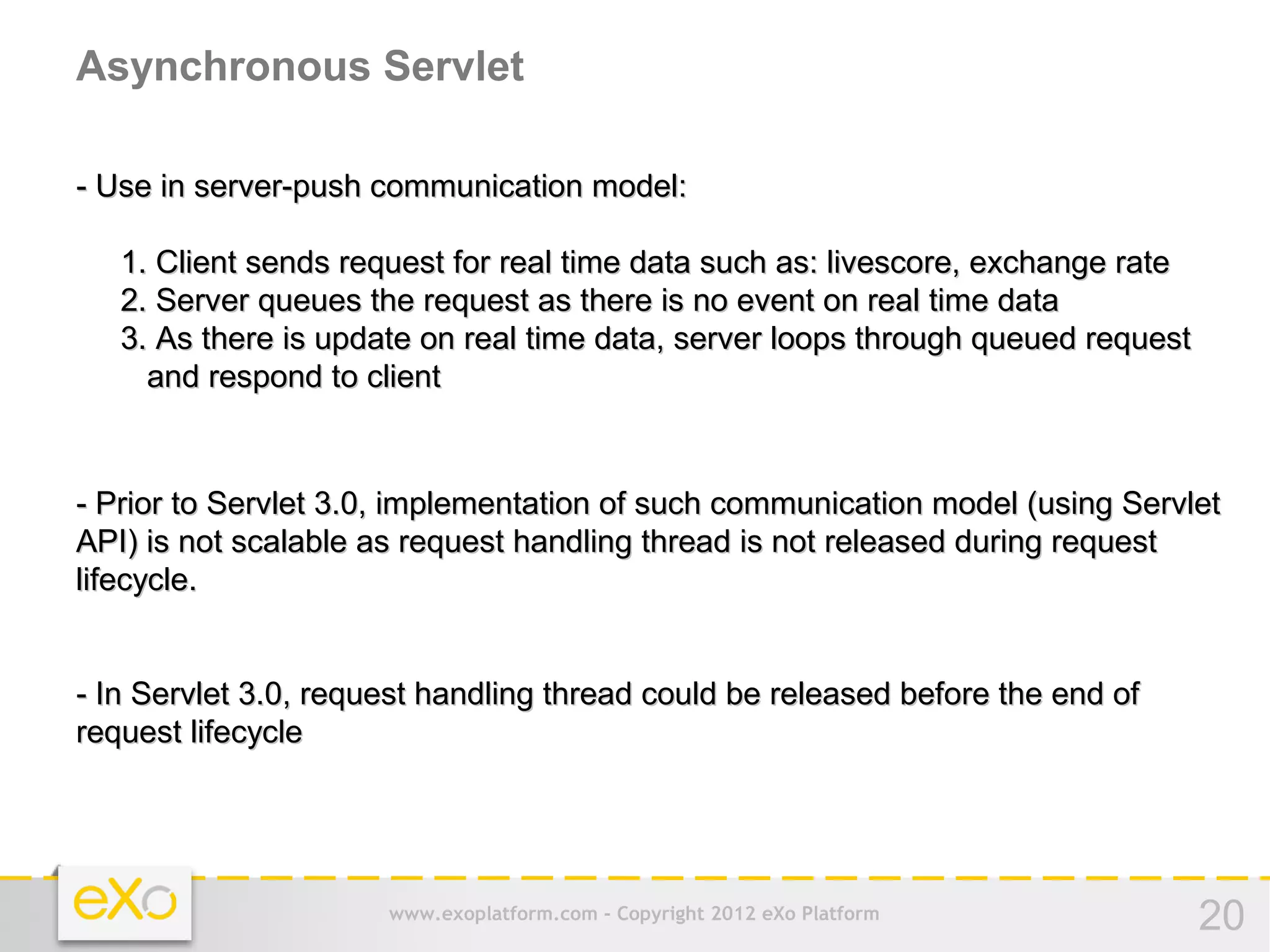
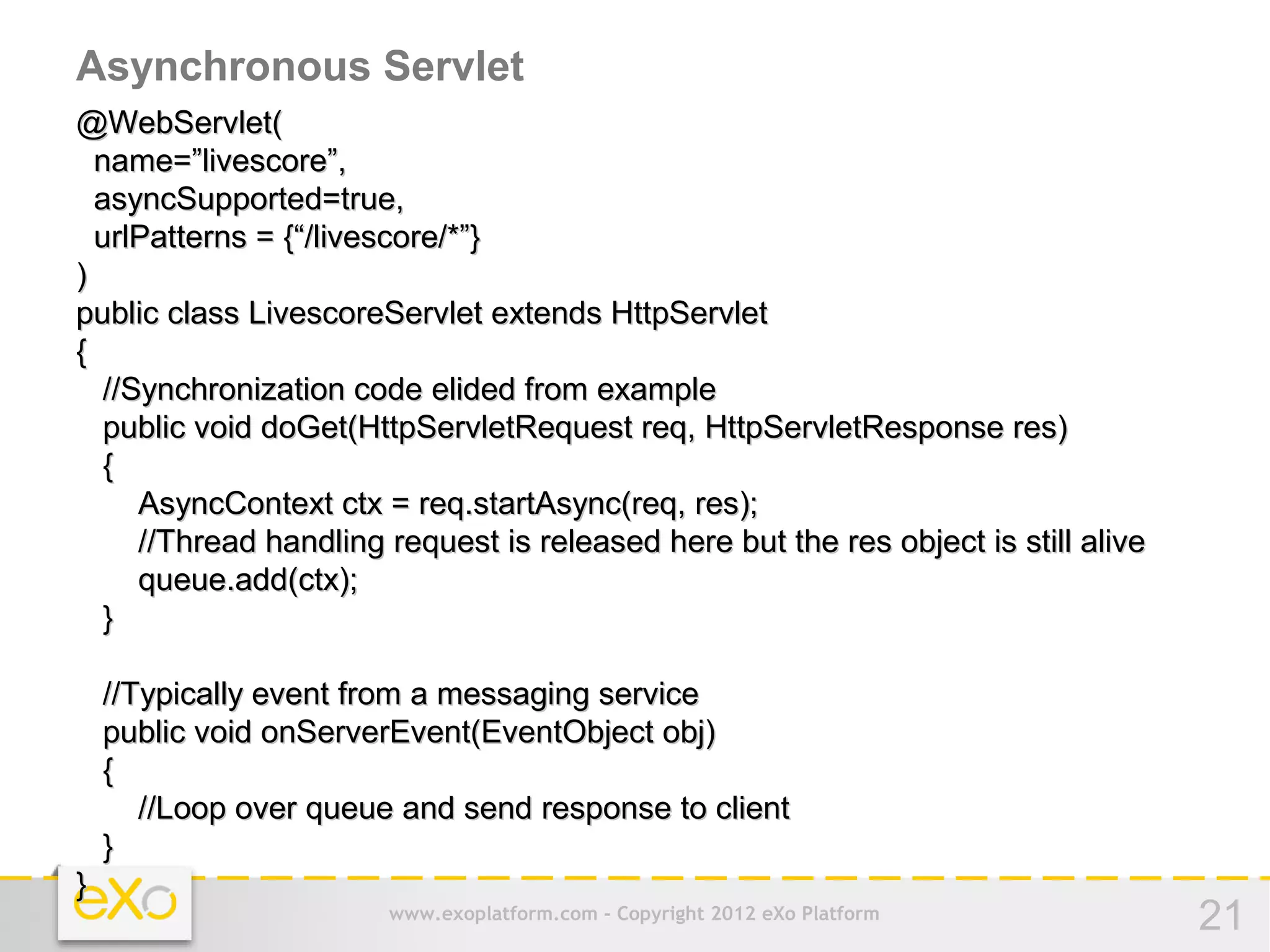
Asynchronous Servlet

- Use in server-push communication model:

   1. Client sends request for real time data such as: livescore, exchange rate
   2. Server queues the request as there is no event on real time data
   3. As there is update on real time data, server loops through queued request
     and respond to client


- Prior to Servlet 3.0, implementation of such communication model (using Servlet
API) is not scalable as request handling thread is not released during request
lifecycle.


- In Servlet 3.0, request handling thread could be released before the end of
request lifecycle


                      www.exoplatform.com - Copyright 2012 eXo Platform           20
Asynchronous Servlet
@WebServlet(
  name=”livescore”,
  asyncSupported=true,
  urlPatterns = {“/livescore/*”}
)
public class LivescoreServlet extends HttpServlet
{
   //Synchronization code elided from example
   public void doGet(HttpServletRequest req, HttpServletResponse res)
   {
      AsyncContext ctx = req.startAsync(req, res);
      //Thread handling request is released here but the res object is still alive
      queue.add(ctx);
   }

    //Typically event from a messaging service
    public void onServerEvent(EventObject obj)
    {
       //Loop over queue and send response to client
    }
}
                       www.exoplatform.com - Copyright 2012 eXo Platform             21
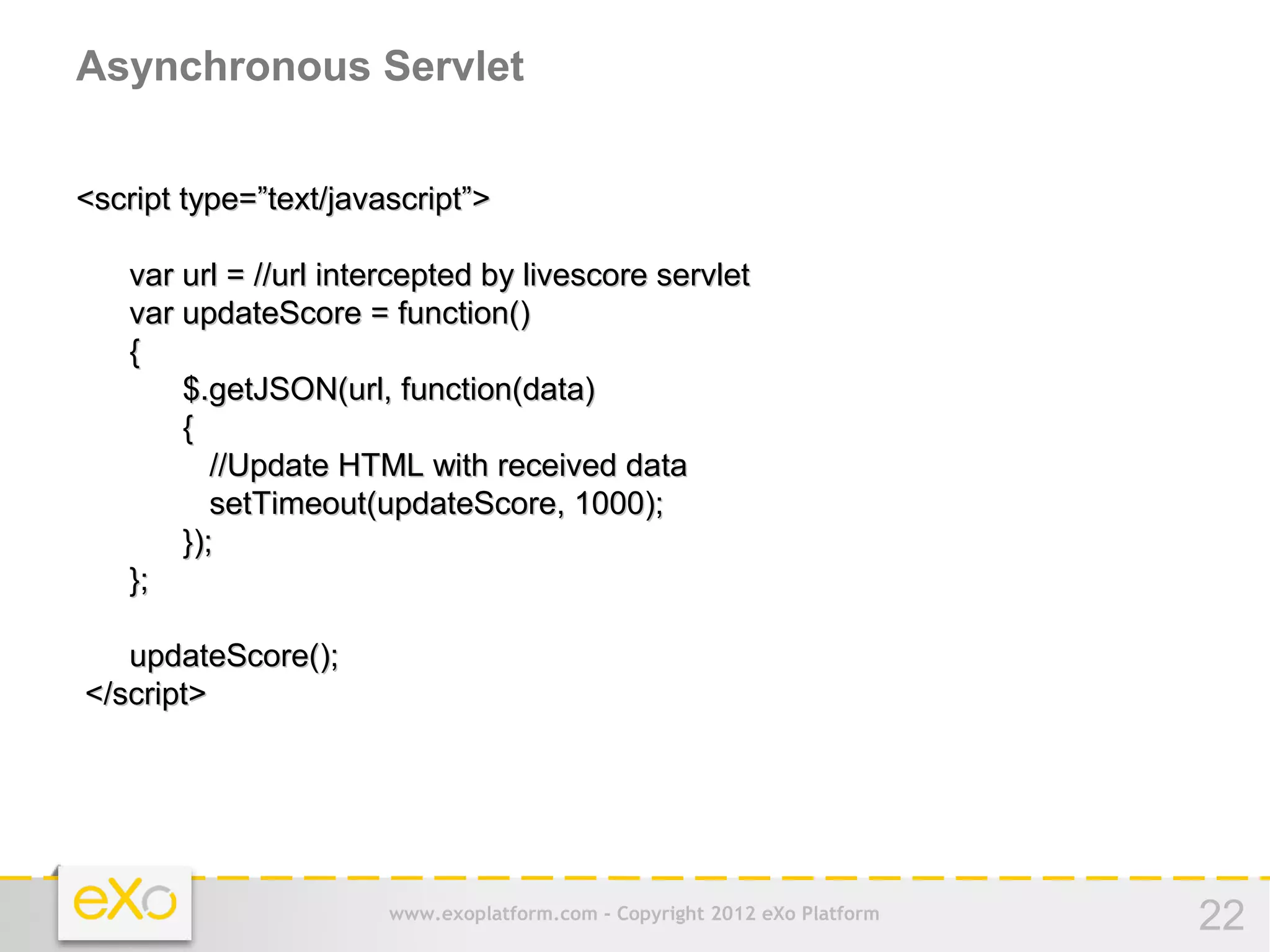
Asynchronous Servlet


<script type=”text/javascript”>

   var url = //url intercepted by livescore servlet
   var updateScore = function()
   {
       $.getJSON(url, function(data)
       {
          //Update HTML with received data
          setTimeout(updateScore, 1000);
       });
   };

   updateScore();
</script>


                       www.exoplatform.com - Copyright 2012 eXo Platform   22
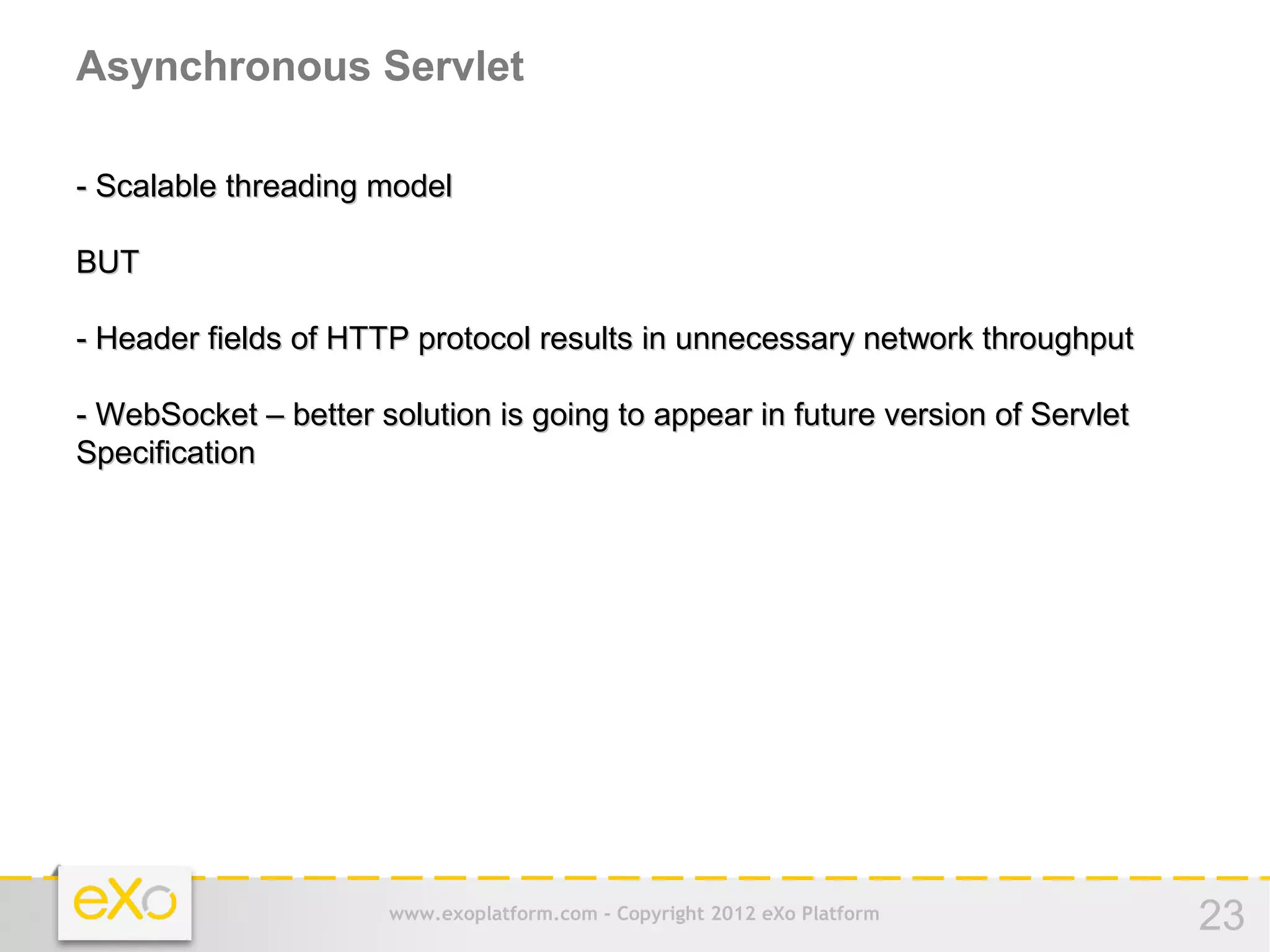
Asynchronous Servlet

- Scalable threading model

BUT

- Header fields of HTTP protocol results in unnecessary network throughput

- WebSocket – better solution is going to appear in future version of Servlet
Specification


                      www.exoplatform.com - Copyright 2012 eXo Platform         23
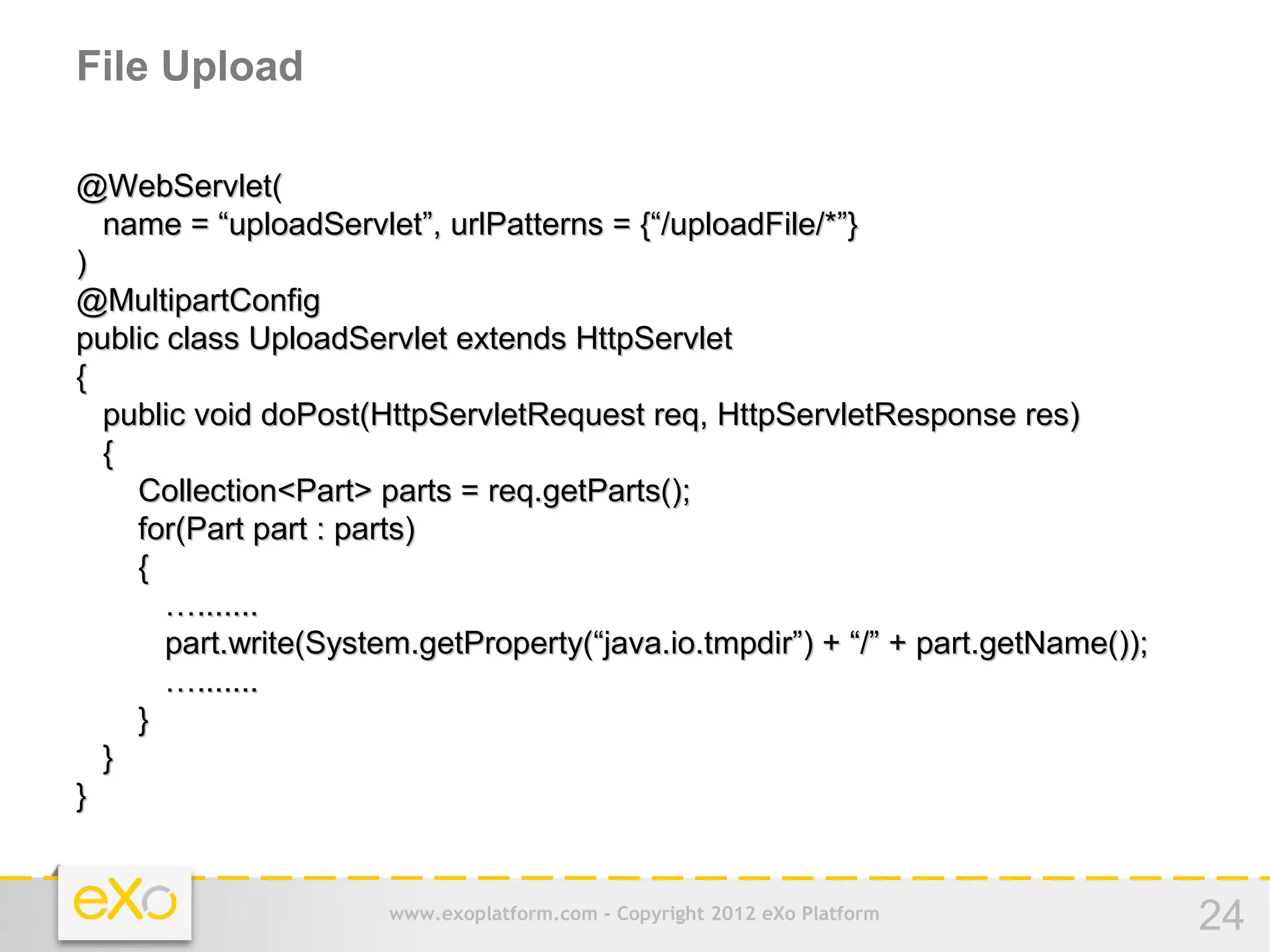
File Upload

@WebServlet(
  name = “uploadServlet”, urlPatterns = {“/uploadFile/*”}
)
@MultipartConfig
public class UploadServlet extends HttpServlet
{
  public void doPost(HttpServletRequest req, HttpServletResponse res)
  {
    Collection<Part> parts = req.getParts();
    for(Part part : parts)
    {
       ….......
       part.write(System.getProperty(“java.io.tmpdir”) + “/” + part.getName());
       ….......
    }
  }
}


                       www.exoplatform.com - Copyright 2012 eXo Platform          24
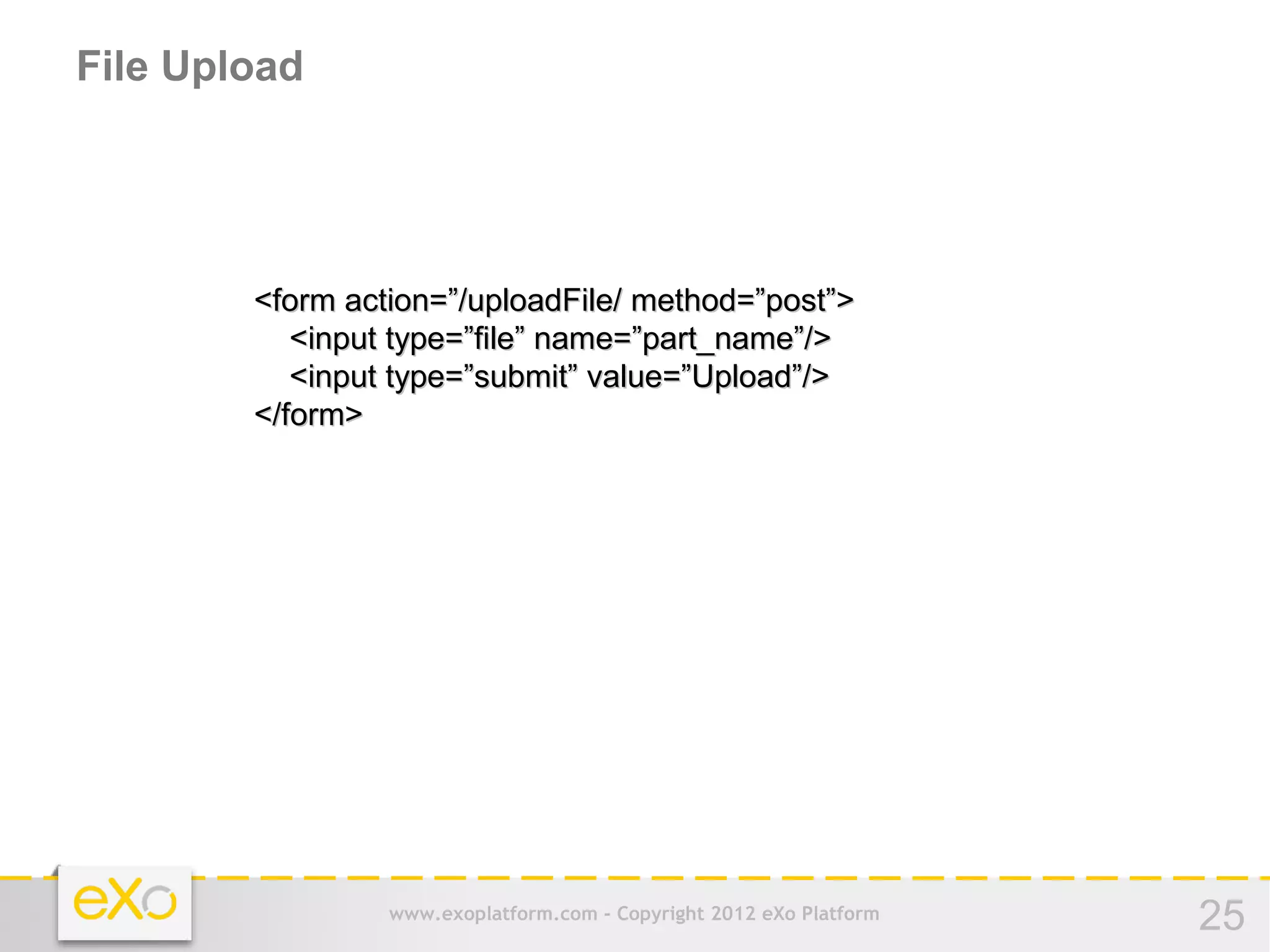
File Upload


        <form action=”/uploadFile/ method=”post”>
           <input type=”file” name=”part_name”/>
           <input type=”submit” value=”Upload”/>
        </form>


                 www.exoplatform.com - Copyright 2012 eXo Platform   25
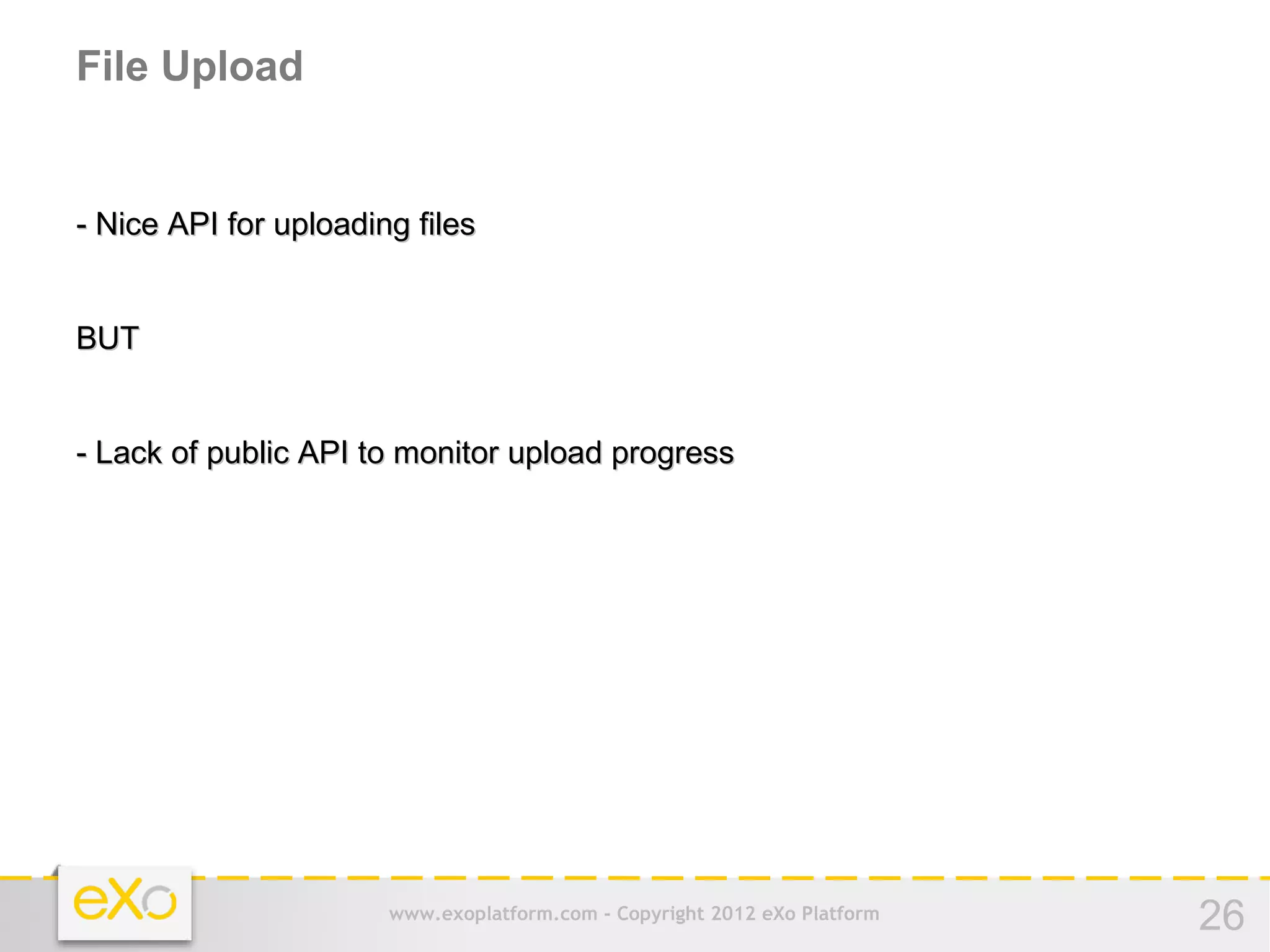
File Upload


- Nice API for uploading files


BUT


- Lack of public API to monitor upload progress


                       www.exoplatform.com - Copyright 2012 eXo Platform   26

Servlet 3.0

  • 1.
    Servlet 3.0 Minh Hoang TO Portal Team
  • 2.
    Servlet 3.0 Specification - Java Specification Request JSR-315 - Part of Java Enterprise Edition 6 - Compliant servers: Apache Tomcat 7, JBoss AS 7, Jetty 8, GlassFish 3, ... www.exoplatform.com - Copyright 2012 eXo Platform 2
  • 3.
    Agenda - Annotations - WebFragment - Dynamic Registration - Programmatic Login - Asynchronous Servlet - File Upload www.exoplatform.com - Copyright 2012 eXo Platform 3
  • 4.
    Annotations - Use annotationsto declare servlet, filter, listener and specify metadata for the declared component @WebServlet @WebFilter @WebInitParam @WebListener @ServletSecurity @HttpConstraint - Servlet container detects annotated class and injects metadata into declared components at deploy time www.exoplatform.com - Copyright 2012 eXo Platform 4
  • 5.
    Annotations Declare servlet viadeployment descriptor: <servlet> <servlet-name>hello</servlet-name> <servlet-class>com.mto.presentation.HelloServlet</servlet-class> </servlet> <servlet-mapping> <servlet-name>hello</servlet-name> <url-pattern>/greeting/*</url-pattern> </servlet-mapping> <servlet-mapping> <servlet-name>hello</servlet-name> <url-pattern>/sayhello/*</url-pattern> </servlet-mapping> www.exoplatform.com - Copyright 2012 eXo Platform 5
  • 6.
    Annotations Declare servlet viaannotated class @WebServlet ( name = “hello”, urlPatterns = {“/greeting/*“, “/sayhello/*“} ) public class HelloServlet extends HttpServlet { } www.exoplatform.com - Copyright 2012 eXo Platform 6
  • 7.
    Annotations Declare filter viadeployment descriptor: <filter> <filter-name>hello</filter-name> <filter-class>com.mto.presentation.HelloFilter</filter-class> </filter> <filter-mapping> <filter-name>hello</filter-name> <url-pattern>/greeting/*</url-pattern> </filter-mapping> <filter-mapping> <filter-name>hello</filter-name> <url-pattern>/sayhello/*</url-pattern> </filter-mapping> www.exoplatform.com - Copyright 2012 eXo Platform 7
  • 8.
    Annotations Declare filter viaannotated class @WebFilter ( name = “hello”, urlPatterns = {“/greeting/*“, “/sayhello/*“} ) public class HelloFilter implements Filter { } www.exoplatform.com - Copyright 2012 eXo Platform 8
  • 9.
    Annotations - Type safeand less error-prone - Facilitate work of developers - No need to master XSD of deployment descriptor BUT - Frequent recompilation is a big obstacle www.exoplatform.com - Copyright 2012 eXo Platform 9
  • 10.
    Web Fragment - DivideWEB-INF/web.xml into multiples META-INF/web-fragment.xml : 1. Each web-fragment.xml is packed in a .jar artifact under WEB-INF/lib 2. Web application components could be declared in web-fragment.xml 3. Order of fragment processing is manageable www.exoplatform.com - Copyright 2012 eXo Platform 10
  • 11.
    Web Fragment Filter configurationin a web.xml <filter><filter-name>filterA</filter-name><filter-class>FilterA</filter-class></filter> <filter><filter-name>filterB</filter-name><filter-class>FilterB</filter-class></filter> <filter-mapping> <filter-name>filterA</filter-name> <url-pattern>/testWebFragment/*</url-pattern> </filter-mapping> <filter-mapping> <filter-name>filterB</filter-name> <url-pattern>/testWebFragment/*</url-pattern> </filter-mapping> www.exoplatform.com - Copyright 2012 eXo Platform 11
  • 12.
    Web Fragment META-INF/web-fragment.xml underfilterA.jar <web-fragment> <name>A</name> <filter><filter-name>filterA</filter-name><filter-class>FilterA</filter-class></filter> <filter-mapping> <filter-name>filterA</filter-name> <url-pattern>/testWebFragment/*</url-pattern> </filter-mapping> <ordering> <before> <others/> </before> </ordering> </web-fragment> www.exoplatform.com - Copyright 2012 eXo Platform 12
  • 13.
    Web Fragment META-INF/web-fragment.xml underfilterB.jar <web-fragment> <name>B</name> <filter><filter-name>filterB</filter-name><filter-class>FilterB</filter-class></filter> <filter-mapping> <filter-name>filterB</filter-name> <url-pattern>/testWebFragment/*</url-pattern> </filter-mapping> <ordering> <after> <name>A</name> </after> </ordering> </web-fragment> www.exoplatform.com - Copyright 2012 eXo Platform 13
  • 14.
    Web Fragment - Baseto implement pluggable/extensible configuration BUT - Quite limit as relevant .jar artifacts must be under WEB-INF/lib www.exoplatform.com - Copyright 2012 eXo Platform 14
  • 15.
    Dynamic Registration - Injectdynamically components, callbacks to ServletContext object on starting the context Use cases: 1. Inject a PortletProducerServlet servlet to ServletContext object of each web- application containing WEB-INF/portlet.xml 2. Register callbacks for deploy/undeploy events on web applications containing gatein-resources.xml - Prior to Servlet 3.0, dynamic registration has to handler native work to containers (WCI project) - Doable in a portable manner with Servlet 3.0 www.exoplatform.com - Copyright 2012 eXo Platform 15
  • 16.
    Dynamic Registration - Ascontainer starts, it detects all implementations of ServletContainerInitializer thanks to java.util.ServiceLoader mechanism, then invokes the method onStartup on each initializing ServletContext public interface ServletContainerInitializer { public void onStartup(Set<Class<?>> c, ServletContext ctx); } - Complex dynamic registration could be plugged to onStartup entry point www.exoplatform.com - Copyright 2012 eXo Platform 16
  • 17.
    Dynamic Registration - Simpleimplementation for dynamic registration public SimpleInitializer implements ServletContainerInitializer{ public void onStartup(Set<Class<?>> c, ServletContext ctx) { if(“/sample”.equals(ctx.getContextPath()) { //Code handling ClassLoader elided from example Class clazz = ctx.getClassLoader().loadClass(“abc.DynamicServlet”); ServletRegistration.Dynamic reg = ctx.addServlet(“dynamicServlet”, clazz); reg.addMapping(“/dynamic/*”); } } } - Declare fully-qualified name of implementation class in META- INF/services/javax.servlet.ServletContainerInitializer www.exoplatform.com - Copyright 2012 eXo Platform 17
  • 18.
    Dynamic Registration - Portablecode for dynamic registration BUT - Class loading issues must be handled gracefully - Container detects ServletContainerInitializer via service loader, so the .jar containing ServletContainerInitializer must be visible to container 's bootstrap class loader www.exoplatform.com - Copyright 2012 eXo Platform 18
  • 19.
    Programmatic Login - Priorto Servlet 3.0, any authentication flow must pass through a redirect request with predefined params 1. j_security_check 2. j_username 3. j_password Container intercepts that request and delegates to JAAS - From Servlet 3.0 request.login(“root”, “gtn”); The whole authentication process could be managed in the scope of a single request www.exoplatform.com - Copyright 2012 eXo Platform 19
  • 20.
    Asynchronous Servlet - Usein server-push communication model: 1. Client sends request for real time data such as: livescore, exchange rate 2. Server queues the request as there is no event on real time data 3. As there is update on real time data, server loops through queued request and respond to client - Prior to Servlet 3.0, implementation of such communication model (using Servlet API) is not scalable as request handling thread is not released during request lifecycle. - In Servlet 3.0, request handling thread could be released before the end of request lifecycle www.exoplatform.com - Copyright 2012 eXo Platform 20
  • 21.
    Asynchronous Servlet @WebServlet( name=”livescore”, asyncSupported=true, urlPatterns = {“/livescore/*”} ) public class LivescoreServlet extends HttpServlet { //Synchronization code elided from example public void doGet(HttpServletRequest req, HttpServletResponse res) { AsyncContext ctx = req.startAsync(req, res); //Thread handling request is released here but the res object is still alive queue.add(ctx); } //Typically event from a messaging service public void onServerEvent(EventObject obj) { //Loop over queue and send response to client } } www.exoplatform.com - Copyright 2012 eXo Platform 21
  • 22.
    Asynchronous Servlet <script type=”text/javascript”> var url = //url intercepted by livescore servlet var updateScore = function() { $.getJSON(url, function(data) { //Update HTML with received data setTimeout(updateScore, 1000); }); }; updateScore(); </script> www.exoplatform.com - Copyright 2012 eXo Platform 22
  • 23.
    Asynchronous Servlet - Scalablethreading model BUT - Header fields of HTTP protocol results in unnecessary network throughput - WebSocket – better solution is going to appear in future version of Servlet Specification www.exoplatform.com - Copyright 2012 eXo Platform 23
  • 24.
    File Upload @WebServlet( name = “uploadServlet”, urlPatterns = {“/uploadFile/*”} ) @MultipartConfig public class UploadServlet extends HttpServlet { public void doPost(HttpServletRequest req, HttpServletResponse res) { Collection<Part> parts = req.getParts(); for(Part part : parts) { …....... part.write(System.getProperty(“java.io.tmpdir”) + “/” + part.getName()); …....... } } } www.exoplatform.com - Copyright 2012 eXo Platform 24
  • 25.
    File Upload <form action=”/uploadFile/ method=”post”> <input type=”file” name=”part_name”/> <input type=”submit” value=”Upload”/> </form> www.exoplatform.com - Copyright 2012 eXo Platform 25
  • 26.
    File Upload - NiceAPI for uploading files BUT - Lack of public API to monitor upload progress www.exoplatform.com - Copyright 2012 eXo Platform 26