ably
                                 prob
What's coming
in Java Message Service 2.0
Arun Gupta, Java EE & GlassFish Guy
blogs.oracle.com/arungupta, @arungupta
 1 | Copyright © 2012, Oracle and/or it’s affiliates. All rights reserved. |
The following is intended to outline our general product direction. It is
intended for information purposes only, and may not be incorporated into any
contract. It is not a commitment to deliver any material, code, or functionality,
and should not be relied upon in making purchasing decisions. The
development, release, and timing of any features or functionality described
for Oracle s products remains at the sole discretion of Oracle.


2 | Copyright © 2012, Oracle and/or it’s affiliates. All rights reserved. |   2	
  
Agenda

   •  JSR 343 Update
   •  What's in the JMS 2.0 Early Draft
            –  Simplifying the JMS API
            –  Improving integration with application servers
            –  New API features
   •  Q&A


3 | Copyright © 2012, Oracle and/or it’s affiliates. All rights reserved. |   3	
  
                                                                                      3	
  
JMS

   •  Java Message Service (JMS) specification
            –  Part of Java EE but also stands alone
            –  Last maintenance release (1.1) was in 2003
   •  Does not mean JMS is moribund!
            –  Multiple active commercial and open source implementations
            –  Shows strength of existing spec
   •  Meanwhile
            –  Java EE has moved on since, and now Java EE 7 is planned
            –  Time for JMS 2.0
4 | Copyright © 2012, Oracle and/or it’s affiliates. All rights reserved. |   4	
  
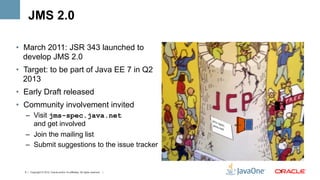
JMS 2.0

•  March 2011: JSR 343 launched to
   develop JMS 2.0
•  Target: to be part of Java EE 7 in Q2
   2013
•  Early Draft released
•  Community involvement invited
  –  Visit jms-spec.java.net
     and get involved
  –  Join the mailing list
  –  Submit suggestions to the issue tracker


  5 | Copyright © 2012, Oracle and/or it’s affiliates. All rights reserved. |   5	
  
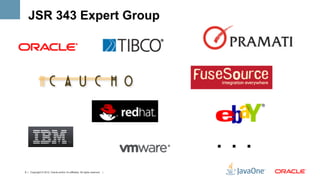
JSR 343 Expert Group


                                                                              ...
6 | Copyright © 2012, Oracle and/or it’s affiliates. All rights reserved. |
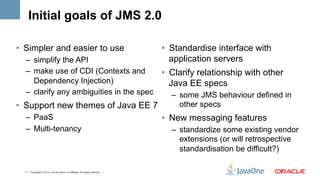
Initial goals of JMS 2.0

•  Simpler and easier to use                                                    •  Standardise interface with
  –  simplify the API                                                              application servers
  –  make use of CDI (Contexts and                                              •  Clarify relationship with other
     Dependency Injection)                                                         Java EE specs
  –  clarify any ambiguities in the spec                                          –  some JMS behaviour defined in
•  Support new themes of Java EE 7                                                   other specs
  –  PaaS                                                                       •  New messaging features
  –  Multi-tenancy                                                                –  standardize some existing vendor
                                                                                     extensions (or will retrospective
                                                                                     standardisation be difficult?)

  7 | Copyright © 2012, Oracle and/or it’s affiliates. All rights reserved. |                                    7	
  
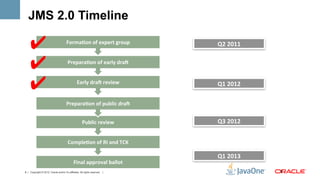
JMS 2.0 Timeline

     ✔	

                              Forma0on	
  of	
  expert	
  group	
        Q2	
  2011	


     ✔	

                               Prepara0on	
  of	
  early	
  dra;	


     ✔	

                                        Early	
  dra;	
  review	
        Q1	
  2012	
  

                                       Prepara0on	
  of	
  public	
  dra;	


                                                      Public	
  review	
          Q3	
  2012	


                                        Comple0on	
  of	
  RI	
  and	
  TCK	
  

                                                                                  Q1	
  2013	
  
                                              Final	
  approval	
  ballot	
  
8 | Copyright © 2012, Oracle and/or it’s affiliates. All rights reserved. |                        8	
  
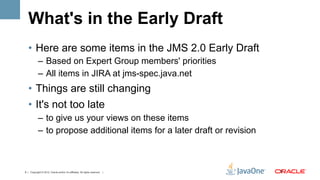
What's in the Early Draft
   •  Here are some items in the JMS 2.0 Early Draft
            –  Based on Expert Group members' priorities
            –  All items in JIRA at jms-spec.java.net
   •  Things are still changing
   •  It's not too late
            –  to give us your views on these items
            –  to propose additional items for a later draft or revision


9 | Copyright © 2012, Oracle and/or it’s affiliates. All rights reserved. |   9	
  
Simplifying the JMS API


10 | Copyright © 2012, Oracle and/or it’s affiliates. All rights reserved. |
What's wrong with the JMS API?
    Not a lot...


11 | Copyright © 2012, Oracle and/or it’s affiliates. All rights reserved. |
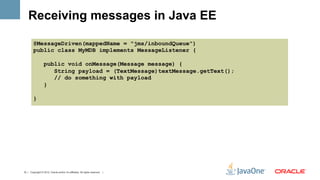
Receiving messages in Java EE

         @MessageDriven(mappedName = "jms/inboundQueue")
         public class MyMDB implements MessageListener {

                   public void onMessage(Message message) {
                      String payload = (TextMessage)textMessage.getText();
                      // do something with payload
                   }

         }


12 | Copyright © 2012, Oracle and/or it’s affiliates. All rights reserved. |
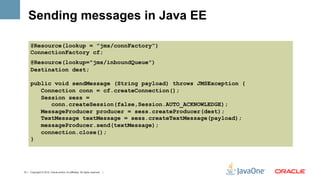
Sending messages in Java EE

      @Resource(lookup = "jms/connFactory")
      ConnectionFactory cf;
      @Resource(lookup="jms/inboundQueue")
      Destination dest;

      public void sendMessage (String payload) throws JMSException {
         Connection conn = cf.createConnection();
         Session sess =
            conn.createSession(false,Session.AUTO_ACKNOWLEDGE);
         MessageProducer producer = sess.createProducer(dest);
         TextMessage textMessage = sess.createTextMessage(payload);
         messageProducer.send(textMessage);
         connection.close();
      }


13 | Copyright © 2012, Oracle and/or it’s affiliates. All rights reserved. |
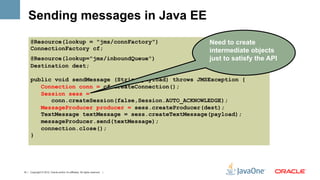
Sending messages in Java EE
      @Resource(lookup = "jms/connFactory")                                    Need to create
      ConnectionFactory cf;                                                    intermediate objects
      @Resource(lookup="jms/inboundQueue")                                     just to satisfy the API
      Destination dest;

      public void sendMessage (String payload) throws JMSException {
         Connection conn = cf.createConnection();
         Session sess =
            conn.createSession(false,Session.AUTO_ACKNOWLEDGE);
         MessageProducer producer = sess.createProducer(dest);
         TextMessage textMessage = sess.createTextMessage(payload);
         messageProducer.send(textMessage);
         connection.close();
      }


14 | Copyright © 2012, Oracle and/or it’s affiliates. All rights reserved. |
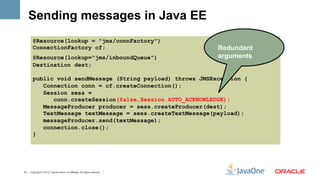
Sending messages in Java EE
        @Resource(lookup = "jms/connFactory")
        ConnectionFactory cf;                                                  Redundant
        @Resource(lookup="jms/inboundQueue")                                   arguments
        Destination dest;

        public void sendMessage (String payload) throws JMSException {
           Connection conn = cf.createConnection();
           Session sess =
              conn.createSession(false,Session.AUTO_ACKNOWLEDGE);
           MessageProducer producer = sess.createProducer(dest);
           TextMessage textMessage = sess.createTextMessage(payload);
           messageProducer.send(textMessage);
           connection.close();
        }


15 | Copyright © 2012, Oracle and/or it’s affiliates. All rights reserved. |
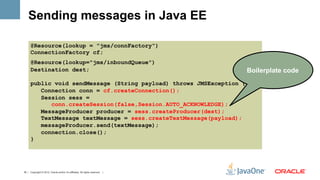
Sending messages in Java EE

      @Resource(lookup = "jms/connFactory")
      ConnectionFactory cf;
      @Resource(lookup="jms/inboundQueue")
      Destination dest;                                                        Boilerplate code
      public void sendMessage (String payload) throws JMSException {
         Connection conn = cf.createConnection();
         Session sess =
            conn.createSession(false,Session.AUTO_ACKNOWLEDGE);
         MessageProducer producer = sess.createProducer(dest);
         TextMessage textMessage = sess.createTextMessage(payload);
         messageProducer.send(textMessage);
         connection.close();
      }


16 | Copyright © 2012, Oracle and/or it’s affiliates. All rights reserved. |
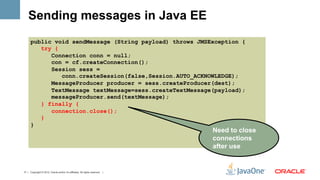
Sending messages in Java EE
      public void sendMessage (String payload) throws JMSException {
         try {
            Connection conn = null;
            con = cf.createConnection();
            Session sess =
               conn.createSession(false,Session.AUTO_ACKNOWLEDGE);
            MessageProducer producer = sess.createProducer(dest);
            TextMessage textMessage=sess.createTextMessage(payload);
            messageProducer.send(textMessage);
         } finally {
            connection.close();
         }
      }
                                                                               Need to close
                                                                               connections
                                                                               after use


17 | Copyright © 2012, Oracle and/or it’s affiliates. All rights reserved. |
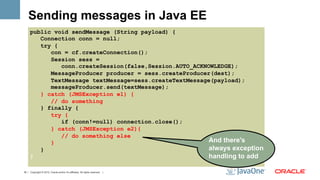
Sending messages in Java EE
      public void sendMessage (String payload) {
         Connection conn = null;
         try {
            con = cf.createConnection();
            Session sess =
               conn.createSession(false,Session.AUTO_ACKNOWLEDGE);
            MessageProducer producer = sess.createProducer(dest);
            TextMessage textMessage=sess.createTextMessage(payload);
            messageProducer.send(textMessage);
         } catch (JMSException e1) {
            // do something
         } finally {
            try {
               if (conn!=null) connection.close();
            } catch (JMSException e2){
               // do something else
            }                                             And there's
         }                                                always exception
      }                                                   handling to add

18 | Copyright © 2012, Oracle and/or it’s affiliates. All rights reserved. |
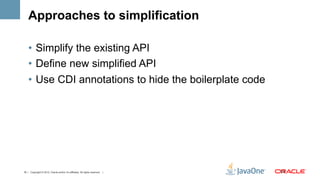
Approaches to simplification

    •  Simplify the existing API
    •  Define new simplified API
    •  Use CDI annotations to hide the boilerplate code


19 | Copyright © 2012, Oracle and/or it’s affiliates. All rights reserved. |   19	
  
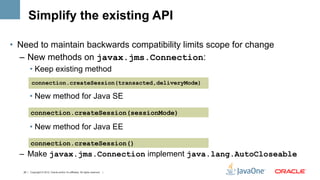
Simplify the existing API

•  Need to maintain backwards compatibility limits scope for change
   –  New methods on javax.jms.Connection:
        •  Keep existing method
          connection.createSession(transacted,deliveryMode)

        •  New method for Java SE

         connection.createSession(sessionMode)

        •  New method for Java EE

         connection.createSession()
  –  Make javax.jms.Connection implement java.lang.AutoCloseable

   20 | Copyright © 2012, Oracle and/or it’s affiliates. All rights reserved. |
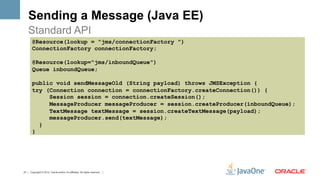
Sending a Message (Java EE)
    Standard API
        @Resource(lookup = "jms/connectionFactory ")
        ConnectionFactory connectionFactory;

        @Resource(lookup="jms/inboundQueue")
        Queue inboundQueue;

        public void sendMessageOld (String payload) throws JMSException {
        try (Connection connection = connectionFactory.createConnection()) {
             Session session = connection.createSession();
             MessageProducer messageProducer = session.createProducer(inboundQueue);
             TextMessage textMessage = session.createTextMessage(payload);
             messageProducer.send(textMessage);
          }
        }


21 | Copyright © 2012, Oracle and/or it’s affiliates. All rights reserved. |
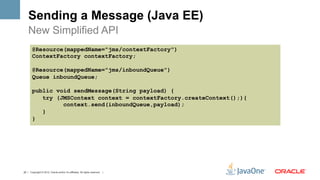
Sending a Message (Java EE)
    New Simplified API
        @Resource(mappedName="jms/contextFactory")
        ContextFactory contextFactory;

        @Resource(mappedName="jms/inboundQueue")
        Queue inboundQueue;

        public void sendMessage(String payload) {
           try (JMSContext context = contextFactory.createContext();){
                 context.send(inboundQueue,payload);
           }
        }


22 | Copyright © 2012, Oracle and/or it’s affiliates. All rights reserved. |
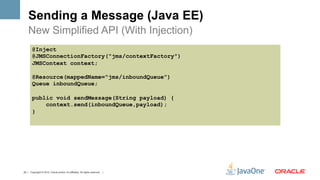
Sending a Message (Java EE)
    New Simplified API (With Injection)
        @Inject
        @JMSConnectionFactory("jms/contextFactory")
        JMSContext context;

        @Resource(mappedName="jms/inboundQueue")
        Queue inboundQueue;

        public void sendMessage(String payload) {
            context.send(inboundQueue,payload);
        }


23 | Copyright © 2012, Oracle and/or it’s affiliates. All rights reserved. |
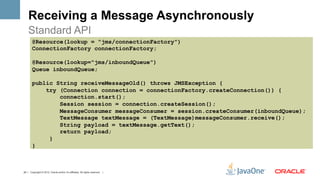
Receiving a Message Asynchronously
    Standard API
        @Resource(lookup = "jms/connectionFactory")
        ConnectionFactory connectionFactory;

        @Resource(lookup="jms/inboundQueue")
        Queue inboundQueue;

        public String receiveMessageOld() throws JMSException {
            try (Connection connection = connectionFactory.createConnection()) {
                connection.start();
                Session session = connection.createSession();
                MessageConsumer messageConsumer = session.createConsumer(inboundQueue);
                TextMessage textMessage = (TextMessage)messageConsumer.receive();
                String payload = textMessage.getText();
                return payload;
             }
        }


24 | Copyright © 2012, Oracle and/or it’s affiliates. All rights reserved. |
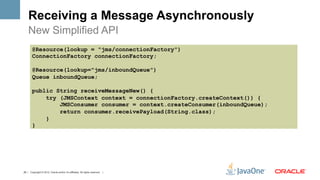
Receiving a Message Asynchronously
    New Simplified API
        @Resource(lookup = "jms/connectionFactory")
        ConnectionFactory connectionFactory;

        @Resource(lookup="jms/inboundQueue")
        Queue inboundQueue;

        public String receiveMessageNew() {
            try (JMSContext context = connectionFactory.createContext()) {
                JMSConsumer consumer = context.createConsumer(inboundQueue);
                return consumer.receivePayload(String.class);
            }
        }


25 | Copyright © 2012, Oracle and/or it’s affiliates. All rights reserved. |
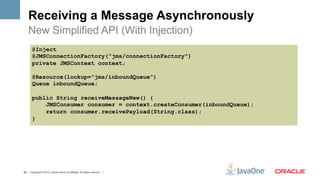
Receiving a Message Asynchronously
    New Simplified API (With Injection)
        @Inject
        @JMSConnectionFactory("jms/connectionFactory")
        private JMSContext context;

        @Resource(lookup="jms/inboundQueue")
        Queue inboundQueue;

        public String receiveMessageNew() {
            JMSConsumer consumer = context.createConsumer(inboundQueue);
            return consumer.receivePayload(String.class);
        }


26 | Copyright © 2012, Oracle and/or it’s affiliates. All rights reserved. |
Some other simplifications


27 | Copyright © 2012, Oracle and/or it’s affiliates. All rights reserved. |
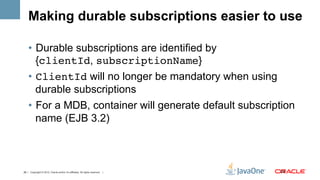
Making durable subscriptions easier to use

    •  Durable subscriptions are identified by
       {clientId, subscriptionName}
    •  ClientId will no longer be mandatory when using
       durable subscriptions
    •  For a MDB, container will generate default subscription
       name (EJB 3.2)


28 | Copyright © 2012, Oracle and/or it’s affiliates. All rights reserved. |   28	
  
New features for PaaS


29 | Copyright © 2012, Oracle and/or it’s affiliates. All rights reserved. |
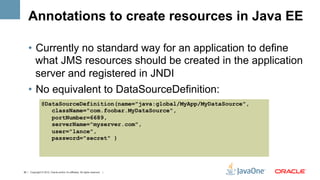
Annotations to create resources in Java EE

    •  Currently no standard way for an application to define
       what JMS resources should be created in the application
       server and registered in JNDI
    •  No equivalent to DataSourceDefinition:
                @DataSourceDefinition(name="java:global/MyApp/MyDataSource",
                   className="com.foobar.MyDataSource",
                   portNumber=6689,
                   serverName="myserver.com",
                   user="lance",
                   password="secret" )


30 | Copyright © 2012, Oracle and/or it’s affiliates. All rights reserved. |
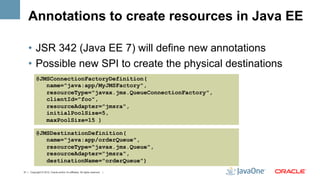
Annotations to create resources in Java EE

    •  JSR 342 (Java EE 7) will define new annotations
    •  Possible new SPI to create the physical destinations
           @JMSConnectionFactoryDefinition(
              name="java:app/MyJMSFactory",
              resourceType="javax.jms.QueueConnectionFactory",
              clientId="foo",
              resourceAdapter="jmsra",
              initialPoolSize=5,
              maxPoolSize=15 )

           @JMSDestinationDefinition(
              name="java:app/orderQueue",
              resourceType="javax.jms.Queue",
              resourceAdapter="jmsra",
              destinationName="orderQueue")
31 | Copyright © 2012, Oracle and/or it’s affiliates. All rights reserved. |
Improving Integration
    with
    Application Servers


32 | Copyright © 2012, Oracle and/or it’s affiliates. All rights reserved. |
Defining the interface between
    JMS provider and an application server


    •  Requirement: allowing any JMS provider to work in any
       Java EE application server
    •  Current solution: JMS 1.1 Chapter 8 JMS Application
       Server Facilities


33 | Copyright © 2012, Oracle and/or it’s affiliates. All rights reserved. |
JMS 1.1 Chapter 8
    JMS Application Server Facilities
    •  Interfaces all optional, so not all vendors implement them
    •  No requirement for application servers to support them
    •  Some omissions
             –  No support for pooled connections
    •  Meanwhile…


34 | Copyright © 2012, Oracle and/or it’s affiliates. All rights reserved. |
Java EE Connector Architecture (JCA)

    •  Designed for integrating pooled, transactional resources
       in an application server
    •  Designed to support async processing of messages by
       MDBs
    •  JCA support already mandatory in Java EE
    •  Many JMS vendors already provide JCA adapters


35 | Copyright © 2012, Oracle and/or it’s affiliates. All rights reserved. |
Defining the interface between
    JMS provider and an application server
    •  JMS 2.0 will make provision of a JCA adaptor mandatory
    •  JMS 1.1 Chapter 8 API remains optional, under review


36 | Copyright © 2012, Oracle and/or it’s affiliates. All rights reserved. |
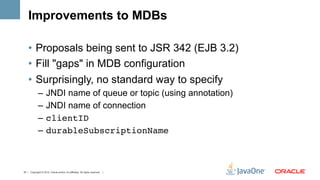
Improvements to MDBs

    •  Proposals being sent to JSR 342 (EJB 3.2)
    •  Fill "gaps" in MDB configuration
    •  Surprisingly, no standard way to specify
             –  JNDI name of queue or topic (using annotation)
             –  JNDI name of connection
             –  clientID!
             –  durableSubscriptionName!


37 | Copyright © 2012, Oracle and/or it’s affiliates. All rights reserved. |
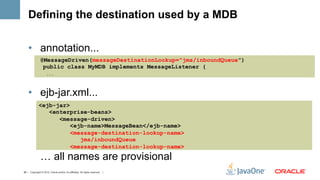
Defining the destination used by a MDB

    •  annotation...
               @MessageDriven(messageDestinationLookup="jms/inboundQueue”)
                public class MyMDB implements MessageListener {
                     ...


    •  ejb-jar.xml...
              <ejb-jar>
                 <enterprise-beans>
                    <message-driven>
                        <ejb-name>MessageBean</ejb-name>
                        <message-destination-lookup-name>
                           jms/inboundQueue
                        <message-destination-lookup-name>
               … all names are provisional
38 | Copyright © 2012, Oracle and/or it’s affiliates. All rights reserved. |
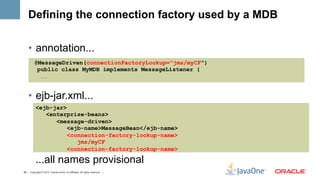
Defining the connection factory used by a MDB

    •  annotation...
          @MessageDriven(connectionFactoryLookup="jms/myCF")
           public class MyMDB implements MessageListener {
                ...


    •  ejb-jar.xml...
           <ejb-jar>
              <enterprise-beans>
                 <message-driven>
                     <ejb-name>MessageBean</ejb-name>
                     <connection-factory-lookup-name>
                        jms/myCF
                     <connection-factory-lookup-name>

           ...all names provisional
39 | Copyright © 2012, Oracle and/or it’s affiliates. All rights reserved. |
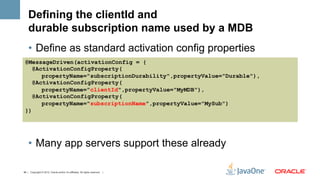
Defining the clientId and
    durable subscription name used by a MDB
    •  Define as standard activation config properties
 @MessageDriven(activationConfig = {
    @ActivationConfigProperty(
       propertyName="subscriptionDurability",propertyValue="Durable"),
    @ActivationConfigProperty(
       propertyName="clientId",propertyValue="MyMDB"),
    @ActivationConfigProperty(
       propertyName="subscriptionName",propertyValue="MySub")
 })


    •  Many app servers support these already

40 | Copyright © 2012, Oracle and/or it’s affiliates. All rights reserved. |
New API Features


41 | Copyright © 2012, Oracle and/or it’s affiliates. All rights reserved. |
New API features

    •  Delivery delay
    •  Send a message with async acknowledgement from server
    •  JMSXDeliveryCount becomes mandatory
    •  Multiple consumers on the same topic subscription (both durable
       and non-durable)
    •  Some products implement some of these already


42 | Copyright © 2012, Oracle and/or it’s affiliates. All rights reserved. |
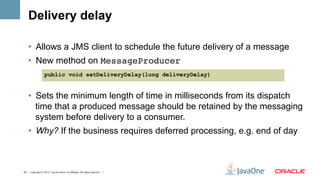
Delivery delay

    •  Allows a JMS client to schedule the future delivery of a message
    •  New method on MessageProducer
                   public void setDeliveryDelay(long deliveryDelay)


    •  Sets the minimum length of time in milliseconds from its dispatch
       time that a produced message should be retained by the messaging
       system before delivery to a consumer.
    •  Why? If the business requires deferred processing, e.g. end of day


43 | Copyright © 2012, Oracle and/or it’s affiliates. All rights reserved. |
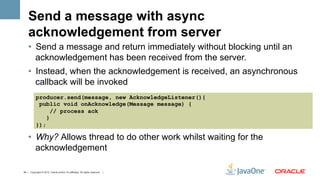
Send a message with async
    acknowledgement from server
    •  Send a message and return immediately without blocking until an
       acknowledgement has been received from the server.
    •  Instead, when the acknowledgement is received, an asynchronous
       callback will be invoked
           producer.send(message, new AcknowledgeListener(){
            public void onAcknowledge(Message message) {
                 // process ack
               }
           });

    •  Why? Allows thread to do other work whilst waiting for the
       acknowledgement

44 | Copyright © 2012, Oracle and/or it’s affiliates. All rights reserved. |
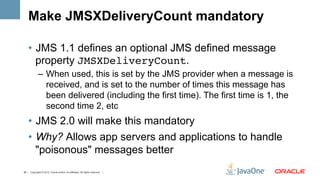
Make JMSXDeliveryCount mandatory

    •  JMS 1.1 defines an optional JMS defined message
       property JMSXDeliveryCount.
             –  When used, this is set by the JMS provider when a message is
                received, and is set to the number of times this message has
                been delivered (including the first time). The first time is 1, the
                second time 2, etc
    •  JMS 2.0 will make this mandatory
    •  Why? Allows app servers and applications to handle
       "poisonous" messages better
45 | Copyright © 2012, Oracle and/or it’s affiliates. All rights reserved. |
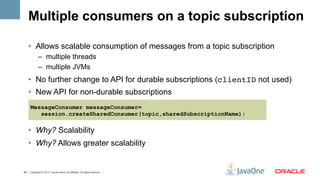
Multiple consumers on a topic subscription

    •  Allows scalable consumption of messages from a topic subscription
             –  multiple threads
             –  multiple JVMs
    •  No further change to API for durable subscriptions (clientID not used)
    •  New API for non-durable subscriptions
      MessageConsumer messageConsumer=
         session.createSharedConsumer(topic,sharedSubscriptionName);

    •  Why? Scalability
    •  Why? Allows greater scalability


46 | Copyright © 2012, Oracle and/or it’s affiliates. All rights reserved. |
Get involved!

    •  Early Draft Already Available
    •  Mailing lists, issue tracker and wiki:
             –  jms-spec.java.net
    •  Join users@jms-spec.java.net to follow and contribute
    •  Applications to join the expert group
             –  http://jcp.org/en/jsr/summary?id=343
    •  Contact the spec lead
             –  nigel.deakin@oracle.com

47 | Copyright © 2012, Oracle and/or it’s affiliates. All rights reserved. |
Questions & Answers


48 | Copyright © 2012, Oracle and/or it’s affiliates. All rights reserved. |

GIDS 2012: Java Message Service 2.0

  • 1.
    ably prob What's coming in Java Message Service 2.0 Arun Gupta, Java EE & GlassFish Guy blogs.oracle.com/arungupta, @arungupta 1 | Copyright © 2012, Oracle and/or it’s affiliates. All rights reserved. |
  • 2.
    The following isintended to outline our general product direction. It is intended for information purposes only, and may not be incorporated into any contract. It is not a commitment to deliver any material, code, or functionality, and should not be relied upon in making purchasing decisions. The development, release, and timing of any features or functionality described for Oracle s products remains at the sole discretion of Oracle. 2 | Copyright © 2012, Oracle and/or it’s affiliates. All rights reserved. | 2  
  • 3.
    Agenda •  JSR 343 Update •  What's in the JMS 2.0 Early Draft –  Simplifying the JMS API –  Improving integration with application servers –  New API features •  Q&A 3 | Copyright © 2012, Oracle and/or it’s affiliates. All rights reserved. | 3   3  
  • 4.
    JMS •  Java Message Service (JMS) specification –  Part of Java EE but also stands alone –  Last maintenance release (1.1) was in 2003 •  Does not mean JMS is moribund! –  Multiple active commercial and open source implementations –  Shows strength of existing spec •  Meanwhile –  Java EE has moved on since, and now Java EE 7 is planned –  Time for JMS 2.0 4 | Copyright © 2012, Oracle and/or it’s affiliates. All rights reserved. | 4  
  • 5.
    JMS 2.0 •  March2011: JSR 343 launched to develop JMS 2.0 •  Target: to be part of Java EE 7 in Q2 2013 •  Early Draft released •  Community involvement invited –  Visit jms-spec.java.net and get involved –  Join the mailing list –  Submit suggestions to the issue tracker 5 | Copyright © 2012, Oracle and/or it’s affiliates. All rights reserved. | 5  
  • 6.
    JSR 343 ExpertGroup ... 6 | Copyright © 2012, Oracle and/or it’s affiliates. All rights reserved. |
  • 7.
    Initial goals ofJMS 2.0 •  Simpler and easier to use •  Standardise interface with –  simplify the API application servers –  make use of CDI (Contexts and •  Clarify relationship with other Dependency Injection) Java EE specs –  clarify any ambiguities in the spec –  some JMS behaviour defined in •  Support new themes of Java EE 7 other specs –  PaaS •  New messaging features –  Multi-tenancy –  standardize some existing vendor extensions (or will retrospective standardisation be difficult?) 7 | Copyright © 2012, Oracle and/or it’s affiliates. All rights reserved. | 7  
  • 8.
    JMS 2.0 Timeline ✔ Forma0on  of  expert  group   Q2  2011   ✔ Prepara0on  of  early  dra;   ✔ Early  dra;  review   Q1  2012   Prepara0on  of  public  dra;   Public  review   Q3  2012   Comple0on  of  RI  and  TCK   Q1  2013   Final  approval  ballot   8 | Copyright © 2012, Oracle and/or it’s affiliates. All rights reserved. | 8  
  • 9.
    What's in theEarly Draft •  Here are some items in the JMS 2.0 Early Draft –  Based on Expert Group members' priorities –  All items in JIRA at jms-spec.java.net •  Things are still changing •  It's not too late –  to give us your views on these items –  to propose additional items for a later draft or revision 9 | Copyright © 2012, Oracle and/or it’s affiliates. All rights reserved. | 9  
  • 10.
    Simplifying the JMSAPI 10 | Copyright © 2012, Oracle and/or it’s affiliates. All rights reserved. |
  • 11.
    What's wrong withthe JMS API? Not a lot... 11 | Copyright © 2012, Oracle and/or it’s affiliates. All rights reserved. |
  • 12.
    Receiving messages inJava EE @MessageDriven(mappedName = "jms/inboundQueue") public class MyMDB implements MessageListener { public void onMessage(Message message) { String payload = (TextMessage)textMessage.getText(); // do something with payload } } 12 | Copyright © 2012, Oracle and/or it’s affiliates. All rights reserved. |
  • 13.
    Sending messages inJava EE @Resource(lookup = "jms/connFactory") ConnectionFactory cf; @Resource(lookup="jms/inboundQueue") Destination dest; public void sendMessage (String payload) throws JMSException { Connection conn = cf.createConnection(); Session sess = conn.createSession(false,Session.AUTO_ACKNOWLEDGE); MessageProducer producer = sess.createProducer(dest); TextMessage textMessage = sess.createTextMessage(payload); messageProducer.send(textMessage); connection.close(); } 13 | Copyright © 2012, Oracle and/or it’s affiliates. All rights reserved. |
  • 14.
    Sending messages inJava EE @Resource(lookup = "jms/connFactory") Need to create ConnectionFactory cf; intermediate objects @Resource(lookup="jms/inboundQueue") just to satisfy the API Destination dest; public void sendMessage (String payload) throws JMSException { Connection conn = cf.createConnection(); Session sess = conn.createSession(false,Session.AUTO_ACKNOWLEDGE); MessageProducer producer = sess.createProducer(dest); TextMessage textMessage = sess.createTextMessage(payload); messageProducer.send(textMessage); connection.close(); } 14 | Copyright © 2012, Oracle and/or it’s affiliates. All rights reserved. |
  • 15.
    Sending messages inJava EE @Resource(lookup = "jms/connFactory") ConnectionFactory cf; Redundant @Resource(lookup="jms/inboundQueue") arguments Destination dest; public void sendMessage (String payload) throws JMSException { Connection conn = cf.createConnection(); Session sess = conn.createSession(false,Session.AUTO_ACKNOWLEDGE); MessageProducer producer = sess.createProducer(dest); TextMessage textMessage = sess.createTextMessage(payload); messageProducer.send(textMessage); connection.close(); } 15 | Copyright © 2012, Oracle and/or it’s affiliates. All rights reserved. |
  • 16.
    Sending messages inJava EE @Resource(lookup = "jms/connFactory") ConnectionFactory cf; @Resource(lookup="jms/inboundQueue") Destination dest; Boilerplate code public void sendMessage (String payload) throws JMSException { Connection conn = cf.createConnection(); Session sess = conn.createSession(false,Session.AUTO_ACKNOWLEDGE); MessageProducer producer = sess.createProducer(dest); TextMessage textMessage = sess.createTextMessage(payload); messageProducer.send(textMessage); connection.close(); } 16 | Copyright © 2012, Oracle and/or it’s affiliates. All rights reserved. |
  • 17.
    Sending messages inJava EE public void sendMessage (String payload) throws JMSException { try { Connection conn = null; con = cf.createConnection(); Session sess = conn.createSession(false,Session.AUTO_ACKNOWLEDGE); MessageProducer producer = sess.createProducer(dest); TextMessage textMessage=sess.createTextMessage(payload); messageProducer.send(textMessage); } finally { connection.close(); } } Need to close connections after use 17 | Copyright © 2012, Oracle and/or it’s affiliates. All rights reserved. |
  • 18.
    Sending messages inJava EE public void sendMessage (String payload) { Connection conn = null; try { con = cf.createConnection(); Session sess = conn.createSession(false,Session.AUTO_ACKNOWLEDGE); MessageProducer producer = sess.createProducer(dest); TextMessage textMessage=sess.createTextMessage(payload); messageProducer.send(textMessage); } catch (JMSException e1) { // do something } finally { try { if (conn!=null) connection.close(); } catch (JMSException e2){ // do something else } And there's } always exception } handling to add 18 | Copyright © 2012, Oracle and/or it’s affiliates. All rights reserved. |
  • 19.
    Approaches to simplification •  Simplify the existing API •  Define new simplified API •  Use CDI annotations to hide the boilerplate code 19 | Copyright © 2012, Oracle and/or it’s affiliates. All rights reserved. | 19  
  • 20.
    Simplify the existingAPI •  Need to maintain backwards compatibility limits scope for change –  New methods on javax.jms.Connection: •  Keep existing method connection.createSession(transacted,deliveryMode) •  New method for Java SE connection.createSession(sessionMode) •  New method for Java EE connection.createSession() –  Make javax.jms.Connection implement java.lang.AutoCloseable 20 | Copyright © 2012, Oracle and/or it’s affiliates. All rights reserved. |
  • 21.
    Sending a Message(Java EE) Standard API @Resource(lookup = "jms/connectionFactory ") ConnectionFactory connectionFactory; @Resource(lookup="jms/inboundQueue") Queue inboundQueue; public void sendMessageOld (String payload) throws JMSException { try (Connection connection = connectionFactory.createConnection()) { Session session = connection.createSession(); MessageProducer messageProducer = session.createProducer(inboundQueue); TextMessage textMessage = session.createTextMessage(payload); messageProducer.send(textMessage); } } 21 | Copyright © 2012, Oracle and/or it’s affiliates. All rights reserved. |
  • 22.
    Sending a Message(Java EE) New Simplified API @Resource(mappedName="jms/contextFactory") ContextFactory contextFactory; @Resource(mappedName="jms/inboundQueue") Queue inboundQueue; public void sendMessage(String payload) { try (JMSContext context = contextFactory.createContext();){ context.send(inboundQueue,payload); } } 22 | Copyright © 2012, Oracle and/or it’s affiliates. All rights reserved. |
  • 23.
    Sending a Message(Java EE) New Simplified API (With Injection) @Inject @JMSConnectionFactory("jms/contextFactory") JMSContext context; @Resource(mappedName="jms/inboundQueue") Queue inboundQueue; public void sendMessage(String payload) { context.send(inboundQueue,payload); } 23 | Copyright © 2012, Oracle and/or it’s affiliates. All rights reserved. |
  • 24.
    Receiving a MessageAsynchronously Standard API @Resource(lookup = "jms/connectionFactory") ConnectionFactory connectionFactory; @Resource(lookup="jms/inboundQueue") Queue inboundQueue; public String receiveMessageOld() throws JMSException { try (Connection connection = connectionFactory.createConnection()) { connection.start(); Session session = connection.createSession(); MessageConsumer messageConsumer = session.createConsumer(inboundQueue); TextMessage textMessage = (TextMessage)messageConsumer.receive(); String payload = textMessage.getText(); return payload; } } 24 | Copyright © 2012, Oracle and/or it’s affiliates. All rights reserved. |
  • 25.
    Receiving a MessageAsynchronously New Simplified API @Resource(lookup = "jms/connectionFactory") ConnectionFactory connectionFactory; @Resource(lookup="jms/inboundQueue") Queue inboundQueue; public String receiveMessageNew() { try (JMSContext context = connectionFactory.createContext()) { JMSConsumer consumer = context.createConsumer(inboundQueue); return consumer.receivePayload(String.class); } } 25 | Copyright © 2012, Oracle and/or it’s affiliates. All rights reserved. |
  • 26.
    Receiving a MessageAsynchronously New Simplified API (With Injection) @Inject @JMSConnectionFactory("jms/connectionFactory") private JMSContext context; @Resource(lookup="jms/inboundQueue") Queue inboundQueue; public String receiveMessageNew() { JMSConsumer consumer = context.createConsumer(inboundQueue); return consumer.receivePayload(String.class); } 26 | Copyright © 2012, Oracle and/or it’s affiliates. All rights reserved. |
  • 27.
    Some other simplifications 27| Copyright © 2012, Oracle and/or it’s affiliates. All rights reserved. |
  • 28.
    Making durable subscriptionseasier to use •  Durable subscriptions are identified by {clientId, subscriptionName} •  ClientId will no longer be mandatory when using durable subscriptions •  For a MDB, container will generate default subscription name (EJB 3.2) 28 | Copyright © 2012, Oracle and/or it’s affiliates. All rights reserved. | 28  
  • 29.
    New features forPaaS 29 | Copyright © 2012, Oracle and/or it’s affiliates. All rights reserved. |
  • 30.
    Annotations to createresources in Java EE •  Currently no standard way for an application to define what JMS resources should be created in the application server and registered in JNDI •  No equivalent to DataSourceDefinition: @DataSourceDefinition(name="java:global/MyApp/MyDataSource", className="com.foobar.MyDataSource", portNumber=6689, serverName="myserver.com", user="lance", password="secret" ) 30 | Copyright © 2012, Oracle and/or it’s affiliates. All rights reserved. |
  • 31.
    Annotations to createresources in Java EE •  JSR 342 (Java EE 7) will define new annotations •  Possible new SPI to create the physical destinations @JMSConnectionFactoryDefinition( name="java:app/MyJMSFactory", resourceType="javax.jms.QueueConnectionFactory", clientId="foo", resourceAdapter="jmsra", initialPoolSize=5, maxPoolSize=15 ) @JMSDestinationDefinition( name="java:app/orderQueue", resourceType="javax.jms.Queue", resourceAdapter="jmsra", destinationName="orderQueue") 31 | Copyright © 2012, Oracle and/or it’s affiliates. All rights reserved. |
  • 32.
    Improving Integration with Application Servers 32 | Copyright © 2012, Oracle and/or it’s affiliates. All rights reserved. |
  • 33.
    Defining the interfacebetween JMS provider and an application server •  Requirement: allowing any JMS provider to work in any Java EE application server •  Current solution: JMS 1.1 Chapter 8 JMS Application Server Facilities 33 | Copyright © 2012, Oracle and/or it’s affiliates. All rights reserved. |
  • 34.
    JMS 1.1 Chapter8 JMS Application Server Facilities •  Interfaces all optional, so not all vendors implement them •  No requirement for application servers to support them •  Some omissions –  No support for pooled connections •  Meanwhile… 34 | Copyright © 2012, Oracle and/or it’s affiliates. All rights reserved. |
  • 35.
    Java EE ConnectorArchitecture (JCA) •  Designed for integrating pooled, transactional resources in an application server •  Designed to support async processing of messages by MDBs •  JCA support already mandatory in Java EE •  Many JMS vendors already provide JCA adapters 35 | Copyright © 2012, Oracle and/or it’s affiliates. All rights reserved. |
  • 36.
    Defining the interfacebetween JMS provider and an application server •  JMS 2.0 will make provision of a JCA adaptor mandatory •  JMS 1.1 Chapter 8 API remains optional, under review 36 | Copyright © 2012, Oracle and/or it’s affiliates. All rights reserved. |
  • 37.
    Improvements to MDBs •  Proposals being sent to JSR 342 (EJB 3.2) •  Fill "gaps" in MDB configuration •  Surprisingly, no standard way to specify –  JNDI name of queue or topic (using annotation) –  JNDI name of connection –  clientID! –  durableSubscriptionName! 37 | Copyright © 2012, Oracle and/or it’s affiliates. All rights reserved. |
  • 38.
    Defining the destinationused by a MDB •  annotation... @MessageDriven(messageDestinationLookup="jms/inboundQueue”) public class MyMDB implements MessageListener { ... •  ejb-jar.xml... <ejb-jar> <enterprise-beans> <message-driven> <ejb-name>MessageBean</ejb-name> <message-destination-lookup-name> jms/inboundQueue <message-destination-lookup-name> … all names are provisional 38 | Copyright © 2012, Oracle and/or it’s affiliates. All rights reserved. |
  • 39.
    Defining the connectionfactory used by a MDB •  annotation... @MessageDriven(connectionFactoryLookup="jms/myCF") public class MyMDB implements MessageListener { ... •  ejb-jar.xml... <ejb-jar> <enterprise-beans> <message-driven> <ejb-name>MessageBean</ejb-name> <connection-factory-lookup-name> jms/myCF <connection-factory-lookup-name> ...all names provisional 39 | Copyright © 2012, Oracle and/or it’s affiliates. All rights reserved. |
  • 40.
    Defining the clientIdand durable subscription name used by a MDB •  Define as standard activation config properties @MessageDriven(activationConfig = { @ActivationConfigProperty( propertyName="subscriptionDurability",propertyValue="Durable"), @ActivationConfigProperty( propertyName="clientId",propertyValue="MyMDB"), @ActivationConfigProperty( propertyName="subscriptionName",propertyValue="MySub") }) •  Many app servers support these already 40 | Copyright © 2012, Oracle and/or it’s affiliates. All rights reserved. |
  • 41.
    New API Features 41| Copyright © 2012, Oracle and/or it’s affiliates. All rights reserved. |
  • 42.
    New API features •  Delivery delay •  Send a message with async acknowledgement from server •  JMSXDeliveryCount becomes mandatory •  Multiple consumers on the same topic subscription (both durable and non-durable) •  Some products implement some of these already 42 | Copyright © 2012, Oracle and/or it’s affiliates. All rights reserved. |
  • 43.
    Delivery delay •  Allows a JMS client to schedule the future delivery of a message •  New method on MessageProducer public void setDeliveryDelay(long deliveryDelay) •  Sets the minimum length of time in milliseconds from its dispatch time that a produced message should be retained by the messaging system before delivery to a consumer. •  Why? If the business requires deferred processing, e.g. end of day 43 | Copyright © 2012, Oracle and/or it’s affiliates. All rights reserved. |
  • 44.
    Send a messagewith async acknowledgement from server •  Send a message and return immediately without blocking until an acknowledgement has been received from the server. •  Instead, when the acknowledgement is received, an asynchronous callback will be invoked producer.send(message, new AcknowledgeListener(){ public void onAcknowledge(Message message) { // process ack } }); •  Why? Allows thread to do other work whilst waiting for the acknowledgement 44 | Copyright © 2012, Oracle and/or it’s affiliates. All rights reserved. |
  • 45.
    Make JMSXDeliveryCount mandatory •  JMS 1.1 defines an optional JMS defined message property JMSXDeliveryCount. –  When used, this is set by the JMS provider when a message is received, and is set to the number of times this message has been delivered (including the first time). The first time is 1, the second time 2, etc •  JMS 2.0 will make this mandatory •  Why? Allows app servers and applications to handle "poisonous" messages better 45 | Copyright © 2012, Oracle and/or it’s affiliates. All rights reserved. |
  • 46.
    Multiple consumers ona topic subscription •  Allows scalable consumption of messages from a topic subscription –  multiple threads –  multiple JVMs •  No further change to API for durable subscriptions (clientID not used) •  New API for non-durable subscriptions MessageConsumer messageConsumer= session.createSharedConsumer(topic,sharedSubscriptionName); •  Why? Scalability •  Why? Allows greater scalability 46 | Copyright © 2012, Oracle and/or it’s affiliates. All rights reserved. |
  • 47.
    Get involved! •  Early Draft Already Available •  Mailing lists, issue tracker and wiki: –  jms-spec.java.net •  Join users@jms-spec.java.net to follow and contribute •  Applications to join the expert group –  http://jcp.org/en/jsr/summary?id=343 •  Contact the spec lead –  nigel.deakin@oracle.com 47 | Copyright © 2012, Oracle and/or it’s affiliates. All rights reserved. |
  • 48.
    Questions & Answers 48| Copyright © 2012, Oracle and/or it’s affiliates. All rights reserved. |