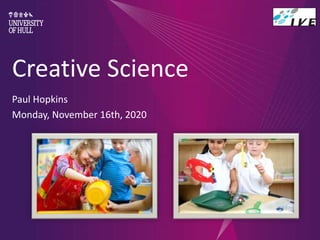
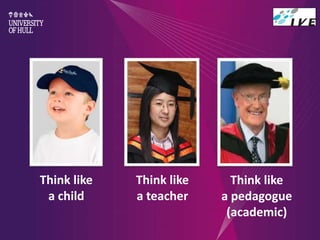
Creative Science
Paul Hopkins
Monday, November 16th, 2020
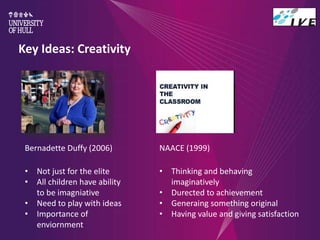
Think like
a child
Think like
a teacher
Think like
a pedagogue
(academic)
Key Ideas: Creativity
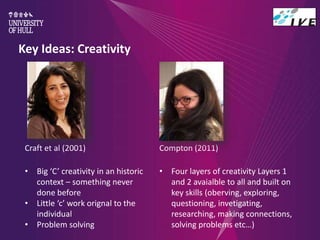
Bernadette Duffy (2006)
• Not just for the elite
• All children have ability
to be imagniative
• Need to play with ideas
• Importance of
enviornment
NAACE (1999)
• Thinking and behaving
imaginatively
• Durected to achievement
• Generaing something original
• Having value and giving satisfaction
Key Ideas: Creativity
Craft et al (2001)
• Big ‘C’ creativity in an historic
context – something never
done before
• Little ‘c’ work orignal to the
individual
• Problem solving
Compton (2011)
• Four layers of creativity Layers 1
and 2 avaialble to all and built on
key skills (oberving, exploring,
questioning, invetigating,
researching, making connections,
solving problems etc…)
Discussion Time
You will now be
allocated into Breakout
rooms and you have 5
mins to discuss.
Discussion Question
In what ways can
science link into one
(or more) of these
creativity models?
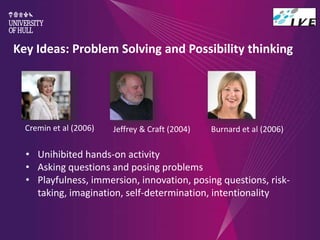
Key Ideas: Problem Solving and Possibility thinking
• Unihibited hands-on activity
• Asking questions and posing problems
• Playfulness, immersion, innovation, posing questions, risk-
taking, imagination, self-determination, intentionality
Jeffrey & Craft (2004) Burnard et al (2006)Cremin et al (2006)
Discussion Time
You will now be
allocated into Breakout
rooms and you have 5
mins to discuss.
Discussion Question
Reflections on the
Cremin et alea paper or
the input from Paul.
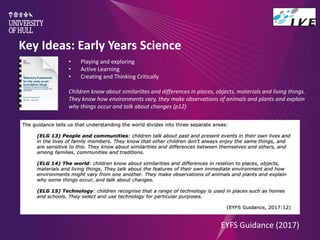
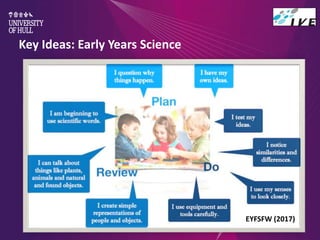
Key Ideas: Early Years Science
EYFS Guidance (2017)
• Playing and exploring
• Active Learning
• Creating and Thinking Critically
Children know about similariites and differences in places, objects, materials and living things.
They know how environments vary, they make observations of animals and plants and explain
why things occur and talk about changes (p12)
Key Ideas: Early Years Science
EYFSFW (2017)
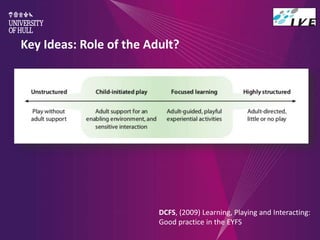
Key Ideas: Role of the Adult?
DCFS, (2009) Learning, Playing and Interacting:
Good practice in the EYFS
Discussion Time
You will now be
allocated into Breakout
rooms and you have 5
mins to discuss.
Discussion Question
How would the key
ideas work for different
points on the role of
the adult spectrum?
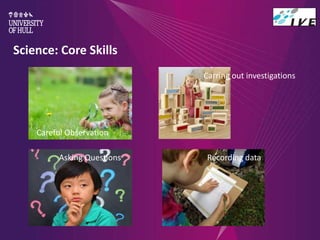
Science: Core Skills
Careful Observation
Asking Questions
Carring out investigations
Recording data
Discussion Time
You will now be
allocated into Breakout
rooms and you have 5
mins to discuss.
Discussion Question
How would you
support ECE children to
develop these skills?
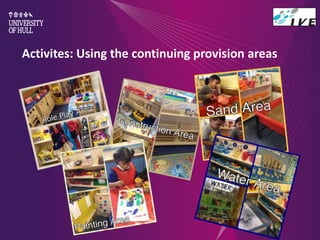
Activites: Using the continuing provision areas
Remember to take pictures and videos which
you might use the assignment
Questions?

S2 creative science

  • 1.
  • 2.
    Think like a child Thinklike a teacher Think like a pedagogue (academic)
  • 3.
    Key Ideas: Creativity BernadetteDuffy (2006) • Not just for the elite • All children have ability to be imagniative • Need to play with ideas • Importance of enviornment NAACE (1999) • Thinking and behaving imaginatively • Durected to achievement • Generaing something original • Having value and giving satisfaction
  • 4.
    Key Ideas: Creativity Craftet al (2001) • Big ‘C’ creativity in an historic context – something never done before • Little ‘c’ work orignal to the individual • Problem solving Compton (2011) • Four layers of creativity Layers 1 and 2 avaialble to all and built on key skills (oberving, exploring, questioning, invetigating, researching, making connections, solving problems etc…)
  • 5.
    Discussion Time You willnow be allocated into Breakout rooms and you have 5 mins to discuss. Discussion Question In what ways can science link into one (or more) of these creativity models?
  • 6.
    Key Ideas: ProblemSolving and Possibility thinking • Unihibited hands-on activity • Asking questions and posing problems • Playfulness, immersion, innovation, posing questions, risk- taking, imagination, self-determination, intentionality Jeffrey & Craft (2004) Burnard et al (2006)Cremin et al (2006)
  • 7.
    Discussion Time You willnow be allocated into Breakout rooms and you have 5 mins to discuss. Discussion Question Reflections on the Cremin et alea paper or the input from Paul.
  • 8.
    Key Ideas: EarlyYears Science EYFS Guidance (2017) • Playing and exploring • Active Learning • Creating and Thinking Critically Children know about similariites and differences in places, objects, materials and living things. They know how environments vary, they make observations of animals and plants and explain why things occur and talk about changes (p12)
  • 9.
    Key Ideas: EarlyYears Science EYFSFW (2017)
  • 10.
    Key Ideas: Roleof the Adult? DCFS, (2009) Learning, Playing and Interacting: Good practice in the EYFS
  • 11.
    Discussion Time You willnow be allocated into Breakout rooms and you have 5 mins to discuss. Discussion Question How would the key ideas work for different points on the role of the adult spectrum?
  • 12.
    Science: Core Skills CarefulObservation Asking Questions Carring out investigations Recording data
  • 13.
    Discussion Time You willnow be allocated into Breakout rooms and you have 5 mins to discuss. Discussion Question How would you support ECE children to develop these skills?
  • 14.
    Activites: Using thecontinuing provision areas
  • 15.
    Remember to takepictures and videos which you might use the assignment
  • 16.