Engaging children as
thinkers and theorisers
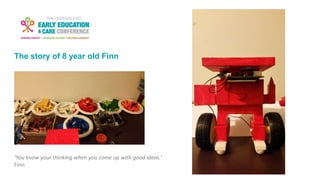
The story of 8 year old Finn
‘You know your thinking when you come up with good ideas.’
Finn
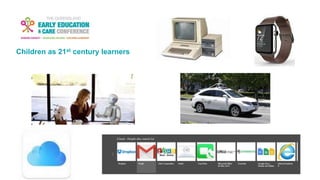
Children as 21st century learners
21st century skills - 4c’s
• Critical thinking
• Communication
• Creativity
• Collaboration
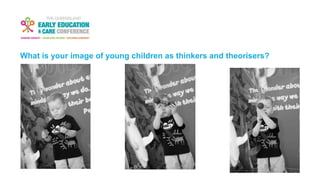
What is your image of young children as thinkers and theorisers?
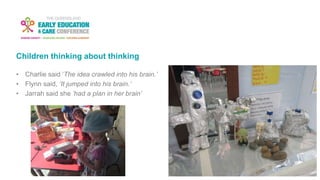
Children thinking about thinking
• Charlie said ‘The idea crawled into his brain.’
• Flynn said, ‘It jumped into his brain.’
• Jarrah said she ‘had a plan in her brain’
Creating a culture and language for thinking
How are educators creating a culture that supports children as thinkers and
theorisers?
What else could be happening in your learning environment ?
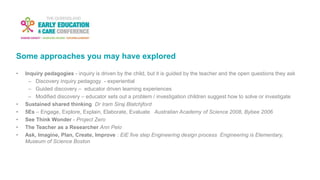
Some approaches you may have explored
• Inquiry pedagogies - inquiry is driven by the child, but it is guided by the teacher and the open questions they ask
– Discovery inquiry pedagogy - experiential
– Guided discovery – educator driven learning experiences
– Modified discovery – educator sets out a problem / investigation children suggest how to solve or investigate
• Sustained shared thinking Dr Iram Siraj Blatchjford
• 5Es – Engage, Explore, Explain, Elaborate, Evaluate Australian Academy of Science 2008, Bybee 2006
• See Think Wonder - Project Zero
• The Teacher as a Researcher Ann Pelo
• Ask, Imagine, Plan, Create, Improve : EiE five step Engineering design process Engineering is Elementary,
Museum of Science Boston
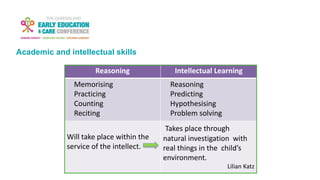
Academic and intellectual skills
Reasoning Intellectual Learning
Memorising
Practicing
Counting
Reciting
Reasoning
Predicting
Hypothesising
Problem solving
Will take place within the
service of the intellect.
Takes place through
natural investigation with
real things in the child’s
environment.
Lilian Katz
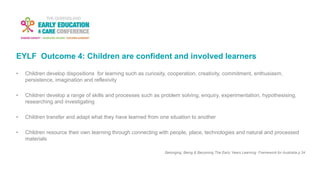
EYLF Outcome 4: Children are confident and involved learners
• Children develop dispositions for learning such as curiosity, cooperation, creativity, commitment, enthusiasm,
persistence, imagination and reflexivity
• Children develop a range of skills and processes such as problem solving, enquiry, experimentation, hypothesising,
researching and investigating
• Children transfer and adapt what they have learned from one situation to another
• Children resource their own learning through connecting with people, place, technologies and natural and processed
materials
Belonging, Being & Becoming The Early Years Learning Framework for Australia p 34
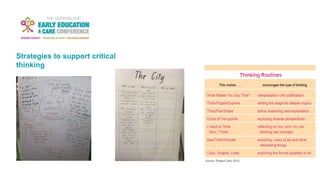
Strategies to support critical
thinking
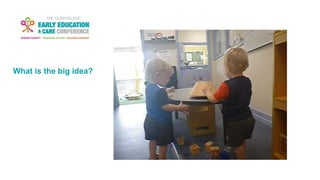
What is the big idea?
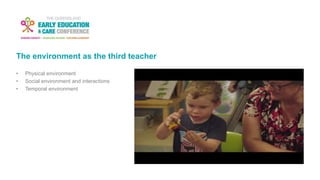
The environment as the third teacher
• Physical environment
• Social environment and interactions
• Temporal environment
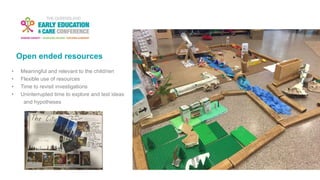
Open ended resources
• Meaningful and relevant to the child/ren
• Flexible use of resources
• Time to revisit investigations
• Uninterrupted time to explore and test ideas
and hypotheses
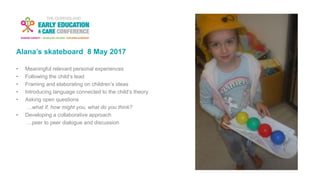
Alana’s skateboard 8 May 2017
• Meaningful relevant personal experiences
• Following the child’s lead
• Framing and elaborating on children’s ideas
• Introducing language connected to the child’s theory
• Asking open questions
…what if, how might you, what do you think?
• Developing a collaborative approach
…peer to peer dialogue and discussion
Suzette’s thinking and response
When Alana walked through the door in the morning, she showed me a ‘skateboard’ she had made at home.
Suzette: Tell me how you put this together.
Alana: I used this shape from my doll’s house and look, I stuck wheels on here with lots of sticky tape.
Suzette: Can we sit down and try it out? I am wondering about the wheels and how we’ll make them move?
Chaston was listening in with interest and then he offered a suggestion: I have skateboards at home. I ride
with my big brother.
Suzette: Oh, great. Would you be able to bring your skateboard in and show us?
Chaston also had a fidget spinner in his hand and his Mum said he had made it at home.
Suzette: I think the ball bearing in the fidget spinners make them move around. Do you think skateboards
might have something like that to make the wheels move too?
The educator’s assessment: Why is this significant?
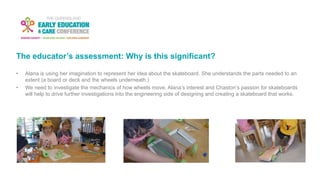
• Alana is using her imagination to represent her idea about the skateboard. She understands the parts needed to an
extent (a board or deck and the wheels underneath.)
• We need to investigate the mechanics of how wheels move. Alana’s interest and Chaston’s passion for skateboards
will help to drive further investigations into the engineering side of designing and creating a skateboard that works.
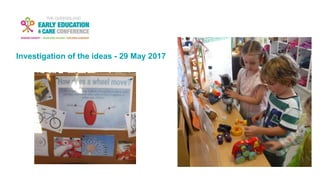
Investigation of the ideas - 29 May 2017
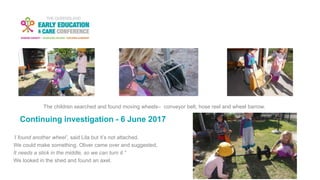
Continuing investigation - 6 June 2017
The children searched and found moving wheels– conveyor belt, hose reel and wheel barrow.
‘I found another wheel’, said Lila but it’s not attached.
We could make something. Oliver came over and suggested,
It needs a stick in the middle, so we can turn it.”
We looked in the shed and found an axel.
Allow time for questions and answers
to be thought through and tested.
Considerations for educators
• An open mind to reflect and consider new ways of thinking about children’s thinking and pedagogy
• Developing a culture and language of thinking for children and educators
• Building on what knowledges children have – information, cultural, their big ideas
• A collaborative approach – children leading, peer mentoring
• Rethinking all elements of the environment – time, space, resources, interactions and references for further
information
• Questioning techniques and types of open questioning
• An incomplete narrative
• Team collaboration
• Children exploring their world outside the service gate and developing connections with community partners with
families or people that can deepen our knowledge on a particular topic
• Critical reflection – How are the 4C’s reflected and promoted daily in your learning environment?
If you give people tools, and they use their natural abilities and their
curiosity, they will develop things in ways that will surprise you very
much beyond what you might have expected.
Bill Gates
Thank you to the children and educators who have shared their thinking
• Finn
• C&K Elanora
• C&K North Caloundra
• C&K QUT Kelvin Grove
• C&K Salisbury Community Child care
• C&K Yuingi Community Child Care
References
Australian Academy of Science 2017 5Es teaching and Learning Model Retrieved 7 June 2017 from https://primaryconnections.org.au/about/teaching
Berger, Cynthia. 23 February 2017 Creating an Engineering Design Process for the Preschool Classroom Retrieved 5 May, 2017 from
http://blog.eie.org/creating-an-engineering-design-process-for-the-preschool-
classroom?hsFormKey=57aa02f96155030d0da503232bd44216&submissionGuid=8bb344f4-1ed4-4415-a715-d56f660fee38
Brunings, Michelle. 2012. 21st Century skills for Australian Students NSW Education & Communities Retrieved 9 June,2017 from
http://www.dec.nsw.gov.au/documents/15060385/15385042/21C_skills_for_Australian_students_141112.pdf
Commonwealth of Australia. 2009b. Belonging, Being and Becoming – The Early Years Learning Framework for Australia. Canberra: Department of
Education, Employment and Workplace Relations for the Council of Australian Governments.
Katz, Lilian. 2010. STEM in the Early Years Retrieved 9 June ,2017 from http://ecrp.illinois.edu/beyond/seed/katz.html
Siraj Blatchjford, Iram. 2009 Sustained Shared Thinking Retrieved 9 June 2017 from http://eprints.ioe.ac.uk/6091/1/Siraj-Blatchford2009Conceptualising77.pdf
Pelo, Ann 2007. A Thinking Lens for Reflective Teaching Retrieved 9 June, 2017 from http://www.rrcc.edu/sites/default/files/early-childhood-education-
ThinkingLens.pdf
Salmon, Angela 2010. Tools to Enhance Young Children’s Thinking. Retrieved 6 June 2017 from
https://www.naeyc.org/tyc/files/tyc/file/V4N5/Tools%20to%20Enhance%20Young%20CHildren%27s%20Thinking.pdf

Engaging children as thinkers and theorisers

  • 1.
  • 3.
    The story of8 year old Finn ‘You know your thinking when you come up with good ideas.’ Finn
  • 4.
    Children as 21stcentury learners
  • 5.
    21st century skills- 4c’s • Critical thinking • Communication • Creativity • Collaboration
  • 6.
    What is yourimage of young children as thinkers and theorisers?
  • 8.
    Children thinking aboutthinking • Charlie said ‘The idea crawled into his brain.’ • Flynn said, ‘It jumped into his brain.’ • Jarrah said she ‘had a plan in her brain’
  • 9.
    Creating a cultureand language for thinking How are educators creating a culture that supports children as thinkers and theorisers? What else could be happening in your learning environment ?
  • 10.
    Some approaches youmay have explored • Inquiry pedagogies - inquiry is driven by the child, but it is guided by the teacher and the open questions they ask – Discovery inquiry pedagogy - experiential – Guided discovery – educator driven learning experiences – Modified discovery – educator sets out a problem / investigation children suggest how to solve or investigate • Sustained shared thinking Dr Iram Siraj Blatchjford • 5Es – Engage, Explore, Explain, Elaborate, Evaluate Australian Academy of Science 2008, Bybee 2006 • See Think Wonder - Project Zero • The Teacher as a Researcher Ann Pelo • Ask, Imagine, Plan, Create, Improve : EiE five step Engineering design process Engineering is Elementary, Museum of Science Boston
  • 11.
    Academic and intellectualskills Reasoning Intellectual Learning Memorising Practicing Counting Reciting Reasoning Predicting Hypothesising Problem solving Will take place within the service of the intellect. Takes place through natural investigation with real things in the child’s environment. Lilian Katz
  • 12.
    EYLF Outcome 4:Children are confident and involved learners • Children develop dispositions for learning such as curiosity, cooperation, creativity, commitment, enthusiasm, persistence, imagination and reflexivity • Children develop a range of skills and processes such as problem solving, enquiry, experimentation, hypothesising, researching and investigating • Children transfer and adapt what they have learned from one situation to another • Children resource their own learning through connecting with people, place, technologies and natural and processed materials Belonging, Being & Becoming The Early Years Learning Framework for Australia p 34
  • 13.
    Strategies to supportcritical thinking
  • 14.
    What is thebig idea?
  • 15.
    The environment asthe third teacher • Physical environment • Social environment and interactions • Temporal environment
  • 16.
    Open ended resources •Meaningful and relevant to the child/ren • Flexible use of resources • Time to revisit investigations • Uninterrupted time to explore and test ideas and hypotheses
  • 17.
    Alana’s skateboard 8May 2017 • Meaningful relevant personal experiences • Following the child’s lead • Framing and elaborating on children’s ideas • Introducing language connected to the child’s theory • Asking open questions …what if, how might you, what do you think? • Developing a collaborative approach …peer to peer dialogue and discussion
  • 18.
    Suzette’s thinking andresponse When Alana walked through the door in the morning, she showed me a ‘skateboard’ she had made at home. Suzette: Tell me how you put this together. Alana: I used this shape from my doll’s house and look, I stuck wheels on here with lots of sticky tape. Suzette: Can we sit down and try it out? I am wondering about the wheels and how we’ll make them move? Chaston was listening in with interest and then he offered a suggestion: I have skateboards at home. I ride with my big brother. Suzette: Oh, great. Would you be able to bring your skateboard in and show us? Chaston also had a fidget spinner in his hand and his Mum said he had made it at home. Suzette: I think the ball bearing in the fidget spinners make them move around. Do you think skateboards might have something like that to make the wheels move too?
  • 19.
    The educator’s assessment:Why is this significant? • Alana is using her imagination to represent her idea about the skateboard. She understands the parts needed to an extent (a board or deck and the wheels underneath.) • We need to investigate the mechanics of how wheels move. Alana’s interest and Chaston’s passion for skateboards will help to drive further investigations into the engineering side of designing and creating a skateboard that works.
  • 20.
    Investigation of theideas - 29 May 2017
  • 21.
    Continuing investigation -6 June 2017 The children searched and found moving wheels– conveyor belt, hose reel and wheel barrow. ‘I found another wheel’, said Lila but it’s not attached. We could make something. Oliver came over and suggested, It needs a stick in the middle, so we can turn it.” We looked in the shed and found an axel.
  • 22.
    Allow time forquestions and answers to be thought through and tested.
  • 23.
    Considerations for educators •An open mind to reflect and consider new ways of thinking about children’s thinking and pedagogy • Developing a culture and language of thinking for children and educators • Building on what knowledges children have – information, cultural, their big ideas • A collaborative approach – children leading, peer mentoring • Rethinking all elements of the environment – time, space, resources, interactions and references for further information • Questioning techniques and types of open questioning • An incomplete narrative • Team collaboration • Children exploring their world outside the service gate and developing connections with community partners with families or people that can deepen our knowledge on a particular topic • Critical reflection – How are the 4C’s reflected and promoted daily in your learning environment?
  • 25.
    If you givepeople tools, and they use their natural abilities and their curiosity, they will develop things in ways that will surprise you very much beyond what you might have expected. Bill Gates
  • 26.
    Thank you tothe children and educators who have shared their thinking • Finn • C&K Elanora • C&K North Caloundra • C&K QUT Kelvin Grove • C&K Salisbury Community Child care • C&K Yuingi Community Child Care
  • 27.
    References Australian Academy ofScience 2017 5Es teaching and Learning Model Retrieved 7 June 2017 from https://primaryconnections.org.au/about/teaching Berger, Cynthia. 23 February 2017 Creating an Engineering Design Process for the Preschool Classroom Retrieved 5 May, 2017 from http://blog.eie.org/creating-an-engineering-design-process-for-the-preschool- classroom?hsFormKey=57aa02f96155030d0da503232bd44216&submissionGuid=8bb344f4-1ed4-4415-a715-d56f660fee38 Brunings, Michelle. 2012. 21st Century skills for Australian Students NSW Education & Communities Retrieved 9 June,2017 from http://www.dec.nsw.gov.au/documents/15060385/15385042/21C_skills_for_Australian_students_141112.pdf Commonwealth of Australia. 2009b. Belonging, Being and Becoming – The Early Years Learning Framework for Australia. Canberra: Department of Education, Employment and Workplace Relations for the Council of Australian Governments. Katz, Lilian. 2010. STEM in the Early Years Retrieved 9 June ,2017 from http://ecrp.illinois.edu/beyond/seed/katz.html Siraj Blatchjford, Iram. 2009 Sustained Shared Thinking Retrieved 9 June 2017 from http://eprints.ioe.ac.uk/6091/1/Siraj-Blatchford2009Conceptualising77.pdf Pelo, Ann 2007. A Thinking Lens for Reflective Teaching Retrieved 9 June, 2017 from http://www.rrcc.edu/sites/default/files/early-childhood-education- ThinkingLens.pdf Salmon, Angela 2010. Tools to Enhance Young Children’s Thinking. Retrieved 6 June 2017 from https://www.naeyc.org/tyc/files/tyc/file/V4N5/Tools%20to%20Enhance%20Young%20CHildren%27s%20Thinking.pdf

Editor's Notes

  • #5 Living in a changing world The jobs in the future may not yet have been created or even thought of New knowledge is increasing exponentially Reimagining excellence Educators therefore need to create learning environments that focus on process, disposition, collaboration and values rather than facts alone. Students need to be metacognitively aware of themselves as learners, able to monitor their learning and set goals to push their learning forward. Today's learning environments and educational settings need to engage students in their learning through authentic, relevant inquiry. It is not only that technology has impacted on our lives and our teaching, it is that we now need to Critical thinking is an active, purposeful and organised cognitive process. Research has shown it can be explicitly taught.
  • #7 Share with the person next to you a story about a child’s thinking from your service Babies and toddlers begin to engage with and interact with their world. As early childhood educators we
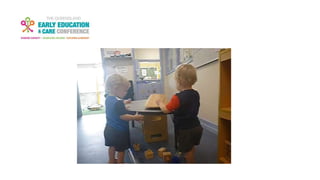
  • #8 In this clip the children’s interactions are purposeful. From one exploration, the child has gone back to keeping testing his hypothesis or theory. This is engaging for us to view as educators. We know that children are learning through their interactions and explorations. Let’s pause and consider … what are they learning? What theories are they testing out…WHAT IS THE BIG IDEA that has captured their interest?
  • #9 The children recently explored and investigated robots They got their big ideas from looking at star wars on the internet and watching star wars movies at home
  • #12 There is a range of intellectual skills that children develop as they grow. Dr Lilian Katz defines a clear distinction between academic and intellectual learning Academic skills are discrete bits of information, the correct answers. Intellectual learning is often associated with higher order thin king skills – problem solving, hypothesising, predicting, the search for understanding For our young children we can begin to bring these into the day, the program. How do we create time and space for children to talk about their ideas and what they are doing?
  • #13 As educators Engaging children in real life meaningful experiences Child lead learning Enquiry approach Critical reflective practice
  • #14 Questions trigger the children to open their minds to observe , think and enquire Way to make children’s thinking visible Thinking routines help children construct knowledge from their prior experiences
  • #15 Taking time to consider the big idea supports educators to consider the next step they take to support , enrich or extend the child’s learning. What is the deeper concept In early childhood practice, the ‘idea’ can refer to the conceptual understanding or knowledge that children are testing, exploring and learning. The dimension named ‘the idea’ is underpinned by research into the appropriateness and relevance of ‘subject knowledge’ in early childhood education. Susan Kreig , November 2016
  • #18  Incomplete narrative - not putting limits on children
  • #19 Showing involvement and participation in learning Thinking skills and dispositions Imagination and creativity Collaborating with others Communicating with others across different situations Designing / transferring knowledges
  • #20 Assessing the children’s understanding and prompting elaboration
  • #21 Meaningful relevant personal experiences Following children’s lead Framing and elaborating on children’s ideas Introducing language connected to the child’s theory Asking open questions …what if, how might you, what do you think Developing a collaborative approach …peer to peer dialogue and discussion Incomplete narrative - not putting limits on children
  • #25 What knowledge do children bring with them to an investigation? What does the child know? What does the child want to know? What is my role? Create opportunities for children to share what they know to think, to bring together what they know and what they want to know more about. Thank you to the children and educators who have shared their ideas and work -
  • #26 Are you a thinker and a theoriser?