Fundamentals of Project Management
MSc Project Management
Roland.Berberich@xjtlu.edu.cn
Organisational Context
• Organisational Context
• Organisational Structure
17.02.2019 Fundamentals of Project Management 2
Organisational Context
Organising for Projects – Theory and Practice
Three theoretical ways to organise Projects within the
company:
1. Functional
2. Dedicated Team
3. Matrix
17.02.2019 Fundamentals of Project Management 3
Organisational Context
Organising for Projects – Theory and Practice
Why?
Projects are significantly different from daily operations.
Thus, it seems sensible to organise them differently.
17.02.2019 Fundamentals of Project Management 4
Organisational Context
Organising for Projects – Theory and Practice
But!
Conflicting priorities between Project and Operations.
What to do first?
17.02.2019 Fundamentals of Project Management 5
Organisational Context
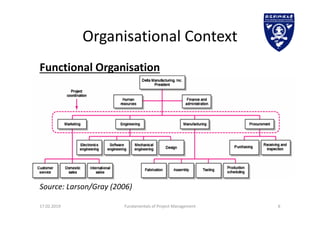
Functional Organisation
Source: Larson/Gray (2006)
17.02.2019 Fundamentals of Project Management 6
Organisational Context
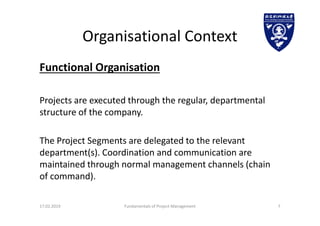
Functional Organisation
Projects are executed through the regular, departmental
structure of the company.
The Project Segments are delegated to the relevant
department(s). Coordination and communication are
maintained through normal management channels (chain
of command).
17.02.2019 Fundamentals of Project Management 7
Organisational Context
• No change to organisation
• Flexible
• Expert Execution
• Easy transition on closure
17.02.2019 Fundamentals of Project Management 8
Functional Organisation
Advantages
• Lack of (Project) focus
• Coordination?
• Lack of ownership
• Slow
Disadvantages
Chosen when one functional area dominates the Project.
Organisational Context
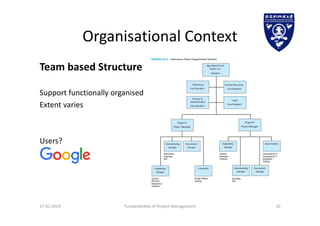
Dedicated Project Teams
Projects are conducted by dedicated teams.
Regular departments support these teams
17.02.2019 Fundamentals of Project Management 9
Organisational Context
17.02.2019 Fundamentals of Project Management 10
Team based Structure
Support functionally organised
Extent varies
Users?
Organisational Context
• Simple
• Fast
• Cohesive
• Cross-Functional Integration
17.02.2019 Fundamentals of Project Management 11
Dedicated Project Teams
Advantages
• Expensive
• Internal Strife
• Limited expertise
• Difficult transition on
closure
Disadvantages
Chosen when Projects dominate the business.
Organisational Context
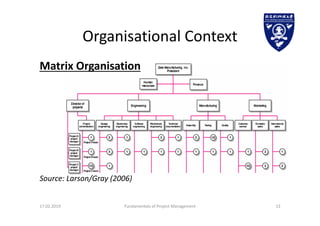
Matrix Organisation
Second level of command laid over the functional
organisation.
Three different Matrixes (weak, balanced, strong)
depending on power of PM.
17.02.2019 Fundamentals of Project Management 12
Organisational Context
Matrix Organisation
Source: Larson/Gray (2006)
17.02.2019 Fundamentals of Project Management 13
Organisational Context
• Efficient resource sharing
• Strong Project focus
• Easier transition on closure
• Flexible
17.02.2019 Fundamentals of Project Management 14
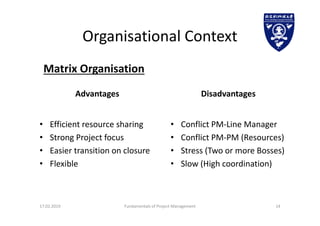
Matrix Organisation
Advantages
• Conflict PM-Line Manager
• Conflict PM-PM (Resources)
• Stress (Two or more Bosses)
• Slow (High coordination)
Disadvantages
Organisational Context
Matrix Organisation
Attempts to balance between function and project but creates a
second layer of difficulty.
Hybrid structure that takes time to establish itself (3-5 years)
17.02.2019 Fundamentals of Project Management 15
Organisational Context
Considerations for Organising
Organisational:
Importance and frequency of Project (success)?
Resource access and availability?
Corporate abilities and strategy?
17.02.2019 Fundamentals of Project Management 16
Organisational Context
Considerations for Organising
Project considerations:
Size, importance, novelty, need for cross-department
collaboration, external interfaces (Stakeholders), budgetary
and time constraints
17.02.2019 Fundamentals of Project Management 17
Organisational Context
17.02.2019 Fundamentals of Project Management 18
Organisational Context
Case study: PERNIS
Read the Case study and consider how Project Management
should be organised. Elaborate on your decision.
Questions to ask: What are the advantages and disadvantages
for every choice? Also consider “the bigger picture“ of
organisational integration. What issues could come up for your
choice and how would you manage them?
17.02.2019 Fundamentals of Project Management 19
Organisational Context
Case study: PERNIS
Expert Advice: Frans van Gunsteren (the guy who did it)
17.02.2019 Fundamentals of Project Management 20
Organisational Context
Considerations for Organising
Mix and Match approach
Different Projects, different types of Organisation.
Transforming the company. Moving from function via
Matrix (weak, balanced, strong) on to Project Teams.
Companies are not fixed entities. They evolve over time! It is necessary
to look at and understand corporate culture.
17.02.2019 Fundamentals of Project Management 21
Organisational Context
Corporate Culture and Projects
Corporate culture is a synonym for shared norms, beliefs,
values and assumptions connecting people working
together for a common goal.
Research determined 10 primary characteristics to explain a
certain culture.
17.02.2019 Fundamentals of Project Management 22
Organisational Context
Corporate Culture and Projects
1. Identification with organisation
2. Level of Team Emphasis
3. Management focus on impact on employees
4. Unit separation or interdependance (Departmentalisation)
5. Control (formal rules)
6. Risk tolerance
7. Reward allocation (seniority or performance?)
8. Conflict Management
9. Focus on outcomes or processes?
10. Change readiness
17.02.2019 Fundamentals of Project Management 23
Organisational Context
Corporate Culture and Projects
How to determine corporate culture – A checklist
1. Study the physical organisation
2. Read about the organisation (History, Founder, Heroes...)
3. Observe how its people interact
4. Interpret their ‘stories‘
17.02.2019 Fundamentals of Project Management 24
Organisational Context
Corporate Culture and Projects – Implications
PM is on receiving end of corporate culture, departmental (sub)culture
as well as Stakeholder‘s culture.
Corporate culture can facilitate, hamper or even prohibit Project
success.
“In a toxic culture completing a Project is like paddling upstream. Lot’s
of effort and you get nowhere”
17.02.2019 Fundamentals of Project Management 25
Organisational Context
Corporate Culture and Projects – Implications
Source: Larson/Grey (2006)
Flexibility and openness seem
to be key facilitators.
17.02.2019 Fundamentals of Project Management 26
Organisational Context
Project Selection and Evaluation
Resource shortage and mandate of innovation combined
with stakeholder entitlement force increased onus on the
corporation to rigorously select and monitor their Projects.
Continued failure questions corporate ability
to do so effectively.
17.02.2019 Fundamentals of Project Management 27
Organisational Context
Project Selection and Evaluation
Solution:
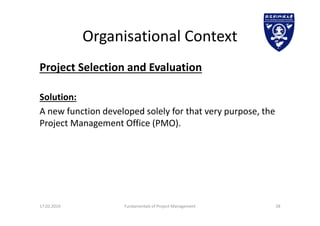
A new function developed solely for that very purpose, the
Project Management Office (PMO).
17.02.2019 Fundamentals of Project Management 28
Organisational Context
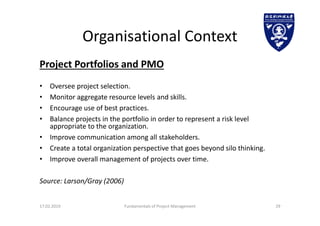
Project Portfolios and PMO
• Oversee project selection.
• Monitor aggregate resource levels and skills.
• Encourage use of best practices.
• Balance projects in the portfolio in order to represent a risk level
appropriate to the organization.
• Improve communication among all stakeholders.
• Create a total organization perspective that goes beyond silo thinking.
• Improve overall management of projects over time.
Source: Larson/Gray (2006)
17.02.2019 Fundamentals of Project Management 29
Organisational Context
The PMO in short
Monitors all current Projects (Tracking)
Performs (Risk and Ability) Analysis, determines ‘Strategic Fit’
Maintains and communicates best practices (Lessons learned)
Acts as resource center (trained PMs, materials etc.)
Developes, refines and suggests Project Selection criteria (no authority to
select or enforce).
17.02.2019 Fundamentals of Project Management 30
Organisational Context
The PMO in short
Contemporary Project Management is a Strategic Exercise,
best handled within a PMO at management level.
PMO, Portfolios and Strategic considerations in MAN474!
17.02.2019 Fundamentals of Project Management 31
Organisational Context
17.02.2019 Fundamentals of Project Management 32
Scoring Models
Ranking Models
Financial Models
Making Decisions based on the same Criteria
Selecting the Project(s) with the best “score”
Organisational Context
Key Questions:
$ and Risk!
17.02.2019 Fundamentals of Project Management 33
Organisational Context
Quantifying Risk and Opportunity (NPV)
Diverse techniques
Numbers are not everything!
17.02.2019 Fundamentals of Project Management 34
Organisational Context
Sources
Gido, Jack. Successful Project Management. 7th edition. Mason, OH: Cengage Learning, 2017.
Gray, C.F., Larson, E.W., 2006/2012. Project management: the managerial process, 3.ed./5..ed, McGraw-Hill,
Boston.
Midler, C., 1995. “Projectification” of the firm: The Renault case. Scandinavian Journal of Management 11, 363–
375.
PMI, 2012. A World of Need [WWW Document]. Project Management Institute. URL http://www.pmiteach.org/
(accessed 10.20.12).
Pinto, J.K., 2016. Project management: achieving competitive advantage, Fourth ed., global ed. ed. Pearson,
Boston, Mass.
Project Management Institute (Ed.), 2013. A guide to the project management body of knowledge (PMBOK
guide), Fifth edition. ed. Project Management Institute, Inc, Newtown Square, Pennsylvania.
17.02.2019 Fundamentals of Project Management 35
Thank you
for your attention!

S02 Organizational Context

  • 1.
    Fundamentals of ProjectManagement MSc Project Management Roland.Berberich@xjtlu.edu.cn
  • 2.
    Organisational Context • OrganisationalContext • Organisational Structure 17.02.2019 Fundamentals of Project Management 2
  • 3.
    Organisational Context Organising forProjects – Theory and Practice Three theoretical ways to organise Projects within the company: 1. Functional 2. Dedicated Team 3. Matrix 17.02.2019 Fundamentals of Project Management 3
  • 4.
    Organisational Context Organising forProjects – Theory and Practice Why? Projects are significantly different from daily operations. Thus, it seems sensible to organise them differently. 17.02.2019 Fundamentals of Project Management 4
  • 5.
    Organisational Context Organising forProjects – Theory and Practice But! Conflicting priorities between Project and Operations. What to do first? 17.02.2019 Fundamentals of Project Management 5
  • 6.
    Organisational Context Functional Organisation Source:Larson/Gray (2006) 17.02.2019 Fundamentals of Project Management 6
  • 7.
    Organisational Context Functional Organisation Projectsare executed through the regular, departmental structure of the company. The Project Segments are delegated to the relevant department(s). Coordination and communication are maintained through normal management channels (chain of command). 17.02.2019 Fundamentals of Project Management 7
  • 8.
    Organisational Context • Nochange to organisation • Flexible • Expert Execution • Easy transition on closure 17.02.2019 Fundamentals of Project Management 8 Functional Organisation Advantages • Lack of (Project) focus • Coordination? • Lack of ownership • Slow Disadvantages Chosen when one functional area dominates the Project.
  • 9.
    Organisational Context Dedicated ProjectTeams Projects are conducted by dedicated teams. Regular departments support these teams 17.02.2019 Fundamentals of Project Management 9
  • 10.
    Organisational Context 17.02.2019 Fundamentalsof Project Management 10 Team based Structure Support functionally organised Extent varies Users?
  • 11.
    Organisational Context • Simple •Fast • Cohesive • Cross-Functional Integration 17.02.2019 Fundamentals of Project Management 11 Dedicated Project Teams Advantages • Expensive • Internal Strife • Limited expertise • Difficult transition on closure Disadvantages Chosen when Projects dominate the business.
  • 12.
    Organisational Context Matrix Organisation Secondlevel of command laid over the functional organisation. Three different Matrixes (weak, balanced, strong) depending on power of PM. 17.02.2019 Fundamentals of Project Management 12
  • 13.
    Organisational Context Matrix Organisation Source:Larson/Gray (2006) 17.02.2019 Fundamentals of Project Management 13
  • 14.
    Organisational Context • Efficientresource sharing • Strong Project focus • Easier transition on closure • Flexible 17.02.2019 Fundamentals of Project Management 14 Matrix Organisation Advantages • Conflict PM-Line Manager • Conflict PM-PM (Resources) • Stress (Two or more Bosses) • Slow (High coordination) Disadvantages
  • 15.
    Organisational Context Matrix Organisation Attemptsto balance between function and project but creates a second layer of difficulty. Hybrid structure that takes time to establish itself (3-5 years) 17.02.2019 Fundamentals of Project Management 15
  • 16.
    Organisational Context Considerations forOrganising Organisational: Importance and frequency of Project (success)? Resource access and availability? Corporate abilities and strategy? 17.02.2019 Fundamentals of Project Management 16
  • 17.
    Organisational Context Considerations forOrganising Project considerations: Size, importance, novelty, need for cross-department collaboration, external interfaces (Stakeholders), budgetary and time constraints 17.02.2019 Fundamentals of Project Management 17
  • 18.
  • 19.
    Organisational Context Case study:PERNIS Read the Case study and consider how Project Management should be organised. Elaborate on your decision. Questions to ask: What are the advantages and disadvantages for every choice? Also consider “the bigger picture“ of organisational integration. What issues could come up for your choice and how would you manage them? 17.02.2019 Fundamentals of Project Management 19
  • 20.
    Organisational Context Case study:PERNIS Expert Advice: Frans van Gunsteren (the guy who did it) 17.02.2019 Fundamentals of Project Management 20
  • 21.
    Organisational Context Considerations forOrganising Mix and Match approach Different Projects, different types of Organisation. Transforming the company. Moving from function via Matrix (weak, balanced, strong) on to Project Teams. Companies are not fixed entities. They evolve over time! It is necessary to look at and understand corporate culture. 17.02.2019 Fundamentals of Project Management 21
  • 22.
    Organisational Context Corporate Cultureand Projects Corporate culture is a synonym for shared norms, beliefs, values and assumptions connecting people working together for a common goal. Research determined 10 primary characteristics to explain a certain culture. 17.02.2019 Fundamentals of Project Management 22
  • 23.
    Organisational Context Corporate Cultureand Projects 1. Identification with organisation 2. Level of Team Emphasis 3. Management focus on impact on employees 4. Unit separation or interdependance (Departmentalisation) 5. Control (formal rules) 6. Risk tolerance 7. Reward allocation (seniority or performance?) 8. Conflict Management 9. Focus on outcomes or processes? 10. Change readiness 17.02.2019 Fundamentals of Project Management 23
  • 24.
    Organisational Context Corporate Cultureand Projects How to determine corporate culture – A checklist 1. Study the physical organisation 2. Read about the organisation (History, Founder, Heroes...) 3. Observe how its people interact 4. Interpret their ‘stories‘ 17.02.2019 Fundamentals of Project Management 24
  • 25.
    Organisational Context Corporate Cultureand Projects – Implications PM is on receiving end of corporate culture, departmental (sub)culture as well as Stakeholder‘s culture. Corporate culture can facilitate, hamper or even prohibit Project success. “In a toxic culture completing a Project is like paddling upstream. Lot’s of effort and you get nowhere” 17.02.2019 Fundamentals of Project Management 25
  • 26.
    Organisational Context Corporate Cultureand Projects – Implications Source: Larson/Grey (2006) Flexibility and openness seem to be key facilitators. 17.02.2019 Fundamentals of Project Management 26
  • 27.
    Organisational Context Project Selectionand Evaluation Resource shortage and mandate of innovation combined with stakeholder entitlement force increased onus on the corporation to rigorously select and monitor their Projects. Continued failure questions corporate ability to do so effectively. 17.02.2019 Fundamentals of Project Management 27
  • 28.
    Organisational Context Project Selectionand Evaluation Solution: A new function developed solely for that very purpose, the Project Management Office (PMO). 17.02.2019 Fundamentals of Project Management 28
  • 29.
    Organisational Context Project Portfoliosand PMO • Oversee project selection. • Monitor aggregate resource levels and skills. • Encourage use of best practices. • Balance projects in the portfolio in order to represent a risk level appropriate to the organization. • Improve communication among all stakeholders. • Create a total organization perspective that goes beyond silo thinking. • Improve overall management of projects over time. Source: Larson/Gray (2006) 17.02.2019 Fundamentals of Project Management 29
  • 30.
    Organisational Context The PMOin short Monitors all current Projects (Tracking) Performs (Risk and Ability) Analysis, determines ‘Strategic Fit’ Maintains and communicates best practices (Lessons learned) Acts as resource center (trained PMs, materials etc.) Developes, refines and suggests Project Selection criteria (no authority to select or enforce). 17.02.2019 Fundamentals of Project Management 30
  • 31.
    Organisational Context The PMOin short Contemporary Project Management is a Strategic Exercise, best handled within a PMO at management level. PMO, Portfolios and Strategic considerations in MAN474! 17.02.2019 Fundamentals of Project Management 31
  • 32.
    Organisational Context 17.02.2019 Fundamentalsof Project Management 32 Scoring Models Ranking Models Financial Models Making Decisions based on the same Criteria Selecting the Project(s) with the best “score”
  • 33.
    Organisational Context Key Questions: $and Risk! 17.02.2019 Fundamentals of Project Management 33
  • 34.
    Organisational Context Quantifying Riskand Opportunity (NPV) Diverse techniques Numbers are not everything! 17.02.2019 Fundamentals of Project Management 34
  • 35.
    Organisational Context Sources Gido, Jack.Successful Project Management. 7th edition. Mason, OH: Cengage Learning, 2017. Gray, C.F., Larson, E.W., 2006/2012. Project management: the managerial process, 3.ed./5..ed, McGraw-Hill, Boston. Midler, C., 1995. “Projectification” of the firm: The Renault case. Scandinavian Journal of Management 11, 363– 375. PMI, 2012. A World of Need [WWW Document]. Project Management Institute. URL http://www.pmiteach.org/ (accessed 10.20.12). Pinto, J.K., 2016. Project management: achieving competitive advantage, Fourth ed., global ed. ed. Pearson, Boston, Mass. Project Management Institute (Ed.), 2013. A guide to the project management body of knowledge (PMBOK guide), Fifth edition. ed. Project Management Institute, Inc, Newtown Square, Pennsylvania. 17.02.2019 Fundamentals of Project Management 35
  • 36.