MODULE: 01
INTRODUCTION TO
MANAGEMENT &
ORGANIZATIONAL
BEHAVIOR
Definition of Management:
Management is a process of planning, organizing,
directing, coordinating and controlling of an
organization’s human, financial and physical resource
in order to achieve organizational goals.
Functions of Management:
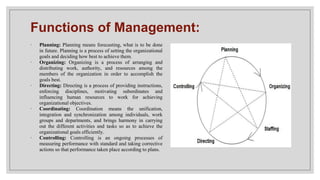
∙ Planning: Planning means forecasting, what is to be done
in future. Planning is a process of setting the organizational
goals and deciding how best to achieve them.
∙ Organizing: Organizing is a process of arranging and
distributing work, authority, and resources among the
members of the organization in order to accomplish the
goals best.
∙ Directing: Directing is a process of providing instructions,
enforcing disciplines, motivating subordinates and
influencing human resources to work for achieving
organizational objectives.
∙ Coordinating: Coordination means the unification,
integration and synchronization among individuals, work
groups and departments, and brings harmony in carrying
out the different activities and tasks so as to achieve the
organizational goals efficiently.
∙ Controlling: Controlling is an ongoing processes of
measuring performance with standard and taking corrective
actions so that performance taken place according to plans.
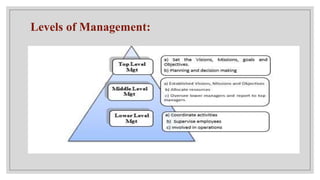
Levels of Management:
Skills of Management:
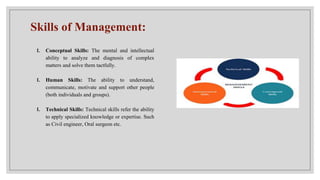
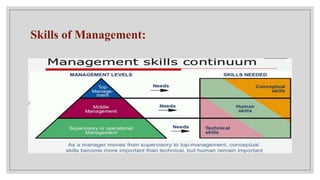
I. Conceptual Skills: The mental and intellectual
ability to analyze and diagnosis of complex
matters and solve them tactfully.
I. Human Skills: The ability to understand,
communicate, motivate and support other people
(both individuals and groups).
I. Technical Skills: Technical skills refer the ability
to apply specialized knowledge or expertise. Such
as Civil engineer, Oral surgeon etc.
Skills of Management:
Definition of Organizational Behavior:
Organizational Behavior is a field of study of what
people do in an organization and how their behavior
affects the organization’s performance. It is a field
of study that researches the actions of people at
work.
Elements of Organizational Behavior:
I. Study of individuals and groups: Study about
the people and all groups and find out how the
behave about the organizational issues.
I. Study the impact of organization’s structure
on human resources: Study the organization’s
environment, work community, facilities and
overall structure and how the impact on human
resources.
I. Application’s of knowledge to achieve
organization’s effectiveness: Study and apply
the knowledge how we achieve the
organizational effectiveness by using minimum
number of resources and low costs.
Role of Organizational Behavior:
I. Helps in making effective organizational structure: Every organization follow a structure to run its operation.
Organizational behavior helps in making an effective and fruitful organizational structure.
II. Helps in define authority, power and status: It is important for an organization to define the particular
authority, power and responsibility for the performance of an individual and group. Organizational behavior
helps to define authority, power and responsibilities.
III. Helps in making groups: A group has a great effort for doing a job. A complete code of organizational
behavior helps to make a successful group.
IV. Helps in motivating employees: One of the important missions of organizational behavior is to motivate the
employees.
V. Helps in leadership practice: Leaders are made not born; Behavioral Theories believe that people can
become leaders through the process of teaching, learning and observation.
VI. Helps in mitigating conflict: Another important role of organizational behavior is to mitigate the interrelated
conflict among individuals and groups.
VII.Helps in organizational change: Overall purpose of organizational behavior is to make a change into the
organization and take a competitive advantage.
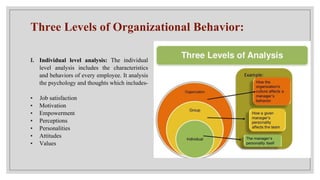
Three Levels of Organizational Behavior:
I. Individual level analysis: The individual
level analysis includes the characteristics
and behaviors of every employee. It analysis
the psychology and thoughts which includes-
▪ Job satisfaction
▪ Motivation
▪ Empowerment
▪ Perceptions
▪ Personalities
▪ Attitudes
▪ Values
Three Levels of Organizational Behavior:
II. Group Level analysis: The group or team level
analysis includes the characteristics and behaviors of
every interacting and interdependent group. It
analysis the sociology, social psychology and
anthropology which includes-
▪ Group dynamics
▪ Group Decisions
▪ Group Power
▪ Group politics
▪ Group Conflict
▪ Group leadership
▪ Group Communication
III. Organizations System Level analysis: The
study of sociology, Psychology, anthropology and
political science. It analysis of how people structure
their working relationships and how organizations
interact their external environmental forces. It
includes-
▪ Organizational Structure
▪ Organizational culture
▪ Organizational power and politics
▪ Organizational innovation and change
▪ Customer dealings and services
▪ Efficiency and effectiveness
▪ Quality and productivity
▪ Work environment
Any
Questions?

MANAGEMENT & ORGANIZATIONAL BEHAVIOR

  • 1.
    MODULE: 01 INTRODUCTION TO MANAGEMENT& ORGANIZATIONAL BEHAVIOR
  • 2.
    Definition of Management: Managementis a process of planning, organizing, directing, coordinating and controlling of an organization’s human, financial and physical resource in order to achieve organizational goals.
  • 3.
    Functions of Management: ∙Planning: Planning means forecasting, what is to be done in future. Planning is a process of setting the organizational goals and deciding how best to achieve them. ∙ Organizing: Organizing is a process of arranging and distributing work, authority, and resources among the members of the organization in order to accomplish the goals best. ∙ Directing: Directing is a process of providing instructions, enforcing disciplines, motivating subordinates and influencing human resources to work for achieving organizational objectives. ∙ Coordinating: Coordination means the unification, integration and synchronization among individuals, work groups and departments, and brings harmony in carrying out the different activities and tasks so as to achieve the organizational goals efficiently. ∙ Controlling: Controlling is an ongoing processes of measuring performance with standard and taking corrective actions so that performance taken place according to plans.
  • 4.
  • 5.
    Skills of Management: I.Conceptual Skills: The mental and intellectual ability to analyze and diagnosis of complex matters and solve them tactfully. I. Human Skills: The ability to understand, communicate, motivate and support other people (both individuals and groups). I. Technical Skills: Technical skills refer the ability to apply specialized knowledge or expertise. Such as Civil engineer, Oral surgeon etc.
  • 6.
  • 7.
    Definition of OrganizationalBehavior: Organizational Behavior is a field of study of what people do in an organization and how their behavior affects the organization’s performance. It is a field of study that researches the actions of people at work. Elements of Organizational Behavior: I. Study of individuals and groups: Study about the people and all groups and find out how the behave about the organizational issues. I. Study the impact of organization’s structure on human resources: Study the organization’s environment, work community, facilities and overall structure and how the impact on human resources. I. Application’s of knowledge to achieve organization’s effectiveness: Study and apply the knowledge how we achieve the organizational effectiveness by using minimum number of resources and low costs.
  • 8.
    Role of OrganizationalBehavior: I. Helps in making effective organizational structure: Every organization follow a structure to run its operation. Organizational behavior helps in making an effective and fruitful organizational structure. II. Helps in define authority, power and status: It is important for an organization to define the particular authority, power and responsibility for the performance of an individual and group. Organizational behavior helps to define authority, power and responsibilities. III. Helps in making groups: A group has a great effort for doing a job. A complete code of organizational behavior helps to make a successful group. IV. Helps in motivating employees: One of the important missions of organizational behavior is to motivate the employees. V. Helps in leadership practice: Leaders are made not born; Behavioral Theories believe that people can become leaders through the process of teaching, learning and observation. VI. Helps in mitigating conflict: Another important role of organizational behavior is to mitigate the interrelated conflict among individuals and groups. VII.Helps in organizational change: Overall purpose of organizational behavior is to make a change into the organization and take a competitive advantage.
  • 9.
    Three Levels ofOrganizational Behavior: I. Individual level analysis: The individual level analysis includes the characteristics and behaviors of every employee. It analysis the psychology and thoughts which includes- ▪ Job satisfaction ▪ Motivation ▪ Empowerment ▪ Perceptions ▪ Personalities ▪ Attitudes ▪ Values
  • 10.
    Three Levels ofOrganizational Behavior: II. Group Level analysis: The group or team level analysis includes the characteristics and behaviors of every interacting and interdependent group. It analysis the sociology, social psychology and anthropology which includes- ▪ Group dynamics ▪ Group Decisions ▪ Group Power ▪ Group politics ▪ Group Conflict ▪ Group leadership ▪ Group Communication III. Organizations System Level analysis: The study of sociology, Psychology, anthropology and political science. It analysis of how people structure their working relationships and how organizations interact their external environmental forces. It includes- ▪ Organizational Structure ▪ Organizational culture ▪ Organizational power and politics ▪ Organizational innovation and change ▪ Customer dealings and services ▪ Efficiency and effectiveness ▪ Quality and productivity ▪ Work environment
  • 11.