Presentation Themes

• Inherent riskiness of uncertain times
• Evolving risk management to stay relevant
• What exactly is Risk Informed Decision-Making (RIDM)?
• Why RIDM now, since we’re already doing Continuous Risk
  Management (CRM)?
• RIDM is       scary!
• When to use RIDM and why
• Actual steps (really?!)
• Go forth & do good RIDM


                                                            2
Uncertainty = Reality – Perception?
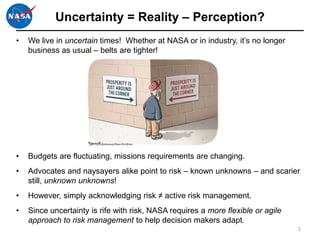
•   We live in uncertain times! Whether at NASA or in industry, it’s no longer
    business as usual – belts are tighter!


•   Budgets are fluctuating, missions requirements are changing.
•   Advocates and naysayers alike point to risk – known unknowns – and scarier
    still, unknown unknowns!
•   However, simply acknowledging risk ≠ active risk management.
•   Since uncertainty is rife with risk, NASA requires a more flexible or agile
    approach to risk management to help decision makers adapt.
                                                                                  3
Evolving Risk Management
• Risk is a triplet = a scenario with a chance or probability (L) of
  experiencing a negative consequence (C).
     −   Ref. NASA Procedural Requirements (NPR) 8000.4A

• In recent years, NASA Programs, Projects, and Directorates have
  employed Continuous Risk Management (CRM) to mitigate risk
  across key performance domains:
     − Cost (to achieve or regain required performance, cost to mitigate
       risk, cost of inaction)
     − Schedule (Critical Path)
     − Technical
     − Safety (and Mission Assurance)
     − Core Capabilities (Critical Assets)


                                                                           4
Evolving Risk Management (cont.)
• Why the need for more flexibility?
     − CRM presupposes a linear mission or a mission that has clearly defined
       end-objectives.
     – Today, missions can be less linear (especially for human spaceflight)
       and end-objectives can be dynamic as policies change.
     – In this environment, decision-makers must be flexible and even
       innovative to readily adapt to changes in mission
       objectives, funding, and resources.
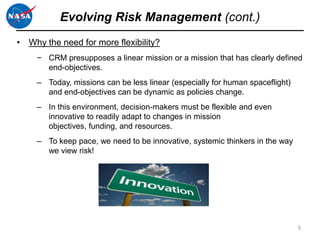
     – To keep pace, we need to be innovative, systemic thinkers in the way
       we view risk!


                                                                               5
Evolving Risk Management (cont.)
•   To remain relevant, risk management practices must evolve as NASA
    adapts/evolves into a 21st century agency:
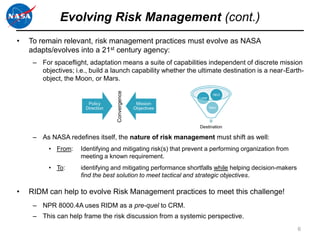
     – For spaceflight, adaptation means a suite of capabilities independent of discrete mission
       objectives; i.e., build a launch capability whether the ultimate destination is a near-Earth-
       object, the Moon, or Mars.


                                   Convergence
                                                                           NEO
                                                                 Lunar
                        Policy                    Mission
                       Direction                 Objectives              Mars


                                                                 Destination

     – As NASA redefines itself, the nature of risk management must shift as well:
          • From:    Identifying and mitigating risk(s) that prevent a performing organization from
                     meeting a known requirement.
          • To:      identifying and mitigating performance shortfalls while helping decision-makers
                     find the best solution to meet tactical and strategic objectives.

•   RIDM can help to evolve Risk Management practices to meet this challenge!
     – NPR 8000.4A uses RIDM as a pre-quel to CRM.
     – This can help frame the risk discussion from a systemic perspective.
                                                                                                       6
Evolving Risk Management (cont.)
Risk Management adds RIDM to CRM in an integrated framework to:
  • Foster proactive management of threats to performance
  • Better inform decision-making using relevant (timely) risk information
  • More effectively manage risks by focusing CRM on existing baseline performance
    requirements and on those emerging via the RIDM process
  • Through a graded approach, adapt to varying levels of risk over time.


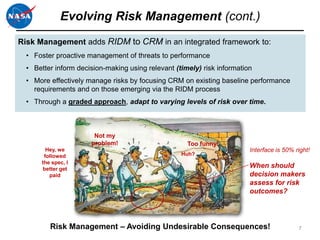
                       Not my
                      problem!                       Too funny!
         Hey, we                                                         Interface is 50% right!
        followed                                   Huh?
       the spec, I
        better get
                                                                         When should
          paid                                                           decision makers
                                                                         assess for risk
                                                                         outcomes?


          Risk Management – Avoiding Undesirable Consequences!                             7
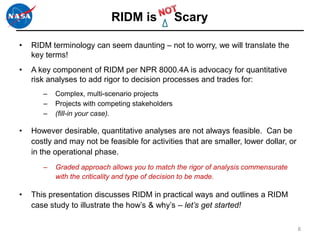
RIDM is               Scary

•   RIDM terminology can seem daunting – not to worry, we will translate the
    key terms!
•   A key component of RIDM per NPR 8000.4A is advocacy for quantitative
    risk analyses to add rigor to decision processes and trades for:
       –   Complex, multi-scenario projects
       –   Projects with competing stakeholders
       –   (fill-in your case).

•   However desirable, quantitative analyses are not always feasible. Can be
    costly and may not be feasible for activities that are smaller, lower dollar, or
    in the operational phase.
       –   Graded approach allows you to match the rigor of analysis commensurate
           with the criticality and type of decision to be made.

•   This presentation discusses RIDM in practical ways and outlines a RIDM
    case study to illustrate the how’s & why’s – let’s get started!

                                                                                       8
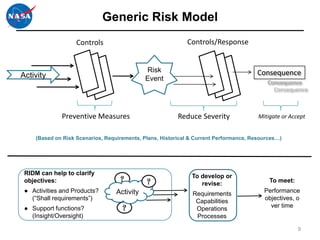
Generic Risk Model
                    Controls                                 Controls/Response


                                              Risk                                     Consequence
Activity                                      Event
                                                                                           Consequence
                                                                                             Consequence


              Preventive Measures                         Reduce Severity               Mitigate or Accept


     (Based on Risk Scenarios, Requirements, Plans, Historical & Current Performance, Resources…)


 RIDM can help to clarify                                      To develop or
 objectives:                        ?         ?                   revise:                   To meet:
 ● Activities and Products?        Activity                    Requirements               Performance
   (“Shall requirements”)                                       Capabilities              objectives, o
 ● Support functions?                ?                          Operations                  ver time
   (Insight/Oversight)                                          Processes

                                                                                                       9
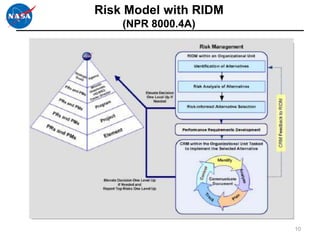
Risk Model with RIDM
    (NPR 8000.4A)


                       10
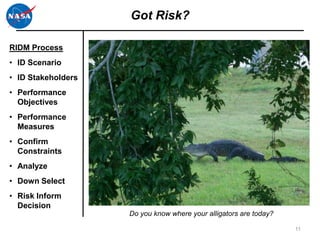
Got Risk?

RIDM Process
• ID Scenario
• ID Stakeholders
• Performance
  Objectives
• Performance
  Measures
• Confirm
  Constraints
• Analyze
• Down Select
• Risk Inform
  Decision
                    Do you know where your alligators are today?

                                                                   11
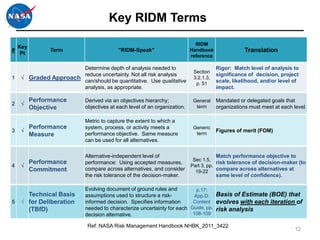
Key RIDM Terms
                                                                            RIDM
  Key
#
   Pt
              Term                       "RIDM-Speak"                     Handbook                Translation
                                                                          reference

                      Determine depth of analysis needed to                           Rigor: Match level of analysis to
                                                                           Section
                      reduce uncertainty. Not all risk analysis                       significance of decision, project
1   √ Graded Approach                                                      3.2.1.3,
                      can/should be quantitative. Use qualitative           p. 51
                                                                                      scale, likelihood, and/or level of
                      analysis, as appropriate.                                       impact.

        Performance        Derived via an objectives hierarchy;            General    Mandated or delegated goals that
2   √
        Objective          objectives at each level of an organization.     term      organizations must meet at each level.

                           Metric to capture the extent to which a
    Performance            system, process, or activity meets a            Generic
3 √                                                                                   Figures of merit (FOM)
    Measure                performance objective. Same measure              term
                           can be used for all alternatives.

                           Alternative-independent level of                           Match performance objective to
                                                                           Sec 1.5,
        Performance        performance: Using accepted measures,                      risk tolerance of decision-maker (to
4   √                                                                     Part 3, pp.
        Commitment         compare across alternatives, and consider        19-22
                                                                                      compare across alternatives at
                           the risk tolerance of the decision-maker.                  same level of confidence).

                           Evolving document of ground rules and          p.17;
    Technical Basis        assumptions used to structure a risk-         App.D: Basis of Estimate (BOE) that
5 √ for Deliberation       informed decision. Specifies information     Content evolves with each iteration of
    (TBfD)                 needed to characterize uncertainty for each Guide, pp. risk analysis
                           decision alternative.                        108-109

                            Ref: NASA Risk Management Handbook NHBK_2011_3422
                                                                                                                       12
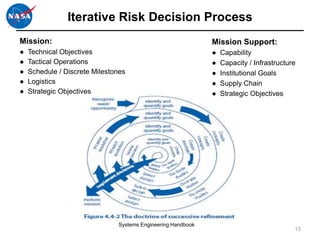
Iterative Risk Decision Process
Mission:                                                      Mission Support:
●   Technical Objectives                                      ●   Capability
●   Tactical Operations                                       ●   Capacity / Infrastructure
●   Schedule / Discrete Milestones                            ●   Institutional Goals
●   Logistics                                                 ●   Supply Chain
●   Strategic Objectives                                      ●   Strategic Objectives


                               Systems Engineering Handbook
                                                                                          13
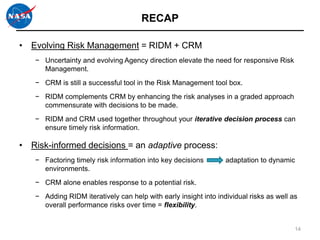
RECAP

• Evolving Risk Management = RIDM + CRM
   − Uncertainty and evolving Agency direction elevate the need for responsive Risk
     Management.
   − CRM is still a successful tool in the Risk Management tool box.
   − RIDM complements CRM by enhancing the risk analyses in a graded approach
     commensurate with decisions to be made.
   − RIDM and CRM used together throughout your iterative decision process can
     ensure timely risk information.

• Risk-informed decisions = an adaptive process:
   − Factoring timely risk information into key decisions        adaptation to dynamic
     environments.
   − CRM alone enables response to a potential risk.
   − Adding RIDM iteratively can help with early insight into individual risks as well as
     overall performance risks over time = flexibility.


                                                                                        14
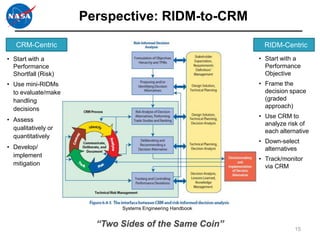
Perspective: RIDM-to-CRM

   CRM-Centric                                               RIDM-Centric
• Start with a                                             • Start with a
  Performance                                                Performance
  Shortfall (Risk)                                           Objective
• Use mini-RIDMs                                           • Frame the
  to evaluate/make                                           decision space
  handling                                                   (graded
  decisions                                                  approach)
                                                           • Use CRM to
• Assess
                                                             analyze risk of
  qualitatively or
                                                             each alternative
  quantitatively
                                                           • Down-select
• Develop/                                                   alternatives
  implement
                                                           • Track/monitor
  mitigation                                                 via CRM


                            Systems Engineering Handbook


                       “Two Sides of the Same Coin”                    15
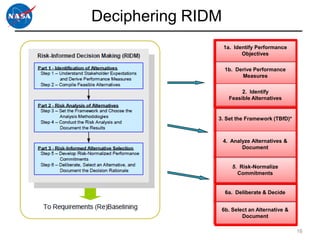
Deciphering RIDM
                   1a. Identify Performance
                          Objectives

                   1b. Derive Performance
                         Measures

                          2. Identify
                     Feasible Alternatives


               3. Set the Framework (TBfD)*


                   4. Analyze Alternatives &
                          Document


                      5. Risk-Normalize
                        Commitments


                   6a. Deliberate & Decide


                6b. Select an Alternative &
                        Document

                                               16
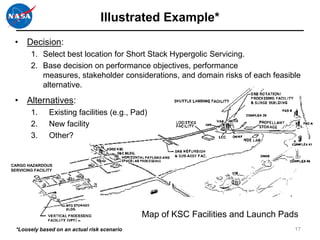
Illustrated Example*
 • Decision:
        1. Select best location for Short Stack Hypergolic Servicing.
        2. Base decision on performance objectives, performance
           measures, stakeholder considerations, and domain risks of each feasible
           alternative.
 • Alternatives:
        1.      Existing facilities (e.g., Pad)
        2.      New facility
        3.      Other?


CARGO HAZARDOUS
SERVICING FACILITY


                                              Map of KSC Facilities and Launch Pads
  *Loosely based on an actual risk scenario                                       17
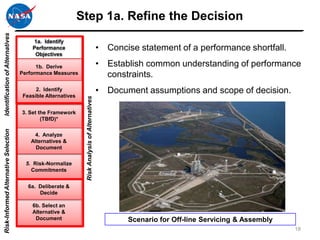
Step 1a. Refine the Decision
Identification of Alternatives


                                          1a. Identify
                                          Performance                                           • Concise statement of a performance shortfall.
                                           Objectives

                                            1b. Derive                                          • Establish common understanding of performance
                                      Performance Measures                                        constraints.
                                            2. Identify                                         • Document assumptions and scope of decision.
                                       Feasible Alternatives
                                                                Risk Analysis of Alternatives


                                      3. Set the Framework
                                              (TBfD)*
Risk-Informed Alternative Selection


                                           4. Analyze
                                          Alternatives &
                                            Document

                                        5. Risk-Normalize
                                          Commitments


                                         6a. Deliberate &
                                             Decide

                                          6b. Select an
                                          Alternative &
                                           Document                                                     Scenario for Off-line Servicing & Assembly
                                                                                                                                                     18
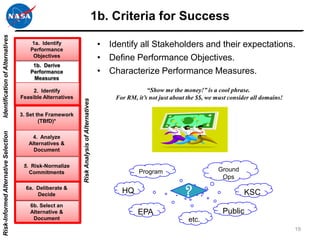
1b. Criteria for Success
Identification of Alternatives


                                         1a. Identify
                                         Performance
                                                                                               • Identify all Stakeholders and their expectations.
                                          Objectives                                           • Define Performance Objectives.
                                          1b. Derive
                                         Performance                                           • Characterize Performance Measures.
                                          Measures

                                           2. Identify                                                         “Show me the money!” is a cool phrase.
                                      Feasible Alternatives                                        For RM, it’s not just about the $$, we must consider all domains!
                                                              Risk Analysis of Alternatives


                                      3. Set the Framework
                                              (TBfD)*
Risk-Informed Alternative Selection


                                          4. Analyze
                                         Alternatives &
                                           Document


                                       5. Risk-Normalize
                                         Commitments                                                        Program                       Ground
                                                                                                                                           Ops
                                        6a. Deliberate &
                                            Decide
                                                                                                     HQ                      ?                       KSC
                                         6b. Select an
                                         Alternative &                                                     EPA                              Public
                                          Document                                                                             etc.
                                                                                                                                                                       19
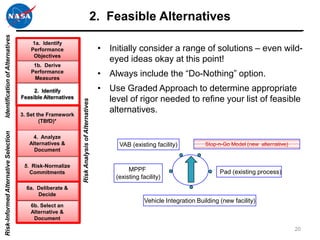
2. Feasible Alternatives
Identification of Alternatives


                                         1a. Identify
                                         Performance                                          • Initially consider a range of solutions – even wild-
                                          Objectives
                                                                                                eyed ideas okay at this point!
                                          1b. Derive
                                         Performance
                                          Measures
                                                                                              • Always include the “Do-Nothing” option.
                                           2. Identify                                        • Use Graded Approach to determine appropriate
                                      Feasible Alternatives
                                                                                                level of rigor needed to refine your list of feasible
                                                              Risk Analysis of Alternatives


                                      3. Set the Framework
                                                                                                alternatives.
                                              (TBfD)*
Risk-Informed Alternative Selection


                                          4. Analyze
                                         Alternatives &                                             VAB (existing facility)           Stop-n-Go Model (new alternative)
                                           Document


                                       5. Risk-Normalize
                                         Commitments                                                    MPPF                                Pad (existing process)
                                                                                                   (existing facility)
                                        6a. Deliberate &
                                            Decide
                                                                                                               Vehicle Integration Building (new facility)
                                         6b. Select an
                                         Alternative &
                                          Document

                                                                                                                                                                          20
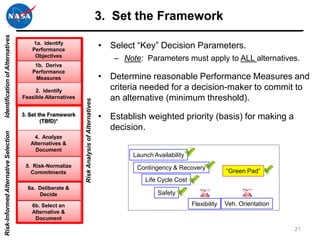
3. Set the Framework
Identification of Alternatives


                                          1a. Identify
                                          Performance
                                                                                              • Select “Key” Decision Parameters.
                                           Objectives
                                                                                                  – Note: Parameters must apply to ALL alternatives.
                                           1b. Derive
                                          Performance
                                           Measures                                           • Determine reasonable Performance Measures and
                                           2. Identify                                          criteria needed for a decision-maker to commit to
                                      Feasible Alternatives                                     an alternative (minimum threshold).
                                                              Risk Analysis of Alternatives


                                      3. Set the Framework
                                              (TBfD)*
                                                                                              • Establish weighted priority (basis) for making a
                                                                                                decision.
Risk-Informed Alternative Selection


                                          4. Analyze
                                         Alternatives &
                                           Document
                                                                                                       Launch Availability
                                       5. Risk-Normalize                                                Contingency & Recovery
                                         Commitments                                                                                       “Green Pad”
                                                                                                           Life Cycle Cost
                                        6a. Deliberate &
                                            Decide                                                              Safety
                                         6b. Select an                                                                       Flexibility   Veh. Orientation
                                         Alternative &
                                          Document

                                                                                                                                                              21
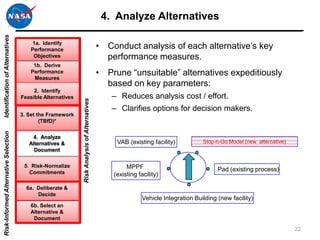
4. Analyze Alternatives
Identification of Alternatives


                                         1a. Identify
                                         Performance                                          • Conduct analysis of each alternative’s key
                                          Objectives                                            performance measures.
                                          1b. Derive
                                         Performance
                                          Measures
                                                                                              • Prune “unsuitable” alternatives expeditiously
                                                                                                based on key parameters:
                                           2. Identify
                                      Feasible Alternatives                                       – Reduces analysis cost / effort.
                                                              Risk Analysis of Alternatives


                                                                                                  – Clarifies options for decision makers.
                                      3. Set the Framework
                                              (TBfD)*
Risk-Informed Alternative Selection


                                          4. Analyze
                                         Alternatives &                                            VAB (existing facility)           Stop-n-Go Model (new alternative)
                                           Document


                                       5. Risk-Normalize                                               MPPF
                                         Commitments
                                                                                                                                           Pad (existing process)
                                                                                                  (existing facility)

                                        6a. Deliberate &
                                            Decide
                                                                                                              Vehicle Integration Building (new facility)
                                         6b. Select an
                                         Alternative &
                                          Document

                                                                                                                                                                         22
Additional RIDM Terminology for Step 5

                                                                               RIDM
    Key
#
     Pt
             Term                        "RIDM-Speak"                        Handbook                  Translation
                                                                             reference


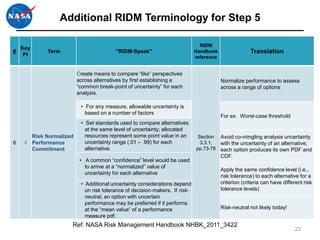
                         Create means to compare “like” perspectives
                         across alternatives by first establishing a                     Normalize performance to assess
                         “common break-point of uncertainty” for each                    across a range of options
                         analysis.

                          • For any measure, allowable uncertainty is
                            based on a number of factors
                                                                                         For ex. Worst-case threshold
                          • Set standards used to compare alternatives
                            at the same level of uncertainty; allocated
       Risk Normalized      resources represent some point value in an        Section Avoid co-mingling analysis uncertainty
6    √ Performance          uncertainty range (.01 – .99) for each             3.3.1, with the uncertainty of an alternative;
       Commitment           alternative.                                     pp.73-78 each option produces its own PDF and
                                                                                         CDF.
                          • A common “confidence” level would be used
                            to arrive at a “normalized” value of
                                                                                         Apply the same confidence level (i.e.,
                            uncertainty for each alternative
                                                                                         risk tolerance) to each alternative for a
                          • Additional uncertainty considerations depend                 criterion (criteria can have different risk
                            on risk tolerance of decision-makers. If risk-               tolerance levels)
                            neutral, an option with uncertain
                            performance may be preferred if it performs
                            at the “mean value” of a performance                         Risk-neutral not likely today!
                            measure pdf.
                     Ref: NASA Risk Management Handbook NHBK_2011_3422
                                                                                                                           23
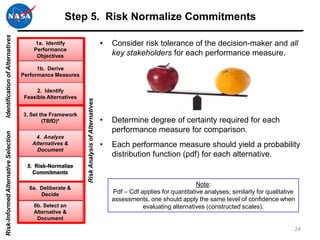
Step 5. Risk Normalize Commitments
Identification of Alternatives


                                          1a. Identify                                         •   Consider risk tolerance of the decision-maker and all
                                          Performance
                                           Objectives                                              key stakeholders for each performance measure.
                                            1b. Derive
                                      Performance Measures

                                            2. Identify
                                       Feasible Alternatives
                                                               Risk Analysis of Alternatives


                                      3. Set the Framework
                                              (TBfD)*                                          •   Determine degree of certainty required for each
                                                                                                   performance measure for comparison.
Risk-Informed Alternative Selection


                                           4. Analyze
                                          Alternatives &                                       •   Each performance measure should yield a probability
                                            Document
                                                                                                   distribution function (pdf) for each alternative.
                                        5. Risk-Normalize
                                          Commitments

                                                                                                                                   Note:
                                         6a. Deliberate &
                                             Decide                                                Pdf – Cdf applies for quantitative analyses; similarly for qualitative
                                                                                                   assessments, one should apply the same level of confidence when
                                          6b. Select an                                                       evaluating alternatives (constructed scales).
                                          Alternative &
                                           Document

                                                                                                                                                                        24
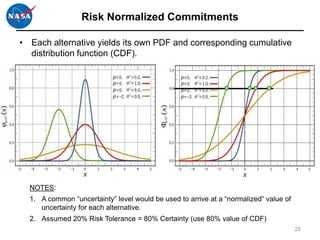
Risk Normalized Commitments

• Each alternative yields its own PDF and corresponding cumulative
  distribution function (CDF).


  NOTES:
  1. A common “uncertainty” level would be used to arrive at a “normalized” value of
     uncertainty for each alternative.
  2. Assumed 20% Risk Tolerance = 80% Certainty (use 80% value of CDF)
                                                                                       25
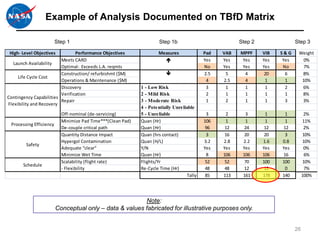
Example of Analysis Documented on TBfD Matrix

                         Step 1                                      Step 1b                           Step 2                Step 3

 High- Level Objectives         Performance Objectives               Measures              Pad   VAB   MPPF     VIB   S&G     Weight
                         Meets CARD                                                       Yes   Yes    Yes     Yes    Yes      0%
   Launch Availability
                         Optimal: Exceeds L.A. reqmts                                      No    Yes    Yes     Yes    No       7%
                         Construction/ refurbishmt ($M)                                   2.5    5      4       20     6      8%
     Life Cycle Cost
                         Operations & Maintenance ($M)                                      4    2.5     4       1      1      10%
                         Discovery                           1 - Low Risk                   3     1      1       1      2      6%
                         Verification                        2 - Mild Risk                  2     1      1       1      1      8%
Contingency Capabilities
                         Repair                              3 - Moderate Risk              1     2      1       1      3      3%
Flexibility and Recovery
                                                             4 - Potentially Unreliable
                           Off-nominal (de-servicing)        5 - Unreliable                 3     2      3       1     1           2%
                           Minimize Pad Time***(Clean Pad)   Quan (Hr)                     106    1      1       1     1          11%
 Processing Efficiency
                           De-couple critical path           Quan (Hr)                      96    12     24      12   12           2%
                           Quantity Distance Impact          Quan (hrs contact)             3     16     20      20    3          10%
                           Hypergol Contamination            Quan (H/L)                    3.2   2.8    2.2     1.6   0.8         10%
        Safety
                           Adequate “clear”                  Y/N                           Yes   Yes    Yes     Yes   Yes          0%
                           Minimize Wet Time                 Quan (Hr)                      8    106    106     106   16           6%
                           Scalability (flight rate)         Flights/Yr                     52    52     70     100   100         10%
       Schedule
                           - Flexibility                     Re-Cycle Time (Hr)             48    48     12      12    0           7%
                                                                                   Tally    85   113    161     178   140         100%


                                                         Note:
                         Conceptual only – data & values fabricated for illustrative purposes only.


                                                                                                                             26
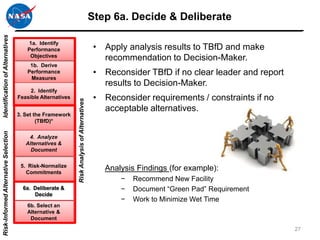
Step 6a. Decide & Deliberate
Identification of Alternatives


                                         1a. Identify
                                         Performance                                           •   Apply analysis results to TBfD and make
                                          Objectives
                                                                                                   recommendation to Decision-Maker.
                                          1b. Derive
                                         Performance                                           •   Reconsider TBfD if no clear leader and report
                                          Measures
                                                                                                   results to Decision-Maker.
                                           2. Identify
                                      Feasible Alternatives                                    •   Reconsider requirements / constraints if no
                                                              Risk Analysis of Alternatives


                                                                                                   acceptable alternatives.
                                      3. Set the Framework
                                              (TBfD)*
Risk-Informed Alternative Selection


                                          4. Analyze
                                         Alternatives &
                                           Document


                                       5. Risk-Normalize
                                         Commitments
                                                                                                   Analysis Findings (for example):
                                                                                                       −   Recommend New Facility
                                        6a. Deliberate &                                               −   Document “Green Pad” Requirement
                                            Decide
                                                                                                       −   Work to Minimize Wet Time
                                         6b. Select an
                                         Alternative &
                                          Document

                                                                                                                                                   27
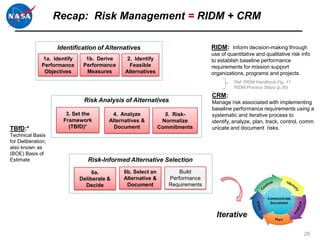
Recap: Risk Management = RIDM + CRM

                    Identification of Alternatives                              RIDM: Inform decision-making through
                                                                                use of quantitative and qualitative risk info
               1a. Identify     1b. Derive      2. Identify                     to establish baseline performance
               Performance     Performance       Feasible                       requirements for mission support
                Objectives      Measures       Alternatives                     organizations, programs and projects.
                                                                                          Ref. RIDM Handbook Fig. 11.
                                                                                          RIDM Process Steps (p.30)
                                                                                CRM:
                               Risk Analysis of Alternatives                    Manage risk associated with implementing
                                                                                baseline performance requirements using a
                        3. Set the        4. Analyze            5. Risk-        systematic and iterative process to
                       Framework         Alternatives &        Normalize        identify, analyze, plan, track, control, comm
TBfD:*                   (TBfD)*           Document           Commitments       unicate and document risks.
Technical Basis
for Deliberation;
also known as
(BOE) Basis of
Estimate                         Risk-Informed Alternative Selection
                                   6a.        6b. Select an          Build
                              Deliberate &    Alternative &      Performance
                                Decide         Document          Requirements


                                                                                  Iterative

                                                                                                                          28
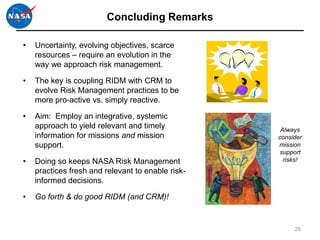
Concluding Remarks

•   Uncertainty, evolving objectives, scarce
    resources – require an evolution in the
    way we approach risk management.

•   The key is coupling RIDM with CRM to
    evolve Risk Management practices to be
    more pro-active vs. simply reactive.

•   Aim: Employ an integrative, systemic
    approach to yield relevant and timely           Always
    information for missions and mission           consider
    support.                                       mission
                                                   support
•   Doing so keeps NASA Risk Management              risks!
    practices fresh and relevant to enable risk-
    informed decisions.

•   Go forth & do good RIDM (and CRM)!


                                                        29
JSCAC3 Sharon L. Thomas
Sharon.L.Thomas@nasa.gov
(281) 244-7668

JSCNA Scott L. Field, PMP
Scott.Field@nasa.gov
(281) 335-2440


                             30

S thomas sfield

  • 2.
    Presentation Themes • Inherentriskiness of uncertain times • Evolving risk management to stay relevant • What exactly is Risk Informed Decision-Making (RIDM)? • Why RIDM now, since we’re already doing Continuous Risk Management (CRM)? • RIDM is scary! • When to use RIDM and why • Actual steps (really?!) • Go forth & do good RIDM 2
  • 3.
    Uncertainty = Reality– Perception? • We live in uncertain times! Whether at NASA or in industry, it’s no longer business as usual – belts are tighter! • Budgets are fluctuating, missions requirements are changing. • Advocates and naysayers alike point to risk – known unknowns – and scarier still, unknown unknowns! • However, simply acknowledging risk ≠ active risk management. • Since uncertainty is rife with risk, NASA requires a more flexible or agile approach to risk management to help decision makers adapt. 3
  • 4.
    Evolving Risk Management •Risk is a triplet = a scenario with a chance or probability (L) of experiencing a negative consequence (C). − Ref. NASA Procedural Requirements (NPR) 8000.4A • In recent years, NASA Programs, Projects, and Directorates have employed Continuous Risk Management (CRM) to mitigate risk across key performance domains: − Cost (to achieve or regain required performance, cost to mitigate risk, cost of inaction) − Schedule (Critical Path) − Technical − Safety (and Mission Assurance) − Core Capabilities (Critical Assets) 4
  • 5.
    Evolving Risk Management(cont.) • Why the need for more flexibility? − CRM presupposes a linear mission or a mission that has clearly defined end-objectives. – Today, missions can be less linear (especially for human spaceflight) and end-objectives can be dynamic as policies change. – In this environment, decision-makers must be flexible and even innovative to readily adapt to changes in mission objectives, funding, and resources. – To keep pace, we need to be innovative, systemic thinkers in the way we view risk! 5
  • 6.
    Evolving Risk Management(cont.) • To remain relevant, risk management practices must evolve as NASA adapts/evolves into a 21st century agency: – For spaceflight, adaptation means a suite of capabilities independent of discrete mission objectives; i.e., build a launch capability whether the ultimate destination is a near-Earth- object, the Moon, or Mars. Convergence NEO Lunar Policy Mission Direction Objectives Mars Destination – As NASA redefines itself, the nature of risk management must shift as well: • From: Identifying and mitigating risk(s) that prevent a performing organization from meeting a known requirement. • To: identifying and mitigating performance shortfalls while helping decision-makers find the best solution to meet tactical and strategic objectives. • RIDM can help to evolve Risk Management practices to meet this challenge! – NPR 8000.4A uses RIDM as a pre-quel to CRM. – This can help frame the risk discussion from a systemic perspective. 6
  • 7.
    Evolving Risk Management(cont.) Risk Management adds RIDM to CRM in an integrated framework to: • Foster proactive management of threats to performance • Better inform decision-making using relevant (timely) risk information • More effectively manage risks by focusing CRM on existing baseline performance requirements and on those emerging via the RIDM process • Through a graded approach, adapt to varying levels of risk over time. Not my problem! Too funny! Hey, we Interface is 50% right! followed Huh? the spec, I better get When should paid decision makers assess for risk outcomes? Risk Management – Avoiding Undesirable Consequences! 7
  • 8.
    RIDM is Scary • RIDM terminology can seem daunting – not to worry, we will translate the key terms! • A key component of RIDM per NPR 8000.4A is advocacy for quantitative risk analyses to add rigor to decision processes and trades for: – Complex, multi-scenario projects – Projects with competing stakeholders – (fill-in your case). • However desirable, quantitative analyses are not always feasible. Can be costly and may not be feasible for activities that are smaller, lower dollar, or in the operational phase. – Graded approach allows you to match the rigor of analysis commensurate with the criticality and type of decision to be made. • This presentation discusses RIDM in practical ways and outlines a RIDM case study to illustrate the how’s & why’s – let’s get started! 8
  • 9.
    Generic Risk Model Controls Controls/Response Risk Consequence Activity Event Consequence Consequence Preventive Measures Reduce Severity Mitigate or Accept (Based on Risk Scenarios, Requirements, Plans, Historical & Current Performance, Resources…) RIDM can help to clarify To develop or objectives: ? ? revise: To meet: ● Activities and Products? Activity Requirements Performance (“Shall requirements”) Capabilities objectives, o ● Support functions? ? Operations ver time (Insight/Oversight) Processes 9
  • 10.
    Risk Model withRIDM (NPR 8000.4A) 10
  • 11.
    Got Risk? RIDM Process •ID Scenario • ID Stakeholders • Performance Objectives • Performance Measures • Confirm Constraints • Analyze • Down Select • Risk Inform Decision Do you know where your alligators are today? 11
  • 12.
    Key RIDM Terms RIDM Key # Pt Term "RIDM-Speak" Handbook Translation reference Determine depth of analysis needed to Rigor: Match level of analysis to Section reduce uncertainty. Not all risk analysis significance of decision, project 1 √ Graded Approach 3.2.1.3, can/should be quantitative. Use qualitative p. 51 scale, likelihood, and/or level of analysis, as appropriate. impact. Performance Derived via an objectives hierarchy; General Mandated or delegated goals that 2 √ Objective objectives at each level of an organization. term organizations must meet at each level. Metric to capture the extent to which a Performance system, process, or activity meets a Generic 3 √ Figures of merit (FOM) Measure performance objective. Same measure term can be used for all alternatives. Alternative-independent level of Match performance objective to Sec 1.5, Performance performance: Using accepted measures, risk tolerance of decision-maker (to 4 √ Part 3, pp. Commitment compare across alternatives, and consider 19-22 compare across alternatives at the risk tolerance of the decision-maker. same level of confidence). Evolving document of ground rules and p.17; Technical Basis assumptions used to structure a risk- App.D: Basis of Estimate (BOE) that 5 √ for Deliberation informed decision. Specifies information Content evolves with each iteration of (TBfD) needed to characterize uncertainty for each Guide, pp. risk analysis decision alternative. 108-109 Ref: NASA Risk Management Handbook NHBK_2011_3422 12
  • 13.
    Iterative Risk DecisionProcess Mission: Mission Support: ● Technical Objectives ● Capability ● Tactical Operations ● Capacity / Infrastructure ● Schedule / Discrete Milestones ● Institutional Goals ● Logistics ● Supply Chain ● Strategic Objectives ● Strategic Objectives Systems Engineering Handbook 13
  • 14.
    RECAP • Evolving RiskManagement = RIDM + CRM − Uncertainty and evolving Agency direction elevate the need for responsive Risk Management. − CRM is still a successful tool in the Risk Management tool box. − RIDM complements CRM by enhancing the risk analyses in a graded approach commensurate with decisions to be made. − RIDM and CRM used together throughout your iterative decision process can ensure timely risk information. • Risk-informed decisions = an adaptive process: − Factoring timely risk information into key decisions adaptation to dynamic environments. − CRM alone enables response to a potential risk. − Adding RIDM iteratively can help with early insight into individual risks as well as overall performance risks over time = flexibility. 14
  • 15.
    Perspective: RIDM-to-CRM CRM-Centric RIDM-Centric • Start with a • Start with a Performance Performance Shortfall (Risk) Objective • Use mini-RIDMs • Frame the to evaluate/make decision space handling (graded decisions approach) • Use CRM to • Assess analyze risk of qualitatively or each alternative quantitatively • Down-select • Develop/ alternatives implement • Track/monitor mitigation via CRM Systems Engineering Handbook “Two Sides of the Same Coin” 15
  • 16.
    Deciphering RIDM 1a. Identify Performance Objectives 1b. Derive Performance Measures 2. Identify Feasible Alternatives 3. Set the Framework (TBfD)* 4. Analyze Alternatives & Document 5. Risk-Normalize Commitments 6a. Deliberate & Decide 6b. Select an Alternative & Document 16
  • 17.
    Illustrated Example* •Decision: 1. Select best location for Short Stack Hypergolic Servicing. 2. Base decision on performance objectives, performance measures, stakeholder considerations, and domain risks of each feasible alternative. • Alternatives: 1. Existing facilities (e.g., Pad) 2. New facility 3. Other? CARGO HAZARDOUS SERVICING FACILITY Map of KSC Facilities and Launch Pads *Loosely based on an actual risk scenario 17
  • 18.
    Step 1a. Refinethe Decision Identification of Alternatives 1a. Identify Performance • Concise statement of a performance shortfall. Objectives 1b. Derive • Establish common understanding of performance Performance Measures constraints. 2. Identify • Document assumptions and scope of decision. Feasible Alternatives Risk Analysis of Alternatives 3. Set the Framework (TBfD)* Risk-Informed Alternative Selection 4. Analyze Alternatives & Document 5. Risk-Normalize Commitments 6a. Deliberate & Decide 6b. Select an Alternative & Document Scenario for Off-line Servicing & Assembly 18
  • 19.
    1b. Criteria forSuccess Identification of Alternatives 1a. Identify Performance • Identify all Stakeholders and their expectations. Objectives • Define Performance Objectives. 1b. Derive Performance • Characterize Performance Measures. Measures 2. Identify “Show me the money!” is a cool phrase. Feasible Alternatives For RM, it’s not just about the $$, we must consider all domains! Risk Analysis of Alternatives 3. Set the Framework (TBfD)* Risk-Informed Alternative Selection 4. Analyze Alternatives & Document 5. Risk-Normalize Commitments Program Ground Ops 6a. Deliberate & Decide HQ ? KSC 6b. Select an Alternative & EPA Public Document etc. 19
  • 20.
    2. Feasible Alternatives Identificationof Alternatives 1a. Identify Performance • Initially consider a range of solutions – even wild- Objectives eyed ideas okay at this point! 1b. Derive Performance Measures • Always include the “Do-Nothing” option. 2. Identify • Use Graded Approach to determine appropriate Feasible Alternatives level of rigor needed to refine your list of feasible Risk Analysis of Alternatives 3. Set the Framework alternatives. (TBfD)* Risk-Informed Alternative Selection 4. Analyze Alternatives & VAB (existing facility) Stop-n-Go Model (new alternative) Document 5. Risk-Normalize Commitments MPPF Pad (existing process) (existing facility) 6a. Deliberate & Decide Vehicle Integration Building (new facility) 6b. Select an Alternative & Document 20
  • 21.
    3. Set theFramework Identification of Alternatives 1a. Identify Performance • Select “Key” Decision Parameters. Objectives – Note: Parameters must apply to ALL alternatives. 1b. Derive Performance Measures • Determine reasonable Performance Measures and 2. Identify criteria needed for a decision-maker to commit to Feasible Alternatives an alternative (minimum threshold). Risk Analysis of Alternatives 3. Set the Framework (TBfD)* • Establish weighted priority (basis) for making a decision. Risk-Informed Alternative Selection 4. Analyze Alternatives & Document Launch Availability 5. Risk-Normalize Contingency & Recovery Commitments “Green Pad” Life Cycle Cost 6a. Deliberate & Decide Safety 6b. Select an Flexibility Veh. Orientation Alternative & Document 21
  • 22.
    4. Analyze Alternatives Identificationof Alternatives 1a. Identify Performance • Conduct analysis of each alternative’s key Objectives performance measures. 1b. Derive Performance Measures • Prune “unsuitable” alternatives expeditiously based on key parameters: 2. Identify Feasible Alternatives – Reduces analysis cost / effort. Risk Analysis of Alternatives – Clarifies options for decision makers. 3. Set the Framework (TBfD)* Risk-Informed Alternative Selection 4. Analyze Alternatives & VAB (existing facility) Stop-n-Go Model (new alternative) Document 5. Risk-Normalize MPPF Commitments Pad (existing process) (existing facility) 6a. Deliberate & Decide Vehicle Integration Building (new facility) 6b. Select an Alternative & Document 22
  • 23.
    Additional RIDM Terminologyfor Step 5 RIDM Key # Pt Term "RIDM-Speak" Handbook Translation reference Create means to compare “like” perspectives across alternatives by first establishing a Normalize performance to assess “common break-point of uncertainty” for each across a range of options analysis. • For any measure, allowable uncertainty is based on a number of factors For ex. Worst-case threshold • Set standards used to compare alternatives at the same level of uncertainty; allocated Risk Normalized resources represent some point value in an Section Avoid co-mingling analysis uncertainty 6 √ Performance uncertainty range (.01 – .99) for each 3.3.1, with the uncertainty of an alternative; Commitment alternative. pp.73-78 each option produces its own PDF and CDF. • A common “confidence” level would be used to arrive at a “normalized” value of Apply the same confidence level (i.e., uncertainty for each alternative risk tolerance) to each alternative for a • Additional uncertainty considerations depend criterion (criteria can have different risk on risk tolerance of decision-makers. If risk- tolerance levels) neutral, an option with uncertain performance may be preferred if it performs at the “mean value” of a performance Risk-neutral not likely today! measure pdf. Ref: NASA Risk Management Handbook NHBK_2011_3422 23
  • 24.
    Step 5. RiskNormalize Commitments Identification of Alternatives 1a. Identify • Consider risk tolerance of the decision-maker and all Performance Objectives key stakeholders for each performance measure. 1b. Derive Performance Measures 2. Identify Feasible Alternatives Risk Analysis of Alternatives 3. Set the Framework (TBfD)* • Determine degree of certainty required for each performance measure for comparison. Risk-Informed Alternative Selection 4. Analyze Alternatives & • Each performance measure should yield a probability Document distribution function (pdf) for each alternative. 5. Risk-Normalize Commitments Note: 6a. Deliberate & Decide Pdf – Cdf applies for quantitative analyses; similarly for qualitative assessments, one should apply the same level of confidence when 6b. Select an evaluating alternatives (constructed scales). Alternative & Document 24
  • 25.
    Risk Normalized Commitments •Each alternative yields its own PDF and corresponding cumulative distribution function (CDF). NOTES: 1. A common “uncertainty” level would be used to arrive at a “normalized” value of uncertainty for each alternative. 2. Assumed 20% Risk Tolerance = 80% Certainty (use 80% value of CDF) 25
  • 26.
    Example of AnalysisDocumented on TBfD Matrix Step 1 Step 1b Step 2 Step 3 High- Level Objectives Performance Objectives Measures Pad VAB MPPF VIB S&G Weight Meets CARD  Yes Yes Yes Yes Yes 0% Launch Availability Optimal: Exceeds L.A. reqmts No Yes Yes Yes No 7% Construction/ refurbishmt ($M)  2.5 5 4 20 6 8% Life Cycle Cost Operations & Maintenance ($M) 4 2.5 4 1 1 10% Discovery 1 - Low Risk 3 1 1 1 2 6% Verification 2 - Mild Risk 2 1 1 1 1 8% Contingency Capabilities Repair 3 - Moderate Risk 1 2 1 1 3 3% Flexibility and Recovery 4 - Potentially Unreliable Off-nominal (de-servicing) 5 - Unreliable 3 2 3 1 1 2% Minimize Pad Time***(Clean Pad) Quan (Hr) 106 1 1 1 1 11% Processing Efficiency De-couple critical path Quan (Hr) 96 12 24 12 12 2% Quantity Distance Impact Quan (hrs contact) 3 16 20 20 3 10% Hypergol Contamination Quan (H/L) 3.2 2.8 2.2 1.6 0.8 10% Safety Adequate “clear” Y/N Yes Yes Yes Yes Yes 0% Minimize Wet Time Quan (Hr) 8 106 106 106 16 6% Scalability (flight rate) Flights/Yr 52 52 70 100 100 10% Schedule - Flexibility Re-Cycle Time (Hr) 48 48 12 12 0 7% Tally 85 113 161 178 140 100% Note: Conceptual only – data & values fabricated for illustrative purposes only. 26
  • 27.
    Step 6a. Decide& Deliberate Identification of Alternatives 1a. Identify Performance • Apply analysis results to TBfD and make Objectives recommendation to Decision-Maker. 1b. Derive Performance • Reconsider TBfD if no clear leader and report Measures results to Decision-Maker. 2. Identify Feasible Alternatives • Reconsider requirements / constraints if no Risk Analysis of Alternatives acceptable alternatives. 3. Set the Framework (TBfD)* Risk-Informed Alternative Selection 4. Analyze Alternatives & Document 5. Risk-Normalize Commitments Analysis Findings (for example): − Recommend New Facility 6a. Deliberate & − Document “Green Pad” Requirement Decide − Work to Minimize Wet Time 6b. Select an Alternative & Document 27
  • 28.
    Recap: Risk Management= RIDM + CRM Identification of Alternatives RIDM: Inform decision-making through use of quantitative and qualitative risk info 1a. Identify 1b. Derive 2. Identify to establish baseline performance Performance Performance Feasible requirements for mission support Objectives Measures Alternatives organizations, programs and projects. Ref. RIDM Handbook Fig. 11. RIDM Process Steps (p.30) CRM: Risk Analysis of Alternatives Manage risk associated with implementing baseline performance requirements using a 3. Set the 4. Analyze 5. Risk- systematic and iterative process to Framework Alternatives & Normalize identify, analyze, plan, track, control, comm TBfD:* (TBfD)* Document Commitments unicate and document risks. Technical Basis for Deliberation; also known as (BOE) Basis of Estimate Risk-Informed Alternative Selection 6a. 6b. Select an Build Deliberate & Alternative & Performance Decide Document Requirements Iterative 28
  • 29.
    Concluding Remarks • Uncertainty, evolving objectives, scarce resources – require an evolution in the way we approach risk management. • The key is coupling RIDM with CRM to evolve Risk Management practices to be more pro-active vs. simply reactive. • Aim: Employ an integrative, systemic approach to yield relevant and timely Always information for missions and mission consider support. mission support • Doing so keeps NASA Risk Management risks! practices fresh and relevant to enable risk- informed decisions. • Go forth & do good RIDM (and CRM)! 29
  • 30.
    JSCAC3 Sharon L.Thomas Sharon.L.Thomas@nasa.gov (281) 244-7668 JSCNA Scott L. Field, PMP Scott.Field@nasa.gov (281) 335-2440 30

Editor's Notes

  • #8 Note risks associated with: System interfaces Understanding and verifying interface requirements Silos (vertical and horizontal interactions) Lack of communication Interface requirements NASA example: Hubble Telescope