DEPARTMENT OF RENEWABLE ENERGY
ENGINEERING
SUBJECT- SOLAR CELL AND ITS COMPONENTS
PRESENTED BY- RUPAL JAIN (M.Tech Final Year)
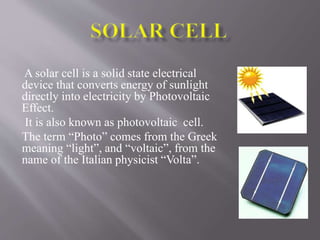
A solar cell is a solid state electrical
device that converts energy of sunlight
directly into electricity by Photovoltaic
Effect.
It is also known as photovoltaic cell.
The term “Photo” comes from the Greek
meaning “light”, and “voltaic”, from the
name of the Italian physicist “Volta”.
Solar cell works on the principle of Photovoltaic
Effects.
The photovoltaic effect was discovered in 1839 by the
French physicist, Alexander Edmond Becquerel.
The photovoltaic effect can be defined as being the
appearance of a potential difference (voltage) between
two layers of a semiconductor slice in which the
conductivities are opposite, or between a
semiconductor and a metal, under the effect of a light
stream.
 Direct conversion of solar radiation to electricity
through a simple solid state device.
 Absence of moving parts.
 They do not create pollution.
 They have a long effective life.
 They are highly reliable.
 Maintenance cost is low as they are easy to operate.
 Ability to function unattended for long periods as
evidence in space programmes.
 The problem of power distribution by wires could be
eliminated by the use of solar cell at the site where
power is required.
 Modular nature in which desired current, voltages and
power levels can be achieved by more integration.
 They consume no fuel to operate as the sun’s energy is
free.
 They are easy to fabricate, being one of the simplest of
semiconductor device.
 They can be used with or without sun tracking, making
possible a wide range of application possibilities.
 They have wide power handling capabilities from
microwatts to kilowatts or even megawatts when
modules are combined into large area array.
 They have rapid response in output to input radiation
changes, no long time constant is involved in this
system.
 Weather dependent device (distributed nature of solar
energy).
 Absence of energy storage, so larges batteries are
required for energy storage.
 Relatively high capital cost.
 Less efficient.
 Uses a lot of space.
 Indirectly associated with pollution in form of
manufacturing and transportation.
 It generates direct current ,so it requires DC appliance
or inverter to convert DC into AC.
It is also known as national solar mission. It is an
initiative of the Government of India and State
Governments to promote solar power in India.
Inaugurated in January 2010, the JNNSM has been
revised twice and now boasts a target of 100 GW of
solar PV by 2022.
Two key objectives of the national solar mission are
 To bring down cost so as to achieve grid parity by
2022
 Establish India as a global leader in solar energy
SN Segment Target for
phase 1
(2010-13)
Cumulative
Target for
phase 2 (2013-
17)
Cumulative
Target for
phase 3 (2017-
22)
1 Utility Grid Power
including rooftop
1100 MW 10,000 MW 20,000 MW
2 Off Grid Solar Application 200 MW 1000 MW 2000 MW
3 Solar Collectors 7 million sq
meter
15 million sq
meter
20 Million sq
meter
 Solar Array
 Blocking Diode
 Battery storage
 Inverter / Converter
 Charge controller
It is a combination of two or more panel which
converts solar insolation into useful DC electrical
power.
 When the sun shines, as long as the voltage produced by
the panels is greater than that of the battery, charging will
take place.
There is a possibility of the current flowing from the
battery to the solar panel during the night time or the time
of irradiance, thereby discharging the battery overnight.
To prevent this from happening, a blocking diode is
installed. It allows the current to flow from the panel to the
battery but blocks the flow in opposite direction.
Blocking diode is used in series with the panels and
battery in reverse biasing to prevent the back flow of
current.
 A battery is a device which converts chemical
energy into electrical energy by chemical reaction.
Batteries are charge during the day time using the DC
power generated by the SPV module.
The battery storages supply power to various load
during the night or non-shiny hours.
Examples- Lead acid battery, Nikil Cadmium battery
 For AC grid-tied systems you do not need a battery
or charge controller if the back up power is not
needed just the inverter.
 An inverter is an electric apparatus that changes
direct current (DC) to alternating current (AC).
 An inverter usually also increases the voltage. In
order to increase the voltage, the current must be
decreased, so an inverter will use a lot of current on
the DC side when only a small amount is being used
on the AC side.
Direct current is created by devices such as
batteries and solar panels. When connected an
inverter allows these devices to provide electric
power for small household devices.
The inverter does this through a complex process of
electrical adjustment. From this process, AC
electric power is produced. This form of electricity
can be used to power an electric light, a microwave
oven, or some other electric machine.
 Inverters are made in many different sizes. They
can be as small as 150 watts, or as large as 1
megawatt (1 million watts).
 Charge controllers are included in most PV
systems to protect the batteries from
overcharge and/or excessive discharge.
 The minimum function of the controller is to
disconnect the array when the battery is fully
charged and keep the battery fully charged
without damage. The charging routine is not
the same for all batteries.
 charge controller designed for lead-acid
batteries should not be used to control NiCd
batteries.
Solar cell
Solar cell
Solar cell

Solar cell

  • 1.
    DEPARTMENT OF RENEWABLEENERGY ENGINEERING SUBJECT- SOLAR CELL AND ITS COMPONENTS PRESENTED BY- RUPAL JAIN (M.Tech Final Year)
  • 2.
    A solar cellis a solid state electrical device that converts energy of sunlight directly into electricity by Photovoltaic Effect. It is also known as photovoltaic cell. The term “Photo” comes from the Greek meaning “light”, and “voltaic”, from the name of the Italian physicist “Volta”.
  • 4.
    Solar cell workson the principle of Photovoltaic Effects. The photovoltaic effect was discovered in 1839 by the French physicist, Alexander Edmond Becquerel. The photovoltaic effect can be defined as being the appearance of a potential difference (voltage) between two layers of a semiconductor slice in which the conductivities are opposite, or between a semiconductor and a metal, under the effect of a light stream.
  • 6.
     Direct conversionof solar radiation to electricity through a simple solid state device.  Absence of moving parts.  They do not create pollution.  They have a long effective life.  They are highly reliable.  Maintenance cost is low as they are easy to operate.  Ability to function unattended for long periods as evidence in space programmes.  The problem of power distribution by wires could be eliminated by the use of solar cell at the site where power is required.
  • 7.
     Modular naturein which desired current, voltages and power levels can be achieved by more integration.  They consume no fuel to operate as the sun’s energy is free.  They are easy to fabricate, being one of the simplest of semiconductor device.  They can be used with or without sun tracking, making possible a wide range of application possibilities.  They have wide power handling capabilities from microwatts to kilowatts or even megawatts when modules are combined into large area array.  They have rapid response in output to input radiation changes, no long time constant is involved in this system.
  • 8.
     Weather dependentdevice (distributed nature of solar energy).  Absence of energy storage, so larges batteries are required for energy storage.  Relatively high capital cost.  Less efficient.  Uses a lot of space.  Indirectly associated with pollution in form of manufacturing and transportation.  It generates direct current ,so it requires DC appliance or inverter to convert DC into AC.
  • 18.
    It is alsoknown as national solar mission. It is an initiative of the Government of India and State Governments to promote solar power in India. Inaugurated in January 2010, the JNNSM has been revised twice and now boasts a target of 100 GW of solar PV by 2022. Two key objectives of the national solar mission are  To bring down cost so as to achieve grid parity by 2022  Establish India as a global leader in solar energy
  • 19.
    SN Segment Targetfor phase 1 (2010-13) Cumulative Target for phase 2 (2013- 17) Cumulative Target for phase 3 (2017- 22) 1 Utility Grid Power including rooftop 1100 MW 10,000 MW 20,000 MW 2 Off Grid Solar Application 200 MW 1000 MW 2000 MW 3 Solar Collectors 7 million sq meter 15 million sq meter 20 Million sq meter
  • 22.
     Solar Array Blocking Diode  Battery storage  Inverter / Converter  Charge controller
  • 23.
    It is acombination of two or more panel which converts solar insolation into useful DC electrical power.
  • 24.
     When thesun shines, as long as the voltage produced by the panels is greater than that of the battery, charging will take place. There is a possibility of the current flowing from the battery to the solar panel during the night time or the time of irradiance, thereby discharging the battery overnight. To prevent this from happening, a blocking diode is installed. It allows the current to flow from the panel to the battery but blocks the flow in opposite direction. Blocking diode is used in series with the panels and battery in reverse biasing to prevent the back flow of current.
  • 26.
     A batteryis a device which converts chemical energy into electrical energy by chemical reaction. Batteries are charge during the day time using the DC power generated by the SPV module. The battery storages supply power to various load during the night or non-shiny hours. Examples- Lead acid battery, Nikil Cadmium battery
  • 28.
     For ACgrid-tied systems you do not need a battery or charge controller if the back up power is not needed just the inverter.  An inverter is an electric apparatus that changes direct current (DC) to alternating current (AC).  An inverter usually also increases the voltage. In order to increase the voltage, the current must be decreased, so an inverter will use a lot of current on the DC side when only a small amount is being used on the AC side.
  • 29.
    Direct current iscreated by devices such as batteries and solar panels. When connected an inverter allows these devices to provide electric power for small household devices. The inverter does this through a complex process of electrical adjustment. From this process, AC electric power is produced. This form of electricity can be used to power an electric light, a microwave oven, or some other electric machine.  Inverters are made in many different sizes. They can be as small as 150 watts, or as large as 1 megawatt (1 million watts).
  • 31.
     Charge controllersare included in most PV systems to protect the batteries from overcharge and/or excessive discharge.  The minimum function of the controller is to disconnect the array when the battery is fully charged and keep the battery fully charged without damage. The charging routine is not the same for all batteries.  charge controller designed for lead-acid batteries should not be used to control NiCd batteries.