Stella
C.
Porto

University
of
Maryland
University
College

Focus


  Faculty grassroots web 2.0
  activity…
  How should institutions react in
  terms of support and ownership
  issues?
Overview


  Context:
UMUC

  Web
2.0
uses

  Tradeoffs
and
challenges:
institutional
vs.

  faculty
perspective

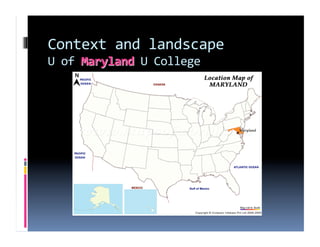
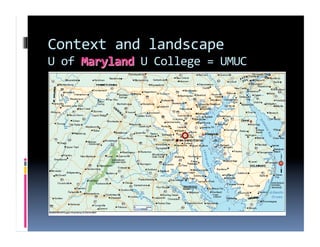
Context
and
landscape

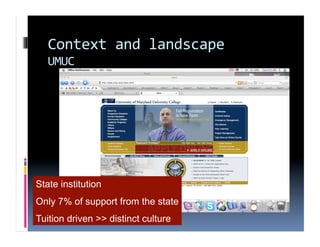
   UMUC


State institution
Only 7% of support from the state
Tuition driven >> distinct culture
Context
and
landscape

  some
quantitative
data

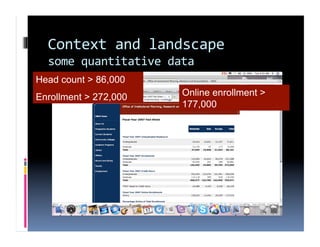
Head count > 86,000
Enrollment > 272,000   Online enrollment >
                       177,000
Context
and
landscape

 UMUC
quick
facts

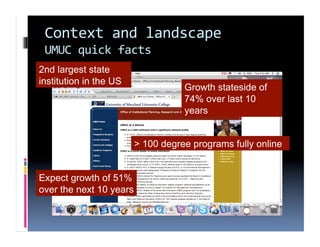
2nd largest state
institution in the US
                                    Growth stateside of
                                    74% over last 10
                                    years


                         > 100 degree programs fully online


Expect growth of 51%
over the next 10 years
Context
and
landscape

  faculty
support


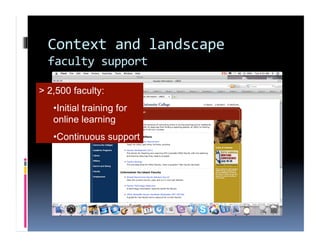
> 2,500 faculty:
   • Initial training for
   online learning
   • Continuous support
Context
and
landscape:

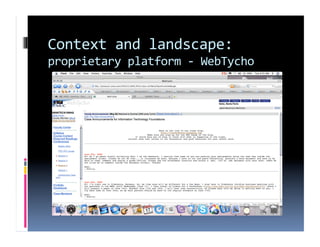
proprietary
platform
‐
WebTycho

Personal
context
within
this
                           

landscape:

  Master
of
Distance
Education


      Administrator

      Faculty

      Student

Meanwhile…
Web
2.0

term
coined
by
Tim
O’Reilly
as
an

evolution
of
the
web
(coined
then

1.0)

Web
2.0

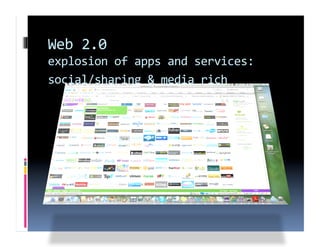
explosion
of
apps
and
services:

social/sharing
&
media
rich


Web
2.0


current
tools
changed
(ex:
2.0

friendly
browser)

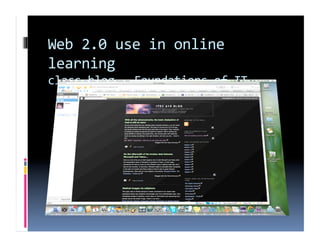
Web
2.0
use
in
online

learning

class
blog
‐
Foundations
of
IT

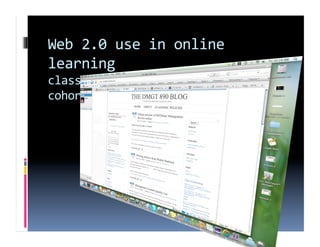
Web
2.0
use
in
online

learning

class
blog
‐
doctoral
dissertation

cohort

Web
2.0
use
in
online

learning

class
blog
‐
capstone
MDE
class

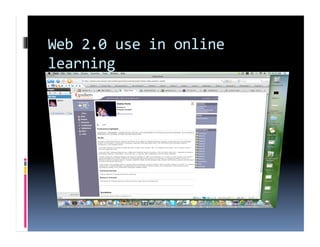
Web
2.0
use
in
online

learning

e‐portfolio
(blog)

Web
2.0
use
in
online

learning

e‐portfolio
app

Web
2.0
use
in
online

learning

community
building
‐
blog

Web
2.0
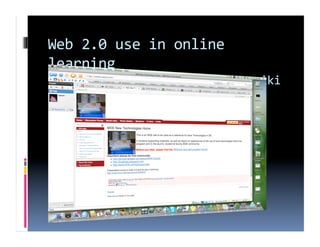
use
in
online

learning

community
building/resources
‐
wiki

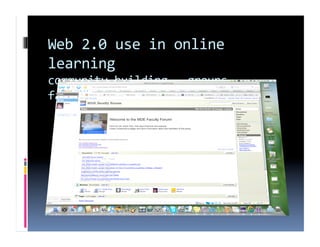
Web
2.0
use
in
online

learning

community
building
‐
groups
‐

faculty

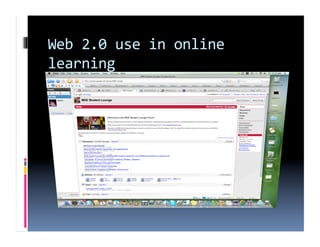
Web
2.0
use
in
online

learning

community
building
‐
groups
‐

students

Tradeoffs
and
challenges

scalability


   How do we provide training and
   support to faculty and students in
   the use of such tools?
   And there is the learning curve,
   technophobia, etc…
Tradeoffs
and
challenges

cost
efficiency


   What tools should the institution
   support? How extensively?
Tradeoffs
and
challenges

ownership


   How much ownership is at risk
   under the institutional umbrella?
   How do we differentiate support
   from ownership?
Tradeoffs
and
challenges

innovation


   Web 2.0 tools are all about beta
   versions…
   How can institutions keep up,
   should they keep up?
   If you build it will they come?
Tradeoffs
and
challenges

support


   We want institutions to support…
   How much, how far?
   Awareness of limitations of the
   underlying business models
Tradeoffs
and
challenges

interoperability/compatibility


   How should these tools connect
   with existing platforms?
   Enclosure?
   Decentralized tools?
Tradeoffs
and
challenges

sustainability
and
robustness


   Should institutions offer such tools
   to whom, for how long?
   Who is accountable?
Tradeoffs
and
challenges

quality
control


   How do institutions guarantee
   quality?
   How much control should they
   have?
   What kind of policies and
   guidelines should be put in place?
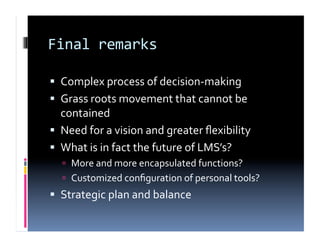
Final
remarks


  Complex
process
of
decision‐making

  Grass
roots
movement
that
cannot
be

   contained

  Need
for
a
vision
and
greater
flexibility

  What
is
in
fact
the
future
of
LMS’s?

    More
and
more
encapsulated
functions?

    Customized
configuration
of
personal
tools?

  Strategic
plan
and
balance

Thank you…
Contact: sporto@umuc.edu
US-China Forum in Distance
Education
June 29 - July 2nd
http://www.umuc.edu/uschina/

S Porto Eden Lisbon 2008 Presentation