Stem Cells Sarah Holton April 22, 2008 April 22, 2009
 
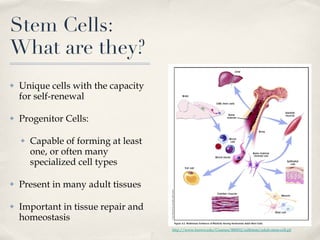
Stem Cells: What are they? Unique cells with the capacity for self-renewal Progenitor Cells: Capable of forming at least one, or often many specialized cell types Present in many adult tissues Important in tissue repair and homeostasis http://www.brown.edu/Courses/BI0032/adltstem/adult-stem-cell.gif
Stem Cells: Types Unipotent Can give rise to one cell type spermatogonial stem cells in testis differentiate to form spermatozoon Multipotent Can give rise to multiple cell types hematopoietic stem cells produce erythrocytes and all types of WBCs Pluripotent Can give rise to every cell type (from all 3 germ layers: ectoderm, mesoderm, endoderm) Derived from embryonic tissues Totipotent Fertilized egg is totipotent because it can form all cells and tissues that form an embryo AND can support it  in utero
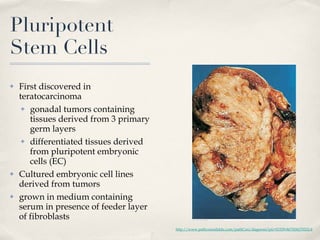
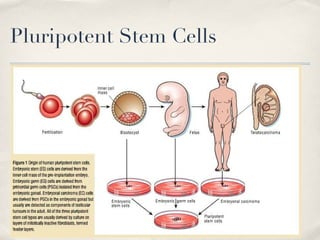
Pluripotent Stem Cells First discovered in teratocarcinoma gonadal tumors containing tissues derived from 3 primary germ layers differentiated tissues derived from pluripotent embryonic cells (EC) Cultured embryonic cell lines derived from tumors grown in medium containing serum in presence of feeder layer of fibroblasts http://www.pathconsultddx.com/pathCon/diagnosis?pii=S1559-8675(06)70552-6
Pluripotent Stem Cells Embryonic Stem Cells (ES) derived from inner cell mass (ICM) cells of pre-implanted blastocyst-stage embryo undifferentiated cells sub-cultured onto feeder layers and expanded into established ES cell lines (seemingly immortal) Embryonic Germ Cells (EG) derived from cultured PGCs isolated directly from embryonic gonad when plated onto feeder layers in presence of serum, forms colonies of cells morphologically different from EC and ES
Pluripotent Stem Cells Classical markers of pluripotent stem cells isozyme of alkaline phosphatase high telomerase activity POU-domain transcription factor Oct4 Oct4 critical in establishing/maintaining pluripotentcy cell surface markers recognized to monoclonal antibodies
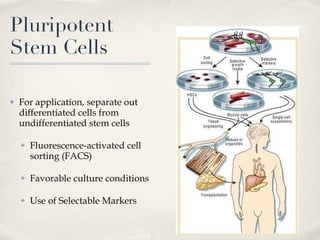
Pluripotent Stem Cells For application, separate out differentiated cells from undifferentiated stem cells Fluorescence-activated cell sorting (FACS) Favorable culture conditions Use of Selectable Markers
Adult Stem Cells Ethical problems related to obtaining and using embryonic tissue-derived stem cells Multipotent  Stem cells exist in most adult tissues Can be derived from germ cells or somatic cells How useful are they? Neural stem cells can form blood-forming and muscle tissue Mesenchymal stem cells can form differentiated cell types in the brain Skin stem cells can make neurons, glia, smooth muscle, and adipocytes May be extremely useful for treatment of some types of disease but unable to treat others
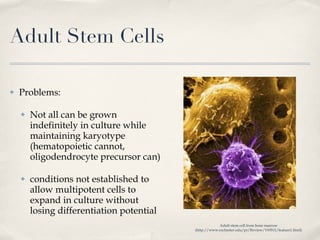
Adult Stem Cells Problems: Not all can be grown indefinitely in culture while maintaining karyotype (hematopoietic cannot, oligodendrocyte precursor can) conditions not established to allow multipotent cells to expand in culture without losing differentiation potential Adult stem cell from bone marrow (http://www.rochester.edu/pr/Review/V69N1/feature1.html)
Progress Animal model studies: cardiomycytes from mouse ES cells form stable, functioning intracardiac grafts in mice mouse ES cell derived glial precursors interact with host neurons to produce myelin in CNS Retinoic-acid (RA) treated mouse ES cells injected into a rat spinal cord 9 days after traumatic injury, differentiated into astrocytes, oligodendrocytes, and neurons and promoted motor recovery genetically selected, insulin-producing cell line derived from mouse ES cells injected into spleen of streptozotocin-induced diabetic mice resulted in normal glycemia Transplanted cells substitute directly for lost populations of cells or provide factors that facilitate regeneration of host cells
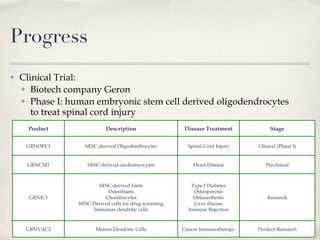
Progress Clinical Trial: Biotech company Geron Phase I: human embryonic stem cell derived oligodendrocytes to treat spinal cord injury Product Description Disease Treatment Stage GRNOPC1 hESC-derived Oligodendrocytes Spinal Cord Injury Clinical (Phase I) GRNCM1 hESC-derived cardiomyocytes Heart Disease Preclinical GRNIC1 hESC-derived Islets Osteoblasts Chondrocytes hESC-Derived cells for drug screening Immature dendritic cells Type I Diabetes Osteoporosis Osteoarthritis Liver disease Immune Rejection Research GRNVAC2 Mature Dendritic Cells Cancer Immunotherapy Product Research
Therapeutic Challenges Will derived cells be histocompatible with each individual? short term: immune suppression or tolerance induction solution: therapeutic cloning: isolate somatic nucleus from patient and grow in oocyte. embryo is genetically identical to patient stem cell line modified by homologous recombination Will the transplanted pluripotent cell form a tumor or otherwise differentiate improperly? EC, ES, EG cells form tumors when implanted in animals solution: use differentiated stem cells, but how can we control this? Will infectious agents possibly present in embryo-derived pluripotent stem cells or contracted through feeder-culture dependent on bovine serum affect the patient? solution: establish conditions for growing pluripotent human stem cells in serum-free medium
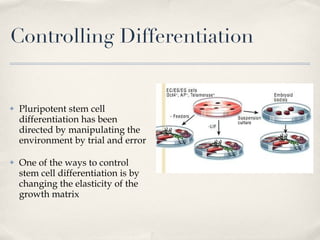
Controlling Differentiation Pluripotent stem cell differentiation has been directed by manipulating the environment by trial and error One of the ways to control stem cell differentiation is by changing the elasticity of the growth matrix
 
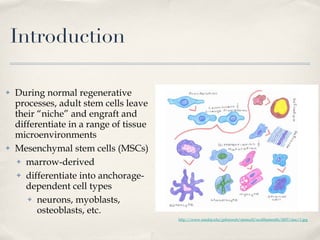
Introduction During normal regenerative processes, adult stem cells leave their “niche” and engraft and differentiate in a range of tissue microenvironments Mesenchymal stem cells (MSCs) marrow-derived differentiate into anchorage-dependent cell types neurons, myoblasts, osteoblasts, etc. http://www.umdnj.edu/gsbsnweb/stemcell/scofthemonth/2007/msc/1.jpg
Effect of microenvironment Effect is well defined for differentiated cells for fibroblasts, response to growth factors is coupled with anchorage to surrounding matrix matrix stiffness influences focal-adhesion structure and cytoskeleton cells committed to a specific lineage respond to physical state of matrix fibroblasts respond differently to floating collagen gels and wrinkling-silicone sheets What about the effect on naïve stem cells?
Effect of matrix elasticity [...]  Tissue-level matrix stiffness is distinct and shown here in sparse cultures to exert very strong effects on the lineage specification and commitment of naïve MSCs, as evident in cell morphology, transcript profiles, marker proteins, and the stability of responses How do the MSCs sense matrix elasticity? Ability to pull against matrix  Requirement of cellular mechano-transducer to generate signal based on force Mechanotransduction of endothelial shear stress ( http://content.onlinejacc.org/cgi/content-nw/full/j.jacc.2007.02.059v1/FIG4 )
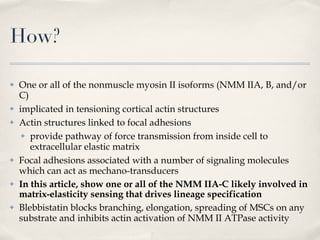
How? One or all of the nonmuscle myosin II isoforms (NMM IIA, B, and/or C) implicated in tensioning cortical actin structures Actin structures linked to focal adhesions provide pathway of force transmission from inside cell to extracellular elastic matrix Focal adhesions associated with a number of signaling molecules which can act as mechano-transducers In this article, show one or all of the NMM IIA-C likely involved in matrix-elasticity sensing that drives lineage specification Blebbistatin blocks branching, elongation, spreading of MSCs on any substrate and inhibits actin activation of NMM II ATPase activity
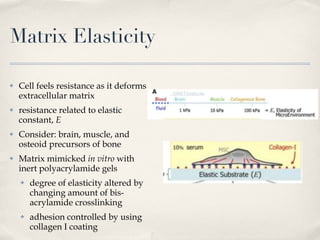
Matrix Elasticity Cell feels resistance as it deforms extracellular matrix resistance related to elastic constant,  E Consider: brain, muscle, and osteoid precursors of bone Matrix mimicked  in vitro  with inert polyacrylamide gels degree of elasticity altered by changing amount of bis-acrylamide crosslinking adhesion controlled by using collagen I coating
Results Matrix can specify lineage of MSCs toward neurons, myoblasts, and osteoblasts When NMM IIs inhibited with blebbistatin, differentiation is blocked Soluble induction factors less selective than matrix stiffness Soluble induction factors cannot reprogram MSCs that have been grown for weeks on a given matrix Controlling gel thickness,  h , establish how far stem cells can feel and physically define their microenvironment
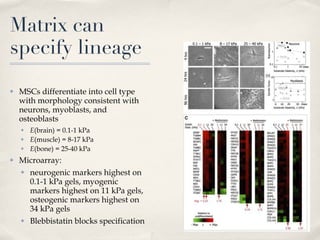
Matrix can specify lineage MSCs differentiate into cell type with morphology consistent with neurons, myoblasts, and osteoblasts E (brain) = 0.1-1 kPa E (muscle) = 8-17 kPa E (bone) = 25-40 kPa Microarray: neurogenic markers highest on 0.1-1 kPa gels, myogenic markers highest on 11 kPa gels, osteogenic markers highest on 34 kPa gels Blebbistatin blocks specification
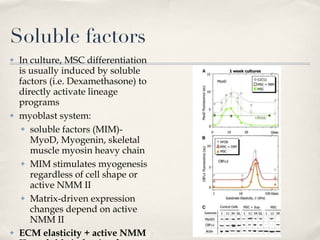
Soluble factors In culture, MSC differentiation is usually induced by soluble factors (i.e. Dexamethasone) to directly activate lineage programs myoblast system:  soluble factors (MIM)- MyoD, Myogenin, skeletal muscle myosin heavy chain MIM stimulates myogenesis regardless of cell shape or active NMM II  Matrix-driven expression changes depend on active NMM II ECM elasticity + active NMM II + soluble induction factors = more complete myogenesis
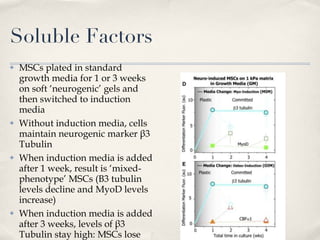
Soluble Factors MSCs plated in standard growth media for 1 or 3 weeks on soft ‘neurogenic’ gels and then switched to induction media Without induction media, cells maintain neurogenic marker  β3 Tubulin When induction media is added after 1 week, result is ‘mixed-phenotype’ MSCs (B3 tubulin levels decline and MyoD levels increase) When induction media is added after 3 weeks, levels of β3 Tubulin stay high: MSCs lose their plasticity
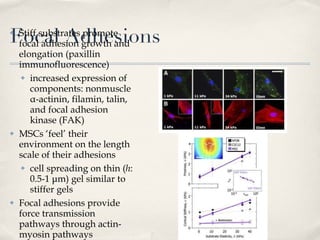
Focal Adhesions Stiff substrates promote focal adhesion growth and elongation (paxillin immunofluorescence) increased expression of components: nonmuscle α-actinin, filamin, talin, and focal adhesion kinase (FAK) MSCs ‘feel’ their environment on the length scale of their adhesions cell spreading on thin ( h : 0.5-1 μm) gel similar to stiffer gels Focal adhesions provide force transmission pathways through actin-myosin pathways cellular prestress  σ  (pulling by cells) balances traction stress  τ  (exerted on gel by cell)
Conclusions Stem Cells (both embryonic and adult) have therapeutic potential Controlled differentiation of multipotent stem cells can be achieved using engineered matrices of defined elasticities ‘Precommitting’ stem cells to a specific lineage using  in vitro  matrix conditions may help overcome an inappropriate or comprimised  in vivo  microenvironment
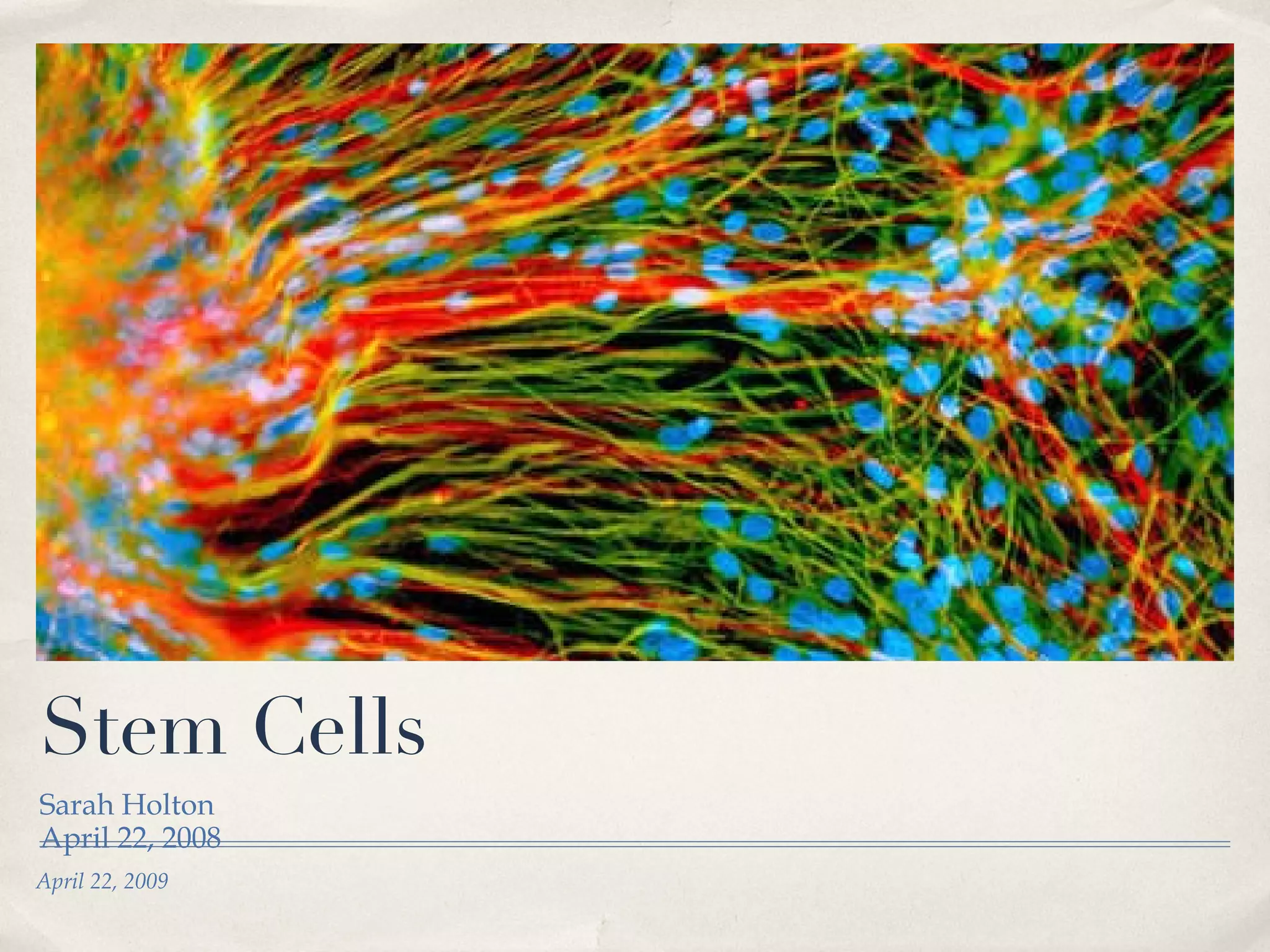
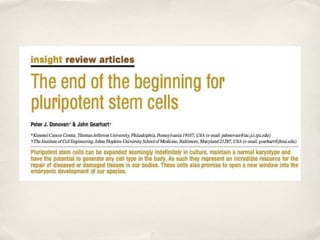
References/Citations “ The end of the beginning for pluripotent stem cells”, Peter J. Donovan and John Gearhart, Nature Vol 414, November 1, 2001 “ Matrix elasticity directs stem cell lineage specification”, Adam J. Engler, Shamik Sen, H. Lee Sweeney, and Dennis E. Discher, Cell Vol 126, August 25, 2006 Cover picture: “Stem Cell Research: Medical Miracle or Moral Morass?”, Gotham Gazette, March 20, 2006 ( http://www.gothamgazette.com/article/issueoftheweek/20060320/200/1794 ) “ Human Embryonic Stem Cells” ( http://www.geron.com/technology/stemcell/stemcellprogram.aspx )

S CdiferenciacióNpormatriz

  • 1.
    Stem Cells SarahHolton April 22, 2008 April 22, 2009
  • 2.
  • 3.
    Stem Cells: Whatare they? Unique cells with the capacity for self-renewal Progenitor Cells: Capable of forming at least one, or often many specialized cell types Present in many adult tissues Important in tissue repair and homeostasis http://www.brown.edu/Courses/BI0032/adltstem/adult-stem-cell.gif
  • 4.
    Stem Cells: TypesUnipotent Can give rise to one cell type spermatogonial stem cells in testis differentiate to form spermatozoon Multipotent Can give rise to multiple cell types hematopoietic stem cells produce erythrocytes and all types of WBCs Pluripotent Can give rise to every cell type (from all 3 germ layers: ectoderm, mesoderm, endoderm) Derived from embryonic tissues Totipotent Fertilized egg is totipotent because it can form all cells and tissues that form an embryo AND can support it in utero
  • 5.
    Pluripotent Stem CellsFirst discovered in teratocarcinoma gonadal tumors containing tissues derived from 3 primary germ layers differentiated tissues derived from pluripotent embryonic cells (EC) Cultured embryonic cell lines derived from tumors grown in medium containing serum in presence of feeder layer of fibroblasts http://www.pathconsultddx.com/pathCon/diagnosis?pii=S1559-8675(06)70552-6
  • 6.
    Pluripotent Stem CellsEmbryonic Stem Cells (ES) derived from inner cell mass (ICM) cells of pre-implanted blastocyst-stage embryo undifferentiated cells sub-cultured onto feeder layers and expanded into established ES cell lines (seemingly immortal) Embryonic Germ Cells (EG) derived from cultured PGCs isolated directly from embryonic gonad when plated onto feeder layers in presence of serum, forms colonies of cells morphologically different from EC and ES
  • 7.
    Pluripotent Stem CellsClassical markers of pluripotent stem cells isozyme of alkaline phosphatase high telomerase activity POU-domain transcription factor Oct4 Oct4 critical in establishing/maintaining pluripotentcy cell surface markers recognized to monoclonal antibodies
  • 8.
    Pluripotent Stem CellsFor application, separate out differentiated cells from undifferentiated stem cells Fluorescence-activated cell sorting (FACS) Favorable culture conditions Use of Selectable Markers
  • 9.
    Adult Stem CellsEthical problems related to obtaining and using embryonic tissue-derived stem cells Multipotent Stem cells exist in most adult tissues Can be derived from germ cells or somatic cells How useful are they? Neural stem cells can form blood-forming and muscle tissue Mesenchymal stem cells can form differentiated cell types in the brain Skin stem cells can make neurons, glia, smooth muscle, and adipocytes May be extremely useful for treatment of some types of disease but unable to treat others
  • 10.
    Adult Stem CellsProblems: Not all can be grown indefinitely in culture while maintaining karyotype (hematopoietic cannot, oligodendrocyte precursor can) conditions not established to allow multipotent cells to expand in culture without losing differentiation potential Adult stem cell from bone marrow (http://www.rochester.edu/pr/Review/V69N1/feature1.html)
  • 11.
    Progress Animal modelstudies: cardiomycytes from mouse ES cells form stable, functioning intracardiac grafts in mice mouse ES cell derived glial precursors interact with host neurons to produce myelin in CNS Retinoic-acid (RA) treated mouse ES cells injected into a rat spinal cord 9 days after traumatic injury, differentiated into astrocytes, oligodendrocytes, and neurons and promoted motor recovery genetically selected, insulin-producing cell line derived from mouse ES cells injected into spleen of streptozotocin-induced diabetic mice resulted in normal glycemia Transplanted cells substitute directly for lost populations of cells or provide factors that facilitate regeneration of host cells
  • 12.
    Progress Clinical Trial:Biotech company Geron Phase I: human embryonic stem cell derived oligodendrocytes to treat spinal cord injury Product Description Disease Treatment Stage GRNOPC1 hESC-derived Oligodendrocytes Spinal Cord Injury Clinical (Phase I) GRNCM1 hESC-derived cardiomyocytes Heart Disease Preclinical GRNIC1 hESC-derived Islets Osteoblasts Chondrocytes hESC-Derived cells for drug screening Immature dendritic cells Type I Diabetes Osteoporosis Osteoarthritis Liver disease Immune Rejection Research GRNVAC2 Mature Dendritic Cells Cancer Immunotherapy Product Research
  • 13.
    Therapeutic Challenges Willderived cells be histocompatible with each individual? short term: immune suppression or tolerance induction solution: therapeutic cloning: isolate somatic nucleus from patient and grow in oocyte. embryo is genetically identical to patient stem cell line modified by homologous recombination Will the transplanted pluripotent cell form a tumor or otherwise differentiate improperly? EC, ES, EG cells form tumors when implanted in animals solution: use differentiated stem cells, but how can we control this? Will infectious agents possibly present in embryo-derived pluripotent stem cells or contracted through feeder-culture dependent on bovine serum affect the patient? solution: establish conditions for growing pluripotent human stem cells in serum-free medium
  • 14.
    Controlling Differentiation Pluripotentstem cell differentiation has been directed by manipulating the environment by trial and error One of the ways to control stem cell differentiation is by changing the elasticity of the growth matrix
  • 15.
  • 16.
    Introduction During normalregenerative processes, adult stem cells leave their “niche” and engraft and differentiate in a range of tissue microenvironments Mesenchymal stem cells (MSCs) marrow-derived differentiate into anchorage-dependent cell types neurons, myoblasts, osteoblasts, etc. http://www.umdnj.edu/gsbsnweb/stemcell/scofthemonth/2007/msc/1.jpg
  • 17.
    Effect of microenvironmentEffect is well defined for differentiated cells for fibroblasts, response to growth factors is coupled with anchorage to surrounding matrix matrix stiffness influences focal-adhesion structure and cytoskeleton cells committed to a specific lineage respond to physical state of matrix fibroblasts respond differently to floating collagen gels and wrinkling-silicone sheets What about the effect on naïve stem cells?
  • 18.
    Effect of matrixelasticity [...] Tissue-level matrix stiffness is distinct and shown here in sparse cultures to exert very strong effects on the lineage specification and commitment of naïve MSCs, as evident in cell morphology, transcript profiles, marker proteins, and the stability of responses How do the MSCs sense matrix elasticity? Ability to pull against matrix Requirement of cellular mechano-transducer to generate signal based on force Mechanotransduction of endothelial shear stress ( http://content.onlinejacc.org/cgi/content-nw/full/j.jacc.2007.02.059v1/FIG4 )
  • 19.
    How? One orall of the nonmuscle myosin II isoforms (NMM IIA, B, and/or C) implicated in tensioning cortical actin structures Actin structures linked to focal adhesions provide pathway of force transmission from inside cell to extracellular elastic matrix Focal adhesions associated with a number of signaling molecules which can act as mechano-transducers In this article, show one or all of the NMM IIA-C likely involved in matrix-elasticity sensing that drives lineage specification Blebbistatin blocks branching, elongation, spreading of MSCs on any substrate and inhibits actin activation of NMM II ATPase activity
  • 20.
    Matrix Elasticity Cellfeels resistance as it deforms extracellular matrix resistance related to elastic constant, E Consider: brain, muscle, and osteoid precursors of bone Matrix mimicked in vitro with inert polyacrylamide gels degree of elasticity altered by changing amount of bis-acrylamide crosslinking adhesion controlled by using collagen I coating
  • 21.
    Results Matrix canspecify lineage of MSCs toward neurons, myoblasts, and osteoblasts When NMM IIs inhibited with blebbistatin, differentiation is blocked Soluble induction factors less selective than matrix stiffness Soluble induction factors cannot reprogram MSCs that have been grown for weeks on a given matrix Controlling gel thickness, h , establish how far stem cells can feel and physically define their microenvironment
  • 22.
    Matrix can specifylineage MSCs differentiate into cell type with morphology consistent with neurons, myoblasts, and osteoblasts E (brain) = 0.1-1 kPa E (muscle) = 8-17 kPa E (bone) = 25-40 kPa Microarray: neurogenic markers highest on 0.1-1 kPa gels, myogenic markers highest on 11 kPa gels, osteogenic markers highest on 34 kPa gels Blebbistatin blocks specification
  • 23.
    Soluble factors Inculture, MSC differentiation is usually induced by soluble factors (i.e. Dexamethasone) to directly activate lineage programs myoblast system: soluble factors (MIM)- MyoD, Myogenin, skeletal muscle myosin heavy chain MIM stimulates myogenesis regardless of cell shape or active NMM II Matrix-driven expression changes depend on active NMM II ECM elasticity + active NMM II + soluble induction factors = more complete myogenesis
  • 24.
    Soluble Factors MSCsplated in standard growth media for 1 or 3 weeks on soft ‘neurogenic’ gels and then switched to induction media Without induction media, cells maintain neurogenic marker β3 Tubulin When induction media is added after 1 week, result is ‘mixed-phenotype’ MSCs (B3 tubulin levels decline and MyoD levels increase) When induction media is added after 3 weeks, levels of β3 Tubulin stay high: MSCs lose their plasticity
  • 25.
    Focal Adhesions Stiffsubstrates promote focal adhesion growth and elongation (paxillin immunofluorescence) increased expression of components: nonmuscle α-actinin, filamin, talin, and focal adhesion kinase (FAK) MSCs ‘feel’ their environment on the length scale of their adhesions cell spreading on thin ( h : 0.5-1 μm) gel similar to stiffer gels Focal adhesions provide force transmission pathways through actin-myosin pathways cellular prestress σ (pulling by cells) balances traction stress τ (exerted on gel by cell)
  • 26.
    Conclusions Stem Cells(both embryonic and adult) have therapeutic potential Controlled differentiation of multipotent stem cells can be achieved using engineered matrices of defined elasticities ‘Precommitting’ stem cells to a specific lineage using in vitro matrix conditions may help overcome an inappropriate or comprimised in vivo microenvironment
  • 27.
    References/Citations “ Theend of the beginning for pluripotent stem cells”, Peter J. Donovan and John Gearhart, Nature Vol 414, November 1, 2001 “ Matrix elasticity directs stem cell lineage specification”, Adam J. Engler, Shamik Sen, H. Lee Sweeney, and Dennis E. Discher, Cell Vol 126, August 25, 2006 Cover picture: “Stem Cell Research: Medical Miracle or Moral Morass?”, Gotham Gazette, March 20, 2006 ( http://www.gothamgazette.com/article/issueoftheweek/20060320/200/1794 ) “ Human Embryonic Stem Cells” ( http://www.geron.com/technology/stemcell/stemcellprogram.aspx )