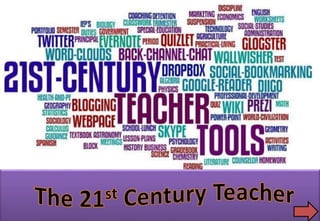
The 21st Century
Teacher and Learner
April 22, 2014
Objectives
DEPARTMENT OF EDUCATION
• Describe the 21st century teacher and learner;
• Identify ways to develop the skills of a 21st
century teacher and learner
• Develop personal plan of action to promote 21st
century teaching and learning
ACTIVITY (Group Work)
DEPARTMENT OF EDUCATION
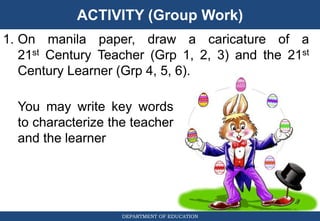
1. On manila paper, draw a caricature of a
21st Century Teacher (Grp 1, 2, 3) and the 21st
Century Learner (Grp 4, 5, 6).
You may write key words
to characterize the teacher
and the learner
DEPARTMENT OF EDUCATION
ANALYSIS
What common characteristics of a 21st century
teacher/learner were surfaced in the drawing?
What skills do they possess?
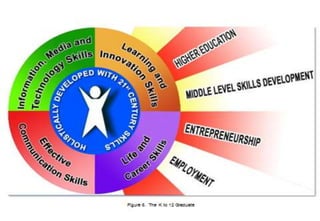
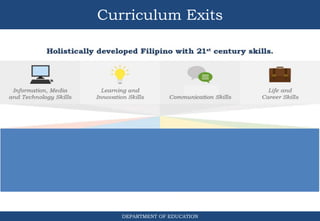
* Information, Media and Technology Skills
* Learning and Innovation Skills
* Communication Skills
* Life and Career Skills
ANALYSIS
Are the characteristics highlighted in the drawing
the same or similar to the ones shown in the video?
How can these skills be developed by the
teachers/learners?
How do you assess yourself in relation to these
expectations?
What insights have you gained from this session?
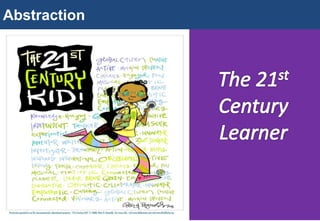
Abstraction
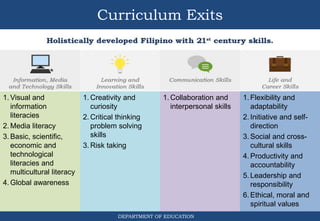
Curriculum Exits
DEPARTMENT OF EDUCATION
Curriculum Exits
1. Visual and
information
literacies
2. Media literacy
3. Basic, scientific,
economic and
technological
literacies and
multicultural literacy
4. Global awareness
1. Creativity and
curiosity
2. Critical thinking
problem solving
skills
3. Risk taking
1. Collaboration and
interpersonal skills
1. Flexibility and
adaptability
2. Initiative and self-
direction
3. Social and cross-
cultural skills
4. Productivity and
accountability
5. Leadership and
responsibility
6. Ethical, moral and
spiritual values
DEPARTMENT OF EDUCATION
Learning and
Innovation Skills
English (Philippine Literature)
The learner transfers learning
by: resolving conflicts
presented in literary selections;
using tools and mechanisms in
locating library resources;
extracting information and
noting details from texts to
write a précis, summary, or
paraphrase; distinguishing
between and using literal and
figurative language and verbal
and non-verbal cues; use
phrases, clauses, and
sentences meaningfully and
appropriately.
Filipino (Ibong Adarna)
Naisasagawa ng mag-aaral ang
malikhaing pagtatanghal ng ilang
saknong ng koridong
naglalarawan ng mga
pagpapahalagang Pilipino.
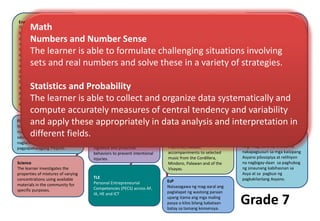
Math
Numbers and Number Sense
The learner is able to formulate
challenging situations involving
sets and real numbers and
solve these in a variety of
strategies.
Statistics and Probability
The learner is able to collect
and organize data
systematically and compute
accurately measures of central
tendency and variability and
apply these appropriately in
data analysis and
interpretation in different
fields.
Science
The learner investigates the
properties of mixtures of varying
concentrations using available
materials in the community for
specific purposes.
AP (Sinaunang Kabihasnan sa
Asya)
Ang mag-aaral ay kritikal na
nakapagsusuri sa mga kaisipang
Asyano pilosopiya at relihiyon
na nagbigay-daan sa paghubog
ng sinaunang kabihasnan sa
Asya at sa pagbuo ng
pagkakilanlang Asyano.
Music (Music of Cordillera,
Mindoro, Palawan, and the
Visayas)
The learner improvises simple
rhythmic/melodic
accompaniments to selected
music from the Cordillera,
Mindoro, Palawan and of the
Visayas.
Arts (Festivals and Theatrical
Forms)
The learner creates appropriate
festival attire with accessories
based on authentic festival
costumes.
PE (Training Guidelines, FITT
Principles)
The learner designs an
individualized exercise program
to achieve personal fitness.
Health (Injury, Prevention,
Safety and First Aid)
The learner consistently
demonstrates resilience,
vigilance and proactive
behaviors to prevent intentional
injuries.
TLE
Personal Entrepreneurial
Competencies (PECS) across AF,
IA, HE and ICT
Grade 7
EsP
Naisasagawa ng mag-aaral ang
paglalapat ng wastong paraan
upang itama ang mga maling
pasya o kilos bilang kabataan
batay sa tamang konsensya.
Math
Numbers and Number Sense
The learner is able to formulate challenging situations involving
sets and real numbers and solve these in a variety of strategies.
Statistics and Probability
The learner is able to collect and organize data systematically and
compute accurately measures of central tendency and variability
and apply these appropriately in data analysis and interpretation in
different fields.
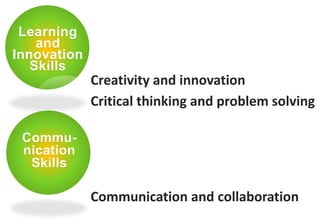
Communication and collaboration
Learning
and
Innovation
Skills
Creativity and innovation
Critical thinking and problem solving
Commu-
nication
Skills
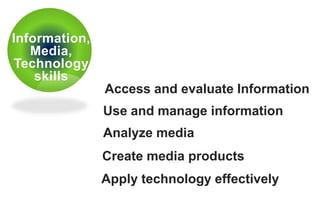
Information,
Media,
Technology
skills
Access and evaluate Information
Use and manage information
Analyze media
Create media products
Apply technology effectively
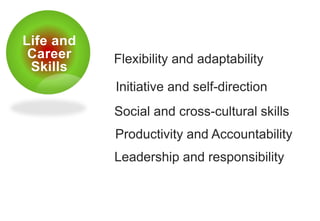
Flexibility and adaptability
Life and
Career
Skills
Initiative and self-direction
Social and cross-cultural skills
Productivity and Accountability
Leadership and responsibility
https://edorigami.wikispaces.com/21st+Century+Teacher
The Adaptor
The Communicator
The Learner
The Visionary
The Leader
The Model
The Collaborator
The Risk taker
Characteristics of a 21st Century Teacher
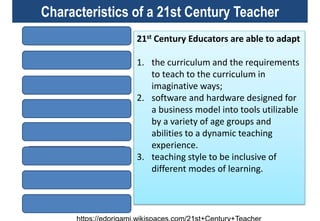
21st Century Educators are able to adapt
1. the curriculum and the requirements
to teach to the curriculum in
imaginative ways;
2. software and hardware designed for
a business model into tools utilizable
by a variety of age groups and
abilities to a dynamic teaching
experience.
3. teaching style to be inclusive of
different modes of learning.
https://edorigami.wikispaces.com/21st+Century+Teacher
The Adaptor
The Communicator
The Learner
The Visionary
The Leader
The Model
The Collaborator
The Risk taker
Characteristics of a 21st Century Teacher
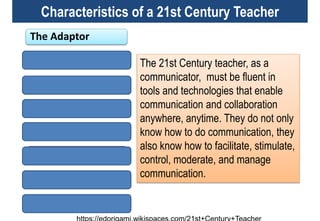
The 21st Century teacher, as a
communicator, must be fluent in
tools and technologies that enable
communication and collaboration
anywhere, anytime. They do not only
know how to do communication, they
also know how to facilitate, stimulate,
control, moderate, and manage
communication.
https://edorigami.wikispaces.com/21st+Century+Teacher
The Adaptor
The Communicator
The Learner
The Visionary
The Leader
The Model
The Collaborator
The Risk taker
Characteristics of a 21st Century Teacher
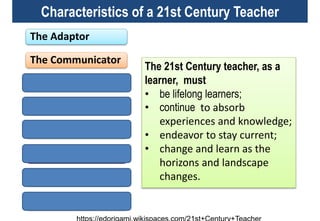
The 21st Century teacher, as a
learner, must
• be lifelong learners;
• continue to absorb
experiences and knowledge;
• endeavor to stay current;
• change and learn as the
horizons and landscape
changes.
https://edorigami.wikispaces.com/21st+Century+Teacher
The Adaptor
The Communicator
The Learner
The Visionary
The Leader
The Model
The Collaborator
The Risk taker
Characteristics of a 21st Century Teacher
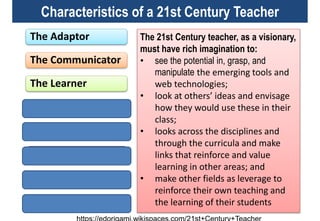
The 21st Century teacher, as a visionary,
must have rich imagination to:
• see the potential in, grasp, and
manipulate the emerging tools and
web technologies;
• look at others’ ideas and envisage
how they would use these in their
class;
• looks across the disciplines and
through the curricula and make
links that reinforce and value
learning in other areas; and
• make other fields as leverage to
reinforce their own teaching and
the learning of their students
https://edorigami.wikispaces.com/21st+Century+Teacher
The Adaptor
The Communicator
The Learner
The Visionary
The Leader
The Model
The Collaborator
The Risk taker
Characteristics of a 21st Century Teacher
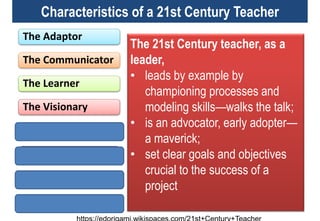
The 21st Century teacher, as a
leader,
• leads by example by
championing processes and
modeling skills—walks the talk;
• is an advocator, early adopter—
a maverick;
• set clear goals and objectives
crucial to the success of a
project
https://edorigami.wikispaces.com/21st+Century+Teacher
The Adaptor
The Communicator
The Learner
The Visionary
The Leader
The Model
The Collaborator
The Risk taker
Characteristics of a 21st Century Teacher
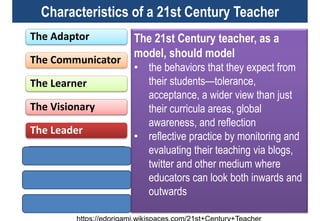
The 21st Century teacher, as a
model, should model
• the behaviors that they expect from
their students—tolerance,
acceptance, a wider view than just
their curricula areas, global
awareness, and reflection
• reflective practice by monitoring and
evaluating their teaching via blogs,
twitter and other medium where
educators can look both inwards and
outwards
https://edorigami.wikispaces.com/21st+Century+Teacher
The Adaptor
The Communicator
The Learner
The Visionary
The Leader
The Model
The Collaborator
The Risk taker
Characteristics of a 21st Century Teacher
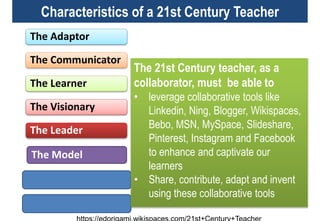
The 21st Century teacher, as a
collaborator, must be able to
• leverage collaborative tools like
Linkedin, Ning, Blogger, Wikispaces,
Bebo, MSN, MySpace, Slideshare,
Pinterest, Instagram and Facebook
to enhance and captivate our
learners
• Share, contribute, adapt and invent
using these collaborative tools
https://edorigami.wikispaces.com/21st+Century+Teacher
The Adaptor
The Communicator
The Learner
The Visionary
The Leader
The Model
The Collaborator
The Risk taker
Characteristics of a 21st Century Teacher
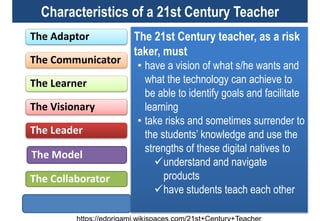
The 21st Century teacher, as a risk
taker, must
• have a vision of what s/he wants and
what the technology can achieve to
be able to identify goals and facilitate
learning
• take risks and sometimes surrender to
the students’ knowledge and use the
strengths of these digital natives to
understand and navigate
products
have students teach each other
Characteristics of a 21st Century Teacher
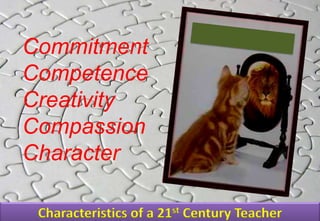
Commitment
Competence
Creativity
Compassion
Character
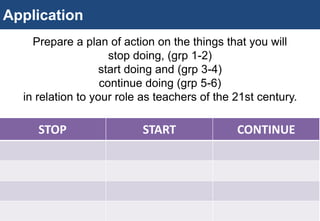
STOP START CONTINUE
Application
Prepare a plan of action on the things that you will
stop doing, (grp 1-2)
start doing and (grp 3-4)
continue doing (grp 5-6)
in relation to your role as teachers of the 21st century.
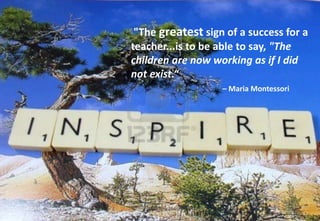
"The greatest sign of a success for a
teacher...is to be able to say, "The
children are now working as if I did
not exist.“
– Maria Montessori
DEPARTMENT OF EDUCATION

S 2 21st century teaching

  • 1.
    The 21st Century Teacherand Learner April 22, 2014
  • 2.
    Objectives DEPARTMENT OF EDUCATION •Describe the 21st century teacher and learner; • Identify ways to develop the skills of a 21st century teacher and learner • Develop personal plan of action to promote 21st century teaching and learning
  • 3.
    ACTIVITY (Group Work) DEPARTMENTOF EDUCATION 1. On manila paper, draw a caricature of a 21st Century Teacher (Grp 1, 2, 3) and the 21st Century Learner (Grp 4, 5, 6). You may write key words to characterize the teacher and the learner
  • 4.
  • 5.
    ANALYSIS What common characteristicsof a 21st century teacher/learner were surfaced in the drawing? What skills do they possess? * Information, Media and Technology Skills * Learning and Innovation Skills * Communication Skills * Life and Career Skills
  • 6.
    ANALYSIS Are the characteristicshighlighted in the drawing the same or similar to the ones shown in the video? How can these skills be developed by the teachers/learners? How do you assess yourself in relation to these expectations? What insights have you gained from this session?
  • 7.
  • 9.
  • 10.
    Curriculum Exits 1. Visualand information literacies 2. Media literacy 3. Basic, scientific, economic and technological literacies and multicultural literacy 4. Global awareness 1. Creativity and curiosity 2. Critical thinking problem solving skills 3. Risk taking 1. Collaboration and interpersonal skills 1. Flexibility and adaptability 2. Initiative and self- direction 3. Social and cross- cultural skills 4. Productivity and accountability 5. Leadership and responsibility 6. Ethical, moral and spiritual values DEPARTMENT OF EDUCATION
  • 11.
    Learning and Innovation Skills English(Philippine Literature) The learner transfers learning by: resolving conflicts presented in literary selections; using tools and mechanisms in locating library resources; extracting information and noting details from texts to write a précis, summary, or paraphrase; distinguishing between and using literal and figurative language and verbal and non-verbal cues; use phrases, clauses, and sentences meaningfully and appropriately. Filipino (Ibong Adarna) Naisasagawa ng mag-aaral ang malikhaing pagtatanghal ng ilang saknong ng koridong naglalarawan ng mga pagpapahalagang Pilipino. Math Numbers and Number Sense The learner is able to formulate challenging situations involving sets and real numbers and solve these in a variety of strategies. Statistics and Probability The learner is able to collect and organize data systematically and compute accurately measures of central tendency and variability and apply these appropriately in data analysis and interpretation in different fields. Science The learner investigates the properties of mixtures of varying concentrations using available materials in the community for specific purposes. AP (Sinaunang Kabihasnan sa Asya) Ang mag-aaral ay kritikal na nakapagsusuri sa mga kaisipang Asyano pilosopiya at relihiyon na nagbigay-daan sa paghubog ng sinaunang kabihasnan sa Asya at sa pagbuo ng pagkakilanlang Asyano. Music (Music of Cordillera, Mindoro, Palawan, and the Visayas) The learner improvises simple rhythmic/melodic accompaniments to selected music from the Cordillera, Mindoro, Palawan and of the Visayas. Arts (Festivals and Theatrical Forms) The learner creates appropriate festival attire with accessories based on authentic festival costumes. PE (Training Guidelines, FITT Principles) The learner designs an individualized exercise program to achieve personal fitness. Health (Injury, Prevention, Safety and First Aid) The learner consistently demonstrates resilience, vigilance and proactive behaviors to prevent intentional injuries. TLE Personal Entrepreneurial Competencies (PECS) across AF, IA, HE and ICT Grade 7 EsP Naisasagawa ng mag-aaral ang paglalapat ng wastong paraan upang itama ang mga maling pasya o kilos bilang kabataan batay sa tamang konsensya. Math Numbers and Number Sense The learner is able to formulate challenging situations involving sets and real numbers and solve these in a variety of strategies. Statistics and Probability The learner is able to collect and organize data systematically and compute accurately measures of central tendency and variability and apply these appropriately in data analysis and interpretation in different fields.
  • 12.
    Communication and collaboration Learning and Innovation Skills Creativityand innovation Critical thinking and problem solving Commu- nication Skills
  • 13.
    Information, Media, Technology skills Access and evaluateInformation Use and manage information Analyze media Create media products Apply technology effectively
  • 14.
    Flexibility and adaptability Lifeand Career Skills Initiative and self-direction Social and cross-cultural skills Productivity and Accountability Leadership and responsibility
  • 16.
    https://edorigami.wikispaces.com/21st+Century+Teacher The Adaptor The Communicator TheLearner The Visionary The Leader The Model The Collaborator The Risk taker Characteristics of a 21st Century Teacher 21st Century Educators are able to adapt 1. the curriculum and the requirements to teach to the curriculum in imaginative ways; 2. software and hardware designed for a business model into tools utilizable by a variety of age groups and abilities to a dynamic teaching experience. 3. teaching style to be inclusive of different modes of learning.
  • 17.
    https://edorigami.wikispaces.com/21st+Century+Teacher The Adaptor The Communicator TheLearner The Visionary The Leader The Model The Collaborator The Risk taker Characteristics of a 21st Century Teacher The 21st Century teacher, as a communicator, must be fluent in tools and technologies that enable communication and collaboration anywhere, anytime. They do not only know how to do communication, they also know how to facilitate, stimulate, control, moderate, and manage communication.
  • 18.
    https://edorigami.wikispaces.com/21st+Century+Teacher The Adaptor The Communicator TheLearner The Visionary The Leader The Model The Collaborator The Risk taker Characteristics of a 21st Century Teacher The 21st Century teacher, as a learner, must • be lifelong learners; • continue to absorb experiences and knowledge; • endeavor to stay current; • change and learn as the horizons and landscape changes.
  • 19.
    https://edorigami.wikispaces.com/21st+Century+Teacher The Adaptor The Communicator TheLearner The Visionary The Leader The Model The Collaborator The Risk taker Characteristics of a 21st Century Teacher The 21st Century teacher, as a visionary, must have rich imagination to: • see the potential in, grasp, and manipulate the emerging tools and web technologies; • look at others’ ideas and envisage how they would use these in their class; • looks across the disciplines and through the curricula and make links that reinforce and value learning in other areas; and • make other fields as leverage to reinforce their own teaching and the learning of their students
  • 20.
    https://edorigami.wikispaces.com/21st+Century+Teacher The Adaptor The Communicator TheLearner The Visionary The Leader The Model The Collaborator The Risk taker Characteristics of a 21st Century Teacher The 21st Century teacher, as a leader, • leads by example by championing processes and modeling skills—walks the talk; • is an advocator, early adopter— a maverick; • set clear goals and objectives crucial to the success of a project
  • 21.
    https://edorigami.wikispaces.com/21st+Century+Teacher The Adaptor The Communicator TheLearner The Visionary The Leader The Model The Collaborator The Risk taker Characteristics of a 21st Century Teacher The 21st Century teacher, as a model, should model • the behaviors that they expect from their students—tolerance, acceptance, a wider view than just their curricula areas, global awareness, and reflection • reflective practice by monitoring and evaluating their teaching via blogs, twitter and other medium where educators can look both inwards and outwards
  • 22.
    https://edorigami.wikispaces.com/21st+Century+Teacher The Adaptor The Communicator TheLearner The Visionary The Leader The Model The Collaborator The Risk taker Characteristics of a 21st Century Teacher The 21st Century teacher, as a collaborator, must be able to • leverage collaborative tools like Linkedin, Ning, Blogger, Wikispaces, Bebo, MSN, MySpace, Slideshare, Pinterest, Instagram and Facebook to enhance and captivate our learners • Share, contribute, adapt and invent using these collaborative tools
  • 23.
    https://edorigami.wikispaces.com/21st+Century+Teacher The Adaptor The Communicator TheLearner The Visionary The Leader The Model The Collaborator The Risk taker Characteristics of a 21st Century Teacher The 21st Century teacher, as a risk taker, must • have a vision of what s/he wants and what the technology can achieve to be able to identify goals and facilitate learning • take risks and sometimes surrender to the students’ knowledge and use the strengths of these digital natives to understand and navigate products have students teach each other
  • 25.
    Characteristics of a21st Century Teacher Commitment Competence Creativity Compassion Character
  • 26.
    STOP START CONTINUE Application Preparea plan of action on the things that you will stop doing, (grp 1-2) start doing and (grp 3-4) continue doing (grp 5-6) in relation to your role as teachers of the 21st century.
  • 27.
    "The greatest signof a success for a teacher...is to be able to say, "The children are now working as if I did not exist.“ – Maria Montessori
  • 29.

Editor's Notes

  • #10 Overall, the K to 12 program is a necessity given the need to: Enhance the curriculum to improve mastery of basic competencies, Ensure seamlessness of primary, secondary, and post-secondary education, Improve teaching and learning outcomes through the use of enhanced pedagogies – such as spiral progression in Science and Math – and the rationalization of the medium of instruction in our schools, especially for Kindergarten and the early primary levels, and Expand job opportunities for both graduates and school leavers alike by reducing the mismatch between acquired skills and available jobs, and provide a stronger foundation for post-secondary education and the world of work. We want to produce holistically developed graduates with 21st century skills. We want to nurture lifelong learners who are better prepared for the rigours of post-secondary education and the world of work.
  • #13 Creativity and innovation Education in the 21st Century this calls for a culture of innovation informed by data, research, and critical and creative thinking. This skill set promotes creative thinking and the ability to work creatively with others. Lack of attention to developing creativity and innovation skills is often based on a common misperception that creativity is only for artistic-types and geniuses – that creativity is something one is born with or without (Trilling & Fadel, 2009). Creativity can, Triling & Fadel argue, be nurtured by teachers and learning environments that encourage questioning, openness to new ideas, and learning from mistakes and failures. Creativity and innovation skills can be developed, like other skills, with practice and over time (Wegerif & Dawes, 2004). Though it is difficult to assess creativity, there are multiple instruments and assessments that have been designed to measure creativity in specific fields such as problem solving and design. Critical thinking and problem solving Critical thinking and problem solving skills include the ability of individuals to a) reason effectively, b) ask pointed questions and solve problems, c) analyze and evaluate alternative points of view, and d) reflect critically on decisions and processes. Communication and collaboration The communication and collaboration skill sets refer to the ability of individuals to communicate clearly, using oral, written, and non-verbal languages, and collaborate effectively and responsibly with diverse populations. Communicate Clearly • Articulate thoughts and ideas effectively using oral, written and nonverbal communication skills in a variety of forms and contexts. • Listen effectively to decipher meaning, including knowledge, values, attitudes and intentions • Use communication for a variety of purposes [e.g., to inform, instruct, motivate and persuade] • Utilize multiple media and technologies, and know how to judge their effectiveness a priori as well as assess their impact • Communicate effectively in diverse environments [including multi-lingual] Collaborate with Others • Demonstrate the ability to work effectively and respectfully with diverse teams • Exercise flexibility and willingness to be helpful in making necessary compromises to accomplish a common goal • Assume shared responsibility for collaborative work, and value individual contributions made by each team member (Trilling & Fadel, 2009)
  • #14 Media literacy The literature on 21st century media skills argues that it is essential for individuals to be able access, understand, and analyze media and media messages. This skill set includes the ability to understand media bias and the ways in which media influences beliefs and behaviors. A media literate individual will be able to understand ethical issues surrounding the production of and use of various media forms and critique the inclusion or exclusion of opinions or factual information in media reports. 21st century media skills also refer to the ability of individuals to effectively create and deliver media products. Learners need skills in critically evaluating and creatively producing representations in a variety of media. Information literacy Information literacy forms the basis for lifelong learning. It is common to all disciplines, to all learning environments, and to all levels of education. It enables learners to master content and extend their investigations, become more self-directed, and assume greater control over their own learning. Information literacy is “the ability to recognize when information is needed and have the ability to locate, evaluate, and use effectively the needed information” (LearnHigher, 2006). Information literacy skills include: accessing information efficiently, evaluating information critically, and using information accurately and creatively. These literacies form the basis for lifelong learning (Andretta, 2005). They are common to all disciplines and to all learning environments. Information literate individuals are able to: Determine the extent of information needed. Access the needed information effectively and efficiently. Evaluate information and its sources critically. Incorporate selected information into one’s knowledge base. Use information effectively to accomplish a specific purpose. Understand the economic, legal, and social issues surrounding the use of information, and access and use information ethically and legally. Technological literacy In supporting digital and learning literacies, support staff and faculty should work to: design flexible learning opportunities, situate those learning opportunities, where possible and appropriate, in authentic contexts, continually review how technologies are integrated into the curriculum, support students to use their own technologies and to develop effective strategies for learning with technology, use assessment and feedback to encourage innovation in learners’ approaches to study, reward exploration as a process, empowering students to navigate increasingly complex learning landscapes, and support student self-assessment and review.
  • #15 The 21st century life and career skills focus on the ability of individuals to work effectively with diverse teams, be open-minded to varying ideas and values, set and meet goals, manage projects effectively, being accountable for results, demonstrate ethical practices, and be responsible to both one’s self and the larger community. Flexibility And Adaptability Adapt to Change • Adapt to varied roles, jobs responsibilities, schedules and contexts • Work effectively in a climate of ambiguity and changing priorities Be Flexible • Incorporate feedback effectively • Deal positively with praise, setbacks and criticism • Understand, negotiate and balance diverse views and beliefs to reach workable solutions, particularly in multi-cultural environments Initiative And Self-direction Manage Goals And Time • Set Goals With Tangible And Intangible Success Criteria • Balance Tactical (Short-term) And Strategic (Long-term) Goals • Utilize Time And Manage Workload Efficiently Work Independently • Monitor, Define, Prioritize And Complete Tasks Without Direct Oversight Be Self-directed Learners • Go Beyond Basic Mastery Of Skills And/Or Curriculum To Explore And Expand One’s Own Learning And Opportunities To Gain Expertise • Demonstrate Initiative To Advance Skill Levels Towards A Professional Level • Demonstrate Commitment To Learning As A Lifelong Process • Reflect Critically On Past Experiences In Order To Inform Future Progress Leadership and responsibility Leadership and responsibility skills include the ability of individuals to work with the interest of the larger community in mind, to inspire others by example, and to capitalize on the strengths of others to achieve a common goal. Productivity and accountability Skills that fall into the “productivity and accountability” category include: setting and meeting goals, prioritizing needs, managing time, working ethically, and collaborating and cooperating with colleagues and clients. Students should be able to manage projects; set and meet goals; prioritize, plan, and manage work; produce results; multitask; work positively and ethically; be accountable for results; and collaborate and cooperate effectively with teams. Social and cross-cultural skills 21st century social and cross-cultural skills reference the ability to work well with colleagues, present oneself professionally, and respect and embrace social and cultural differences. This ability is an essential 21st century life skill. Understanding and embracing cultural and social differences and using those differences to develop new ideas and new solutions to problems are increasingly important in social spheres as well as in the workplace. Students should be able to interact effectively with others, conduct themselves in a respectful and professional manner, work effectively in diverse teams, respond open-mindedly to different ideas and values, and be able to work effectively with people from a range of social and cultural backgrounds.
  • #17  When it all goes wrong in the middle of a class, when the technologies fail, the show must go on.
  • #22 The 21st Century teacher is an adaptor. Harnessed as we are to an assessment focused education model the 21st Century Educator must be able to adapt the curriculum and the requirements to teach to the curriculum in imaginative ways. They must also be able to adapt software and hardware designed for a business model into tools utilisable by a variety of age groups and abilities. They must also be able to adapt to a dynamic teaching experience. When it all goes wrong in the middle of a class, when the technologies fail, the show must go on. As an educator, we must understand and apply different learning styles. we must be able to adapt our teaching style to be inclusive of different modes of learning.
  • #24 The learning pyramid shows that the highest retention of knowledge comes from teaching others. Trust your students.
  • #25 Click the arrow to lead you to the discussion on developing 21st century learner / teacher