the 21st century teacher
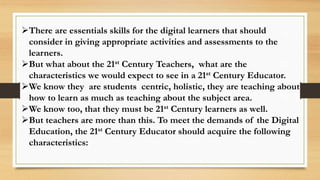
There are essentials skills for the digital learners that should
consider in giving appropriate activities and assessments to the
learners.
But what about the 21st Century Teachers, what are the
characteristics we would expect to see in a 21st Century Educator.
We know they are students centric, holistic, they are teaching about
how to learn as much as teaching about the subject area.
We know too, that they must be 21st Century learners as well.
But teachers are more than this. To meet the demands of the Digital
Education, the 21st Century Educator should acquire the following
characteristics:
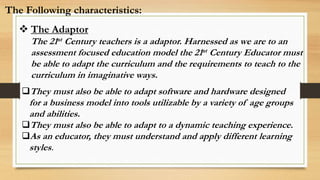
The Following characteristics:
 The Adaptor
The 21st Century teachers is a adaptor. Harnessed as we are to an
assessment focused education model the 21st Century Educator must
be able to adapt the curriculum and the requirements to teach to the
curriculum in imaginative ways.
They must also be able to adapt software and hardware designed
for a business model into tools utilizable by a variety of age groups
and abilities.
They must also be able to adapt to a dynamic teaching experience.
As an educator, they must understand and apply different learning
styles.
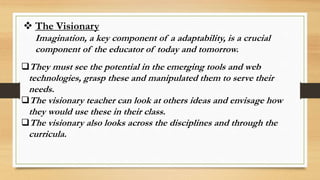
 The Visionary
Imagination, a key component of a adaptability, is a crucial
component of the educator of today and tomorrow.
They must see the potential in the emerging tools and web
technologies, grasp these and manipulated them to serve their
needs.
The visionary teacher can look at others ideas and envisage how
they would use these in their class.
The visionary also looks across the disciplines and through the
curricula.
The collaborator
 Ning, Blogger, Wikispace, Bebo, MSN, MySpace, Second Life-
as an educator we must be able to leverage these collaborative
tools to enhance and captivate our learners.
The Risk Taker
How can you as an educator know all these things? How
can you teach them how to use them? There are so many, so
much to learn.
A 21st Century Educator must take risk and some times surrender
yourself to the students knowledge.
Have a vision of what you want and what the technology can
achieve, Identify the goals and facilitate the learning.
 The learner
 We expect our students to be life long learner. How many
schools have the phrase “life long learners” in their statements
and objective.
The communicator
 The 21st Century teachers are fluent in tools and technologies
that enable communication and collaboration.
 They know how to use different media in communication.
 It allows students to be able to express their insights and share
their thoughts in a topic or any issues that concern them.
The Model
 The Digital teacher must model the behaviors that are expected
from their students.
 The 21st Century Educators also models reflective practice,, or
through reflective practice via blogs, twitter and other medium,
these educators look both inwards and outwards.
 These teachers also model a number of other characteristics.
These are not necessarily associated with ICT or the curriculum,
but are of equal importance.
The Leader
 Leadership, like clear goals and objectives is crucial to the
success or failure of any project.
 Tolerance
 Acceptance
 A wider view than just their curricula areas
 Global awareness
 Reflection
 They model:
Facilitating 21st Century Learning
 ICT is an abbreviation for information and Communication
Technologies.
 In facilitating 21st Century learning, there are three factors that
administrators and educators are deliberately considering in the
implementation of technology in education.
1.Resources
2.Skills
3.Curriculum

Edtech #2

  • 1.
  • 2.
    There are essentialsskills for the digital learners that should consider in giving appropriate activities and assessments to the learners. But what about the 21st Century Teachers, what are the characteristics we would expect to see in a 21st Century Educator. We know they are students centric, holistic, they are teaching about how to learn as much as teaching about the subject area. We know too, that they must be 21st Century learners as well. But teachers are more than this. To meet the demands of the Digital Education, the 21st Century Educator should acquire the following characteristics:
  • 3.
    The Following characteristics: The Adaptor The 21st Century teachers is a adaptor. Harnessed as we are to an assessment focused education model the 21st Century Educator must be able to adapt the curriculum and the requirements to teach to the curriculum in imaginative ways. They must also be able to adapt software and hardware designed for a business model into tools utilizable by a variety of age groups and abilities. They must also be able to adapt to a dynamic teaching experience. As an educator, they must understand and apply different learning styles.
  • 4.
     The Visionary Imagination,a key component of a adaptability, is a crucial component of the educator of today and tomorrow. They must see the potential in the emerging tools and web technologies, grasp these and manipulated them to serve their needs. The visionary teacher can look at others ideas and envisage how they would use these in their class. The visionary also looks across the disciplines and through the curricula.
  • 5.
    The collaborator  Ning,Blogger, Wikispace, Bebo, MSN, MySpace, Second Life- as an educator we must be able to leverage these collaborative tools to enhance and captivate our learners. The Risk Taker How can you as an educator know all these things? How can you teach them how to use them? There are so many, so much to learn. A 21st Century Educator must take risk and some times surrender yourself to the students knowledge. Have a vision of what you want and what the technology can achieve, Identify the goals and facilitate the learning.
  • 6.
     The learner We expect our students to be life long learner. How many schools have the phrase “life long learners” in their statements and objective. The communicator  The 21st Century teachers are fluent in tools and technologies that enable communication and collaboration.  They know how to use different media in communication.  It allows students to be able to express their insights and share their thoughts in a topic or any issues that concern them.
  • 7.
    The Model  TheDigital teacher must model the behaviors that are expected from their students.  The 21st Century Educators also models reflective practice,, or through reflective practice via blogs, twitter and other medium, these educators look both inwards and outwards.  These teachers also model a number of other characteristics. These are not necessarily associated with ICT or the curriculum, but are of equal importance.
  • 8.
    The Leader  Leadership,like clear goals and objectives is crucial to the success or failure of any project.  Tolerance  Acceptance  A wider view than just their curricula areas  Global awareness  Reflection  They model:
  • 9.
    Facilitating 21st CenturyLearning  ICT is an abbreviation for information and Communication Technologies.  In facilitating 21st Century learning, there are three factors that administrators and educators are deliberately considering in the implementation of technology in education. 1.Resources 2.Skills 3.Curriculum