MULTICULTURAL SCHOOL AND 
THE 21ST CENTURY KEY 
COMPETENCES 
OF GLOBAL CITIZENS 
Tiina Sarisalmi 
STEPS 6 - Tampere 
Wednesday 29th October
CONTENTS 
Multicultural school & education 
21st century key competences and global 
citizenship 
Finnish core curriculum 2016 
Values 
School Culture 
 Cross-curricular approach 
 Other aspects 
TODAYSMEET: https://todaysmeet.com/STEPS- 
6 
TI INA SARISALMI STEPS 6 OCTOBER 29TH, 2014
DEFINITION OF 
MULTICULTURALISM 
Multiculturalism is a system of beliefs and 
behaviors that 
recognizes and respects the presence of all 
diverse groups in an organization or society, 
acknowledges and values their socio-cultural 
differences, and 
encourages and enables their continued 
contribution within an inclusive cultural 
context which 
empowers all within the organization or 
society. 
TI INA SARISALMI STEPS 6 OCTOBER 29TH, 2014
MULTICULTURAL SCHOOL 
Many schools think they are multicultural simply because 
there’s ethnic diversity present 
Not enough 
 Multicultural school acknowledges and respects the 
contributions which the various racial/ethnic groups have 
made to society, and integrates these contributions in the 
curriculum and school culture which meet the needs of an 
ever-changing society and is sensitive to the personal and 
social development of all persons concerned. 
TI INA SARISALMI STEPS 6 OCTOBER 29TH, 2014
FIVE DIMENSIONS OF 
MULTICULTURALISM IN EDUCATION: 
1. Content integration 
 different cultural contents, while that’s 
important, that’s really only one dimension 
2. Knowledge construction 
 find assumptions and attitudes behind 
information  becoming critical 
thinkers/learners 
3. Equity pedagogy 
 teachers change their methods to enable kids 
from diverse racial groups and both genders to 
achieve 
TI INA SARISALMI STEPS 6 OCTOBER 29TH, 2014
FIVE DIMENSIONS OF 
MULTICULTURALISM IN EDUCATION: 
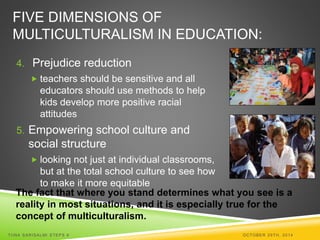
4. Prejudice reduction 
 teachers should be sensitive and all 
educators should use methods to help 
kids develop more positive racial 
attitudes 
5. Empowering school culture and 
social structure 
 looking not just at individual classrooms, 
but at the total school culture to see how 
to make it more equitable 
The fact that where you stand determines what you see is a 
reality in most situations, and it is especially true for the 
concept of multiculturalism. 
TI INA SARISALMI STEPS 6 OCTOBER 29TH, 2014
MULTICULTURAL SCHOOL 
Students grow up in a multicultural and multilingual world. 
Culturally sustainable life style and living in a manifold 
environment entail intercultural competence, respectful 
communication and interaction skills and know-how to express 
oneself and one’s opinions. 
Students are guided in putting themslves in the positions of 
others and look at things/issues from different perspectives. At 
school the knowledge of and respect for human and children’s 
rights and world cultural heritage as well as respect and trust of 
people of different ethnical backgrounds and interest in 
international cooperation. 
TI INA SARISALMI STEPS 6 OCTOBER 29TH, 2014
THINK AND DISCUSS! 
What about your classroom and school? 
 Which of the five dimensions of multiculturalism in 
education have you implemented and how? What have you 
done? What could you do? 
 Five Ps 
1. Content integration 
2. Knowledge construction 
3. Equity pedagogy 
4. Prejudice reduction 
5. Empowering the whole school culture 
TODAYSMEET 
Perspectiv 
esPolicies 
Programs 
Personnel 
Practices 
TI INA SARISALMI STEPS 6 OCTOBER 29TH, 2014
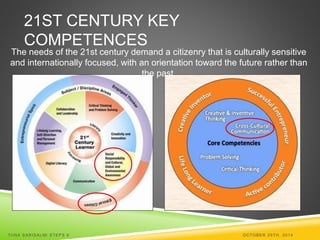
21ST CENTURY KEY 
COMPETENCES 
The needs of the 21st century demand a citizenry that is culturally sensitive 
and internationally focused, with an orientation toward the future rather than 
the past. 
TI INA SARISALMI STEPS 6 OCTOBER 29TH, 2014
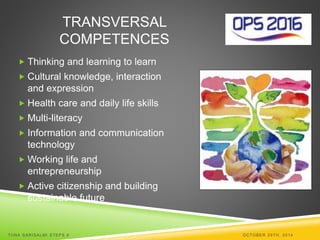
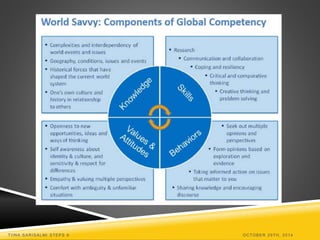
TRANSVERSAL 
COMPETENCES 
 Thinking and learning to learn 
 Cultural knowledge, interaction 
and expression 
 Health care and daily life skills 
 Multi-literacy 
 Information and communication 
technology 
Working life and 
entrepreneurship 
 Active citizenship and building 
sustainable future 
TI INA SARISALMI STEPS 6 OCTOBER 29TH, 2014
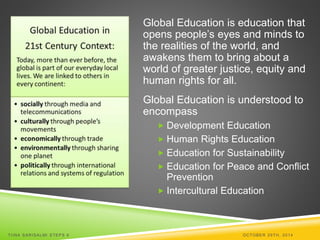
Global Education is education that 
opens people’s eyes and minds to 
the realities of the world, and 
awakens them to bring about a 
world of greater justice, equity and 
human rights for all. 
Global Education is understood to 
encompass 
 Development Education 
 Human Rights Education 
 Education for Sustainability 
 Education for Peace and Conflict 
Prevention 
 Intercultural Education 
TI INA SARISALMI STEPS 6 OCTOBER 29TH, 2014
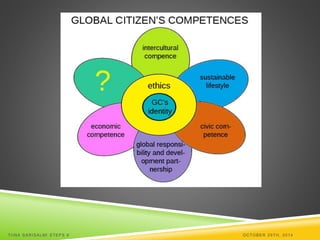
LINKS TO COMPETENCE PADLETS 
 Intercultural Competence 
Padlet 
Sustainable Life Style 
Padlet 
 Civic Competence Padlet 
 Global Responsibility and 
Development Padlet 
Economic Competence 
Padlet 
New Ideas - ? - Padlet 
TI INA SARISALMI STEPS 6 OCTOBER 29TH, 2014
THINK AND DISCUSS! 
What about your classroom and 
school? 
 Which areas of Global Education 
are already integrated in the 
curriculum or syllabus you follow? 
How? In which school subjects? 
 Which global competences are 
learned/developed in your 
classroom? 
TODAYSMEET 
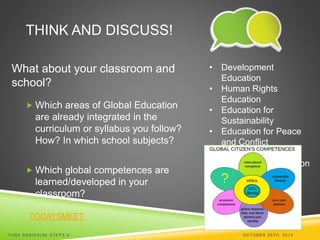
• Development 
Education 
• Human Rights 
Education 
• Education for 
Sustainability 
• Education for Peace 
and Conflict 
Prevention 
• Intercultural Education 
TI INA SARISALMI STEPS 6 OCTOBER 29TH, 2014
VALUES 
Education ensures that both individuals and communities 
are able to solve conflicts basing the solutions on ethical 
reflection, empathy and informed consideration. 
Education is based on the respect for life and human 
rights and guides students to defend them. It promotes 
well-being, democracy and active citizenship in civil 
society. Development towards equality is at the basis of 
education. It includes economic, social, regional and 
gender equality. 
 In education, the necessity of sustainability is 
acknowledged, schools act accordingly and guide 
students to adop a sustainable lifestyle. The dimensions of 
sustainable development and lifestyle are ecological and 
economic as well as social and cultural. 
TI INA SARISALMI STEPS 6 OCTOBER 29TH, 2014
SCHOOL CULTURE 
The school as a learning community is a part of a 
culturally diverse and changing society in which the 
local and global overlap. Different identities, 
languages, religions and beliefs, coexist and interact 
with each other. School exploits the country’s own 
cultural heritage as well as the cultural and linguistic 
diversity of the community around it. 
 One of the manifestations of cultural diversity is 
multilingualism. Different languages co-exist side by 
side in everyday school life. It is considered natural 
and enriching. All languages are valued. 
TI INA SARISALMI STEPS 6 OCTOBER 29TH, 2014
CROSS-CURRICULAR LEARNING 
 The goal of cross-curricular or phenomenon-based learning is to 
help students understand the relations and interdependencies 
between the issues studied in different school subjects… to be 
able to study the real world phenomena and look at them from 
different perspectives or … as entities. 
 Cross-curricular learning projects are designed to broaden 
students' experiences with the goal 
 to strengthen the students' participation 
 provide opportunities to combine formal and informal learning 
 provide space for intellectual curiosity, experiences and creativity 
 … to train the sustainable way of life and to inspire students to act 
in the community and society in a constructive way. 
TI INA SARISALMI STEPS 6 OCTOBER 29TH, 2014
INTERACTION AND 
INTERNATIONAL 
COOPERATION 
Students are encouraged to interaction and self-expression 
even if their language skills aren’t very well-developed. 
Students get experiences about using ICT in international 
interaction and encounters. This way they can better 
conceive its meaning and possibilities in the global world. 
Conections with schools in different countries enhance 
global citizen’s skills. They encourage students to act to 
promote equity, human rights and peace. 
TI INA SARISALMI STEPS 6 OCTOBER 29TH, 2014
LANGUAGE EDUCATION 
 Students’ language skills start to develop in early childhood and it 
goes on as a life-long process. Multilingual competence develops 
at hoem, schools and free-time… Language instruction at school 
is based on using language in different situations. It strengthens 
student’s language awereness and the parallel use of different 
languages. Student learns to detect texts in different languages 
and different ways of interaction, to use linguistic terminology and 
concepts in the interpratation of texts and make use of different 
ways of learning languages. 
 Student uses his knowledge of different languages to enhance 
her/his learning in general. Student is guided to read texts that 
suit her/his level of language competence and aquire information 
in different languages. 
TI INA SARISALMI STEPS 6 OCTOBER 29TH, 2014
BILINGUAL INSTRUCTION 
 The goal of bilingual instruction is to achieve good and 
varied language skills in the school’s language of 
instruction and in the target language. 
 The long-term goal of bilingual instruction is to create a 
foundation for life-long language learning and 
appreciation of linguistic and cultural diversity. 
 In bilingual education pupils are offered an authentic 
language learning environment. 
TI INA SARISALMI STEPS 6 OCTOBER 29TH, 2014
INTERESTING 
APPROACHES 
Reading to Learn Method: 
 http://www.readingtolearn.com. 
au/ 
 science lesson videos 
Language Education Forum 
 Forum materials 
TodaysMeet 
 https://todaysmeet.com/STEPS 
-6 
TI INA SARISALMI STEPS 6 OCTOBER 29TH, 2014
Olen suomalainen 
 http://youtu.be/v7ch4mJ51CA 
Tiina Sarisalmi 
 tiina.sarisalmi@orivesi.fi 
 http://schoolsgoingglobal.blogspot.fi/ 
 http://kvmentoriohjelma.wordpress.com/ 
TI INA SARISALMI STEPS 6 OCTOBER 29TH, 2014

Multicultural School and 21st Century Key Competences for Global Citizens

  • 1.
    MULTICULTURAL SCHOOL AND THE 21ST CENTURY KEY COMPETENCES OF GLOBAL CITIZENS Tiina Sarisalmi STEPS 6 - Tampere Wednesday 29th October
  • 2.
    CONTENTS Multicultural school& education 21st century key competences and global citizenship Finnish core curriculum 2016 Values School Culture  Cross-curricular approach  Other aspects TODAYSMEET: https://todaysmeet.com/STEPS- 6 TI INA SARISALMI STEPS 6 OCTOBER 29TH, 2014
  • 3.
    DEFINITION OF MULTICULTURALISM Multiculturalism is a system of beliefs and behaviors that recognizes and respects the presence of all diverse groups in an organization or society, acknowledges and values their socio-cultural differences, and encourages and enables their continued contribution within an inclusive cultural context which empowers all within the organization or society. TI INA SARISALMI STEPS 6 OCTOBER 29TH, 2014
  • 4.
    MULTICULTURAL SCHOOL Manyschools think they are multicultural simply because there’s ethnic diversity present Not enough  Multicultural school acknowledges and respects the contributions which the various racial/ethnic groups have made to society, and integrates these contributions in the curriculum and school culture which meet the needs of an ever-changing society and is sensitive to the personal and social development of all persons concerned. TI INA SARISALMI STEPS 6 OCTOBER 29TH, 2014
  • 5.
    FIVE DIMENSIONS OF MULTICULTURALISM IN EDUCATION: 1. Content integration  different cultural contents, while that’s important, that’s really only one dimension 2. Knowledge construction  find assumptions and attitudes behind information  becoming critical thinkers/learners 3. Equity pedagogy  teachers change their methods to enable kids from diverse racial groups and both genders to achieve TI INA SARISALMI STEPS 6 OCTOBER 29TH, 2014
  • 6.
    FIVE DIMENSIONS OF MULTICULTURALISM IN EDUCATION: 4. Prejudice reduction  teachers should be sensitive and all educators should use methods to help kids develop more positive racial attitudes 5. Empowering school culture and social structure  looking not just at individual classrooms, but at the total school culture to see how to make it more equitable The fact that where you stand determines what you see is a reality in most situations, and it is especially true for the concept of multiculturalism. TI INA SARISALMI STEPS 6 OCTOBER 29TH, 2014
  • 7.
    MULTICULTURAL SCHOOL Studentsgrow up in a multicultural and multilingual world. Culturally sustainable life style and living in a manifold environment entail intercultural competence, respectful communication and interaction skills and know-how to express oneself and one’s opinions. Students are guided in putting themslves in the positions of others and look at things/issues from different perspectives. At school the knowledge of and respect for human and children’s rights and world cultural heritage as well as respect and trust of people of different ethnical backgrounds and interest in international cooperation. TI INA SARISALMI STEPS 6 OCTOBER 29TH, 2014
  • 8.
    THINK AND DISCUSS! What about your classroom and school?  Which of the five dimensions of multiculturalism in education have you implemented and how? What have you done? What could you do?  Five Ps 1. Content integration 2. Knowledge construction 3. Equity pedagogy 4. Prejudice reduction 5. Empowering the whole school culture TODAYSMEET Perspectiv esPolicies Programs Personnel Practices TI INA SARISALMI STEPS 6 OCTOBER 29TH, 2014
  • 9.
    21ST CENTURY KEY COMPETENCES The needs of the 21st century demand a citizenry that is culturally sensitive and internationally focused, with an orientation toward the future rather than the past. TI INA SARISALMI STEPS 6 OCTOBER 29TH, 2014
  • 10.
    TRANSVERSAL COMPETENCES Thinking and learning to learn  Cultural knowledge, interaction and expression  Health care and daily life skills  Multi-literacy  Information and communication technology Working life and entrepreneurship  Active citizenship and building sustainable future TI INA SARISALMI STEPS 6 OCTOBER 29TH, 2014
  • 11.
    Global Education iseducation that opens people’s eyes and minds to the realities of the world, and awakens them to bring about a world of greater justice, equity and human rights for all. Global Education is understood to encompass  Development Education  Human Rights Education  Education for Sustainability  Education for Peace and Conflict Prevention  Intercultural Education TI INA SARISALMI STEPS 6 OCTOBER 29TH, 2014
  • 12.
    TI INA SARISALMISTEPS 6 OCTOBER 29TH, 2014
  • 13.
    LINKS TO COMPETENCEPADLETS  Intercultural Competence Padlet Sustainable Life Style Padlet  Civic Competence Padlet  Global Responsibility and Development Padlet Economic Competence Padlet New Ideas - ? - Padlet TI INA SARISALMI STEPS 6 OCTOBER 29TH, 2014
  • 14.
    TI INA SARISALMISTEPS 6 OCTOBER 29TH, 2014
  • 15.
    THINK AND DISCUSS! What about your classroom and school?  Which areas of Global Education are already integrated in the curriculum or syllabus you follow? How? In which school subjects?  Which global competences are learned/developed in your classroom? TODAYSMEET • Development Education • Human Rights Education • Education for Sustainability • Education for Peace and Conflict Prevention • Intercultural Education TI INA SARISALMI STEPS 6 OCTOBER 29TH, 2014
  • 16.
    VALUES Education ensuresthat both individuals and communities are able to solve conflicts basing the solutions on ethical reflection, empathy and informed consideration. Education is based on the respect for life and human rights and guides students to defend them. It promotes well-being, democracy and active citizenship in civil society. Development towards equality is at the basis of education. It includes economic, social, regional and gender equality.  In education, the necessity of sustainability is acknowledged, schools act accordingly and guide students to adop a sustainable lifestyle. The dimensions of sustainable development and lifestyle are ecological and economic as well as social and cultural. TI INA SARISALMI STEPS 6 OCTOBER 29TH, 2014
  • 17.
    SCHOOL CULTURE Theschool as a learning community is a part of a culturally diverse and changing society in which the local and global overlap. Different identities, languages, religions and beliefs, coexist and interact with each other. School exploits the country’s own cultural heritage as well as the cultural and linguistic diversity of the community around it.  One of the manifestations of cultural diversity is multilingualism. Different languages co-exist side by side in everyday school life. It is considered natural and enriching. All languages are valued. TI INA SARISALMI STEPS 6 OCTOBER 29TH, 2014
  • 18.
    CROSS-CURRICULAR LEARNING The goal of cross-curricular or phenomenon-based learning is to help students understand the relations and interdependencies between the issues studied in different school subjects… to be able to study the real world phenomena and look at them from different perspectives or … as entities.  Cross-curricular learning projects are designed to broaden students' experiences with the goal  to strengthen the students' participation  provide opportunities to combine formal and informal learning  provide space for intellectual curiosity, experiences and creativity  … to train the sustainable way of life and to inspire students to act in the community and society in a constructive way. TI INA SARISALMI STEPS 6 OCTOBER 29TH, 2014
  • 19.
    INTERACTION AND INTERNATIONAL COOPERATION Students are encouraged to interaction and self-expression even if their language skills aren’t very well-developed. Students get experiences about using ICT in international interaction and encounters. This way they can better conceive its meaning and possibilities in the global world. Conections with schools in different countries enhance global citizen’s skills. They encourage students to act to promote equity, human rights and peace. TI INA SARISALMI STEPS 6 OCTOBER 29TH, 2014
  • 20.
    LANGUAGE EDUCATION Students’ language skills start to develop in early childhood and it goes on as a life-long process. Multilingual competence develops at hoem, schools and free-time… Language instruction at school is based on using language in different situations. It strengthens student’s language awereness and the parallel use of different languages. Student learns to detect texts in different languages and different ways of interaction, to use linguistic terminology and concepts in the interpratation of texts and make use of different ways of learning languages.  Student uses his knowledge of different languages to enhance her/his learning in general. Student is guided to read texts that suit her/his level of language competence and aquire information in different languages. TI INA SARISALMI STEPS 6 OCTOBER 29TH, 2014
  • 21.
    BILINGUAL INSTRUCTION The goal of bilingual instruction is to achieve good and varied language skills in the school’s language of instruction and in the target language.  The long-term goal of bilingual instruction is to create a foundation for life-long language learning and appreciation of linguistic and cultural diversity.  In bilingual education pupils are offered an authentic language learning environment. TI INA SARISALMI STEPS 6 OCTOBER 29TH, 2014
  • 22.
    INTERESTING APPROACHES Readingto Learn Method:  http://www.readingtolearn.com. au/  science lesson videos Language Education Forum  Forum materials TodaysMeet  https://todaysmeet.com/STEPS -6 TI INA SARISALMI STEPS 6 OCTOBER 29TH, 2014
  • 23.
    Olen suomalainen http://youtu.be/v7ch4mJ51CA Tiina Sarisalmi  tiina.sarisalmi@orivesi.fi  http://schoolsgoingglobal.blogspot.fi/  http://kvmentoriohjelma.wordpress.com/ TI INA SARISALMI STEPS 6 OCTOBER 29TH, 2014