Using Smart Technology to Improve Global Health Initiatives Suzanne Rainey Angela Milton Joe Pringle July 29, 2008 Presented at SID/W
Agenda Introductions Overview Examples Discussion:   How can we and our communities benefit from these tools? What are you doing at your organization now? Where are the gaps/challenges? Looking forward.
Welcome to…. SID/W Global Health  Internet   Olympics 2008!  Stretch your mind! Test your limits!
How Many Do We Have Today? Bloggers? LinkedIn? Facebook? Tweeters? Online community managers? Web masters? Twittervision
Overview
 
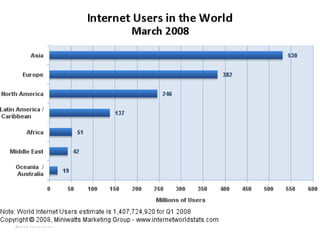
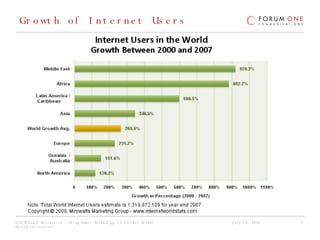
Growth of Internet Users
Worldwide mobile telephone subscriptions reached 3.3 billion -- equivalent to half the global population -- on Thursday, 26 years after the first cellular network was launched  Reuters, Nov 29, 2007  Cellphone usage in Africa is growing almost twice as fast as any other region…152 million in 2006.
“ As online communities spread across the world, Wikipedia's knowledge-sharing can free us from poverty and ignorance.” Jimmy Wales, founder, Wikipedia
How is this relevant to you?  You need to: Run successful projects Facilitate knowledge sharing Build capacity Influence policy makers Connect with co-workers and lots of other people Demonstrate progress and success Online tools aren’t THE solution, but they’re often part of the most effective solutions in global health.
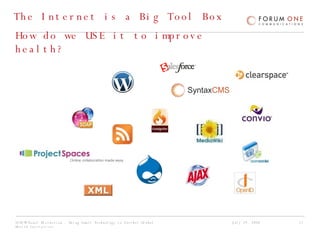
The Internet is a Big Tool Box How do we USE it to improve health? Syntax CMS
Examples
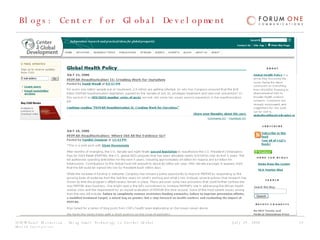
Blogs: Center for Global Development
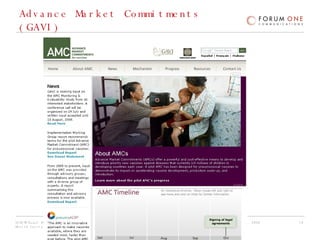
Advance Market Commitments (GAVI)
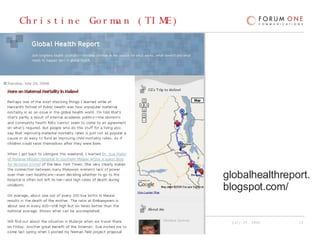
Christine Gorman (TIME) globalhealthreport. blogspot.com/
Communal Libraries
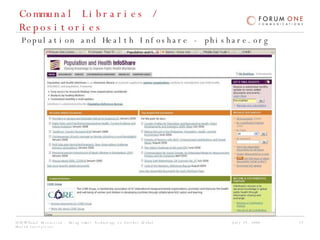
Communal Libraries / Repositories Population and Health Infoshare - phishare.org
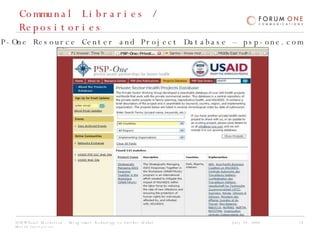
Communal Libraries / Repositories PSP-One Resource Center and Project Database – psp-one.com
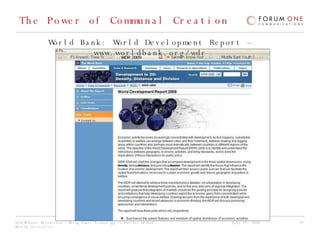
The Power of Communal Creation World Bank: World Development Report –  www.worldbank.org/wdr
Social Media Tools
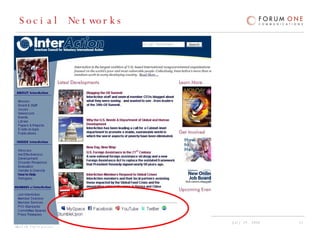
Social Networks
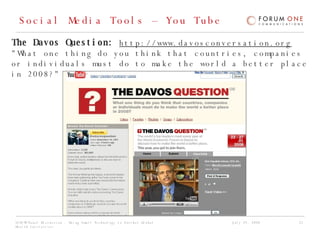
Social Media Tools – You Tube The Davos Question:  http://www.davosconversation.org "What one thing do you think that countries, companies or individuals must do to make the world a better place in 2008?"
 
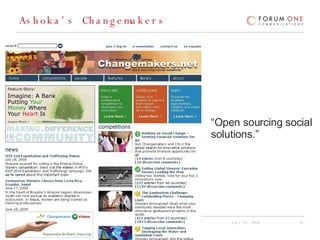
Ashoka’s Changemakers “ Open sourcing social solutions.”
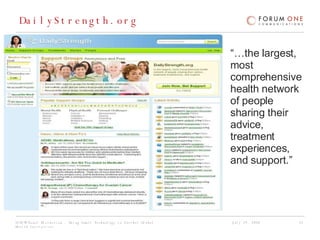
DailyStrength.org “… the largest, most comprehensive health network of people sharing their advice, treatment experiences, and support.”
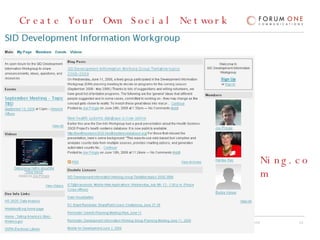
Create Your Own Social Network Ning.com
Interaction & Collaboration Online Tools to help people: understand data,  manage knowledge, and  collaborate with each other
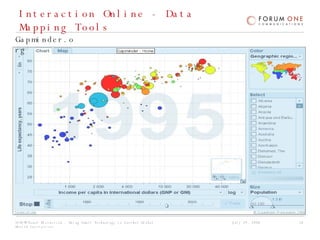
Interaction Online - Data Mapping Tools Gapminder.org
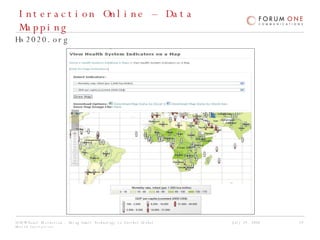
Interaction Online – Data Mapping Hs2020.org
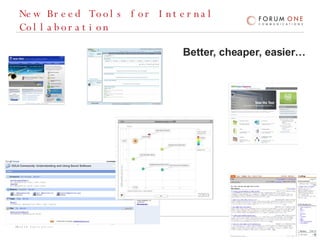
New Breed Tools for Internal Collaboration Better, cheaper, easier…
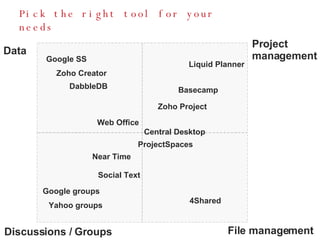
Pick the right tool for your needs Project  management Discussions / Groups Data Web Office Basecamp Yahoo groups ProjectSpaces Social Text Near Time File management Google groups Zoho Project Google SS Central Desktop Zoho Creator Liquid Planner 4Shared DabbleDB
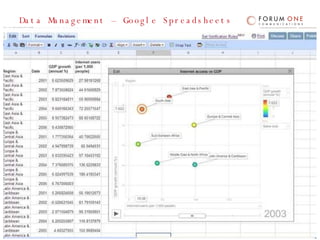
Data Management – Google Spreadsheets
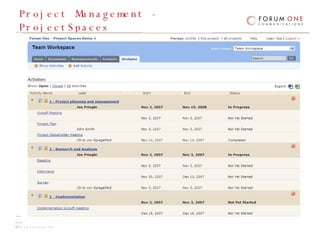
Project Management - ProjectSpaces
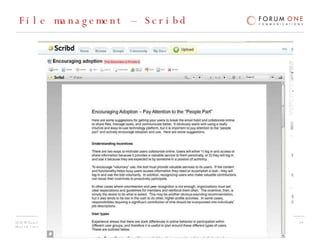
File management – Scribd
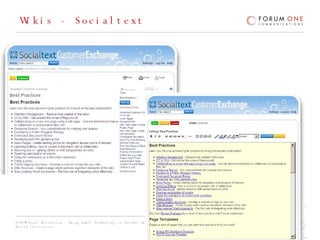
Wikis - Socialtext
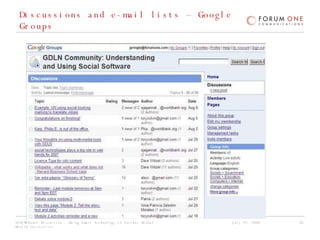
Discussions and e-mail lists – Google Groups
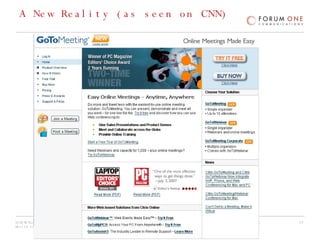
A New Reality (as seen on CNN)
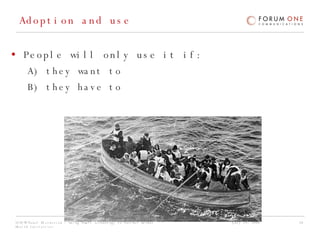
Adoption and use People will only use it if: A) they want to B) they have to
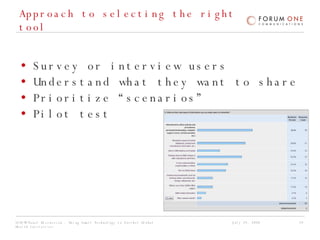
Approach to selecting the right tool Survey or interview users Understand what they want to share Prioritize “scenarios” Pilot test
Pay attention to the people part Explain why you are using the tool Define expectations for participating Help them get started
Discussion How can the community benefit from these tools? What are you already doing? What are challenges do you face, or foresee in adopting new technologies? Thanks! [email_address]   [email_address]

Using Smart Technology to Improve Global Health Initiatives

  • 1.
    Using Smart Technologyto Improve Global Health Initiatives Suzanne Rainey Angela Milton Joe Pringle July 29, 2008 Presented at SID/W
  • 2.
    Agenda Introductions OverviewExamples Discussion: How can we and our communities benefit from these tools? What are you doing at your organization now? Where are the gaps/challenges? Looking forward.
  • 3.
    Welcome to…. SID/WGlobal Health Internet Olympics 2008! Stretch your mind! Test your limits!
  • 4.
    How Many DoWe Have Today? Bloggers? LinkedIn? Facebook? Tweeters? Online community managers? Web masters? Twittervision
  • 5.
  • 6.
  • 7.
  • 8.
    Worldwide mobile telephonesubscriptions reached 3.3 billion -- equivalent to half the global population -- on Thursday, 26 years after the first cellular network was launched Reuters, Nov 29, 2007 Cellphone usage in Africa is growing almost twice as fast as any other region…152 million in 2006.
  • 9.
    “ As onlinecommunities spread across the world, Wikipedia's knowledge-sharing can free us from poverty and ignorance.” Jimmy Wales, founder, Wikipedia
  • 10.
    How is thisrelevant to you? You need to: Run successful projects Facilitate knowledge sharing Build capacity Influence policy makers Connect with co-workers and lots of other people Demonstrate progress and success Online tools aren’t THE solution, but they’re often part of the most effective solutions in global health.
  • 11.
    The Internet isa Big Tool Box How do we USE it to improve health? Syntax CMS
  • 12.
  • 13.
    Blogs: Center forGlobal Development
  • 14.
  • 15.
    Christine Gorman (TIME)globalhealthreport. blogspot.com/
  • 16.
  • 17.
    Communal Libraries /Repositories Population and Health Infoshare - phishare.org
  • 18.
    Communal Libraries /Repositories PSP-One Resource Center and Project Database – psp-one.com
  • 19.
    The Power ofCommunal Creation World Bank: World Development Report – www.worldbank.org/wdr
  • 20.
  • 21.
  • 22.
    Social Media Tools– You Tube The Davos Question: http://www.davosconversation.org "What one thing do you think that countries, companies or individuals must do to make the world a better place in 2008?"
  • 23.
  • 24.
    Ashoka’s Changemakers “Open sourcing social solutions.”
  • 25.
    DailyStrength.org “… thelargest, most comprehensive health network of people sharing their advice, treatment experiences, and support.”
  • 26.
    Create Your OwnSocial Network Ning.com
  • 27.
    Interaction & CollaborationOnline Tools to help people: understand data, manage knowledge, and collaborate with each other
  • 28.
    Interaction Online -Data Mapping Tools Gapminder.org
  • 29.
    Interaction Online –Data Mapping Hs2020.org
  • 30.
    New Breed Toolsfor Internal Collaboration Better, cheaper, easier…
  • 31.
    Pick the righttool for your needs Project management Discussions / Groups Data Web Office Basecamp Yahoo groups ProjectSpaces Social Text Near Time File management Google groups Zoho Project Google SS Central Desktop Zoho Creator Liquid Planner 4Shared DabbleDB
  • 32.
    Data Management –Google Spreadsheets
  • 33.
    Project Management -ProjectSpaces
  • 34.
  • 35.
  • 36.
    Discussions and e-maillists – Google Groups
  • 37.
    A New Reality(as seen on CNN)
  • 38.
    Adoption and usePeople will only use it if: A) they want to B) they have to
  • 39.
    Approach to selectingthe right tool Survey or interview users Understand what they want to share Prioritize “scenarios” Pilot test
  • 40.
    Pay attention tothe people part Explain why you are using the tool Define expectations for participating Help them get started
  • 41.
    Discussion How canthe community benefit from these tools? What are you already doing? What are challenges do you face, or foresee in adopting new technologies? Thanks! [email_address] [email_address]

Editor's Notes

  • #2 Welcome and good afternoon! We’re very excited that you’ve joined us. I’m Suzanne Rainey, a Director of Business Development with Forum One. I feel honored to be in this room with you all, because so many of you have dedicated your careers to helping solve some of the most pressing health challenges of our time. Thank you for joining us, and I also look forward to hearing from our panelists today about some really innovative & creative approaches to global health today. Before we get started, I need to review a few logistical points for our morning together: If you haven’t already, please silence your cell phones. We will take a short break at 9:45 for coffee and networking and we’ll wrap up at 11:00 sharp. Bathrooms are outside & around the corner to the right. Some of us are going to lunch together after the event. Please join us! We’ll meet at the base of the stairs immediately following the event, and then go down to the food court together. There are a number of choices, and a big space for us to convene & talk more. Introductions: This is a gathering of some of the smartest people in Washington grappling with global health issues, and this event is as much about you as our panel. So we’d like to do a round of introductions. A list of attendees are in the packet, and if you’re looking to talk to someone during the break, this is your chance to put a face with the name. As we go around, please STAND, and share your Name Organization Role Thank you all – as usual, a great group. So – On to Global Health & the Internet