In step six we will look at how to:
1 Hold governments and others to account.
STEP SIX
Seek accountability
Accountability
The process of holding governments, organisations or
individuals responsible for their commitments and actions.
Transparency
When people are involved in decision-making and the life of
their communities (both locally and globally).
Participation
When governments, organisations or individuals work in a
way that is easy for outsiders to see their actions, plans,
processes, rules and the information they hold.
KEY TERMS (recap)
Accountability, participation and transparency are all crucial for good governance.
Good governance will be essential for achieving the SDGs.
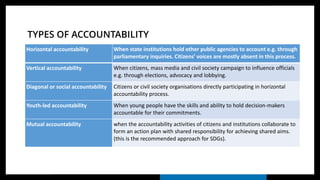
Horizontal accountability When state institutions hold other public agencies to account e.g. through
parliamentary inquiries. Citizens’ voices are mostly absent in this process.
Vertical accountability When citizens, mass media and civil society campaign to influence officials
e.g. through elections, advocacy and lobbying.
Diagonal or social accountability Citizens or civil society organisations directly participating in horizontal
accountability process.
Youth-led accountability When young people have the skills and ability to hold decision-makers
accountable for their commitments.
Mutual accountability when the accountability activities of citizens and institutions collaborate to
form an action plan with shared responsibility for achieving shared aims.
(this is the recommended approach for SDGs).
TYPES OF ACCOUNTABILITY
The SDGs will be monitored at different levels, from community level to the global level.
To be effective, decide at which level you will target your efforts.
WHERE SHOULD YOU START?
CHOOSE YOUR ENTRY POINTS
Selecting your entry points
ACTIVITY
1. Review the SDG Accountability Matrix.
2. Identify the primary level you want to target.
3. Be realistic.
4. Identify the secondary level you want to target.
There are 4 main ways:
1. Reporting
2. Supporting
3. Connecting
4. Advocacy
CHOOSING YOUR APPROACH
RECAP
Looked at different accountability methods and entry
points.
In step six we have:
Selected your primary and secondary entry points
for your framework.
Considered what approach your team will take.
This project has been funded with support from the European Commission.
This publication ‘Accountability in action training’ reflects the views of the author, and the Commission
cannot be held responsible for any use which may be made of the information contained therein.
This project is led by Restless Development and draws together a consortium
of youth-led and youth-focused organisations from around the world.
Together they have a wealth of experience in supporting young people to
play a leading role in governance and accountability.

Accountability in Action - Step Six

  • 1.
    In step sixwe will look at how to: 1 Hold governments and others to account. STEP SIX Seek accountability
  • 2.
    Accountability The process ofholding governments, organisations or individuals responsible for their commitments and actions. Transparency When people are involved in decision-making and the life of their communities (both locally and globally). Participation When governments, organisations or individuals work in a way that is easy for outsiders to see their actions, plans, processes, rules and the information they hold. KEY TERMS (recap) Accountability, participation and transparency are all crucial for good governance. Good governance will be essential for achieving the SDGs.
  • 3.
    Horizontal accountability Whenstate institutions hold other public agencies to account e.g. through parliamentary inquiries. Citizens’ voices are mostly absent in this process. Vertical accountability When citizens, mass media and civil society campaign to influence officials e.g. through elections, advocacy and lobbying. Diagonal or social accountability Citizens or civil society organisations directly participating in horizontal accountability process. Youth-led accountability When young people have the skills and ability to hold decision-makers accountable for their commitments. Mutual accountability when the accountability activities of citizens and institutions collaborate to form an action plan with shared responsibility for achieving shared aims. (this is the recommended approach for SDGs). TYPES OF ACCOUNTABILITY
  • 4.
    The SDGs willbe monitored at different levels, from community level to the global level. To be effective, decide at which level you will target your efforts. WHERE SHOULD YOU START? CHOOSE YOUR ENTRY POINTS
  • 5.
    Selecting your entrypoints ACTIVITY 1. Review the SDG Accountability Matrix. 2. Identify the primary level you want to target. 3. Be realistic. 4. Identify the secondary level you want to target.
  • 6.
    There are 4main ways: 1. Reporting 2. Supporting 3. Connecting 4. Advocacy CHOOSING YOUR APPROACH
  • 7.
    RECAP Looked at differentaccountability methods and entry points. In step six we have: Selected your primary and secondary entry points for your framework. Considered what approach your team will take.
  • 8.
    This project hasbeen funded with support from the European Commission. This publication ‘Accountability in action training’ reflects the views of the author, and the Commission cannot be held responsible for any use which may be made of the information contained therein. This project is led by Restless Development and draws together a consortium of youth-led and youth-focused organisations from around the world. Together they have a wealth of experience in supporting young people to play a leading role in governance and accountability.