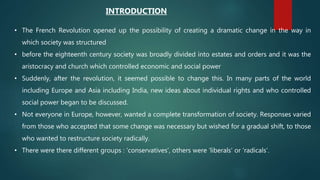
• The French Revolution opened up the possibility of creating a dramatic change in the way in
which society was structured
• before the eighteenth century society was broadly divided into estates and orders and it was the
aristocracy and church which controlled economic and social power
• Suddenly, after the revolution, it seemed possible to change this. In many parts of the world
including Europe and Asia including India, new ideas about individual rights and who controlled
social power began to be discussed.
• Not everyone in Europe, however, wanted a complete transformation of society. Responses varied
from those who accepted that some change was necessary but wished for a gradual shift, to those
who wanted to restructure society radically.
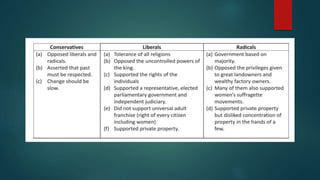
• There were there different groups : ‘conservatives’, others were ‘liberals’ or ‘radicals’.
INTRODUCTION
https://www.toppr.com/content/video/conservatives-
liberals-and-radicals-english-132741/
Video
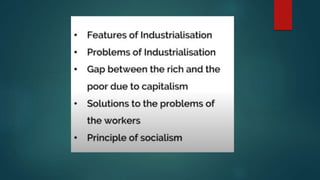
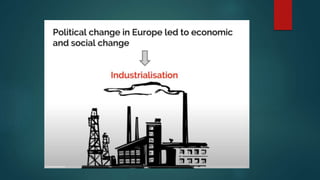
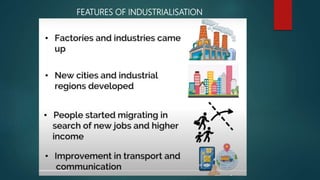
FEATURES OF INDUSTRIALISATION
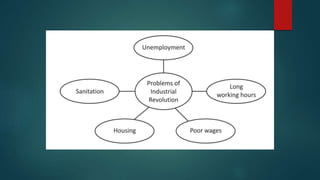
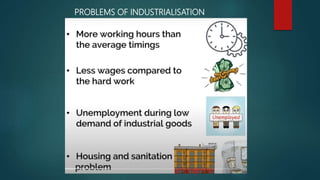
PROBLEMS OF INDUSTRIALISATION
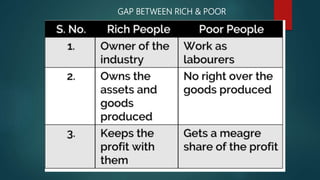
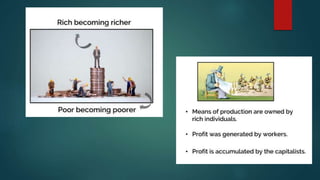
GAP BETWEEN RICH & POOR
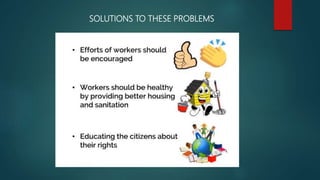
SOLUTIONS TO THESE PROBLEMS
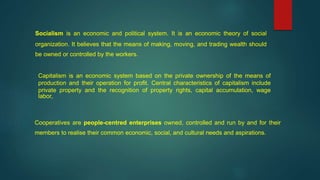
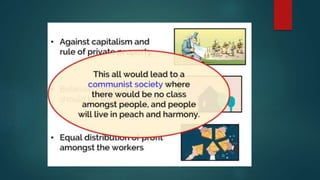
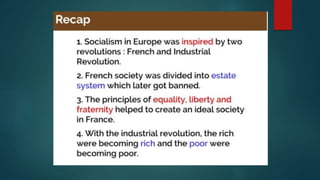
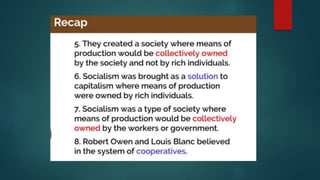
Socialism is an economic and political system. It is an economic theory of social
organization. It believes that the means of making, moving, and trading wealth should
be owned or controlled by the workers.
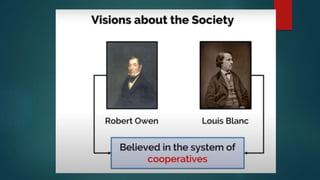
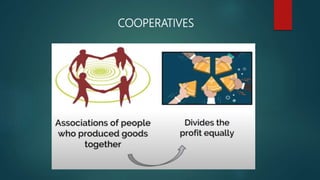
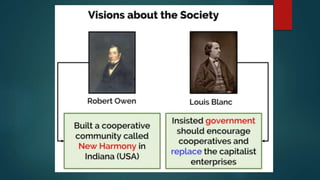
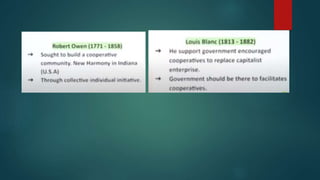
Cooperatives are people-centred enterprises owned, controlled and run by and for their
members to realise their common economic, social, and cultural needs and aspirations.
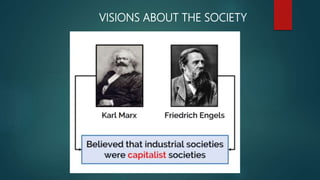
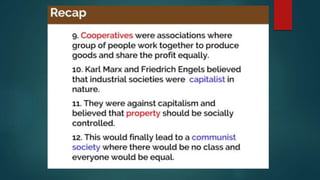
Capitalism is an economic system based on the private ownership of the means of
production and their operation for profit. Central characteristics of capitalism include
private property and the recognition of property rights, capital accumulation, wage
labor,
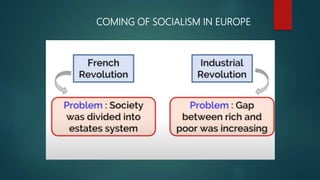
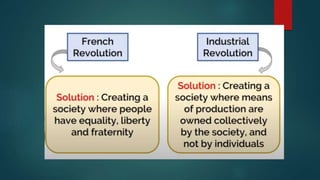
COMING OF SOCIALISM IN EUROPE
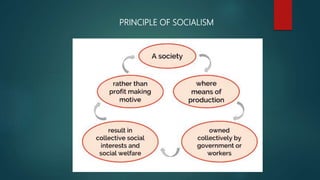
PRINCIPLE OF SOCIALISM
COOPERATIVES
VISIONS ABOUT THE SOCIETY
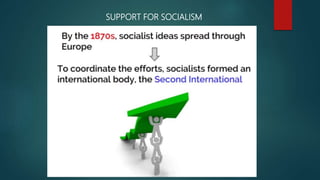
SUPPORT FOR SOCIALISM
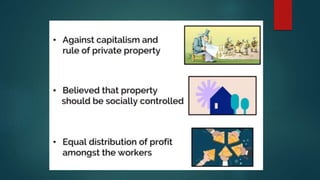
Differences between the capitalist and socialist ideas of private property are
1. Capitalism believed in individual controlled property or private whereas socialism
believed in society or state controlled property.
2. Socialists believe private property is the source of evil and exploitation of weaker
classes while as capitalists believe private property is the source of progress and
freedom.
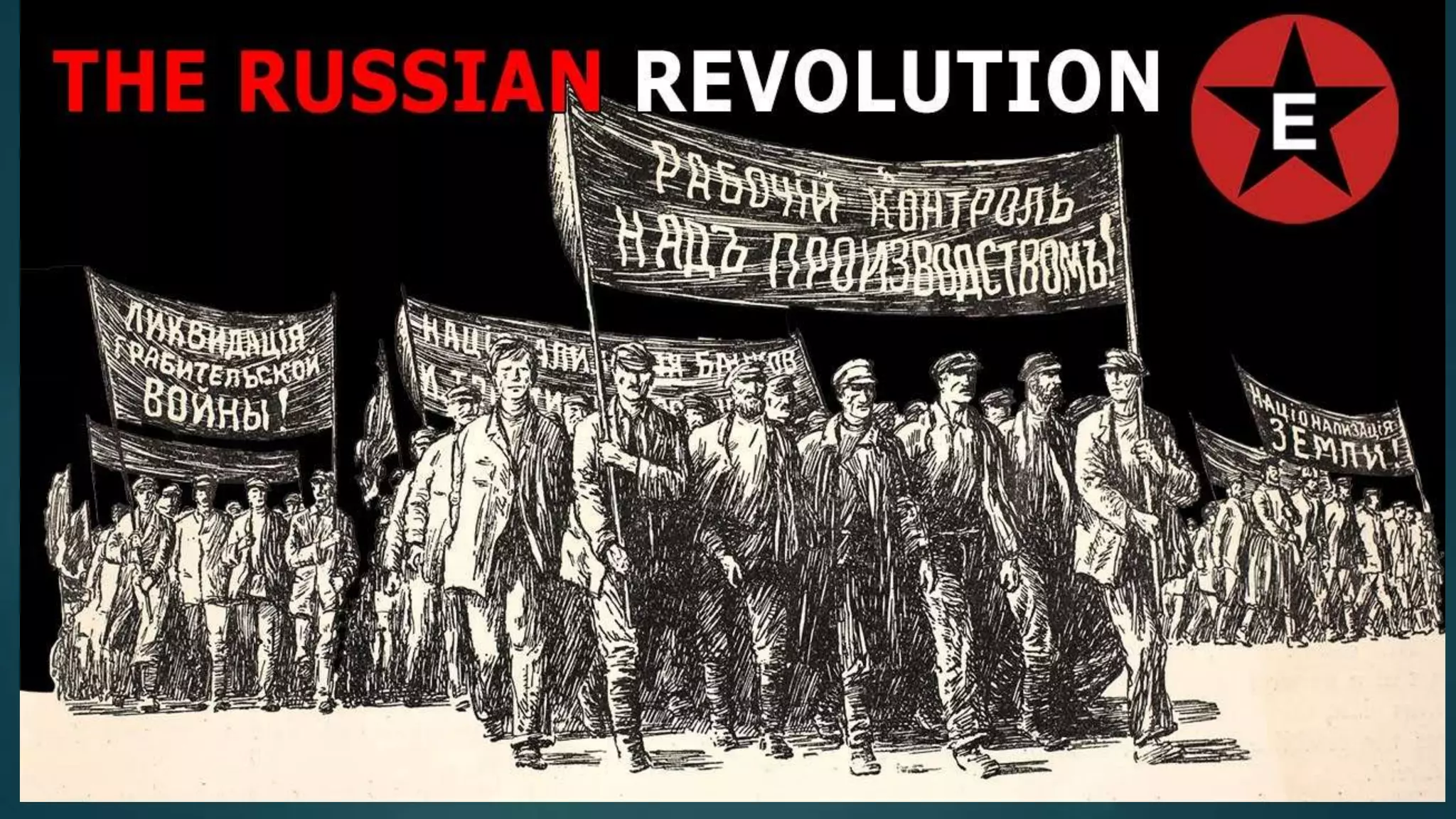
The Russian Revolution:
Russia- Fall of Monarchy in February 1917- Socialist took over the Government in Russia through the
October Revolution of 1917.
Monarch(Tsar Nicholas II)
 How did all this happen?
 What were the social & political conditions in Russia?
The Russian Empire in 1914
 Emperor- Tsar Nicholas II
 Majority religion was Russian orthodox christanity---------- Empire also includes Catholics, protestants,
muslims & Buddhist.
It was mainly an agricultural economy----------- About 85 per cent of the Russian empire’s population
earned their living from agriculture.
------------ cultivators produced for the market as well as for their
own needs and Russia was a major exporter of grain.
.
Industry was found in pockets---------- Prominent industrial areas were St Petersburg and Moscow
 Craftsmen undertook much of the production, but large factories existed alongside craft workshops.
1890’s------ Railway Russia’s network was extended foreign investment in industry increased-
---Coal production doubled and iron and steel
output quadrupled.
Russian Economy
Most industry was the private property of industrialists------ Profit Maximization
Often these rules were broken was there not any regulation by Government?
Government supervised large factories to
ensure minimum wages and limited hours of work
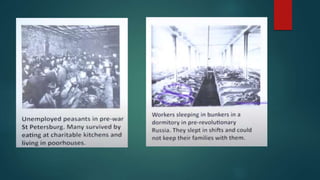
 Long working hours upto hours (15 hours, compared with 10 or 12 hours in factories)
 Accommodation varied from rooms to dormitories.
Russian Society
Workers migrated from village & settled in cities they were divided by skill.
e,.g- A metalworker of St. Petersburg recalled, ‘Metalworkers considered themselves aristocrats
among other workers.
 Women made up 31 per cent of the factory labour force by 1914,
but they were paid less than men
 workers formed associations to help members in times of unemployment or financial hardship but
such associations were few.
 Despite divisions, workers did unite to strike work (stop work) when they disagreed with employers
about dismissals or work conditions
Society in the countryside
 peasants cultivated most of the land nobility , but most of the properties by nobility, the crown
and the Orthodox Church
 Like workers, peasants too were divided.
 they had no respect for the Source A nobility. Nobles got their power and position through their services to the
Tsar, not through local popularity. (In France, during the French Revolution in Brittany, peasants respected nobles
and fought for them)
 In Russia, peasants wanted the land of the nobles to be given to them---------- they refused to pay rent and even
murdered landlords.
 Russian peasants were different from other European peasants in another way. They pooled their land together
periodically and divided it according to the needs of individual families.
All political parties were illegal in Russia before 1914.
 The Russian Social Democratic Workers (labour) Party was founded in 1898 (by socialists who
respected Marxís ideas) it had to operate as an illegal organisation. It set up a newspaper,
mobilised workers and organised strikes.
 Idea of Russian socialists regarding the Russian peasant natural socialists.
Because of their custom of dividing land periodically.
It was believed that peasants would be the main
force of the revolution
 They formed the Socialist Revolutionary Party in 1900.
Social Democrats disagreed with Socialist Revolutionaries over the fact that the Russian peasants are
“Naturally Socialist”
Lenin felt that the peasants are not one united group
Some were rich and some were poor
Some worked as worker while others were capitalists who employed workers
This "differentiation" within them didn't allowed peasants to be a part of socialist movement.
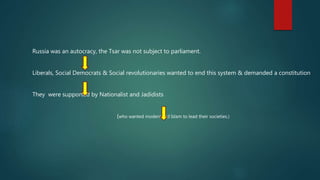
Russia was an autocracy, the Tsar was not subject to parliament.
Liberals, Social Democrats & Social revolutionaries wanted to end this system & demanded a constitution
They were supported by Nationalist and Jadidists
(who wanted modernised Islam to lead their societies.)
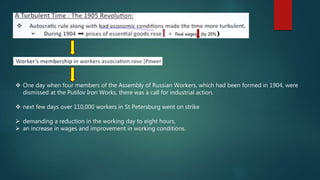
 One day when four members of the Assembly of Russian Workers, which had been formed in 1904, were
dismissed at the Putilov Iron Works, there was a call for industrial action.
 next few days over 110,000 workers in St Petersburg went on strike
 demanding a reduction in the working day to eight hours,
 an increase in wages and improvement in working conditions.
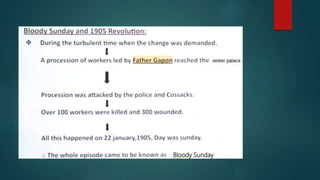
Bloody Sunday
Bloody Sunday, started a series of events that became known as the 1905 Revolution.
• Strikes took place all over the country
• universities closed down when student bodies staged walkouts, complaining about the lack of civil liberties.
• Lawyers, doctors, engineers and other middle-class workers established the Union of Unions
• demanded a constituent assembly
Impact and Aftermath of1905 Revolution
Under pressure of revolution Tasr allowed the creation of an elected consultative
Parliament or Duma
It was a consultative body with quasi- legislative function.
 The Tsar dismissed the first Duma within 75 days and the re-elected second Duma
within three months.
 After a period of time 2nd Duma was also dissolved and third Duma was formed.
He changed the voting laws and packed
the third Duma with conservative
politicians.
Why Duma was dissolved?
He did not want any questioning of his authority or any reduction in his power.
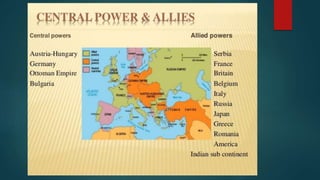
World War One is a conflict between the Central Powers and the Allies.
 The Central Powers (red) consist of Austria-Hungary, Germany, Bulgaria and the Ottoman Empire.
 Important allied powers (yellow) are Serbia, Russia, France, the United Kingdom, Italy, Belgium and the
United States.
 The war was fought outside & inside Europe
 War was fought on two fronts------ war on eastern front differed from that on the
western front
 Causalities were more on eastern front as compared to western front
 Defeat were shocking and demoralizing
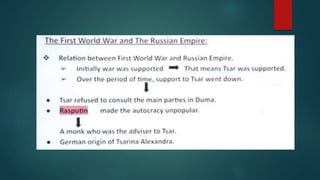
 The first world war had a deep impact on Russia
 Russia's army lost badly in Germany & Austria
 Leading to large casualties (7 million casualties by 1917 )
 The destruction of crops & buildings by Russianarmy led to over 3 million refugees in Russia
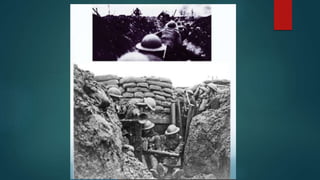
 Soldiers did not wish to fight such war
 The war also had severe impact on industry
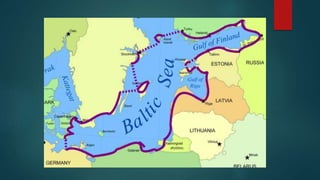
 German control of Baltic seas- Russia was cut off from supplies- leading to Industrial Equipment
disintegration
Able - bodied men were called up to war---- large supplies of grains were sent to feed army.
Shortage of Labours Bread and flour became scarce leading to
riots at bread shop frequently.
Small workshops producing essentials were shut down
Layout of the capital city Petrograd
On the left bank were the fashionable areas, the winter palace & official building , Duma
The workers quarters & factories were located on the right bank of river Neva
Situation in city:
Food shortage, bad weather,Tsar was having the desire to dissolve the Duma, and parliamentarians were not happy with this.
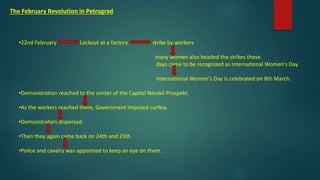
The February Revolution in Petrograd
•22nd February Lockout at a factory strike by workers
many women also headed the strikes these
days came to be recognized as International Women's Day.
International Women's Day is celebrated on 8th March.
•Demonstration reached to the center of the Capital Nevskii Prospekt.
•As the workers reached there, Government imposed curfew.
•Demonstrators dispersed
•Then they again came back on 24th and 25th.
•Police and cavalry was appointed to keep an eye on them.
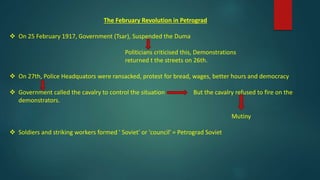
The February Revolution in Petrograd
 On 25 February 1917, Government (Tsar), Suspended the Duma
Politicians criticised this, Demonstrations
returned t the streets on 26th.
 On 27th, Police Headquators were ransacked, protest for bread, wages, better hours and democracy
 Government called the cavalry to control the situation But the cavalry refused to fire on the
demonstrators.
Mutiny
 Soldiers and striking workers formed ' Soviet' or 'council' = Petrograd Soviet
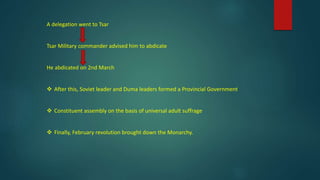
A delegation went to Tsar
Tsar Military commander advised him to abdicate
He abdicated on 2nd March
 After this, Soviet leader and Duma leaders formed a Provincial Government
 Constituent assembly on the basis of universal adult suffrage
 Finally, February revolution brought down the Monarchy.
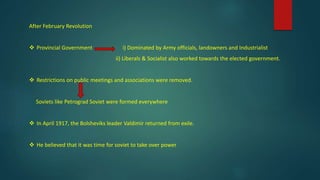
After February Revolution
 Provincial Government i) Dominated by Army officials, landowners and Industrialist
ii) Liberals & Socialist also worked towards the elected government.
 Restrictions on public meetings and associations were removed.
Soviets like Petrograd Soviet were formed everywhere
 In April 1917, the Bolsheviks leader Valdimir returned from exile.
 He believed that it was time for soviet to take over power
In April 1917, the Bolshevik leader Vladimir Lenin returned to Russia from his exile.
After returning from exile he felt it was time for soviets to take over power.
Lenin’s ‘April Theses’.
These three demands were
 He declared that the war be brought to a close
 Land be transferred to the peasants
 Banks be nationalized
 He also argued that the Bolshevik Party rename itself the Communist Party to indicate its
new radical aims.
 Many in the Bolshevik Party thought that the time was not yet ripe for a socialist revolution
and the Provisional Government needed to be supported.
 But the developments of the subsequent months changed their attitude.
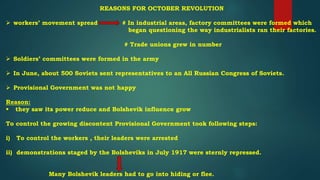
REASONS FOR OCTOBER REVOLUTION
 workers’ movement spread # In industrial areas, factory committees were formed which
began questioning the way industrialists ran their factories.
# Trade unions grew in number
 Soldiers’ committees were formed in the army
 In June, about 500 Soviets sent representatives to an All Russian Congress of Soviets.
 Provisional Government was not happy
Reason:
 they saw its power reduce and Bolshevik influence grow
To control the growing discontent Provisional Government took following steps:
i) To control the workers , their leaders were arrested
ii) demonstrations staged by the Bolsheviks in July 1917 were sternly repressed.
Many Bolshevik leaders had to go into hiding or flee.
SITUATION IN THE COUNTRYSIDE
• Peasants seized land between July & September 1917.
• Land committees were formed to handle this
• This all provided a fertile ground for October revolution
What changed after October
 Most industry and banks were nationalised in November 1917( This meant that the
government took over ownership and management).
 Land was declared social property and peasants were allowed to seize the land of the
nobility.
 In cities, Bolsheviks enforced the partition of large houses according to family
requirements.
 They banned the use of the old titles of aristocracy (To bring equality)
 To show the change, new uniforms were designed for the army and officials, following a
clothing competition organised in 1918 – when the Soviet hat (budeonovka) was chosen.
 The Bolshevik Party was renamed the Russian Communist Party (Bolshevik)
Problems after October Revolution:
 In November 1917, the Bolsheviks conducted the elections to the Constituent Assembly,
they failed to gain majority support
 In January 1918, the Assembly rejected Bolshevik measures Lenin dismissed the Assembly.
He thought the All Russian congress
of Soviets was more democratic
than an assembly elected in
uncertain conditions.
 In March 1918, despite opposition by their political allies, the Bolsheviks made peace with Germany at
Brest Litovsk.
In the years that followed, the Bolsheviks became the only party to participate in the elections to the
All Russian Congress of Soviets, which became the Parliament of the country. Russia became a one-
party state.
Trade unions were kept under party control. The secret police (called the Cheka first, and later
OGPU and NKVD) punished those who criticized the Bolsheviks
Problems After October Revolution
All this steps taken by Bolsheviks was creating tension among the Russian Society
People (writers & Artists) joined and supported Bolshevik because they stood for socialism
and change.
But many became disillusioned because of the censorship the party encouraged
So , this attitude of Bolshevik party along with other factors created a situation of Civil war
in Russia.

Russian revolution

  • 2.
    • The FrenchRevolution opened up the possibility of creating a dramatic change in the way in which society was structured • before the eighteenth century society was broadly divided into estates and orders and it was the aristocracy and church which controlled economic and social power • Suddenly, after the revolution, it seemed possible to change this. In many parts of the world including Europe and Asia including India, new ideas about individual rights and who controlled social power began to be discussed. • Not everyone in Europe, however, wanted a complete transformation of society. Responses varied from those who accepted that some change was necessary but wished for a gradual shift, to those who wanted to restructure society radically. • There were there different groups : ‘conservatives’, others were ‘liberals’ or ‘radicals’. INTRODUCTION
  • 3.
  • 7.
  • 9.
  • 10.
  • 12.
  • 13.
    Socialism is aneconomic and political system. It is an economic theory of social organization. It believes that the means of making, moving, and trading wealth should be owned or controlled by the workers. Cooperatives are people-centred enterprises owned, controlled and run by and for their members to realise their common economic, social, and cultural needs and aspirations. Capitalism is an economic system based on the private ownership of the means of production and their operation for profit. Central characteristics of capitalism include private property and the recognition of property rights, capital accumulation, wage labor,
  • 14.
  • 16.
  • 18.
  • 20.
  • 24.
  • 30.
    Differences between thecapitalist and socialist ideas of private property are 1. Capitalism believed in individual controlled property or private whereas socialism believed in society or state controlled property. 2. Socialists believe private property is the source of evil and exploitation of weaker classes while as capitalists believe private property is the source of progress and freedom.
  • 31.
    The Russian Revolution: Russia-Fall of Monarchy in February 1917- Socialist took over the Government in Russia through the October Revolution of 1917. Monarch(Tsar Nicholas II)  How did all this happen?  What were the social & political conditions in Russia?
  • 32.
    The Russian Empirein 1914  Emperor- Tsar Nicholas II  Majority religion was Russian orthodox christanity---------- Empire also includes Catholics, protestants, muslims & Buddhist. It was mainly an agricultural economy----------- About 85 per cent of the Russian empire’s population earned their living from agriculture. ------------ cultivators produced for the market as well as for their own needs and Russia was a major exporter of grain. . Industry was found in pockets---------- Prominent industrial areas were St Petersburg and Moscow  Craftsmen undertook much of the production, but large factories existed alongside craft workshops.
  • 33.
    1890’s------ Railway Russia’snetwork was extended foreign investment in industry increased- ---Coal production doubled and iron and steel output quadrupled. Russian Economy Most industry was the private property of industrialists------ Profit Maximization Often these rules were broken was there not any regulation by Government? Government supervised large factories to ensure minimum wages and limited hours of work  Long working hours upto hours (15 hours, compared with 10 or 12 hours in factories)  Accommodation varied from rooms to dormitories.
  • 35.
    Russian Society Workers migratedfrom village & settled in cities they were divided by skill. e,.g- A metalworker of St. Petersburg recalled, ‘Metalworkers considered themselves aristocrats among other workers.  Women made up 31 per cent of the factory labour force by 1914, but they were paid less than men  workers formed associations to help members in times of unemployment or financial hardship but such associations were few.  Despite divisions, workers did unite to strike work (stop work) when they disagreed with employers about dismissals or work conditions
  • 36.
    Society in thecountryside  peasants cultivated most of the land nobility , but most of the properties by nobility, the crown and the Orthodox Church  Like workers, peasants too were divided.  they had no respect for the Source A nobility. Nobles got their power and position through their services to the Tsar, not through local popularity. (In France, during the French Revolution in Brittany, peasants respected nobles and fought for them)  In Russia, peasants wanted the land of the nobles to be given to them---------- they refused to pay rent and even murdered landlords.  Russian peasants were different from other European peasants in another way. They pooled their land together periodically and divided it according to the needs of individual families.
  • 37.
    All political partieswere illegal in Russia before 1914.  The Russian Social Democratic Workers (labour) Party was founded in 1898 (by socialists who respected Marxís ideas) it had to operate as an illegal organisation. It set up a newspaper, mobilised workers and organised strikes.  Idea of Russian socialists regarding the Russian peasant natural socialists. Because of their custom of dividing land periodically. It was believed that peasants would be the main force of the revolution  They formed the Socialist Revolutionary Party in 1900.
  • 38.
    Social Democrats disagreedwith Socialist Revolutionaries over the fact that the Russian peasants are “Naturally Socialist” Lenin felt that the peasants are not one united group Some were rich and some were poor Some worked as worker while others were capitalists who employed workers This "differentiation" within them didn't allowed peasants to be a part of socialist movement.
  • 39.
    Russia was anautocracy, the Tsar was not subject to parliament. Liberals, Social Democrats & Social revolutionaries wanted to end this system & demanded a constitution They were supported by Nationalist and Jadidists (who wanted modernised Islam to lead their societies.)
  • 40.
     One daywhen four members of the Assembly of Russian Workers, which had been formed in 1904, were dismissed at the Putilov Iron Works, there was a call for industrial action.  next few days over 110,000 workers in St Petersburg went on strike  demanding a reduction in the working day to eight hours,  an increase in wages and improvement in working conditions.
  • 41.
  • 42.
    Bloody Sunday, starteda series of events that became known as the 1905 Revolution. • Strikes took place all over the country • universities closed down when student bodies staged walkouts, complaining about the lack of civil liberties. • Lawyers, doctors, engineers and other middle-class workers established the Union of Unions • demanded a constituent assembly
  • 43.
    Impact and Aftermathof1905 Revolution Under pressure of revolution Tasr allowed the creation of an elected consultative Parliament or Duma It was a consultative body with quasi- legislative function.  The Tsar dismissed the first Duma within 75 days and the re-elected second Duma within three months.  After a period of time 2nd Duma was also dissolved and third Duma was formed. He changed the voting laws and packed the third Duma with conservative politicians. Why Duma was dissolved? He did not want any questioning of his authority or any reduction in his power.
  • 44.
    World War Oneis a conflict between the Central Powers and the Allies.  The Central Powers (red) consist of Austria-Hungary, Germany, Bulgaria and the Ottoman Empire.  Important allied powers (yellow) are Serbia, Russia, France, the United Kingdom, Italy, Belgium and the United States.  The war was fought outside & inside Europe
  • 48.
     War wasfought on two fronts------ war on eastern front differed from that on the western front  Causalities were more on eastern front as compared to western front  Defeat were shocking and demoralizing  The first world war had a deep impact on Russia  Russia's army lost badly in Germany & Austria  Leading to large casualties (7 million casualties by 1917 )  The destruction of crops & buildings by Russianarmy led to over 3 million refugees in Russia  Soldiers did not wish to fight such war  The war also had severe impact on industry  German control of Baltic seas- Russia was cut off from supplies- leading to Industrial Equipment disintegration
  • 49.
    Able - bodiedmen were called up to war---- large supplies of grains were sent to feed army. Shortage of Labours Bread and flour became scarce leading to riots at bread shop frequently. Small workshops producing essentials were shut down
  • 51.
    Layout of thecapital city Petrograd On the left bank were the fashionable areas, the winter palace & official building , Duma The workers quarters & factories were located on the right bank of river Neva Situation in city: Food shortage, bad weather,Tsar was having the desire to dissolve the Duma, and parliamentarians were not happy with this.
  • 52.
    The February Revolutionin Petrograd •22nd February Lockout at a factory strike by workers many women also headed the strikes these days came to be recognized as International Women's Day. International Women's Day is celebrated on 8th March. •Demonstration reached to the center of the Capital Nevskii Prospekt. •As the workers reached there, Government imposed curfew. •Demonstrators dispersed •Then they again came back on 24th and 25th. •Police and cavalry was appointed to keep an eye on them.
  • 53.
    The February Revolutionin Petrograd  On 25 February 1917, Government (Tsar), Suspended the Duma Politicians criticised this, Demonstrations returned t the streets on 26th.  On 27th, Police Headquators were ransacked, protest for bread, wages, better hours and democracy  Government called the cavalry to control the situation But the cavalry refused to fire on the demonstrators. Mutiny  Soldiers and striking workers formed ' Soviet' or 'council' = Petrograd Soviet
  • 54.
    A delegation wentto Tsar Tsar Military commander advised him to abdicate He abdicated on 2nd March  After this, Soviet leader and Duma leaders formed a Provincial Government  Constituent assembly on the basis of universal adult suffrage  Finally, February revolution brought down the Monarchy.
  • 55.
    After February Revolution Provincial Government i) Dominated by Army officials, landowners and Industrialist ii) Liberals & Socialist also worked towards the elected government.  Restrictions on public meetings and associations were removed. Soviets like Petrograd Soviet were formed everywhere  In April 1917, the Bolsheviks leader Valdimir returned from exile.  He believed that it was time for soviet to take over power
  • 56.
    In April 1917,the Bolshevik leader Vladimir Lenin returned to Russia from his exile. After returning from exile he felt it was time for soviets to take over power. Lenin’s ‘April Theses’. These three demands were  He declared that the war be brought to a close  Land be transferred to the peasants  Banks be nationalized  He also argued that the Bolshevik Party rename itself the Communist Party to indicate its new radical aims.  Many in the Bolshevik Party thought that the time was not yet ripe for a socialist revolution and the Provisional Government needed to be supported.  But the developments of the subsequent months changed their attitude.
  • 57.
    REASONS FOR OCTOBERREVOLUTION  workers’ movement spread # In industrial areas, factory committees were formed which began questioning the way industrialists ran their factories. # Trade unions grew in number  Soldiers’ committees were formed in the army  In June, about 500 Soviets sent representatives to an All Russian Congress of Soviets.  Provisional Government was not happy Reason:  they saw its power reduce and Bolshevik influence grow To control the growing discontent Provisional Government took following steps: i) To control the workers , their leaders were arrested ii) demonstrations staged by the Bolsheviks in July 1917 were sternly repressed. Many Bolshevik leaders had to go into hiding or flee.
  • 58.
    SITUATION IN THECOUNTRYSIDE SITUATION IN THE COUNTRYSIDE • Peasants seized land between July & September 1917. • Land committees were formed to handle this • This all provided a fertile ground for October revolution
  • 59.
    What changed afterOctober  Most industry and banks were nationalised in November 1917( This meant that the government took over ownership and management).  Land was declared social property and peasants were allowed to seize the land of the nobility.  In cities, Bolsheviks enforced the partition of large houses according to family requirements.  They banned the use of the old titles of aristocracy (To bring equality)  To show the change, new uniforms were designed for the army and officials, following a clothing competition organised in 1918 – when the Soviet hat (budeonovka) was chosen.  The Bolshevik Party was renamed the Russian Communist Party (Bolshevik)
  • 60.
    Problems after OctoberRevolution:  In November 1917, the Bolsheviks conducted the elections to the Constituent Assembly, they failed to gain majority support  In January 1918, the Assembly rejected Bolshevik measures Lenin dismissed the Assembly. He thought the All Russian congress of Soviets was more democratic than an assembly elected in uncertain conditions.  In March 1918, despite opposition by their political allies, the Bolsheviks made peace with Germany at Brest Litovsk.
  • 61.
    In the yearsthat followed, the Bolsheviks became the only party to participate in the elections to the All Russian Congress of Soviets, which became the Parliament of the country. Russia became a one- party state. Trade unions were kept under party control. The secret police (called the Cheka first, and later OGPU and NKVD) punished those who criticized the Bolsheviks Problems After October Revolution All this steps taken by Bolsheviks was creating tension among the Russian Society People (writers & Artists) joined and supported Bolshevik because they stood for socialism and change. But many became disillusioned because of the censorship the party encouraged So , this attitude of Bolshevik party along with other factors created a situation of Civil war in Russia.