

Nicholas Sullivan
Systems Engineer

CloudFlare

@grittygrease
Running Secure Server Software on
Insecure Hardware without a Parachute
What this talk is about
u The web is changing — consolidation at the edge
u Fundamental assumptions about server security are wrong
u How do we design server software with the worst case in mind?
u Distinguish between long and short term secrets
u Devise approaches for protecting each
2
Let’s Talk About Web
Infrastructure
4
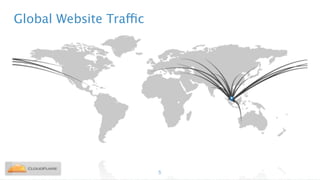
Global Website Traffic
5
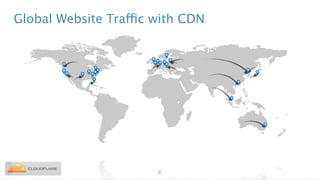
Global Website Traffic with CDN
6
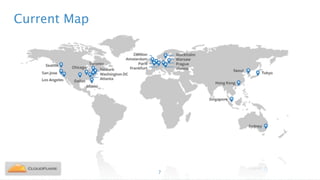
Current Map
7
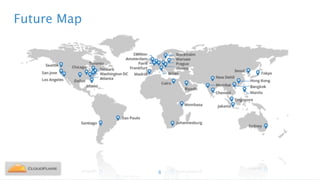
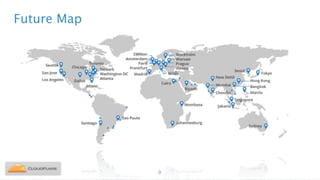
Future Map
8
Future Map
9
Edge Computing
Threat Model
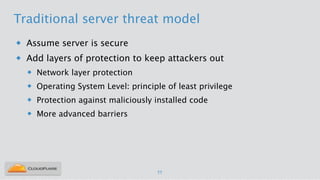
Traditional server threat model
u Assume server is secure
u Add layers of protection to keep attackers out
u Network layer protection
u Operating System Level: principle of least privilege
u Protection against maliciously installed code
u More advanced barriers
11
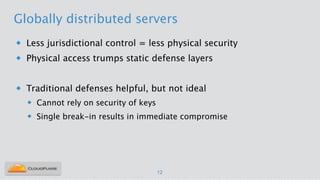
Globally distributed servers
u Less jurisdictional control = less physical security
u Physical access trumps static defense layers
!
u Traditional defenses helpful, but not ideal
u Cannot rely on security of keys
u Single break-in results in immediate compromise
12
A More Effective
Approach
Approach system security the ‘DRM way’
u Assume attacker has bypassed all static defenses
u Goal is to refresh secrets before they are compromised
u Split system into long-term secrets and short-term secrets
u Focus on renewability of secrets
14
Secrets must be split into two tiers
u Long-term Secrets
u Useful for attacker for long period of time
u Do not store at the edge
!
u Short-term Secrets
u Expire after a short period of time
u Cannot be re-used
15
Example: Traditional TLS termination
u TLS handshake with nginx and Apache
u SSL keys on disk
u Read from disk, use in memory
!
u Cryptographic elements at risk if server is compromised
u Private key
u Session key
16
TLS revisited for untrusted hardware
u Long term secrets
u Private key
!
u Short term secrets
u Session key
u Session IDs and Session ticket keys
u Credentials to access private keys
17
How to Protect 

Short-term Secrets
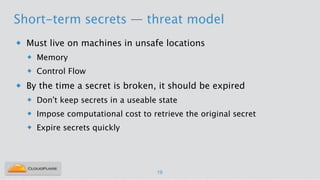
Short-term secrets — threat model
u Must live on machines in unsafe locations
u Memory
u Control Flow
u By the time a secret is broken, it should be expired
u Don’t keep secrets in a useable state
u Impose computational cost to retrieve the original secret
u Expire secrets quickly
!
19
Techniques from DRM are applicable
u White-box cryptography
u Code obfuscation
20
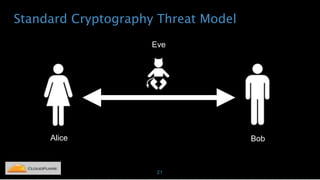
Standard Cryptography Threat Model
21
Alice Bob
Eve
White-box Cryptography Threat Model
22
Alice Bob
Eve
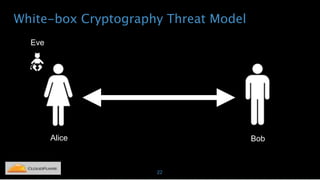
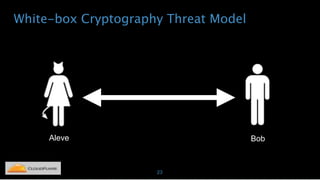
White-box Cryptography Threat Model
23
Aleve Bob
White-box cryptography
u Hide the cryptographic key from everyone
u Protect against key extraction in the strongest threat model
!
u Takes time to extract key — lots of math
u Choose difficulty based on secret lifetime
24
White-box cryptography implementations
25
u Commercial products
u Irdeto, Arxan, SafeNet, etc.
u Open source
u OpenWhiteBox
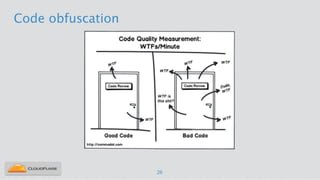
Code obfuscation
26
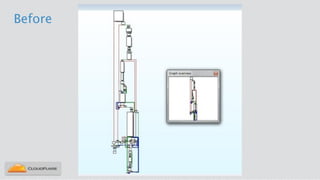
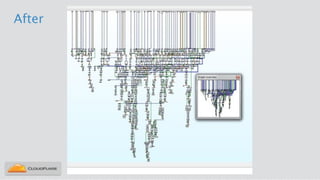
Code obfuscation
u Making reverse engineering difficult
u Compile-time control-flow modification
u Data transformation in memory
u Anti-debugging
27
Before
28
After
29
Code obfuscation implementations
u Commercial products
u Arxan, Irdeto, etc.
u Open source
u Obfuscator-LLVM
30
Long-term Secrets
Keyless SSL
u SSL without keys? Surely you’re joking.
u SSL without keys at the edge. That’s better.
32
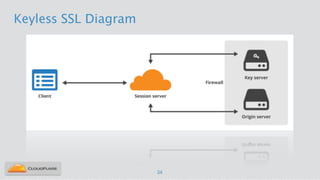
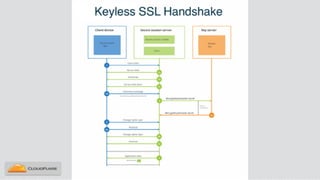
How Keyless SSL Works
u Split the TLS state machine geographically
u Perform private key operation at site owner’s facility (in HSM, etc)
u Perform rest of handshake at edge
u Communicate with signing server over mutually authenticated TLS
33
Keyless SSL Diagram
34
35
Conclusion
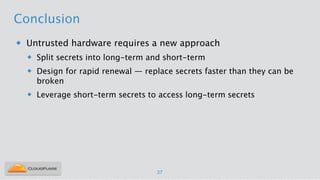
Conclusion
u Untrusted hardware requires a new approach
u Split secrets into long-term and short-term
u Design for rapid renewal — replace secrets faster than they can be
broken
u Leverage short-term secrets to access long-term secrets
37

Running Secure Server Software on Insecure Hardware Without Parachute

  • 1.
    Nicholas Sullivan Systems Engineer
 CloudFlare
 @grittygrease RunningSecure Server Software on Insecure Hardware without a Parachute
  • 2.
    What this talkis about u The web is changing — consolidation at the edge u Fundamental assumptions about server security are wrong u How do we design server software with the worst case in mind? u Distinguish between long and short term secrets u Devise approaches for protecting each 2
  • 3.
    Let’s Talk AboutWeb Infrastructure
  • 4.
  • 5.
  • 6.
  • 7.
  • 8.
  • 9.
  • 10.
  • 11.
    Traditional server threatmodel u Assume server is secure u Add layers of protection to keep attackers out u Network layer protection u Operating System Level: principle of least privilege u Protection against maliciously installed code u More advanced barriers 11
  • 12.
    Globally distributed servers uLess jurisdictional control = less physical security u Physical access trumps static defense layers ! u Traditional defenses helpful, but not ideal u Cannot rely on security of keys u Single break-in results in immediate compromise 12
  • 13.
  • 14.
    Approach system securitythe ‘DRM way’ u Assume attacker has bypassed all static defenses u Goal is to refresh secrets before they are compromised u Split system into long-term secrets and short-term secrets u Focus on renewability of secrets 14
  • 15.
    Secrets must besplit into two tiers u Long-term Secrets u Useful for attacker for long period of time u Do not store at the edge ! u Short-term Secrets u Expire after a short period of time u Cannot be re-used 15
  • 16.
    Example: Traditional TLStermination u TLS handshake with nginx and Apache u SSL keys on disk u Read from disk, use in memory ! u Cryptographic elements at risk if server is compromised u Private key u Session key 16
  • 17.
    TLS revisited foruntrusted hardware u Long term secrets u Private key ! u Short term secrets u Session key u Session IDs and Session ticket keys u Credentials to access private keys 17
  • 18.
    How to Protect
 Short-term Secrets
  • 19.
    Short-term secrets —threat model u Must live on machines in unsafe locations u Memory u Control Flow u By the time a secret is broken, it should be expired u Don’t keep secrets in a useable state u Impose computational cost to retrieve the original secret u Expire secrets quickly ! 19
  • 20.
    Techniques from DRMare applicable u White-box cryptography u Code obfuscation 20
  • 21.
    Standard Cryptography ThreatModel 21 Alice Bob Eve
  • 22.
    White-box Cryptography ThreatModel 22 Alice Bob Eve
  • 23.
  • 24.
    White-box cryptography u Hidethe cryptographic key from everyone u Protect against key extraction in the strongest threat model ! u Takes time to extract key — lots of math u Choose difficulty based on secret lifetime 24
  • 25.
    White-box cryptography implementations 25 uCommercial products u Irdeto, Arxan, SafeNet, etc. u Open source u OpenWhiteBox
  • 26.
  • 27.
    Code obfuscation u Makingreverse engineering difficult u Compile-time control-flow modification u Data transformation in memory u Anti-debugging 27
  • 28.
  • 29.
  • 30.
    Code obfuscation implementations uCommercial products u Arxan, Irdeto, etc. u Open source u Obfuscator-LLVM 30
  • 31.
  • 32.
    Keyless SSL u SSLwithout keys? Surely you’re joking. u SSL without keys at the edge. That’s better. 32
  • 33.
    How Keyless SSLWorks u Split the TLS state machine geographically u Perform private key operation at site owner’s facility (in HSM, etc) u Perform rest of handshake at edge u Communicate with signing server over mutually authenticated TLS 33
  • 34.
  • 35.
  • 36.
  • 37.
    Conclusion u Untrusted hardwarerequires a new approach u Split secrets into long-term and short-term u Design for rapid renewal — replace secrets faster than they can be broken u Leverage short-term secrets to access long-term secrets 37