©2010 Improving Enterprises, Inc.
Lets talk about
Java Safety
Jane Prusakova
@Improving Enterprises
©2010 Improving Enterprises, Inc.
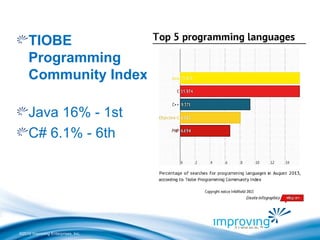
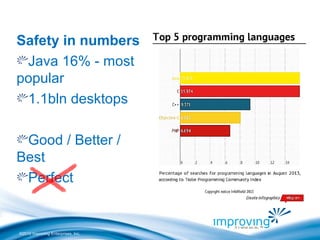
TIOBE
Programming
Community Index
Java 16% - 1st
C# 6.1% - 6th
©2010 Improving Enterprises, Inc.
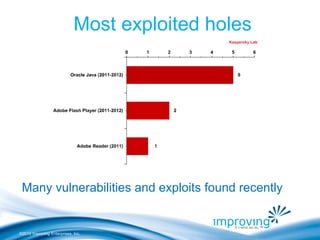
Most exploited holes
Many vulnerabilities and exploits found recently
©2010 Improving Enterprises, Inc.
Write once, run anywhere
Ubiquitous
Over 20 years old
Security model first implemented in 1.1.5 -
stack inspection with scopes [broken]
Exploits combine more than one
vulnerability
©2010 Improving Enterprises, Inc.
Java security mechanism
Java stack inspection mechanism makes it impossible to abuse
target system’s security by the means of arbitrary injection of a
stack frame belonging to untrusted code inside a privileged code
block (scope).
Security Manager’s check methods verify permissions of all the
classes from a current scope (call stack). Stack frames are
inspected until either the end of a call stack or a special
(privileged) frame is reached.
The permission check will succeed only if all classes from a
current code scope have a given permission granted. In the case
of encountering an unprivileged stack frame, security exception
is thrown, and execution is aborted.
©2010 Improving Enterprises, Inc.
Java security mechanism
Concept
Powerful & clever
Single issue rarely
leads to full-blown
exploit
Mechanism
Complex and hard to
implement
Poor design and
implementation choices
abound
©2010 Improving Enterprises, Inc.
Vulnerable APIs
Reflection API
access restricted classes, fields and methods
create restricted objects
Invoke restricted methods
XML Beans Decoder
Specially crafted XML can inject an arbitrary
user-defined class into trusted code
©2010 Improving Enterprises, Inc.
Vulnerable implementation
Bytecode Verifier does not properly verify
the bytecode instruction stream for the
invokespecial
RMI implementation does not verify object
type before unmarshalling remote object.
©2010 Improving Enterprises, Inc.
So what?
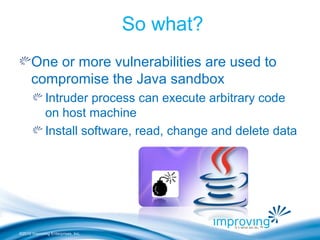
One or more vulnerabilities are used to
compromise the Java sandbox
Intruder process can execute arbitrary code
on host machine
Install software, read, change and delete data
©2010 Improving Enterprises, Inc.
Will I get hacked?
Win the lottery
1.1 billion desktops
3 billion mobile phones
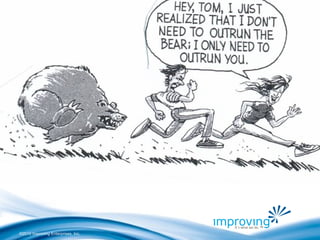
Run Java version(s) with known exploits
Subject to popular, untargeted attacks
©2010 Improving Enterprises, Inc.
Java: newer is better
(on the average, most of the time)
Known bugs get patched
Exploits take time to be prepared and
distributed
Most organizations are slow to upgrade
therefore exploiting older, more popular
systems is easier and better value
attack on a brand-new system less likely
©2010 Improving Enterprises, Inc.
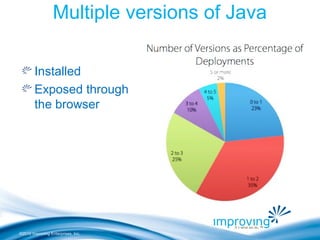
Multiple versions of Java
Installed
Exposed through
the browser
©2010 Improving Enterprises, Inc.
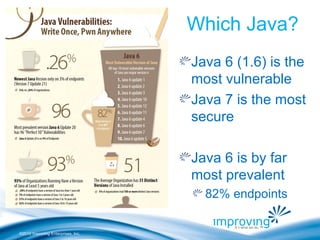
Which Java?
Java 6 (1.6) is the
most vulnerable
Java 7 is the most
secure
Java 6 is by far
most prevalent
82% endpoints
©2010 Improving Enterprises, Inc.
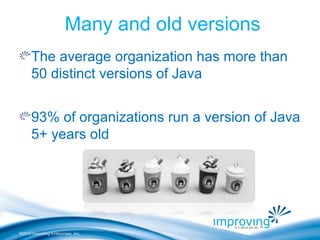
Many and old versions
The average organization has more than
50 distinct versions of Java
93% of organizations run a version of Java
5+ years old
©2010 Improving Enterprises, Inc.
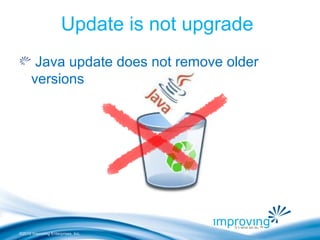
Update is not upgrade
Java update does not remove older
versions
©2010 Improving Enterprises, Inc.
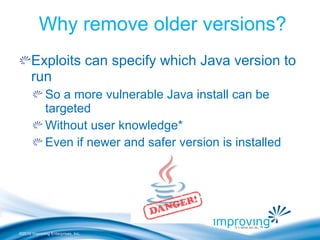
Why remove older versions?
Exploits can specify which Java version to
run
So a more vulnerable Java install can be
targeted
Without user knowledge*
Even if newer and safer version is installed
©2010 Improving Enterprises, Inc.
Creating a safer environment
Use Java safely
Regularly upgrade to latest, best patched version
Remove all other installs
Remove all Java
Remove all Java installs
Java embedded in other products is safe
If it is not made available to the browser
©2010 Improving Enterprises, Inc.
Use Java Safely
Determine the safest version
Less popular version may be more
secure
Establish regular upgrade schedule
Ensure removal of earlier versions
Audit regularly for unauthorized installs
©2010 Improving Enterprises, Inc.
Remove Java completely
Use tools to verify and manage uninstalls
Monitor network (layer-7 visibility tools)
Audit for unauthorized installs
Pick replacement technology
Ensure its safety
©2010 Improving Enterprises, Inc.
Safety in numbers
Java 16% - most
popular
1.1bln desktops
Good / Better /
Best
Perfect
©2010 Improving Enterprises, Inc.
Questions?
Jane.Prusakova@ImprovingEnterprises.com
SoftwareAndOtherThings.blogspot.com
@jprusakova
Jane Prusakova
http://www.slideshare.net/jprusakova
©2010 Improving Enterprises, Inc.
Lets talk about
Java Safety
Jane Prusakova
@Improving Enterprises
©2010 Improving Enterprises, Inc.
References
Kaspersky Lab report: Evaluating the
threat level of software vulnerabilities.
February 1, 2013
Java SE security research project
Security Explorations, 2013
Bit9 research report: Java Vulnerabilities:
Write Once, Pwn Anywhere. 2013
©2010 Improving Enterprises, Inc.

Running Java safely

  • 1.
    ©2010 Improving Enterprises,Inc. Lets talk about Java Safety Jane Prusakova @Improving Enterprises
  • 2.
    ©2010 Improving Enterprises,Inc. TIOBE Programming Community Index Java 16% - 1st C# 6.1% - 6th
  • 3.
    ©2010 Improving Enterprises,Inc. Most exploited holes Many vulnerabilities and exploits found recently
  • 4.
  • 5.
    ©2010 Improving Enterprises,Inc. Write once, run anywhere Ubiquitous Over 20 years old Security model first implemented in 1.1.5 - stack inspection with scopes [broken] Exploits combine more than one vulnerability
  • 6.
    ©2010 Improving Enterprises,Inc. Java security mechanism Java stack inspection mechanism makes it impossible to abuse target system’s security by the means of arbitrary injection of a stack frame belonging to untrusted code inside a privileged code block (scope). Security Manager’s check methods verify permissions of all the classes from a current scope (call stack). Stack frames are inspected until either the end of a call stack or a special (privileged) frame is reached. The permission check will succeed only if all classes from a current code scope have a given permission granted. In the case of encountering an unprivileged stack frame, security exception is thrown, and execution is aborted.
  • 7.
    ©2010 Improving Enterprises,Inc. Java security mechanism Concept Powerful & clever Single issue rarely leads to full-blown exploit Mechanism Complex and hard to implement Poor design and implementation choices abound
  • 8.
    ©2010 Improving Enterprises,Inc. Vulnerable APIs Reflection API access restricted classes, fields and methods create restricted objects Invoke restricted methods XML Beans Decoder Specially crafted XML can inject an arbitrary user-defined class into trusted code
  • 9.
    ©2010 Improving Enterprises,Inc. Vulnerable implementation Bytecode Verifier does not properly verify the bytecode instruction stream for the invokespecial RMI implementation does not verify object type before unmarshalling remote object.
  • 10.
    ©2010 Improving Enterprises,Inc. So what? One or more vulnerabilities are used to compromise the Java sandbox Intruder process can execute arbitrary code on host machine Install software, read, change and delete data
  • 11.
    ©2010 Improving Enterprises,Inc. Will I get hacked? Win the lottery 1.1 billion desktops 3 billion mobile phones Run Java version(s) with known exploits Subject to popular, untargeted attacks
  • 12.
  • 13.
    ©2010 Improving Enterprises,Inc. Java: newer is better (on the average, most of the time) Known bugs get patched Exploits take time to be prepared and distributed Most organizations are slow to upgrade therefore exploiting older, more popular systems is easier and better value attack on a brand-new system less likely
  • 14.
    ©2010 Improving Enterprises,Inc. Multiple versions of Java Installed Exposed through the browser
  • 15.
    ©2010 Improving Enterprises,Inc. Which Java? Java 6 (1.6) is the most vulnerable Java 7 is the most secure Java 6 is by far most prevalent 82% endpoints
  • 16.
    ©2010 Improving Enterprises,Inc. Many and old versions The average organization has more than 50 distinct versions of Java 93% of organizations run a version of Java 5+ years old
  • 17.
    ©2010 Improving Enterprises,Inc. Update is not upgrade Java update does not remove older versions
  • 18.
    ©2010 Improving Enterprises,Inc. Why remove older versions? Exploits can specify which Java version to run So a more vulnerable Java install can be targeted Without user knowledge* Even if newer and safer version is installed
  • 19.
    ©2010 Improving Enterprises,Inc. Creating a safer environment Use Java safely Regularly upgrade to latest, best patched version Remove all other installs Remove all Java Remove all Java installs Java embedded in other products is safe If it is not made available to the browser
  • 20.
    ©2010 Improving Enterprises,Inc. Use Java Safely Determine the safest version Less popular version may be more secure Establish regular upgrade schedule Ensure removal of earlier versions Audit regularly for unauthorized installs
  • 21.
    ©2010 Improving Enterprises,Inc. Remove Java completely Use tools to verify and manage uninstalls Monitor network (layer-7 visibility tools) Audit for unauthorized installs Pick replacement technology Ensure its safety
  • 22.
    ©2010 Improving Enterprises,Inc. Safety in numbers Java 16% - most popular 1.1bln desktops Good / Better / Best Perfect
  • 23.
    ©2010 Improving Enterprises,Inc. Questions? Jane.Prusakova@ImprovingEnterprises.com SoftwareAndOtherThings.blogspot.com @jprusakova Jane Prusakova http://www.slideshare.net/jprusakova
  • 24.
    ©2010 Improving Enterprises,Inc. Lets talk about Java Safety Jane Prusakova @Improving Enterprises
  • 25.
    ©2010 Improving Enterprises,Inc. References Kaspersky Lab report: Evaluating the threat level of software vulnerabilities. February 1, 2013 Java SE security research project Security Explorations, 2013 Bit9 research report: Java Vulnerabilities: Write Once, Pwn Anywhere. 2013
  • 26.

Editor's Notes

  • #14 Java versions do not have a large number of severe vulnerabilities, and these are the very old and unpopular 1.4- and 1.3-based versions.
  • #18 Update may try to remove the latest version, before installing a new one, but it will not look for older versions present. Installer does not remove older versions, with some minor exceptions. . Only Java 7 version installers and some versions of Java 6 installers remove minor versions within that major version (version 6 installers do not uninstall version 5 installations, for example).
  • #19 Java 7.21, out in 2013, provides a cryptic warning dialog to the user when non-latest Java is targeted by an applet