Thoughts on building
Software Architecture
Jane Prusakova
@jprusakova
Why architecture?
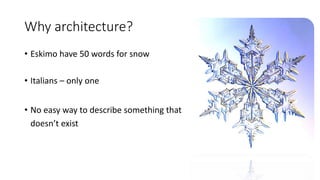
• Eskimo have 50 words for snow
• Italians – only one
• No easy way to describe something that
doesn’t exist
Kruchten’s 4+1 View Model
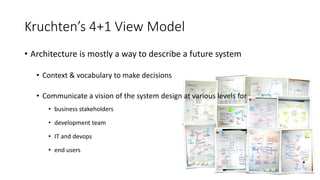
• Architecture is mostly a way to describe a future system
• Context & vocabulary to make decisions
• Communicate a vision of the system design at various levels for
• business stakeholders
• development team
• IT and devops
• end users
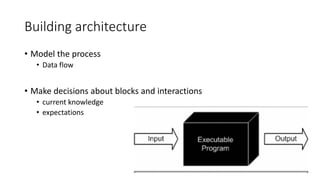
Building architecture
• Model the process
• Data flow
• Make decisions about blocks and interactions
• current knowledge
• expectations
From requirements to solution
• The data arrives from …
• Every … message triggers … action
• User can see data arranged in … way
• User can affect data in … way
• Processing results are forwarded to …
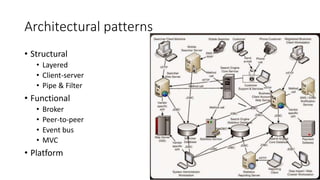
Architectural patterns
• Structural
• Layered
• Client-server
• Pipe & Filter
• Functional
• Broker
• Peer-to-peer
• Event bus
• MVC
• Platform
For all of the architectural patterns:
Pros
• Well-understood
• [Some] Can be delivered piece-
meal
• Offer good support for original
purpose
Cons
• Complex
• [Some] Big bang delivery style
• Suitable in distinct situations
• Hard to expand beyond original
goals
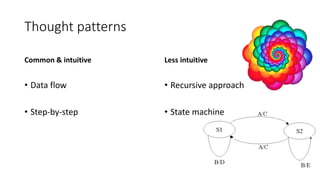
Thought patterns
Common & intuitive
• Data flow
• Step-by-step
Less intuitive
• Recursive approach
• State machine
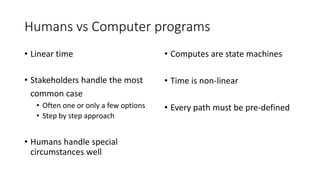
Humans vs Computer programs
• Linear time
• Stakeholders handle the most
common case
• Often one or only a few options
• Step by step approach
• Humans handle special
circumstances well
• Computes are state machines
• Time is non-linear
• Every path must be pre-defined
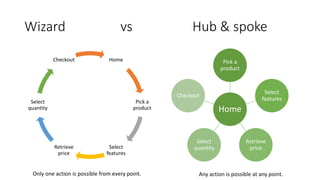
Wizard vs Hub & spoke
Home
Pick a
product
Select
features
Retrieve
price
Select
quantity
Checkout
Home
Pick a
product
Select
features
Retrieve
price
Select
quantity
Checkout
Only one action is possible from every point. Any action is possible at any point.
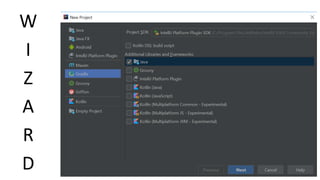
W
I
Z
A
R
D
S
p
o
k
e
Hub
&
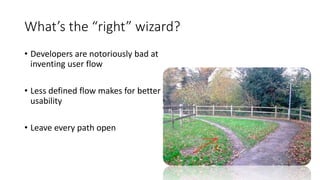
What’s the “right” wizard?
• Developers are notoriously bad at
inventing user flow
• Less defined flow makes for better
usability
• Leave every path open
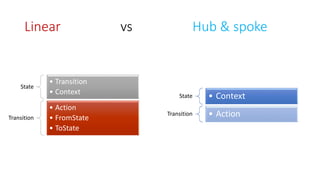
Linear vs Hub & spoke
State
• Transition
• Context
Transition
• Action
• FromState
• ToState
State • Context
Transition • Action
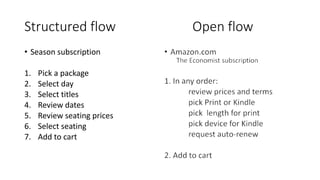
Structured flow Open flow
• Season subscription
1. Pick a package
2. Select day
3. Select titles
4. Review dates
5. Review seating prices
6. Select seating
7. Add to cart
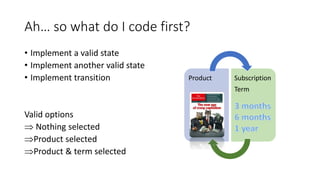
Ah… so what do I code first?
• Implement a valid state
• Implement another valid state
• Implement transition
Valid options
 Nothing selected
Product selected
Product & term selected
Product Subscription
Term
Future brings change
• Rewrite: every 3 years
• Survivors: Twitter
• Did not survive: Netscape
• Hurt: hundreds of businesses
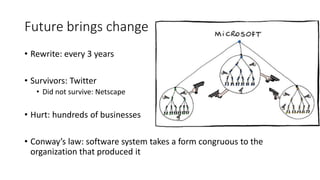
• Conway’s law: software system takes a form congruous to the
organization that produced it
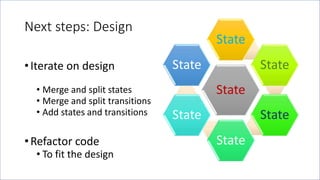
Next steps: Design
•Iterate on design
• Merge and split states
• Merge and split transitions
• Add states and transitions
•Refactor code
• To fit the design
State
State
State
State
State
State
State
Maintaining architecture
• Review system design every
development cycle
• Keep the diagrams out and in the focus of
the team
• Communicate architectural decisions
continuously
• made previously
• current
• being re-thought
• Continue asking stakeholders
• What else is there?
Inspired reading
• “The Mythical Man-Month”
by Fred Brooks (Addison-Wesley,
1975)
• “The Pragmatic Programmer”
series by Andrew Hunt and Dave
Thomas
Thoughts on building
Software Architecture
Jane Prusakova
@jprusakova

Thoughts on building software architecture

  • 1.
    Thoughts on building SoftwareArchitecture Jane Prusakova @jprusakova
  • 2.
    Why architecture? • Eskimohave 50 words for snow • Italians – only one • No easy way to describe something that doesn’t exist
  • 3.
    Kruchten’s 4+1 ViewModel • Architecture is mostly a way to describe a future system • Context & vocabulary to make decisions • Communicate a vision of the system design at various levels for • business stakeholders • development team • IT and devops • end users
  • 4.
    Building architecture • Modelthe process • Data flow • Make decisions about blocks and interactions • current knowledge • expectations
  • 5.
    From requirements tosolution • The data arrives from … • Every … message triggers … action • User can see data arranged in … way • User can affect data in … way • Processing results are forwarded to …
  • 6.
    Architectural patterns • Structural •Layered • Client-server • Pipe & Filter • Functional • Broker • Peer-to-peer • Event bus • MVC • Platform
  • 7.
    For all ofthe architectural patterns: Pros • Well-understood • [Some] Can be delivered piece- meal • Offer good support for original purpose Cons • Complex • [Some] Big bang delivery style • Suitable in distinct situations • Hard to expand beyond original goals
  • 8.
    Thought patterns Common &intuitive • Data flow • Step-by-step Less intuitive • Recursive approach • State machine
  • 9.
    Humans vs Computerprograms • Linear time • Stakeholders handle the most common case • Often one or only a few options • Step by step approach • Humans handle special circumstances well • Computes are state machines • Time is non-linear • Every path must be pre-defined
  • 10.
    Wizard vs Hub& spoke Home Pick a product Select features Retrieve price Select quantity Checkout Home Pick a product Select features Retrieve price Select quantity Checkout Only one action is possible from every point. Any action is possible at any point.
  • 11.
  • 12.
  • 13.
    What’s the “right”wizard? • Developers are notoriously bad at inventing user flow • Less defined flow makes for better usability • Leave every path open
  • 14.
    Linear vs Hub& spoke State • Transition • Context Transition • Action • FromState • ToState State • Context Transition • Action
  • 15.
    Structured flow Openflow • Season subscription 1. Pick a package 2. Select day 3. Select titles 4. Review dates 5. Review seating prices 6. Select seating 7. Add to cart
  • 16.
    Ah… so whatdo I code first? • Implement a valid state • Implement another valid state • Implement transition Valid options  Nothing selected Product selected Product & term selected Product Subscription Term
  • 17.
    Future brings change •Rewrite: every 3 years • Survivors: Twitter • Did not survive: Netscape • Hurt: hundreds of businesses • Conway’s law: software system takes a form congruous to the organization that produced it
  • 18.
    Next steps: Design •Iterateon design • Merge and split states • Merge and split transitions • Add states and transitions •Refactor code • To fit the design State State State State State State State
  • 19.
    Maintaining architecture • Reviewsystem design every development cycle • Keep the diagrams out and in the focus of the team • Communicate architectural decisions continuously • made previously • current • being re-thought • Continue asking stakeholders • What else is there?
  • 20.
    Inspired reading • “TheMythical Man-Month” by Fred Brooks (Addison-Wesley, 1975) • “The Pragmatic Programmer” series by Andrew Hunt and Dave Thomas
  • 21.
    Thoughts on building SoftwareArchitecture Jane Prusakova @jprusakova