ETHICS
in software development
Jane Prusakova
@jprusakova
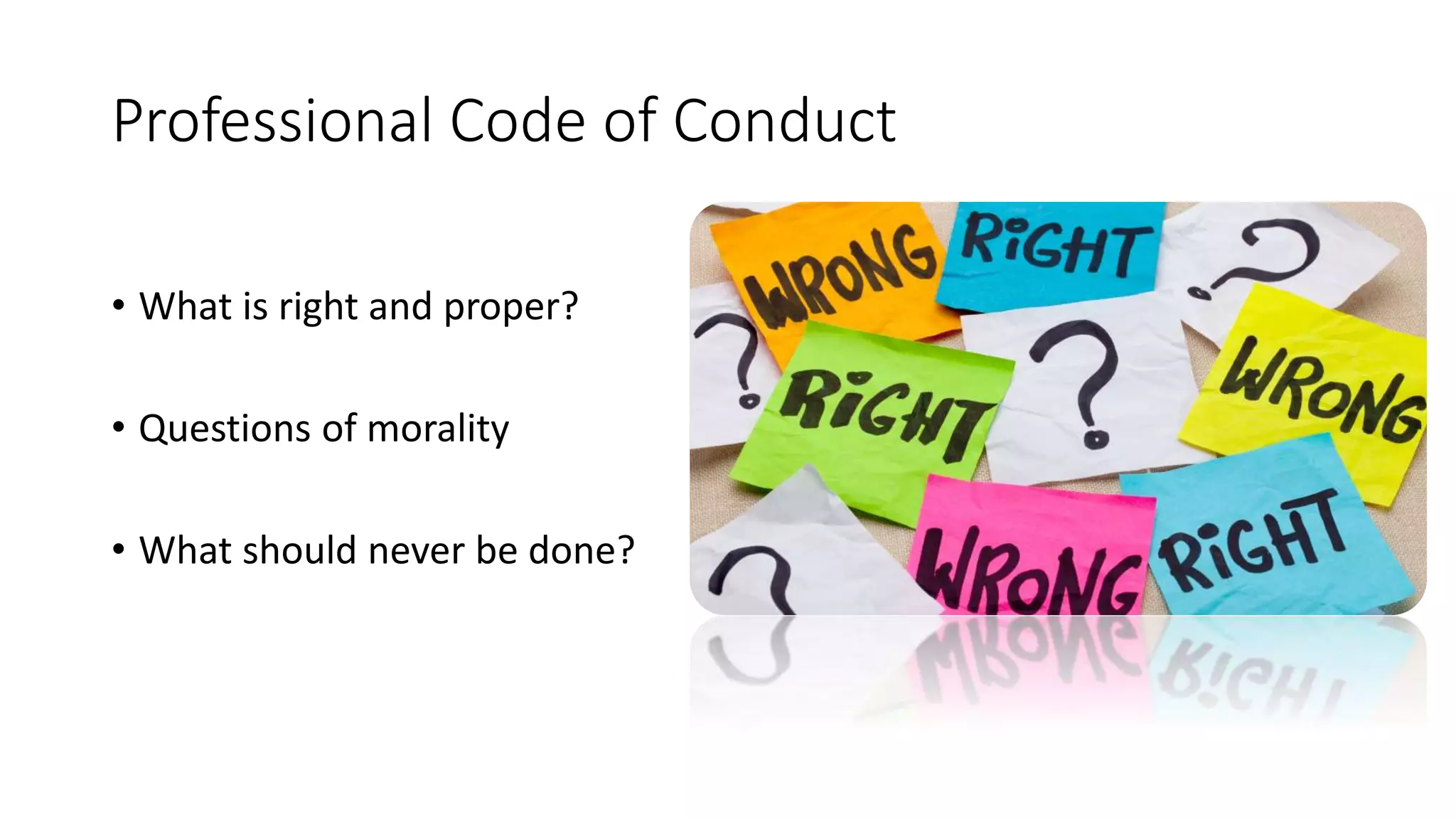
Professional Code of Conduct
• What is right and proper?
• Questions of morality
• What should never be done?
Moral questions are hard
• IT is truly global
• Effects and results of a technology can occur far away and a long time
after its development
• Unintentional consequences can be significant
Association for Computing Machinery (ACM)
• Contribute to society and human well-being.
• Avoid harm to others.
• Be honest and trustworthy.
• Give proper credit for intellectual property.
• Respect the privacy of others. Honor confidentiality.
Technology and its consequences
• Dispensing drugs
• Testing automobiles
• Emissions
• Working brakes
• Transforming users and their data into product
Technology and its consequences
Ethical concerns
• Evil software
• software that is likely to do harm
• Data
• what to keep, what to publish, how to use
• Bugs
• is it OK to not fix a bug or vulnerability
• Quality
• is it acceptable to deliver poor or untested product
Association for Computing Machinery (ACM)
• Contribute to society and human well-being.
• Avoid harm to others.
• Be honest and trustworthy.
• Give proper credit for intellectual property.
• Respect the privacy of others. Honor confidentiality.
Software and hardware bugs
• What is the harm?
• Who was harmed,
if anyone?
• What is the ethical
course of actions?
Association for Computing Machinery (ACM)
• Contribute to society and human well-being.
• Avoid harm to others.
• Be honest and trustworthy.
• Give proper credit for intellectual property.
• Respect the privacy of others. Honor confidentiality.
Smart Listening devices
- Devices should “wake up” on specific word.
- Record audio and send out.
• Should this technology be trusted?
• What is the harm, if any?
Association for Computing Machinery (ACM)
• Contribute to society and human well-being.
• Avoid harm to others.
• Be honest and trustworthy.
• Give proper credit for intellectual property.
• Respect the privacy of others. Honor confidentiality.
Quiz: Cost of software piracy
$0
Millions of dollars
Poor developers’ livelihood
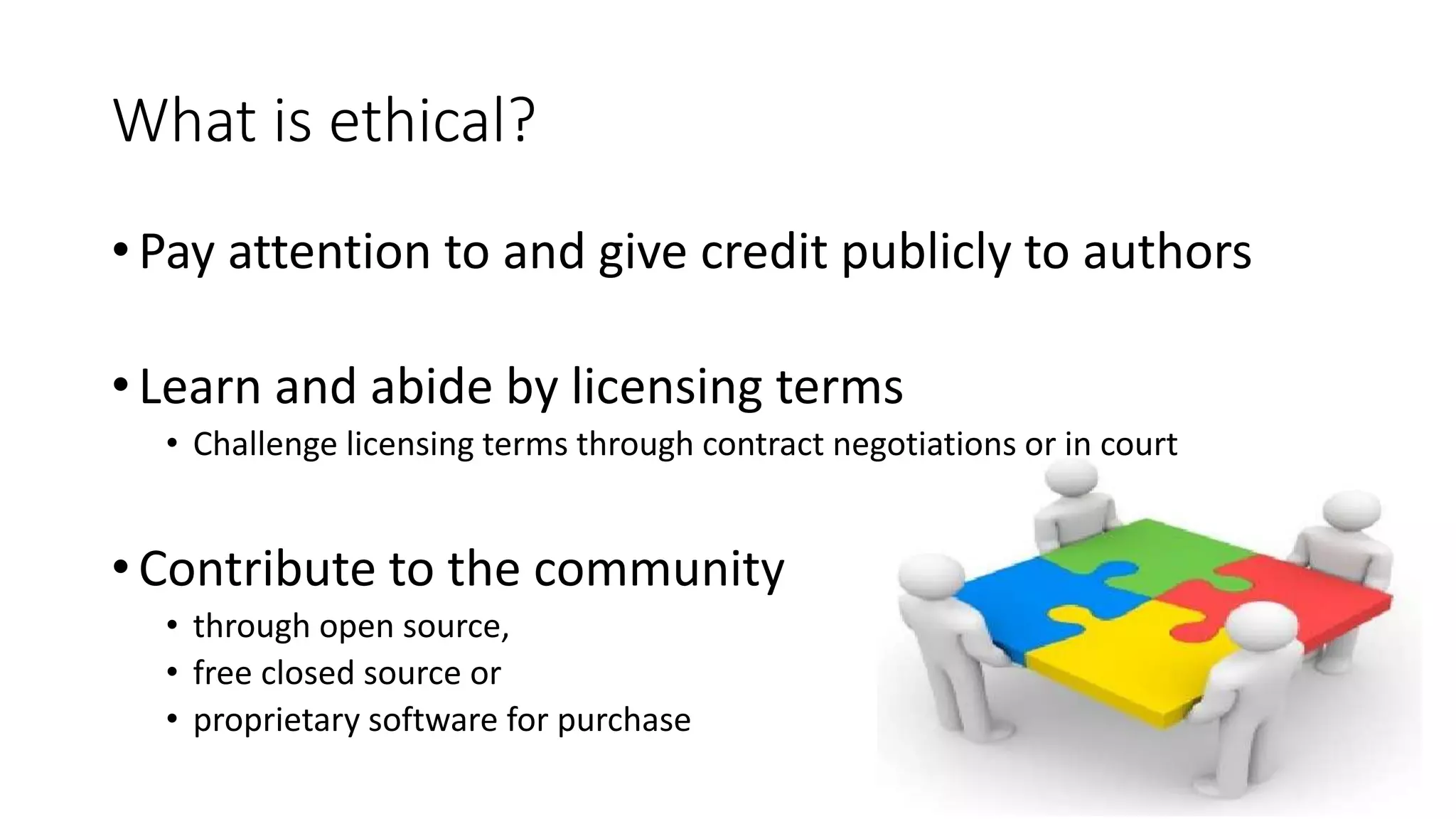
What is ethical?
• Pay attention to and give credit publicly to authors
• Learn and abide by licensing terms
• Challenge licensing terms through contract negotiations or in court
• Contribute to the community
• through open source,
• free closed source or
• proprietary software for purchase
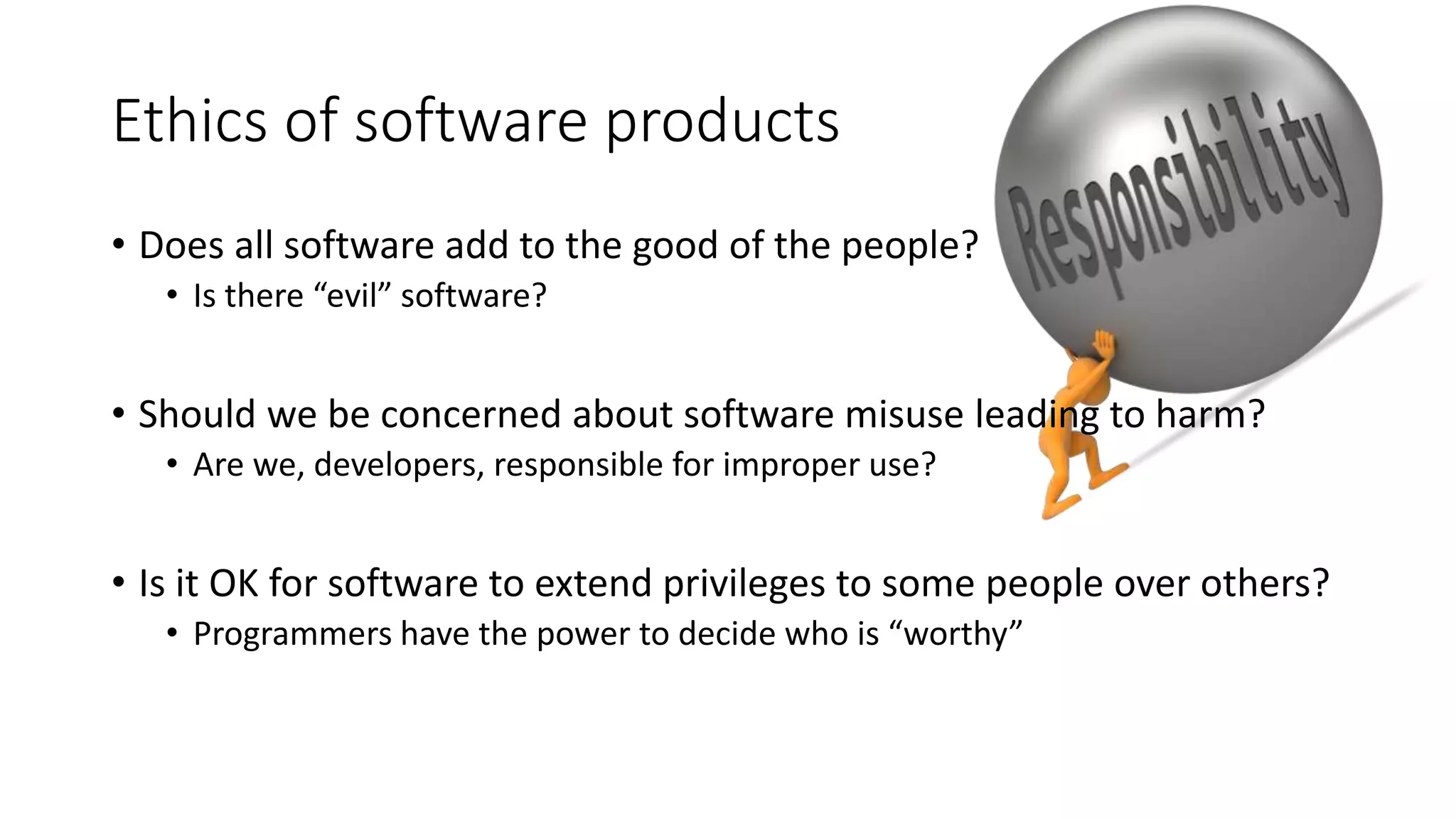
Ethics of software products
• Does all software add to the good of the people?
• Is there “evil” software?
• Should we be concerned about software misuse leading to harm?
• Are we, developers, responsible for improper use?
• Is it OK for software to extend privileges to some people over others?
• Programmers have the power to decide who is “worthy”
Video jail visitation
- Leads to bans on in-person visits
- Limits accessibility of visitation
Encrypted communication makes
It harder for authorities to detect
Illegal and terrorist activities
Alt-right uses social networking sites
to spread their message.
Ethics of software development
practice
• Is it OK to fail and learn from mistakes?
• Is it ethical to require a “death march” from the
team?
• Is it acceptable to keep a high-performing
person who is otherwise hurting the team?
What ethical dilemmas
are you facing?
ETHICS
in software development
Jane Prusakova
@jprusakova

Questions of Ethics in Software Development

  • 1.
  • 2.
    Professional Code ofConduct • What is right and proper? • Questions of morality • What should never be done?
  • 3.
    Moral questions arehard • IT is truly global • Effects and results of a technology can occur far away and a long time after its development • Unintentional consequences can be significant
  • 4.
    Association for ComputingMachinery (ACM) • Contribute to society and human well-being. • Avoid harm to others. • Be honest and trustworthy. • Give proper credit for intellectual property. • Respect the privacy of others. Honor confidentiality.
  • 5.
    Technology and itsconsequences • Dispensing drugs • Testing automobiles • Emissions • Working brakes • Transforming users and their data into product
  • 6.
    Technology and itsconsequences
  • 7.
    Ethical concerns • Evilsoftware • software that is likely to do harm • Data • what to keep, what to publish, how to use • Bugs • is it OK to not fix a bug or vulnerability • Quality • is it acceptable to deliver poor or untested product
  • 9.
    Association for ComputingMachinery (ACM) • Contribute to society and human well-being. • Avoid harm to others. • Be honest and trustworthy. • Give proper credit for intellectual property. • Respect the privacy of others. Honor confidentiality.
  • 10.
    Software and hardwarebugs • What is the harm? • Who was harmed, if anyone? • What is the ethical course of actions?
  • 11.
    Association for ComputingMachinery (ACM) • Contribute to society and human well-being. • Avoid harm to others. • Be honest and trustworthy. • Give proper credit for intellectual property. • Respect the privacy of others. Honor confidentiality.
  • 12.
    Smart Listening devices -Devices should “wake up” on specific word. - Record audio and send out. • Should this technology be trusted? • What is the harm, if any?
  • 13.
    Association for ComputingMachinery (ACM) • Contribute to society and human well-being. • Avoid harm to others. • Be honest and trustworthy. • Give proper credit for intellectual property. • Respect the privacy of others. Honor confidentiality.
  • 14.
    Quiz: Cost ofsoftware piracy $0 Millions of dollars Poor developers’ livelihood
  • 15.
    What is ethical? •Pay attention to and give credit publicly to authors • Learn and abide by licensing terms • Challenge licensing terms through contract negotiations or in court • Contribute to the community • through open source, • free closed source or • proprietary software for purchase
  • 16.
    Ethics of softwareproducts • Does all software add to the good of the people? • Is there “evil” software? • Should we be concerned about software misuse leading to harm? • Are we, developers, responsible for improper use? • Is it OK for software to extend privileges to some people over others? • Programmers have the power to decide who is “worthy”
  • 17.
    Video jail visitation -Leads to bans on in-person visits - Limits accessibility of visitation Encrypted communication makes It harder for authorities to detect Illegal and terrorist activities Alt-right uses social networking sites to spread their message.
  • 18.
    Ethics of softwaredevelopment practice • Is it OK to fail and learn from mistakes? • Is it ethical to require a “death march” from the team? • Is it acceptable to keep a high-performing person who is otherwise hurting the team?
  • 19.
  • 20.

Editor's Notes

  • #5 American scholar Norbert Wiener, a professor of mathematics and engineering at MIT. The issues that he identified in his books Cybernetics (1948), The Human Use of Human Beings(1950), God and Golem, Inc. (1963), included topics that are still important today: computers and security, computers and unemployment, responsibilities of computer professionals, computers for persons with disabilities, information networks and globalization, virtual communities, teleworking, merging of human bodies with machines, robot ethics, artificial intelligence, computers and religion, and a number of other subjects. 
  • #6 https://www.wired.com/2015/03/how-technology-led-a-hospital-to-give-a-patient-38-times-his-dosage/
  • #7 American scholar Norbert Wiener, a professor of mathematics and engineering at MIT. The issues that he identified in his books Cybernetics (1948), The Human Use of Human Beings(1950), God and Golem, Inc. (1963), included topics that are still important today: computers and security, computers and unemployment, responsibilities of computer professionals, computers for persons with disabilities, information networks and globalization, virtual communities, teleworking, merging of human bodies with machines, robot ethics, artificial intelligence, computers and religion, and a number of other subjects. 
  • #19 Fowler detailed the sexism and harassment she faced at the company where she was a site reliability engineer for a year. Her essay, which details how her managers did little to rectify her issues, shed light on a system that protected high performers when accused of bad behavior like harassment.