Language Interpreter Training as a Stepping Stone to work 
№ 2012-1-GB2-LEO05-07809 
FINAL CONFERENCE 
10th September 2014 
Berlin, Germany 
Center RUNI 
Sofia 
Bulgaria
Work Package 2 Needs analysis 
Start: November 2012 
End: March 2013 
Aim 
To provide a picture of the state-of-the-art in each partner 
country – Italy, Greece, Bulgaria, Germany, related to the 
provision of interpreting and translation services
The analysis has looked at: 
 The approach and policies of the public service agencies 
 The process of certifying interpreters and translators 
 The availability of interpreters in the local areas 
 The existence of a formal training for public service 
interpreters and translators 
 The specific languages in which interpreters are most 
needed 
 The position of higher education institutions towards the 
provision of training 
 The view of the society 
 Recommendations
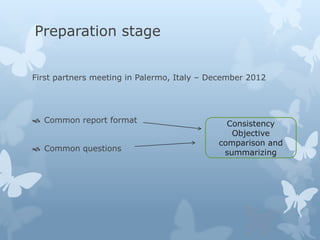
Preparation stage 
First partners meeting in Palermo, Italy – December 2012 
 Common report format 
 Common questions 
Consistency 
Objective 
comparison and 
summarizing
Target groups 
1. Higher education institutions, Education institutions and 
centers 
2. Authorities certifying interpreters and translators and 
Translation agencies 
3. Organizations for integration of refugees and migrants , 
Immigration communities and members 
Specific questionnaire for each stakeholder group has been 
prepared
Approaches 
 Mixed 
- Face-to-face interviews 
- Emails 
- Phone calls 
 99 filled questionnaires 
 9 weeks 
 United Kingdom, Bulgaria, Germany, Italy and Greece. 
 The report from the UK provided an overview on how 
training is delivered there (the UK is the country 
transferring the innovation)
Main points 
 Introduction –about the project; about the training 
course 
 Findings from the stakeholder groups 
 Summary 
 Conclusions and recommendations 
 Future project plans
Findings 
1. Higher education institutions and Educational institutions 
and centers (25 interviews) 
- In each country the universities offer courses for 
interpreters and translators but none is specialized in the 
field of immigration 
- Usually the courses are paid 
- Certificate/diploma after final exams or 
dissertation/thesis
Findings - 2 
2. Authorities certifying interpreters and translators and 
translation agencies (13 interviews) 
- Italy and Greece  No authorities or public bodies 
certifying interpreters/translators 
- Germany – umbrella organisation of German 
Chamber of Industry and Commerce and the 
Chambers of Commerce and Industry of individual 
provinces 
- Bulgaria – Ministry of Foreign Affairs (Department of 
Certifications and Legalizations)
Findings - 3 
3. Organisations for integration of refugees and migrants 
Immigration communities and members (65 interviews) 
- Common languages 
- Problems faced by the migrants and refugees when 
accessing public services 
- Characteristics which an interpreter should possess
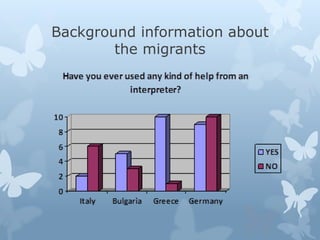
Background information about 
the migrants
Background information about 
the migrants
Background information about 
the migrants
Summary and conclusions 
 EU – attractive destination for migrants 
 Main reasons for migration – personal and economical 
 Basic problem – language barrier 
 Need of qualified interpreters and translators 
 Lack of interpreting services and specialized training 
courses 
 The linguistic skills and the detailed knowledge of the 
specific terminology is not the most important 
 Emphasis  “Human” skills
Thank you for your 
attention!

Need analysis

  • 1.
    Language Interpreter Trainingas a Stepping Stone to work № 2012-1-GB2-LEO05-07809 FINAL CONFERENCE 10th September 2014 Berlin, Germany Center RUNI Sofia Bulgaria
  • 2.
    Work Package 2Needs analysis Start: November 2012 End: March 2013 Aim To provide a picture of the state-of-the-art in each partner country – Italy, Greece, Bulgaria, Germany, related to the provision of interpreting and translation services
  • 3.
    The analysis haslooked at:  The approach and policies of the public service agencies  The process of certifying interpreters and translators  The availability of interpreters in the local areas  The existence of a formal training for public service interpreters and translators  The specific languages in which interpreters are most needed  The position of higher education institutions towards the provision of training  The view of the society  Recommendations
  • 4.
    Preparation stage Firstpartners meeting in Palermo, Italy – December 2012  Common report format  Common questions Consistency Objective comparison and summarizing
  • 5.
    Target groups 1.Higher education institutions, Education institutions and centers 2. Authorities certifying interpreters and translators and Translation agencies 3. Organizations for integration of refugees and migrants , Immigration communities and members Specific questionnaire for each stakeholder group has been prepared
  • 6.
    Approaches  Mixed - Face-to-face interviews - Emails - Phone calls  99 filled questionnaires  9 weeks  United Kingdom, Bulgaria, Germany, Italy and Greece.  The report from the UK provided an overview on how training is delivered there (the UK is the country transferring the innovation)
  • 7.
    Main points Introduction –about the project; about the training course  Findings from the stakeholder groups  Summary  Conclusions and recommendations  Future project plans
  • 8.
    Findings 1. Highereducation institutions and Educational institutions and centers (25 interviews) - In each country the universities offer courses for interpreters and translators but none is specialized in the field of immigration - Usually the courses are paid - Certificate/diploma after final exams or dissertation/thesis
  • 9.
    Findings - 2 2. Authorities certifying interpreters and translators and translation agencies (13 interviews) - Italy and Greece  No authorities or public bodies certifying interpreters/translators - Germany – umbrella organisation of German Chamber of Industry and Commerce and the Chambers of Commerce and Industry of individual provinces - Bulgaria – Ministry of Foreign Affairs (Department of Certifications and Legalizations)
  • 10.
    Findings - 3 3. Organisations for integration of refugees and migrants Immigration communities and members (65 interviews) - Common languages - Problems faced by the migrants and refugees when accessing public services - Characteristics which an interpreter should possess
  • 11.
  • 12.
  • 13.
  • 14.
    Summary and conclusions  EU – attractive destination for migrants  Main reasons for migration – personal and economical  Basic problem – language barrier  Need of qualified interpreters and translators  Lack of interpreting services and specialized training courses  The linguistic skills and the detailed knowledge of the specific terminology is not the most important  Emphasis  “Human” skills
  • 15.
    Thank you foryour attention!