Immigration in
       Finland
           Maija-Leena Kemppi
        Salpaus Further Education
Adult Education and Working Life Services
Immigration to Finland
O Today, people’s main motives for moving to
  Finland are study, work and family. Despite
  the fact that immigration to Finland on it’s
  current scale is a relatively recent phenomen,
  foreigners make up a significant proportion of
  the population in some parts of Finland – for
  instance in the Greater Helsinki Area.
O Immigration to Finland started to decline on
  2009 and the trend continued in 2010. (2008
  immigration 29114) A total of 25650 people
  moved to Finland in 2010.
Foreigners in Finland
O The largest number of foreigners moving
  to Finland are Russians. Finnish
  citizenship is most often applied for by the
  people from outside the EU, but among
  the ten largest groups of applicants there
  is one EU-country – Estonia.
O The number of asylum seekers continued
  to decline globally. In 2010, a total of 4018
  people sought asylum in Finland, (drop of
  33 %).
Some facts
O Foreign nationals account for 3 % of the
  population. Most of the people who were
  born abroad were born in Europe (65 %).
  Foreing-language speakers make up 4 %
  of the population.
O At the end of 2010 with dual nationality
  54,912.
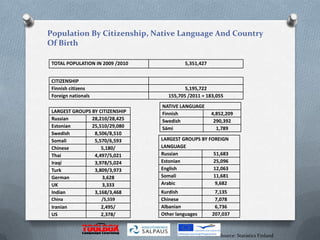
Population By Citizenship, Native Language And Country
Of Birth

 TOTAL POPULATION IN 2009 /2010            5,351,427


 CITIZENSHIP
 Finnish citizens                           5,195,722
 Foreign nationals                   155,705 /2011 = 183,055
                                  NATIVE LANGUAGE
 LARGEST GROUPS BY CITIZENSHIP    Finnish              4,852,209
 Russian        28,210/28,425     Swedish               290,392
 Estonian       25,510/29,080     Sámi                   1,789
 Swedish         8,506/8,510
 Somali          5,570/6,593      LARGEST GROUPS BY FOREIGN
 Chinese            5,180/        LANGUAGE
 Thai            4,497/5,021      Russian             51,683
 Iraqi           3,978/5,024      Estonian            25,096
 Turk            3,809/3,973      English             12,063
 German             3,628         Somali              11,681
 UK                 3,333         Arabic               9,682
 Indian          3,168/3,468      Kurdish               7,135
 China               /5,559       Chinese               7,078
 Iranian             2,495/       Albanian              6,736
 US                  2,378/       Other languages      207,037


                                                          Source: Statistics Finland
A new trend in migration –
         mobility
O New trend wordlwide – mobility
O Nowadays many people want to move to
  a second or third country, some go back
  and forth between certain countries while
  others move to their parents’ country of
  origin.
O Researchers call these modern-day
  emigrants transnationals. Some of them
  apply for citizenship of another country
  because it makes travelling easier.
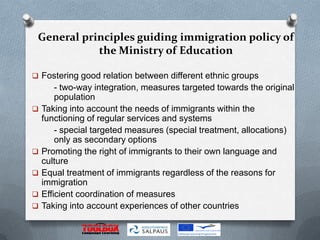
General principles guiding immigration policy of
            the Ministry of Education

 Fostering good relation between different ethnic groups
        - two-way integration, measures targeted towards the original
        population
   Taking into account the needs of immigrants within the
    functioning of regular services and systems
        - special targeted measures (special treatment, allocations)
        only as secondary options
   Promoting the right of immigrants to their own language and
    culture
   Equal treatment of immigrants regardless of the reasons for
    immigration
   Efficient coordination of measures
   Taking into account experiences of other countries
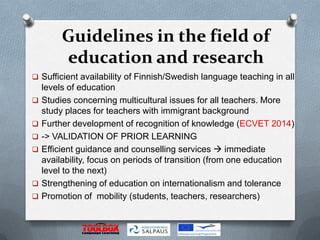
Guidelines in the field of
         education and research
 Sufficient availability of Finnish/Swedish language teaching in all
    levels of education
   Studies concerning multicultural issues for all teachers. More
    study places for teachers with immigrant background
   Further development of recognition of knowledge (ECVET 2014)
   -> VALIDATION OF PRIOR LEARNING
   Efficient guidance and counselling services  immediate
    availability, focus on periods of transition (from one education
    level to the next)
   Strengthening of education on internationalism and tolerance
   Promotion of mobility (students, teachers, researchers)
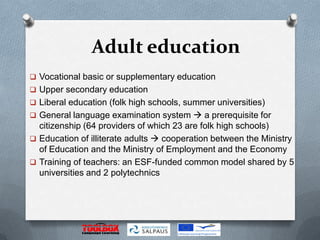
Adult education
 Vocational basic or supplementary education
 Upper secondary education
 Liberal education (folk high schools, summer universities)
 General language examination system  a prerequisite for
  citizenship (64 providers of which 23 are folk high schools)
 Education of illiterate adults  cooperation between the Ministry
  of Education and the Ministry of Employment and the Economy
 Training of teachers: an ESF-funded common model shared by 5
  universities and 2 polytechnics
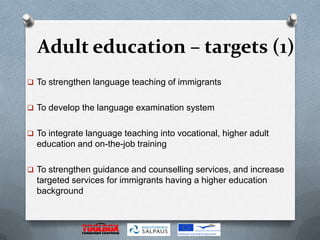
Adult education – targets (1)
 To strengthen language teaching of immigrants


 To develop the language examination system


 To integrate language teaching into vocational, higher adult
  education and on-the-job training

 To strengthen guidance and counselling services, and increase
  targeted services for immigrants having a higher education
  background
Adult education – targets (2)
 To increase training for teachers with immigrant background or
  teachers working with immigrants

 Transfers of administrative resources from the Min. of
  Employment and the Economy to the Min. of Education which
  concern teaching of illiterate adults

 More resources for upper secondary education institutes


 Changes in the legislation and funding of liberal adult education
More about immigration in
        Finland
O http://docreader.readspeaker.com/docread
 er/?cid=brzou&lang=en_uk&url=www.migr
 i.fi%2fdownload%2f16939_maahanmuuto
 n_vuosikatsaus_eng_netti_1_.pdf

Immigration in Finland

  • 1.
    Immigration in Finland Maija-Leena Kemppi Salpaus Further Education Adult Education and Working Life Services
  • 2.
    Immigration to Finland OToday, people’s main motives for moving to Finland are study, work and family. Despite the fact that immigration to Finland on it’s current scale is a relatively recent phenomen, foreigners make up a significant proportion of the population in some parts of Finland – for instance in the Greater Helsinki Area. O Immigration to Finland started to decline on 2009 and the trend continued in 2010. (2008 immigration 29114) A total of 25650 people moved to Finland in 2010.
  • 3.
    Foreigners in Finland OThe largest number of foreigners moving to Finland are Russians. Finnish citizenship is most often applied for by the people from outside the EU, but among the ten largest groups of applicants there is one EU-country – Estonia. O The number of asylum seekers continued to decline globally. In 2010, a total of 4018 people sought asylum in Finland, (drop of 33 %).
  • 4.
    Some facts O Foreignnationals account for 3 % of the population. Most of the people who were born abroad were born in Europe (65 %). Foreing-language speakers make up 4 % of the population. O At the end of 2010 with dual nationality 54,912.
  • 5.
    Population By Citizenship,Native Language And Country Of Birth TOTAL POPULATION IN 2009 /2010 5,351,427 CITIZENSHIP Finnish citizens 5,195,722 Foreign nationals 155,705 /2011 = 183,055 NATIVE LANGUAGE LARGEST GROUPS BY CITIZENSHIP Finnish 4,852,209 Russian 28,210/28,425 Swedish 290,392 Estonian 25,510/29,080 Sámi 1,789 Swedish 8,506/8,510 Somali 5,570/6,593 LARGEST GROUPS BY FOREIGN Chinese 5,180/ LANGUAGE Thai 4,497/5,021 Russian 51,683 Iraqi 3,978/5,024 Estonian 25,096 Turk 3,809/3,973 English 12,063 German 3,628 Somali 11,681 UK 3,333 Arabic 9,682 Indian 3,168/3,468 Kurdish 7,135 China /5,559 Chinese 7,078 Iranian 2,495/ Albanian 6,736 US 2,378/ Other languages 207,037 Source: Statistics Finland
  • 7.
    A new trendin migration – mobility O New trend wordlwide – mobility O Nowadays many people want to move to a second or third country, some go back and forth between certain countries while others move to their parents’ country of origin. O Researchers call these modern-day emigrants transnationals. Some of them apply for citizenship of another country because it makes travelling easier.
  • 8.
    General principles guidingimmigration policy of the Ministry of Education  Fostering good relation between different ethnic groups - two-way integration, measures targeted towards the original population  Taking into account the needs of immigrants within the functioning of regular services and systems - special targeted measures (special treatment, allocations) only as secondary options  Promoting the right of immigrants to their own language and culture  Equal treatment of immigrants regardless of the reasons for immigration  Efficient coordination of measures  Taking into account experiences of other countries
  • 9.
    Guidelines in thefield of education and research  Sufficient availability of Finnish/Swedish language teaching in all levels of education  Studies concerning multicultural issues for all teachers. More study places for teachers with immigrant background  Further development of recognition of knowledge (ECVET 2014)  -> VALIDATION OF PRIOR LEARNING  Efficient guidance and counselling services  immediate availability, focus on periods of transition (from one education level to the next)  Strengthening of education on internationalism and tolerance  Promotion of mobility (students, teachers, researchers)
  • 10.
    Adult education  Vocationalbasic or supplementary education  Upper secondary education  Liberal education (folk high schools, summer universities)  General language examination system  a prerequisite for citizenship (64 providers of which 23 are folk high schools)  Education of illiterate adults  cooperation between the Ministry of Education and the Ministry of Employment and the Economy  Training of teachers: an ESF-funded common model shared by 5 universities and 2 polytechnics
  • 11.
    Adult education –targets (1)  To strengthen language teaching of immigrants  To develop the language examination system  To integrate language teaching into vocational, higher adult education and on-the-job training  To strengthen guidance and counselling services, and increase targeted services for immigrants having a higher education background
  • 12.
    Adult education –targets (2)  To increase training for teachers with immigrant background or teachers working with immigrants  Transfers of administrative resources from the Min. of Employment and the Economy to the Min. of Education which concern teaching of illiterate adults  More resources for upper secondary education institutes  Changes in the legislation and funding of liberal adult education
  • 13.
    More about immigrationin Finland O http://docreader.readspeaker.com/docread er/?cid=brzou&lang=en_uk&url=www.migr i.fi%2fdownload%2f16939_maahanmuuto n_vuosikatsaus_eng_netti_1_.pdf