MIGRATION IN TURKEY
 Throughout history, Turkey has been affected by
diverse forms of migratory movements and refugee
flows. Traditionally, Turkey has been a country of
emigration with large numbers of its citizens migrating
to Western Europe, particularly Germany since the
1970s.
 Since the early 1990s, the country has been positioned
on the transit route for irregular migrants from
Afghanistan, Bangladesh, Iraq, Iran, and Pakistan.
Turkey remains a destination for human trafficking in
the Black Sea region, with victims usually coming from
Moldova, Ukraine, Russian Federation, Kyrgyzstan, and
Uzbekistan.
Source :Migration in Turkey: A Country Profile 2008
 Turkey has also long been a country of destination for
migrants, either economic migrants or refugees or
asylum seekers. It has recently emerged as a
destination for migrants from Eastern Europe and the
former Soviet Union, as these new migrants envisage
Turkey as a gateway to a new job, a new life, and a
stepping stone to employment in the West.
Source :Migration in Turkey: A Country Profile 2008
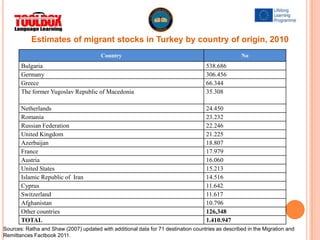
Estimates of migrant stocks in Turkey by country of origin, 2010
Sources: Ratha and Shaw (2007) updated with additional data for 71 destination countries as described in the Migration and
Remittances Factbook 2011.
Country No
Bulgaria 538.686
Germany 306.456
Greece 66.344
The former Yugoslav Republic of Macedonia 35.308
Netherlands 24.450
Romania 23.232
Russian Federation 22.246
United Kingdom 21.225
Azerbaijan 18.807
France 17.979
Austria 16.060
United States 15.213
Islamic Republic of Iran 14.516
Cyprus 11.642
Switzerland 11.617
Afghanistan 10.796
Other countries 126,348
TOTAL 1.410.947
The number of Refugees and Asylum
seekers in Turkey
Source: UNHCR.
The number of Refugees and Asylum
seekers in Turkey
Source: UNHCR.
The number of Refugees and Asylum
seekers in Turkey
Source: UNHCR.
The number of Refugees and Asylum
seekers in Turkey
Source: UNHCR.
The number of Syrian Refugees in
Turkey
Source: UNHCR.

Migration in turkey

  • 1.
  • 2.
     Throughout history,Turkey has been affected by diverse forms of migratory movements and refugee flows. Traditionally, Turkey has been a country of emigration with large numbers of its citizens migrating to Western Europe, particularly Germany since the 1970s.  Since the early 1990s, the country has been positioned on the transit route for irregular migrants from Afghanistan, Bangladesh, Iraq, Iran, and Pakistan. Turkey remains a destination for human trafficking in the Black Sea region, with victims usually coming from Moldova, Ukraine, Russian Federation, Kyrgyzstan, and Uzbekistan. Source :Migration in Turkey: A Country Profile 2008
  • 3.
     Turkey hasalso long been a country of destination for migrants, either economic migrants or refugees or asylum seekers. It has recently emerged as a destination for migrants from Eastern Europe and the former Soviet Union, as these new migrants envisage Turkey as a gateway to a new job, a new life, and a stepping stone to employment in the West. Source :Migration in Turkey: A Country Profile 2008
  • 4.
    Estimates of migrantstocks in Turkey by country of origin, 2010 Sources: Ratha and Shaw (2007) updated with additional data for 71 destination countries as described in the Migration and Remittances Factbook 2011. Country No Bulgaria 538.686 Germany 306.456 Greece 66.344 The former Yugoslav Republic of Macedonia 35.308 Netherlands 24.450 Romania 23.232 Russian Federation 22.246 United Kingdom 21.225 Azerbaijan 18.807 France 17.979 Austria 16.060 United States 15.213 Islamic Republic of Iran 14.516 Cyprus 11.642 Switzerland 11.617 Afghanistan 10.796 Other countries 126,348 TOTAL 1.410.947
  • 5.
    The number ofRefugees and Asylum seekers in Turkey Source: UNHCR.
  • 6.
    The number ofRefugees and Asylum seekers in Turkey Source: UNHCR.
  • 7.
    The number ofRefugees and Asylum seekers in Turkey Source: UNHCR.
  • 8.
    The number ofRefugees and Asylum seekers in Turkey Source: UNHCR.
  • 9.
    The number ofSyrian Refugees in Turkey Source: UNHCR.