RUMINATION
DISORDER
Lexy Moore
INTRODUCTION
16-year-old female diagnosed with
rumination disorder.
Rumination disorder was an interesting and
new disease to study
OBJECTIVES
Background information on rumination
disease
Nutrition Implications
Literature review dealing with rumination
disease
Nutrition Care Process
o Nutrition assessment
o Nutrition diagnosis
o Nutrition intervention
o Nutrition monitoring and evaluation
INTRODUCTION OF
RUMINATION DISORDER
Repeatedly regurgitate food after eating
No nausea or involuntary vomiting
The food may be spit out or reswallowed
Behavior must occur over a period of ≥ 1 month
oMust not be caused by a GI disorder that can lead to
regurgitation
oOr an eating disorder
Regurgitation occurs several times a week, typically
daily
Rumination in adults of average intelligence has been
ROME III DEFINITION OF RUMINATION
SYNDROME GREEN AD, ET AL.
Must Include:
1.Persistent/recurrent regurgitation of recently ingested
food into the mouth with subsequent reswallowing or
spitting out.
2.No preceding nausea/vomiting
3.Cessation of regurgitation once gastric content is
acidified
4.Does not occur during sleep
5.Regurgitation food has a pleasant taste
PATHOPHYSIOLOGY
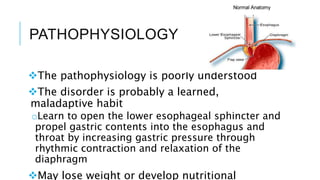
The pathophysiology is poorly understood
The disorder is probably a learned,
maladaptive habit
oLearn to open the lower esophageal sphincter and
propel gastric contents into the esophagus and
throat by increasing gastric pressure through
rhythmic contraction and relaxation of the
diaphragm
May lose weight or develop nutritional
TREATMENT
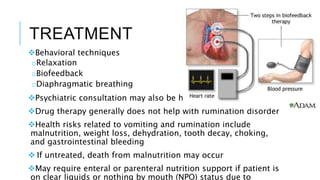
Behavioral techniques
oRelaxation
oBiofeedback
oDiaphragmatic breathing
Psychiatric consultation may also be helpful
Drug therapy generally does not help with rumination disorder
Health risks related to vomiting and rumination include
malnutrition, weight loss, dehydration, tooth decay, choking,
and gastrointestinal bleeding
 If untreated, death from malnutrition may occur
May require enteral or parenteral nutrition support if patient is
on clear liquids or nothing by mouth (NPO) status due to
NUTRITION RECOMMENDATIONS FOR
PROLONGED VOMITING AND
RUMINATION DISORDER
Dehydration, electrolyte, and acid-base imbalance
may occur
Mild cases where no weight loss is present:
oThe practice of reswallowing regurgitated food
oPractice of diaphragmatic breathing
oConsumption of very small, very frequent meals
oChewing gum after meals to increase the frequency of swallow
Significant weight loss, failure to thrive, and/or
malnutrition:
o24-hour continuous enteral nutrition support with a high-
DIETARY REFERENCE
INTAKES
Calorie Requirement:
o14-16 is 1760 kcal/day (33 kcal/kg/d)
Protein Requirement:
o46 g protein/day (0.85 g protein/kg/d)
Fluid Requirement:
Baseline fluid requirements for patients >20 kg is 1500 ml +
20 mL/kg for each kg above 20 kg
CHIAL, CAMILLERI, ET AL.
Methods: Review of the medical records for all 147
patients ages 5 to 20 dx with rumination disease
between 1975 and 2000
Results and Conclusions:
Early intervention with behavioral modification is advocated
Over 80% success in children and adolescents who have
received behavioral therapy (biofeedback, relaxation training,
instruction in diaphragmatic breathing, and/or cognitive
behavioral therapy)
Collaboration between gastroenterologists, pediatricians, and
psychologists
PATIENT HISTORY
16-year-old female
diagnosed with rumination
disorder
About a year of vomiting
occurring 1-2 times per day
on average
First EGD was normal and
they started her on proton
pump inhibitor (PPI)
Depression and anxiety
disorder
Patient has continued to
vomit 1 to 2 times a day since
diagnosis of rumination
disorder
Patient has not been eating
for the last 5 days due to
vomiting
Patient has associated
abdominal spasms after
vomiting
She feels all her anxiety is
related to her vomiting
ENTRY INTO NCP
Admitted to the hospital for vomiting and a 5
lb. weight loss over a 5-day period
The patient was scheduled for an EGD and
NGT placement
Referred to the RD for a tube feeding
recommendation
NUTRITION ASSESSMENT
ANTHROPOMETRICS
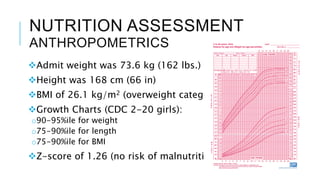
Admit weight was 73.6 kg (162 lbs.)
Height was 168 cm (66 in)
BMI of 26.1 kg/m2 (overweight category)
Growth Charts (CDC 2-20 girls):
o90-95%ile for weight
o75-90%ile for length
o75-90%ile for BMI
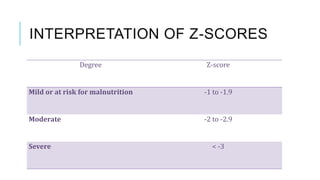
Z-score of 1.26 (no risk of malnutrition).
INTERPRETATION OF Z-SCORES
Degree Z-score
Mild or at risk for malnutrition -1 to -1.9
Moderate -2 to -2.9
Severe < -3
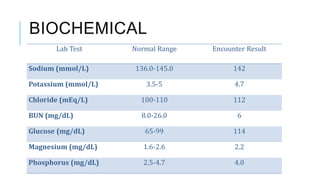
BIOCHEMICAL
Lab Test Normal Range Encounter Result
Sodium (mmol/L) 136.0-145.0 142
Potassium (mmol/L) 3.5-5 4.7
Chloride (mEq/L) 100-110 112
BUN (mg/dL) 8.0-26.0 6
Glucose (mg/dL) 65-99 114
Magnesium (mg/dL) 1.6-2.6 2.2
Phosphorus (mg/dL) 2.5-4.7 4.0
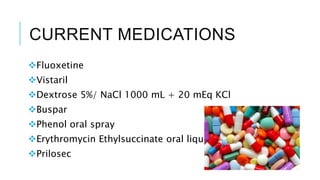
CURRENT MEDICATIONS
Fluoxetine
Vistaril
Dextrose 5%/ NaCl 1000 mL + 20 mEq KCl
Buspar
Phenol oral spray
Erythromycin Ethylsuccinate oral liquid
Prilosec
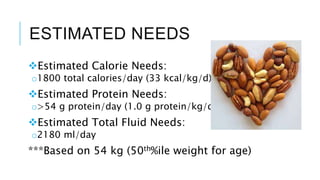
ESTIMATED NEEDS
Estimated Calorie Needs:
o1800 total calories/day (33 kcal/kg/d)
Estimated Protein Needs:
o>54 g protein/day (1.0 g protein/kg/d)
Estimated Total Fluid Needs:
o2180 ml/day
***Based on 54 kg (50th%ile weight for age)
NUTRITION DIAGNOSIS
Altered GI function related to vomiting as
evidenced by the need for enteral nutrition
feeding to meet estimated needs.
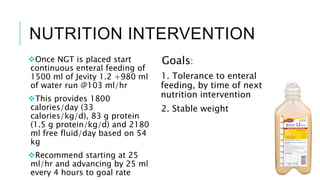
NUTRITION INTERVENTION
Once NGT is placed start
continuous enteral feeding of
1500 ml of Jevity 1.2 +980 ml
of water run @103 ml/hr
This provides 1800
calories/day (33
calories/kg/d), 83 g protein
(1.5 g protein/kg/d) and 2180
ml free fluid/day based on 54
kg
Recommend starting at 25
ml/hr and advancing by 25 ml
every 4 hours to goal rate
Goals:
1. Tolerance to enteral
feeding, by time of next
nutrition intervention
2. Stable weight
NUTRITION MONITORING AND
EVALUATION
The EGD biopsy results once again were normal
The patient’s tube feeding placement went well
(some emesis with initiation)
She is now tolerating Jevity 1.2 @50 ml/hr
Increase the rate of tube feeding as tolerated
Continue to monitor tolerance to enteral nutrition
and body weight
If any aspiration occurs with the NGT, a tube in the
small bowel may be acceptable
NUTRITION MONITORING AND
EVALUATION
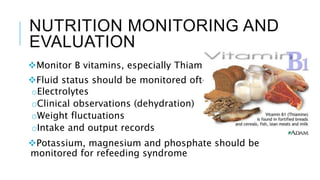
Monitor B vitamins, especially Thiamin
Fluid status should be monitored often:
oElectrolytes
oClinical observations (dehydration)
oWeight fluctuations
oIntake and output records
Potassium, magnesium and phosphate should be
monitored for refeeding syndrome
NUTRITION MONITORING AND
EVALUATION
Early recognition of the clinical features of
rumination and referral for behavioral treatment
to help reduce adverse consequences is vital to
the patient’s overall health
MD discussed multidisciplinary behavioral
modification therapy at a rumination clinic at
Nationwide Children’s
Patient will be a candidate for their inpatient
program
NATIONWIDE CHILDREN’S
Multiple experts working to
eliminate rumination behavior:
Gastroenterology
Pediatric psychology
Clinical nutrition
Child life
Massage therapy
Therapeutic recreation
Daily Schedule includes:
Times with each therapist
Specific times each day in which
patients work on their eating
skills
Found that patients age 12
and older seem to do the best in
our program
Treatment approach requires
patients to have insight into their
challenges, be able to work
independently, and have the
ability to work continuously
FUTURE DIRECTION
More variety of participants in studies
Overall case-controlled studies on participants
with rumination disorder
Rumination complicated by comorbid medical,
psychological, or psychiatric conditions may
require additional therapeutic interventions
Clinical features, extensive diagnostic testing
including gastroduodenal manometry and
esophageal pH testing is unnecessary
CONCLUSION
In rumination disorder, patients repeatedly regurgitate food after
eating, but they have no nausea or involuntary vomiting
The behavior must occur over a period of ≥ 1 month and must not
be caused by a GI disorder that can lead to regurgitation or an eating
disorder
 Health risks related to vomiting and rumination include
malnutrition, weight loss, dehydration, tooth decay, choking, and
gastrointestinal bleeding
Behavioral techniques like relaxation, biofeedback, using the
diaphragm instead of the chest muscles to breathe for mild cases
More severe cases with weight loss may require continuous enteral
nutrition support
Multidisciplinary team
REFERENCES
Introduction to Eating Disorders. The Merck Manual Professional
Version. 2015. Available at
http://www.merckmanuals.com/professional/psychiatric-
disorders/eating-disorders/introduction-to-eating-disorders.
Accessed on February 23, 2016.
Developmental Disabilities. Nutrition Care Manual. 2015. Available at
https://www.nutritioncaremanual.org/topic.cfm?ncm_category_id=1&
ncm_toc_id=255356&ncm_heading=Nutrition%20Care&ncm_content_
id=110329#DiseaseProcess. Accessed on February 23, 2016.
Rumination. The Merck Manual Professional Version. 2015. Available
at http://www.merckmanuals.com/professional/gastrointestinal-
disorders/symptoms-of-gi-disorders/rumination. Accessed on
February 23, 2016.
Land R, Mulloy A, Giesbers S et al. Behavioral interventions for
rumination and operant vomiting in individuals with intellectual
disabilities: A systematic review. Research in Developmental
Disabilities. 2011;32: 2193-2205.
REFERENCES CONT.
Nausea and Vomiting. Nutrition Care Manual. 2016. Available at
https://www.nutritioncaremanual.org/topic.cfm?ncm_category_id=1&ncm_t
oc_id=20079&ncm_heading=Nutrition%20Care&ncm_content_id=83027#Bio
chemicalandNutrientIssue. Accessed on February 23, 2016.
Dietary Reference intakes: The essential guide to nutrition requirements
divided into smaller groupings. Based on NCHS/CDC 200 Growth charts.
Institute of Medicine. 2006.
Johnson, KB. Fluid and Electrolytes. The Harriet Lane Handbook. St. Louis. CV
Mosby 1993: 164-165.
Green AD, Alioto A, Mousa H, DiLorenzo C. Severe pediatric rumination
syndrome: successful interdisciplinary inpatient management. J Pediatr
Gastroenterol Nutr. 2011;52:414-418.

Rumination disorder Presentation-2-2

  • 1.
  • 2.
    INTRODUCTION 16-year-old female diagnosedwith rumination disorder. Rumination disorder was an interesting and new disease to study
  • 3.
    OBJECTIVES Background information onrumination disease Nutrition Implications Literature review dealing with rumination disease Nutrition Care Process o Nutrition assessment o Nutrition diagnosis o Nutrition intervention o Nutrition monitoring and evaluation
  • 4.
    INTRODUCTION OF RUMINATION DISORDER Repeatedlyregurgitate food after eating No nausea or involuntary vomiting The food may be spit out or reswallowed Behavior must occur over a period of ≥ 1 month oMust not be caused by a GI disorder that can lead to regurgitation oOr an eating disorder Regurgitation occurs several times a week, typically daily Rumination in adults of average intelligence has been
  • 5.
    ROME III DEFINITIONOF RUMINATION SYNDROME GREEN AD, ET AL. Must Include: 1.Persistent/recurrent regurgitation of recently ingested food into the mouth with subsequent reswallowing or spitting out. 2.No preceding nausea/vomiting 3.Cessation of regurgitation once gastric content is acidified 4.Does not occur during sleep 5.Regurgitation food has a pleasant taste
  • 6.
    PATHOPHYSIOLOGY The pathophysiology ispoorly understood The disorder is probably a learned, maladaptive habit oLearn to open the lower esophageal sphincter and propel gastric contents into the esophagus and throat by increasing gastric pressure through rhythmic contraction and relaxation of the diaphragm May lose weight or develop nutritional
  • 7.
    TREATMENT Behavioral techniques oRelaxation oBiofeedback oDiaphragmatic breathing Psychiatricconsultation may also be helpful Drug therapy generally does not help with rumination disorder Health risks related to vomiting and rumination include malnutrition, weight loss, dehydration, tooth decay, choking, and gastrointestinal bleeding  If untreated, death from malnutrition may occur May require enteral or parenteral nutrition support if patient is on clear liquids or nothing by mouth (NPO) status due to
  • 8.
    NUTRITION RECOMMENDATIONS FOR PROLONGEDVOMITING AND RUMINATION DISORDER Dehydration, electrolyte, and acid-base imbalance may occur Mild cases where no weight loss is present: oThe practice of reswallowing regurgitated food oPractice of diaphragmatic breathing oConsumption of very small, very frequent meals oChewing gum after meals to increase the frequency of swallow Significant weight loss, failure to thrive, and/or malnutrition: o24-hour continuous enteral nutrition support with a high-
  • 9.
    DIETARY REFERENCE INTAKES Calorie Requirement: o14-16is 1760 kcal/day (33 kcal/kg/d) Protein Requirement: o46 g protein/day (0.85 g protein/kg/d) Fluid Requirement: Baseline fluid requirements for patients >20 kg is 1500 ml + 20 mL/kg for each kg above 20 kg
  • 10.
    CHIAL, CAMILLERI, ETAL. Methods: Review of the medical records for all 147 patients ages 5 to 20 dx with rumination disease between 1975 and 2000 Results and Conclusions: Early intervention with behavioral modification is advocated Over 80% success in children and adolescents who have received behavioral therapy (biofeedback, relaxation training, instruction in diaphragmatic breathing, and/or cognitive behavioral therapy) Collaboration between gastroenterologists, pediatricians, and psychologists
  • 11.
    PATIENT HISTORY 16-year-old female diagnosedwith rumination disorder About a year of vomiting occurring 1-2 times per day on average First EGD was normal and they started her on proton pump inhibitor (PPI) Depression and anxiety disorder Patient has continued to vomit 1 to 2 times a day since diagnosis of rumination disorder Patient has not been eating for the last 5 days due to vomiting Patient has associated abdominal spasms after vomiting She feels all her anxiety is related to her vomiting
  • 12.
    ENTRY INTO NCP Admittedto the hospital for vomiting and a 5 lb. weight loss over a 5-day period The patient was scheduled for an EGD and NGT placement Referred to the RD for a tube feeding recommendation
  • 13.
    NUTRITION ASSESSMENT ANTHROPOMETRICS Admit weightwas 73.6 kg (162 lbs.) Height was 168 cm (66 in) BMI of 26.1 kg/m2 (overweight category) Growth Charts (CDC 2-20 girls): o90-95%ile for weight o75-90%ile for length o75-90%ile for BMI Z-score of 1.26 (no risk of malnutrition).
  • 14.
    INTERPRETATION OF Z-SCORES DegreeZ-score Mild or at risk for malnutrition -1 to -1.9 Moderate -2 to -2.9 Severe < -3
  • 15.
    BIOCHEMICAL Lab Test NormalRange Encounter Result Sodium (mmol/L) 136.0-145.0 142 Potassium (mmol/L) 3.5-5 4.7 Chloride (mEq/L) 100-110 112 BUN (mg/dL) 8.0-26.0 6 Glucose (mg/dL) 65-99 114 Magnesium (mg/dL) 1.6-2.6 2.2 Phosphorus (mg/dL) 2.5-4.7 4.0
  • 16.
    CURRENT MEDICATIONS Fluoxetine Vistaril Dextrose 5%/NaCl 1000 mL + 20 mEq KCl Buspar Phenol oral spray Erythromycin Ethylsuccinate oral liquid Prilosec
  • 17.
    ESTIMATED NEEDS Estimated CalorieNeeds: o1800 total calories/day (33 kcal/kg/d) Estimated Protein Needs: o>54 g protein/day (1.0 g protein/kg/d) Estimated Total Fluid Needs: o2180 ml/day ***Based on 54 kg (50th%ile weight for age)
  • 18.
    NUTRITION DIAGNOSIS Altered GIfunction related to vomiting as evidenced by the need for enteral nutrition feeding to meet estimated needs.
  • 19.
    NUTRITION INTERVENTION Once NGTis placed start continuous enteral feeding of 1500 ml of Jevity 1.2 +980 ml of water run @103 ml/hr This provides 1800 calories/day (33 calories/kg/d), 83 g protein (1.5 g protein/kg/d) and 2180 ml free fluid/day based on 54 kg Recommend starting at 25 ml/hr and advancing by 25 ml every 4 hours to goal rate Goals: 1. Tolerance to enteral feeding, by time of next nutrition intervention 2. Stable weight
  • 20.
    NUTRITION MONITORING AND EVALUATION TheEGD biopsy results once again were normal The patient’s tube feeding placement went well (some emesis with initiation) She is now tolerating Jevity 1.2 @50 ml/hr Increase the rate of tube feeding as tolerated Continue to monitor tolerance to enteral nutrition and body weight If any aspiration occurs with the NGT, a tube in the small bowel may be acceptable
  • 21.
    NUTRITION MONITORING AND EVALUATION MonitorB vitamins, especially Thiamin Fluid status should be monitored often: oElectrolytes oClinical observations (dehydration) oWeight fluctuations oIntake and output records Potassium, magnesium and phosphate should be monitored for refeeding syndrome
  • 22.
    NUTRITION MONITORING AND EVALUATION Earlyrecognition of the clinical features of rumination and referral for behavioral treatment to help reduce adverse consequences is vital to the patient’s overall health MD discussed multidisciplinary behavioral modification therapy at a rumination clinic at Nationwide Children’s Patient will be a candidate for their inpatient program
  • 23.
    NATIONWIDE CHILDREN’S Multiple expertsworking to eliminate rumination behavior: Gastroenterology Pediatric psychology Clinical nutrition Child life Massage therapy Therapeutic recreation Daily Schedule includes: Times with each therapist Specific times each day in which patients work on their eating skills Found that patients age 12 and older seem to do the best in our program Treatment approach requires patients to have insight into their challenges, be able to work independently, and have the ability to work continuously
  • 24.
    FUTURE DIRECTION More varietyof participants in studies Overall case-controlled studies on participants with rumination disorder Rumination complicated by comorbid medical, psychological, or psychiatric conditions may require additional therapeutic interventions Clinical features, extensive diagnostic testing including gastroduodenal manometry and esophageal pH testing is unnecessary
  • 25.
    CONCLUSION In rumination disorder,patients repeatedly regurgitate food after eating, but they have no nausea or involuntary vomiting The behavior must occur over a period of ≥ 1 month and must not be caused by a GI disorder that can lead to regurgitation or an eating disorder  Health risks related to vomiting and rumination include malnutrition, weight loss, dehydration, tooth decay, choking, and gastrointestinal bleeding Behavioral techniques like relaxation, biofeedback, using the diaphragm instead of the chest muscles to breathe for mild cases More severe cases with weight loss may require continuous enteral nutrition support Multidisciplinary team
  • 26.
    REFERENCES Introduction to EatingDisorders. The Merck Manual Professional Version. 2015. Available at http://www.merckmanuals.com/professional/psychiatric- disorders/eating-disorders/introduction-to-eating-disorders. Accessed on February 23, 2016. Developmental Disabilities. Nutrition Care Manual. 2015. Available at https://www.nutritioncaremanual.org/topic.cfm?ncm_category_id=1& ncm_toc_id=255356&ncm_heading=Nutrition%20Care&ncm_content_ id=110329#DiseaseProcess. Accessed on February 23, 2016. Rumination. The Merck Manual Professional Version. 2015. Available at http://www.merckmanuals.com/professional/gastrointestinal- disorders/symptoms-of-gi-disorders/rumination. Accessed on February 23, 2016. Land R, Mulloy A, Giesbers S et al. Behavioral interventions for rumination and operant vomiting in individuals with intellectual disabilities: A systematic review. Research in Developmental Disabilities. 2011;32: 2193-2205.
  • 27.
    REFERENCES CONT. Nausea andVomiting. Nutrition Care Manual. 2016. Available at https://www.nutritioncaremanual.org/topic.cfm?ncm_category_id=1&ncm_t oc_id=20079&ncm_heading=Nutrition%20Care&ncm_content_id=83027#Bio chemicalandNutrientIssue. Accessed on February 23, 2016. Dietary Reference intakes: The essential guide to nutrition requirements divided into smaller groupings. Based on NCHS/CDC 200 Growth charts. Institute of Medicine. 2006. Johnson, KB. Fluid and Electrolytes. The Harriet Lane Handbook. St. Louis. CV Mosby 1993: 164-165. Green AD, Alioto A, Mousa H, DiLorenzo C. Severe pediatric rumination syndrome: successful interdisciplinary inpatient management. J Pediatr Gastroenterol Nutr. 2011;52:414-418.