INTRODUCTION
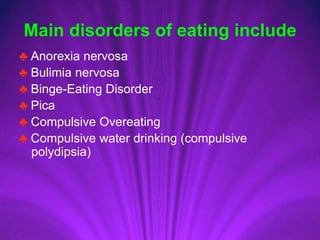
Main disorders of eating include
♣ Anorexia nervosa
♣ Bulimia nervosa
♣ Binge-Eating Disorder
♣ Pica
♣ Compulsive Overeating
♣ Compulsive water drinking (compulsive
polydipsia)
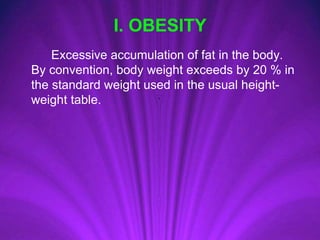
I. OBESITY
Excessive accumulation of fat in the body.
By convention, body weight exceeds by 20 % in
the standard weight used in the usual height-
weight table.
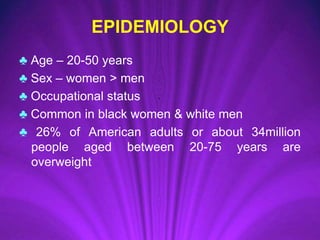
EPIDEMIOLOGY
♣ Age – 20-50 years
♣ Sex – women > men
♣ Occupational status
♣ Common in black women & white men
♣ 26% of American adults or about 34million
people aged between 20-75 years are
overweight
DETERMINANTS OF OBESITY
1. Heredity
2. Developmental determinants
3. Physical activity
4. Brain damage
5. Endocrine factors
6. Drugs
7. Emotional determinants
CLINICAL FEATURES
• Increase in body weight & encompassing mass
of fatty tissue
• Pressure on thorax
• Orthopedic disturbance
• Amenorrhea & menstrual disturbances
• Abdominal & diaphragmatic hernias
• Varicose vein
• Hyperlipidaemia
• Hypertension
DIAGNOSTIC EVALUATION
• Appearance
• Measurement of height and weight
• Obesity is indicated by a reading above 20mm in
a man, and 28mm in a woman.
MANAGEMENT
• Most patients do not come to the treatment
• Motivate & educate
• Reduce energy intake or by increasing out put
• No ‘slimming foods’ or ‘slimming tablets’
• Behaviour therapy
Pharmacological treatment
• Appetite suppressants – Amphetamine,
Fenfluramine, Glycerol.
• MAO inhibitors, Tricyclic antidepressants.
(Phenytoin, Fluoxetine)
Contd...
• Diet
• Therapeutic starvation
• Exercise
• Surgery
♦ Lipectomy
♦ Abdominal balloon
♦ Intestinal bypass
II. ANOREXIA NERVOSA
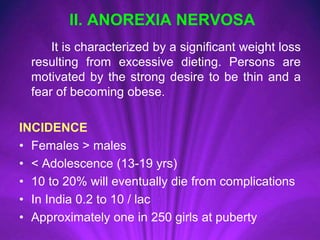
It is characterized by a significant weight loss
resulting from excessive dieting. Persons are
motivated by the strong desire to be thin and a
fear of becoming obese.
INCIDENCE
• Females > males
• < Adolescence (13-19 yrs)
• 10 to 20% will eventually die from complications
• In India 0.2 to 10 / lac
• Approximately one in 250 girls at puberty
ETIOLOGY
Psychological theories
Personal and family
characteristics
Life events
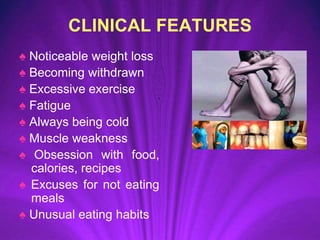
CLINICAL FEATURES
♠ Noticeable weight loss
♠ Becoming withdrawn
♠ Excessive exercise
♠ Fatigue
♠ Always being cold
♠ Muscle weakness
♠ Obsession with food,
calories, recipes
♠ Excuses for not eating
meals
♠ Unusual eating habits
• Feel "too fat",
• Cooking for others, but not eating themselves
• Restricting food choices
• Guilt or shame about eating
• Depression, mood swings
• vomiting, laxative, diet pills or diuretics abuse.
• Irregular menstruation
• Wearing baggy clothes to hide weight loss
• Frequently checking weight
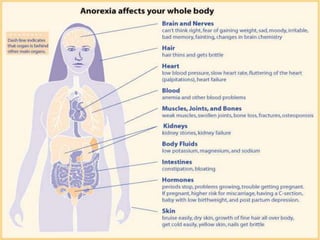
PHYSICAL/MEDICAL COMPLICATIONS
• Fatigue
• Amenorrhea
• Skin problems
• Dizziness and
headaches
• Dehydration
• Shortness of breath
• Irregular heartbeats
• Cold hands and feet
• Bloating
• Constipation
• Hair loss
• Edema
• Lanugo
• Loss of bone mass
• Kidney & liver damage
• Electrolyte imbalance
• Osteoporosis
• Insomnia
• Infertility
• Depression
• Anorexia Tardive
• Refusal to maintain weight gain over a
minimal of weight for age and height.
• Intense fear of weight gaining
• Disturbance in the one’s body weight &
shape.
• In female, absence of at least 3 menstrual
cycles
Diagnosis: DSM III-R Criteria
MANAGEMENT
i) Behaviour therapy
ii) Individual psychotherapy
iii) Hospitalization
vi)Drugs
♠ Chlorpromazine
♠ Antidepressants (e.g Fluoxetine,clomipramine)
♠ Cyproheptadine-Dose is 8-32 mg/day in dived
dose.
v) Family therapy & group therapy
vi) Electro convulsive therapy
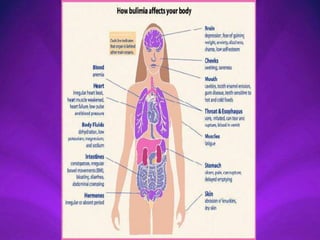
III. BULIMIA NERVOSA
Bulimia is characterized by a cycle of binge
eating followed by purging to try and rid the body
of unwanted calories. Purging methods usually
involve vomiting and laxative abuse.
EPIDEMIOLOGY
• Exact prevalence is not known
• More common in females than male
• Usually begins in adolescence or early
adulthood
• More in upper and middle socioeconomic
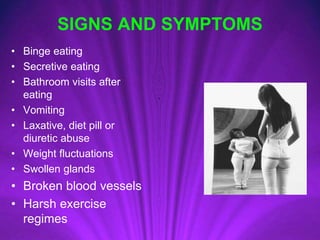
SIGNS AND SYMPTOMS
• Binge eating
• Secretive eating
• Bathroom visits after
eating
• Vomiting
• Laxative, diet pill or
diuretic abuse
• Weight fluctuations
• Swollen glands
• Broken blood vessels
• Harsh exercise
regimes
• Fasting
• Mood swings
• Depression
• Severe self-criticism
• Fear of not being able to stop
eating voluntarily
• Self-deprecating thoughts
following eating
• Fatigue
• Muscle weakness
• Tooth decay
Physical/Medical Complications
• Fatigue and lack of
energy
• Amenorrhea
• Dizziness
• Headaches
• Dehydration
• Constipation and
diarrhea
• Shortness of breath
• Irregular heartbeats
• Depression
• Tears of esophagus
vv
• Hair loss
• Bloating
• Erosion of teeth
enamel
• Chronic sore throat
• Kidney & liver damage
• Parotid gland
enlargement
• Anemias
• Cardiac arrest
MANAGEMENT
i) Hospitalization
ii) Behaviour therapy
iii) Cognitive therapy
vi) Drugs
♦TCA (E.g: Imipramine, clomipramine)
♦ MAO inhibitors (Moclobemide)
♦ Lithium
♦ Carbazepine
IV) BINGE-EATING DISORDER
Binge-eating disorder is characterized by
recurrent binge-eating episodes during which a
person feels a loss of control over his or her
eating. Unlike bulimia, binge-eating episodes are
not followed by purging, excessive exercise or
fasting.
COMPLICATIONS
• Psychological distress
• Cardiovascular disease and hypertension
TREATMENT
• Smilar to those used to treat bulimia.
• Antidepressants
• Aappetite suppressants.
• Psychotherapy, especially CBT, & individual or
group environment.
V) PICA
It is defined as persistent eating of non-food
products such as dirt, clay, paper, plaster, string,
hair or cloth.
EPIDEMIOLOGY
• Uncommon disorder
• Estimated between 20-30% with peak at 20-26
months.
• Common in both sexes
ETIOLOGY
i) Cultural acceptance
ii) Emotional factors
iii) Organic factors
♣ Mental retardation
♣ Iron deficiency anemia and worm infestation
COMPLICATIONS
• Led poisoning
• Hair ball in the stomach
• Iron & Zinc deficiency
• Other diseases
Management
– Dangerous objects should be removed
– Infant stimulation programs
– Guidance to the parents
– Training if child MR
– Correct emotional causes.
VI) COMPULSIVE OVEREATING
Compulsive overeating is characterized by
uncontrollable eating and consequent weight
gain. Compulsive overeaters use food as a way
to cope with stress, emotional conflicts and daily
problems.
ETIOLOGY
♠ More in males
♠ Victims sexual abuse
♠ Improper coping of stressful situations
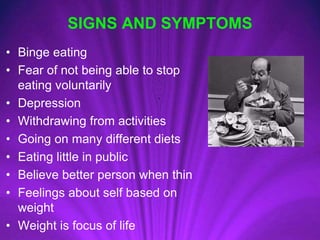
SIGNS AND SYMPTOMS
• Binge eating
• Fear of not being able to stop
eating voluntarily
• Depression
• Withdrawing from activities
• Going on many different diets
• Eating little in public
• Believe better person when thin
• Feelings about self based on
weight
• Weight is focus of life
PHYSICAL/MEDICAL COMPLICATIONS
• Weight gain
• Hypertension or
fatigue
• Heart ailments
• Mobility problems
• Diabetes
• Arthritis
• Sciatica
• Varicose veins
• High blood pressure
• Shortness of breath
• High Cholesterol levels
• Cardiac arrest and
death
• Hiatus hernia
• Embolism
VII) COMPULSIVE WATER DRINKING
Uncommon disorder characterized by drinking
an excessive amount of fluids, far above their
daily requirements, secondary to psychological
rather than physical pathology. It results in water
intoxication.
ETIOLOGY
♠ Disturbances e.g. Anxiety neurosis
♠ Delusional hypochondriasis
♠ Personality disorder
♠ Chronic schizophrenia
♠ Depression
♠ MR and compulsion eating
MANAGEMENT
• Correct identification and treatment of underlying
psychiatric condition
• Hypertonic saline (IV) brings about rapid
symptomatic improvement.
NURSING MANAGEMENT
NURSING DIAGNOSIS
• Imbalanced nutrition less than body requirements
related to refusal to eat
INTERVENTIONS
• Dietician will determine number of calories required
to provide adequate nutrition and realistic weight
gain.
• Explain to the client that privileges and restrictions
will be based on compliance with treatment and
direct weight gain.
• Weight client daily, immediately upon arising and
following first voiding.
• Stay with client during established time for meals.
• If weight loss occurs use restrictions. (Tube feeding)
NURSING DIAGNOSIS
Ineffective denial related to retarded ego
development and fear of losing the only aspect of
life over which he or she perceives some control
(eating)
INTERVENTIONS
• Develop a trusting relationship. Convey positive
regard
• Avoid arguing or bargaining with the client who is
resistant treatment
• Encourage the clients to verbalize the feelings
regarding role within the family, issues and
sexuality.
NURSING DIAGNOSIS
Disturbed body image/low self-esteem related to
retarded ego development, dysfunctional family
system, or feelings of dissatisfaction with body
appearance
INTERVENTIONS
• Help client to develop a realistic perception of
body image and relationship with food.
• Promote feelings of control within the
environment through participation and
independent decision making.
• Help clients realize that perfection is unrealistic,
and explore this need with him or her.
NURSING DIAGNOSIS
• Imbalanced nutrition more than body requirements
related to compulsive overeating.
INTERVENTIONS
• Encourage the client to keep a dairy of food intake
• Discuss feelings and emotions associated with
eating
• Formulate a eating plan by patient input level
• Identify realistic increment goals for weekly weight
loss
• Plan progressive exercise program tailored to
individual goals and choice
• Provide instruction about medications to assist with
weight loss if ordered by physician.
• SUMMARY
• CONCLUSION
Eating disorder

Eating disorder

  • 2.
  • 3.
    Main disorders ofeating include ♣ Anorexia nervosa ♣ Bulimia nervosa ♣ Binge-Eating Disorder ♣ Pica ♣ Compulsive Overeating ♣ Compulsive water drinking (compulsive polydipsia)
  • 4.
    I. OBESITY Excessive accumulationof fat in the body. By convention, body weight exceeds by 20 % in the standard weight used in the usual height- weight table.
  • 5.
    EPIDEMIOLOGY ♣ Age –20-50 years ♣ Sex – women > men ♣ Occupational status ♣ Common in black women & white men ♣ 26% of American adults or about 34million people aged between 20-75 years are overweight
  • 6.
    DETERMINANTS OF OBESITY 1.Heredity 2. Developmental determinants 3. Physical activity 4. Brain damage 5. Endocrine factors 6. Drugs 7. Emotional determinants
  • 7.
    CLINICAL FEATURES • Increasein body weight & encompassing mass of fatty tissue • Pressure on thorax • Orthopedic disturbance • Amenorrhea & menstrual disturbances • Abdominal & diaphragmatic hernias • Varicose vein • Hyperlipidaemia • Hypertension
  • 8.
    DIAGNOSTIC EVALUATION • Appearance •Measurement of height and weight • Obesity is indicated by a reading above 20mm in a man, and 28mm in a woman.
  • 9.
    MANAGEMENT • Most patientsdo not come to the treatment • Motivate & educate • Reduce energy intake or by increasing out put • No ‘slimming foods’ or ‘slimming tablets’ • Behaviour therapy Pharmacological treatment • Appetite suppressants – Amphetamine, Fenfluramine, Glycerol. • MAO inhibitors, Tricyclic antidepressants. (Phenytoin, Fluoxetine) Contd...
  • 10.
    • Diet • Therapeuticstarvation • Exercise • Surgery ♦ Lipectomy ♦ Abdominal balloon ♦ Intestinal bypass
  • 11.
    II. ANOREXIA NERVOSA Itis characterized by a significant weight loss resulting from excessive dieting. Persons are motivated by the strong desire to be thin and a fear of becoming obese. INCIDENCE • Females > males • < Adolescence (13-19 yrs) • 10 to 20% will eventually die from complications • In India 0.2 to 10 / lac • Approximately one in 250 girls at puberty
  • 12.
    ETIOLOGY Psychological theories Personal andfamily characteristics Life events
  • 13.
    CLINICAL FEATURES ♠ Noticeableweight loss ♠ Becoming withdrawn ♠ Excessive exercise ♠ Fatigue ♠ Always being cold ♠ Muscle weakness ♠ Obsession with food, calories, recipes ♠ Excuses for not eating meals ♠ Unusual eating habits
  • 14.
    • Feel "toofat", • Cooking for others, but not eating themselves • Restricting food choices • Guilt or shame about eating • Depression, mood swings • vomiting, laxative, diet pills or diuretics abuse. • Irregular menstruation • Wearing baggy clothes to hide weight loss • Frequently checking weight
  • 16.
    PHYSICAL/MEDICAL COMPLICATIONS • Fatigue •Amenorrhea • Skin problems • Dizziness and headaches • Dehydration • Shortness of breath • Irregular heartbeats • Cold hands and feet • Bloating • Constipation • Hair loss • Edema • Lanugo • Loss of bone mass • Kidney & liver damage • Electrolyte imbalance • Osteoporosis • Insomnia • Infertility • Depression • Anorexia Tardive
  • 17.
    • Refusal tomaintain weight gain over a minimal of weight for age and height. • Intense fear of weight gaining • Disturbance in the one’s body weight & shape. • In female, absence of at least 3 menstrual cycles Diagnosis: DSM III-R Criteria
  • 18.
    MANAGEMENT i) Behaviour therapy ii)Individual psychotherapy iii) Hospitalization vi)Drugs ♠ Chlorpromazine ♠ Antidepressants (e.g Fluoxetine,clomipramine) ♠ Cyproheptadine-Dose is 8-32 mg/day in dived dose. v) Family therapy & group therapy vi) Electro convulsive therapy
  • 19.
    III. BULIMIA NERVOSA Bulimiais characterized by a cycle of binge eating followed by purging to try and rid the body of unwanted calories. Purging methods usually involve vomiting and laxative abuse. EPIDEMIOLOGY • Exact prevalence is not known • More common in females than male • Usually begins in adolescence or early adulthood • More in upper and middle socioeconomic
  • 20.
    SIGNS AND SYMPTOMS •Binge eating • Secretive eating • Bathroom visits after eating • Vomiting • Laxative, diet pill or diuretic abuse • Weight fluctuations • Swollen glands • Broken blood vessels • Harsh exercise regimes
  • 21.
    • Fasting • Moodswings • Depression • Severe self-criticism • Fear of not being able to stop eating voluntarily • Self-deprecating thoughts following eating • Fatigue • Muscle weakness • Tooth decay
  • 23.
    Physical/Medical Complications • Fatigueand lack of energy • Amenorrhea • Dizziness • Headaches • Dehydration • Constipation and diarrhea • Shortness of breath • Irregular heartbeats • Depression • Tears of esophagus vv • Hair loss • Bloating • Erosion of teeth enamel • Chronic sore throat • Kidney & liver damage • Parotid gland enlargement • Anemias • Cardiac arrest
  • 24.
    MANAGEMENT i) Hospitalization ii) Behaviourtherapy iii) Cognitive therapy vi) Drugs ♦TCA (E.g: Imipramine, clomipramine) ♦ MAO inhibitors (Moclobemide) ♦ Lithium ♦ Carbazepine
  • 25.
    IV) BINGE-EATING DISORDER Binge-eatingdisorder is characterized by recurrent binge-eating episodes during which a person feels a loss of control over his or her eating. Unlike bulimia, binge-eating episodes are not followed by purging, excessive exercise or fasting. COMPLICATIONS • Psychological distress • Cardiovascular disease and hypertension
  • 26.
    TREATMENT • Smilar tothose used to treat bulimia. • Antidepressants • Aappetite suppressants. • Psychotherapy, especially CBT, & individual or group environment.
  • 27.
    V) PICA It isdefined as persistent eating of non-food products such as dirt, clay, paper, plaster, string, hair or cloth. EPIDEMIOLOGY • Uncommon disorder • Estimated between 20-30% with peak at 20-26 months. • Common in both sexes
  • 28.
    ETIOLOGY i) Cultural acceptance ii)Emotional factors iii) Organic factors ♣ Mental retardation ♣ Iron deficiency anemia and worm infestation
  • 29.
    COMPLICATIONS • Led poisoning •Hair ball in the stomach • Iron & Zinc deficiency • Other diseases Management – Dangerous objects should be removed – Infant stimulation programs – Guidance to the parents – Training if child MR – Correct emotional causes.
  • 30.
    VI) COMPULSIVE OVEREATING Compulsiveovereating is characterized by uncontrollable eating and consequent weight gain. Compulsive overeaters use food as a way to cope with stress, emotional conflicts and daily problems. ETIOLOGY ♠ More in males ♠ Victims sexual abuse ♠ Improper coping of stressful situations
  • 31.
    SIGNS AND SYMPTOMS •Binge eating • Fear of not being able to stop eating voluntarily • Depression • Withdrawing from activities • Going on many different diets • Eating little in public • Believe better person when thin • Feelings about self based on weight • Weight is focus of life
  • 32.
    PHYSICAL/MEDICAL COMPLICATIONS • Weightgain • Hypertension or fatigue • Heart ailments • Mobility problems • Diabetes • Arthritis • Sciatica • Varicose veins • High blood pressure • Shortness of breath • High Cholesterol levels • Cardiac arrest and death • Hiatus hernia • Embolism
  • 33.
    VII) COMPULSIVE WATERDRINKING Uncommon disorder characterized by drinking an excessive amount of fluids, far above their daily requirements, secondary to psychological rather than physical pathology. It results in water intoxication. ETIOLOGY ♠ Disturbances e.g. Anxiety neurosis ♠ Delusional hypochondriasis ♠ Personality disorder ♠ Chronic schizophrenia ♠ Depression ♠ MR and compulsion eating
  • 34.
    MANAGEMENT • Correct identificationand treatment of underlying psychiatric condition • Hypertonic saline (IV) brings about rapid symptomatic improvement.
  • 35.
  • 36.
    NURSING DIAGNOSIS • Imbalancednutrition less than body requirements related to refusal to eat INTERVENTIONS • Dietician will determine number of calories required to provide adequate nutrition and realistic weight gain. • Explain to the client that privileges and restrictions will be based on compliance with treatment and direct weight gain. • Weight client daily, immediately upon arising and following first voiding. • Stay with client during established time for meals. • If weight loss occurs use restrictions. (Tube feeding)
  • 37.
    NURSING DIAGNOSIS Ineffective denialrelated to retarded ego development and fear of losing the only aspect of life over which he or she perceives some control (eating) INTERVENTIONS • Develop a trusting relationship. Convey positive regard • Avoid arguing or bargaining with the client who is resistant treatment • Encourage the clients to verbalize the feelings regarding role within the family, issues and sexuality.
  • 38.
    NURSING DIAGNOSIS Disturbed bodyimage/low self-esteem related to retarded ego development, dysfunctional family system, or feelings of dissatisfaction with body appearance INTERVENTIONS • Help client to develop a realistic perception of body image and relationship with food. • Promote feelings of control within the environment through participation and independent decision making. • Help clients realize that perfection is unrealistic, and explore this need with him or her.
  • 39.
    NURSING DIAGNOSIS • Imbalancednutrition more than body requirements related to compulsive overeating. INTERVENTIONS • Encourage the client to keep a dairy of food intake • Discuss feelings and emotions associated with eating • Formulate a eating plan by patient input level • Identify realistic increment goals for weekly weight loss • Plan progressive exercise program tailored to individual goals and choice • Provide instruction about medications to assist with weight loss if ordered by physician.
  • 40.