The Google Knowledge Graph –
                                        Moving Toward a “Semantic
                                        Web”
Highlights                              By: Chloe Ravat, Coordinator| Sara Collis, Associate Director
                                            Insights and Innovation
 Google has rolled out new search          June 18, 2012
  technology called the
  Knowledge Graph.
                                        Summary
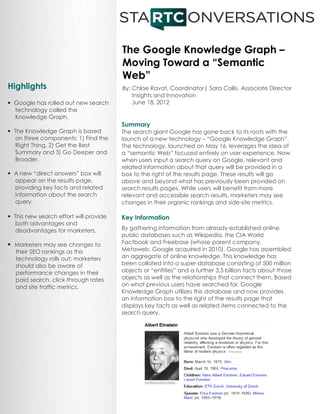
 The Knowledge Graph is based          The search giant Google has gone back to its roots with the
   on three components: 1) Find the     launch of a new technology – “Google Knowledge Graph”.
   Right Thing, 2) Get the Best         The technology, launched on May 16, leverages the idea of
   Summary and 3) Go Deeper and         a “semantic Web” focused entirely on user experience. Now
   Broader.                             when users input a search query on Google, relevant and
                                        related information about that query will be provided in a
 A new “direct answers” box will       box to the right of the results page. These results will go
  appear on the results page,           above and beyond what has previously been provided on
  providing key facts and related       search results pages. While users will benefit from more
  information about the search          relevant and accessible search results, marketers may see
  query.                                changes in their organic rankings and side-site metrics.

 This new search effort will provide   Key Information
   both advantages and
   disadvantages for marketers.         By gathering information from already-established online
                                        public databases such as Wikipedia, the CIA World
 Marketers may see changes to          Factbook and Freebase (whose parent company,
  their SEO rankings as this            Metaweb, Google acquired in 2010), Google has assembled
  technology rolls out; marketers       an aggregate of online knowledge. This knowledge has
  should also be aware of               been collated into a super-database consisting of 500 million
  performance changes in their          objects or “entities” and a further 3.5 billion facts about those
  paid search, click-through rates      objects as well as the relationships that connect them. Based
  and site traffic metrics.             on what previous users have searched for, Google
                                        Knowledge Graph utilizes this database and now provides
                                        an information box to the right of the results page that
                                        displays key facts as well as related items connected to the
                                        search query.
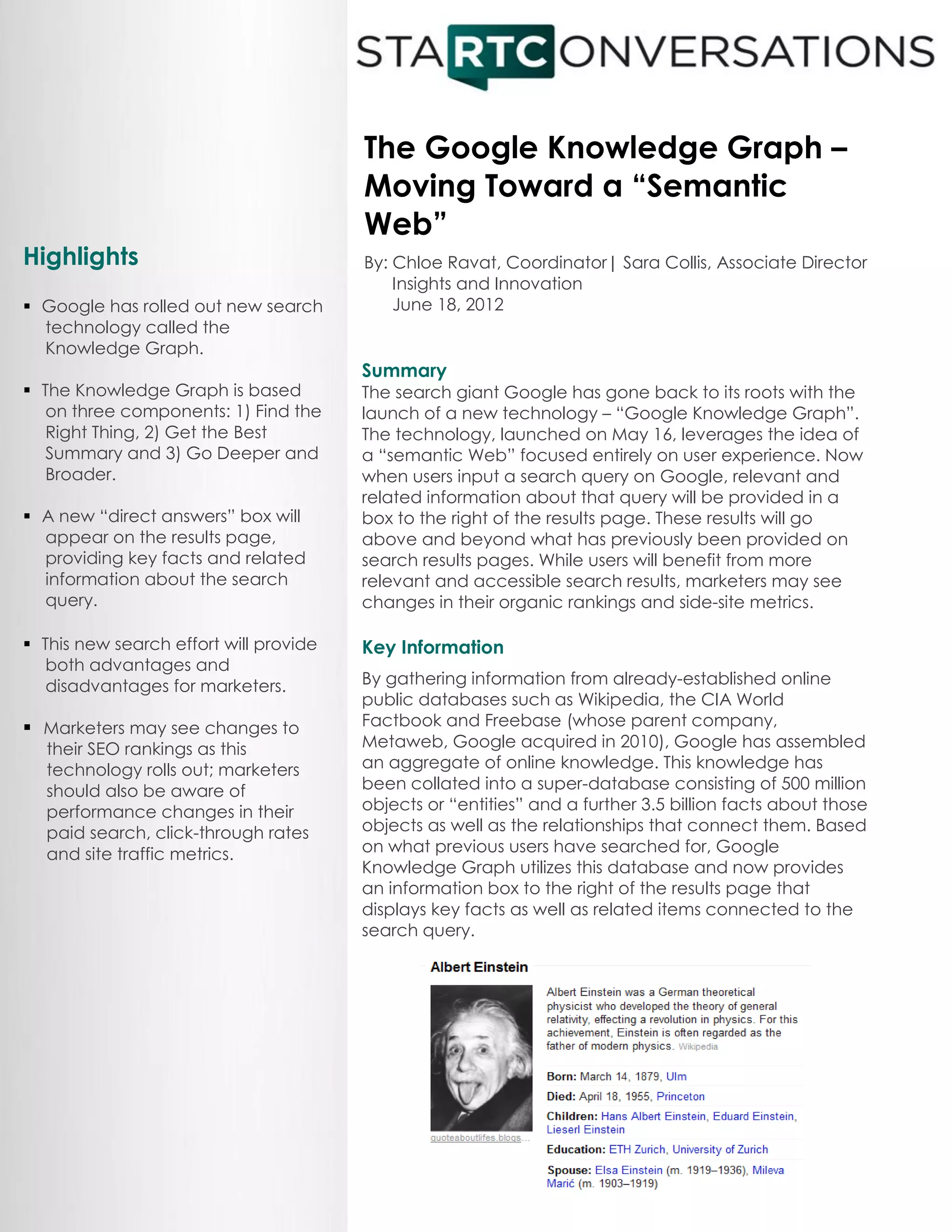
The Knowledge Graph is built on three theoretical pillars:

1) Find the Right Thing: This facet of
the tool aims to remove ambiguity
from search queries by providing
the user with related searches that
use the same keywords. The
example Google gives in its official
blog1 is “Taj Mahal.” A user may
be looking to find information on
the famous landmark, the blues
musician or a casino. Using the
aggregate of knowledge at its disposal, the Knowledge Graph will recognize this ambiguity
and allow the searcher to choose the right topic in order to gain relevant results.

2) Get the Best Summary: Depending on what you search for, Google will now provide a
“direct answers” box on the right-hand side of the search results page, containing relevant
information about the search query. The Knowledge Graph recognizes that “Albert Einstein,”
for example, is not just a set of keywords but a person; a revolutionary scientist with real-world
connections to other people and objects. Information in these boxes has been pulled from
and organized according to what Google has found other users have sought next in
connection to the original search query.

3) Go Deeper and Broader: This is Google’s way of encouraging spontaneous unearthing of
information through a search query: the idea that the discovery of one thing will lead to the
discovery of another. For example, a user might search for “Disneyland” looking for directions.
Through the links in the direct answers box they can learn which are the most popular rides
and their durations. It is information they had not intended to find but is provided in addition to
the answers they originally sought.


Questions and Opportunities

1
    Google Official Blog: http://googleblog.blogspot.com/2012/05/introducing-knowledge-graph-things-not.html


                                                     RTC Proprietary                                           Page 2
This technology will no doubt have implications for consumers and marketers. While the
technology facilitates search results and enables a streamlined user experience, marketers
may see changes in their search rankings and click-through rates from the search engines.
Additionally, privacy issues regarding this new technology have already sparked push-back
from the industry and may or may not limit uptake of Knowledge Graph over time. In this
regard, there are implications across the following areas.

           User Experience: Users of Google Search will benefit from Knowledge Graph. Google
           has developed it to ease and improve the user experience, making search faster,
           easier, more relevant and more enjoyable.

           User Privacy: Under the new privacy policy2, when users are signed in to their Google
           account, their search history is automatically tracked to allow for personalized results.
           This includes integration of social Google+ information into searches, YouTube viewing
           history and more targeted ads. Many feel that collecting this kind of data may reveal
           more about users than they would wish or even realize. For example, search results may
           indicate age, interests, sexual orientation and health concerns. As a result, we can
           expect backlash to follow regarding Google’s privacy policies.

           SEO Marketing: The implications for search marketers are considerable. Google Penguin
           is a search algorithm aimed at filtering and eliminating websites that appear in search
           results but that violate the Google Webmaster Guidelines. As a result of its 1.1 update
           rolled out on May 25, many sites have seen decreased search rankings, which in turn
           have led to declines in site traffic. As with the Graph itself, search results shown on
           Google under the new Penguin algorithm are now centered more around the validity,
           authenticity and relevance of content, rather than tactics such as keyword-stuffing and
           cloaking. The Penguin update works alongside the Knowledge Graph, supporting it to
           offer the user better-quality, more relevant results. Additionally, Google appears to be
           imposing a higher standard for Web content on sites that rely heavily on search for
           traffic. SEO marketers should keep an eye on ranking as Knowledge Graph gains
           ground, and make optimizations accordingly.

           Marketing Analytics: The Knowledge graph may both hurt and help performance
           metrics. It is possible that marketers will see changes in click-through rates in organic
           and paid search. This is because Google is essentially changing the user experience on
           the search results page, and offering more options to follow through on. Analysts should
           pay attention to click-through and visitor rates (in addition to rankings) to assess the
           impact from this new technology. It is also possible that the new search experience will
           provide insights into new keyword opportunities and consumer interests related to a
           particular product or category. These insights could be used to optimize content
           strategy, keyword strategy and copy strategy.

Above all, the Knowledge Graph technology will make search easier, more relevant and more
enjoyable for its users. Consumers should see an improvement in the search experience as a

2
    Google’s updated Privacy Policy as of March 1 2012: http://www.google.com/policies/privacy/


                                                     RTC Proprietary                              Page 3
whole, but due to the privacy policy may have more information revealed about their search
habits than they would like. Marketers, too, may yield benefits and insights from the new
technology, but should be aware of possible changes to organic and paid search rankings, as
well as site-side performance.
About RTC
RTC is a full-service direct and relationship marketing agency based in Washington, D.C., in the
heart of Georgetown, with an additional office in New York. RTC boasts more than 45 years’
worth of innovative, targeted solutions that grow its clients’ brands and help them forge
lasting, valuable relationships with their customers. What distinguishes RTC is its unique ability to
analyze data and research on both a rational and emotional level, and to leverage insights
gleaned from that data to motivate customers and prospects to take action. RTC’s clients
include AARP, Procter & Gamble and Sunovion, as well as other major brands in the
pharmaceutical, financial services and telecom industries.

To learn more about RTC, please visit www.RTC agency.com or follow the Twitter feed
@RTCagency.


                                           RTC Proprietary                                    Page 4

RTC Google Knowledge Graph POV June 2012

  • 1.
    The Google KnowledgeGraph – Moving Toward a “Semantic Web” Highlights By: Chloe Ravat, Coordinator| Sara Collis, Associate Director Insights and Innovation  Google has rolled out new search June 18, 2012 technology called the Knowledge Graph. Summary  The Knowledge Graph is based The search giant Google has gone back to its roots with the on three components: 1) Find the launch of a new technology – “Google Knowledge Graph”. Right Thing, 2) Get the Best The technology, launched on May 16, leverages the idea of Summary and 3) Go Deeper and a “semantic Web” focused entirely on user experience. Now Broader. when users input a search query on Google, relevant and related information about that query will be provided in a  A new “direct answers” box will box to the right of the results page. These results will go appear on the results page, above and beyond what has previously been provided on providing key facts and related search results pages. While users will benefit from more information about the search relevant and accessible search results, marketers may see query. changes in their organic rankings and side-site metrics.  This new search effort will provide Key Information both advantages and disadvantages for marketers. By gathering information from already-established online public databases such as Wikipedia, the CIA World  Marketers may see changes to Factbook and Freebase (whose parent company, their SEO rankings as this Metaweb, Google acquired in 2010), Google has assembled technology rolls out; marketers an aggregate of online knowledge. This knowledge has should also be aware of been collated into a super-database consisting of 500 million performance changes in their objects or “entities” and a further 3.5 billion facts about those paid search, click-through rates objects as well as the relationships that connect them. Based and site traffic metrics. on what previous users have searched for, Google Knowledge Graph utilizes this database and now provides an information box to the right of the results page that displays key facts as well as related items connected to the search query.
  • 2.
    The Knowledge Graphis built on three theoretical pillars: 1) Find the Right Thing: This facet of the tool aims to remove ambiguity from search queries by providing the user with related searches that use the same keywords. The example Google gives in its official blog1 is “Taj Mahal.” A user may be looking to find information on the famous landmark, the blues musician or a casino. Using the aggregate of knowledge at its disposal, the Knowledge Graph will recognize this ambiguity and allow the searcher to choose the right topic in order to gain relevant results. 2) Get the Best Summary: Depending on what you search for, Google will now provide a “direct answers” box on the right-hand side of the search results page, containing relevant information about the search query. The Knowledge Graph recognizes that “Albert Einstein,” for example, is not just a set of keywords but a person; a revolutionary scientist with real-world connections to other people and objects. Information in these boxes has been pulled from and organized according to what Google has found other users have sought next in connection to the original search query. 3) Go Deeper and Broader: This is Google’s way of encouraging spontaneous unearthing of information through a search query: the idea that the discovery of one thing will lead to the discovery of another. For example, a user might search for “Disneyland” looking for directions. Through the links in the direct answers box they can learn which are the most popular rides and their durations. It is information they had not intended to find but is provided in addition to the answers they originally sought. Questions and Opportunities 1 Google Official Blog: http://googleblog.blogspot.com/2012/05/introducing-knowledge-graph-things-not.html RTC Proprietary Page 2
  • 3.
    This technology willno doubt have implications for consumers and marketers. While the technology facilitates search results and enables a streamlined user experience, marketers may see changes in their search rankings and click-through rates from the search engines. Additionally, privacy issues regarding this new technology have already sparked push-back from the industry and may or may not limit uptake of Knowledge Graph over time. In this regard, there are implications across the following areas. User Experience: Users of Google Search will benefit from Knowledge Graph. Google has developed it to ease and improve the user experience, making search faster, easier, more relevant and more enjoyable. User Privacy: Under the new privacy policy2, when users are signed in to their Google account, their search history is automatically tracked to allow for personalized results. This includes integration of social Google+ information into searches, YouTube viewing history and more targeted ads. Many feel that collecting this kind of data may reveal more about users than they would wish or even realize. For example, search results may indicate age, interests, sexual orientation and health concerns. As a result, we can expect backlash to follow regarding Google’s privacy policies. SEO Marketing: The implications for search marketers are considerable. Google Penguin is a search algorithm aimed at filtering and eliminating websites that appear in search results but that violate the Google Webmaster Guidelines. As a result of its 1.1 update rolled out on May 25, many sites have seen decreased search rankings, which in turn have led to declines in site traffic. As with the Graph itself, search results shown on Google under the new Penguin algorithm are now centered more around the validity, authenticity and relevance of content, rather than tactics such as keyword-stuffing and cloaking. The Penguin update works alongside the Knowledge Graph, supporting it to offer the user better-quality, more relevant results. Additionally, Google appears to be imposing a higher standard for Web content on sites that rely heavily on search for traffic. SEO marketers should keep an eye on ranking as Knowledge Graph gains ground, and make optimizations accordingly. Marketing Analytics: The Knowledge graph may both hurt and help performance metrics. It is possible that marketers will see changes in click-through rates in organic and paid search. This is because Google is essentially changing the user experience on the search results page, and offering more options to follow through on. Analysts should pay attention to click-through and visitor rates (in addition to rankings) to assess the impact from this new technology. It is also possible that the new search experience will provide insights into new keyword opportunities and consumer interests related to a particular product or category. These insights could be used to optimize content strategy, keyword strategy and copy strategy. Above all, the Knowledge Graph technology will make search easier, more relevant and more enjoyable for its users. Consumers should see an improvement in the search experience as a 2 Google’s updated Privacy Policy as of March 1 2012: http://www.google.com/policies/privacy/ RTC Proprietary Page 3
  • 4.
    whole, but dueto the privacy policy may have more information revealed about their search habits than they would like. Marketers, too, may yield benefits and insights from the new technology, but should be aware of possible changes to organic and paid search rankings, as well as site-side performance. About RTC RTC is a full-service direct and relationship marketing agency based in Washington, D.C., in the heart of Georgetown, with an additional office in New York. RTC boasts more than 45 years’ worth of innovative, targeted solutions that grow its clients’ brands and help them forge lasting, valuable relationships with their customers. What distinguishes RTC is its unique ability to analyze data and research on both a rational and emotional level, and to leverage insights gleaned from that data to motivate customers and prospects to take action. RTC’s clients include AARP, Procter & Gamble and Sunovion, as well as other major brands in the pharmaceutical, financial services and telecom industries. To learn more about RTC, please visit www.RTC agency.com or follow the Twitter feed @RTCagency. RTC Proprietary Page 4