Sep 09Renewable Energy – New Tariff Guidelines & REC FrameworkSaurabh MehtaAsst. Manager (BD – Projects)Reliance Power
Flow of presentationCERC’s new regulation
Background
Salient Features
Wind Energy
Solar Energy
National Solar Mission
Renewable Energy Certificate (REC)
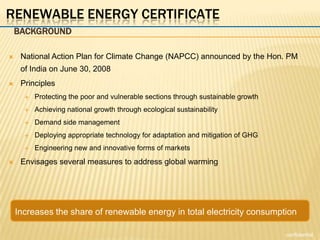
Background
REC Concept
Operational FrameworkCERC’s new RegulationBackground – Pre regulation scenarioWind EnergyDifferent Tariff regimes for different statesLarge variations – Rajasthan Rs 4.28 / Unit v/s Tamilnadu Rs. 3.39 / UnitSimilar tariff for different wind zones in a stateNo clarity for CDM Benefits sharingFixed project cost without any indexingFixed ROE throughout the project lifeSolar EnergyDifferent Tariff regimes for different statesNo clarity of tariff determination methodologyLarge portions of tariff (Rs. 10 to 12) to come from GOI as Generation Based Incentive (GBI)CERC’s new regulation addresses the issues of Renewable Energy Tariff Determination
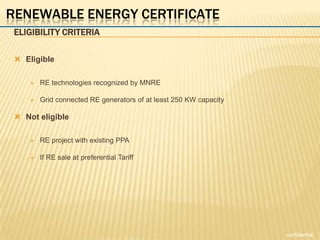
CERC’s new RegulationSalient FeaturesEligibility criteria
CERC’s new regulationSalient Features contd.Review Period –3 years Tariff Period – Small Hydro Projects                       : 35 years Solar PV & Solar Thermal               : 25 years Other RE Projects                            : 13 yearsUseful life –Wind Projects                                  : 25 yearsBiomass Projects                            : 20 yearsSmall Hydro Projects                      : 35 yearsSolar PV / Solar Thermal Projects : 25 yearsProject Specific Tariff – May be determined by commission on case to case basis for the following;Hybrid Solar Thermal Power PlantsMunicipal solid waste projectsAny other new renewable technology
CERC’s new regulationSalient Features contd.Tariff StructureSingle part  tariff with following fixed cost components (except for biomass and non – fossil fuel based cogen plants)Return on Equity (ROE)Interest on loan capitalDepreciationInterest on working capitalOperation and maintenance expensesLevellised Tariff – Discount factor equivalent to weighted average cost of capital (WACC)Dispatch Principles –“MUST RUN” status for all RE projects except biomass project of 10 MW and non-fossil fuel based cogen plants.
CERC’s new regulationFinancial Principles for Tariff Determination
CERC’s new regulationFinancial Principles for Tariff Determination# - Varying for different states
CERC’s new regulationLevellised Tariff State-wise Comparison# - Wind zone not present in the state
Wind EnergyProject IRRs w/o depreciation benefit – comparisonCapex @ Rs. 6.0 Crs / MW
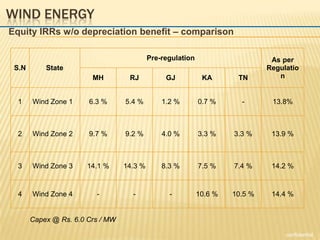
Wind EnergyEquity IRRs w/o depreciation benefit – comparisonCapex @ Rs. 6.0 Crs / MW
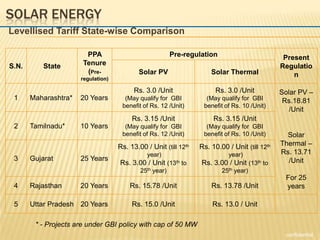
Solar EnergyLevellised Tariff State-wise Comparison* - Projects are under GBI policy with cap of 50 MW
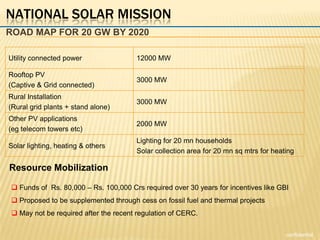
ObjectivesNational Solar MissionTo make India Global leader in solar energy through -20,000 MW Generation Capacity by 2020100,000 MW Generation Capacity by 2030200,000 MW Generation Capacity by 2050Cost reduction for solar power to grid parity (Rs 4-5 / kWh) by 2020 To achieve parity with coal based Thermal Power by 2030Mandatory setting of solar plants equivalent to 5% of thermal power plant capacity to be set by the generation utilities.4 – 5 GW of solar manufacturing capacity by 2017
NATIONAL SOLAR MISSIONmission – 20 gw by 2020Phase 1 (2009 – 12)Consolidating ongoing efforts on off grid applications
Demo utility scale projects (CSP – Solar Thermal)
To achieve 1 – 1.5 GW during this phasePhase 2 (2012 – 17)Scaling up across applications & Rapid cost reduction
Deployment of new technologies – Concentrating PV, storage technologies

Renewable Energy - Recent Initiatives

  • 1.
    Sep 09Renewable Energy– New Tariff Guidelines & REC FrameworkSaurabh MehtaAsst. Manager (BD – Projects)Reliance Power
  • 2.
  • 3.
  • 4.
  • 5.
  • 6.
  • 7.
  • 8.
  • 9.
  • 10.
  • 11.
    Operational FrameworkCERC’s newRegulationBackground – Pre regulation scenarioWind EnergyDifferent Tariff regimes for different statesLarge variations – Rajasthan Rs 4.28 / Unit v/s Tamilnadu Rs. 3.39 / UnitSimilar tariff for different wind zones in a stateNo clarity for CDM Benefits sharingFixed project cost without any indexingFixed ROE throughout the project lifeSolar EnergyDifferent Tariff regimes for different statesNo clarity of tariff determination methodologyLarge portions of tariff (Rs. 10 to 12) to come from GOI as Generation Based Incentive (GBI)CERC’s new regulation addresses the issues of Renewable Energy Tariff Determination
  • 12.
    CERC’s new RegulationSalientFeaturesEligibility criteria
  • 13.
    CERC’s new regulationSalientFeatures contd.Review Period –3 years Tariff Period – Small Hydro Projects : 35 years Solar PV & Solar Thermal : 25 years Other RE Projects : 13 yearsUseful life –Wind Projects : 25 yearsBiomass Projects : 20 yearsSmall Hydro Projects : 35 yearsSolar PV / Solar Thermal Projects : 25 yearsProject Specific Tariff – May be determined by commission on case to case basis for the following;Hybrid Solar Thermal Power PlantsMunicipal solid waste projectsAny other new renewable technology
  • 14.
    CERC’s new regulationSalientFeatures contd.Tariff StructureSingle part tariff with following fixed cost components (except for biomass and non – fossil fuel based cogen plants)Return on Equity (ROE)Interest on loan capitalDepreciationInterest on working capitalOperation and maintenance expensesLevellised Tariff – Discount factor equivalent to weighted average cost of capital (WACC)Dispatch Principles –“MUST RUN” status for all RE projects except biomass project of 10 MW and non-fossil fuel based cogen plants.
  • 15.
    CERC’s new regulationFinancialPrinciples for Tariff Determination
  • 16.
    CERC’s new regulationFinancialPrinciples for Tariff Determination# - Varying for different states
  • 17.
    CERC’s new regulationLevellisedTariff State-wise Comparison# - Wind zone not present in the state
  • 18.
    Wind EnergyProject IRRsw/o depreciation benefit – comparisonCapex @ Rs. 6.0 Crs / MW
  • 19.
    Wind EnergyEquity IRRsw/o depreciation benefit – comparisonCapex @ Rs. 6.0 Crs / MW
  • 20.
    Solar EnergyLevellised TariffState-wise Comparison* - Projects are under GBI policy with cap of 50 MW
  • 21.
    ObjectivesNational Solar MissionTomake India Global leader in solar energy through -20,000 MW Generation Capacity by 2020100,000 MW Generation Capacity by 2030200,000 MW Generation Capacity by 2050Cost reduction for solar power to grid parity (Rs 4-5 / kWh) by 2020 To achieve parity with coal based Thermal Power by 2030Mandatory setting of solar plants equivalent to 5% of thermal power plant capacity to be set by the generation utilities.4 – 5 GW of solar manufacturing capacity by 2017
  • 22.
    NATIONAL SOLAR MISSIONmission– 20 gw by 2020Phase 1 (2009 – 12)Consolidating ongoing efforts on off grid applications
  • 23.
    Demo utility scaleprojects (CSP – Solar Thermal)
  • 24.
    To achieve 1– 1.5 GW during this phasePhase 2 (2012 – 17)Scaling up across applications & Rapid cost reduction
  • 25.
    Deployment of newtechnologies – Concentrating PV, storage technologies