Download to read offline
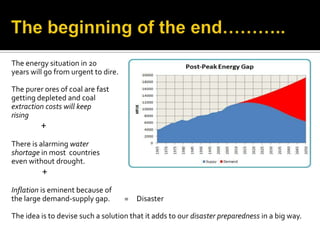
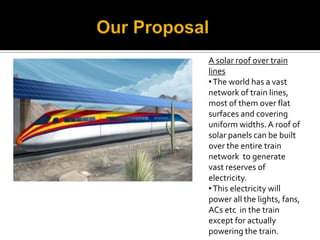
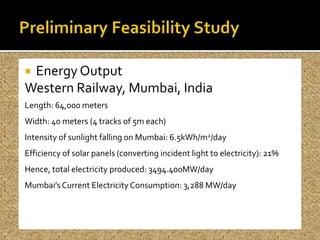
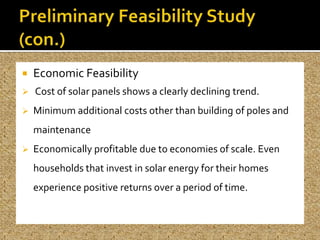
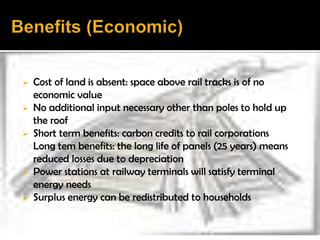
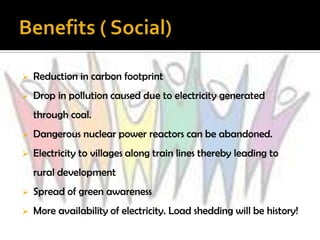
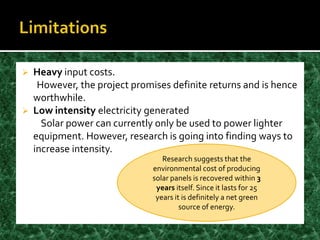
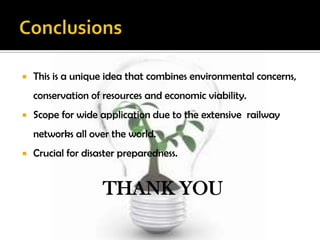

The document proposes building solar roofs over train lines to generate vast reserves of electricity. A solar roof over Mumbai's Western Railway lines could generate 3494.4 MW per day, exceeding the city's current daily consumption of 3288 MW. It would be economically feasible due to declining solar panel costs and no land costs. Benefits include reduced carbon emissions, less coal-based power generation, and rural electrification. While upfront costs are high, returns are ensured. The idea combines environmental protection, conservation, and economic viability with wide applicability due to extensive global railway networks.


![[Challenge:Future] people who needs love](https://cdn.slidesharecdn.com/ss_thumbnails/challengefuture-people-who-needs-love2010-111204121609-phpapp01-thumbnail.jpg?width=640&height=640&fit=bounds)


![[Challenge:Future] Fun office -from now the work is joyful](https://cdn.slidesharecdn.com/ss_thumbnails/challengefuture-fun-office-from-now-the-work-is-joyful1229-thumbnail.jpg?width=640&height=640&fit=bounds)


![[Challenge:Future] Think twice before quitting](https://cdn.slidesharecdn.com/ss_thumbnails/challengefuture-think-twice-before-quitting951-150214074403-conversion-gate01-thumbnail.jpg?width=640&height=640&fit=bounds)
![[Challenge:Future] Raft Guide Job](https://cdn.slidesharecdn.com/ss_thumbnails/challengefuture-raft-guide-job815-150205081913-conversion-gate01-thumbnail.jpg?width=640&height=640&fit=bounds)
![[Challenge:Future] " The Secret of Happiness."](https://cdn.slidesharecdn.com/ss_thumbnails/challengefuture-the-secret-of-happiness3329-150202124318-conversion-gate01-thumbnail.jpg?width=640&height=640&fit=bounds)
![[Challenge:Future] What is life?](https://cdn.slidesharecdn.com/ss_thumbnails/challengefuture-what-is-life1507-150131153303-conversion-gate02-thumbnail.jpg?width=640&height=640&fit=bounds)
![[Challenge:Future] The Power of Happiness](https://cdn.slidesharecdn.com/ss_thumbnails/challengefuture-the-power-of-happiness4947-150131104822-conversion-gate01-thumbnail.jpg?width=640&height=640&fit=bounds)
![[Challenge:Future] Do not delay it!](https://cdn.slidesharecdn.com/ss_thumbnails/challengefuture-do-not-delay-it2242-150129172304-conversion-gate01-thumbnail.jpg?width=640&height=640&fit=bounds)
![[Challenge:Future] Always rely only on yourself](https://cdn.slidesharecdn.com/ss_thumbnails/challengefuture-always-rely-only-on-yourself4726-150129133806-conversion-gate02-thumbnail.jpg?width=640&height=640&fit=bounds)
![[Challenge:Future] Hard work, Dedication & Patience!](https://cdn.slidesharecdn.com/ss_thumbnails/challengefuture-hard-work-dedication-patience94-150128133507-conversion-gate02-thumbnail.jpg?width=640&height=640&fit=bounds)
![[Challenge:Future] I give you this medal as a sign](https://cdn.slidesharecdn.com/ss_thumbnails/challengefuture-i-give-you-this-medal-as-a-sign4652-150120121011-conversion-gate02-thumbnail.jpg?width=640&height=640&fit=bounds)
![[Challenge:Future] Guard Your Soul](https://cdn.slidesharecdn.com/ss_thumbnails/challengefuture-guard-your-soul3130-150120050804-conversion-gate01-thumbnail.jpg?width=640&height=640&fit=bounds)
![[Challenge:Future] My Career Tip for 2015](https://cdn.slidesharecdn.com/ss_thumbnails/challengefuture-my-career-tip-for-20153724-150119150629-conversion-gate01-thumbnail.jpg?width=640&height=640&fit=bounds)
![[Challenge:Future] box of choices](https://cdn.slidesharecdn.com/ss_thumbnails/challengefuture-box-of-choices459-150118141228-conversion-gate02-thumbnail.jpg?width=640&height=640&fit=bounds)
![[Challenge:Future] The magic world of Homo Ludens](https://cdn.slidesharecdn.com/ss_thumbnails/challengefuture-the-magic-world-of-homo-ludens3765-150113074618-conversion-gate01-thumbnail.jpg?width=640&height=640&fit=bounds)
![[Challenge:Future] Break the Borders](https://cdn.slidesharecdn.com/ss_thumbnails/challengefuture-break-the-borders2417-150112055706-conversion-gate02-thumbnail.jpg?width=640&height=640&fit=bounds)
![[Challenge:Future] Passion](https://cdn.slidesharecdn.com/ss_thumbnails/challengefuture-passion3521-150109034003-conversion-gate02-thumbnail.jpg?width=640&height=640&fit=bounds)
![[Challenge:Future] BE YOURSELF](https://cdn.slidesharecdn.com/ss_thumbnails/challengefuture-be-yourself2860-150107152106-conversion-gate01-thumbnail.jpg?width=640&height=640&fit=bounds)
![[Challenge:Future] Lifelong Learning](https://cdn.slidesharecdn.com/ss_thumbnails/challengefuture-lifelong-learning3412-150105134404-conversion-gate02-thumbnail.jpg?width=640&height=640&fit=bounds)
![[Challenge:Future] Smile And Accept the Challange](https://cdn.slidesharecdn.com/ss_thumbnails/challengefuture-smile-and-accept-the-challange4466-150104005903-conversion-gate01-thumbnail.jpg?width=640&height=640&fit=bounds)
![[Challenge:Future] HELP YOURSELF AND LIVE](https://cdn.slidesharecdn.com/ss_thumbnails/challengefuture-help-yourself-and-live870-141223142803-conversion-gate02-thumbnail.jpg?width=640&height=640&fit=bounds)
![[Challenge:Future] Faith in humanity](https://cdn.slidesharecdn.com/ss_thumbnails/challengefuture-faith-in-humanity2748-141218140104-conversion-gate01-thumbnail.jpg?width=640&height=640&fit=bounds)