
RQR Overview – Presentation 2014Q1
Linked In - Ahmed El-Askalany, CSTE, CSQA, PMP, CQIA, ITIL | LinkedIn
https://www.facebook.com/EdgeConsultancyInc
E-mail: EdgeConsultancyInc@Gmail.com
Managing RQR
Managing RQR
 Respect – Respect Our Organization ,
Our Employees, Our Management , And
Our Customers. Determining how to
satisfy them.
 Quality – Establish a higher level of
quality program “World-Class” that
would provide confidence to our
customers.
 Results – Evaluating overall results.
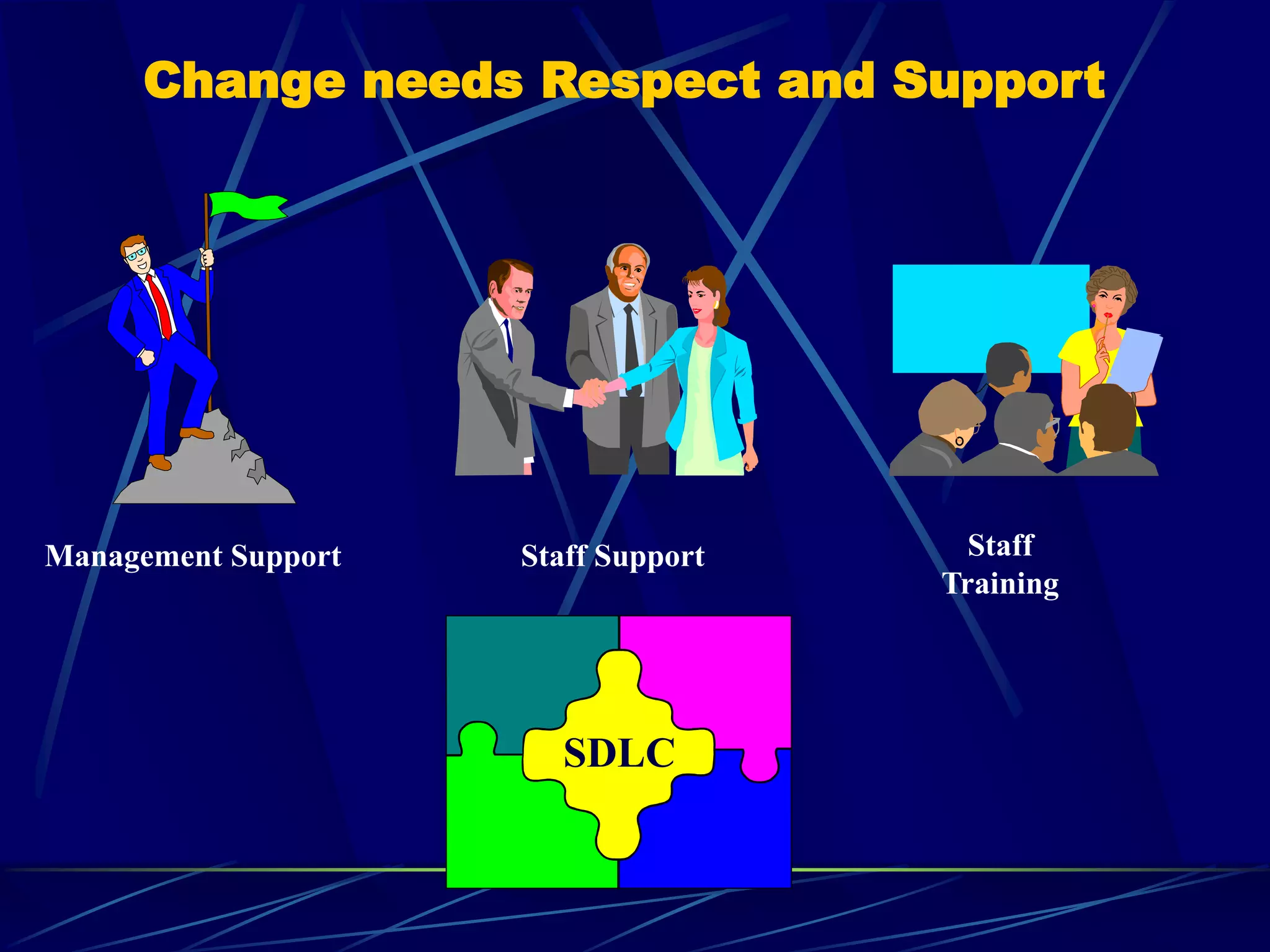
Change needs Respect and Support
Management Support Staff Support Staff
Training
SDLC
Managing RQR
Respect Key Trends:
• Competition in the Global Workplace
• Higher Quality Standards
• Rising Customer Expectations
• Many Competitors
• Shortest Cycle Time
• Globalization of Economies
• Constant Innovation
Managing RQR
Respect Changing Work Force:
 Minds vs. Hands
 Employee Empowerment
 Downsizing
 New Management and Leadership Models
 Work Increasingly Accomplished in Teams
Managing RQR
Respect the Effect of Technology:
• Paperless Environment
• Faster Collection
• Electronic Mail
• Internet and Websites
• Social Media and Mobile Apps
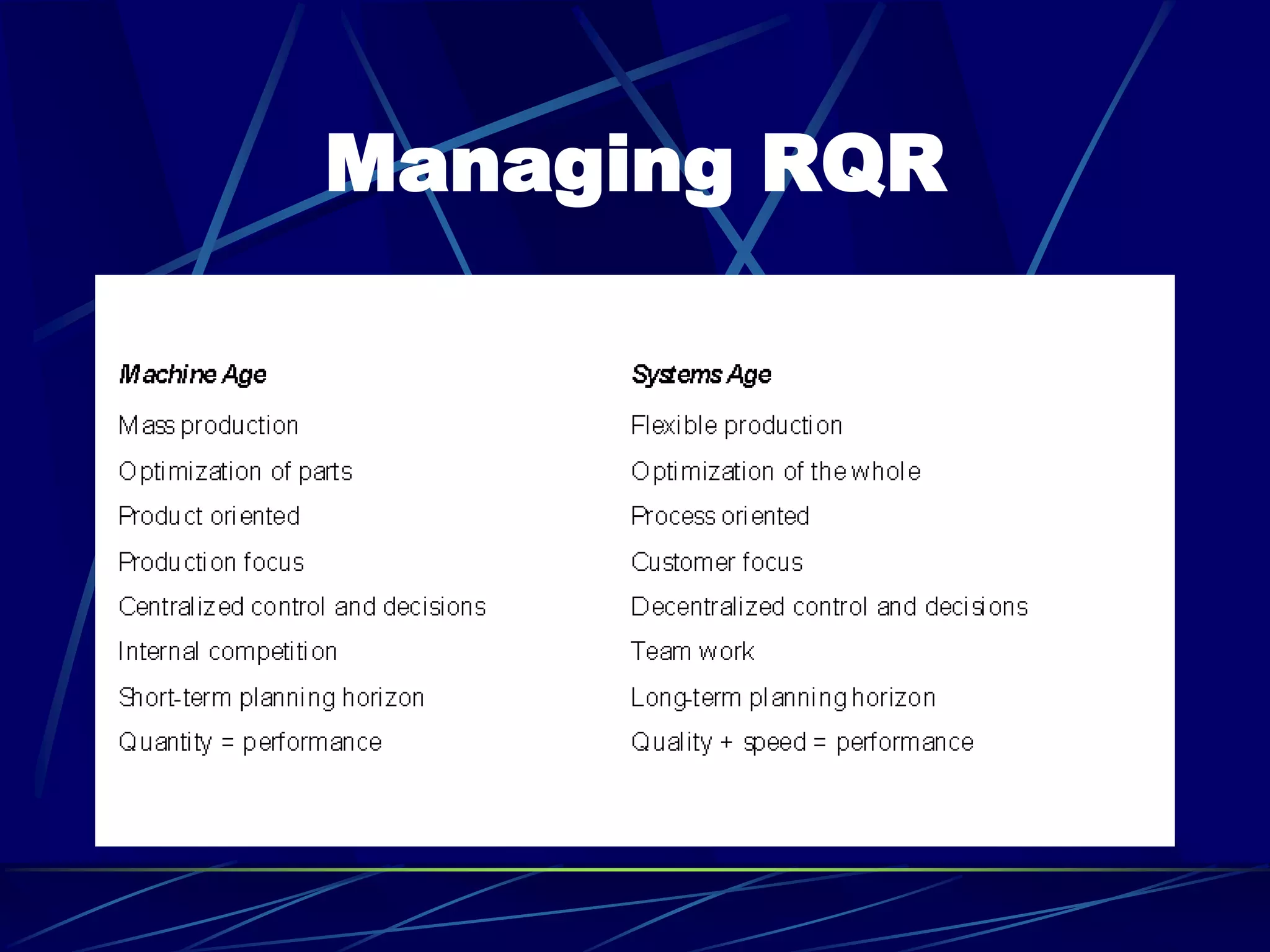
Managing RQR
Managing RQR
Quality Management = World-Class Management:
 Deliberate, Disciplined, Structured Use of
Best-Known Management Methods
 Situational
 Dynamic and Flexible
 Constantly Improving
 Global Leadership Standard
Managing RQR
Quality Management Principle:
Customer Focus:
• Deliberate concentration on satisfying
the needs and expectations of all your
customers
Managing RQR
Identifying Customers
Understand Who Your Customers Are:
• Internal
• Intermediate
• External
• End users
Segment Your Customer Population By—
• Size
• Service or product provided
• Job function
Managing RQR
Best Project Manager Practices:
Customer Focus
 Link Organizational and Project Purposes to
Customer Needs
 Involve the Customer in Project Planning and
Decision Making
 Establish Routine and Meaningful Dialogue
With Customers
 Establish Methods to Build Customer
Feedback into Project Management
Processes
Managing RQR
Quality Program Goals:
• Fitness for Use
-- Describes the Product or Service When It Is
Provided to the Customer
• Fitness for Purpose
-- Product or Service Meet Its Intended Purpose In All
Respects
• Customer Satisfaction
-- Describes the Customer’s Feelings About a Product
or Service
• Conformance to Requirements
-- Describes Condition of Product or Service in
Relation to Customer’s Requirements
Managing RQR
Quality Concepts:
• Zero Defects
• The Customer is the Next Person in the Process
• Do the Right Thing Right the First Time
• Continuous Improvement Process
• Process Capability
Managing RQR
 Less fire fighting, resulting in more time for innovation
and creativity
 Increased customer satisfaction
 More efficient project management
 Higher productivity
 Lower costs
 Higher project team morale
Proven Benefits of Quality for Global
Project Managers:
Managing RQR
Characteristics of Manufactured Product
Quality the Nine “ilities”)
 Producibility
 Usability
 Reliability (mean-time between failures (MTBF)
 Maintainability (mean-time to repair (MTTR)
 Availability (MTBF, MTTR)
 Operability
 Flexibility
 Social Acceptability
 Affordability
Managing RQR
Characteristics of Service Product Quality:
 Responsiveness
 Competence
 Access
 Courtesy
 Communication
 Credibility
 Security
 Knowledge of the Customer
 Tangibles
 Reliability
Managing RQR
Project Quality Management:
• The Process of Ensuring that a Project Fully
Meets the Needs and Expectations of its
Customers (Internal and External)
Managing RQR
Absolutes of Quality Management:
 Quality Means Conformance to Requirements
 Problems Are Functional in Nature
 There Is No Optimum Level of Defects
 Cost of Quality Is the Only Useful Measurement
 Zero Defects Is the Only Performance Standard
Managing RQR
Common Features:
 Cause of Poor Quality Stems from the Management
and the System Rather than the Workers
 Inspection Is Not the Answer to Quality Improvement
 Involvement of and Leadership by Top Management
is Essential
 Quality Programs Require Organization-Wide Effort
and Long-Term Commitment
 Commitment to Training
 Quality Must Come First
Managing Quality
Quality Management Principle:
Commitment to World-Class Quality
• Making Quality a Major Focus of All Activity
and Effort
• Everyone Becomes Involved With Quality
Throughout the Organization
• Quality Is Constantly Pursued on All Projects
Through Effective and Efficient Methods of
Execution
Managing RQR
Characteristics of a Quality
Organization:
 Customer Focus
 Compelling Motivation Toward Quality
 Recognizing Work As Related Processes
 Freedom Through Process Control
 Company Vision
 Looking for Faults in Systems
 Teamwork
 Continued Education and Training
Managing RQR
Best Practices for Project Managers
Committed to World-Class Quality:
 Focus on Quality Before Cost or Production
 Lead by Making Quality Improvement a High-Priority Activity for
Yourself and Your Team
 Recognize That Everyone on the Team Has a Responsibility for
Quality
 View Problems As Opportunities
 Constantly Examine the Value to the Customer of Project
Management Policies, Practices, and Procedures
 Encourage Innovative Thinking and New Ideas
 Practice Systems-Centered Project Management
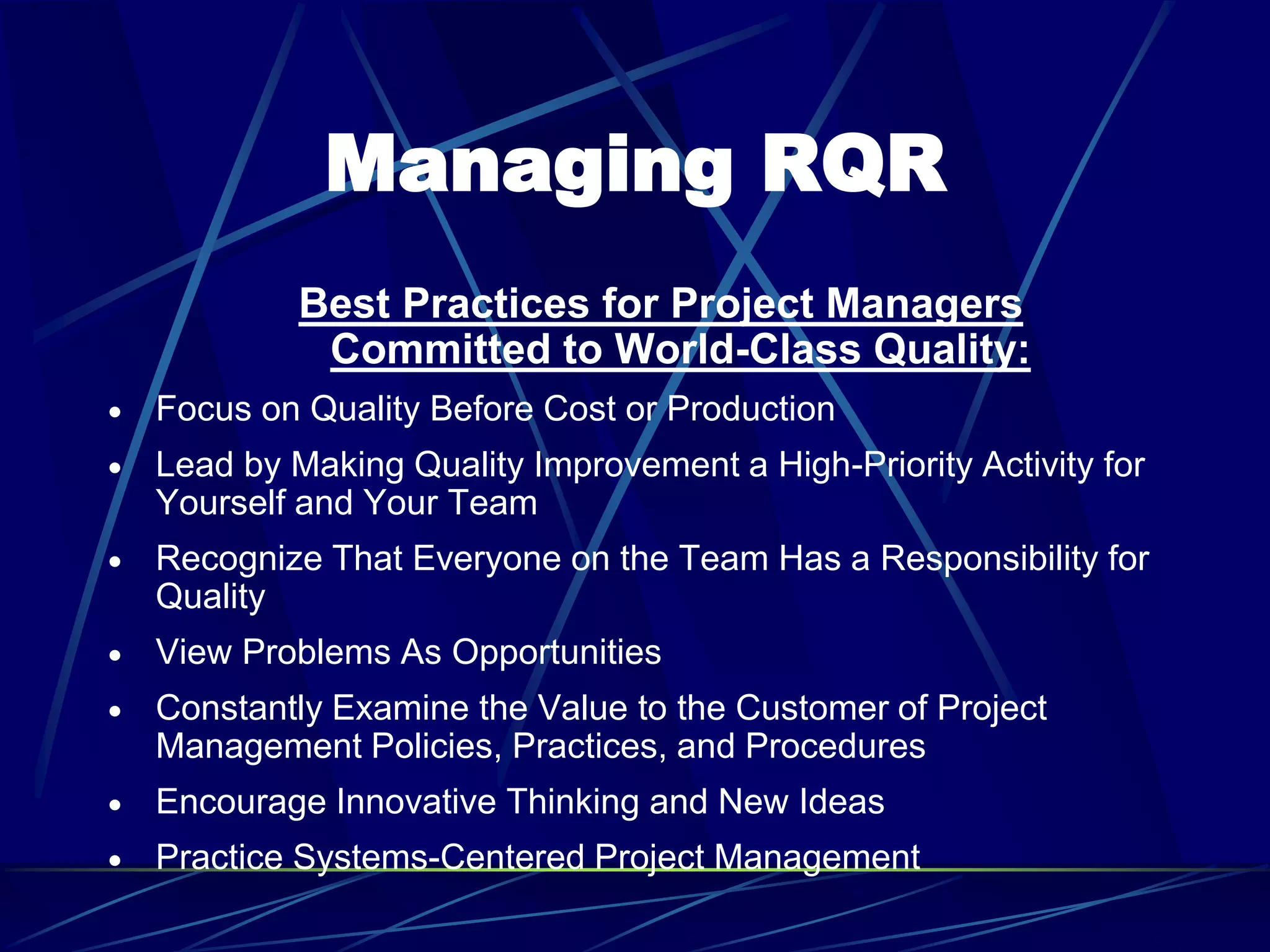
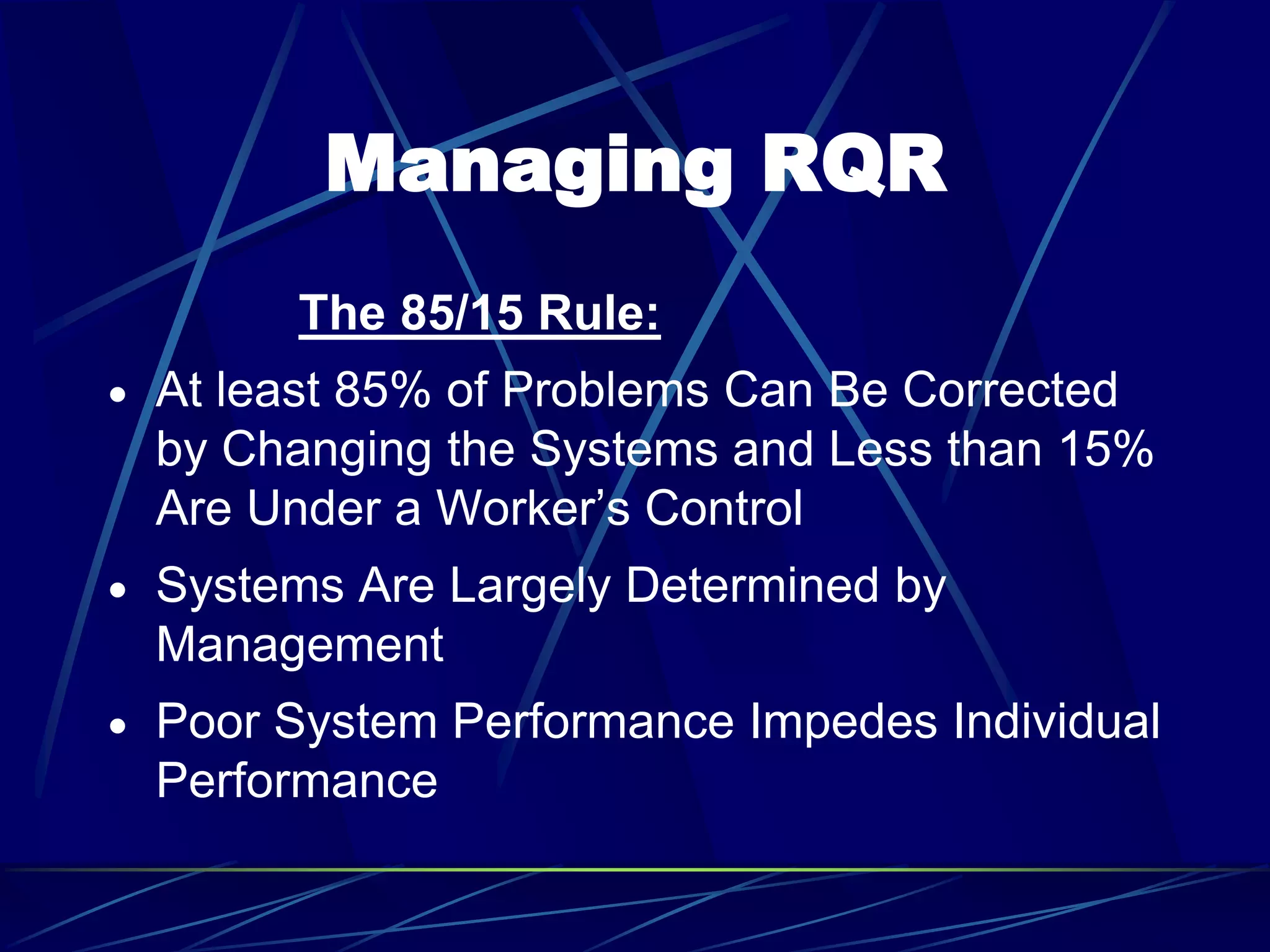
Managing RQR
The 85/15 Rule:
 At least 85% of Problems Can Be Corrected
by Changing the Systems and Less than 15%
Are Under a Worker’s Control
 Systems Are Largely Determined by
Management
 Poor System Performance Impedes Individual
Performance
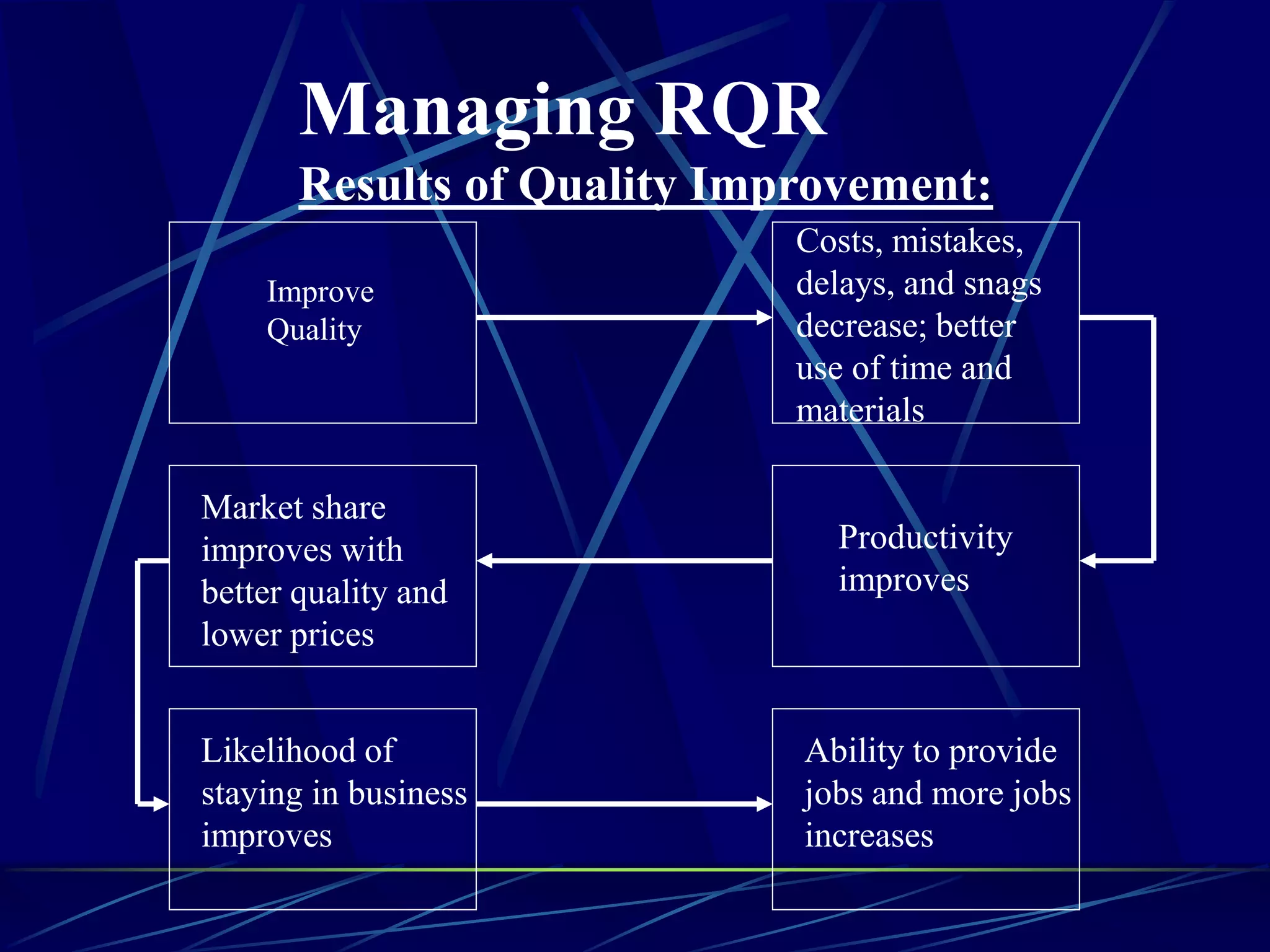
Improve
Quality
Costs, mistakes,
delays, and snags
decrease; better
use of time and
materials
Market share
improves with
better quality and
lower prices
Productivity
improves
Likelihood of
staying in business
improves
Ability to provide
jobs and more jobs
increases
Managing RQR
Results of Quality Improvement:
Managing RQR
Techniques for Measuring Customer
Expectations:
 Customer Research
 Surveys
 Audits
 Focus Groups
 Quality Function Deployment
 Employee Exchange Programs
 Joint Problem Solving
 Customer Service Data Analysis
 Point of Delivery Feedback
Managing RQR
Project Characteristics:
• Producibility
• Usability
• Reliability
• Maintainability
• Availability
Managing RQR
Project Characteristics:
• Operability
• Flexibility
• Social Acceptance
• Affordability
Managing RQR
Your Role:
 Organizations Cannot Change Themselves!
 People Change Organizations
 Each Person Is a Change Creator
 If Your Organization Needs Change, You
Have the Opportunity to Lead the Change
Process
 Consider Each Topic Discussed in Terms of
How You Can Use it to Produce Change in
the Sphere You Influence
Managing RQR
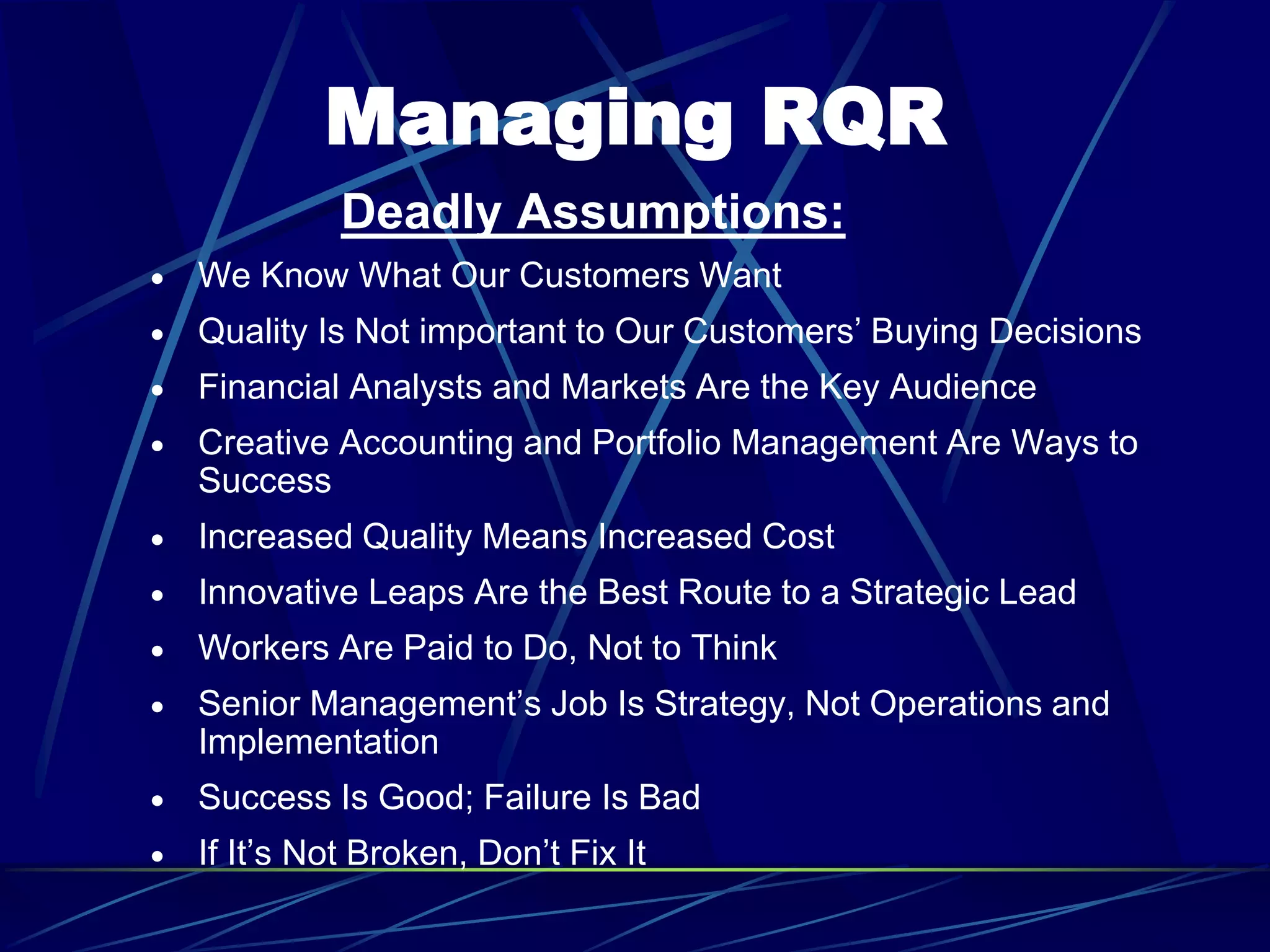
Deadly Assumptions:
 We Know What Our Customers Want
 Quality Is Not important to Our Customers’ Buying Decisions
 Financial Analysts and Markets Are the Key Audience
 Creative Accounting and Portfolio Management Are Ways to
Success
 Increased Quality Means Increased Cost
 Innovative Leaps Are the Best Route to a Strategic Lead
 Workers Are Paid to Do, Not to Think
 Senior Management’s Job Is Strategy, Not Operations and
Implementation
 Success Is Good; Failure Is Bad
 If It’s Not Broken, Don’t Fix It
Managing RQR
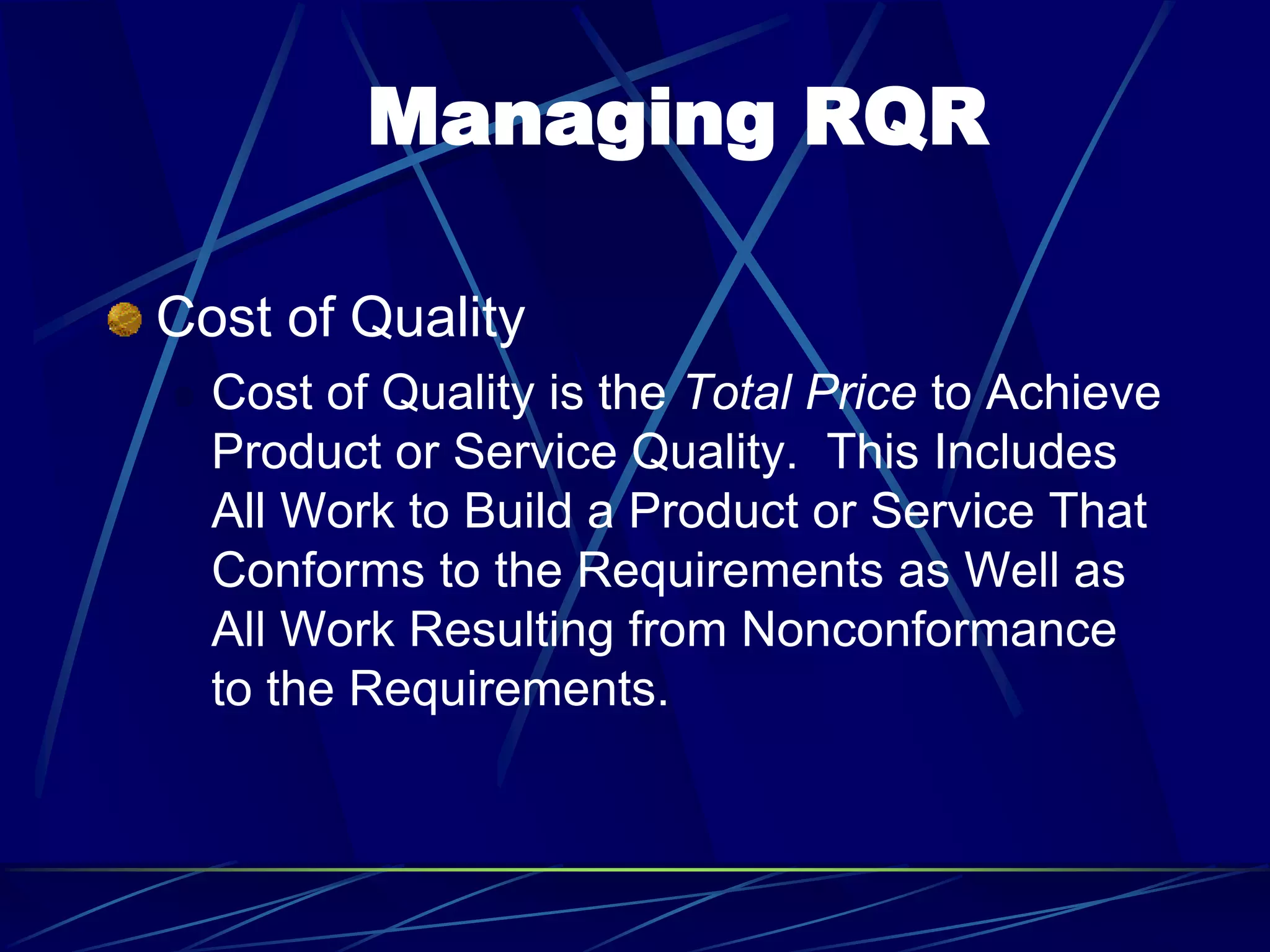
Cost of Quality
 Cost of Quality is the Total Price to Achieve
Product or Service Quality. This Includes
All Work to Build a Product or Service That
Conforms to the Requirements as Well as
All Work Resulting from Nonconformance
to the Requirements.
Managing RQR
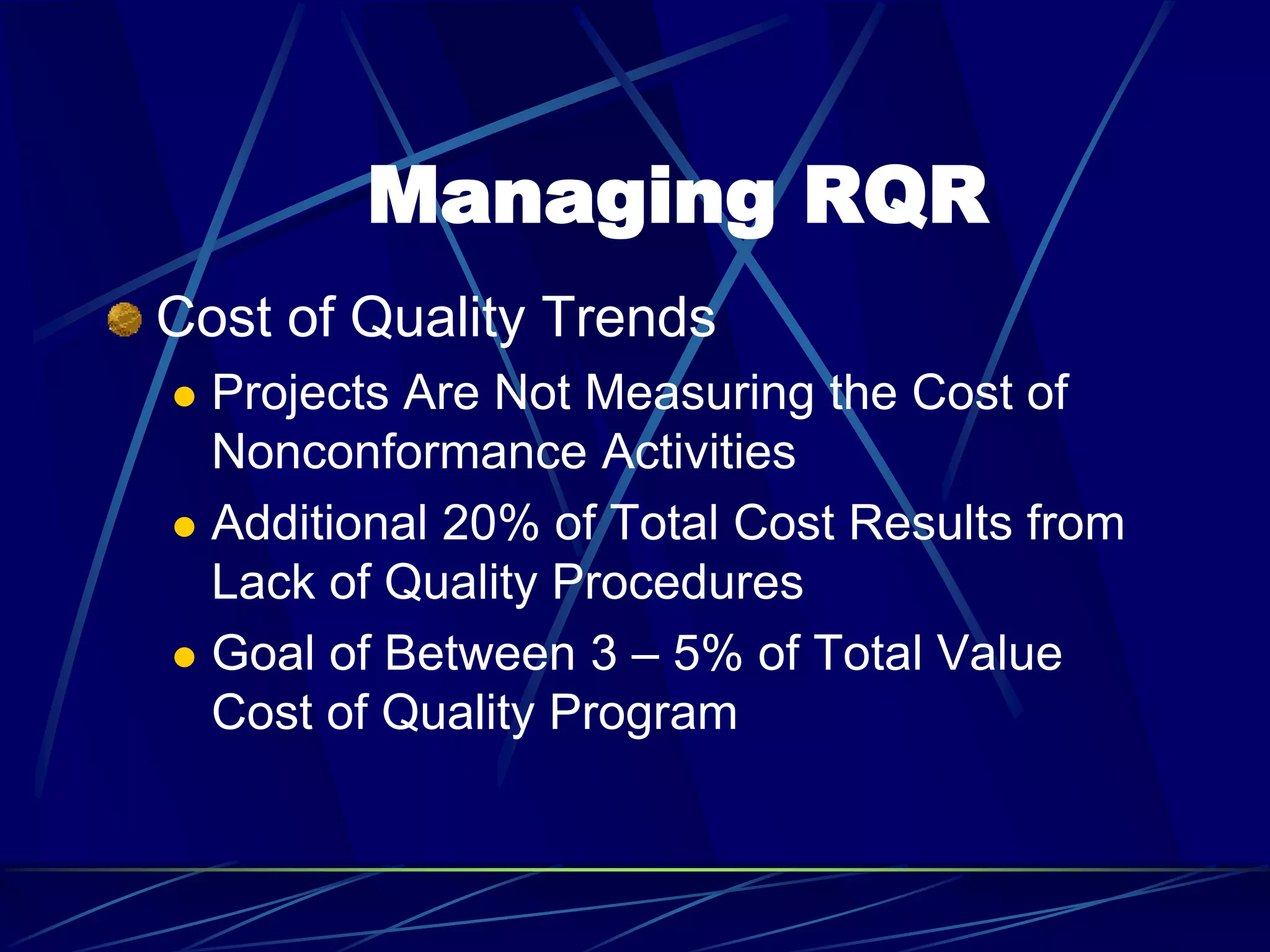
Cost of Quality Trends
 Projects Are Not Measuring the Cost of
Nonconformance Activities
 Additional 20% of Total Cost Results from
Lack of Quality Procedures
 Goal of Between 3 – 5% of Total Value
Cost of Quality Program
Managing RQR
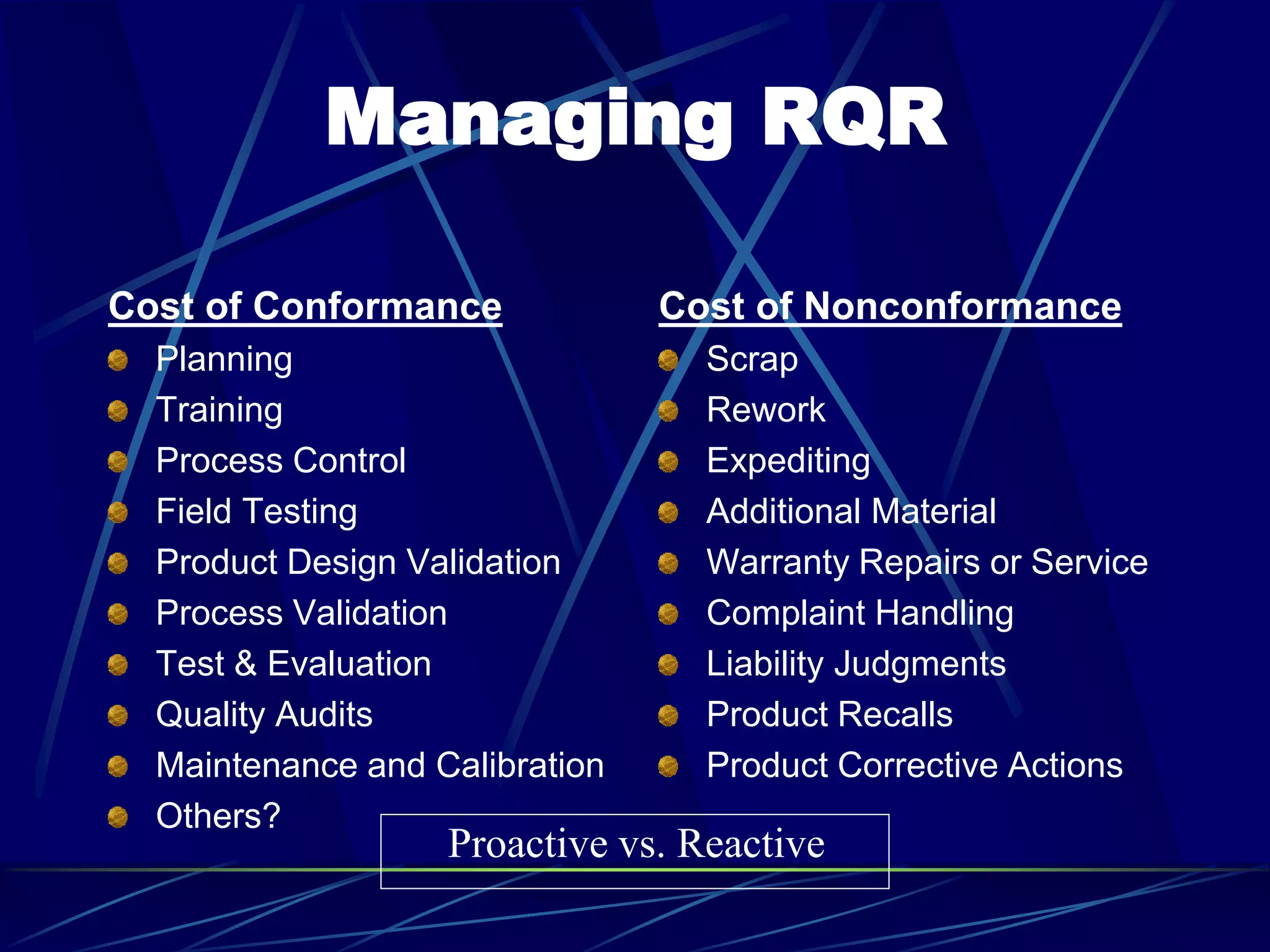
Cost of Conformance
Planning
Training
Process Control
Field Testing
Product Design Validation
Process Validation
Test & Evaluation
Quality Audits
Maintenance and Calibration
Others?
Cost of Nonconformance
Scrap
Rework
Expediting
Additional Material
Warranty Repairs or Service
Complaint Handling
Liability Judgments
Product Recalls
Product Corrective Actions
Proactive vs. Reactive
Managing RQR
Quality Management Principle:
Process Orientation
• Deliberately Aligning Thought, Interest,
and Action in the Direction of Processes
Rather Than Functions
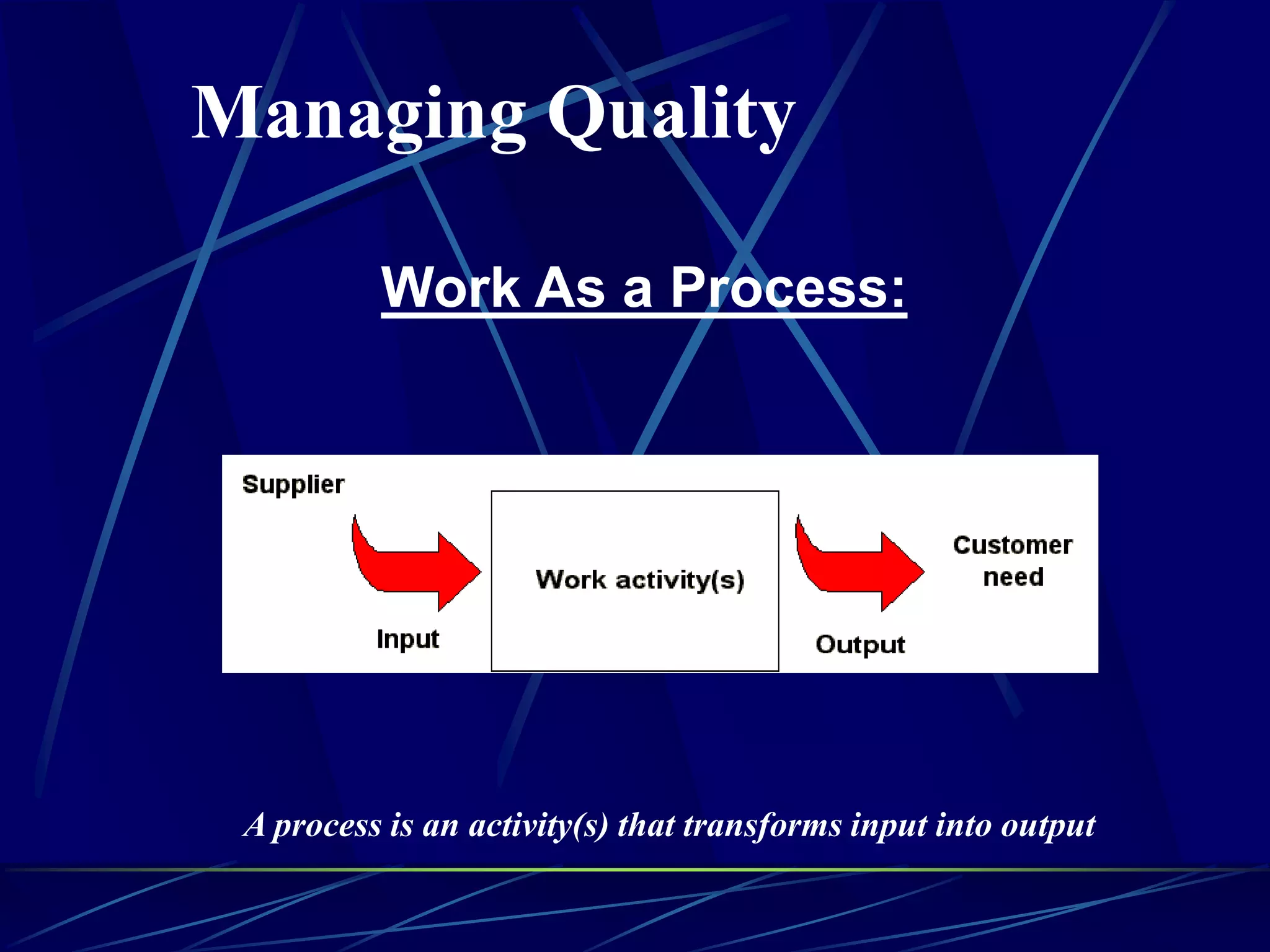
Work As a Process:
A process is an activity(s) that transforms input into output
Managing Quality
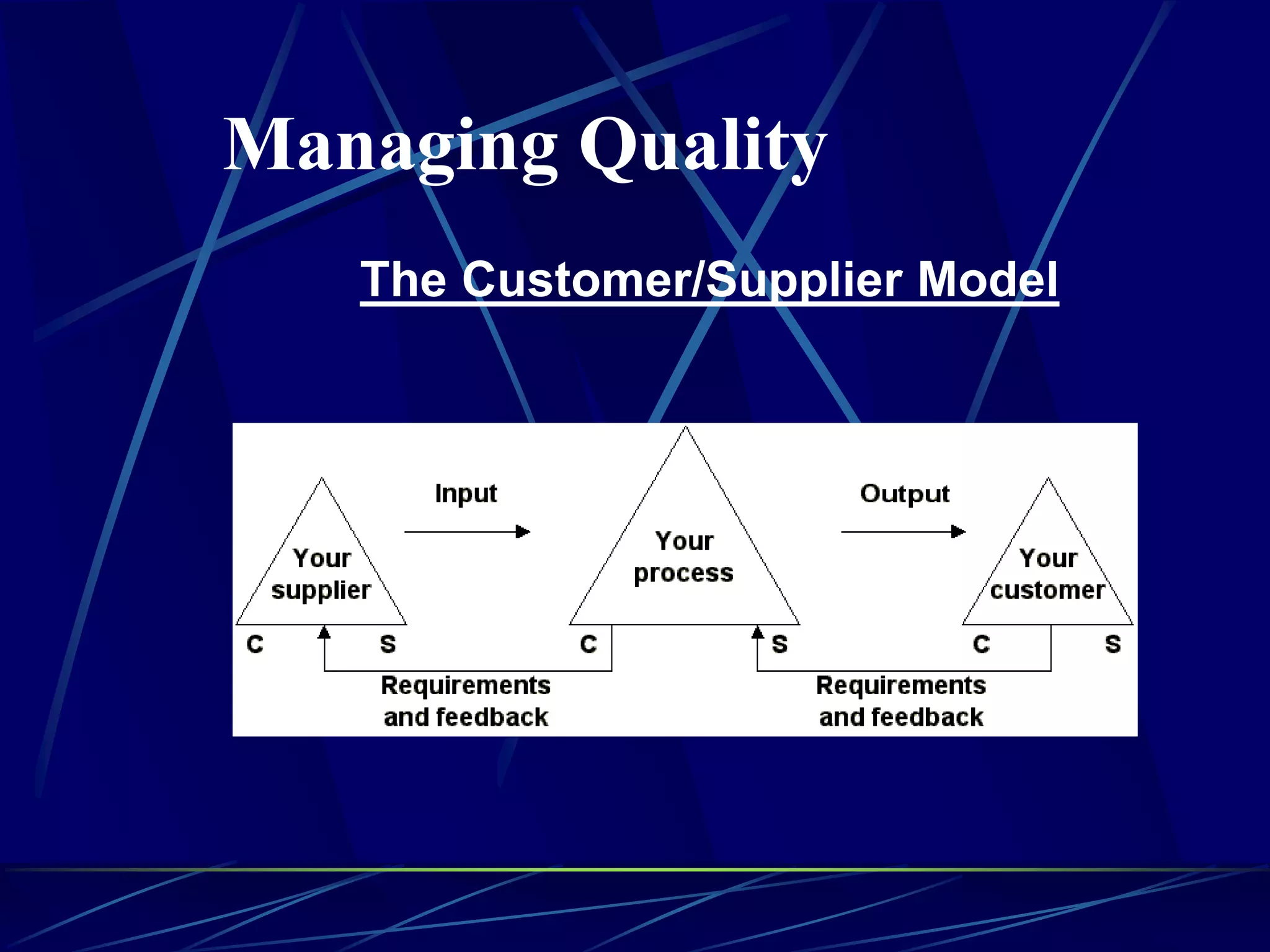
The Customer/Supplier Model
Managing Quality
Managing RQR
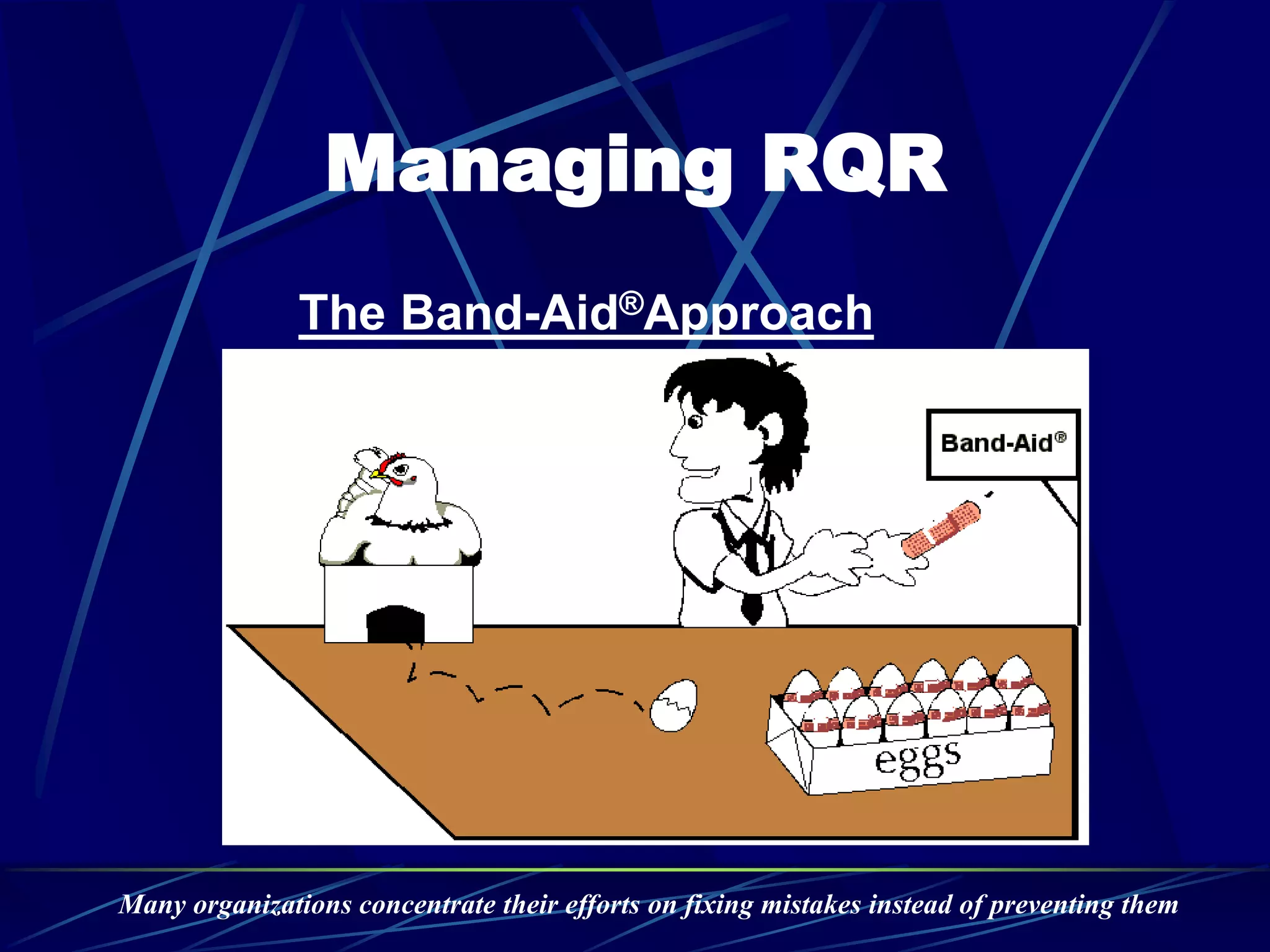
The Band-Aid®Approach
Many organizations concentrate their efforts on fixing mistakes instead of preventing them
Managing RQR
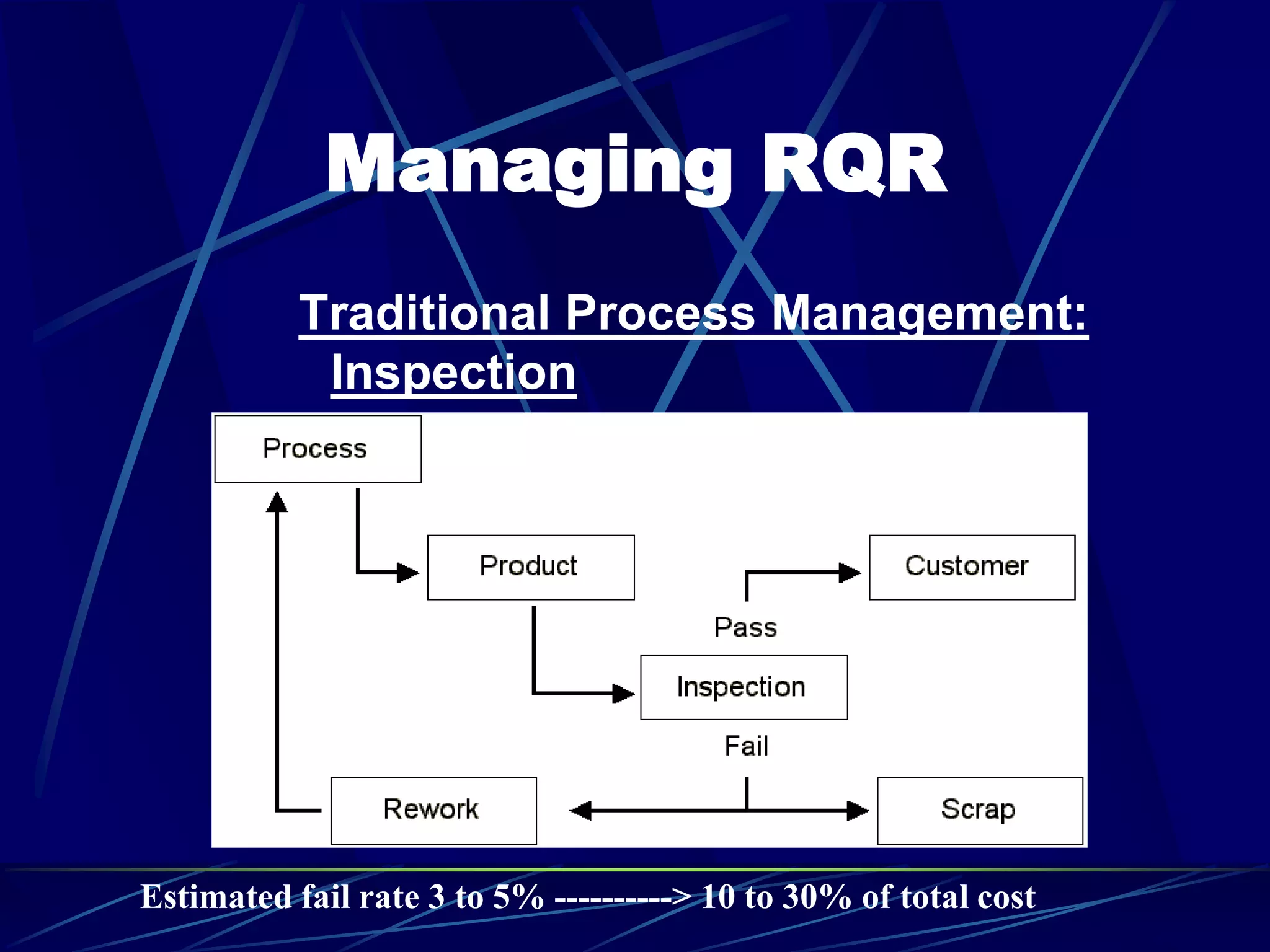
Traditional Process Management:
Inspection
Estimated fail rate 3 to 5% ----------> 10 to 30% of total cost
Managing RQR
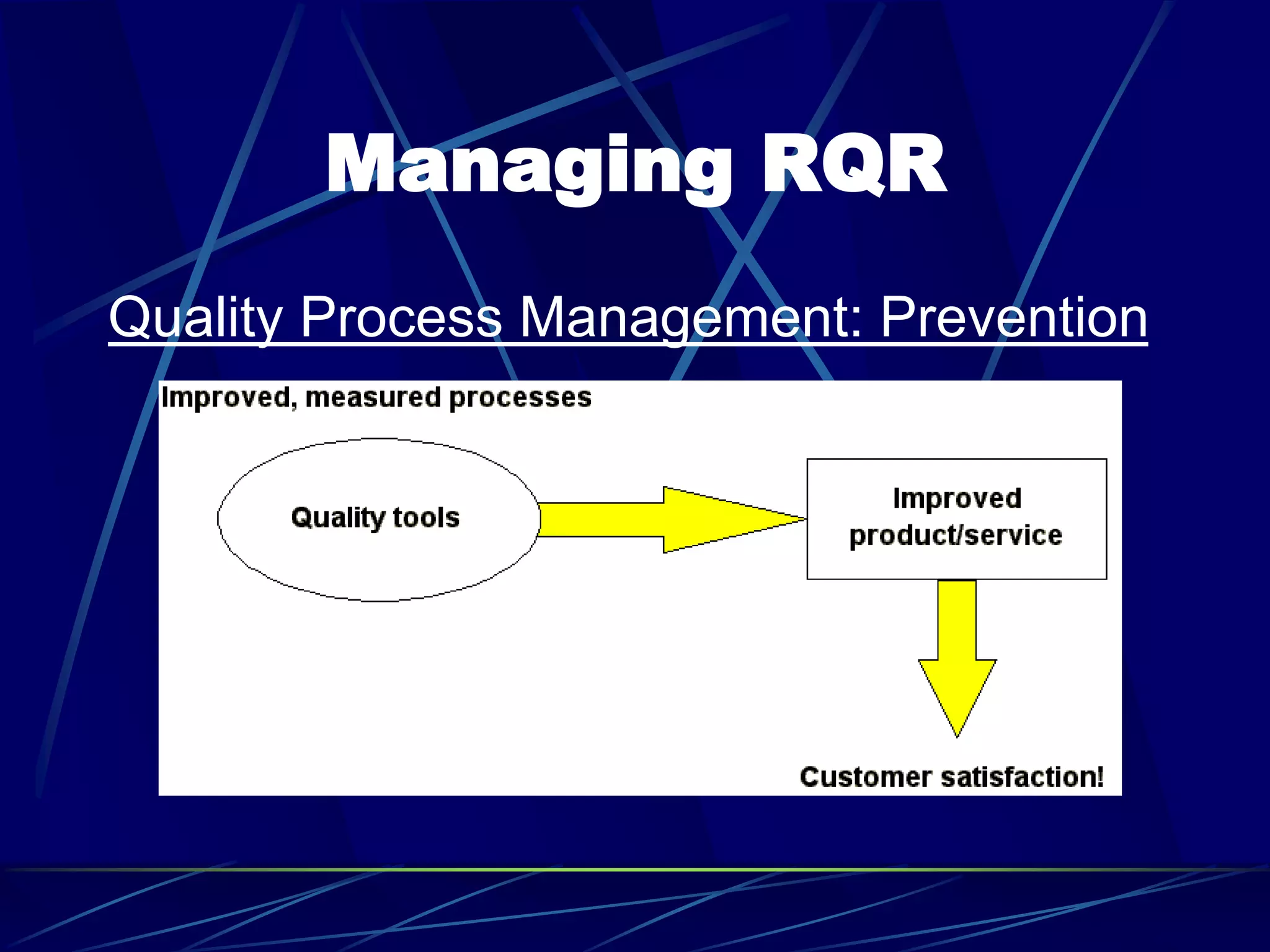
Quality Process Management: Prevention
Managing RQR
Best Practices: Process Orientation
 Whenever feasible, structure project activities around
processes rather than functions
 Encourage teamwork, communication, and
cooperation across functional lines
 Collocate project team, if possible
 Spend time with suppliers and customers
 Stop relying on mass inspection
 Establish project management process measures,
and measure and correct processes as they operate
ISO 9000
• Set of Standards for Quality Management Systems
• More than 90 countries have adopted ISO 9000 as national
standards
•According to ISO, the new ISO 9000 2000 standards are based
on eight quality management principles
Quality Management Principles:
#1 Focus on your Customers
Organizations rely on customers.
Therefore:
 Organizations must understand
customer needs.
 Organizations must meet or exceed
customer requirements.
Quality Management Principles:
#2 Provide Leadership
Organizations rely on leaders.
Therefore:
 Leaders must establish a unity of
purpose and set the direction the
organization should take.
 Leaders must create an environment that
encourages people to achieve the
organization's objectives.
Quality Management Principles:
#3 Involve your People
Organizations rely on people.
Therefore:
 Organizations must encourage the
involvement of people at all levels.
 Organizations must help people to
develop and use their abilities.
Quality Management Principles:
#4 Use a Process Approach
Organizations are more efficient and
effective when they use a process
approach. Therefore:
 Organizations must use a process
approach to manage activities and
related resources.
Quality Management Principles:
#5 Take a Systems Approach
Organizations are more efficient and
effective when they use a systems
approach. Therefore:
 Organizations must identify interrelated
processes and treat them as a system.
 Organizations must use a systems
approach to manage their interrelated
processes.
Quality Management Principles:
#6 Encourage Continual Improvement
Organizations are more efficient and
effective when they continually try to
improve. Therefore:
 Organizations must make a permanent
commitment to continually improve their
overall performance.
Quality Management Principles:
#7 Get the Facts before you Decide
Organizations perform better when
their decisions are based on facts.
Therefore:
 Organizations must base decisions on
the analysis of factual information and
data.
Quality Management Principles:
#8 Work with your Suppliers
Organizations depend on their
suppliers to help them create value.
Therefore:
 Organizations must maintain a mutually
beneficial relationship with their
suppliers.
Managing RQR
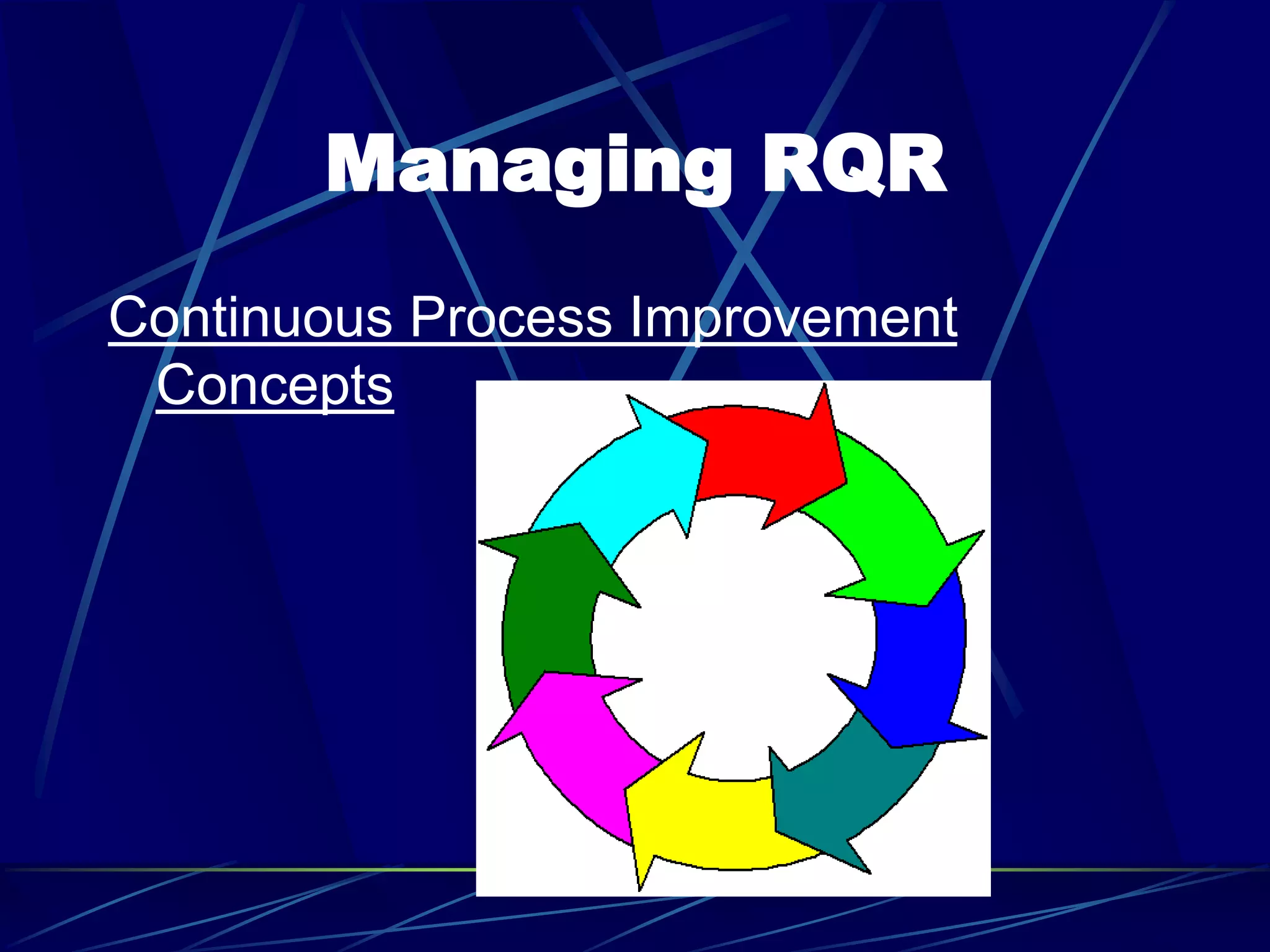
Continuous Process Improvement
Concepts
Managing RQR
Quality Management Principle:
Continuous Process Improvement
 Using Objective Measurement and Data to
Continuously and Simultaneously Improve
Quality, Cost, and Delivery
 An Ongoing Process of Transition From an
Organization’s Traditional Management
Culture to World-Class Management Culture
Managing RQR
Continuous Process Improvement
Steps:
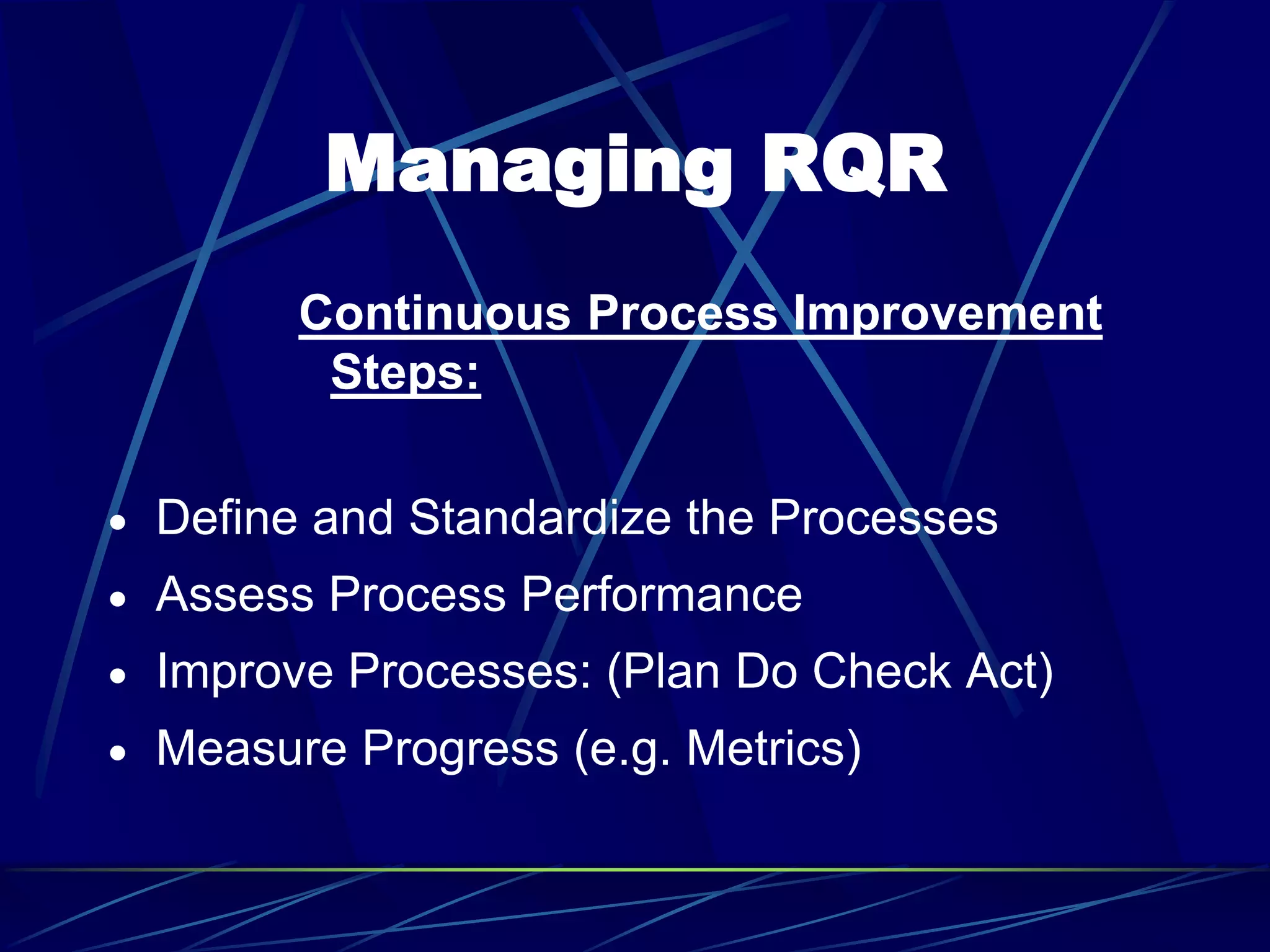
 Define and Standardize the Processes
 Assess Process Performance
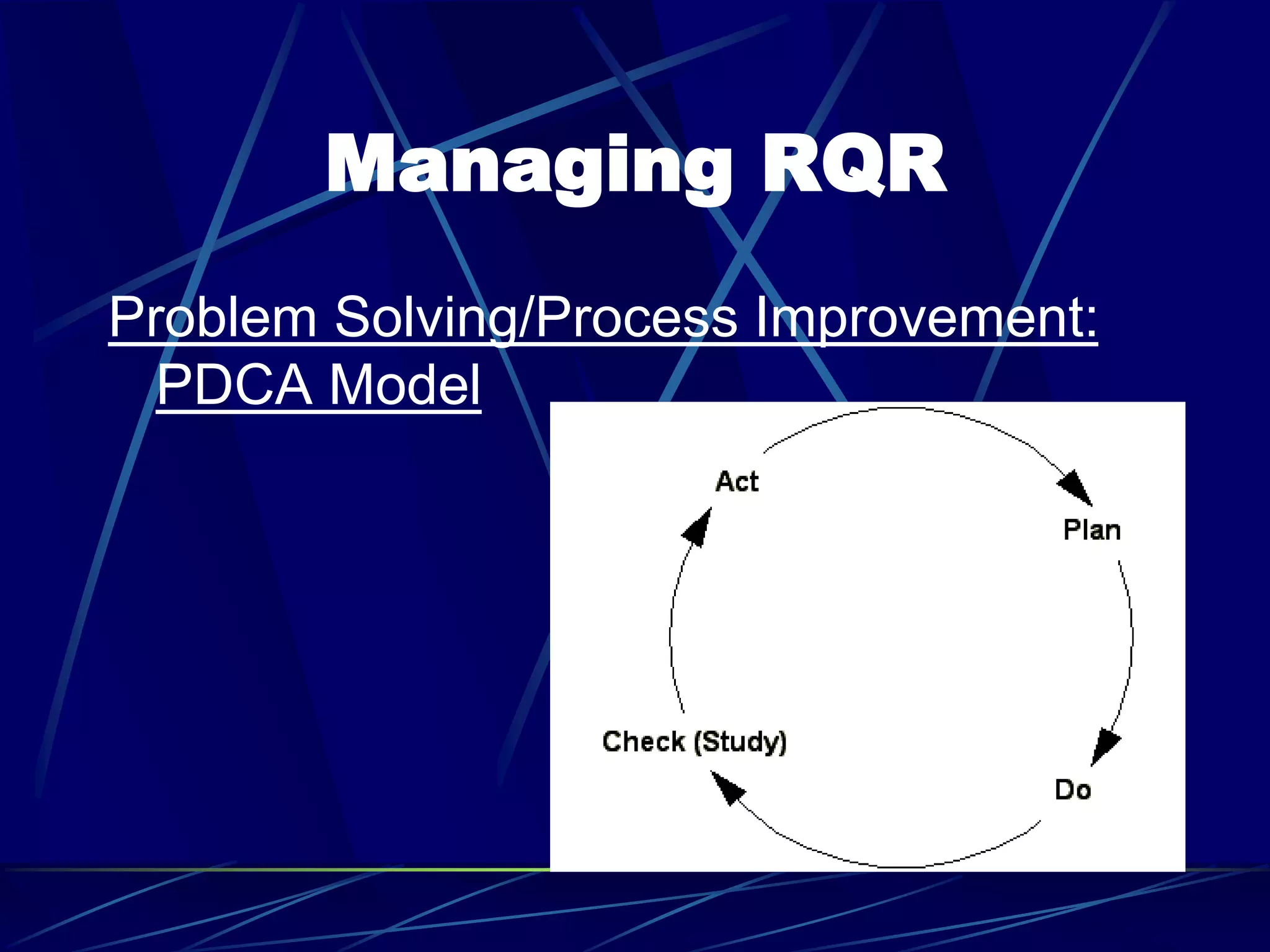
 Improve Processes: (Plan Do Check Act)
 Measure Progress (e.g. Metrics)
Managing RQR
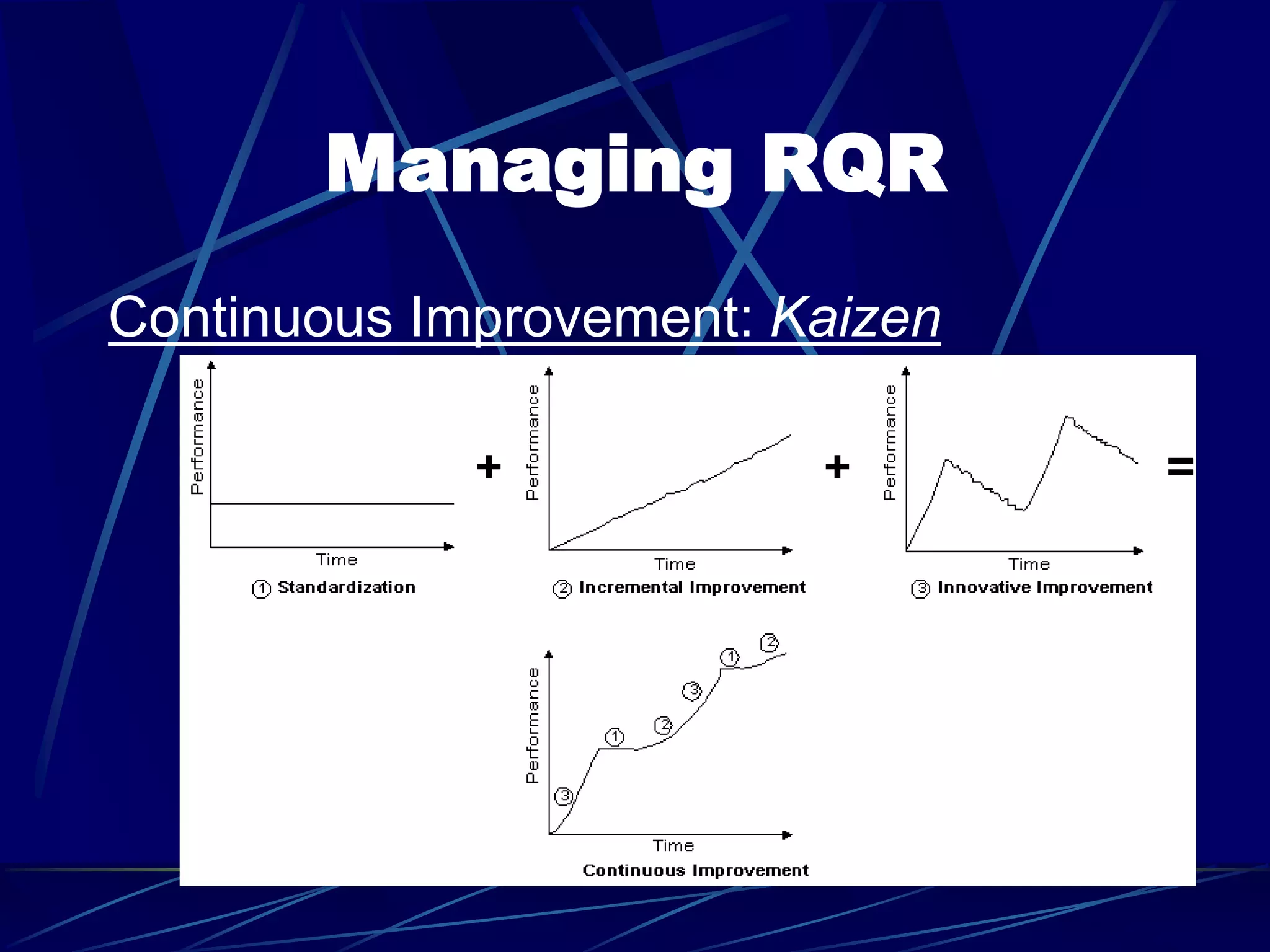
Continuous Improvement: Kaizen
Managing RQR
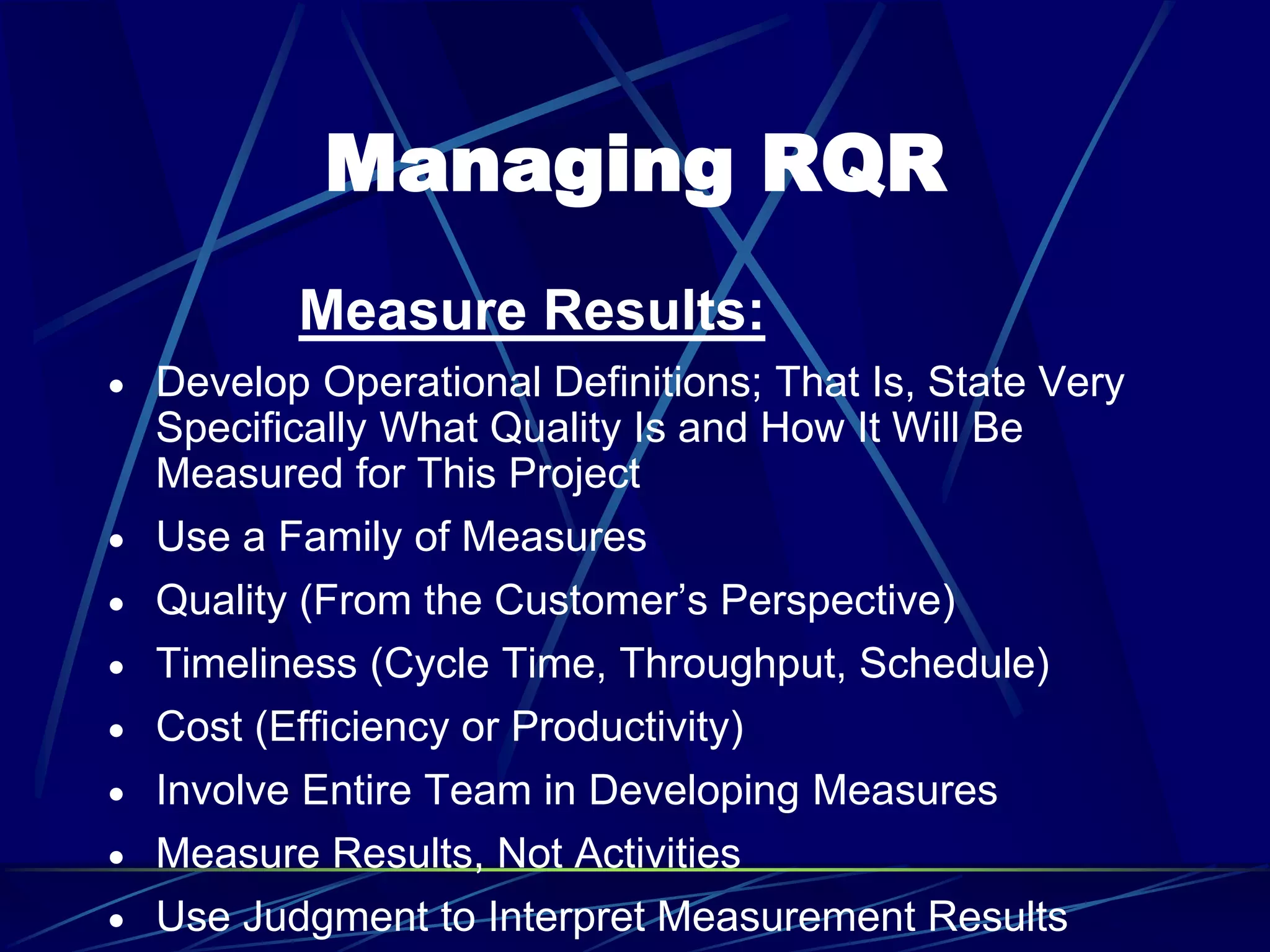
Measure Results:
 Develop Operational Definitions; That Is, State Very
Specifically What Quality Is and How It Will Be
Measured for This Project
 Use a Family of Measures
 Quality (From the Customer’s Perspective)
 Timeliness (Cycle Time, Throughput, Schedule)
 Cost (Efficiency or Productivity)
 Involve Entire Team in Developing Measures
 Measure Results, Not Activities
 Use Judgment to Interpret Measurement Results
Managing RQR
Some Project Results:
 Number of Deliverables On Time
 Number of Trouble Calls Per Week, Month, and so on
 Estimated and Budgeted Costs vs. Actuals
 Proposals Submitted vs. Proposals Won
 Bid Hours vs. Actual Hours
 Number of Milestones Completed
 Number of Projects with Risk and Safety Plans
 Time Spent Fixing Errors (Yours or Others)
 Wait Time
 Percent of Time on Value-Added Tasks
 Number and/or Cost of Contract Modifications
 Prototype Failures
 Others?
Managing RQR
Problem Solving/Process Improvement:
PDCA Model
Managing RQR
You Are on the Best Course If You . .
 Demand to see data before making decisions
(act on fact)
 Use basic statistical tools to investigate
problems and to gather and analyze data
 Dig for root causes of problems
 Seek permanent solutions rather than relying
on quick fixes
Managing RQR
You May Be in Trouble If You . . .
 Insist you do not need data because your
intelligence and experience are enough to tell
you what the problems and solutions are
 Take wild stabs at supposed solutions:
jumping to conclusions, using too many
inferences and assumptions, shooting from
the hip
 Act hastily: “Ready, fire, aim!”
Managing RQR
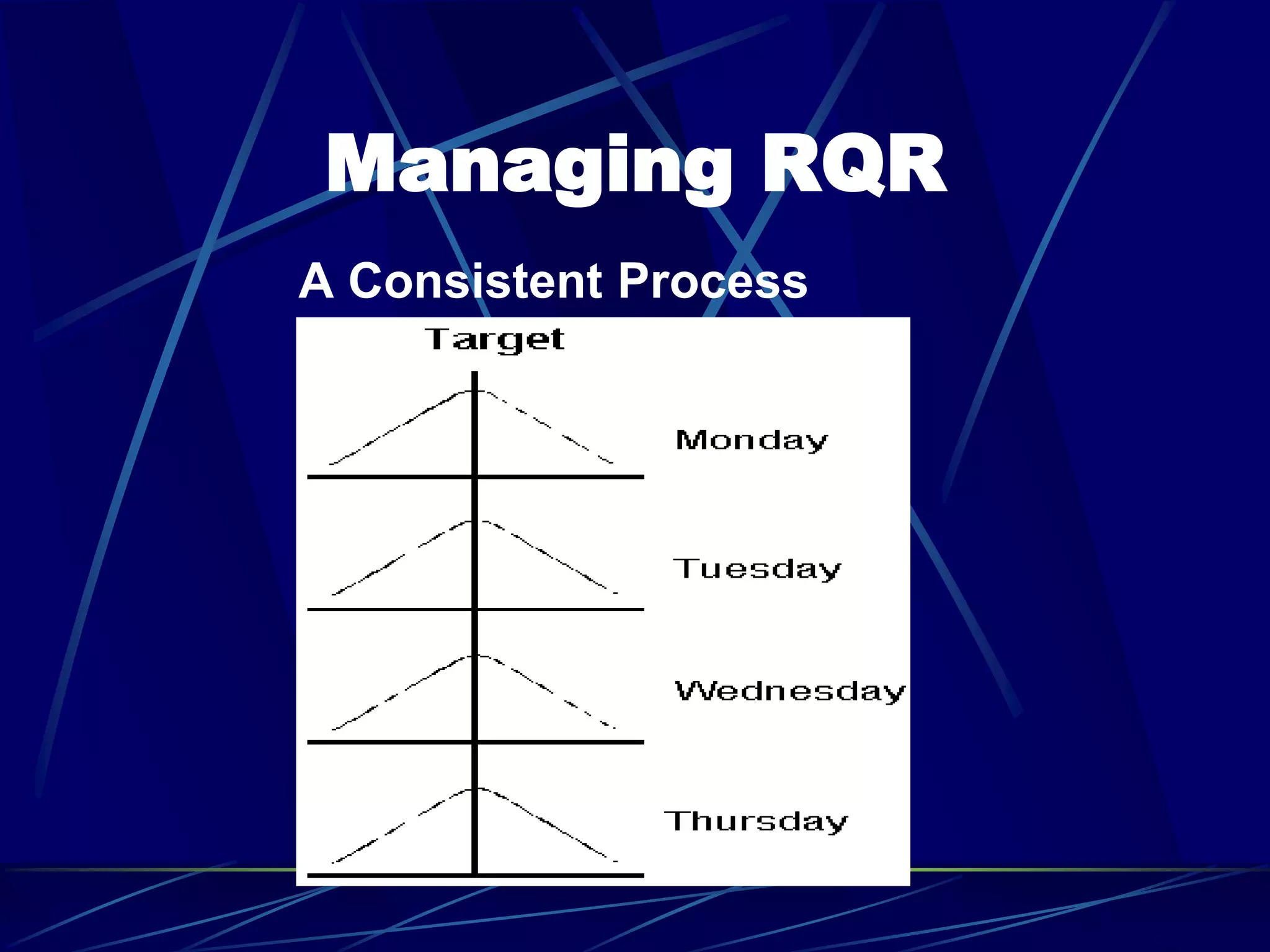
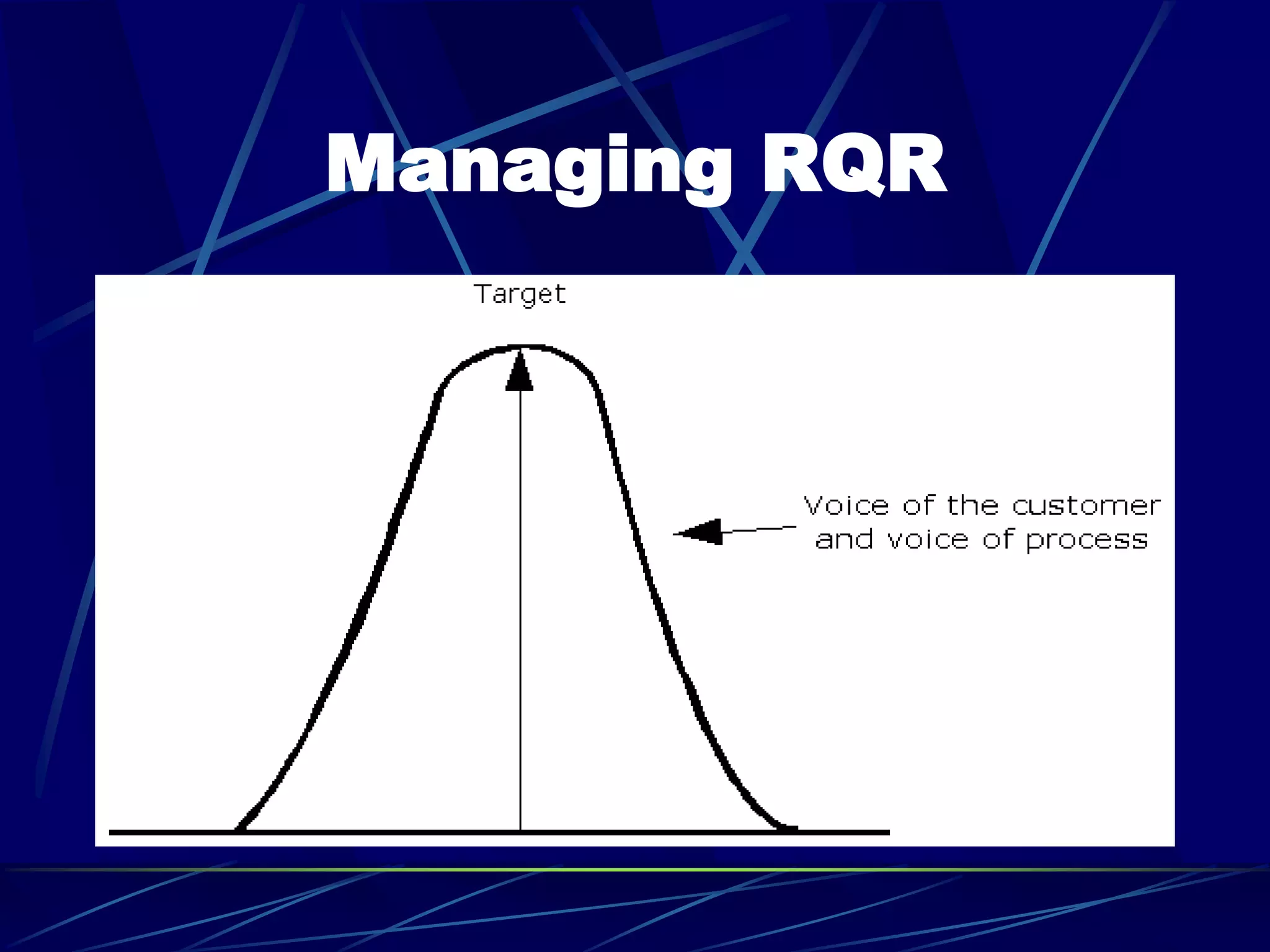
A Consistent Process
A consistent process is one that,
because of a lack of special causes,
enables us to predict process
performance
Managing RQR
A Consistent Process
Managing RQR
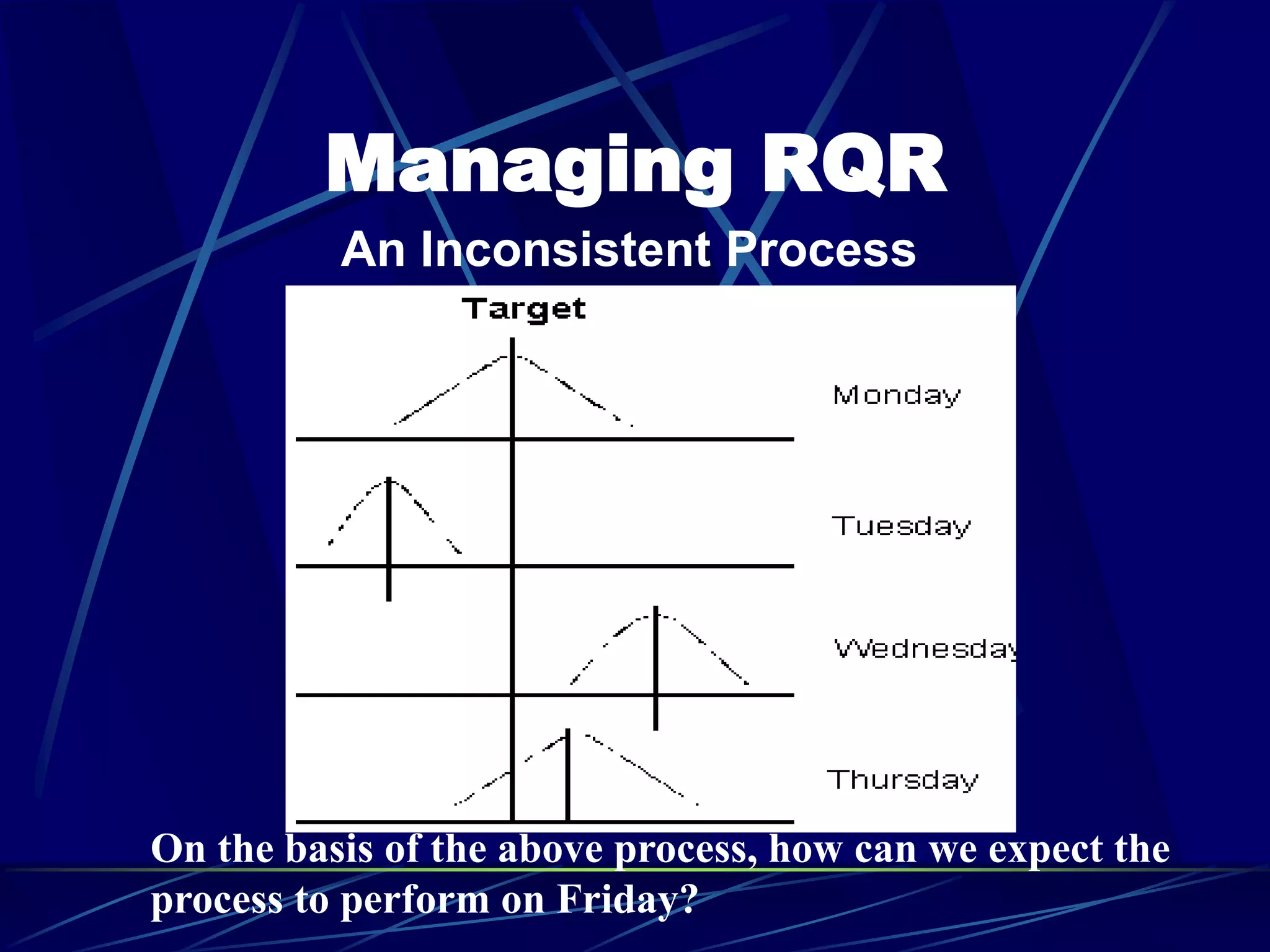
An Inconsistent Process
An inconsistent process is one that
varies because of special causes
acting on the process
Managing RQR
An Inconsistent Process
On the basis of the above process, how can we expect the
process to perform on Friday?
Managing RQR
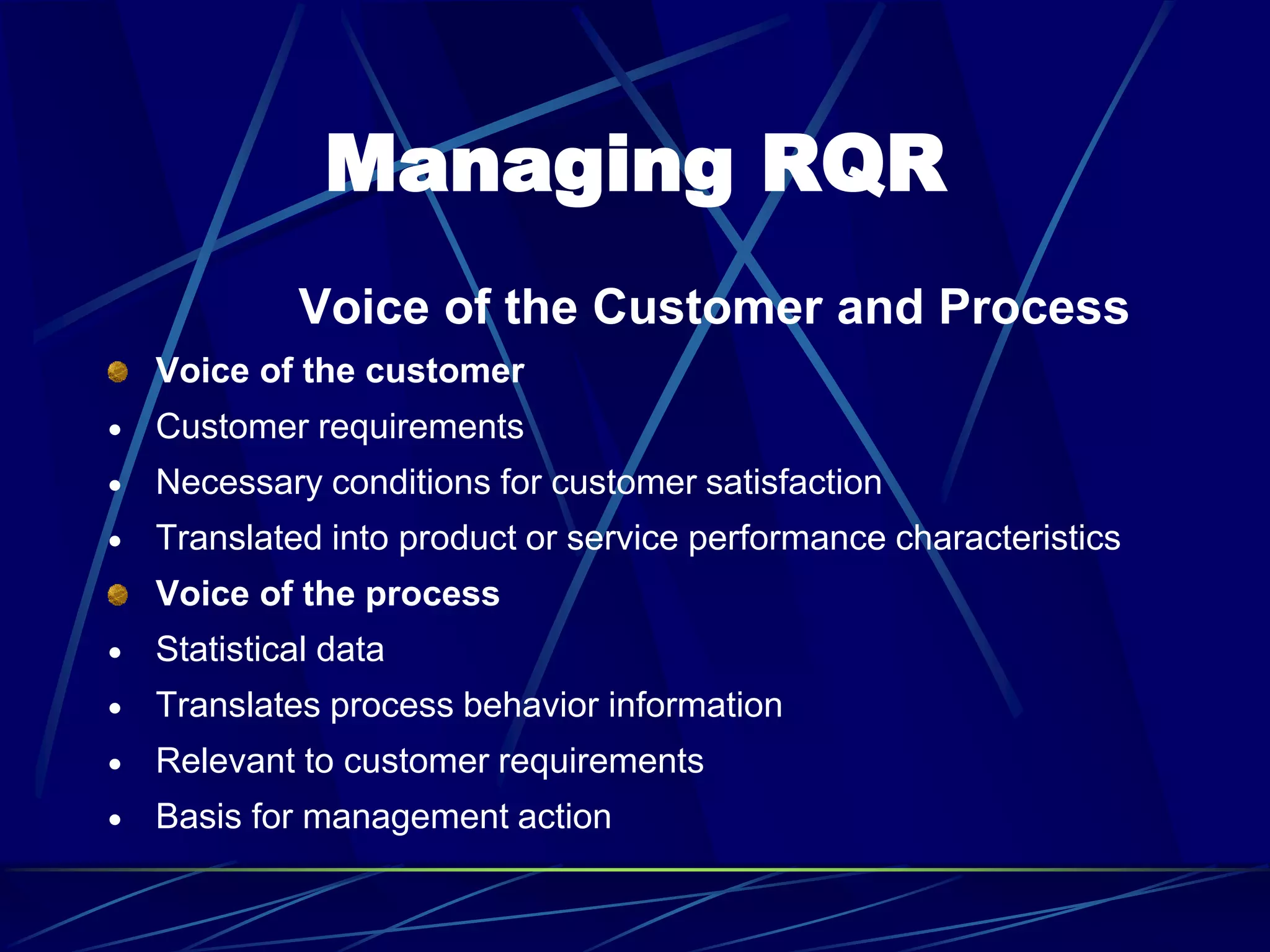
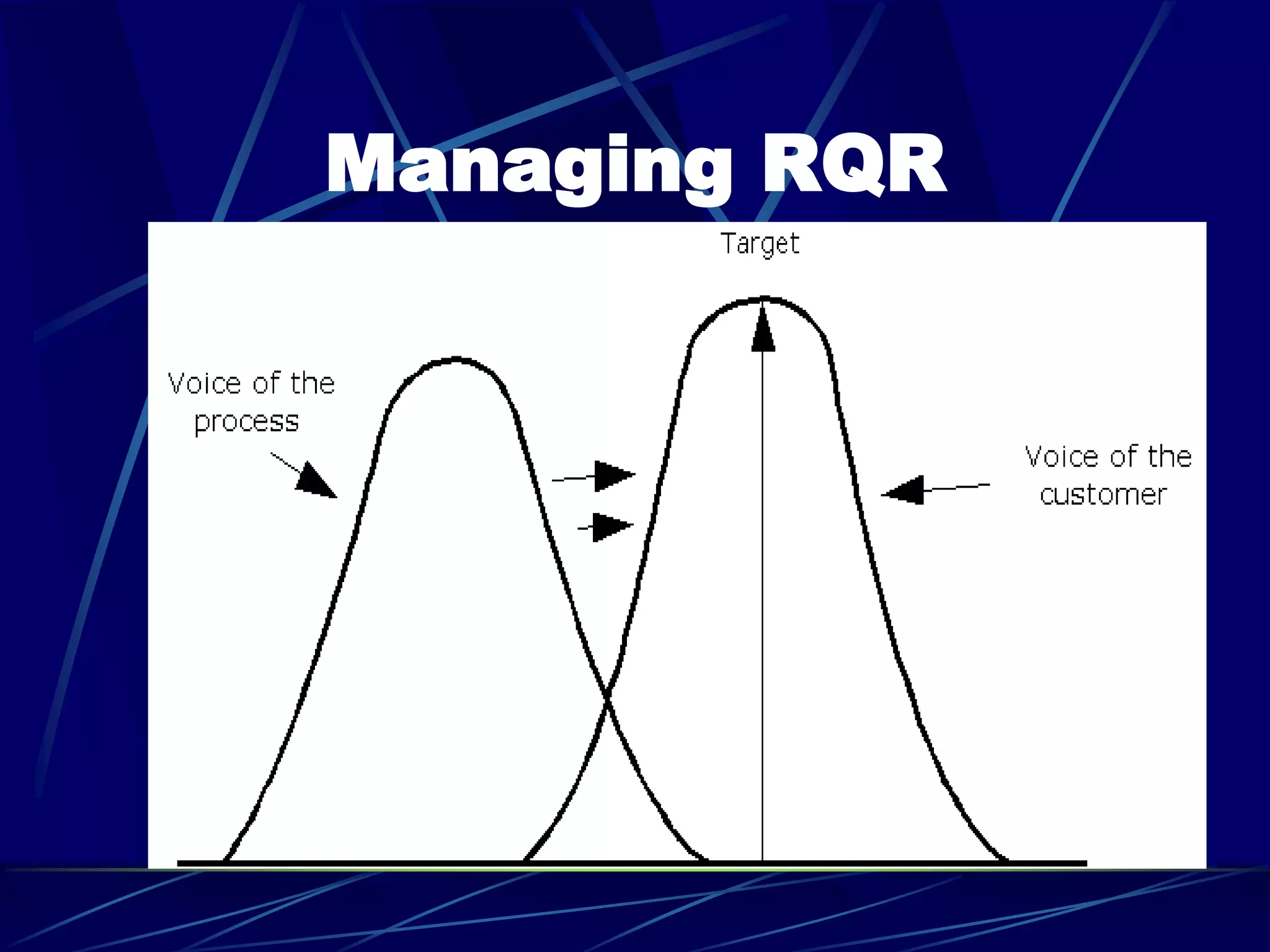
Voice of the Customer and Process
Voice of the customer
 Customer requirements
 Necessary conditions for customer satisfaction
 Translated into product or service performance characteristics
Voice of the process
 Statistical data
 Translates process behavior information
 Relevant to customer requirements
 Basis for management action
Managing RQR
Managing RQR
Managing RQR
Causes of Variation in Systems
Common causes (inherent in the system)
 Always present
 Random
 Predictable
 Regular part of the "as currently constituted"
system
 Improvement can be achieved only by
improving the process
Managing RQR
Examples
 Tolerance of parts
 Ambient temperature range
 Variability of input
 Poor training
 Poor materials
 Poor equipment
Managing RQR
Best Quality Management Practices for
Understanding Data
 Trust no one who cannot, or will not, provide
the context for figures
 Stop reporting comparisons between pairs of
values except as part of a broader
comparison
 Start using graphs to present current values
in context
Questions
Managing RQR
(Definitions)
 Quality Planning – Identifying which
standards are relevant to the project
and determining how to satisfy them.
 Quality Assurance – Evaluating overall
project performance on a regular basis
to provide confidence that the project
will satisfy the relevant quality
standards.
Managing RQR
(Definitions)
Quality Control – Monitoring specific
project results to determine if they comply
with relevant quality standards and identifying
ways to eliminate causes of unsatisfactory
performance.
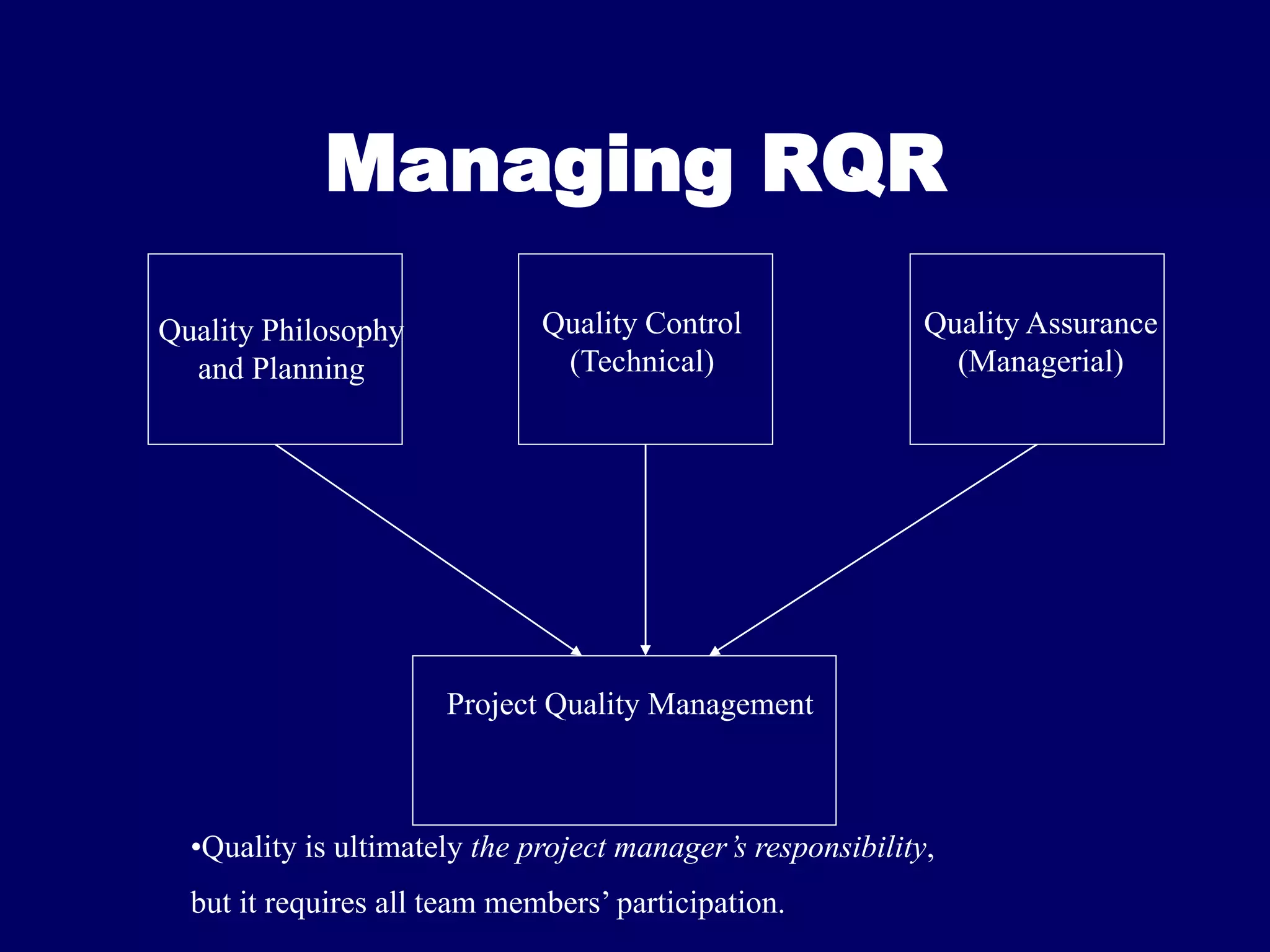
Managing RQR
Quality Philosophy
and Planning
Quality Control
(Technical)
Quality Assurance
(Managerial)
Project Quality Management
•Quality is ultimately the project manager’s responsibility,
but it requires all team members’ participation.
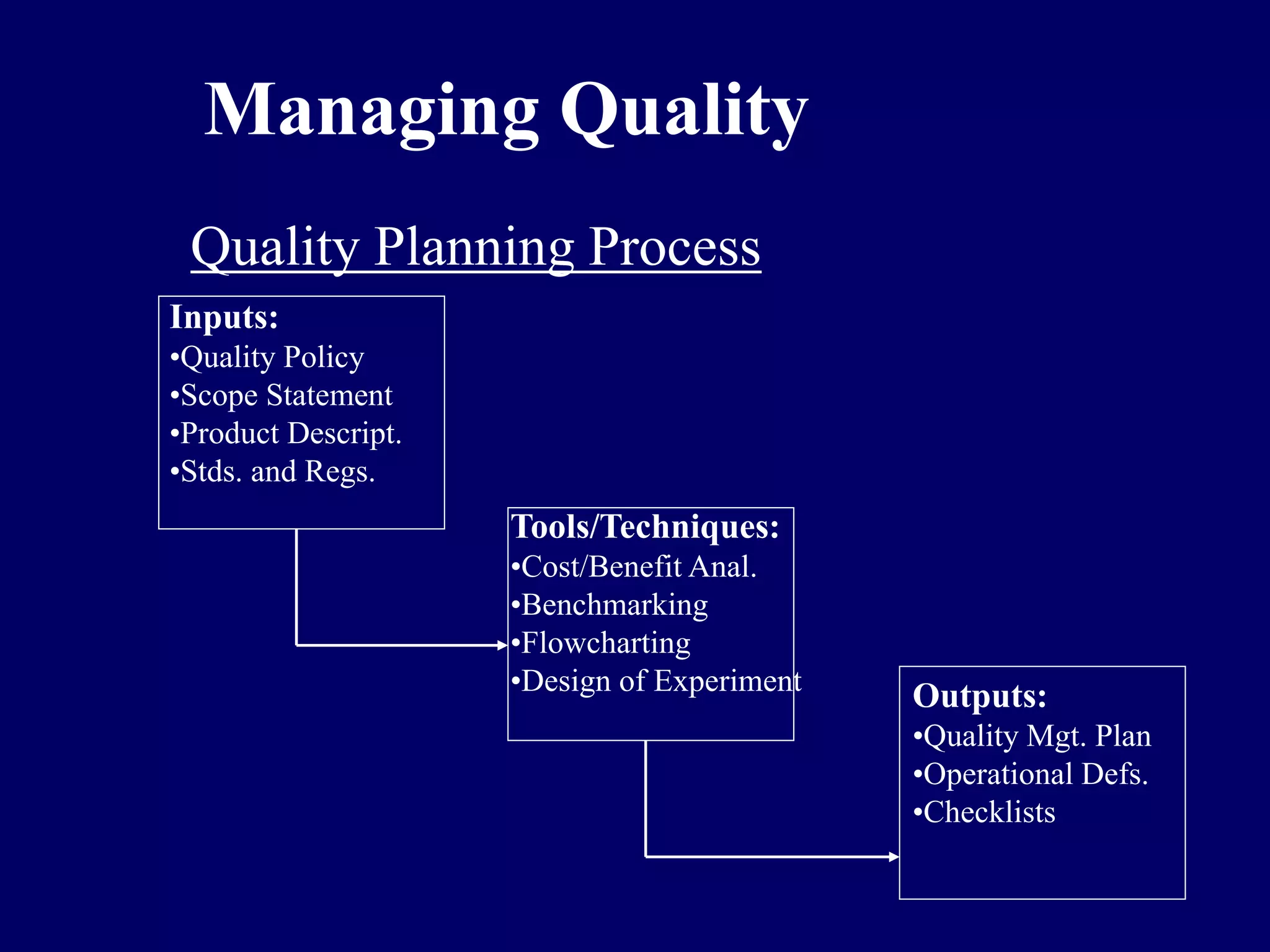
Managing Quality
Quality Planning Process
Inputs:
•Quality Policy
•Scope Statement
•Product Descript.
•Stds. and Regs.
Tools/Techniques:
•Cost/Benefit Anal.
•Benchmarking
•Flowcharting
•Design of Experiment
Outputs:
•Quality Mgt. Plan
•Operational Defs.
•Checklists
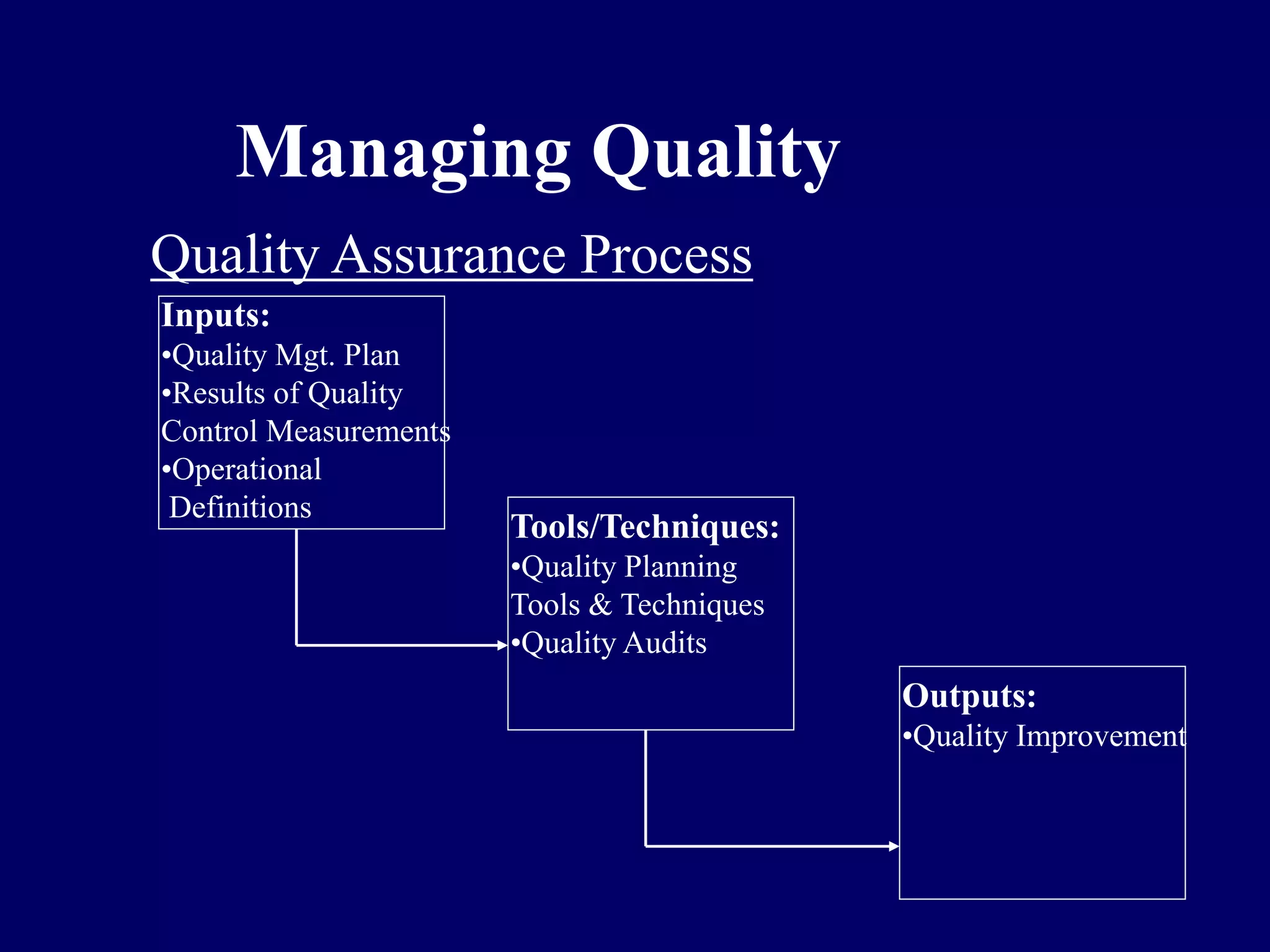
Managing Quality
Tools/Techniques:
•Quality Planning
Tools & Techniques
•Quality Audits
Outputs:
•Quality Improvement
Inputs:
•Quality Mgt. Plan
•Results of Quality
Control Measurements
•Operational
Definitions
Quality Assurance Process
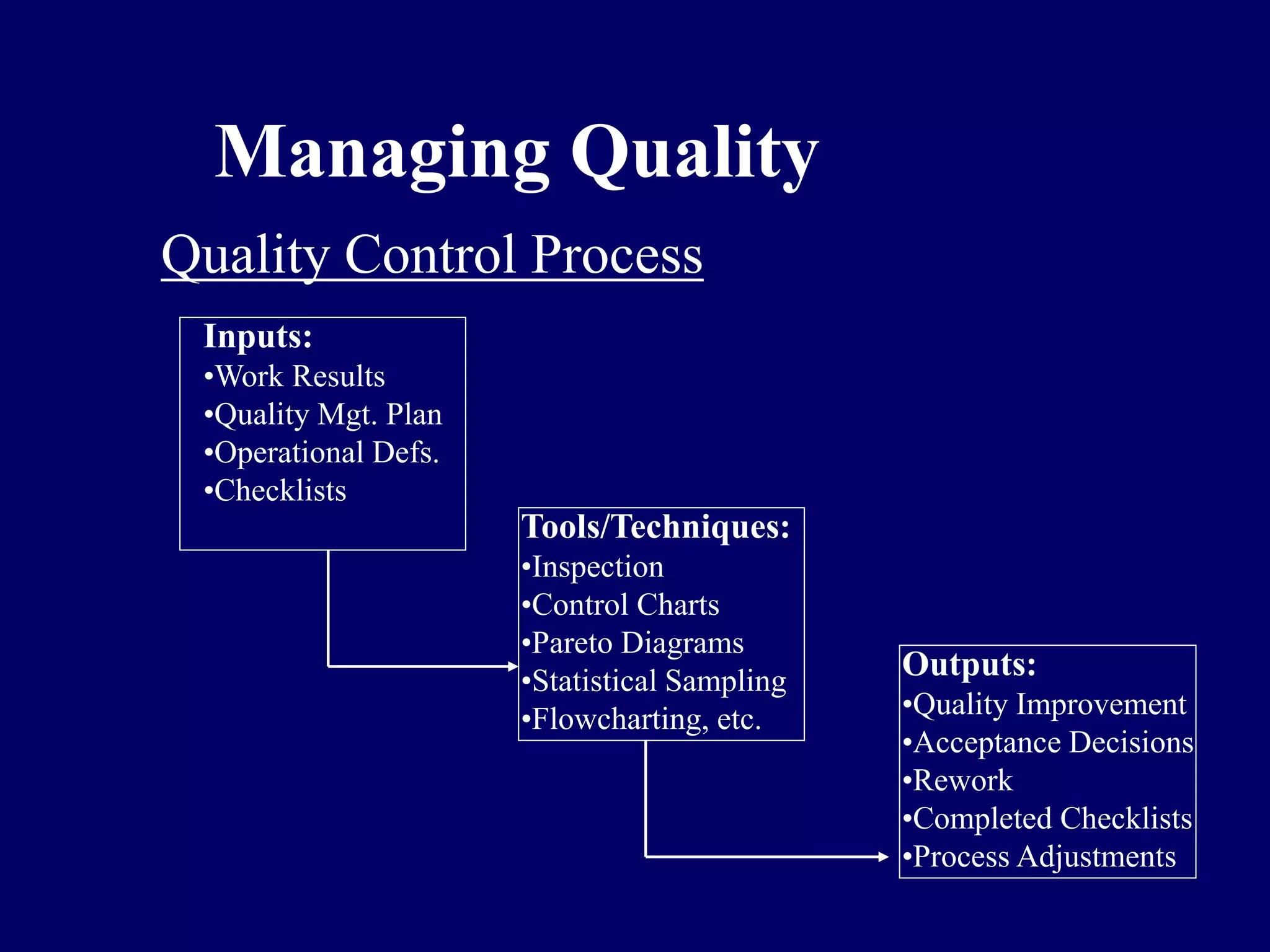
Managing Quality
Quality Control Process
Inputs:
•Work Results
•Quality Mgt. Plan
•Operational Defs.
•Checklists
Tools/Techniques:
•Inspection
•Control Charts
•Pareto Diagrams
•Statistical Sampling
•Flowcharting, etc.
Outputs:
•Quality Improvement
•Acceptance Decisions
•Rework
•Completed Checklists
•Process Adjustments

Managing RQR Applied Quality Model into Organization.

  • 1.
    RQR Overview –Presentation 2014Q1 Linked In - Ahmed El-Askalany, CSTE, CSQA, PMP, CQIA, ITIL | LinkedIn https://www.facebook.com/EdgeConsultancyInc E-mail: EdgeConsultancyInc@Gmail.com Managing RQR
  • 2.
    Managing RQR  Respect– Respect Our Organization , Our Employees, Our Management , And Our Customers. Determining how to satisfy them.  Quality – Establish a higher level of quality program “World-Class” that would provide confidence to our customers.  Results – Evaluating overall results.
  • 3.
    Change needs Respectand Support Management Support Staff Support Staff Training SDLC
  • 4.
    Managing RQR Respect KeyTrends: • Competition in the Global Workplace • Higher Quality Standards • Rising Customer Expectations • Many Competitors • Shortest Cycle Time • Globalization of Economies • Constant Innovation
  • 5.
    Managing RQR Respect ChangingWork Force:  Minds vs. Hands  Employee Empowerment  Downsizing  New Management and Leadership Models  Work Increasingly Accomplished in Teams
  • 6.
    Managing RQR Respect theEffect of Technology: • Paperless Environment • Faster Collection • Electronic Mail • Internet and Websites • Social Media and Mobile Apps
  • 7.
  • 8.
    Managing RQR Quality Management= World-Class Management:  Deliberate, Disciplined, Structured Use of Best-Known Management Methods  Situational  Dynamic and Flexible  Constantly Improving  Global Leadership Standard
  • 9.
    Managing RQR Quality ManagementPrinciple: Customer Focus: • Deliberate concentration on satisfying the needs and expectations of all your customers
  • 10.
    Managing RQR Identifying Customers UnderstandWho Your Customers Are: • Internal • Intermediate • External • End users Segment Your Customer Population By— • Size • Service or product provided • Job function
  • 11.
    Managing RQR Best ProjectManager Practices: Customer Focus  Link Organizational and Project Purposes to Customer Needs  Involve the Customer in Project Planning and Decision Making  Establish Routine and Meaningful Dialogue With Customers  Establish Methods to Build Customer Feedback into Project Management Processes
  • 12.
    Managing RQR Quality ProgramGoals: • Fitness for Use -- Describes the Product or Service When It Is Provided to the Customer • Fitness for Purpose -- Product or Service Meet Its Intended Purpose In All Respects • Customer Satisfaction -- Describes the Customer’s Feelings About a Product or Service • Conformance to Requirements -- Describes Condition of Product or Service in Relation to Customer’s Requirements
  • 13.
    Managing RQR Quality Concepts: •Zero Defects • The Customer is the Next Person in the Process • Do the Right Thing Right the First Time • Continuous Improvement Process • Process Capability
  • 14.
    Managing RQR  Lessfire fighting, resulting in more time for innovation and creativity  Increased customer satisfaction  More efficient project management  Higher productivity  Lower costs  Higher project team morale Proven Benefits of Quality for Global Project Managers:
  • 15.
    Managing RQR Characteristics ofManufactured Product Quality the Nine “ilities”)  Producibility  Usability  Reliability (mean-time between failures (MTBF)  Maintainability (mean-time to repair (MTTR)  Availability (MTBF, MTTR)  Operability  Flexibility  Social Acceptability  Affordability
  • 16.
    Managing RQR Characteristics ofService Product Quality:  Responsiveness  Competence  Access  Courtesy  Communication  Credibility  Security  Knowledge of the Customer  Tangibles  Reliability
  • 17.
    Managing RQR Project QualityManagement: • The Process of Ensuring that a Project Fully Meets the Needs and Expectations of its Customers (Internal and External)
  • 18.
    Managing RQR Absolutes ofQuality Management:  Quality Means Conformance to Requirements  Problems Are Functional in Nature  There Is No Optimum Level of Defects  Cost of Quality Is the Only Useful Measurement  Zero Defects Is the Only Performance Standard
  • 19.
    Managing RQR Common Features: Cause of Poor Quality Stems from the Management and the System Rather than the Workers  Inspection Is Not the Answer to Quality Improvement  Involvement of and Leadership by Top Management is Essential  Quality Programs Require Organization-Wide Effort and Long-Term Commitment  Commitment to Training  Quality Must Come First
  • 20.
    Managing Quality Quality ManagementPrinciple: Commitment to World-Class Quality • Making Quality a Major Focus of All Activity and Effort • Everyone Becomes Involved With Quality Throughout the Organization • Quality Is Constantly Pursued on All Projects Through Effective and Efficient Methods of Execution
  • 21.
    Managing RQR Characteristics ofa Quality Organization:  Customer Focus  Compelling Motivation Toward Quality  Recognizing Work As Related Processes  Freedom Through Process Control  Company Vision  Looking for Faults in Systems  Teamwork  Continued Education and Training
  • 22.
    Managing RQR Best Practicesfor Project Managers Committed to World-Class Quality:  Focus on Quality Before Cost or Production  Lead by Making Quality Improvement a High-Priority Activity for Yourself and Your Team  Recognize That Everyone on the Team Has a Responsibility for Quality  View Problems As Opportunities  Constantly Examine the Value to the Customer of Project Management Policies, Practices, and Procedures  Encourage Innovative Thinking and New Ideas  Practice Systems-Centered Project Management
  • 23.
    Managing RQR The 85/15Rule:  At least 85% of Problems Can Be Corrected by Changing the Systems and Less than 15% Are Under a Worker’s Control  Systems Are Largely Determined by Management  Poor System Performance Impedes Individual Performance
  • 24.
    Improve Quality Costs, mistakes, delays, andsnags decrease; better use of time and materials Market share improves with better quality and lower prices Productivity improves Likelihood of staying in business improves Ability to provide jobs and more jobs increases Managing RQR Results of Quality Improvement:
  • 25.
    Managing RQR Techniques forMeasuring Customer Expectations:  Customer Research  Surveys  Audits  Focus Groups  Quality Function Deployment  Employee Exchange Programs  Joint Problem Solving  Customer Service Data Analysis  Point of Delivery Feedback
  • 26.
    Managing RQR Project Characteristics: •Producibility • Usability • Reliability • Maintainability • Availability
  • 27.
    Managing RQR Project Characteristics: •Operability • Flexibility • Social Acceptance • Affordability
  • 28.
    Managing RQR Your Role: Organizations Cannot Change Themselves!  People Change Organizations  Each Person Is a Change Creator  If Your Organization Needs Change, You Have the Opportunity to Lead the Change Process  Consider Each Topic Discussed in Terms of How You Can Use it to Produce Change in the Sphere You Influence
  • 29.
    Managing RQR Deadly Assumptions: We Know What Our Customers Want  Quality Is Not important to Our Customers’ Buying Decisions  Financial Analysts and Markets Are the Key Audience  Creative Accounting and Portfolio Management Are Ways to Success  Increased Quality Means Increased Cost  Innovative Leaps Are the Best Route to a Strategic Lead  Workers Are Paid to Do, Not to Think  Senior Management’s Job Is Strategy, Not Operations and Implementation  Success Is Good; Failure Is Bad  If It’s Not Broken, Don’t Fix It
  • 30.
    Managing RQR Cost ofQuality  Cost of Quality is the Total Price to Achieve Product or Service Quality. This Includes All Work to Build a Product or Service That Conforms to the Requirements as Well as All Work Resulting from Nonconformance to the Requirements.
  • 31.
    Managing RQR Cost ofQuality Trends  Projects Are Not Measuring the Cost of Nonconformance Activities  Additional 20% of Total Cost Results from Lack of Quality Procedures  Goal of Between 3 – 5% of Total Value Cost of Quality Program
  • 32.
    Managing RQR Cost ofConformance Planning Training Process Control Field Testing Product Design Validation Process Validation Test & Evaluation Quality Audits Maintenance and Calibration Others? Cost of Nonconformance Scrap Rework Expediting Additional Material Warranty Repairs or Service Complaint Handling Liability Judgments Product Recalls Product Corrective Actions Proactive vs. Reactive
  • 33.
    Managing RQR Quality ManagementPrinciple: Process Orientation • Deliberately Aligning Thought, Interest, and Action in the Direction of Processes Rather Than Functions
  • 34.
    Work As aProcess: A process is an activity(s) that transforms input into output Managing Quality
  • 35.
  • 36.
    Managing RQR The Band-Aid®Approach Manyorganizations concentrate their efforts on fixing mistakes instead of preventing them
  • 37.
    Managing RQR Traditional ProcessManagement: Inspection Estimated fail rate 3 to 5% ----------> 10 to 30% of total cost
  • 38.
    Managing RQR Quality ProcessManagement: Prevention
  • 39.
    Managing RQR Best Practices:Process Orientation  Whenever feasible, structure project activities around processes rather than functions  Encourage teamwork, communication, and cooperation across functional lines  Collocate project team, if possible  Spend time with suppliers and customers  Stop relying on mass inspection  Establish project management process measures, and measure and correct processes as they operate
  • 40.
    ISO 9000 • Setof Standards for Quality Management Systems • More than 90 countries have adopted ISO 9000 as national standards •According to ISO, the new ISO 9000 2000 standards are based on eight quality management principles
  • 41.
    Quality Management Principles: #1Focus on your Customers Organizations rely on customers. Therefore:  Organizations must understand customer needs.  Organizations must meet or exceed customer requirements.
  • 42.
    Quality Management Principles: #2Provide Leadership Organizations rely on leaders. Therefore:  Leaders must establish a unity of purpose and set the direction the organization should take.  Leaders must create an environment that encourages people to achieve the organization's objectives.
  • 43.
    Quality Management Principles: #3Involve your People Organizations rely on people. Therefore:  Organizations must encourage the involvement of people at all levels.  Organizations must help people to develop and use their abilities.
  • 44.
    Quality Management Principles: #4Use a Process Approach Organizations are more efficient and effective when they use a process approach. Therefore:  Organizations must use a process approach to manage activities and related resources.
  • 45.
    Quality Management Principles: #5Take a Systems Approach Organizations are more efficient and effective when they use a systems approach. Therefore:  Organizations must identify interrelated processes and treat them as a system.  Organizations must use a systems approach to manage their interrelated processes.
  • 46.
    Quality Management Principles: #6Encourage Continual Improvement Organizations are more efficient and effective when they continually try to improve. Therefore:  Organizations must make a permanent commitment to continually improve their overall performance.
  • 47.
    Quality Management Principles: #7Get the Facts before you Decide Organizations perform better when their decisions are based on facts. Therefore:  Organizations must base decisions on the analysis of factual information and data.
  • 48.
    Quality Management Principles: #8Work with your Suppliers Organizations depend on their suppliers to help them create value. Therefore:  Organizations must maintain a mutually beneficial relationship with their suppliers.
  • 49.
    Managing RQR Continuous ProcessImprovement Concepts
  • 50.
    Managing RQR Quality ManagementPrinciple: Continuous Process Improvement  Using Objective Measurement and Data to Continuously and Simultaneously Improve Quality, Cost, and Delivery  An Ongoing Process of Transition From an Organization’s Traditional Management Culture to World-Class Management Culture
  • 51.
    Managing RQR Continuous ProcessImprovement Steps:  Define and Standardize the Processes  Assess Process Performance  Improve Processes: (Plan Do Check Act)  Measure Progress (e.g. Metrics)
  • 52.
  • 53.
    Managing RQR Measure Results: Develop Operational Definitions; That Is, State Very Specifically What Quality Is and How It Will Be Measured for This Project  Use a Family of Measures  Quality (From the Customer’s Perspective)  Timeliness (Cycle Time, Throughput, Schedule)  Cost (Efficiency or Productivity)  Involve Entire Team in Developing Measures  Measure Results, Not Activities  Use Judgment to Interpret Measurement Results
  • 54.
    Managing RQR Some ProjectResults:  Number of Deliverables On Time  Number of Trouble Calls Per Week, Month, and so on  Estimated and Budgeted Costs vs. Actuals  Proposals Submitted vs. Proposals Won  Bid Hours vs. Actual Hours  Number of Milestones Completed  Number of Projects with Risk and Safety Plans  Time Spent Fixing Errors (Yours or Others)  Wait Time  Percent of Time on Value-Added Tasks  Number and/or Cost of Contract Modifications  Prototype Failures  Others?
  • 55.
    Managing RQR Problem Solving/ProcessImprovement: PDCA Model
  • 56.
    Managing RQR You Areon the Best Course If You . .  Demand to see data before making decisions (act on fact)  Use basic statistical tools to investigate problems and to gather and analyze data  Dig for root causes of problems  Seek permanent solutions rather than relying on quick fixes
  • 57.
    Managing RQR You MayBe in Trouble If You . . .  Insist you do not need data because your intelligence and experience are enough to tell you what the problems and solutions are  Take wild stabs at supposed solutions: jumping to conclusions, using too many inferences and assumptions, shooting from the hip  Act hastily: “Ready, fire, aim!”
  • 58.
    Managing RQR A ConsistentProcess A consistent process is one that, because of a lack of special causes, enables us to predict process performance
  • 59.
  • 60.
    Managing RQR An InconsistentProcess An inconsistent process is one that varies because of special causes acting on the process
  • 61.
    Managing RQR An InconsistentProcess On the basis of the above process, how can we expect the process to perform on Friday?
  • 62.
    Managing RQR Voice ofthe Customer and Process Voice of the customer  Customer requirements  Necessary conditions for customer satisfaction  Translated into product or service performance characteristics Voice of the process  Statistical data  Translates process behavior information  Relevant to customer requirements  Basis for management action
  • 63.
  • 64.
  • 65.
    Managing RQR Causes ofVariation in Systems Common causes (inherent in the system)  Always present  Random  Predictable  Regular part of the "as currently constituted" system  Improvement can be achieved only by improving the process
  • 66.
    Managing RQR Examples  Toleranceof parts  Ambient temperature range  Variability of input  Poor training  Poor materials  Poor equipment
  • 67.
    Managing RQR Best QualityManagement Practices for Understanding Data  Trust no one who cannot, or will not, provide the context for figures  Stop reporting comparisons between pairs of values except as part of a broader comparison  Start using graphs to present current values in context
  • 68.
  • 69.
    Managing RQR (Definitions)  QualityPlanning – Identifying which standards are relevant to the project and determining how to satisfy them.  Quality Assurance – Evaluating overall project performance on a regular basis to provide confidence that the project will satisfy the relevant quality standards.
  • 70.
    Managing RQR (Definitions) Quality Control– Monitoring specific project results to determine if they comply with relevant quality standards and identifying ways to eliminate causes of unsatisfactory performance.
  • 71.
    Managing RQR Quality Philosophy andPlanning Quality Control (Technical) Quality Assurance (Managerial) Project Quality Management •Quality is ultimately the project manager’s responsibility, but it requires all team members’ participation.
  • 72.
    Managing Quality Quality PlanningProcess Inputs: •Quality Policy •Scope Statement •Product Descript. •Stds. and Regs. Tools/Techniques: •Cost/Benefit Anal. •Benchmarking •Flowcharting •Design of Experiment Outputs: •Quality Mgt. Plan •Operational Defs. •Checklists
  • 73.
    Managing Quality Tools/Techniques: •Quality Planning Tools& Techniques •Quality Audits Outputs: •Quality Improvement Inputs: •Quality Mgt. Plan •Results of Quality Control Measurements •Operational Definitions Quality Assurance Process
  • 74.
    Managing Quality Quality ControlProcess Inputs: •Work Results •Quality Mgt. Plan •Operational Defs. •Checklists Tools/Techniques: •Inspection •Control Charts •Pareto Diagrams •Statistical Sampling •Flowcharting, etc. Outputs: •Quality Improvement •Acceptance Decisions •Rework •Completed Checklists •Process Adjustments