Leadership Masterclass
– Reflective Practice
for Leaders
Craig McDowell
October 2013
Learning Outcomes
Intentions for today:
 Exploring what is reflective practice.
 Sharing some useful concepts and practical tools to enable
reflective skills.
 In particular, addressing the leadership behaviours
of Adaptability and Decision Making, on the ODI Leadership
Competencies Framework, although there are links to Results
Focus, and Vision and Strategy.
2
Two Hungers
In Africa, they say there are two hungers,
the lesser hunger and the greater hunger.
The lesser hunger is for the things that
sustain life, the goods, the services, and
the money to pay for them, which we all
need.
The greater hunger is for the answer to the
question ”why”, for some understanding
of what life is for.
Handy (1997)
3
Reflection
Reflection is an important human activity in which people
recapture their experience, think about it, mull over and
evaluate it. It is this working with experience that is important
in learning.
Boud (1985)
Informal:
 Involves self-questioning, develops our awareness of our own
assumptions
Formal:
 Draws on research & theory, provides guidance &
frameworks for practice
4
Reflective Practice
The art of consciously and deliberately thinking things through,
while developing understanding of complex, real world
situations.
5
Model of Reflection – 5 stage
model
 We identify a problem that is perplexing & ‘felt’
 We observe & refine the identified problem to create a fuller
understanding
 We develop a hypothesis or an understanding about the
problem, its origins & possible solutions
 We subject the hypothesis to scrutiny & reasoning
 We test the hypothesis or understanding in practice.
Dewey (1938)
6
Model of Reflection –
Reflection in Action
 Reflection in action concerns thinking about something whilst
engaged in doing it, having a feeling about something &
practicing according to that feeling.
 This model celebrates the intuitive & artistic approaches that
can be brought to uncertain situations. Legitimises emotions.
Schon (1983)
7
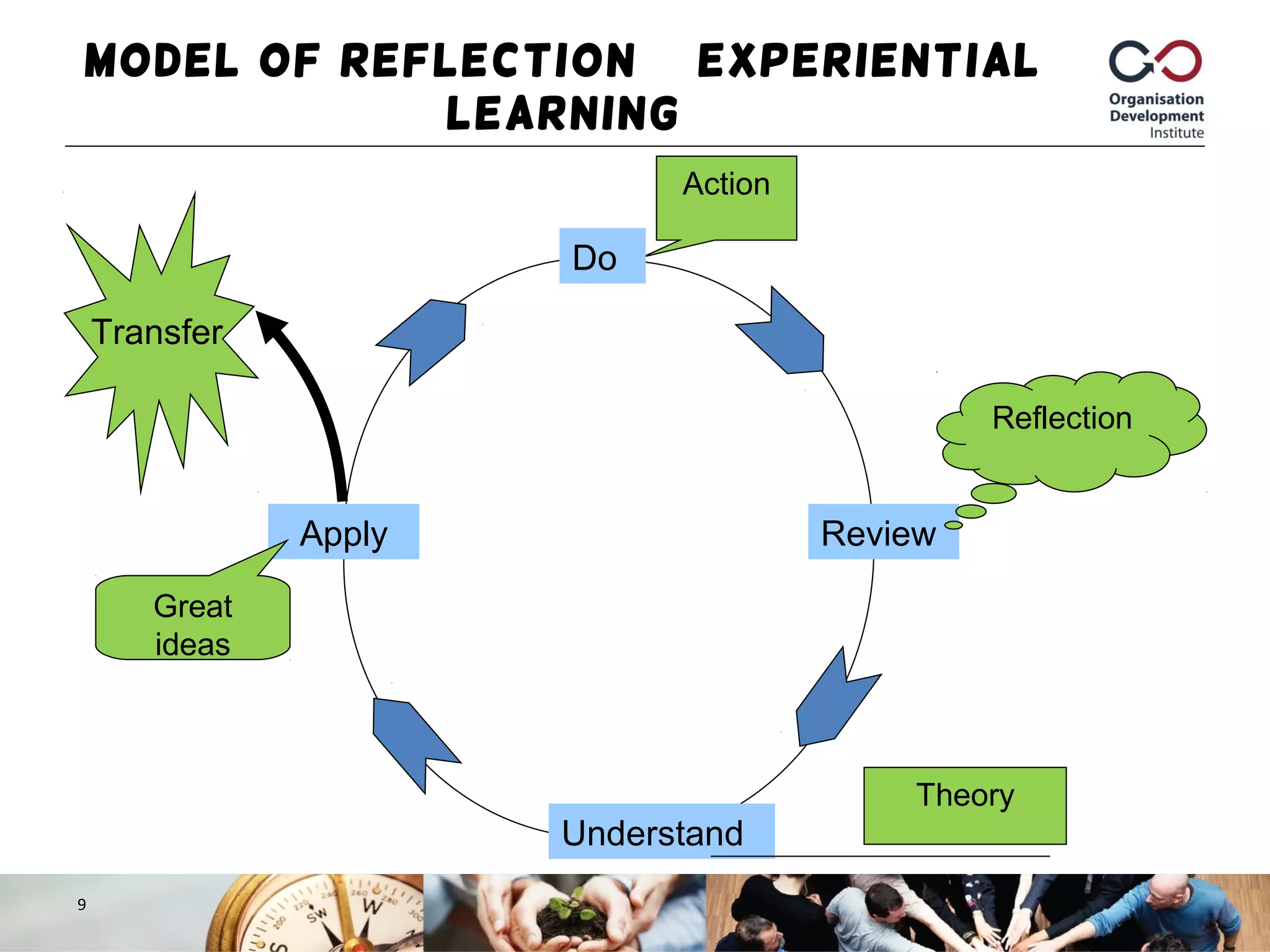
Model of Reflection – Experiential
Learning
 Concrete experience: the event
 Reflective observation: consider what has happened from a
variety of perspectives e.g. own feelings, the group’s, another
individual’s view
 Abstract conceptualisation: re-package & process your
reflections into a theoretical understanding (analysis)
 Active experimentation: armed with this new understanding,
you do it again, differently this time.
Kolb (1984)
8
Model of Reflection – Experiential
Learning
9
Action
Do
Review
Reflection
Understand
Theory
Apply
Great
ideas
Transfer
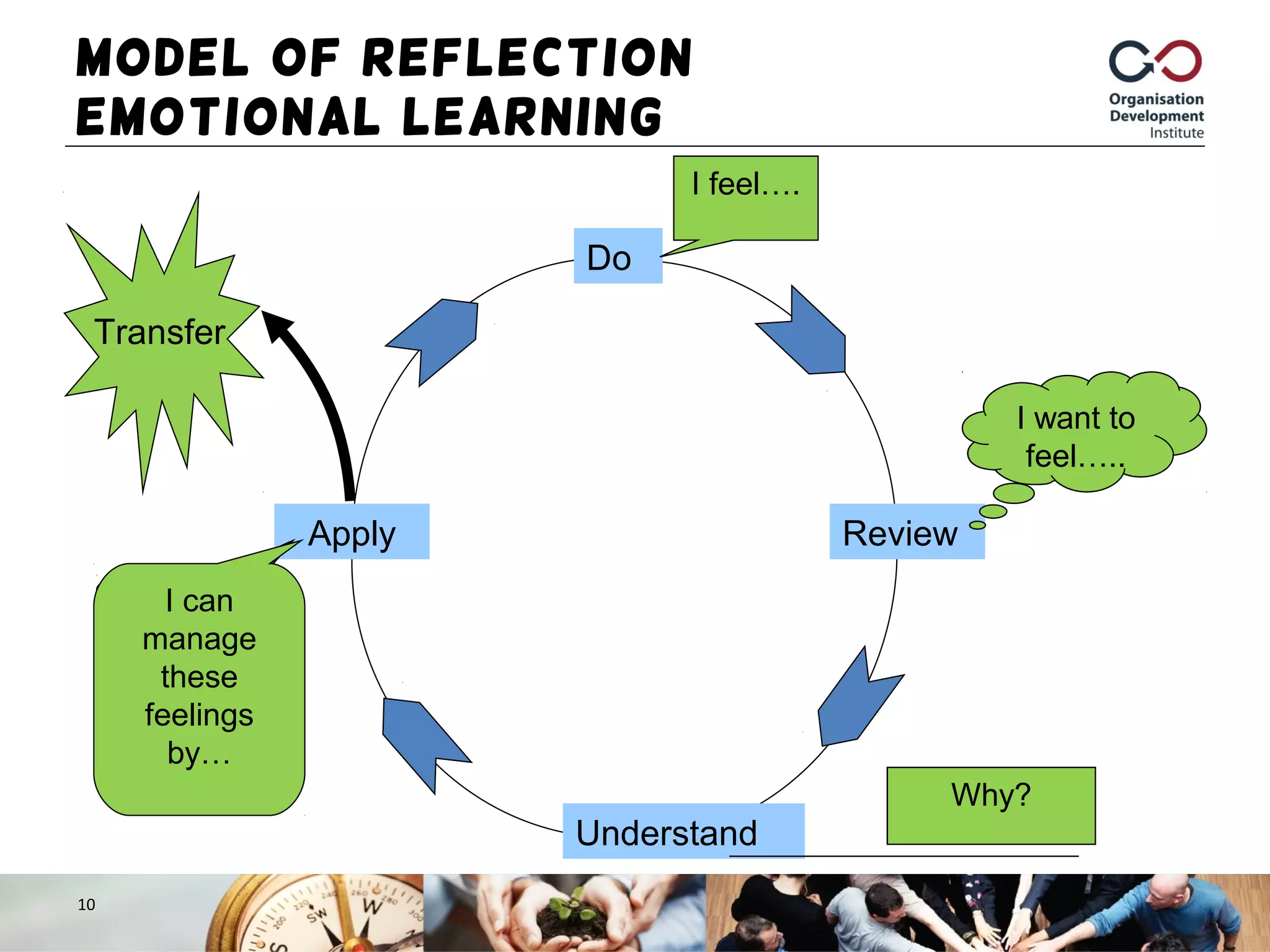
Model of Reflection –
Emotional Learning
10
Action
Do
Review
Reflectio
n
Understand
Theory
Apply
Great
ideas
Transfer
I feel….
I want to
feel…..
Why?
I can
manage
these
feelings
by…
Barriers to Reflection
 Kolb sees that to reflect effectively on your experience, you
should actively set aside time to reflect & analyse.
 Psychological barriers include fear of judgement, fear of
criticism, being closed to feedback, defensiveness,
professional arrogance.
11
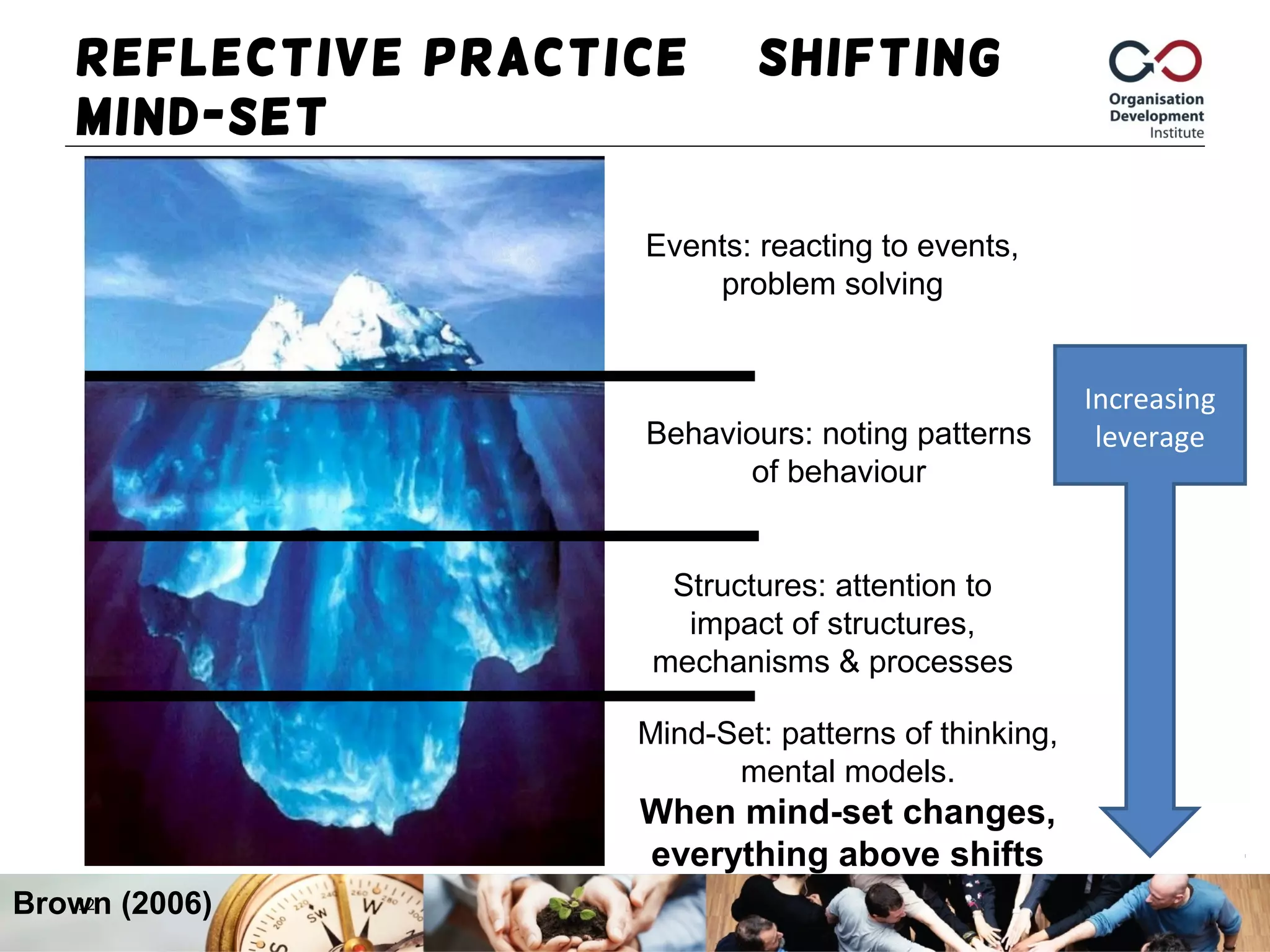
Reflective Practice – Shifting
Mind-Set
12
Mind-Set: patterns of thinking,
mental models.
When mind-set changes,
everything above shifts
Brown (2006)
Events: reacting to events,
problem solving
Behaviours: noting patterns
of behaviour
Structures: attention to
impact of structures,
mechanisms & processes
Increasing
leverage
Adaptive and Reflective
Practice
 Reflective practice – the art of consciously and deliberately
thinking things through, while developing understanding of
complex, real world situations.
 Adaptive Leadership: “The practice of mobilizing people to
tackle tough challenges and thrive.”
Heifetz(2009)
13
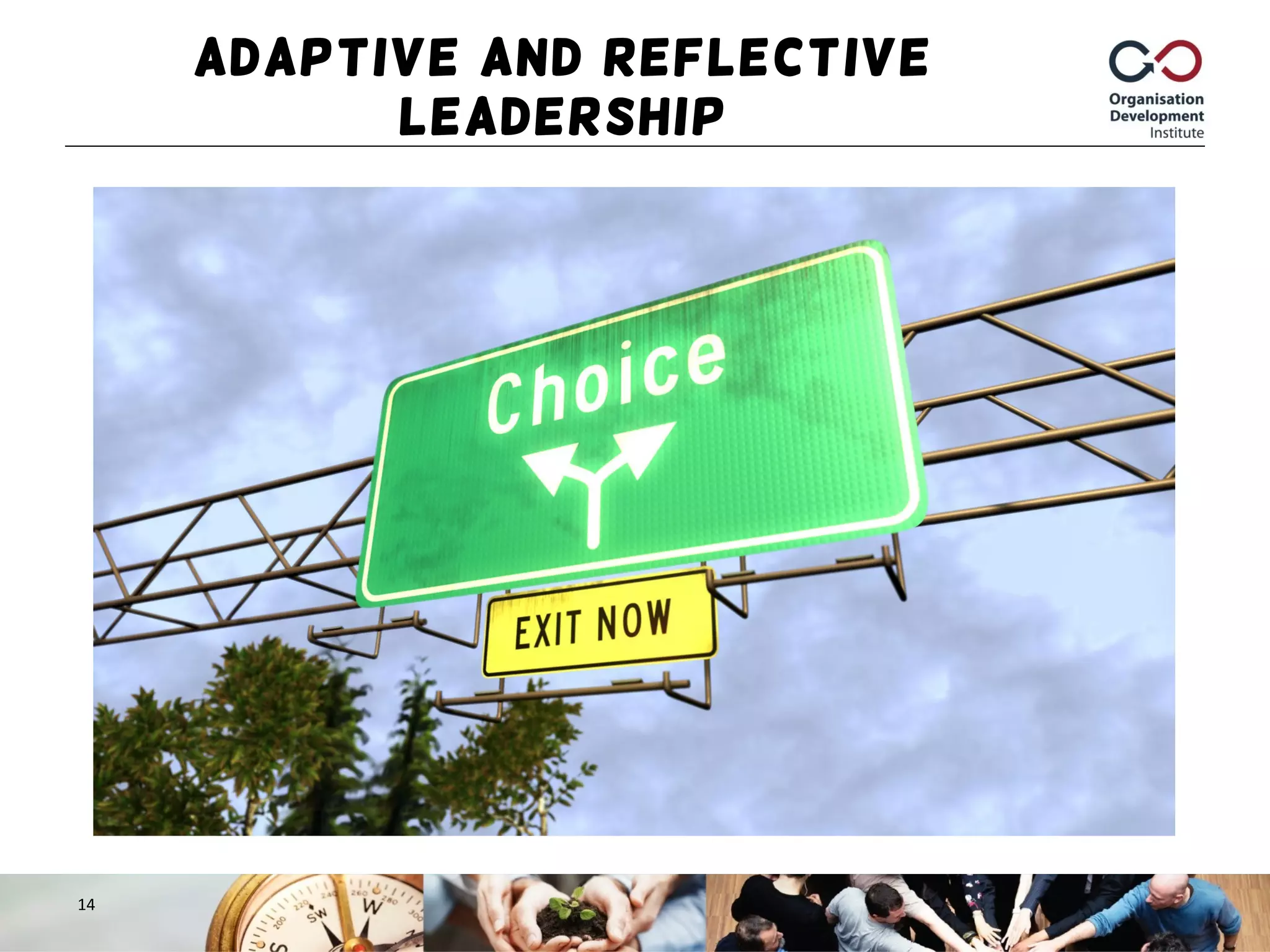
Adaptive and Reflective
Leadership
14
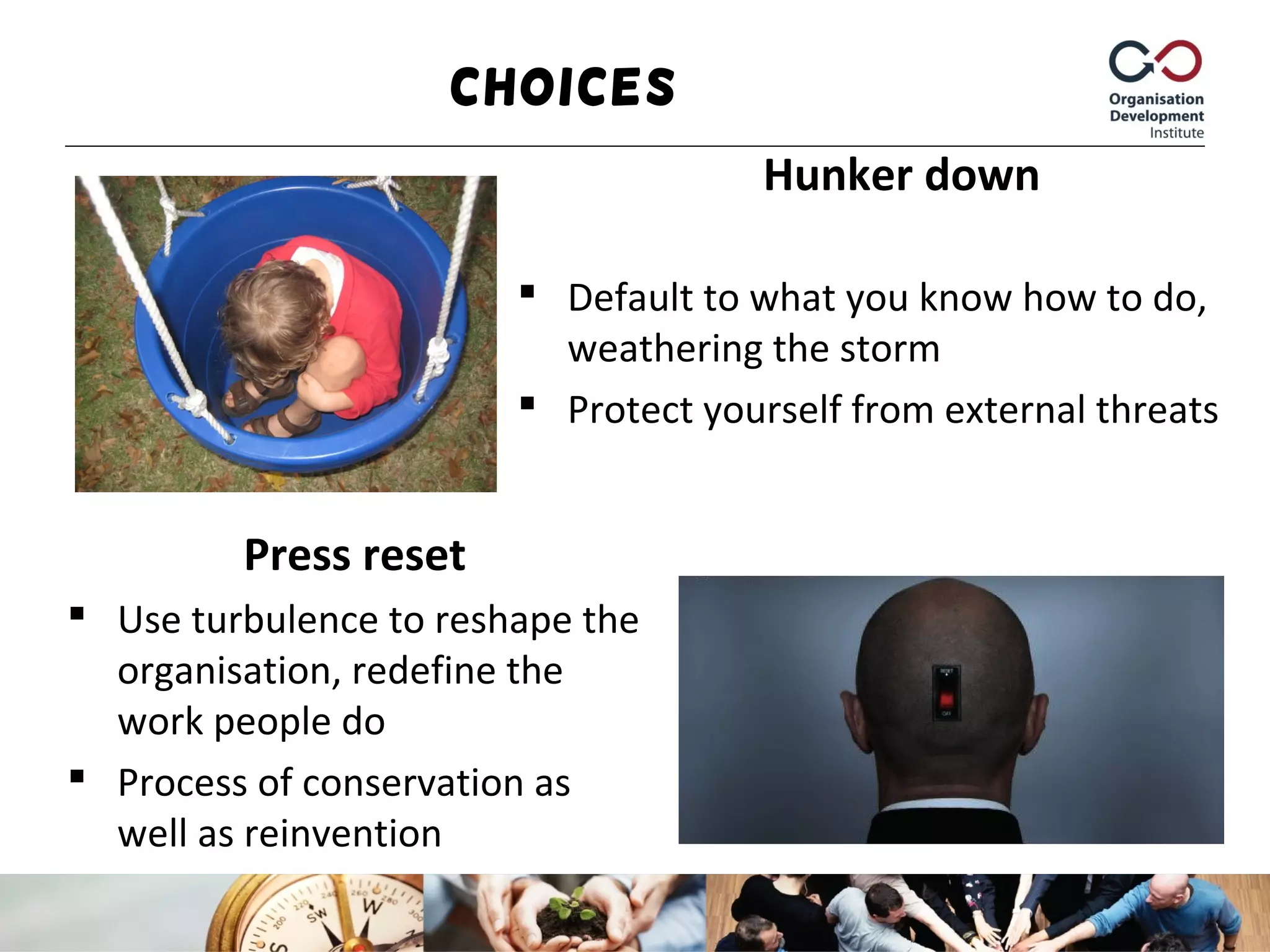
Hunker down
 Default to what you know how to do,
weathering the storm
 Protect yourself from external threats
Press reset
 Use turbulence to reshape the
organisation, redefine the
work people do
 Process of conservation as
well as reinvention
Choices
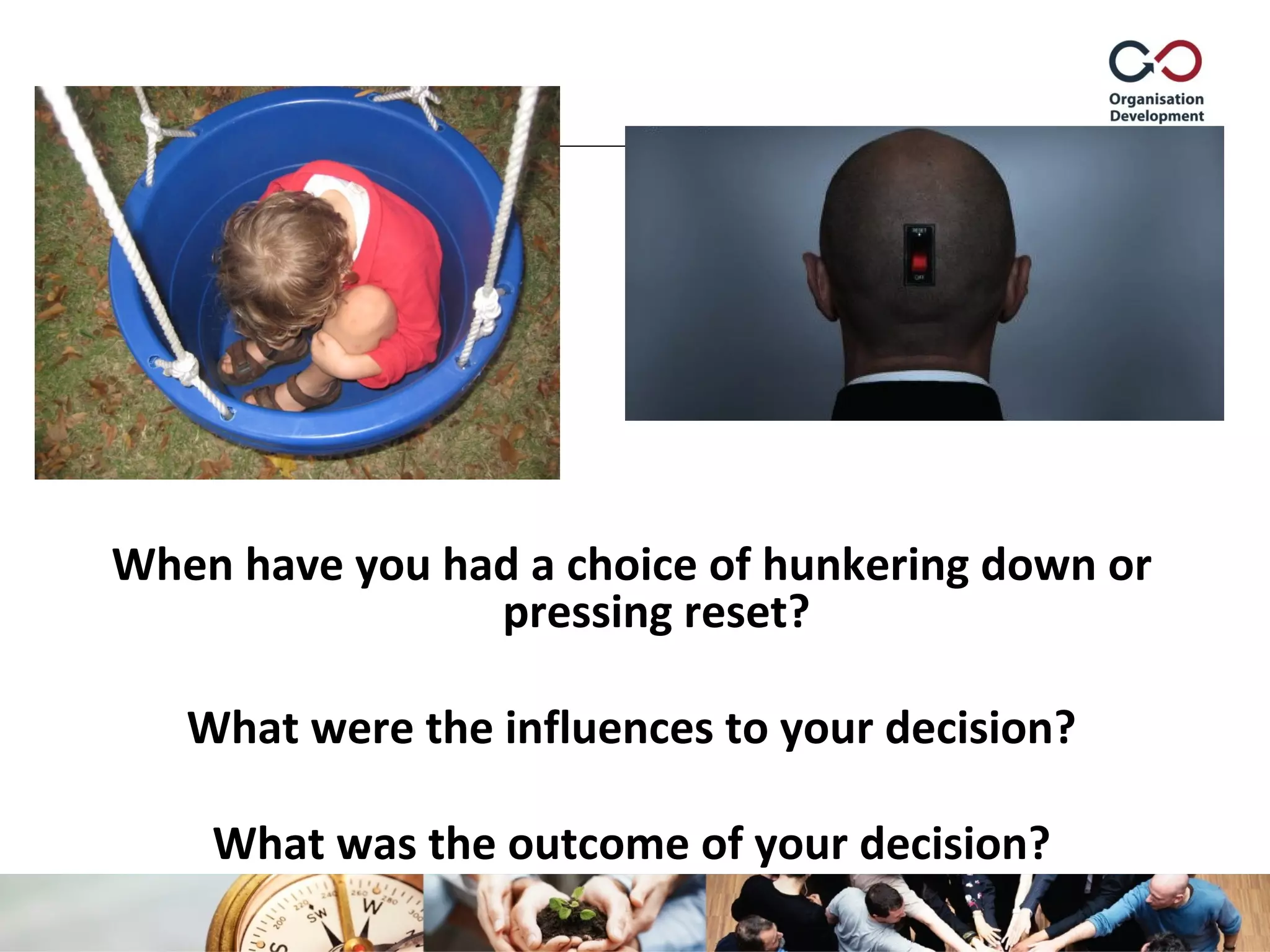
When have you had a choice of hunkering down or
pressing reset?
What were the influences to your decision?
What was the outcome of your decision?
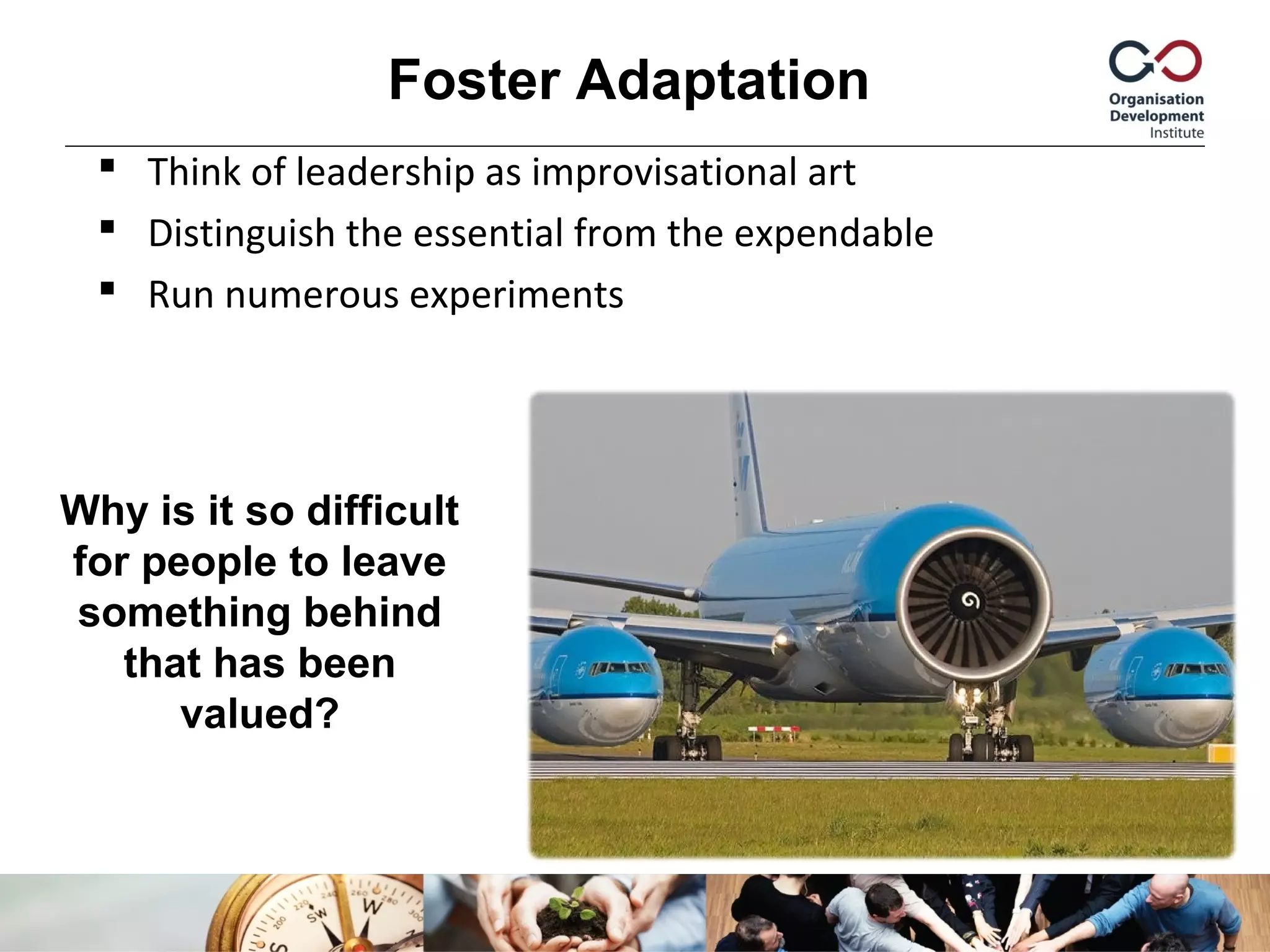
 Think of leadership as improvisational art
 Distinguish the essential from the expendable
 Run numerous experiments
Foster Adaptation
Why is it so difficult
for people to leave
something behind
that has been
valued?
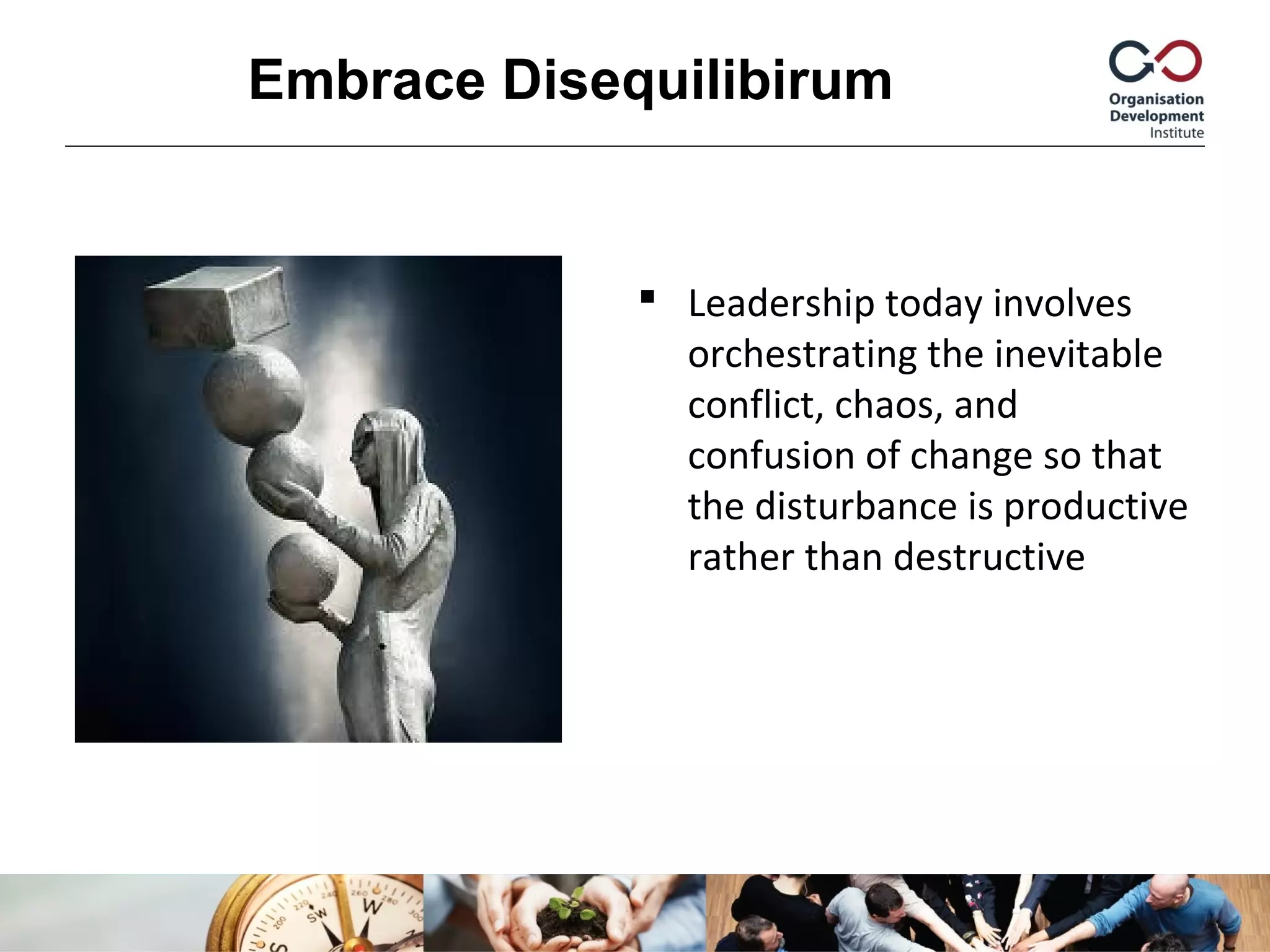
 Leadership today involves
orchestrating the inevitable
conflict, chaos, and
confusion of change so that
the disturbance is productive
rather than destructive
Embrace Disequilibirum
 Keep your eyes on the
thermostat
 Depersonalise conflict
 Have courageous conversations
Embrace Disequilibirum
What do you see as the challenges to
having courageous conversations?
 Acknowledge interdependence of people
 Use leadership to generate more leadership deep in
organisation - mobilise everyone to generate solutions
 Give up some authority and ownership
Generate Leadership
When have you had to give up some authority and
ownership to others in order to generate
leadership, and how did this feel?
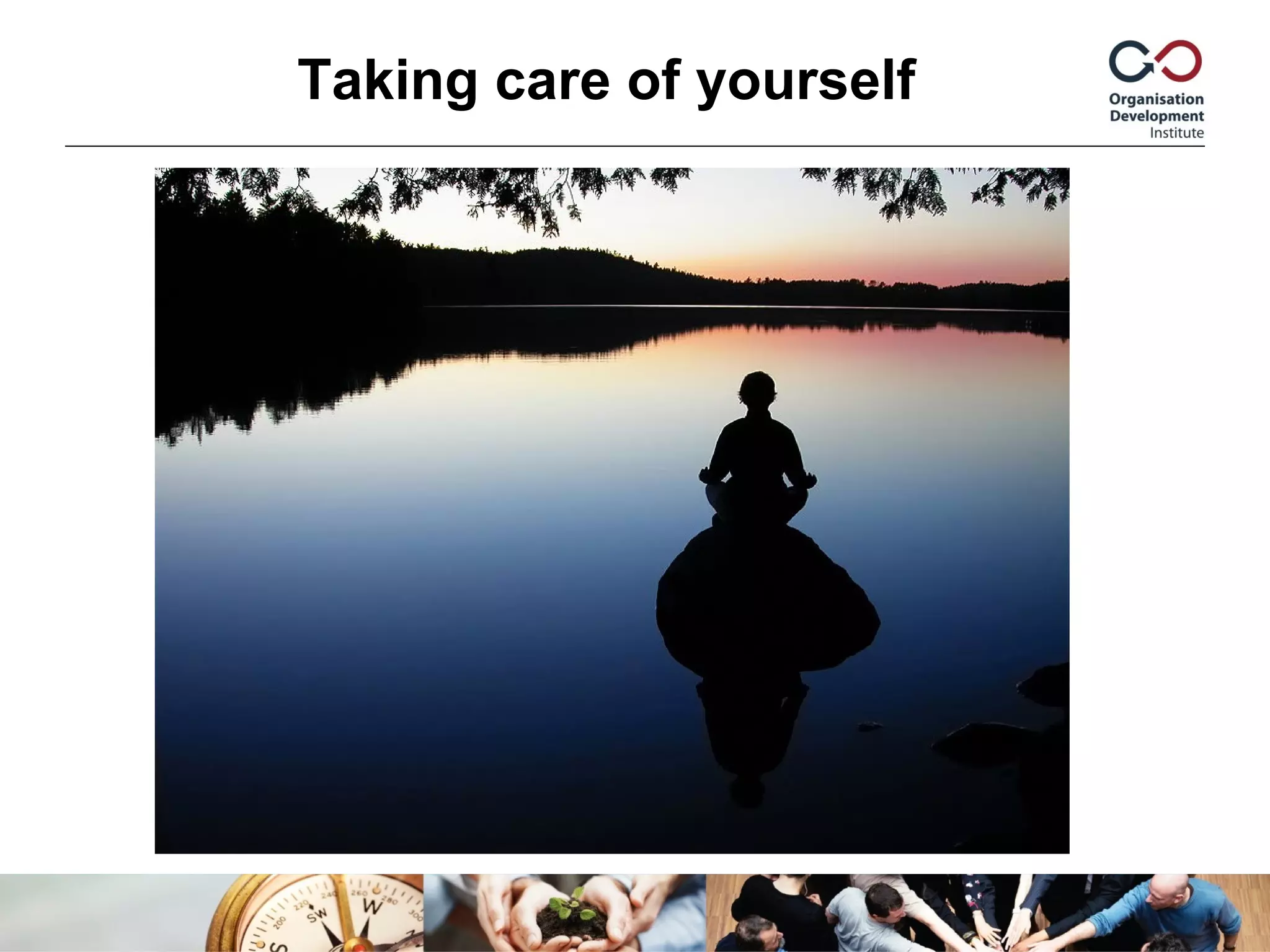
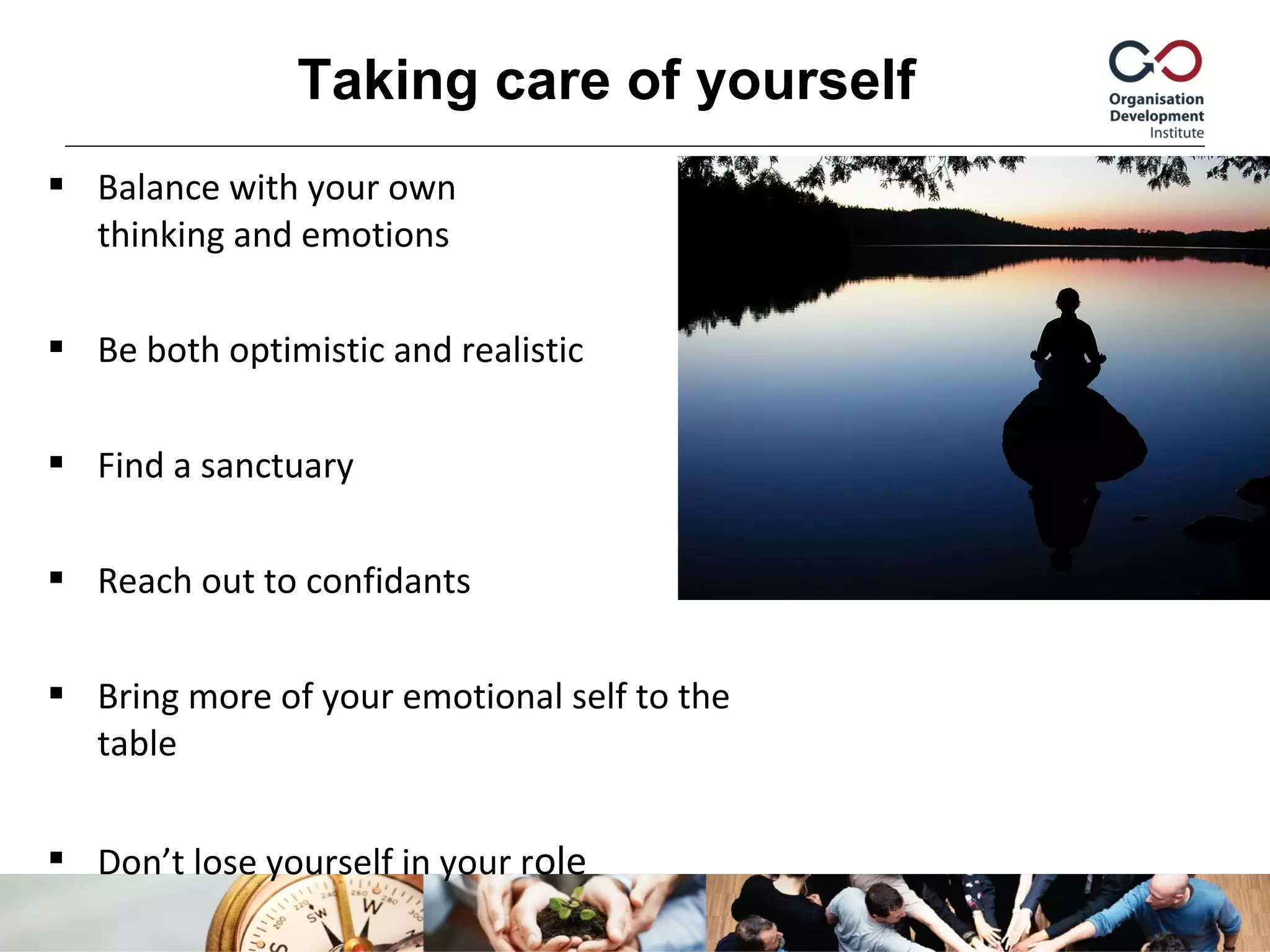
Taking care of yourself
 Balance with your own
thinking and emotions
 Be both optimistic and realistic
 Find a sanctuary
 Reach out to confidants
 Bring more of your emotional self to the
table
 Don’t lose yourself in your role
Taking care of yourself
Reflective Practice
The art of consciously and deliberately thinking things through,
while developing understanding of complex, real world
situations.
23
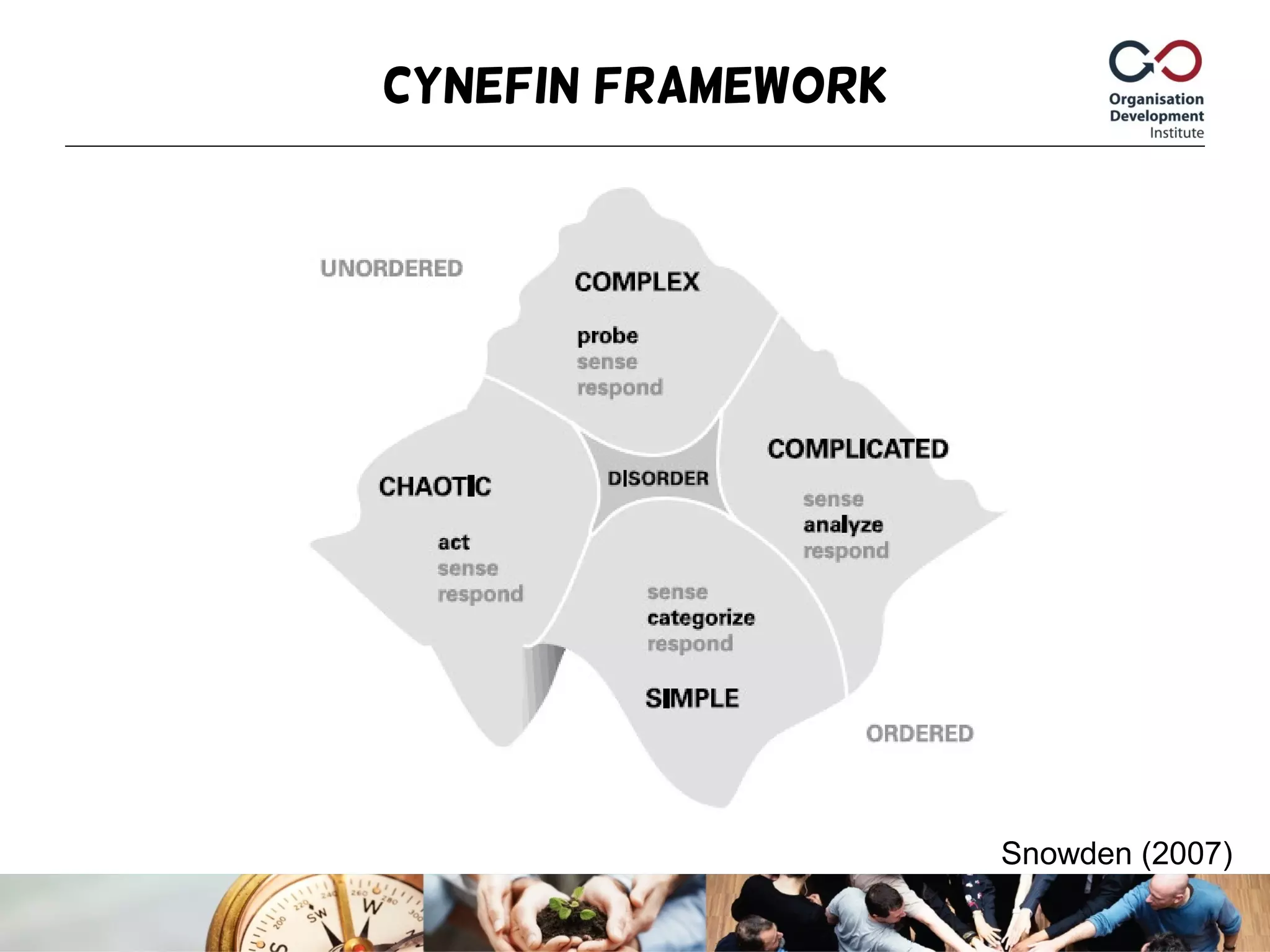
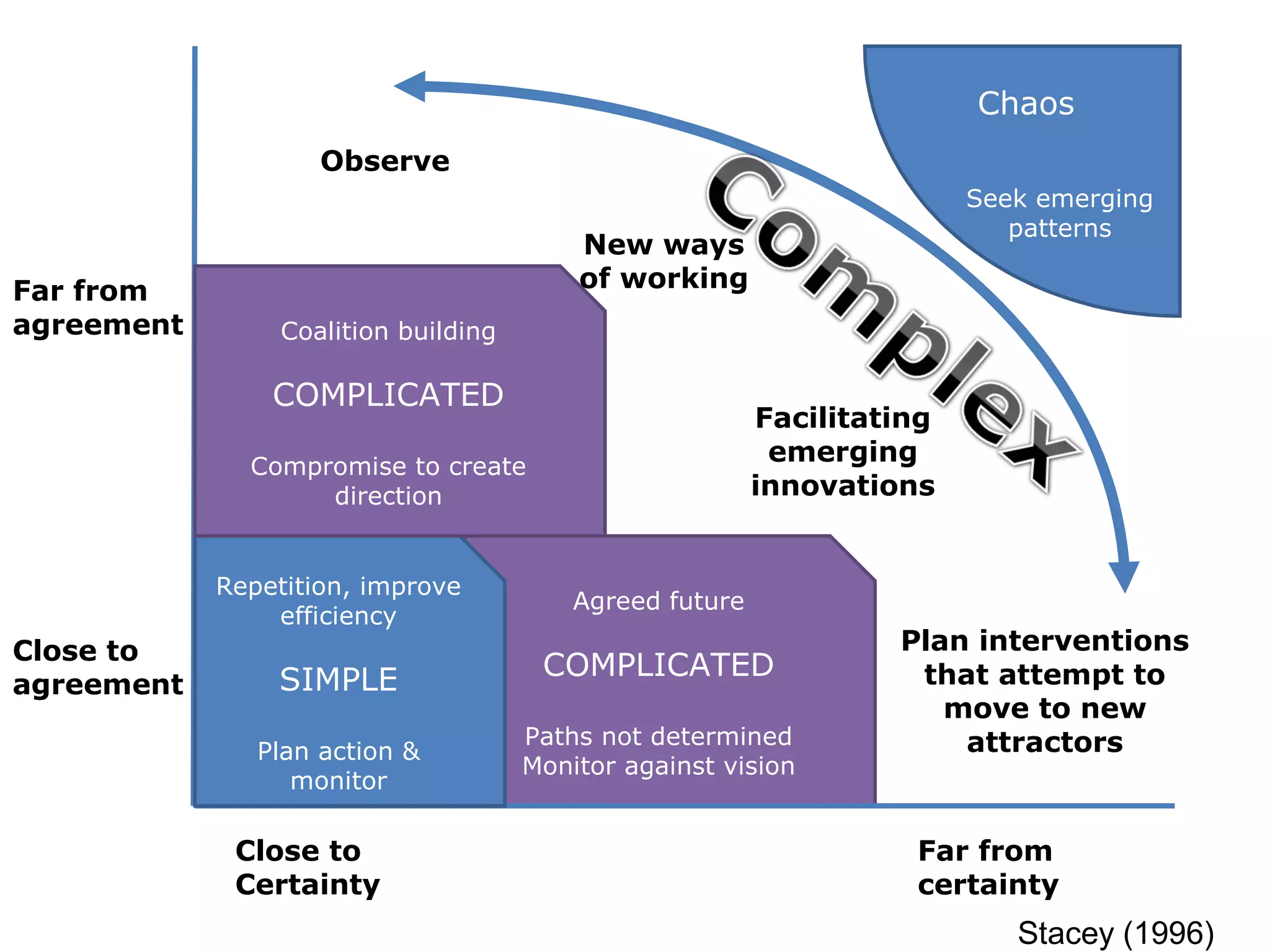
Cynefin Framework
Snowden (2007)
Far from
agreement
Close to
agreement
Agreed future
COMPLICATED
Paths not determined
Monitor against vision
Close to
Certainty
Far from
certainty
Repetition, improve
efficiency
SIMPLE
Plan action &
monitor
Coalition building
COMPLICATED
Compromise to create
direction
Chaos
Seek emerging
patterns
Observe
New ways
of working
Facilitating
emerging
innovations
Plan interventions
that attempt to
move to new
attractors
Stacey (1996)
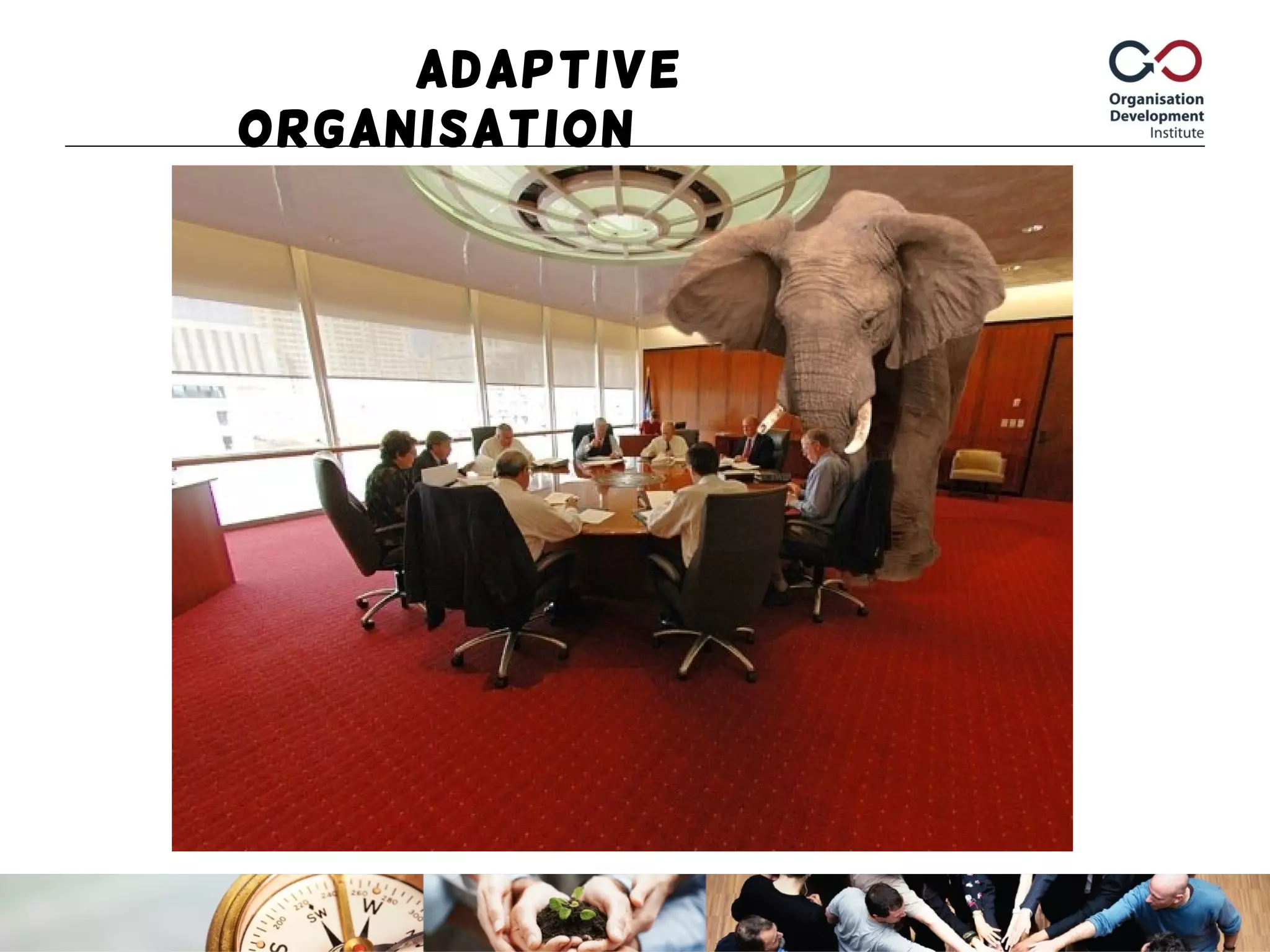
Adaptive
Organisation
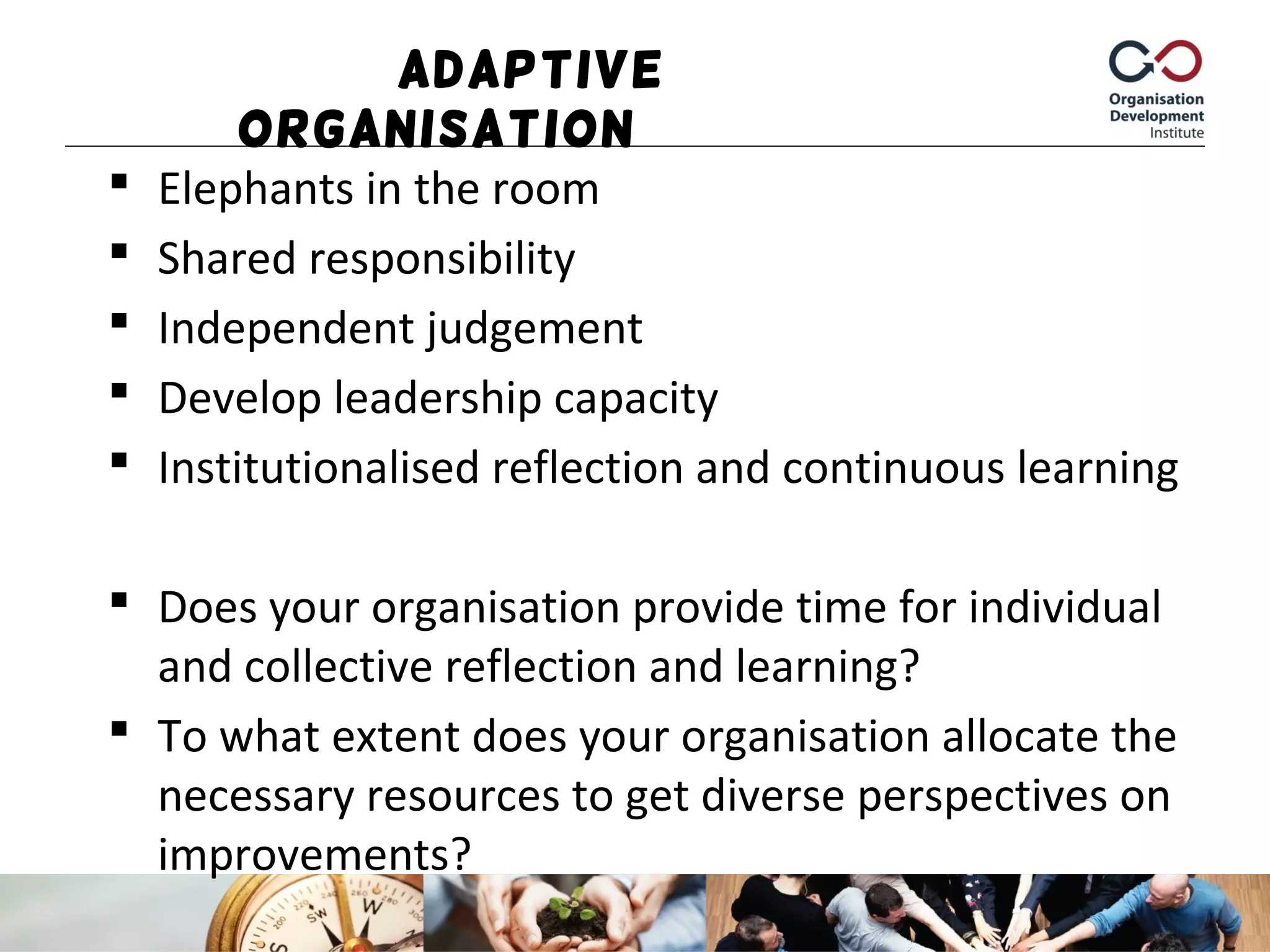
Adaptive
Organisation
 Elephants in the room
 Shared responsibility
 Independent judgement
 Develop leadership capacity
 Institutionalised reflection and continuous learning
 Does your organisation provide time for individual
and collective reflection and learning?
 To what extent does your organisation allocate the
necessary resources to get diverse perspectives on
improvements?
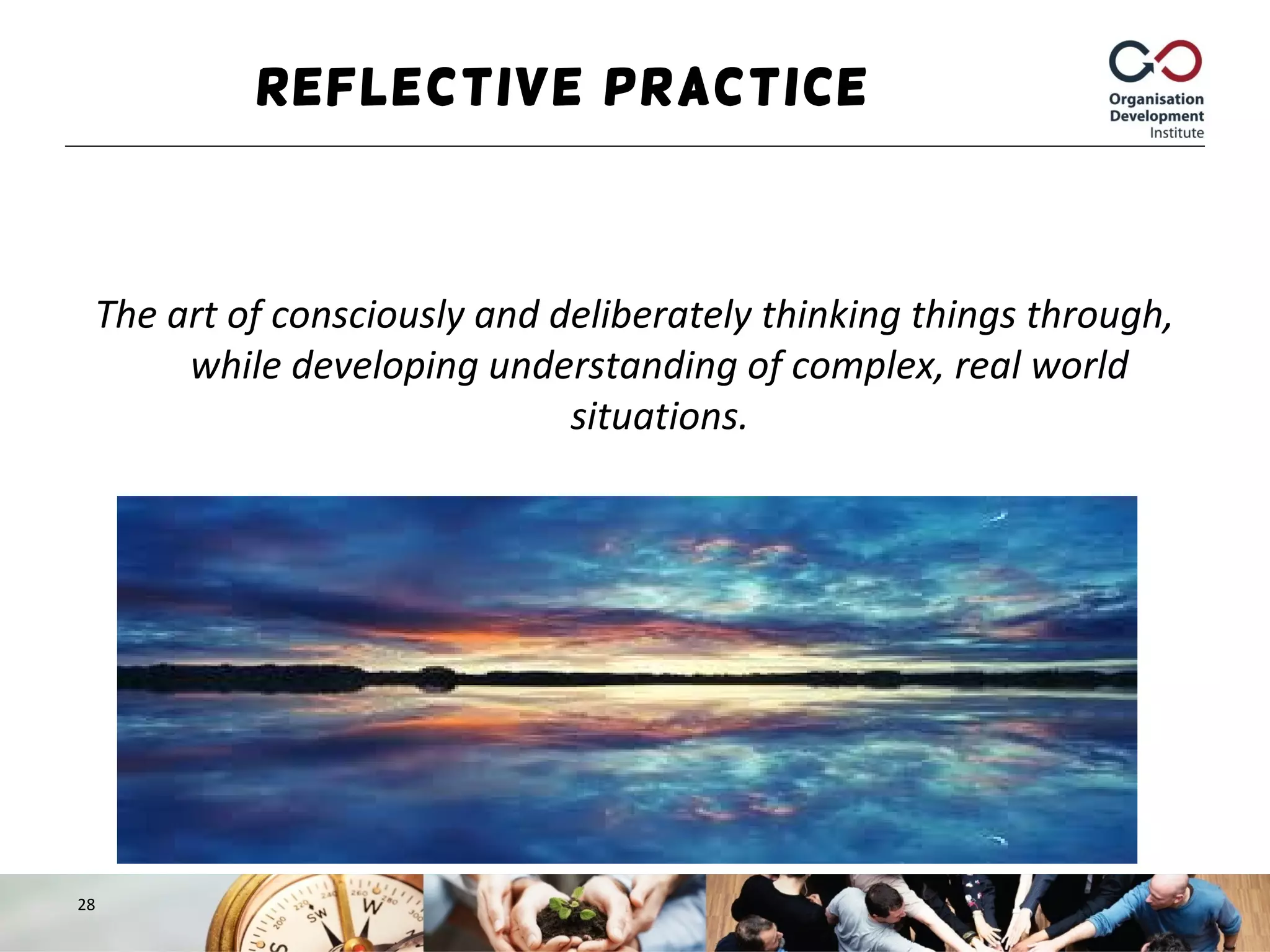
Reflective Practice
The art of consciously and deliberately thinking things through,
while developing understanding of complex, real world
situations.
28
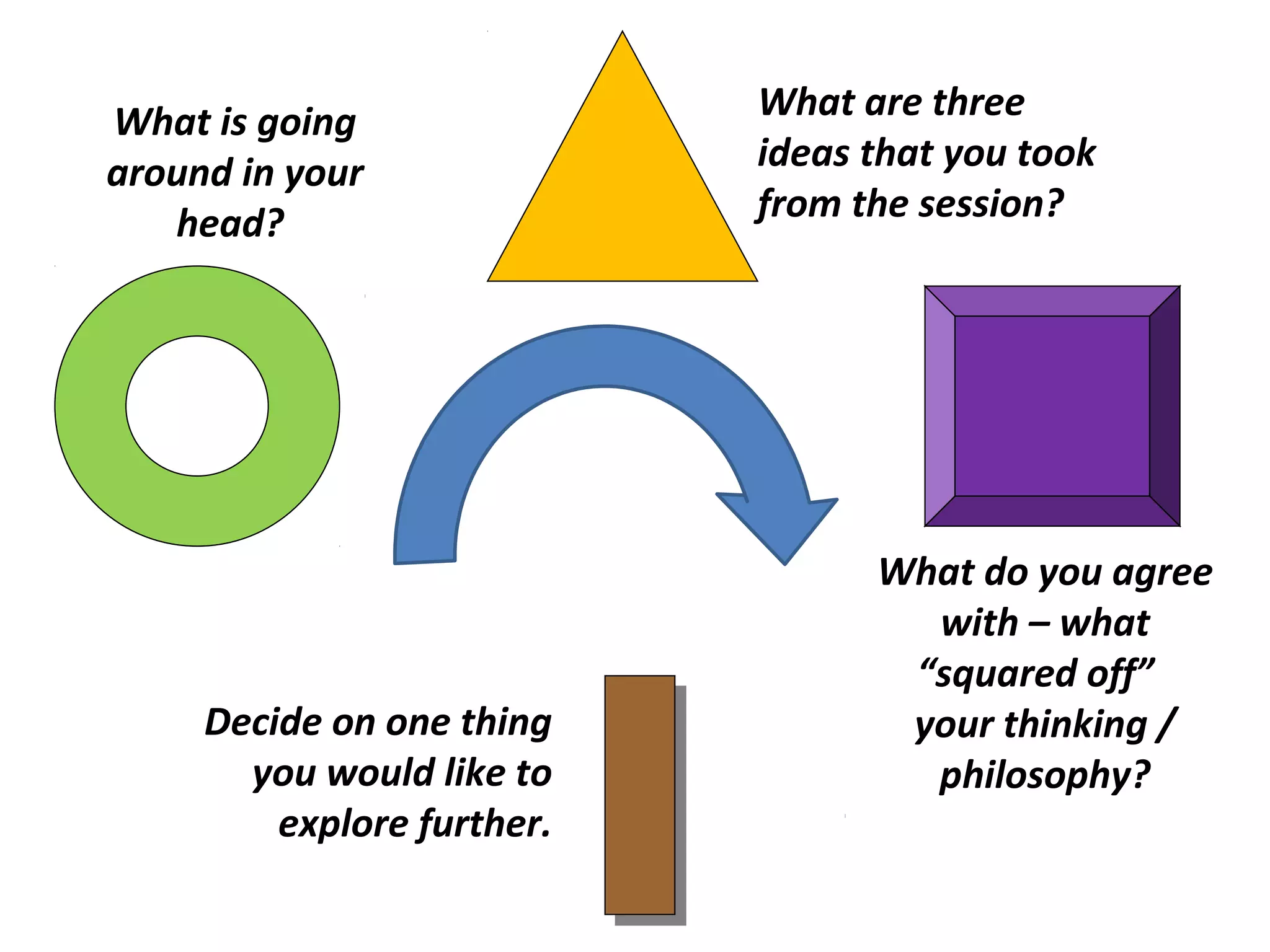
Decide on one thing
you would like to
explore further.
What is going
around in your
head?
What are three
ideas that you took
from the session?
What do you agree
with – what
“squared off”
your thinking /
philosophy?

RPL Masterclass(v2)

  • 1.
    Leadership Masterclass – ReflectivePractice for Leaders Craig McDowell October 2013
  • 2.
    Learning Outcomes Intentions fortoday:  Exploring what is reflective practice.  Sharing some useful concepts and practical tools to enable reflective skills.  In particular, addressing the leadership behaviours of Adaptability and Decision Making, on the ODI Leadership Competencies Framework, although there are links to Results Focus, and Vision and Strategy. 2
  • 3.
    Two Hungers In Africa,they say there are two hungers, the lesser hunger and the greater hunger. The lesser hunger is for the things that sustain life, the goods, the services, and the money to pay for them, which we all need. The greater hunger is for the answer to the question ”why”, for some understanding of what life is for. Handy (1997) 3
  • 4.
    Reflection Reflection is animportant human activity in which people recapture their experience, think about it, mull over and evaluate it. It is this working with experience that is important in learning. Boud (1985) Informal:  Involves self-questioning, develops our awareness of our own assumptions Formal:  Draws on research & theory, provides guidance & frameworks for practice 4
  • 5.
    Reflective Practice The artof consciously and deliberately thinking things through, while developing understanding of complex, real world situations. 5
  • 6.
    Model of Reflection– 5 stage model  We identify a problem that is perplexing & ‘felt’  We observe & refine the identified problem to create a fuller understanding  We develop a hypothesis or an understanding about the problem, its origins & possible solutions  We subject the hypothesis to scrutiny & reasoning  We test the hypothesis or understanding in practice. Dewey (1938) 6
  • 7.
    Model of Reflection– Reflection in Action  Reflection in action concerns thinking about something whilst engaged in doing it, having a feeling about something & practicing according to that feeling.  This model celebrates the intuitive & artistic approaches that can be brought to uncertain situations. Legitimises emotions. Schon (1983) 7
  • 8.
    Model of Reflection– Experiential Learning  Concrete experience: the event  Reflective observation: consider what has happened from a variety of perspectives e.g. own feelings, the group’s, another individual’s view  Abstract conceptualisation: re-package & process your reflections into a theoretical understanding (analysis)  Active experimentation: armed with this new understanding, you do it again, differently this time. Kolb (1984) 8
  • 9.
    Model of Reflection– Experiential Learning 9 Action Do Review Reflection Understand Theory Apply Great ideas Transfer
  • 10.
    Model of Reflection– Emotional Learning 10 Action Do Review Reflectio n Understand Theory Apply Great ideas Transfer I feel…. I want to feel….. Why? I can manage these feelings by…
  • 11.
    Barriers to Reflection Kolb sees that to reflect effectively on your experience, you should actively set aside time to reflect & analyse.  Psychological barriers include fear of judgement, fear of criticism, being closed to feedback, defensiveness, professional arrogance. 11
  • 12.
    Reflective Practice –Shifting Mind-Set 12 Mind-Set: patterns of thinking, mental models. When mind-set changes, everything above shifts Brown (2006) Events: reacting to events, problem solving Behaviours: noting patterns of behaviour Structures: attention to impact of structures, mechanisms & processes Increasing leverage
  • 13.
    Adaptive and Reflective Practice Reflective practice – the art of consciously and deliberately thinking things through, while developing understanding of complex, real world situations.  Adaptive Leadership: “The practice of mobilizing people to tackle tough challenges and thrive.” Heifetz(2009) 13
  • 14.
  • 15.
    Hunker down  Defaultto what you know how to do, weathering the storm  Protect yourself from external threats Press reset  Use turbulence to reshape the organisation, redefine the work people do  Process of conservation as well as reinvention Choices
  • 16.
    When have youhad a choice of hunkering down or pressing reset? What were the influences to your decision? What was the outcome of your decision?
  • 17.
     Think ofleadership as improvisational art  Distinguish the essential from the expendable  Run numerous experiments Foster Adaptation Why is it so difficult for people to leave something behind that has been valued?
  • 18.
     Leadership todayinvolves orchestrating the inevitable conflict, chaos, and confusion of change so that the disturbance is productive rather than destructive Embrace Disequilibirum
  • 19.
     Keep youreyes on the thermostat  Depersonalise conflict  Have courageous conversations Embrace Disequilibirum What do you see as the challenges to having courageous conversations?
  • 20.
     Acknowledge interdependenceof people  Use leadership to generate more leadership deep in organisation - mobilise everyone to generate solutions  Give up some authority and ownership Generate Leadership When have you had to give up some authority and ownership to others in order to generate leadership, and how did this feel?
  • 21.
  • 22.
     Balance withyour own thinking and emotions  Be both optimistic and realistic  Find a sanctuary  Reach out to confidants  Bring more of your emotional self to the table  Don’t lose yourself in your role Taking care of yourself
  • 23.
    Reflective Practice The artof consciously and deliberately thinking things through, while developing understanding of complex, real world situations. 23
  • 24.
  • 25.
    Far from agreement Close to agreement Agreedfuture COMPLICATED Paths not determined Monitor against vision Close to Certainty Far from certainty Repetition, improve efficiency SIMPLE Plan action & monitor Coalition building COMPLICATED Compromise to create direction Chaos Seek emerging patterns Observe New ways of working Facilitating emerging innovations Plan interventions that attempt to move to new attractors Stacey (1996)
  • 26.
  • 27.
    Adaptive Organisation  Elephants inthe room  Shared responsibility  Independent judgement  Develop leadership capacity  Institutionalised reflection and continuous learning  Does your organisation provide time for individual and collective reflection and learning?  To what extent does your organisation allocate the necessary resources to get diverse perspectives on improvements?
  • 28.
    Reflective Practice The artof consciously and deliberately thinking things through, while developing understanding of complex, real world situations. 28
  • 29.
    Decide on onething you would like to explore further. What is going around in your head? What are three ideas that you took from the session? What do you agree with – what “squared off” your thinking / philosophy?