Potential Pathological
& Molecular Mechanisms of TMJ Arthiritis
A NARRATIVE REVIEW
BY
HANG JUAN, MU XING-TONG, ZHANG XU, LI CHANG-YI,
JOURNAL OF DENTAL SCIENCES, VOLUME 18, ISSUE 3, 2023
PAGES 959-971,
WHY I CHOSE THIS ARTICLE?
• Relevant to the Course
• Potential future research project
• Area of interest
• Research gap
BACKGROUND
TMJ OA is a progressive degenerative disease in the temporomandibular joint
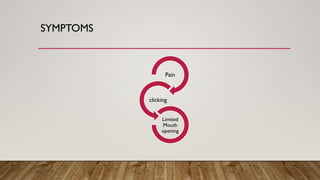
SYMPTOMS
Pain
clicking
Limited
Mouth
opening
EPIDEMIOLOGY
• 30% of the Chinese population
• 14.56% imaging lesions on the articular surface and bone tissue.
AETIOLOGY
• Aging
• Gender
• Mechanical stress
• Trauma
• Body Posture
• Psychological Stress
• Oral parafunctional habits
• Psychological Stress
AIM & OBJECTIVE
• Etiology and pathogenesis of TMJ OA is still not clear.
• Comprehensive Literature search regarding molecular mechanism and
pathogenesis of TMJ OA.
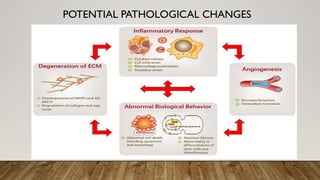
POTENTIAL PATHOLOGICAL CHANGES
INFLAMMATORY RESPONSES
RESEARCH GAP
• Studies on genetic factors of TMJ OA can undoubtedly contribute to predicting
susceptibility, making a precise diagnosis, and tailoring therapeutic procedures for
patients.
CONCLUSION
• Though in-vivo and in-vitro animal models of TMJ OA have been successfully established
in various ways, it is urgent to develop models closer to human TMJ OA.
• New medicine, materials, and approaches for treatingTMJ OA needs investigations.
• The role of genetic factors in TMJ OA still need further investigation.

Pathological pathways in TMJ Osteoarthritis.pptx

  • 1.
    Potential Pathological & MolecularMechanisms of TMJ Arthiritis A NARRATIVE REVIEW BY HANG JUAN, MU XING-TONG, ZHANG XU, LI CHANG-YI, JOURNAL OF DENTAL SCIENCES, VOLUME 18, ISSUE 3, 2023 PAGES 959-971,
  • 2.
    WHY I CHOSETHIS ARTICLE? • Relevant to the Course • Potential future research project • Area of interest • Research gap
  • 3.
    BACKGROUND TMJ OA isa progressive degenerative disease in the temporomandibular joint
  • 4.
  • 5.
    EPIDEMIOLOGY • 30% ofthe Chinese population • 14.56% imaging lesions on the articular surface and bone tissue.
  • 6.
    AETIOLOGY • Aging • Gender •Mechanical stress • Trauma • Body Posture • Psychological Stress • Oral parafunctional habits • Psychological Stress
  • 7.
    AIM & OBJECTIVE •Etiology and pathogenesis of TMJ OA is still not clear. • Comprehensive Literature search regarding molecular mechanism and pathogenesis of TMJ OA.
  • 8.
  • 9.
  • 10.
    RESEARCH GAP • Studieson genetic factors of TMJ OA can undoubtedly contribute to predicting susceptibility, making a precise diagnosis, and tailoring therapeutic procedures for patients.
  • 11.
    CONCLUSION • Though in-vivoand in-vitro animal models of TMJ OA have been successfully established in various ways, it is urgent to develop models closer to human TMJ OA. • New medicine, materials, and approaches for treatingTMJ OA needs investigations. • The role of genetic factors in TMJ OA still need further investigation.

Editor's Notes

  • #7 Unfortunately, due to the ambiguity of etiology and path- ogenesis, current conservative therapeutic approaches for TMJ OA seem ineffective for curing this long-lasting dis- ease, Moreover, TMJ OA may finally lead to limitation of jaw movement, and even orofacial deformity in adoles- cences, which burdens patients’ lives and social economy.