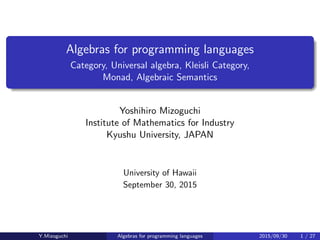
Algebras for programming languages
Category, Universal algebra, Kleisli Category,
Monad, Algebraic Semantics
Yoshihiro Mizoguchi
Institute of Mathematics for Industry
Kyushu University, JAPAN
University of Hawaii
September 30, 2015
Y.Mizoguchi Algebras for programming languages 2015/09/30 1 / 27
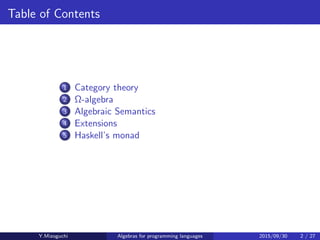
Table of Contents
1 Category theory
2 Ω-algebra
3 Algebraic Semantics
4 Extensions
5 Haskell’s monad
Y.Mizoguchi Algebras for programming languages 2015/09/30 2 / 27
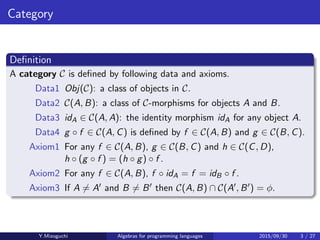
Category
Definition
A category C is defined by the following data and axioms.
Datum1 Obj(C): a class of objects in C.
Datum2 C(A, B): a class of C-morphisms for objects A and B.
Datum3 idA ∈ C(A, A): the identity morphism idA for any object A.
Datum4 g · f ∈ C(A, C) is defined by f ∈ C(A, B) and g ∈ C(B, C).
Axiom1 For any f ∈ C(A, B), g ∈ C(B, C) and h ∈ C(C, D),
h · (g · f ) = (h · g) · f .
Axiom2 For any f ∈ C(A, B), f · idA = f = idB · f .
Axiom3 If A ̸= A′ and B ̸= B′ then C(A, B) ∩ C(A′, B′) = ϕ.
Y.Mizoguchi Algebras for programming languages 2015/09/30 3 / 27
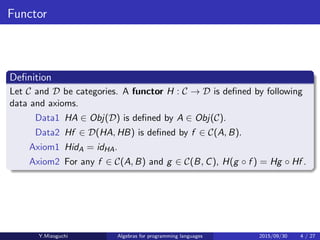
Functor
Definition
Let C and D be categories. A functor H : C → D is defined by the
following data and axioms.
Datum1 HA ∈ Obj(D) is defined by A ∈ Obj(C).
Datum2 Hf ∈ D(HA, HB) is defined by f ∈ C(A, B).
Axiom1 HidA = idHA.
Axiom2 For any f ∈ C(A, B) and g ∈ C(B, C), H(g · f ) = Hg · Hf .
Y.Mizoguchi Algebras for programming languages 2015/09/30 4 / 27
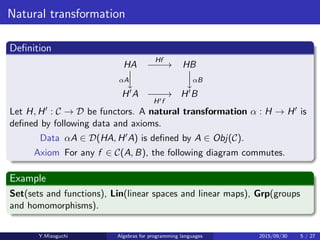
Natural transformation
Definition
HA
Hf
−−−→ HB

αA


αB
H′A −−−→
H′f
H′B
Let H, H′ : C → D be functors. A natural transformation α : H → H′ is
defined by the following datum and axiom.
Datum αA ∈ D(HA, H′A) is defined by A ∈ Obj(C).
Axiom For any f ∈ C(A, B), the following diagram commutes.
Example
Set(sets and functions), Lin(linear spaces and linear maps), Grp(groups
and homomorphisms).
Y.Mizoguchi Algebras for programming languages 2015/09/30 5 / 27
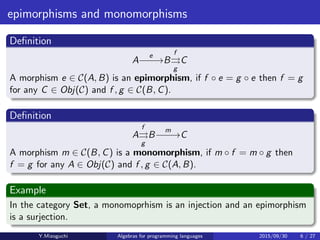
epimorphisms and monomorphisms
Definition
A
e
−−−→B
f
⇒
g
C
A morphism e ∈ C(A, B) is an epimorphism, if f · e = g · e then f = g for
any C ∈ Obj(C) and f , g ∈ C(B, C).
Definition
A
f
⇒
g
B
m
−−−→C
A morphism m ∈ C(B, C) is a monomorphism, if m · f = m · g then
f = g for any A ∈ Obj(C) and f , g ∈ C(A, B).
Example
In the category Set, a monomoprhism is an injection and an epimorphism
is a surjection.
Y.Mizoguchi Algebras for programming languages 2015/09/30 6 / 27
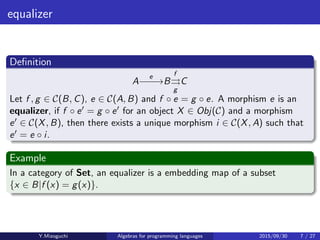
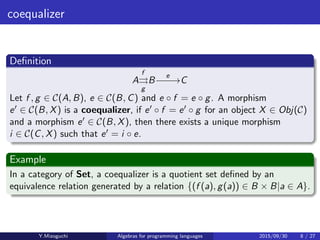
equalizer
Definition
A
e
−−−→B
f
⇒
g
C
Let f , g ∈ C(B, C), e ∈ C(A, B) and f · e = g · e. A morphism e is an
equalizer, if f · e′ = g · e′ for an object X ∈ Obj(C) and a morphism
e′ ∈ C(X, B), then there exists a unique morphism i ∈ C(X, A) such that
e′ = e · i.
Example
In a category of Set, an equalizer is a embedding map of a subset
{x ∈ B|f (x) = g(x)}.
Y.Mizoguchi Algebras for programming languages 2015/09/30 7 / 27
coequalizer
Definition
A
f
⇒
g
B
e
−−−→C
Let f , g ∈ C(A, B), e ∈ C(B, C) and e · f = e · g. A morphism
e′ ∈ C(B, X) is a coequalizer, if e′ · f = e′ · g for an object X ∈ Obj(C)
and a morphism e′ ∈ C(B, X), then there exists a unique morphism
i ∈ C(C, X) such that e′ = i · e.
Example
In a category of Set, a coequalizer is a quotient set defined by an
equivalence relation generated by a relation {(f (a), g(a)) ∈ B × B|a ∈ A}.
Y.Mizoguchi Algebras for programming languages 2015/09/30 8 / 27
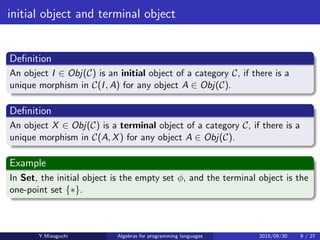
initial object and terminal object
Definition
An object I ∈ Obj(C) is an initial object of a category C, if there is a
unique morphism in C(I, A) for any object A ∈ Obj(C).
Definition
An object X ∈ Obj(C) is a terminal object of a category C, if there is a
unique morphism in C(A, X) for any object A ∈ Obj(C).
Example
In Set, the initial object is the empty set ϕ, and the terminal object is the
one-point set {∗}.
Y.Mizoguchi Algebras for programming languages 2015/09/30 9 / 27
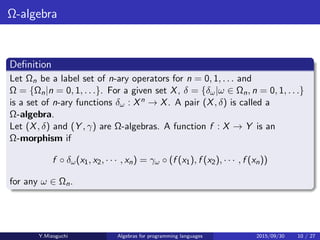
Ω-algebra
Definition
Let Ωn be a label set of n-ary operators for n = 0, 1, . . . and
Ω = {Ωn|n = 0, 1, . . .}. For a given set X, δ = {δω|ω ∈ Ωn, n = 0, 1, . . .}
is a set of n-ary functions δω : Xn → X. A pair (X, δ) is called a
Ω-algebra.
Let (X, δ) and (Y , γ) are Ω-algebras. A function f : X → Y is an
Ω-morphism if
f · δω(x1, x2, · · · , xn) = γω(f (x1), f (x2), · · · , f (xn))
for any ω ∈ Ωn.
Y.Mizoguchi Algebras for programming languages 2015/09/30 10 / 27
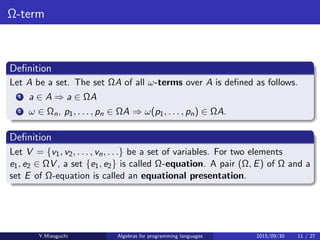
Ω-term
Definition
Let A be a set. The set ΩA of all ω-terms over A is defined as follows.
1 a ∈ A ⇒ a ∈ ΩA
2 ω ∈ Ωn, p1, . . . , pn ∈ ΩA ⇒ ω(p1, . . . , pn) ∈ ΩA.
Definition
Let V = {v1, v2, . . . , vn, . . .} be a set of variables. For two elements
e1, e2 ∈ ΩV , a set {e1, e2} is called Ω-equation. A pair (Ω, E) of Ω and a
set E of Ω-equation is called an equational presentation.
Y.Mizoguchi Algebras for programming languages 2015/09/30 11 / 27
Example
Example
Let m(multiple), i(inverse) and e(unit) be labels of operators. Let
Ω0 = {e}, Ω1 = {i}, Ω2 = {m} and E = {{m(v1, m(v2, v3)),
m(m(v1, v2), v3)}, {m(v1, e), v1}, {m(e, v1), v1}, {m(v1, i(v1), e},
{m(i(v1), v1), e}}. Then a group X can be considered as an Ω-algebra.
Example
For a division function d(x, y) = m(x, i(y)) in a group, we define
Ω2 = {d} and
E = {{d(x, d(d(d(d(x, x), y), z), d(d(d(x, x), x), z))), y}}.
Then an (Ω,E)-algebra can be considered as a group[1].
Y.Mizoguchi Algebras for programming languages 2015/09/30 12 / 27
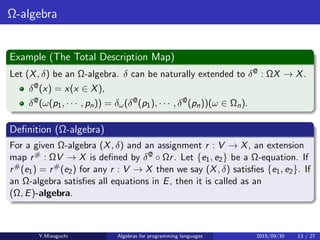
Ω-algebra
Example (The Total Description Map)
Let (X, δ) be an Ω-algebra. δ can be naturally extended to δ@ : ΩX → X.
δ@(x) = x(x ∈ X),
δ@(ω(p1, · · · , pn)) = δω(δ@(p1), · · · , δ@(pn))(ω ∈ Ωn).
Definition (Ω-algebra)
For a given Ω-algebra (X, δ) and an assignment r : V → X, an extension
map r# : ΩV → X is defined by δ@ · Ωr. Let {e1, e2} be a Ω-equation. If
r#(e1) = r#(e2) for any r : V → X then we say (X, δ) satisfies {e1, e2}. If
an Ω-algebra satisfies all equations in E, then it is called as an
(Ω, E)-algebra.
Y.Mizoguchi Algebras for programming languages 2015/09/30 13 / 27
Ω-morphism
Definition
For a given set A, we define an equivalence relation EA over ΩA by
EA = {(p, q)|∀(X, δ) : Ω − algebra, ∀f : A → X, f #
(p) = f #
(q)}.
We denote a quotient set of ΩA by an equivalence relation EA as
TA = ΩA/EA. We denote an equivalence class including p ∈ ΩA as
ρA(p) = [p]. Then ρA : ΩA → TA.
Proposition
Let ωn ∈ Ωn, ωn([p1], · · · , [pn]) = [ωn(p1, · · · , pn)] and
ω = {ωn|n = 0, 1, . . .}. An Ω-algebra (TA, ω) is an (Ω, E)-algebra and
ρA : ΩA → TA is an Ω-morphism.
Y.Mizoguchi Algebras for programming languages 2015/09/30 14 / 27
(Ω, E)-algebra (1)
Definition
We denote (TA, ω) as TA and it is called a free (Ω, E)-algebra over A.
Proposition (The Universal Property of TA)
A function ηA : A → TA is defined by ηA(a) = [a]. For any (Ω, E)-algebra
(X, δ) and a function f : A → X, there exists a unique Ω-morphism
f ## : TA → (X, δ) of f such that f ## · ηA = f .
Y.Mizoguchi Algebras for programming languages 2015/09/30 15 / 27
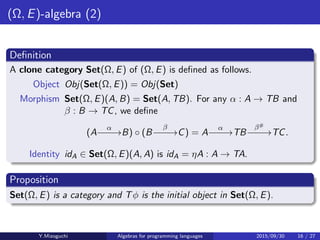
(Ω, E)-algebra (2)
Definition
A clone category Set(Ω, E) of (Ω, E) is defined as follows.
Object Obj(Set(Ω, E)) = Obj(Set)
Morphism Set(Ω, E)(A, B) = Set(A, TB). For any α : A → TB and
β : B → TC, we define
(A
α
−−−→B) ◦ (B
β
−−−→C) = A
α
−−−→TB
β#
−−−→TC.
Identity idA ∈ Set(Ω, E)(A, A) is idA = ηA : A → TA.
Proposition
Set(Ω, E) is a category and Tϕ is the initial object in Set(Ω, E).
Y.Mizoguchi Algebras for programming languages 2015/09/30 16 / 27
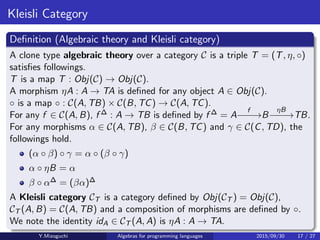
Kleisli Category
Definition (Algebraic theory and Kleisli category)
A clone type algebraic theory over a category C is a triple T = (T, η, ◦)
satisfies followings.
T is a map T : Obj(C) → Obj(C).
A morphism ηA : A → TA is defined for any object A ∈ Obj(C).
◦ is a map ◦ : C(A, TB) × C(B, TC) → C(A, TC).
For any f ∈ C(A, B), f ∆ : A → TB is defined by f ∆ = A
f
−−−→B
ηB
−−−→TB.
For any morphisms α ∈ C(A, TB), β ∈ C(B, TC) and γ ∈ C(C, TD), the
followings hold.
(α ◦ β) ◦ γ = α ◦ (β ◦ γ)
α ◦ ηB = α
β ◦ α∆ = (βα)∆
A Kleisli category CT is a category defined by Obj(CT ) = Obj(C),
CT (A, B) = C(A, TB) and a composition of morphisms are defined by ◦.
We note the identity idA ∈ CT (A, A) is ηA : A → TA.
Y.Mizoguchi Algebras for programming languages 2015/09/30 17 / 27
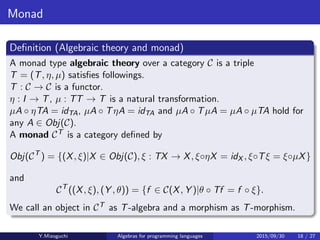
Monad
Definition (Algebraic theory and monad)
A monad type algebraic theory over a category C is a triple
T = (T, η, µ) satisfies followings.
T : C → C is a functor.
η : I → T, µ : TT → T is a natural transformation.
µA · ηTA = idTA, µA · TηA = idTA and µA · TµA = µA · µTA hold for any
A ∈ Obj(C).
A category CT of T-algebra and T-homomorphisms is defined by
Obj(CT
) = {(X, ξ) | X ∈ Obj(C), ξ : TX → X, ξ·ηX = idX , ξ·Tξ = ξ·µX}
and
CT
((X, ξ), (Y , θ)) = {f ∈ C(X, Y ) | θ · Tf = f · ξ}.
We call an object in CT as T-algebra and a morphism as
T-homomorphism.
Y.Mizoguchi Algebras for programming languages 2015/09/30 18 / 27
Monad and Kleisli category
Theorem ([3])
There exists a bijective correspondence between a clone type algebraic
theory T = (T, η, ◦) and a monad type algebraic theory T = (T, η, µ).
Theorem
A category of (Ω, E)-algebra is isomorphic to a category of SetT
defined
by its algebraic theory T = (T, η, ◦).
Y.Mizoguchi Algebras for programming languages 2015/09/30 19 / 27
Algebraic Semantics
For (Ω, E), we define the following axioms and inference rules.
Axiom1 (Ω, E) ⊢ t = t
Axiom2 (Ω, E) ⊢ s = t ({s, t} ∈ E)
Assignment
(Ω, E) ⊢ s = t
(Ω, E) ⊢ s[x1 := t1, · · · , xn := tn] = t[x1 := t1, · · · , xn := tn]
Replacement
(Ω, E) ⊢ s1 = t1, · · · , (Ω, E) ⊢ sn = tn
(Ω, E) ⊢ f (s1, · · · , sn) = f (t1, · · · , tn)
Exchange
(Ω, E) ⊢ s = t
(Ω, E) ⊢ t = s
Associative
(Ω, E) ⊢ t1 = t2, (Ω, E) ⊢ t2 = t3,
(Ω, E) ⊢ t1 = t3
Y.Mizoguchi Algebras for programming languages 2015/09/30 20 / 27
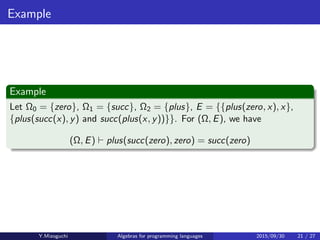
Example
Example
Let Ω0 = {zero}, Ω1 = {succ}, Ω2 = {plus}, E = {{plus(zero, x), x},
{plus(succ(x), y) and succ(plus(x, y))}}. For (Ω, E), we have
(Ω, E) ⊢ plus(succ(zero), zero) = succ(zero)
Y.Mizoguchi Algebras for programming languages 2015/09/30 21 / 27
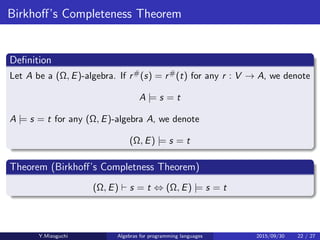
Birkhoff’s Completeness Theorem
Definition
Let A be a (Ω, E)-algebra. If r#(s) = r#(t) for any r : V → A, we denote
A |= s = t
A |= s = t for any (Ω, E)-algebra A, we denote
(Ω, E) |= s = t
Theorem (Birkhoff’s Completness Theorem)
(Ω, E) ⊢ s = t ⇔ (Ω, E) |= s = t
Y.Mizoguchi Algebras for programming languages 2015/09/30 22 / 27
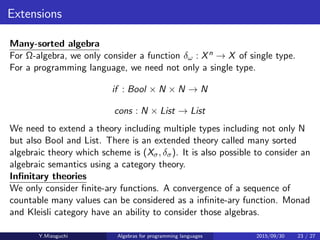
Extensions
Many-sorted algebra
For Ω-algebra, we only consider a function δω : Xn → X of single type.
For a programming language, we need not only a single type.
if : Bool × N × N → N
cons : N × List → List
We need to extend a theory including multiple types including not only N
but also Bool and List. There is an extended theory called many sorted
algebraic theory which scheme is (Xσ, δσ). It is also possible to consider an
algebraic semantics using a category theory.
Infinitary theories
We only consider finite-ary functions. A convergence of a sequence of
countable many values can be considered as an infinite-ary function.
Monad and Kleisli category have an ability to consider those algebras.
Y.Mizoguchi Algebras for programming languages 2015/09/30 23 / 27
Haskell’s monad (1)
Let Set be the category of sets and functions.
Let List be the category of free monoids and homomorphisms.
Let A = Integer (the set of all integers).
Let F : Set → List be a functor creating a free monoid.
We note 1, 2, 3 ∈ A and [1, 2, 3] ∈ FA.
For f : A → B we define Ff : FA → FB as Ff = (map f ).
Ff[1,2,3] = (map f [1,2,3]) = [f(1),f(2),f(3)]
concat : FFA → FA is a natural transfromation.
concat[[1, 2], [3], [4, 5, 6]] = [1, 2, 3, 4, 5, 6]
return : A → FA is a natural transformation.
return x = [x]
Y.Mizoguchi Algebras for programming languages 2015/09/30 24 / 27
Haskell’s monad (2)
Haskell’s monad is constructed by a triple (F, return, >>=).
F : Obj(Set) → Obj(Set).
return : A → FA (for A ∈ Obj(Set))
>>=: Set(A, FA) → Set(FA, FB)
We denote >>= (f )(la) as l >>= f .
la >>= f is defined as (concat (map f la)).
[1, 2, 3] >>= (λ x.[x, 2x])
= concat (map (λ x.[x, 2x]) [1, 2, 3])
= concat [[1, 2], [2, 4], [3, 6]]
= [1, 2, 2, 4, 3, 6]
Y.Mizoguchi Algebras for programming languages 2015/09/30 25 / 27
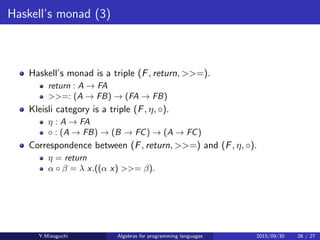
Haskell’s monad (3)
Haskell’s monad is a triple (F, return, >>=).
return : A → FA
>>=: (A → FB) → (FA → FB)
Kleisli category is a triple (F, η, ◦).
η : A → FA
◦ : (A → FB) × (B → FC) → (A → FC)
Correspondence between (F, return, >>=) and (F, η, ◦).
η = return
α ◦ β = λ x.((α x) >>= β).
Y.Mizoguchi Algebras for programming languages 2015/09/30 26 / 27
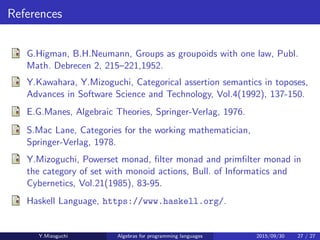
References
G.Higman, B.H.Neumann, Groups as groupoids with one law, Publ.
Math. Debrecen 2, 215–221,1952.
Y.Kawahara, Y.Mizoguchi, Categorical assertion semantics in toposes,
Advances in Software Science and Technology, Vol.4(1992), 137-150.
E.G.Manes, Algebraic Theories, Springer-Verlag, 1976.
S.Mac Lane, Categories for the working mathematician,
Springer-Verlag, 1978.
Y.Mizoguchi, Powerset monad, filter monad and primfilter monad in
the category of set with monoid actions, Bull. of Informatics and
Cybernetics, Vol.21(1985), 83-95.
Haskell Language, https://www.haskell.org/.
Y.Mizoguchi Algebras for programming languages 2015/09/30 27 / 27

Algebras for programming languages

  • 1.
    Algebras for programminglanguages Category, Universal algebra, Kleisli Category, Monad, Algebraic Semantics Yoshihiro Mizoguchi Institute of Mathematics for Industry Kyushu University, JAPAN University of Hawaii September 30, 2015 Y.Mizoguchi Algebras for programming languages 2015/09/30 1 / 27
  • 2.
    Table of Contents 1Category theory 2 Ω-algebra 3 Algebraic Semantics 4 Extensions 5 Haskell’s monad Y.Mizoguchi Algebras for programming languages 2015/09/30 2 / 27
  • 3.
    Category Definition A category Cis defined by the following data and axioms. Datum1 Obj(C): a class of objects in C. Datum2 C(A, B): a class of C-morphisms for objects A and B. Datum3 idA ∈ C(A, A): the identity morphism idA for any object A. Datum4 g · f ∈ C(A, C) is defined by f ∈ C(A, B) and g ∈ C(B, C). Axiom1 For any f ∈ C(A, B), g ∈ C(B, C) and h ∈ C(C, D), h · (g · f ) = (h · g) · f . Axiom2 For any f ∈ C(A, B), f · idA = f = idB · f . Axiom3 If A ̸= A′ and B ̸= B′ then C(A, B) ∩ C(A′, B′) = ϕ. Y.Mizoguchi Algebras for programming languages 2015/09/30 3 / 27
  • 4.
    Functor Definition Let C andD be categories. A functor H : C → D is defined by the following data and axioms. Datum1 HA ∈ Obj(D) is defined by A ∈ Obj(C). Datum2 Hf ∈ D(HA, HB) is defined by f ∈ C(A, B). Axiom1 HidA = idHA. Axiom2 For any f ∈ C(A, B) and g ∈ C(B, C), H(g · f ) = Hg · Hf . Y.Mizoguchi Algebras for programming languages 2015/09/30 4 / 27
  • 5.
    Natural transformation Definition HA Hf −−−→ HB  αA   αB H′A−−−→ H′f H′B Let H, H′ : C → D be functors. A natural transformation α : H → H′ is defined by the following datum and axiom. Datum αA ∈ D(HA, H′A) is defined by A ∈ Obj(C). Axiom For any f ∈ C(A, B), the following diagram commutes. Example Set(sets and functions), Lin(linear spaces and linear maps), Grp(groups and homomorphisms). Y.Mizoguchi Algebras for programming languages 2015/09/30 5 / 27
  • 6.
    epimorphisms and monomorphisms Definition A e −−−→B f ⇒ g C Amorphism e ∈ C(A, B) is an epimorphism, if f · e = g · e then f = g for any C ∈ Obj(C) and f , g ∈ C(B, C). Definition A f ⇒ g B m −−−→C A morphism m ∈ C(B, C) is a monomorphism, if m · f = m · g then f = g for any A ∈ Obj(C) and f , g ∈ C(A, B). Example In the category Set, a monomoprhism is an injection and an epimorphism is a surjection. Y.Mizoguchi Algebras for programming languages 2015/09/30 6 / 27
  • 7.
    equalizer Definition A e −−−→B f ⇒ g C Let f ,g ∈ C(B, C), e ∈ C(A, B) and f · e = g · e. A morphism e is an equalizer, if f · e′ = g · e′ for an object X ∈ Obj(C) and a morphism e′ ∈ C(X, B), then there exists a unique morphism i ∈ C(X, A) such that e′ = e · i. Example In a category of Set, an equalizer is a embedding map of a subset {x ∈ B|f (x) = g(x)}. Y.Mizoguchi Algebras for programming languages 2015/09/30 7 / 27
  • 8.
    coequalizer Definition A f ⇒ g B e −−−→C Let f ,g ∈ C(A, B), e ∈ C(B, C) and e · f = e · g. A morphism e′ ∈ C(B, X) is a coequalizer, if e′ · f = e′ · g for an object X ∈ Obj(C) and a morphism e′ ∈ C(B, X), then there exists a unique morphism i ∈ C(C, X) such that e′ = i · e. Example In a category of Set, a coequalizer is a quotient set defined by an equivalence relation generated by a relation {(f (a), g(a)) ∈ B × B|a ∈ A}. Y.Mizoguchi Algebras for programming languages 2015/09/30 8 / 27
  • 9.
    initial object andterminal object Definition An object I ∈ Obj(C) is an initial object of a category C, if there is a unique morphism in C(I, A) for any object A ∈ Obj(C). Definition An object X ∈ Obj(C) is a terminal object of a category C, if there is a unique morphism in C(A, X) for any object A ∈ Obj(C). Example In Set, the initial object is the empty set ϕ, and the terminal object is the one-point set {∗}. Y.Mizoguchi Algebras for programming languages 2015/09/30 9 / 27
  • 10.
    Ω-algebra Definition Let Ωn bea label set of n-ary operators for n = 0, 1, . . . and Ω = {Ωn|n = 0, 1, . . .}. For a given set X, δ = {δω|ω ∈ Ωn, n = 0, 1, . . .} is a set of n-ary functions δω : Xn → X. A pair (X, δ) is called a Ω-algebra. Let (X, δ) and (Y , γ) are Ω-algebras. A function f : X → Y is an Ω-morphism if f · δω(x1, x2, · · · , xn) = γω(f (x1), f (x2), · · · , f (xn)) for any ω ∈ Ωn. Y.Mizoguchi Algebras for programming languages 2015/09/30 10 / 27
  • 11.
    Ω-term Definition Let A bea set. The set ΩA of all ω-terms over A is defined as follows. 1 a ∈ A ⇒ a ∈ ΩA 2 ω ∈ Ωn, p1, . . . , pn ∈ ΩA ⇒ ω(p1, . . . , pn) ∈ ΩA. Definition Let V = {v1, v2, . . . , vn, . . .} be a set of variables. For two elements e1, e2 ∈ ΩV , a set {e1, e2} is called Ω-equation. A pair (Ω, E) of Ω and a set E of Ω-equation is called an equational presentation. Y.Mizoguchi Algebras for programming languages 2015/09/30 11 / 27
  • 12.
    Example Example Let m(multiple), i(inverse)and e(unit) be labels of operators. Let Ω0 = {e}, Ω1 = {i}, Ω2 = {m} and E = {{m(v1, m(v2, v3)), m(m(v1, v2), v3)}, {m(v1, e), v1}, {m(e, v1), v1}, {m(v1, i(v1), e}, {m(i(v1), v1), e}}. Then a group X can be considered as an Ω-algebra. Example For a division function d(x, y) = m(x, i(y)) in a group, we define Ω2 = {d} and E = {{d(x, d(d(d(d(x, x), y), z), d(d(d(x, x), x), z))), y}}. Then an (Ω,E)-algebra can be considered as a group[1]. Y.Mizoguchi Algebras for programming languages 2015/09/30 12 / 27
  • 13.
    Ω-algebra Example (The TotalDescription Map) Let (X, δ) be an Ω-algebra. δ can be naturally extended to δ@ : ΩX → X. δ@(x) = x(x ∈ X), δ@(ω(p1, · · · , pn)) = δω(δ@(p1), · · · , δ@(pn))(ω ∈ Ωn). Definition (Ω-algebra) For a given Ω-algebra (X, δ) and an assignment r : V → X, an extension map r# : ΩV → X is defined by δ@ · Ωr. Let {e1, e2} be a Ω-equation. If r#(e1) = r#(e2) for any r : V → X then we say (X, δ) satisfies {e1, e2}. If an Ω-algebra satisfies all equations in E, then it is called as an (Ω, E)-algebra. Y.Mizoguchi Algebras for programming languages 2015/09/30 13 / 27
  • 14.
    Ω-morphism Definition For a givenset A, we define an equivalence relation EA over ΩA by EA = {(p, q)|∀(X, δ) : Ω − algebra, ∀f : A → X, f # (p) = f # (q)}. We denote a quotient set of ΩA by an equivalence relation EA as TA = ΩA/EA. We denote an equivalence class including p ∈ ΩA as ρA(p) = [p]. Then ρA : ΩA → TA. Proposition Let ωn ∈ Ωn, ωn([p1], · · · , [pn]) = [ωn(p1, · · · , pn)] and ω = {ωn|n = 0, 1, . . .}. An Ω-algebra (TA, ω) is an (Ω, E)-algebra and ρA : ΩA → TA is an Ω-morphism. Y.Mizoguchi Algebras for programming languages 2015/09/30 14 / 27
  • 15.
    (Ω, E)-algebra (1) Definition Wedenote (TA, ω) as TA and it is called a free (Ω, E)-algebra over A. Proposition (The Universal Property of TA) A function ηA : A → TA is defined by ηA(a) = [a]. For any (Ω, E)-algebra (X, δ) and a function f : A → X, there exists a unique Ω-morphism f ## : TA → (X, δ) of f such that f ## · ηA = f . Y.Mizoguchi Algebras for programming languages 2015/09/30 15 / 27
  • 16.
    (Ω, E)-algebra (2) Definition Aclone category Set(Ω, E) of (Ω, E) is defined as follows. Object Obj(Set(Ω, E)) = Obj(Set) Morphism Set(Ω, E)(A, B) = Set(A, TB). For any α : A → TB and β : B → TC, we define (A α −−−→B) ◦ (B β −−−→C) = A α −−−→TB β# −−−→TC. Identity idA ∈ Set(Ω, E)(A, A) is idA = ηA : A → TA. Proposition Set(Ω, E) is a category and Tϕ is the initial object in Set(Ω, E). Y.Mizoguchi Algebras for programming languages 2015/09/30 16 / 27
  • 17.
    Kleisli Category Definition (Algebraictheory and Kleisli category) A clone type algebraic theory over a category C is a triple T = (T, η, ◦) satisfies followings. T is a map T : Obj(C) → Obj(C). A morphism ηA : A → TA is defined for any object A ∈ Obj(C). ◦ is a map ◦ : C(A, TB) × C(B, TC) → C(A, TC). For any f ∈ C(A, B), f ∆ : A → TB is defined by f ∆ = A f −−−→B ηB −−−→TB. For any morphisms α ∈ C(A, TB), β ∈ C(B, TC) and γ ∈ C(C, TD), the followings hold. (α ◦ β) ◦ γ = α ◦ (β ◦ γ) α ◦ ηB = α β ◦ α∆ = (βα)∆ A Kleisli category CT is a category defined by Obj(CT ) = Obj(C), CT (A, B) = C(A, TB) and a composition of morphisms are defined by ◦. We note the identity idA ∈ CT (A, A) is ηA : A → TA. Y.Mizoguchi Algebras for programming languages 2015/09/30 17 / 27
  • 18.
    Monad Definition (Algebraic theoryand monad) A monad type algebraic theory over a category C is a triple T = (T, η, µ) satisfies followings. T : C → C is a functor. η : I → T, µ : TT → T is a natural transformation. µA · ηTA = idTA, µA · TηA = idTA and µA · TµA = µA · µTA hold for any A ∈ Obj(C). A category CT of T-algebra and T-homomorphisms is defined by Obj(CT ) = {(X, ξ) | X ∈ Obj(C), ξ : TX → X, ξ·ηX = idX , ξ·Tξ = ξ·µX} and CT ((X, ξ), (Y , θ)) = {f ∈ C(X, Y ) | θ · Tf = f · ξ}. We call an object in CT as T-algebra and a morphism as T-homomorphism. Y.Mizoguchi Algebras for programming languages 2015/09/30 18 / 27
  • 19.
    Monad and Kleislicategory Theorem ([3]) There exists a bijective correspondence between a clone type algebraic theory T = (T, η, ◦) and a monad type algebraic theory T = (T, η, µ). Theorem A category of (Ω, E)-algebra is isomorphic to a category of SetT defined by its algebraic theory T = (T, η, ◦). Y.Mizoguchi Algebras for programming languages 2015/09/30 19 / 27
  • 20.
    Algebraic Semantics For (Ω,E), we define the following axioms and inference rules. Axiom1 (Ω, E) ⊢ t = t Axiom2 (Ω, E) ⊢ s = t ({s, t} ∈ E) Assignment (Ω, E) ⊢ s = t (Ω, E) ⊢ s[x1 := t1, · · · , xn := tn] = t[x1 := t1, · · · , xn := tn] Replacement (Ω, E) ⊢ s1 = t1, · · · , (Ω, E) ⊢ sn = tn (Ω, E) ⊢ f (s1, · · · , sn) = f (t1, · · · , tn) Exchange (Ω, E) ⊢ s = t (Ω, E) ⊢ t = s Associative (Ω, E) ⊢ t1 = t2, (Ω, E) ⊢ t2 = t3, (Ω, E) ⊢ t1 = t3 Y.Mizoguchi Algebras for programming languages 2015/09/30 20 / 27
  • 21.
    Example Example Let Ω0 ={zero}, Ω1 = {succ}, Ω2 = {plus}, E = {{plus(zero, x), x}, {plus(succ(x), y) and succ(plus(x, y))}}. For (Ω, E), we have (Ω, E) ⊢ plus(succ(zero), zero) = succ(zero) Y.Mizoguchi Algebras for programming languages 2015/09/30 21 / 27
  • 22.
    Birkhoff’s Completeness Theorem Definition LetA be a (Ω, E)-algebra. If r#(s) = r#(t) for any r : V → A, we denote A |= s = t A |= s = t for any (Ω, E)-algebra A, we denote (Ω, E) |= s = t Theorem (Birkhoff’s Completness Theorem) (Ω, E) ⊢ s = t ⇔ (Ω, E) |= s = t Y.Mizoguchi Algebras for programming languages 2015/09/30 22 / 27
  • 23.
    Extensions Many-sorted algebra For Ω-algebra,we only consider a function δω : Xn → X of single type. For a programming language, we need not only a single type. if : Bool × N × N → N cons : N × List → List We need to extend a theory including multiple types including not only N but also Bool and List. There is an extended theory called many sorted algebraic theory which scheme is (Xσ, δσ). It is also possible to consider an algebraic semantics using a category theory. Infinitary theories We only consider finite-ary functions. A convergence of a sequence of countable many values can be considered as an infinite-ary function. Monad and Kleisli category have an ability to consider those algebras. Y.Mizoguchi Algebras for programming languages 2015/09/30 23 / 27
  • 24.
    Haskell’s monad (1) LetSet be the category of sets and functions. Let List be the category of free monoids and homomorphisms. Let A = Integer (the set of all integers). Let F : Set → List be a functor creating a free monoid. We note 1, 2, 3 ∈ A and [1, 2, 3] ∈ FA. For f : A → B we define Ff : FA → FB as Ff = (map f ). Ff[1,2,3] = (map f [1,2,3]) = [f(1),f(2),f(3)] concat : FFA → FA is a natural transfromation. concat[[1, 2], [3], [4, 5, 6]] = [1, 2, 3, 4, 5, 6] return : A → FA is a natural transformation. return x = [x] Y.Mizoguchi Algebras for programming languages 2015/09/30 24 / 27
  • 25.
    Haskell’s monad (2) Haskell’smonad is constructed by a triple (F, return, >>=). F : Obj(Set) → Obj(Set). return : A → FA (for A ∈ Obj(Set)) >>=: Set(A, FA) → Set(FA, FB) We denote >>= (f )(la) as l >>= f . la >>= f is defined as (concat (map f la)). [1, 2, 3] >>= (λ x.[x, 2x]) = concat (map (λ x.[x, 2x]) [1, 2, 3]) = concat [[1, 2], [2, 4], [3, 6]] = [1, 2, 2, 4, 3, 6] Y.Mizoguchi Algebras for programming languages 2015/09/30 25 / 27
  • 26.
    Haskell’s monad (3) Haskell’smonad is a triple (F, return, >>=). return : A → FA >>=: (A → FB) → (FA → FB) Kleisli category is a triple (F, η, ◦). η : A → FA ◦ : (A → FB) × (B → FC) → (A → FC) Correspondence between (F, return, >>=) and (F, η, ◦). η = return α ◦ β = λ x.((α x) >>= β). Y.Mizoguchi Algebras for programming languages 2015/09/30 26 / 27
  • 27.
    References G.Higman, B.H.Neumann, Groupsas groupoids with one law, Publ. Math. Debrecen 2, 215–221,1952. Y.Kawahara, Y.Mizoguchi, Categorical assertion semantics in toposes, Advances in Software Science and Technology, Vol.4(1992), 137-150. E.G.Manes, Algebraic Theories, Springer-Verlag, 1976. S.Mac Lane, Categories for the working mathematician, Springer-Verlag, 1978. Y.Mizoguchi, Powerset monad, filter monad and primfilter monad in the category of set with monoid actions, Bull. of Informatics and Cybernetics, Vol.21(1985), 83-95. Haskell Language, https://www.haskell.org/. Y.Mizoguchi Algebras for programming languages 2015/09/30 27 / 27