Tom Paseka
Routing for an Anycast CDN     Network Engineer
                             tom@cloudflare.com
What is CloudFlare?
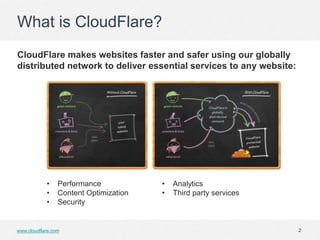
CloudFlare makes websites faster and safer using our globally
distributed network to deliver essential services to any website:


            •    Performance            •   Analytics
            •    Content Optimization   •   Third party services
            •    Security


www.cloudflare.com                                                  2
How does CloudFlare Work?
CloudFlare works at the network level.
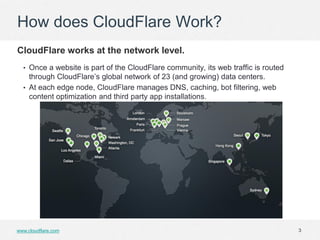
  • Once a website is part of the CloudFlare community, its web traffic is routed
    through CloudFlare’s global network of 23 (and growing) data centers.
  • At each edge node, CloudFlare manages DNS, caching, bot filtering, web
    content optimization and third party app installations.


www.cloudflare.com                                                                  3
IPv6 Gateway
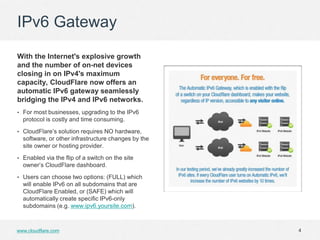
With the Internet's explosive growth
and the number of on-net devices
closing in on IPv4's maximum
capacity, CloudFlare now offers an
automatic IPv6 gateway seamlessly
bridging the IPv4 and IPv6 networks.
• For most businesses, upgrading to the IPv6
  protocol is costly and time consuming.

• CloudFlare’s solution requires NO hardware,
  software, or other infrastructure changes by the
  site owner or hosting provider.

• Enabled via the flip of a switch on the site
  owner’s CloudFlare dashboard.
• Users can choose two options: (FULL) which
  will enable IPv6 on all subdomains that are
  CloudFlare Enabled, or (SAFE) which will
  automatically create specific IPv6-only
  subdomains (e.g. www.ipv6.yoursite.com).


www.cloudflare.com                                   4
Anycast CDN
Anycast CDN

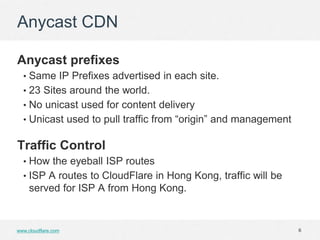
Anycast prefixes
  • Same IP Prefixes advertised in each site.
  • 23 Sites around the world.
  • No unicast used for content delivery
  • Unicast used to pull traffic from “origin” and management


Traffic Control
  • How the eyeball ISP routes
  • ISP A routes to CloudFlare in Hong Kong, traffic will be
     served for ISP A from Hong Kong.


www.cloudflare.com                                              6
Anycast CDN
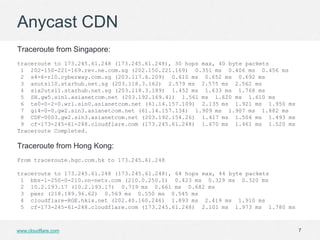
Traceroute from Singapore:
traceroute to 173.245.61.248 (173.245.61.248), 30 hops max, 40 byte packets
 1 202-150-221-169.rev.ne.com.sg (202.150.221.169) 0.351 ms 0.406 ms 0.456 ms
 2 s4-6-r10.cyberway.com.sg (203.117.6.209) 0.610 ms 0.652 ms 0.692 ms
 3 anutsi10.starhub.net.sg (203.118.3.162) 2.579 ms 2.575 ms 2.562 ms
 4 six2utsi1.starhub.net.sg (203.118.3.189) 1.452 ms 1.633 ms 1.768 ms
 5 SH.gw5.sin1.asianetcom.net (203.192.169.41) 1.561 ms 1.620 ms 1.610 ms
 6 te0-0-2-0.wr1.sin0.asianetcom.net (61.14.157.109) 2.135 ms 1.921 ms 1.950 ms
 7 gi4-0-0.gw2.sin3.asianetcom.net (61.14.157.134) 1.909 ms 1.907 ms 1.882 ms
 8 CDF-0003.gw2.sin3.asianetcom.net (203.192.154.26) 1.417 ms 1.504 ms 1.493 ms
 9 cf-173-245-61-248.cloudflare.com (173.245.61.248) 1.470 ms 1.461 ms 1.520 ms
Traceroute Completed.

Traceroute from Hong Kong:
From traceroute.hgc.com.hk to 173.245.61.248

traceroute to 173.245.61.248 (173.245.61.248), 64 hops max, 44 byte packets
 1 bbs-1-250-0-210.on-nets.com (210.0.250.1) 0.423 ms 0.329 ms 0.320 ms
 2 10.2.193.17 (10.2.193.17) 0.719 ms 0.661 ms 0.682 ms
 3 peer (218.189.96.62) 0.569 ms 0.550 ms 0.545 ms
 4 cloudflare-RGE.hkix.net (202.40.160.246) 1.893 ms 2.419 ms 1.910 ms
 5 cf-173-245-61-248.cloudflare.com (173.245.61.248) 2.101 ms 1.973 ms 1.780 ms


www.cloudflare.com                                                                7
Anycast CDN
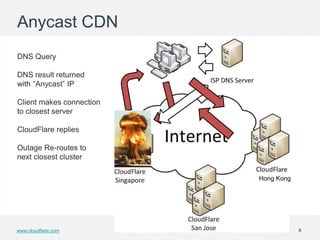
DNS Query

DNS result returned
with “Anycast” IP

Client makes connection
to closest server

CloudFlare replies

Outage Re-routes to
next closest cluster

                          Hong Kong


www.cloudflare.com                    8
Transit
Transit
Who?
  • Choice of Transit Provider is VERY important
  • We’ve chosen a limited number of providers per region:
       • Two in US/EU
       • Two in Asia.
  • Single Provider makes routing easier, but two for full reach
  • Transit provider should offer good routing controls
       • You need to be able to keep routes within a region
       • Prepend to specific peers
  • Transit Provider should make use of “Hot Potato” routing to
     their peers.
       • ie. Peer and exchange traffic in every mutual location.

www.cloudflare.com                                                 10
Transit
Routing Controls?
  • Must be able to keep advertisements within region.
       • A Customer of your European transit provider is likely to be a
         peer of your Asian Transit provider
       • You don’t want to serve traffic from Asia for Europe
  • Some routing controls listed on:
    http://www.onesc.net/communities/
  • A lot of work should be done in the presales stage to
    understand the providers network and how they peer.
  • Looking at AS1299’s (Telia-Sonera) whois entry gives a
    good idea how they peer.


www.cloudflare.com                                                    11
Transit

Choices?
  • Many providers can give you good coverage for common
    US and EU Locations (San Jose, LA, New York, London,
    Amsterdam, etc...)
  • One provider can’t do it all in Asia.
  • Asian networks are usually somewhat ‘disconnected’
       • Few peer with NTT in Asia
       • NTT, Pacnet, TATA all disconnected from each other.
       • Transit in the US could be far cheaper for the provider than
         within Asia.
  • Supplement this with Peering


www.cloudflare.com                                                      12
Peering
Peering

USA Peering
  • Is it economic to peer?
  • Transit is < US$1
  • Eyeball networks probably *wont* peer with you
       • Comcast (not at any exchange)
       • ATT
  • South America?
       • Peering in Miami
       • Most networks open to peering


www.cloudflare.com                                   14
Peering

EU Peering
  • Same argument as US, might be more costly to peer
  • Many networks more open to peering however
  • Major providers / incumbents more difficult, probably wont peer:
       • DTAG
       • TeliaSonera
       • Telecom Italia Sparkle
       • Telefonica
       • France Telecom
  • IX’s have good reach to surrounding regions.
       • AMS-IX, DE-CIX, netnod, LINX


www.cloudflare.com                                                 15
Peering

Asia Peering
 • Very economical.
 • Large providers may not peer
 • HKIX……. (and Hong Kong Equinix)
    • Local Loop to HKIX can be around US$1,000 for 1G
    • No IX charges.
    • HKIX will get you 100% of domestic Hong Kong.
    • Very Good Vietnam and some Taiwan, Korea, Japan and China routes too
 • Singapore Equinix
      • Priced competitively
      • Great Coverage for South East Asia (Indonesia, Thailand, Malaysia, India)
 • JPIX and JPNAP much more costly.


www.cloudflare.com                                                             16
Peering

Asia/Hong Kong Peering Economics
 • Transit ~US$10/M (HK)
 • HKIX US$2/M at 50% utilisation
 • Worthwhile after just 100mbit utilization.
 • If transit is more expensive, justification comes faster!
 • Hong Kong users will be upset if you don’t peer at HKIX
      • Quoting a customer:

        “Having a PoP in HKG without announcing prefixes to HKIX is
        like a dinner without fork.”


www.cloudflare.com                                                17
Peering

Asia/Sydney Peering Economics
  • Transit ~US$30+/M
  • Equinix/PIPE ~US$2/M at 50% utilisation
  • Worthwhile after around 30mbit.
  • Around half the “Eyeballs” Connect to Equinix or PIPE in
    Sydney, WAIX in Perth.
  • No Telstra, Optus. (or AAPT/Verizon)


www.cloudflare.com                                             18
Challenges
Challenges

Challenges
 • Routing
      • Inefficient routing, optimizing.
      • Turning up peering, causing unexpected routing changes
      • Russian Network preferred our routes via HKIX instead of
        in Europe.
      • Keeping optimal routing to Eyeball Networks
 • Deployments into new markets
    • China
    • South America.


www.cloudflare.com                                                 20
Challenges

SOME NETWORKS DO STRANGE THINGS!
 • An Israeli ISP is doing per-packet load sharing over
   multiple ISPs
 • A SYN will connect in Amsterdam
 • Amsterdam anycast node replies with SYN-ACK
 • Washington DC receives ACK.
      • TCP IS BROKEN!
 • Troubleshooting is not easy.


www.cloudflare.com                                        21
Challenges

How to troubleshoot?
 • Whole new techniques
 • Ping is wonderful tool.
      • Ping from Anycast IP, to determine if remote side is reachable
        from that node.
      • Ping from Unicast IP, to determine if remote side is reachable.


www.cloudflare.com                                                   22
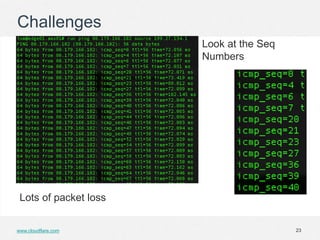
Challenges
                       Look at the Seq
                       Numbers


 Lots of packet loss


www.cloudflare.com                       23
Challenges


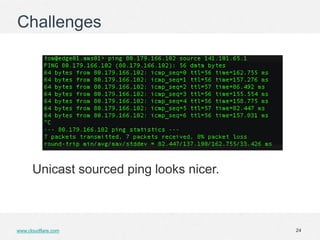
      Unicast sourced ping looks nicer.


www.cloudflare.com                        24
Challenges


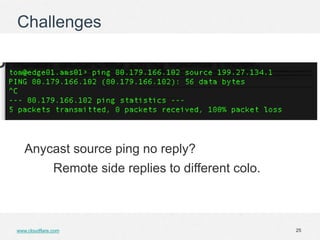
   Anycast source ping no reply?
               Remote side replies to different colo.


www.cloudflare.com                                      25
26


Questions?

Routing for an Anycast CDN

  • 1.
    Tom Paseka Routing foran Anycast CDN Network Engineer tom@cloudflare.com
  • 2.
    What is CloudFlare? CloudFlaremakes websites faster and safer using our globally distributed network to deliver essential services to any website: • Performance • Analytics • Content Optimization • Third party services • Security www.cloudflare.com 2
  • 3.
    How does CloudFlareWork? CloudFlare works at the network level. • Once a website is part of the CloudFlare community, its web traffic is routed through CloudFlare’s global network of 23 (and growing) data centers. • At each edge node, CloudFlare manages DNS, caching, bot filtering, web content optimization and third party app installations. www.cloudflare.com 3
  • 4.
    IPv6 Gateway With theInternet's explosive growth and the number of on-net devices closing in on IPv4's maximum capacity, CloudFlare now offers an automatic IPv6 gateway seamlessly bridging the IPv4 and IPv6 networks. • For most businesses, upgrading to the IPv6 protocol is costly and time consuming. • CloudFlare’s solution requires NO hardware, software, or other infrastructure changes by the site owner or hosting provider. • Enabled via the flip of a switch on the site owner’s CloudFlare dashboard. • Users can choose two options: (FULL) which will enable IPv6 on all subdomains that are CloudFlare Enabled, or (SAFE) which will automatically create specific IPv6-only subdomains (e.g. www.ipv6.yoursite.com). www.cloudflare.com 4
  • 5.
  • 6.
    Anycast CDN Anycast prefixes • Same IP Prefixes advertised in each site. • 23 Sites around the world. • No unicast used for content delivery • Unicast used to pull traffic from “origin” and management Traffic Control • How the eyeball ISP routes • ISP A routes to CloudFlare in Hong Kong, traffic will be served for ISP A from Hong Kong. www.cloudflare.com 6
  • 7.
    Anycast CDN Traceroute fromSingapore: traceroute to 173.245.61.248 (173.245.61.248), 30 hops max, 40 byte packets 1 202-150-221-169.rev.ne.com.sg (202.150.221.169) 0.351 ms 0.406 ms 0.456 ms 2 s4-6-r10.cyberway.com.sg (203.117.6.209) 0.610 ms 0.652 ms 0.692 ms 3 anutsi10.starhub.net.sg (203.118.3.162) 2.579 ms 2.575 ms 2.562 ms 4 six2utsi1.starhub.net.sg (203.118.3.189) 1.452 ms 1.633 ms 1.768 ms 5 SH.gw5.sin1.asianetcom.net (203.192.169.41) 1.561 ms 1.620 ms 1.610 ms 6 te0-0-2-0.wr1.sin0.asianetcom.net (61.14.157.109) 2.135 ms 1.921 ms 1.950 ms 7 gi4-0-0.gw2.sin3.asianetcom.net (61.14.157.134) 1.909 ms 1.907 ms 1.882 ms 8 CDF-0003.gw2.sin3.asianetcom.net (203.192.154.26) 1.417 ms 1.504 ms 1.493 ms 9 cf-173-245-61-248.cloudflare.com (173.245.61.248) 1.470 ms 1.461 ms 1.520 ms Traceroute Completed. Traceroute from Hong Kong: From traceroute.hgc.com.hk to 173.245.61.248 traceroute to 173.245.61.248 (173.245.61.248), 64 hops max, 44 byte packets 1 bbs-1-250-0-210.on-nets.com (210.0.250.1) 0.423 ms 0.329 ms 0.320 ms 2 10.2.193.17 (10.2.193.17) 0.719 ms 0.661 ms 0.682 ms 3 peer (218.189.96.62) 0.569 ms 0.550 ms 0.545 ms 4 cloudflare-RGE.hkix.net (202.40.160.246) 1.893 ms 2.419 ms 1.910 ms 5 cf-173-245-61-248.cloudflare.com (173.245.61.248) 2.101 ms 1.973 ms 1.780 ms www.cloudflare.com 7
  • 8.
    Anycast CDN DNS Query DNSresult returned with “Anycast” IP Client makes connection to closest server CloudFlare replies Outage Re-routes to next closest cluster Hong Kong www.cloudflare.com 8
  • 9.
  • 10.
    Transit Who? •Choice of Transit Provider is VERY important • We’ve chosen a limited number of providers per region: • Two in US/EU • Two in Asia. • Single Provider makes routing easier, but two for full reach • Transit provider should offer good routing controls • You need to be able to keep routes within a region • Prepend to specific peers • Transit Provider should make use of “Hot Potato” routing to their peers. • ie. Peer and exchange traffic in every mutual location. www.cloudflare.com 10
  • 11.
    Transit Routing Controls? • Must be able to keep advertisements within region. • A Customer of your European transit provider is likely to be a peer of your Asian Transit provider • You don’t want to serve traffic from Asia for Europe • Some routing controls listed on: http://www.onesc.net/communities/ • A lot of work should be done in the presales stage to understand the providers network and how they peer. • Looking at AS1299’s (Telia-Sonera) whois entry gives a good idea how they peer. www.cloudflare.com 11
  • 12.
    Transit Choices? •Many providers can give you good coverage for common US and EU Locations (San Jose, LA, New York, London, Amsterdam, etc...) • One provider can’t do it all in Asia. • Asian networks are usually somewhat ‘disconnected’ • Few peer with NTT in Asia • NTT, Pacnet, TATA all disconnected from each other. • Transit in the US could be far cheaper for the provider than within Asia. • Supplement this with Peering www.cloudflare.com 12
  • 13.
  • 14.
    Peering USA Peering • Is it economic to peer? • Transit is < US$1 • Eyeball networks probably *wont* peer with you • Comcast (not at any exchange) • ATT • South America? • Peering in Miami • Most networks open to peering www.cloudflare.com 14
  • 15.
    Peering EU Peering • Same argument as US, might be more costly to peer • Many networks more open to peering however • Major providers / incumbents more difficult, probably wont peer: • DTAG • TeliaSonera • Telecom Italia Sparkle • Telefonica • France Telecom • IX’s have good reach to surrounding regions. • AMS-IX, DE-CIX, netnod, LINX www.cloudflare.com 15
  • 16.
    Peering Asia Peering •Very economical. • Large providers may not peer • HKIX……. (and Hong Kong Equinix) • Local Loop to HKIX can be around US$1,000 for 1G • No IX charges. • HKIX will get you 100% of domestic Hong Kong. • Very Good Vietnam and some Taiwan, Korea, Japan and China routes too • Singapore Equinix • Priced competitively • Great Coverage for South East Asia (Indonesia, Thailand, Malaysia, India) • JPIX and JPNAP much more costly. www.cloudflare.com 16
  • 17.
    Peering Asia/Hong Kong PeeringEconomics • Transit ~US$10/M (HK) • HKIX US$2/M at 50% utilisation • Worthwhile after just 100mbit utilization. • If transit is more expensive, justification comes faster! • Hong Kong users will be upset if you don’t peer at HKIX • Quoting a customer: “Having a PoP in HKG without announcing prefixes to HKIX is like a dinner without fork.” www.cloudflare.com 17
  • 18.
    Peering Asia/Sydney Peering Economics • Transit ~US$30+/M • Equinix/PIPE ~US$2/M at 50% utilisation • Worthwhile after around 30mbit. • Around half the “Eyeballs” Connect to Equinix or PIPE in Sydney, WAIX in Perth. • No Telstra, Optus. (or AAPT/Verizon) www.cloudflare.com 18
  • 19.
  • 20.
    Challenges Challenges • Routing • Inefficient routing, optimizing. • Turning up peering, causing unexpected routing changes • Russian Network preferred our routes via HKIX instead of in Europe. • Keeping optimal routing to Eyeball Networks • Deployments into new markets • China • South America. www.cloudflare.com 20
  • 21.
    Challenges SOME NETWORKS DOSTRANGE THINGS! • An Israeli ISP is doing per-packet load sharing over multiple ISPs • A SYN will connect in Amsterdam • Amsterdam anycast node replies with SYN-ACK • Washington DC receives ACK. • TCP IS BROKEN! • Troubleshooting is not easy. www.cloudflare.com 21
  • 22.
    Challenges How to troubleshoot? • Whole new techniques • Ping is wonderful tool. • Ping from Anycast IP, to determine if remote side is reachable from that node. • Ping from Unicast IP, to determine if remote side is reachable. www.cloudflare.com 22
  • 23.
    Challenges Look at the Seq Numbers Lots of packet loss www.cloudflare.com 23
  • 24.
    Challenges Unicast sourced ping looks nicer. www.cloudflare.com 24
  • 25.
    Challenges Anycast source ping no reply? Remote side replies to different colo. www.cloudflare.com 25
  • 26.